I. INTRODUCTION
Aluminum alloys reinforced with ceramic particulates, aluminum metal matrix composites (MMCs),Reference Tjiong and Ma1,Reference Lloyd2 show a high potential in meeting the ever-increasing demand for property improvement, such as high strength and high modulus, from the fast growing aerospace, electronics, and automotive industries.Reference Tjiong and Ma1–Reference Ibrahim and Mohamed4 Aluminum alloys, as matrices, are featured with low density, high thermal conductivity, and plasticity. Meanwhile, the ceramic particulates offer high strength and moduli. Among various ceramic reinforcements, TiB2 particulates have attracted a great deal of attention due to their high strength, hardness, and strong covalent bonding with the aluminum matrix.Reference Arnberg, Bäckerud and Klang5–Reference Zhang, Wu, Chen, Jiang and Luan15 The most attractive property of TiB2 as reinforcement is its good wettability by an aluminum melt, resulting in strong bonding to the aluminum matrix, which transfers stress from the matrix to the reinforcing particulates effectively in service with improved strength. A good wettability is also a key factor for obtaining uniform dispersion of the reinforcing particulates and therefore homogeneous properties of the composites. In comparison, other ceramic particulates, such as Al2O3, SiC, etc., are not wetted by an aluminum melt, causing difficulties in dispersion into an aluminum melt and therefore weak matrix/reinforcement interfacial bonding and possible premature failure.Reference Tjiong and Ma1,Reference Lloyd2,Reference Liu, Rakita, Xu, Wang and Han16–Reference Kennedy, Karantzalis and Wyatt19
TiB2 particulates can be introduced into an aluminum matrix as preformed particulates (ex situ) or formed in situ in the matrix. In situ fabrication eliminates possible oxygen contamination, producing a clean TiB2/Al interface and, therefore, strong TiB2/Al interfacial bonding after solidification.Reference Arnberg, Bäckerud and Klang5–Reference Suresh, Shenbaga and Moorthi14 A popular method in synthesizing in situ TiB2 particulates is through salt–metal reactions by adding mixed K2TiF6 and KBF4 salts into an aluminum alloy melt derived from the production of Al–Ti–B type master alloys for grain refinement.Reference Wood, Davies and Kellie20 From the beneficial effects of TiB2 in aluminum grain refinement, the advantages of TiB2 particulates as reinforcement are obvious.Reference Arnberg, Bäckerud and Klang5,Reference Jones and Pearson6 Possible chemical reactions between an aluminum melt and mixed salts are presented as reactions (1)–(3) without the consideration of AlB2 formation, where Ti and B are reduced from fluoride salts by aluminum.Reference Wang, Brydson, Jha and Ellis10 The Ti and B in solution will then form TiB2 particulates in an Al melt. The formation of AlB2 as a separate phase or in solid solution with TiB2 is possible by considering the production of Al–B master alloys from reactions of KBF4 and an aluminum melt.Reference Birol21–Reference Wang24
 $${{\rm{K}}_2}{\rm{Ti}}{{\rm{F}}_6} + 2{\rm{KB}}{{\rm{F}}_4} + {{10} / 3}{\rm{Al}} = {\rm{Ti}}{{\rm{B}}_2} + {4 / 3}\left( {3{\rm{KF}}\cdot{\rm{Al}}{{\rm{F}}_3}} \right) + 2{\rm{Al}}{{\rm{F}}_3}\quad ,$$
 $$2{{\rm{K}}_2}{\rm{Ti}}{{\rm{F}}_6} + 2{\rm{KB}}{{\rm{F}}_4} + {{23} / 3}{\rm{Al}} = {\rm{Ti}}{{\rm{B}}_2} + {\rm{A}}{{\rm{l}}_3}{\rm{Ti}} + 2\left( {3{\rm{KF}}\cdot{\rm{Al}}{{\rm{F}}_3}} \right) + {8 / 3}{\rm{Al}}{{\rm{F}}_3}\quad ,$$
 $${{\rm{K}}_2}{\rm{Ti}}{{\rm{F}}_6} + {{13} / 3}{\rm{Al}} = {\rm{A}}{{\rm{l}}_3}{\rm{Ti}} + {2 / 3}\left( {3{\rm{KF}}\cdot{\rm{Al}}{{\rm{F}}_3}} \right) + {2 / 3}{\rm{Al}}{{\rm{F}}_3}\quad .$$
According to reactions (1)–(3), TiB2 and Al3Ti particulates in a variable ratio can be produced by reactions between an aluminum melt and a mixture of K2TiF6 and KBF4 salts. The formation of Al3Ti particulates can be avoided by varying the K2TiF6/KBF4 ratio to reaction (1). However, a small amount of excess Ti in solution is beneficial for the dispersion of TiB2 particulates by promoting the nucleation of aluminum grains on the TiB2 particulates.Reference Wang, Song, Vian, Ma and Han7,Reference Wang, Liu, Dai and Han25 Among the reaction products, TiB2 is the most stable phase thermodynamically because of its lowest standard free energy change of formation.Reference Moldovan, Butu, Popescu, Buzatu, Usurelu, Soare and Mitrica26 However, it is unavoidable to form AlB2 intrinsic to the chemical reactions, where aluminum participates in the reactions with boron.Reference Wang and Han12,Reference Fjellstedt and Jarfors13 Different diborides form solid solutions in the aluminum melt with a high tendency to transform into mixtures of diborides, TiB2, AlB2, etc, which is not widely agreed.Reference Arnberg, Bäckerud and Klang5,Reference Wang and Han12,Reference Fjellstedt and Jarfors13 TiB2 is generally treated as the final product in the aluminum melt due to difficulties in distinguishing different diboride phases in an aluminum alloy. The beneficial effects of adding TiB2 particulates into aluminum alloys have been reported despite the debate about phase formation.Reference Davies, Kellie and Wood18,Reference Kennedy, Karantzalis and Wyatt19,Reference Tjong, Wang and Mai27 However, the complicated chemical reactions between the salts and aluminum melts and the exothermal nature of the reactions lead to difficulties in controlling the size and morphology of the TiB2 particulates, which must be resolved before a wide spread application of in situ TiB2 particulate reinforced aluminum MMCs.
Efforts on producing uniform dispersion of fine in situ TiB2 particulates have been made mainly through altering the reaction chemistry and applying mechanical agitation. The latter includes mechanical shearing, ultrasonic sonication, electromagnetic stirring, etc., leading to an improved dispersion of the TiB2 particulates and therefore increased mechanical properties.Reference Moldovan, Butu, Popescu, Buzatu, Usurelu, Soare and Mitrica26,Reference Agrawal, Ghose and Chakrabarty28,Reference Chen, Chen, Mao, Wang and Cao29 Meanwhile, the former focuses on the effects of alloying elements on the growth and dispersion of the in situ TiB2 particulates.Reference Wang, Brydson, Jha and Ellis10,Reference Herbert, Maiti, Mitra and Chakraborty30–Reference Liu, Liu, Huang, Han and Wang36 The effects of different alloying elements have been revealed as either forming solid solutions with TiB2 leading to coarsening or modifying the interfacial energies to promote the nucleation of the TiB2 particulates, resulting in fine sized particulates. Specifically, magnesium as an alloying element promotes the nucleation of TiB2 particulates, while zirconium leads to coarse TiB2 particulates. Interestingly, TiB2 particulates also modify the morphology of eutectic Si in an Al–Si alloy.Reference Liu, Liu, Huang, Han and Wang36 The addition of alloying elements in modifying the in situ TiB2 particulates also resulted in the increase of mechanical properties.Reference Herbert, Maiti, Mitra and Chakraborty30–Reference Liu, Liu, Huang, Han and Wang36
By considering the significant strengthening effects of Sc in aluminum alloys and the increasing applications of Al alloys containing Sc,Reference Liu, Liu, Huang, Han and Wang36–Reference Pramod, Prasada Rao, Murty and Bakshi38 understanding the effects of Sc on the formation of in situ TiB2 particulates becomes imminent. However, there is hardly information available about the effects of Sc on the formation of TiB2 particulates. Sc forms Al3Sc in aluminum either as a strong aluminum grain refiner or dispersoid for precipitation hardening depending on its concentration in an alloy.Reference Røyse and Ryum37 As reported, when being added into the A356 alloy, Sc has combined effects of being an effective grain refiner as well as Si modifier, modifying the morphology of eutectic Si from needle-like to spheroidal particulates.Reference Pramod, Prasada Rao, Murty and Bakshi38
From the above review, the addition of TiB2 particulates into aluminum alloys is effective in strengthening the alloys. Additionally, there is a possibility of adding Sc to increase the properties of the in situ TiB2 particulate reinforced aluminum MMCs. However, information on the effects of Sc addition on the formation and dispersion of the TiB2 particulates in Al–TiB2 composites is lacking, which is the knowledge gap that this article tries to fill.
II. EXPERIMENTAL PROCEDURES
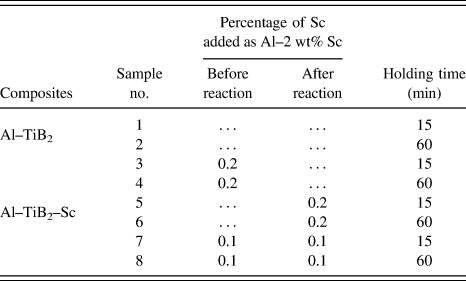
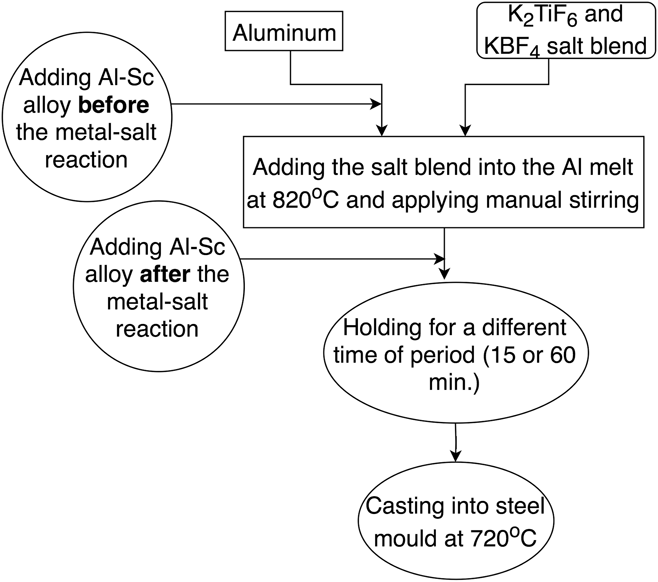
A series of in situ TiB2 particulate reinforced aluminum MMCs were fabricated with the modification of Sc addition. Pure aluminum (99.99% purity) was placed in a graphite crucible and melted inside an electrical resistant furnace. K2TiF6 and KBF4 salts were used to introduce alloying elements Ti and B. Sc was deployed as an Al–2 wt% Sc master alloy. Al–TiB2–Sc alloys with 5 wt% TiB2 particulates and 0.2 wt% Sc were designed. As listed in Table I, an Al–2 wt% Sc master alloy was added under three different sequences to evaluate the effects of Sc addition at different stages of the reactions between the salts and the aluminum melt. When adding the salts and the Al–Sc master alloy, manual stirring was applied to alleviate the possible agglomeration of reaction products. The reaction temperature was set to 820 °C when the raw materials were melted and alloying elements were added. A holding time for the chemical reaction were set as 15 and 60 min to study their effects on the reaction products. This is based on microstructure analysis showing a 60 min holding time leading to a better dispersion of TiB2 particulates, whereas a holding time longer than 60 min might not be suitable, as reported by Birol.Reference Birol21,Reference Birol22 Salt products on top of the melt were decanted before casting the melt into a steel mold. A pouring temperature was chosen as 720 °C and the melt was poured into a steel mold and cooled down to the room temperature. The process is shown in Fig. 1 schematically.
Experimental details for producing Al–TiB2 (Al–TiB2–Sc) MMCs.

Schematic processing chart showing the participation of Sc in different stages of the salt–metal reaction.

After casting, the ingots were sectioned, ground, polished, and etched following a standard procedure for metallurgical sample preparation for scanning electron microscopy (SEM) and energy dispersive X-ray (EDX) analysis. The SEM images were taken by using an FEI 3D Quanta Dual Beam SEM (ThermoFisher Scientific, Hillsboro, Oregon) operated at 20 kV. Secondary electron images (SEIs) were also taken on deep-etched samples that were prepared by submerging the samples into a solution that consists of 250 mL methanol, 10 g iodine, and 25 g tartaric for 50–60 min, and soaking the samples in acetone until the solvent was clear. The etched samples were then rinsed with acetone and dried up for SEM examination. EDX analysis was performed to reveal the compositions of the particulates.
III. RESULTS AND DISCUSSION
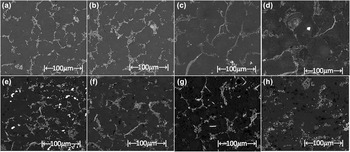
The overall dispersion of the in situ TiB2 particulates in the aluminum matrix is presented in Figs. 2(a)–2(h), the back-scattered electron images (BEIs) of eight samples in Table I under a SEM. These images are featured with clusters of diboride particulates along the aluminum grain boundaries, in accordance with the typical dispersion of the diboride particulates in aluminum master alloys, evidencing the weak ability of TiB2 particulates in nucleating aluminum grains in solidification.Reference Wang, Brydson, Jha and Ellis10,Reference Ramesh, Pramod and Keshavamurthy11,Reference Wang, Liu, Dai and Han25,Reference Fjellstedt, Jarfors and Svendsen39 The TiB2 particulates were therefore pushed by the solidifying front of the α-Al grains to the aluminum grain boundaries during solidification.Reference Wang, Song, Vian, Ma and Han7,Reference Guzowski, Sigworth and Sentner8,Reference Wang, Brydson, Jha and Ellis10–Reference Wang and Han12,Reference Arnberg, Backerud and Klang40,Reference Quested41 The only noticeable difference in the images caused by Sc is the different thickness of the TiB2 layers.
BSE images of Samples 1–8 showing the dispersion of in situ diboride particles: (a) No addition of Sc (15 min); (b) No addition of Sc (60 min); (c) Adding Sc before the metal–salt reaction (15 min); (d) Adding Sc before the metal–salt reaction (60 min); (e) Adding Sc after the metal–salt reaction (15 min); (f) Adding Sc after the metal–salt reaction (60 min); (g) Adding Sc both before and after the metal–salt reaction (15 min); (h) Adding Sc both before and after the metal–salt reaction (60 min).

Figures 2(a) and 2(b) are the micrographs of the in situ Al–TiB2 composites produced without the addition of Sc for a holding time of 15 and 60 min (i.e., Samples 1 and 2), respectively. TiB2 particulates agglomerate along the α-Al grain boundaries under these conditions. Figures 2(c) and 2(d) show the micrographs of Samples 3 and 4, in which Sc was participating in the metal–salt reactions for a holding time of 15 and 60 min. It can be found from Fig. 2(c) that the TiB2 particulates tend to agglomerate into layers at the α-Al grain boundaries. This indicates that the participation of Sc in the metal–salt reactions results in a different way of agglomeration of the TiB2 particulates along the α-Al grain boundaries from the one without Sc addition in Fig. 2(a). Figures 2(e) and 2(f) show the BEIs of Samples 5 and 6, which have Sc added after the metal–salt reactions for a holding time of 15 and 60 min, respectively. By comparing Figs. 2(b)–2(f) (Samples 2 and 6) with the same holding time but under different Sc addition sequences, it is clear that TiB2 particulates are dispersed rather broadly in Fig. 2(f) than in Fig. 2(b), though the particulates still agglomerated along the α-Al grain boundaries. These results suggest that the addition of Sc after the metal–salt reactions promotes the dispersion of TiB2 particulates though still along the α-Al grain boundaries comparing with the dispersion of TiB2 particulates when Sc was participating in the metal–salt reactions. Figures 2(g) and 2(h) present the BSIs of Samples 7 and 8, with the addition of Sc both before and after the metal-salt reactions for holding times of 15 and 60 min, respectively. It is evident that the agglomeration of the TiB2 particulates alleviated in Fig. 2(h) (Sample 8) compared to Fig. 2(b) (Sample 2).
In brief, the addition of Sc influences the dispersion of the in situ TiB2 particulates to a certain degree. To be specific, the participation of Sc in the metal–salt reactions causes a layer-like agglomeration of the TiB2 particulates along the α-Al grain boundaries, while the addition of Sc after the reactions (without the participation of Sc in the metal–salt reactions) alleviates the agglomeration at the grain boundaries.
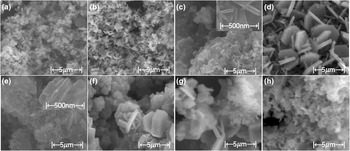
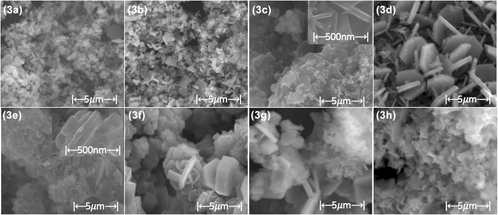
Figures 3(a)–3(h) are the SEIs of deep-etched Samples 1–8, showing the overall morphologies of the in situ TiB2 particulates at the Al grain boundaries. Hexagonal TiB2 particulates in the Al–TiB2 composites are revealed in all the samples, in agreement with other findings.Reference Moldovan, Butu, Popescu, Buzatu, Usurelu, Soare and Mitrica26,Reference Maxwell and Hellawell42–Reference Abdel-Hamid, Hamar-Thibault and Hamar44 The growth of the in situ TiB2 particulates in the absence of Sc with respect to holding time is not clear by comparing Figs. 3(a) and 3(b). In Fig. 3(a), most of the individual TiB2 particulates are blocky in submicrometer sizes and only a small portion of the TiB2 particulates have grown into sizes near 2 µm, similar to the TiB2 particulates in Fig. 3(b). The result indicates that the effects of the holding time on the growth of the TiB2 particulates are limited in the absence of Sc. In comparison, Sc addition resulted in the growth of the in situ TiB2 particulates in different ways depending on the sequence of the addition of Sc and, therefore, its participation in the formation of the TiB2 particulates at different stages, which is to be discussed in the following paragraphs.
SEIs of deep-etched Samples 1–8 showing the morphologies of in situ diboride particles: (a) No addition of Sc (15 min); (b) No addition of Sc (60 min); (c) Adding Sc before the metal–salt reaction (15 min); (d) Adding Sc before the metal–salt reaction (60 min); (e) Adding Sc after the metal–salt reaction (15 min); (f) Adding Sc after the metal–salt reaction (60 min); (g) Adding Sc both before and after the metal–salt reaction (15 min); (h) Adding Sc both before and after the metal–salt reaction (60 min) (Inserted figures in (c) and (e) are magnified typical TiB2 particles).

The participation of Sc in the metal–salt reactions resulted in the growth of the TiB2 particulates for both holding times of 15 and 60 min, which is clear by comparing Figs. 3(c) and 3(d) to 3(a) and 3(b), respectively. Sc promotes the growth of TiB2 plates through fusion at a short holding time (15 min) and individual plates at a longer holding time (60 min). The effects of holding time on the morphologies of the in situ TiB2 particulates are clear by comparing Figs. 3(c) and 3(d). A longer holding time of 60 min resulted in the growth of the TiB2 particulates into about 5 µm in size in Fig. 3(d) from about 2 µm in Fig. 3(c). No obvious growth of the thickness of the hexagonal TiB2 disks was observed with the increase of holding time, resulting in disks with a larger aspect ratio. These results suggest that the participation of Sc in the metal–salt reactions promotes preferentially the growth of the {0001} planes of the TiB2 particulates in such a way that it restricts the growth in the [0001] direction comparatively.Reference Arnberg, Bäckerud and Klang5
When Sc was added after the metal–salt reactions, TiB2 particulates tend to grow together by {0001} planes at a short holding time (15 min), which is clear in the inset in Fig. 3(e). It can be attributed to that Sc modifies the {0001} planes of the TiB2 particulates.Reference Arnberg, Bäckerud and Klang5 The growth of the TiB2 particulates has reached a completion after 60 min, evidenced by the perfect hexagonal shape of the particulates in Fig. 3(f). The growth of TiB2 particulates is affected largely by the addition sequence of Sc, i.e., the participation in metal–salt reactions or modification of the particulate surfaces. From Fig. 3(e) (Sample 5), it can be found that a large amount of TiB2 particulates tend to grow up with a blocky morphology with a 15 min holding time. When the holding time increased to 60 min, the TiB2 particulates coarsened to size of several micrometers and remained blocky. Therefore, it can be proposed that when adding Sc after the metal–salt reactions (without Sc participating in metal–salt reactions), Sc promotes the coarsening of the TiB2 particulates in all crystal directions though growth or coalescence.
The effects of adding Sc half amount before and the rest half after the metal–salt reactions resulted in TiB2 particulates in different sizes, which may grow after a longer holding time, as shown in Figs. 3(g) and 3(h). Figure 3(g) shows only a portion of the TiB2 particulates have grown up to disks about 5 µm, meanwhile the rest are in smaller sizes agglomerated together. A longer holding time (60 min) promoted the growth of the smaller particulates as shown in Fig. 3(h).
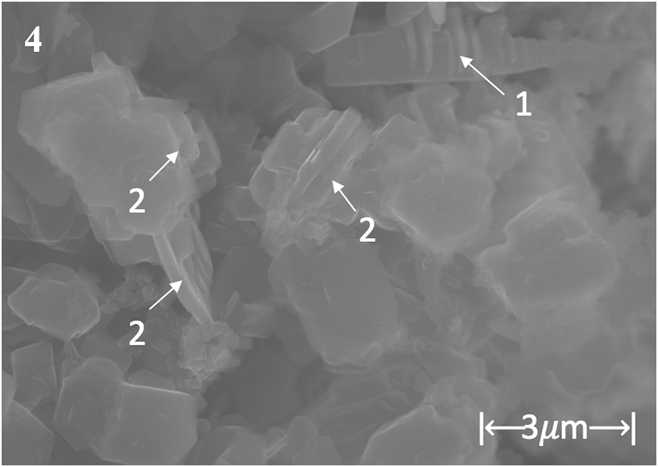
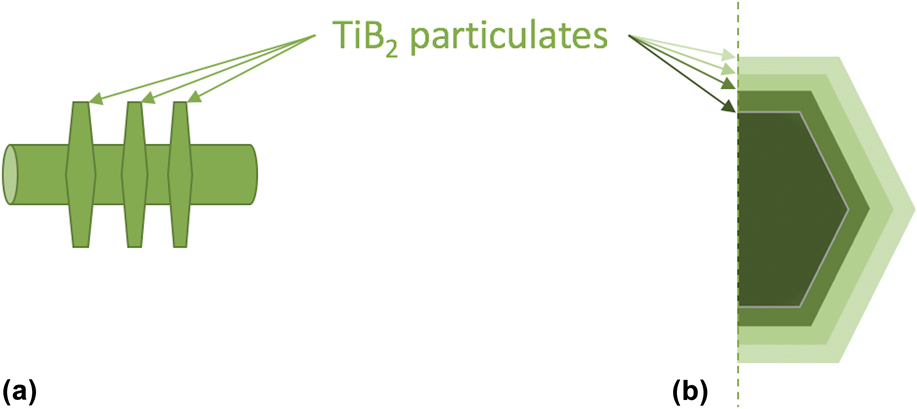
Figure 4 is a high magnification SEI of Sample 5 produced by adding Sc after the metal–salt reactions, and Figs. 5(a) and 5(b) are the illustrations of the coarsening of the in situ TiB2 particulates. As indicated by arrows in Fig. 4, TiB2 particulates grew in a layer-by-layer manner along the axis of the hexagonal disks. The particulates may grow into a rod-like shape, which is indicated by arrow 1 in Fig. 4 and in Fig. 5(a) or a terrace-like blocky shape, which is shown by arrow 2 in Fig. 4 and in Fig. 5(b). In Fig. 5(a) (also see arrow 1 in Fig. 4), TiB2 particulates were growing together separately along a rod-like base parallel to each other. On the other hand, in Fig. 5(b) (also see arrow 2 in Fig. 4), TiB2 particulates were coalescing upon each other without a distance between neighboring TiB2 disks [arrow 1 in Figs. 4 and 5(a)]. However, these two growing behaviors of TiB2 particulates still need further investigation.
High magnification SEI of deep-etched Sample 5 showing coarse TiB2 particles: Arrow (1) rod-like TiB2 particles; Arrow (2) terrace-like blocky TiB2 particles.

Schematic drawings of the coarsening mechanisms: (a) rod-like shape and (b) terrace-like block shape.

By comparing Fig. 4 (Sample 5) and Fig. 3(c) (Sample 3), the coarsening mechanism is not applicable to Sample 3 that was produced by adding Sc before the metal–salt reactions, i.e., the participation of Sc in the metal–salt reactions does not result in similar coarsening of the TiB2 particulates. The coarsening of the TiB2 particulates is a direct effect of the modification of the surfaces of the TiB2 particulates by Sc after the formation of TiB2 particulates. By considering the high stability of TiB2 in an aluminum melt,Reference Wang, Liu, Dai and Han25 the Ostwald ripening process is unlikely to happen, which is supported by the current results. Therefore, it can be elucidated that Sc modifies the surface of the TiB2 particulates promoting coarsening of the particulates through a stacking process, i.e., coarsening by stacking TiB2 disks on their hexagonal surfaces.
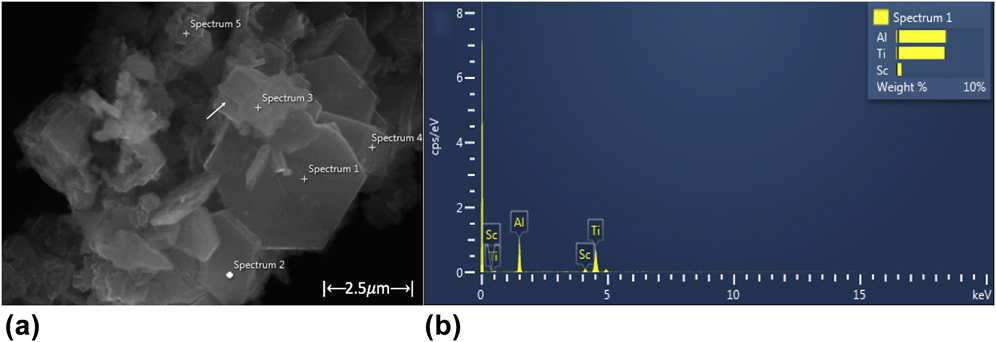
Figure 6(a) shows a magnified SEI of deep-etched Sample 4 with an EDX spectrum of a typical TiB2 cluster from point 1 in the image of Fig. 6(b). EDX spectra from other four locations gave similar compositions to Fig. 6(b). Sc was detected in all the five coarse particulates. EDX analysis validates the participation of Sc in the coarsening of the in situ TiB2 particulates by modifying the reaction chemistry and the surface energy of the TiB2 particulates. However, a detailed mechanism about the influence of the Sc during the reaction is still not clear and that requires further investigation.
Magnified SEI of deep-etched Sample 4 (a) with an EDS spectrum (b).

IV. CONCLUSIONS
In situ TiB2 particulates were produced successfully in an aluminum matrix by the reactions of aluminum and a mixture of K2TiF6 and KBF4 salts with the addition of Sc at different stages of the metal–salt reactions. TiB2 particulates agglomerated along the Al grain boundaries in all Al–TiB2–Sc MMCs and the distribution and growth of the TiB2 particulates were influenced by the presence of Sc during or after the metal–salt reactions. The addition of Sc resulted in the coarsening of TiB2 particulates, regardless of the participation of the Sc in the metal–salt reactions or not. The participation of Sc in the metal–salt reactions resulted in the formation of petal-like particulates, meanwhile, the addition of Sc after the metal–salt reactions led to the formation of coarse TiB2 terraces bonded by the large surfaces of the individual TiB2 disks. Sc also plays a role in promoting the growth of the {0001} planes when participated in the metal–salt reactions. By contrast, the TiB2 particulates are blocky terraces, when the addition of Sc was made after the metal–salt reactions. EDX analysis validated the existence of Sc in coarse TiB2 particulates and evidence of an active role of Sc in the formation of the in situ TiB2 particulates. The paper focuses on the effects of Sc on the formation of in situ TiB2 particulates without considering possible effects on the mechanical properties of the MMCs.
ACKNOWLEDGMENT
The authors would like to acknowledge AMG Aluminum North America for providing salts for the research.