René Descartes never received a medical degree and did not publish his first work until 1637. Nevertheless, in either late 1632 or early 1633 he was invited to fill a chair of theoretical medicine at the University of Bologna. This invitation, to join one of Europe's most prestigious medical faculties, is not mentioned by any biographer of Descartes.Footnote 1 Among the seven references to the ‘Bologna affair’ that exist in the scholarly literature, either no effort is made to explain why Bologna showed interest in Descartes or the invitation is misrepresented as coming from Padua.Footnote 2 Given these oversights and simple errors, coupled with the lack of attention the invitation has received in the nearly 380 years since it was originally extended, contemporary scholars may be forgiven for doubting the invitation's authenticity.
My goal in this paper is to give the details of the Bologna affair.Footnote 3 I begin by summarizing Descartes's intellectual development between 1629 and 1633. During these crucial years, while Descartes's mature philosophy and science began to take shape, his interest in theoretical and practical medicine – chemistry, anatomy, physiology, pathology and therapeutics – also emerged. Far from being an ancillary feature of his research at the time, medicine played an important role in the evolving content of Descartes's physics during these years and this holds especially true of anatomy and physiology. I then provide a transcription of the surviving evidence of the Bologna affair: a letter written in late 1632 or early 1633 by Andrea Torelli, a professor of law at Bologna, to the Bolognese Senate, in which he details his efforts, along with those of the Pope's nuncio extraordinary to Paris, Francesco Adriano Ceva, to convince Descartes to join the university's faculty. I go on to provide further details about the Bologna affair and the parties involved – most notably Torelli, Ceva and George Scharpe, whom the university ultimately hired. Regrettably, Descartes's response to Bologna's invitation does not survive, and indeed it is not even certain that the reclusive Descartes actually received it. I conclude by reflecting on the wider significance of the Bologna affair for our understanding of Descartes.
As a turning point in Descartes's development, the years between 1629 and 1633 are second only to 1618 and 1619, when he had his chance encounter with Isaac Beeckman and his famous three dreams. Our best evidence suggests that in 1629 Descartes abandoned work on the Regulae ad Directionem Ingenii, which had occupied him for nearly a decade. And in 1633, upon learning of the Papal Condemnation of Galileo, Descartes chose to withhold Le Monde from publication and thereafter remained cautious whenever discussing Copernicanism. Among the key insights Descartes gained in these years was that, if his natural philosophy was to gain broad acceptance, he needed a metaphysics capable of displacing the metaphysics of the schools. The doctrine of the eternal truths first appeared in these years as well, as did several of the scientific and mathematical doctrines Descartes is famous for, including his theory of vortices, account of the rainbow and solution to the Pappus problem.
This much is common knowledge. Less well known is Descartes's remark in a letter from 18 December 1629 to his friend and ally in Paris, Marin Mersenne, that Descartes had begun ‘to study anatomy’.Footnote 4 Early the next year Descartes made his interest in both theoretical and practical medicine more explicit and at the same time declared it more central to his ongoing work. Writing again to Mersenne, Descartes expressed regret in January 1630 that Mersenne was experiencing an outbreak of erysipelas, an acute skin disease common in the seventeenth century that we now know to be caused by bacteria of the genus Streptococcus. ‘Please look after yourself’, Descartes wrote to his friend, ‘at least until I know whether it is possible to discover a system of medicine which is founded on infallible demonstrations, which is what I am investigating at present’.Footnote 5 Shortly afterward, on 15 April 1630, Descartes similarly indicated how medicine consumed his time:
I am now studying chemistry and anatomy simultaneously; every day I learn something that I cannot find in any book. I wish I had already started to research into diseases and their remedies, so that I could find some cure for your erysipelas, which I am sorry has troubled you for such a long time.Footnote 6
For Descartes these are the earliest incontestable references to an active interest in theoretical and practical medicine.Footnote 7
Theoretical medicine continued to play a prominent role in Descartes's research over the next three years. While any reconstruction of Descartes's activities during this time, due to gaps in the historical record, must be inferred from a limited number of surviving letters along with the ultimate fruit born later in the 1630s, we do know that Le Monde was initially conceived as a work of meteorology, portions of which appeared separately in the 1637 Les Météores. But we also know that Descartes repeatedly expanded the scope of Le Monde, so much so that what survives as Le Monde and the Traité de l'Homme were meant to be two parts of a single work of physics.Footnote 8 And finally, we know that the content of the Traité de l'Homme presupposes and incorporates extensive knowledge of theoretical medicine.Footnote 9 In the remainder of this section I summarize Descartes's activities during the years immediately leading up to the Bologna affair, highlighting the role of theoretical medicine in particular.
In October 1629, Descartes did not yet have the idea to write Le Monde. In correspondence with Mersenne, Descartes acknowledged having received a description of a parhelion observed near Rome in March 1629. Specifically, Descartes reported that his ‘friend’ Henri Reneri had asked for his ‘opinion’ on the phenomenon, but
before I could give him my answer I had to interrupt my current work [on metaphysics] in order to make a systematic study of the whole of meteorology. But I think I can now give some explanation of the phenomenon. I have decided to write a short treatise on the topic; this will give the explanation of the colors of the rainbow (a topic which has given me more trouble than any other) and for all sublunary phenomena in general.Footnote 10
Just one month later, in a letter of 13 November 1629, Descartes informed Mersenne that his ambitions for his ‘short treatise’ had changed. Descartes was no longer contemplating just meteorology, for ‘instead of explaining just one phenomenon [he had] decided to explain all the phenomena of nature, that is to say, the whole of physics’.Footnote 11
Although the phenomenon of light remained a primary theme of Descartes's physics for many years to come, by late 1629 his research project had expanded; Le Monde was starting to take shape. The scholastic commentaries on Aristotle's Physics, which Descartes read in school, were likely his model for the ‘whole of physics’. In slightly varying order and emphasis, these commentaries included discussions of first and very general principles of natural bodies, such as change, matter, form, privation and place, but then progressed to discussions of the planets, stars, sublunary elements, plants, animals and then human beings (the latter three topics involving some account of generation and of the soul and its various powers).Footnote 12 The ‘whole of physics’ was a significant undertaking in the seventeenth century, and over the next three years Descartes repeatedly overestimated his ability to complete what he now called ‘my Physics’ in a timely fashion.
With such an ambitious project, it is little wonder that the following year Descartes referred to his work on Le Monde as ‘going very slowly, because I take more pleasure in acquiring knowledge than in putting into writing the little that I know’.Footnote 13 In 1630, the extent of what was required to complete his project was likely becoming apparent. And if there were any doubt about his shift away from a straightforward work of meteorology, another letter to Mersenne written on 27 May 1630 clarified the scope of his project.
The very fact that particular things perish and that others appear in their place is one of the principal perfections of the universe. As for animals' souls and other forms and qualities, do not worry about what happens to them. I am about to explain all this in my treatise.Footnote 14
Clearly, Descartes had moved beyond his initial plan of explaining only meteorological phenomena.
Two years later, in April 1632, Descartes had a manuscript near completion. As for its contents, he told Mersenne, ‘after the general description of the stars, the heavens and the earth, I did not originally intend to give an account of particular bodies on the earth but only to treat of their various qualities’.Footnote 15 Now, however, he was writing about particular bodies. ‘I am … in Deventer’, he added two months later, and for the last month
I have been trying to decide whether I should include in Le Monde an account of how animals are generated. I have finally decided not to, because it would take me too long. I have finished all I had planned to include in it concerning inanimate bodies. It only remains for me to add something concerning the nature of man.Footnote 16
Having now opted not to include an account of animal generation, the content of Descartes's ‘short treatise’ had stabilized.Footnote 17 In November or December 1632, Descartes again wrote to Mersenne:
My discussion of man in Le Monde will be a little fuller than I had intended, for I have undertaken to explain all the main functions [principales fonctions] of man. I have already written of the vital functions, such as the digestion of food, the heart beat, the distribution of nourishment, etc., and the five senses. I am now dissecting the heads of various animals, so that I can explain what imagination, memory, etc. consist in. I have seen the book De Motu Cordis which you previously spoke to me about. I find that it differs slightly from my own view, although I saw it only after having finished writing on this topic.Footnote 18
This letter, which is contemporaneous with the Bologna affair, contains three points about Descartes and theoretical medicine worth noticing. First and most important, the letter utilizes a standard description of the subject matter for theoretical medicine. Jean Fernel, who had written an influential textbook of theoretical medicine in the sixteenth century, specifically characterized physiologia as the study of ‘all the powers and functions’ of human beings.Footnote 19 In examining our ‘main functions’ in late 1632, Descartes was studying topics that would have been recognized as also belonging to theoretical medicine. Even commentaries on Aristotle's Physics from this period were beginning to draw on insights coming from sixteenth-century physiology and anatomy.Footnote 20 Second, Descartes is explicitly citing his own first-hand study of anatomy. This is significant because more than anything else it was first-hand anatomical study – actually performing dissections – that distinguished the physician's approach to physiological questions from the physicist's approach to the same questions.Footnote 21 In other words, only physicians were expected to study and use anatomy as Descartes was doing in 1632, and as he advised his readers to do in the fourth paragraph of the Traité de l'Homme.Footnote 22 Finally, Descartes indicated that he had read William Harvey's De Motu Cordis.Footnote 23 No work of medicine at the time was more innovative or showed greater attention to anatomical detail. Not only had Descartes examined De Motu Cordis, he also claimed to have arrived at a number of Harvey's conclusions on his own. Thus, in spite of not having a medical degree, Descartes's work between 1629 and 1632 led him to study theoretical medicine, even equipping him to draw conclusions similar to those of one of the most learned physicians of the period. Put a slightly different way, the letter shows Descartes to be far more sensitive to the detailed work of physicians than the typical writer of an Aristotelian physics of the same period.
Evidence for Descartes's interest in medicine can also be seen throughout his subsequent publications and correspondence, the latter of which even includes physicians writing to Descartes seeking his advice.Footnote 24 It was in the 1637 Discours, however, that Descartes first made public display of his medical interests and aspirations. He hoped ‘to devote the rest of [his] life to nothing other than trying to acquire some knowledge of nature from which we may extract rules for medicine which are more reliable than those we have had up till now’. A few lines later Descartes added, ‘I should always hold myself more obliged to those by whose favour I enjoy uninterrupted leisure than to any who might offer me the most honourable positions in the world’.Footnote 25 Perhaps Descartes was thinking here of Andrea Torelli, who sought to obtain for Descartes just such an ‘honourable position’ at the University of Bologna.
The Bologna affair could have only occurred if more people than just Mersenne had knowledge of Descartes's competence in theoretical medicine. As the details of the Bologna affair will show, it was Monsignor Ceva, the Pope's nuncio extraordinary to France from 1632 to 1634, who brought Descartes's qualifications to the attention of Andrea Torelli, professor of law at the University of Bologna. Torelli had been tasked with locating a suitable candidate for a chair in theoretical medicine and his initial efforts in France focused on George Scharpe, who was on the medical faculty at Montpellier. Descartes was Torelli's second choice and, as a result, when Scharpe elected to go to Bologna, Torelli appears to have shown no further interest in Descartes. These details, and more, are all contained in our only surviving evidence for the Bologna affair: a letter Torelli wrote to the Bolognese Senate that was read aloud on 14 March 1633.
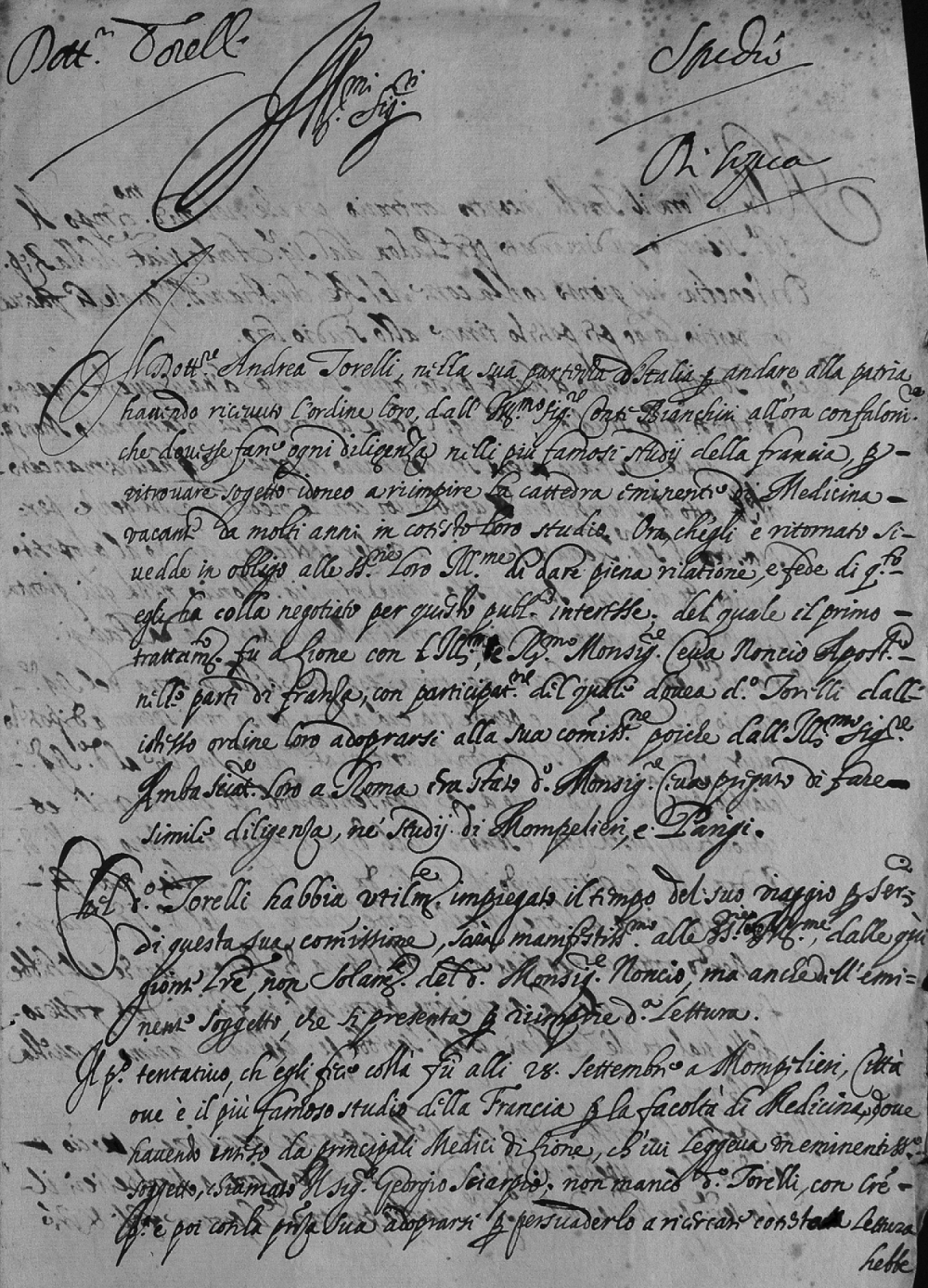
First page of Andrea Torelli's letter to the Bolognese Senate, read 14 March 1633, from the Assunteria di studio, n. 56 (printed with permission of the Archivio di Stato di Bologna).

What follows is a diplomatic transcription of Torelli's letter, which he wrote in the third person:Footnote 26
Ill.mi Sig.ri
Il Dott.re Andrea Torelli, nella sua partirla d'Italia p andare alla patria havendo ricevuto l'ordine loro dall'Ill.mo Sig.re Conte Bianchini all'ora confaloni.che dovesse farsi ogni diligenza nelli più famosi studi della francia p ritrovare sogetto idoneo a riempire la cattedra eminente di Medicina vacante da molti anni in cotesto loro studio. Ora chegli è ritornato si vedde in obligo alle Ss.rie Loro Ill.me di dare piena rilatione, e fede di q.to egli ha colla negotiato per questo publ.co interesse; del quale il primo trattam.to fu a Lione con I'Ill.mo e Rev.mo Monsig.re Ceva Noncio Apost.co nelle parti di franza, con participat.ne del quale dovea d.o Torilli dall'istisso ordine loro adoprarsi alla sua commiss.ne poichè dall'Ill.mo Sig.re Ambasciat.re loro a Roma era stato d.o Monsig.re Ceva prigato di fare simile diligenza, ne'studij di Mompelieri, e Parigi.
Che il d.o Torelli habbia utilm.e impiegato il tempo del suo viaggio p servi.o di questa sua commissione, sarà manifestiss.mo alle SS.rie Ill.me, dalle qui gionte lre,[Footnote 27] non solam.te del d.o Monsig.re Noncio, ma anche dell'eminente soggetto, che si presenta p riempire d.a lettura.
Il p.o tentativo, ch'egli fece collà fu alli 28 settembre a Mompelieri, Città ove è il più famoso studio della Francia p la facoltà di Medicina, dove havendo inteso da principali Medici di Lione, ch'ivi leggeva un eminentiss.o soggetto, chiamato Il Sig.re Georgio Sciarpio, non mancò d.o Torelli, con lre p.a e poi con la preza[Footnote 28] sua adoprarsi p persuaderlo a …[Footnote 29] cotesta lettura.
Hebbe all'ora il Torelli incontro contrario, per che nel med.mo tempo Il Sig.re Sciarpio fu dimandato per Padoa dal Sig.re Ambasciat.re della Rip. di Venetia ivi gionto con la corte del Re christianiss.mo,[Footnote 30] quale li faceva vn partito largo per poterlo tirare allo studio loro.
Perciò il Torelli credendo d'haver persa ogni speranza d'haver questo soggetto, voltatosi allo studio di Parigi, dove ancora s'era incaminato Monsig.re Ceva, quale mostrava seco straordinario dispiacere p haversi mancato q.to soggetto di Mompilieri, ambiduoi con le medesime diligenze persuasero il Sig.re Renato Cartesio a voler applicare l'animo al proposito partito; & di questo soggetto solo scrivend.o monsig.re Noncio nella qùi gionta sua lra, che fu data da lui al Torelli nella sua partenza da Parigi.
Che d.o Monsig.re Ceva non faccia mentione espressa della persona del Sig.re Sciarpio di Mompelieri, è perche già era allora persa ogni speranza di poterlo havere, nondimeno il Torelli con la continuat.ne delle sue lre al d.o Sig.re Sciarpio, non mancava[Footnote 31] procurarsi di voltarlo a se, ripresentandoli gli honori, utili et comodità di questa Città, e studio, quali di gran longa avanzano quelli di Padoa. Si che ritornando il Torelli da Parigi in Italia, non fù cosi tosto gionto a Lione, ch'egli hebbe nuove lre del d.o Sig.re Sciarpio, scrivendoli[Footnote 32], ch'essendo rotta la negotiatione della lettura di Padoa, perche egli ebbe la ferma opinione, che la provisione promessali in fiorini doro fossero della valuta de’ zecchini, degli sarebbe per applicare l'animo a quella di Bologna.
Non volse il Torelli perdere cosi bella, e pronta occasione, perciò giudicò ch'era ispediente di mandare a posta da Lione a Mompelieri il suo ser.re per haver dal d.o Sig.re Sciarpio …[Footnote 33] Le procure fidi & …[Footnote 34] necessarie per informare less.rie Loro Ill.me de'requisiti di questo soggetto quale è in stima del più famoso med.eo di questi tempi, eminentiss.mo Cattedrante, havendolo d.o Torelli sentito nell'occ.ne del dottorato d'un suo allievo, egli è di anni cinquanta, robusto di natura di presenza nobile con moglie, e figliuoli, tutti cattolici[Footnote 35] di natione scossese, che per cagione della relgion volentieri lasciarà d.a Città di Mompelieri, Stimando d.o Torelli ch'egli si contenterà dello stipendio di mille ducatoni l'anno, come gliene diedo parola l'Ill.mo Sig.re Confaloniere di quel tempo.
Resta alla prudenza delle Ss.rie loro Ill.me da questa relatione cavare quello che giudicheranno utile al serv.io; pubblico; & alla solita loro benignità habilitare il d.o Dott.re Torelli, che con fattiche, e spese proprie non ha mancato di servili, del tempo passato delle lettioni, ch'egli non ha potuto fare per l'occupatione sola di questa sua comissione, come consta dalle datte delle lre dell'Ill.mo e R.mo Monsig.re Noncio, & di questo soggetto di Mompelieri, & sarà tenuto sempre p oblig.mo servo della SS Loro Ill.me.
D.SS.rie VV. Ill.me
Divotiss.mo Servo.
Torelli
Paragraphs three to five are the most important in the letter. Not only is Descartes mentioned there, but the explanation for why he was courted by Torelli is also given. It is worth translating these paragraphs in full:
He [Torelli] made his first attempt there on 28 September in Montpellier, the city with the most famous medical school in France. Having learned from leading doctors in Lyon that the most eminent Giorgio Sciarpio taught there, Torelli did everything he could by letters and then in person to persuade him to transfer his lectureship here [Bologna].Footnote 36
Torelli ran into the difficulty that at the same time the ambassador of the Republic of Venice offered Signore Sciarpio a post in Padua. Being connected with the court of the Most Christian King, the ambassador had a great advantage in his effort to draw Sciarpio to Padua.
Believing that he had no hope of obtaining Sciarpio, Torelli turned to the University of Paris, where Monsignore Ceva had gone. He was very irritated at having lost this person of Montpellier. Both of them [Ceva and Torelli] with the same assiduity would persuade Signore Renato Cartesio to consider the proposal; about whom the Monsignore Nuncio [Ceva] wrote the attached letter, which he gave to Torelli when he left Paris.
Sadly, Ceva's attached letter describing Descartes has not survived in the Archivio di Stato di Bologna. Consequently, and in view of the paucity of Descartes's surviving correspondence between 1632 and 1633, many questions about the Bologna affair remain unanswered: who informed Ceva about Descartes? Why was Ceva involved at all? What prompted Ceva to recommend Descartes to Torelli? Did Torelli and Ceva actually succeed in contacting Descartes, or did they only write letters that never reached Descartes? What was Descartes's response? All we know for sure is that through its representatives the University of Bologna tried to convince Descartes to accept a chair in theoretical medicine. As I have already indicated several times, the exact date of Torelli's letter to the Bolognese Senate is uncertain but it must have been written either late in 1632 or early in 1633. The letter contains a reference to an initial effort to fill the chair in theoretical medicine on ‘28 September’. A separate date appears on the letter's facing page, where a note was added stating that the letter was read aloud at a meeting of the Bolognese Senate on 14 March 1633. This suggests that Torelli's initial effort in September took place in 1632. It also suggests that Torelli was given the task of filling the chair in theoretical medicine in 1632, completing his charge in 1633.
There are five parties to the Bologna affair: Andrea Torelli, George Scharpe, Francesco Adriano Ceva, René Descartes and the person or persons who recommended Descartes to Ceva. In this section I will provide additional details about the first three participants. Barring new archival discoveries, we will likely never know how Ceva became aware of Descartes or how Descartes responded to Bologna's invitation.
Andrea Torelli was a member of the faculty of Bologna from 1627 to 1647. According to one source, he was a ‘Professore de Leggi’, but histories of the University of Bologna also identify him among the ‘huomini di lettere’, as a professor of ‘lettere greche’, or simply as part of the ‘umanita’.Footnote 37 Not being a part of the medical faculty, Torelli initially seems an odd choice to lead a search in theoretical medicine. After all, the faculty position he sought to fill had been unoccupied since the death of Giovanni Costeo in 1603.Footnote 38 Costeo's fame made the stakes for Torelli's search much higher, as did the fact that Costeo's chair had been left empty for thirty years. Deciding to search outside Italy, however, the University of Bologna was actually taking a safe route to finding its ideal candidate, and continuing a long tradition of seeking distinguished and expensive foreign scholars.Footnote 39 Torelli's role in the Bologna affair is most likely explained by this tradition, for Torelli was French, having been born in Dijon, Burgundy, in spite of his Italian family name.Footnote 40 If the University of Bologna wanted to find a foreigner of Costeo's calibre, two requirements had to be satisfied: first, the candidate needed to be Catholic, and second, he needed to come with impeccable credentials. Outside Italy, in 1632, the country with candidates most likely to satisfy these two requirements was France.Footnote 41
In his letter to the Bolognese Senate, Torelli reported first visiting Lyon. There he made contact with Francesco Adriano Ceva and subsequently decided to approach George Scharpe, our next figure in the Bologna affair.Footnote 42 Born in Scotland and initially educated at Edinburgh, Scharpe came to study in Montpellier in 1601. In 1607 he received his doctorate in medicine, and for several years he taught in Montpellier's botanic garden. In 1619 Scharpe was finally appointed to a chair in medicine, filling a position left vacant two years earlier. A decade later, in 1631, Scharpe was made proctor of medical disputations and in 1632, at the time of Torelli's visit, Scharpe was Montpellier's vice chancellor. Notwithstanding Scharpe's academic and administrative credentials, there is an obvious question about Scharpe's religious affiliation and suitability for Bologna. Edinburgh, where Scharpe was first educated, was a Calvinist school, and so too was Montpellier during his early years there. Once Louis XIII retook Montpellier in 1622 and reinstituted Catholic control of the city, however, the university's Catholic school of theology was re-established and neither the city nor the university remained entirely Protestant thereafter. It is telling that a note written on Torelli's letter specifically praises Scharpe and his family for being ‘tutti cattolici’. We can only assume that at some point Scharpe had converted.
As a result of what Torelli learned in Lyon, Scharpe became his first choice, and his preference must only have been strengthened on learning that Padua was attempting to recruit Scharpe at the same time. But initially Torelli failed to convince Scharpe to come to Bologna. So Torelli turned his attention away from Montpellier and to the other major university in France, the University of Paris. It was at this point that Torelli again contacted Ceva. Ceva had been sent to France by Pope Urban VIII on a diplomatic mission to quell the growing tensions between France and Spain.Footnote 43 Ceva went to Lyon in August 1632 to wait for the king to arrive in the city, which he did along with his court on 5 September. The king stayed in Lyon for only a few weeks. Ceva would remain for at least a month, engaging in various political manoeuvres, before rejoining Louis XIII and his court in Paris. Given Ceva's standing as nuncio extraordinary, he had significant political and social contacts in France and in the King's court. Why and how Torelli gained access to Ceva is unknown, though at the time Bologna was within Papal control and Ceva would have been a natural ally for Torelli. What is certain, however, is that Ceva informed Torelli about Descartes. The person or persons who informed Ceva about Descartes are unknown.Footnote 44
The only remaining party to the Bologna affair is Descartes himself. It bears repeating that we do not know what his response to Torelli's invitation was or whether he even received it. If we recall the two requirements I outlined for Torelli's search – that he find a Catholic and that he find a candidate with impeccable credentials – it is something of a mystery how Descartes satisfied the second requirement. He was a Catholic, to be sure, but whereas Scharpe held a medical degree and was an established university professor, Descartes could claim neither honour.Footnote 45 We know he was studying practical and theoretical medicine at the time of the invitation but this in itself does not explain the presumed willingness of Bologna's medical faculty to accept a foreigner without a medical degree. Nevertheless, Descartes must have accomplished enough in theoretical medicine by 1632–1633 to gain a reputation as a learned physician. Descartes's part in the Bologna affair ended, however, when the University of Padua's courtship of Scharpe proved unsuccessful and Scharpe accepted the offer from Bologna. Scharpe left Montpellier for Italy in 1634 and Descartes remained forever without a university appointment.
Conclusion
My goal here has been to introduce, document and provide context for the Bologna affair. The evidence is conclusive that Andrea Torelli and Francesco Adriano Ceva attempted to persuade Descartes to come to Bologna in late 1632 or early 1633. But, as we saw, there are many questions which we cannot answer definitively.
There is also the following question: should the Bologna affair prompt us to rethink Descartes's scientific and philosophical projects? It surely reminds us how porous the disciplinary divide could sometimes be between physics and theoretical medicine.Footnote 46 Yet beyond this bare reminder, more work ought to be done by historians of science and philosophy who are knowledgeable about the history of medicine, and vice versa, before we rest content with a traditional historiography that limits the relevance of Descartes's medical interests to a small corner of his natural philosophy. After all, the Bologna affair has been a neglected clue about the ways in which Descartes was perceived beyond a close circle of friends and correspondents before his first publication. Acknowledging that in the eyes of at least some of Descartes's contemporaries he was qualified to assume a prestigious chair in theoretical medicine, it is only natural to look more carefully in his broader corpus for signs of medicine's presence and influence.