According to the International Federation of Red Cross and Red Crescent Societies (IFRC), a disaster occurs suddenly, is disastrous, and seriously disrupts the way a community or society functions. Furthermore, it is usually associated with huge human, material, and economic or environmental losses than what the communities or societies can cope with on their own. Although disasters tend to occur by nature, they can also be man-made (IFRC).
Disaster preparedness, including hazard appraisal, and multidisciplinary management methodologies at all system levels, is basic to the delivery of powerful responses to the short-, medium-, and long-haul health needs of a disaster-stricken populace. Reference Ibrahim1
When a disaster involves humans, it usually results in a mass casualty incident, which is characterized by a great number of patients affected on 1 occasion than locally accessible resources can handle using routine techniques. Reference Ben-Ishay, Mitaritonno and Catena2 Such incidents require exceptional emergency arrangements and additional or exceptional help. Thus, the management of mass casualty incidents requires efforts over a wide assortment of agencies, some of which may have little understanding of working with the health sector.
Saudi Arabia, a young developing country, with a young population (40% of the population is less than 19 y old), has suffered from a high morbidity and mortality burden due to injuries. Reference Alshahri, Cripps and Lee3-Reference Ansari, Akhdar and Mandoorah6 The second leading cause of death in the Kingdom of Saudi Arabia is preventable injuries, accounting for approximately a fifth of all reported fatalities in the country. 7 According to the Global Burden of Disease report, 22.6% of years of potential life are lost in Saudi Arabia due to traumatic injuries. Reference Murray, Vos and Lozano8,Reference Alghnam, Alkelya, Al-Bedah and Al-Enazi9 However, studies are lacking, evaluating emergency medical services (EMS), including the perceived knowledge and role awareness of EMS staff in Saudi Arabia, a nation that annually hosts 1 of the world’s largest mass gatherings in the form of Hajj. Reference Alzahrani and Kyratsis10
The Saudi Red Crescent Authority (SRCA), renamed in 2008, was established in Saudi Arabia on behalf of the Saudi Red Crescent Society in 1963. 11-13 The SRCA has several major objectives, the most important of which are the preparedness and action at peacetime and wartime, to aid the medical administration of the Armed Forces. This is done by means of cooperating with and integrating all civilian and military victims of war, as provided for in the Geneva Conventions. In particular, it includes the transfer of the sick and wounded, the setting up of the means of transportation, assisting war victims and prisoners of war, and mediating in the exchange of their correspondence both within and without the Kingdom, to provide the necessary urgent assistance to victims of accidents, disasters, and public disasters. 11
The EMS in Saudi Arabia is a key initial point of contact for prehospital patients, rendering the duty of providing prehospital care and transport to the SRCA. This duty is comprehensive for the whole country, with a few exceptions. The prehospital care system in Saudi Arabia is still making progress regarding issues related to community awareness, attitude, and knowledge deficiencies on prehospital care providers. Reference AlShammari, Jennings and Williams14
In Saudi Arabia, the EMS system is typically an Anglo-American emergency medical services system (AAS), which is involved in rapidly bringing of patients to the hospitals following life-saving prehospital interventions (load and go). Reference Al Mutairi, Jawadi and Al Harthy15,Reference Al-Shaqsi16 At the National Association of Emergency Medical Technicians’ (NAEMT) conference held in Las Vegas in 2017, a survey was conducted for the participants to measure their level of preparedness for disasters of all kinds. The major finding was that participants had significant knowledge gaps on preparedness responses to natural and man-made disasters. Moreover, regarding the training for chemical, biological, or radiological events, as well as pandemics, few practitioners had knowledge about the subjects. Reference Judge, Cunningham and Ditch17 Thus, the purpose of the current study was to evaluate the level of disaster preparedness in the SRCA as the key initial point of contact providing the prehospital health care to patients. This was done by assessing the medical staff’s attitude and perceptions, their level of knowledge of disaster management and response, and to determine their need for training on disaster management.
Methods
A descriptive cross-sectional survey was conducted in Riyadh, Saudi Arabia, among SRCA-employed medical staff working in prehospital care in 2018. With 34 stations distributed in the north, east, west, south, and central Riyadh, each station serves its surrounding area. Medical staff includes paramedics, EMS technicians, and physicians.
The participants in this study were all medical staff of the prehospital workforce in SRCA in Riyadh city, and were selected randomly. The survey was distributed to the entire medical staff, with 531 participants spread across the 34 stations. All nonmedical staff in SRCA in Riyadh city were excluded as well as those working in administration with medical certification
Data Collection
We received the approval of the institutional review board (IRB) committee of King Saud University and SRCA approval for the sharing of employee data. Social network technology and electronic communication were used to invite the prehospital health-care providers in SRCA to be research participants. The researcher conducted an online Google Forms survey to collect the data. Before completing the survey questions, participants were informed about the study; they completed the survey after providing informed consent. Prospective participants received the survey questions by means of email or by receiving a broadcast link. To encourage them to respond and participate, the link led to a survey in which data could be entered anonymously every 15 d. The collection of data was from March to April 2018.
Measures
The classic Arabic version of the Disaster Preparedness Evaluation Tool (DPET) was used in this study. Reference Al Khalaileh, Bond and Beckstrand18 The DPET’s use was based on the assertion that instruments used in basic research should have a reliability of 0.70 or greater. Reference Nunnally19 Cronbach’s alpha for the whole questionnaire (45 items) was 0.958. The Arabic version of the DPET is a valid and reliable instrument to measure nurses’ perception of disaster management Reference Al Khalaileh, Bond and Beckstrand18 The questionnaire consists of 45 questions and 3 subscales. The first scale comprised the predisaster stage preparedness, the second scale concerns the response stage to disaster, while the third scale concerns the recovery and mitigation stages of disaster, and used to measure the postdisaster response. Responses to the different items of the questionnaire were measured on a Likert-like scale from 1 to 5 (strongly disagree to strongly agree).
To describe the strength of the perception on preparedness, descriptive statistics of participants’ responses were applied as mean, standard deviation (SD), and relative important index (RII), according to the 5-point Likert scale equal interval. Reference Pimentel20 A strong, moderate, and weak perceptions were reflected by mean scores ranging from 3.40 to 5.00, 2.60 to 3.39, and 1.00 to 2.59, respectively. RII analysis was selected in this study to rank the criteria according to their relative importance. The following formula was used to determine the RII:
 $$RII = \;\sum {{W \over {A\;N}}} $$
where (W) is the weighting assigned by each respondent on a 5-point scale, with 1 implying the least and 5 being the highest. (A) is the highest weight, and (N) is the total number of samples (163).
According to Akadiri, Reference Akadiri21 5 important levels are transformed from RII values as: high (H) (0.80 ≤ RII ≤ 1), high-medium (H-M) (0.60 ≤ RII ≤ 0.80), medium (M) (0.40 ≤ RII ≤ 0.60), medium-low (M-L) (0.20 ≤ RII ≤ 0.40), and low (L) (0 ≤ RII ≤ 0.20).
Data Analysis
The IBM SPSS Statistics for Windows, version 23 (IBM Corp., Armonk, NY, USA) was used to analyze the data. We reported the mean score, SD, RII, ranking, and trend for all subscales of the questionnaire, as well as the frequencies and percentages for all demographic variables. The 5-point Likert scale was used to describe the mean scores for the options—strongly agree, agree, neutral, disagree, strongly disagree—in an ordinal scale. The numbers entered in the statistical program were as follows: strongly agree = 5, agree = 4, neutral = 3, disagree = 2, and strongly disagree =1. The arithmetic average (weighted average) was calculated using the length of the first interval—the sum of the divisions of 4-5.
Independent samples t-tests and 1-way analysis of variance (ANOVA) were performed to evaluate the differences in responses between the participants’ demographic variables (age, level of EMS, years of experience, previous exposure to disaster situations, and previous disaster training) and their preparedness for disaster management; P < 0.05 was considered as the level of significance. Finally, chi-squared tests were conducted to test for associations between categorical variables, such as age and experience categories, in those who had experienced a real disaster.
Results
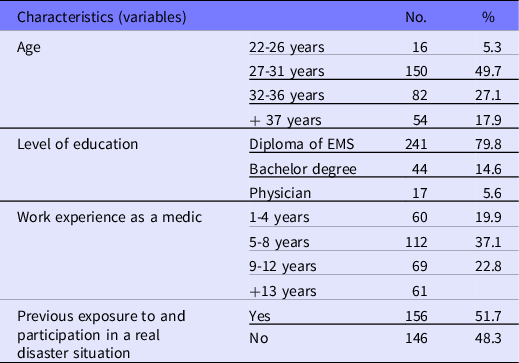
The demographic characteristics of the 302 participants, with a response rate of 56.9%, are shown in Table 1. Most of the participants were aged 27-31 y (49.7%), had an EMS provider diploma (79.8%), had > 13 y of work experience as a paramedic (39.1%), and had previous exposure to and participation in a real disaster situation (51.7%) (Table 1).
Demographic characteristics of the study participants

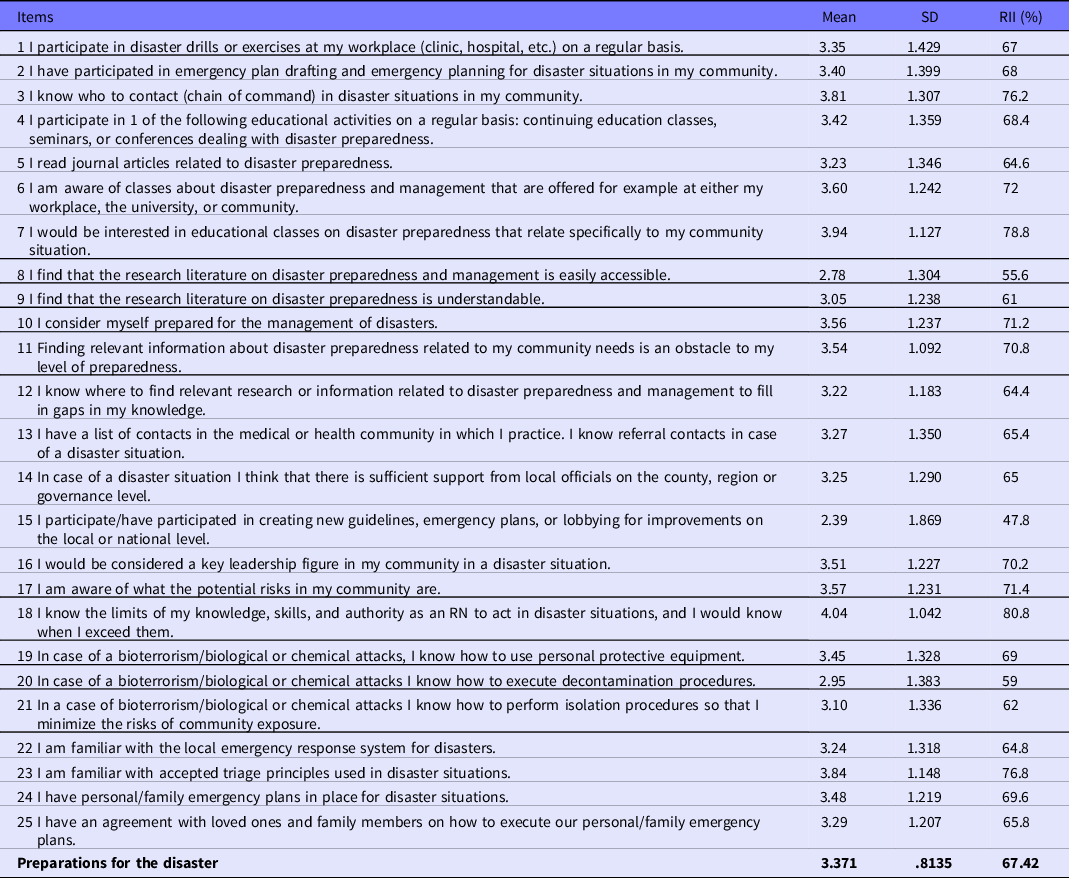
The responses to the subscale on predisaster preparedness indicate that most of the participants believed themselves to be moderately prepared to use the predisaster protocol: the mean score for the overall subscale was 3.37 (SD 0.81), which is considered a moderate level based on the RII (RII= 67.42%; high-medium [H-M]) (0.60 ≤ RII≤ 0.80), while the mean score of the items ranged from 2.39 (RII = 47.80%; medium [M]) (0.40 ≤ RII ≤ 0.60) up to 4.04 (RII = 80.80%; high [H]) (0.80 ≤ RII ≤ 1) (Table 2).
Descriptive statistics of the preparations for the disaster

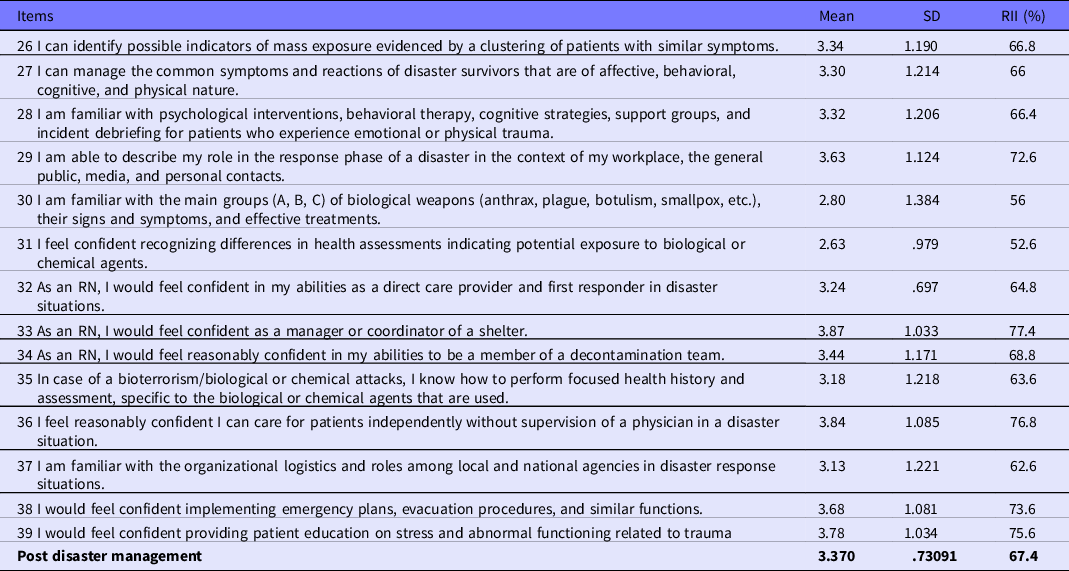
The results from the questions on the subscale concerning postdisaster management showed that most of the participants thought they possessed moderate skills on disaster management. The overall mean score for each subscale was 3.37 (SD 0.73), which is considered a moderate level with RII (RII = 67.40%; high-medium [H-M]) (0.60 ≤ RII≤ 0.80), while the mean score of the items ranged from 2.63 (RII = 52.60%; medium [M]) (0.40 ≤ RII ≤ 0.60) to 3.87 (RII = 77.40%; high-medium [H-M]) (0.60 ≤ RII ≤ 0.80) (Table 3).
Descriptive statistics of post disaster management

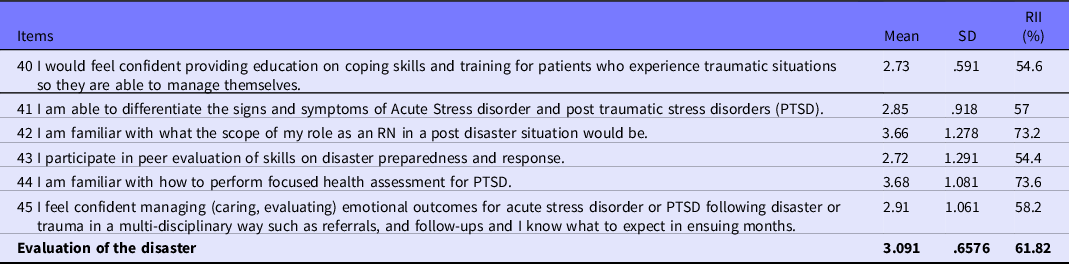
The results from the questions on the subscale concerning evaluation of disaster showed that most of the participants thought they possessed moderate evaluation abilities. The overall mean score for each subscale was 3.09 (SD 0.66), which is considered a moderate level with RII (RII= 61.82%; high-medium [H-M]) (0.60 ≤ RII ≤ 0.80), while the mean score of the items ranged from 2.72 (RII = 54.40%; medium [M]) (0.40 ≤ RII ≤ 0.60) to 3.68 (RII = 73.60%; high-medium [H-M]) (0.60 ≤ RII ≤ 0.80) (Table 4).
Descriptive statistics of disaster evaluation

Additionally, the results showed that most participants (80.79%; n = 244) had motivation to further their education regarding their role, scope of practice, and skills as health-care providers in disaster situations. Of these, 50% (n = 151) desired additional education concerning the potential risks posed by a disaster to their communities and resources available in their communities, such as agencies for referral to the health departments, emergency contacts, the chain of command, and community shelters. Likewise, 48.6% (n = 147) expressed an interest in acquiring more knowledge about biological and chemical agents and the signs and symptoms of exposure to them. Another 46% (n = 139) desired further education regarding biological and chemical agents, their differential diagnoses, and treatments (Table 2).
We asked about their preparedness regarding what they would do in cases of terrorism disasters; only 48.7% of the participants reported officially having preparedness capability for terrorism disasters. Regarding awareness whether their workplace had a disaster (emergency) plan, only 43.4% were aware. Furthermore, only 37.4% felt confident that the disaster (emergency) plan in their workplace would work well in a disaster situation. Finally, regarding whether they had taken a drill exercise and practical application of a regular disaster or emergency plan in their workplace, only 20.9% reported doing so. Among those who participated in such exercises, 61.3% believed that they were effective and helpful (Table 2).
An independent t-test was performed for previous exposure to and participation in a real disaster situation and their perceptions of preparedness in the 3 subscales. The results showed that preparations for the disaster and evaluation of the disaster did not differ (P > 0.05), except for postdisaster management. There was a statistically significant difference (t = 1.892; P = 0.049 < 0.05), between those who had previous experience of a real disaster (mean = 3.55; SD = 0.73) and those who did not (mean = 3.29; SD = 0.72). Participants who had previous experience of a real disaster reported higher postdisaster management scores than those without exposure to a real disaster (Table 5).
T test results for previous exposure to and participation in a real disaster situation and sub-scales of the study

*Significant at level 0.05.
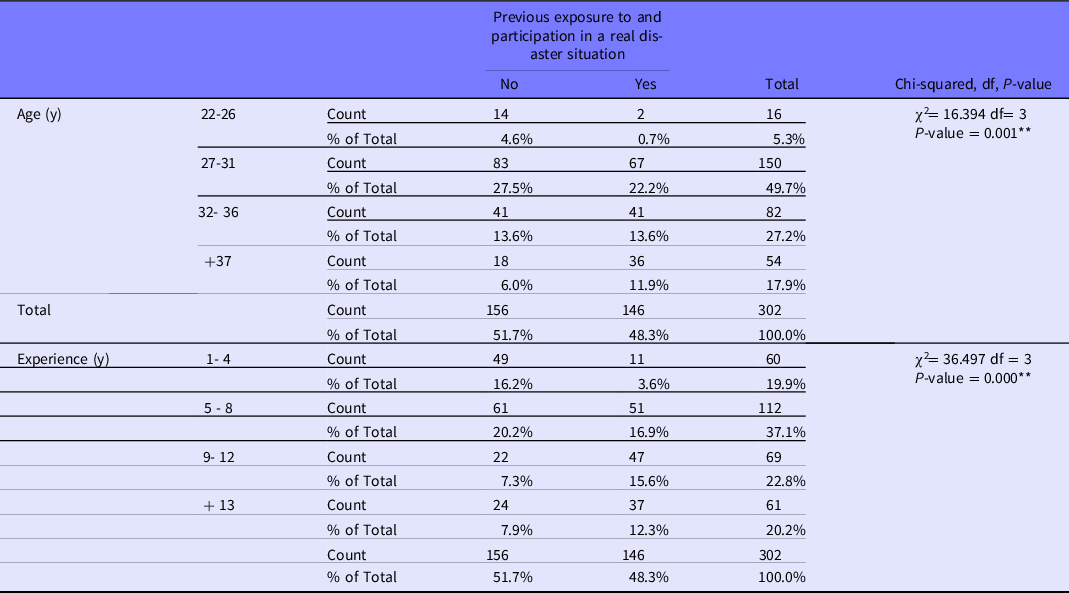
Moreover, we found a statistically significant association between age categories in those who had experienced a real disaster during their employment at prehospital level (χ 2 = 16.394; P = 0.001). We also found a statistically significant association between experience categories in those who had experienced a real disaster during their employment at prehospital level (χ 2 = 36.497; P = 0.000) (Table 6).
Association between age and those who had experienced a real disaster

**Significant at level 0.01.
Furthermore, for all the 3 subscales, 1-way ANOVA showed statistically significant differences between participants who were confident that their workplace disaster or emergency plan would work well in disaster situations across all 3 subscales. The Bonferroni adjustment pairwise tests were used after controlling for type I error across these tests. Results showed that the participants who were confident that their workplace disaster or emergency plan would work well in disaster situations were more likely to perceive themselves to have preparedness, knowledge, and skills for disaster management than those who were not confident.
Finally, 1-way ANOVA showed no statistically significant differences according to demographic variables (age, education, and experience), and their perceptions of preparedness in the 3 subscales did not differ (P > 0.05).
Discussion
This is the first study conducted among the medical staff of SRCA to assess their knowledge, skills, and level of preparedness regarding disaster management, as well as to investigate the degree to which the medical staff perceived themselves as having preparedness, knowledge, and skills regarding disaster management.
In general, the current study’s findings showed that most of the participants considered themselves to be moderately prepared, with moderate levels of knowledge and skills. The results of this study were consistent with those of previous studies by Rassin et al. Reference Rassin, Avraham and Nasi-Bashari22 , Al Khalaileh et al., Reference Al Khalaileh, Bond and Alasad23 and Spranger et al. Reference Spranger, Villegas and Kazda24 who found moderate perception of disaster preparedness among the participants on the preparedness and knowledge subscales. Reference Rassin, Avraham and Nasi-Bashari22,Reference Al Khalaileh, Bond and Alasad23,Reference Al-Ali and Ibaid25 However, the results in the current study showed that participants perceived themselves as having only moderate skills, contradicting the literature that participants perceived themselves as having weak to moderate skills.
According to Rebmann, Reference Rebmann26 knowledge of bioterrorism can be acquired when participants are involved in different disciplinary academic initiatives and bioterrorism exercises. Rebmann Reference Rebmann26 and Manley et al. Reference Manley, Furbee and Coben27 recommended focusing on natural and large-scale accident disaster preparedness for registered nurses (RN), instead of focusing on biological disasters. The participants perceived themselves as being moderately prepared for disaster management due to the lack of drills for emergency plans in their workplaces, low level of experience in real disaster situations, and low awareness of terrorist attacks, consistent with our findings. Reference Manley, Furbee and Coben27 Meanwhile, Putra et al. Reference Putra, Petpichetchian and Maneewat28 showed that nurses perceived themselves as having low preparedness level for disaster management. Reference Putra, Petpichetchian and Maneewat28
In the evaluation of the perceptions of participants’ knowledge in disaster management, as indicated in the second part of the DPET, the results showed moderate levels of preparedness. This result is consistent with those of Al Khalaileh et al. Reference Al Khalaileh, Bond and Alasad23 and Al-Ali and Abu-Abaid Reference Al-Ali and Ibaid25 and others. Reference Spranger, Villegas and Kazda24,Reference Crane, McCluskey and Johnson29 In this part, the highest ranked answer by the participants was for the item “I know the limits of my knowledge, skills, and authority as an RN to act in disaster situations, and I would know when I have exceeded them.” This is an important indication about the participants’ awareness of the importance of disaster preparedness. This result is similar to the findings of Al Khalaileh et al. Reference Al Khalaileh, Bond and Alasad23 and Elgie et al. Reference Elgie, Sapien and Fullerton-Gleason30 The lowest ranked answer by the participants was for the item “I participate/have participated in creating new guidelines, emergency plans, or lobbying for improvements at the local or national level” This study result indicates a lack of research on disaster preparedness and management of SRCA that contradicts the finding of Al Khalaileh et al., Reference Al Khalaileh, Bond and Alasad23 who reported that participants had participated in drafting emergency plans for disaster situations.
However, Cox Reference Cox31 contradicted the finding of Elgie et al., Reference Elgie, Sapien and Fullerton-Gleason30 and showed that participants acted appropriately in disaster planning and response. In this part, the highest ranked answer by the participants was for the item, “As an RN, I would feel confident as a manager or coordinator of a shelter.” This result indicated that they had better skills in classifying and triaging disaster and emergency cases. However, their lowest ranked answer was for the item “I feel confident recognizing differences in health assessments indicating potential exposure to biological or chemical agents” This result indicates insufficient level of confidence in recognizing differences in health assessments. Different results obtained by Fothergill et al. Reference Fothergill, Palumbo and Rambur32 and Al Khalaileh et al. Reference Al Khalaileh, Bond and Alasad23 and revealed that participants perceived themselves as having weak to moderate skills for disaster management. Reference Fothergill, Palumbo and Rambur32 Moreover, Hughes et al. Reference Hughes, Grigg and Fritsch33 showed that it is necessary to guarantee that participants have adequate knowledge and skills to respond well to disaster situations. Reference Hughes, Grigg and Fritsch33
In this study, we found significant differences between participants who had regular disasters or emergency drills in their workplaces and their perceptions of disaster preparedness on the postdisaster management subscale. The same results were revealed by Crane et al., Reference Crane, McCluskey and Johnson29 who showed that those with prior training were more likely to be ready in disaster situations than those with no training. To develop participants’ preparedness for managing disasters, it is crucial to take into account disaster drills and training programs. Reference Crane, McCluskey and Johnson29
Limitations
The limitations of this study included the use of a self-reported survey only and a 56.9% response rate (ie, 306 respondents of the 506 surveys sent). The most obvious limitation was the use of online self-reporting data collection procedures. In addition, this study was a cross-sectional study in which participants responded to the survey only once. Therefore, other factors, such as having an unexpected issue on the specific day that the survey was completed, might have affected the response rate. Another limitation of this study was that the respondents were medical staff employed in Riyadh only, not from the entire country.
Recommendations
-
More training and education regarding preparedness for disaster management
-
Further study is recommended in all centers for SRCA’s medical staff, as this study was limited to only Riyadh. We recommend the distribution of emergency and disaster plans to all SRCA stations.
Conclusions
The study indicated that participants perceived themselves as having moderate levels of preparedness, knowledge, and skills for disaster management. Significant differences were found between those who took training drills for a regular disaster or emergency plan in their workplaces and those who did not, in all the 3 subscales. That is, participants who felt confident about their workplace disaster or emergency plan would work well in disaster situations and were more likely to perceive themselves as having preparedness, knowledge, and skills management than those who were not confident or not sure. Moreover, there was a significant association between age categories and those who experienced a real disaster during their employment, as well as between experience categories and those who experienced a real disaster during their employment.
Acknowledgments
The authors express their appreciation to Prince Sultan Bin Abdulziz College of Emergency Medical Services Research Center and extend their appreciation to the Deanship of Scientific Research at King Saud University for funding this work through Research Group no RG-1440-134. Finally, we deeply thank the Saudi Red Crescent Association and EMS members for their support of the project.