Introduction
The most commonly accepted definition of ‘dowry’ is the transfer of resources from the family of a bride to a groom or a groom’s family at the time of marriage (Goody, Reference Goody1973; Dalmia & Lawrence, Reference Dalmia and Lawrence2005). In India dowry has long been practised, mainly by upper caste Hindus (Vohra, Reference Vohra2003; Dalmia & Lawrence, Reference Dalmia and Lawrence2005). In recent years the practice has gained prominence, spreading to lower caste Hindus, Muslims, Christians and some tribal communities (Stein, Reference Stein1988; Ashraf, Reference Ashraf1997; Waheed, Reference Waheed2009; Ambrus et al., Reference Ambrus, Field and Torero2010).
Marriage in India is predominantly arranged by parents. Among the Indo-Aryan-speaking population of northern India marriages are preferred between families that are not blood related. On the other hand, in Dravidian-speaking southern India marriages between blood relatives are preferred. In arranged marriages, irrespective of cultural affiliation, the onus of protecting daughters within marriage is with the parents. In recent years there have been important changes in marriage practices in both the northern and southern cultural zones of India. With the increase in female education and employment there have been changes in marriage practices where less significance is given to parents in arranging marriages for their children (Dommaraju, Reference Dommaraju2009). Another significant change has been the increase in age at marriage in India. Broadly, age at marriage is higher in the southern states compared with the northern states. According to the National Family Health Survey (NFHS-4) the median age at marriage for women aged 20–49 years in 2015–16 was 19.0, compared with 17.2 in 2006–07 (IIPS & Macro International, 2007; IIPS & ICF, 2017). While women’s age at marriage has been increasing in India, many families still practise child marriage. Changes in marriage practices across India are likely to have a significant impact on the dowry system.
Economic development in India in the last few decades, particularly in the post-liberalization period, seems to have had an increasing effect on dowry practice and its inflation. A study carried out in Karnataka in 2002 found the average dowry value to be about seven times the annual income of the bride’s family (Bloch & Rao, Reference Bloch and Rao2002). Many studies have reported significant dowry inflation in India (Hayer, Reference Hayer1992; Ambrus et al., Reference Ambrus, Field and Torero2010). In India over recent decades, not only has the amount of money involved in dowry increased, but also the nature of dowry. For example, dowry today often consists of consumer goods such as electrical home appliances, cars and motor bikes and also land and property (Bradley & Pallikadavth, 2012). The higher the groom’s wage the greater the expected dowry (Stein, Reference Stein1988; Kishwar, Reference Kishwar1993; Biao, Reference Biao2005). The economic burden of arranging dowry has been highlighted in many studies (see for example Dogra, Reference Dogra1997).
There are several explanations for why dowry continues to be practised in India. One of the strongest arguments is that women see dowry as a form of pre-mortem inheritance. Even after the Hindu Succession Act of 1956 women in India seldom inherited parental property (Carroll, Reference Carroll1991). Another rationale is that parents perceive that dowry can protect their daughters from potential abuse from their husbands and others, particularly mothers-in-law. However, the available evidence is non-conclusive. For example, a study carried out in Bangladesh showed that dowry did not help protect women from domestic abuse (Suran et al., Reference Suran, Amin, Huq and Chowdury2004). Another study carried out in Tamil Nadu gave a different picture, indicating that a large proportion of women support dowry practice because it provides security and status to young married women in their marital households (Srinivasan & Bedi, Reference Srinivasan and Bedi2007). Dowry is regarded as a necessary part of marriage, without which it is very difficult for a woman to secure a good husband both in terms of status and treatment.
A concerning negative consequence of not giving dowry or not giving adequate dowry is thought by many to be violence directed at the young wife. According to the National Crime Record Bureau (NCRB), in India there were 8618 dowry deaths in 2011 – about a 26% increase from the 2001 level. The highest number of dowry deaths, and dowry death rates, were recorded in the two northern states of Uttar Pradesh and Bihar (National Crime Bureau Report (NCRB), 2011). The NCBR has also reported a number cases that were registered under ‘cruelty by husband and relatives to women’, of which 99,135 cases were recorded in 2011. A number of studies also reported dowry-related violence against women in other South Asian countries. For example, in Nepal dowry was shown to act as a key trigger for domestic violence against women (Paudel, Reference Paudel2007). In Bangladesh, demand for dowry has been shown to be a factor in the abuse of pregnant women (Naved & Persson, Reference Naved and Persson2008). In India, research in a slum population in Bangalore showed that an additional demand for dowry after marriage was a significant reason for physical violence against young married women (Rocca et al., Reference Rocca, Rathod, Falle, Pande and Krishnan2009). Another study carried out in seven cities in India showed that about 20% of the women reported experiencing spousal violence, and that those who experienced dowry harassment were three times more likely to suffer spousal violence (Jeyaseelan et al., Reference Jeyaseelan, Kumar, Neelakantan, Peedicayil and Pillai2007).
Dowry practice has many negative consequences, not just for the young married woman, but also for her parents and even wider society. For example, recent research has linked the perceived burden of dowry to an increase in female feticide in India (Diamond-Smith et al., Reference Diamond-Smith, Luke and McGarvey2008; Ahmad, Reference Ahmad2010) and a growing imbalance in sex ratios favouring boys. This imbalance in the sex ratio is leading rapidly to a critical shortage of brides in some parts of India. Recent media reports have highlighted a new phenomenon of inter-state marriages emerging to overcome the difficulties arising from a shortage of suitable brides (BBC, 2011). Finally, dowry is thought to support the continuity of early marriage for girls. For example, poorer families see child marriage as a way of avoiding large or even any dowry payments (Anderson, Reference Anderson1995).
In India, dowry practice is illegal under the Dowry Prohibition Act 1961 (amended in 1984 and 1986). The law seems to be ineffective not only to prevent dowry practice but also in averting dowry-related violence and death (Dalmia & Lawrence, Reference Dalmia and Lawrence2005; Ghosh & Choudhuri, Reference Ghosh and Choudhuri2011; Shetty et al., Reference Shetty, Rao and Shetty2012). According to the NCBR, 6619 cases were registered under the Dowry Prohibition Act 1961 in 2011 (NCRB, 2011). Clearly the legal provisions to protect women from dowry are too weak and other socio-cultural interventions are required (Dogra, Reference Dogra1997).
While there have been a number of studies linking dowry practice and physical domestic violence, little research has been done on women’s autonomy over dowry (termed here ‘dowry autonomy’) and its association with physical domestic violence. In this paper, ‘dowry autonomy’ is defined as the ability of women to use the dowry they have been given during marriage. As most dowry-related violence is likely to emerge during the first few years of marriage (Prasad, Reference Prasad1994) research should focus on young married women. Therefore, this study examined young married women in the age group 15–24 years. It conceptualized that dowry practice is associated with contextual factors such as state and rural–urban residence; social factors such as religion and caste; household economic status; husband’s characteristics such as occupation; parental characteristics such as father’s education; individual characters such as age at marriage, type of marriage (arranged or love), work before marriage, paid work before marriage and education. The study also conceptualized that ‘dowry autonomy’ is associated with the above set of factors. The study further assessed whether dowry practice and women’s ‘dowry autonomy’ are associated with physical domestic violence.
Given the context, the objectives of this study were: (1) to examine the extent of dowry practice and its associated factors; (2) to assess the extent to which women can exercise autonomy over the use of dowry, i.e. ‘dowry autonomy’; and (3) to examine whether dowry and ‘dowry autonomy’ have any association with women experiencing physical domestic violence.
Methods
Data
Survey data were taken from the ‘Youth in India: Situation and Needs Study’ (Youth Study), carried out in six Indian states (Andhra Pradesh, Bihar, Jharkhand, Maharashtra, Rajasthan and Tamil Nadu) during 2006–07. These states are representative of the different geographic and socio-cultural regions of India. Bihar and Jharkhand represent the eastern region; Rajasthan represents the northern region; Maharashtra represents the western region; and Andhra Pradesh and Tamil Nadu represent the southern region. Together these states represent 39% of India’s population.
The objectives of the Youth Study, among others, were to identify key transitions experienced by youth, including those pertaining to education, work, sexual activity, marriage, health and civic participation. The Youth Study focused on married and unmarried young women aged 15–24 years and men aged 15–29 years. The data were collected from both rural and urban areas and were treated independently. A systematic, multistage sampling design was adopted to draw sample areas from rural and urban areas. For sample selection in rural areas, the 2001 Census list of villages was used as the sampling frame. From this list, 150 villages (PSUs) were selected using probability proportional to size (PPS) methodology. Half of these villages were designated to interview young men and another half for young women. A full household listing was carried out in the villages. Households were selected using a systematic sampling procedure. In urban areas 2001 Census wards were the sampling frame. The sample was then selected in three stages. At the first stage 75 wards were selected using PPS methodology. At the second stage, Census Enumeration Blocks (CEBs) – one each for male and female – containing 150–200 households were selected using PPS sampling methodology. Households were selected at the third stage using systematic sampling procedure. Further details of sampling are given in the full survey report (IIPS & Population Council, 2010).
Data were collected using six questionnaires: a rural community questionnaire, a household questionnaire and four individual questionnaires, one each for married young men, married young women, unmarried young men and unmarried young women. These questions were developing using information gathered from 105 focus group discussions, 231 key informant interviews and 420 in-depth interviews in the pre-survey qualitative phase from all six states. No more than one married and one unmarried respondent was interviewed from each household. All the interviews were conducted in local languages by trained interviewers. Training was provided by the principal investigators of the participating institutions and special attention was given to the ethical issues involved. The survey considered a number of ethical issues; this is fully explained in the full survey report (IIPS & Population Council, 2010).
A total of 50,848 married and unmarried young women and men were successfully interviewed in the survey (13,912 married young women; 17,362 unmarried young women; 8052 married young men; 11,522 unmarried young men). Response rates for individual interviews were in the range of 84–90%. Unmarried women registered the highest response rate (90%). The response rates were marginally lower among those residing in rural areas compared with those in urban areas. The response rates varied only marginally over the states included in the survey. A comparison of estimates based on the Youth Study with other large-scale population-based household surveys in India (e.g. National Family Health Survey; District Level Household Survey) suggests that data from the Youth Study are of optimal quality. The data are available for academic use from the Population Council or the International Institute for Population Sciences (IIPS).
The present study used survey data from 13,912 young married women aged 15–24 years.
Outcome variables
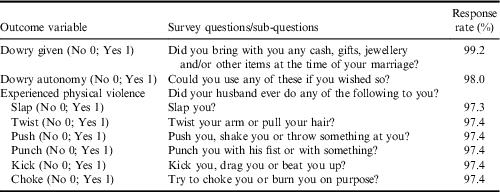
Table 1 shows the outcome variables, relevant survey questions in their exact format and survey response rates. Privacy was ensured before administering these questions and respondents were ensured of the confidentially of information gathered. The response rate (over 97%) for each question is at an acceptable level for a large-scale survey involving sensitive questions. In total eight outcome variables were included with the binary responses ‘No’ or ‘Yes’. Two were related to dowry (dowry giving and ‘dowry autonomy’) and the remaining six were related to physical domestic violence (husband slapped, twisted, pushed, punched, kicked or choked wife). However, only five outcome variables for physical domestic violence were included in the multivariate analysis, i.e. husband slapped, twisted, pushed, punched or kicked.
Outcome variables, questions and response rate, ‘Youth in India: Situation and Needs study, India, 2006–07

Independent variables
A number of independent variables were selected for inclusion in the analysis based on available evidence on their association with dowry practice. The unavailability of a few important variables (e.g. husband’s education, amount of dowry given) in the data set prevented their inclusion in the analysis. The six main variable categories included in the analysis were: (1) place of residence: state and rural/urban residence; (2) religion: Hindu, Muslim, other; caste: Scheduled Castes (SC) (i.e. those at the lower end of the socioeconomic strata, mainly untouchable), Scheduled Tribes (ST) (i.e. indigenous populations of India), Other Backward Classes (OBC), (communities in the middle socioeconomic strata of the caste system and which have been recognized as requiring positive discrimination), General (i.e. those mainly belonging to the upper castes) and No Caste (i.e. those reporting no caste); (3) household economic status, assessed by husband’s income and given as wealth quintiles; (4) age at marriage and type of marriage; (5) education of women and their fathers; and (6) work, i.e. paid work status of women and occupation of husbands.
Statistical analysis
Exploratory bivariate analyses were carried for each outcome variable and independent variable giving percentage distributions and associations. All the variables included in the bivariate analysis were included in the multivariate analysis as these variables were included on an a priori basis. Since the data set had a hierarchical structure, a multilevel modelling technique was used to study factors associated with outcome variables of interest. In the analysis individuals and districts were considered as Level 1 and Level 2 hierarchies, respectively. Since there were only six states included in the survey they were treated as covariates in the multivariable model. The multilevel modelling technique offers a mechanism for measuring the influence of unobserved community effects on outcome variables. It also provides a robust method for analysing hierarchically clustered data by accounting for non-independence of observations with the clusters (Goldstein, Reference Goldstein2010). The two levels were included in the analysis to estimate the variance in outcome measures that remained after accounting for the factors included in the models. As all the outcome variables in the analysis were binary, logistic multilevel models were run using the runmlwin command for MLwiN 2.26 (Leckie & Charlton, Reference Leckie and Charlton2011; Centre for Multilevel Modelling, 2012) in Stata 11.2 (StataCorp, 2009). Results are presented as odds ratios (OR) in order to facilitate interpretation of results. Significance levels are reported at p<0.01, p<0.005 and p<0.001, but level of significance was set at p<0.005 when interpreting the results.
Results
Prevalence of dowry giving and ‘dowry autonomy’ among women by background characteristics
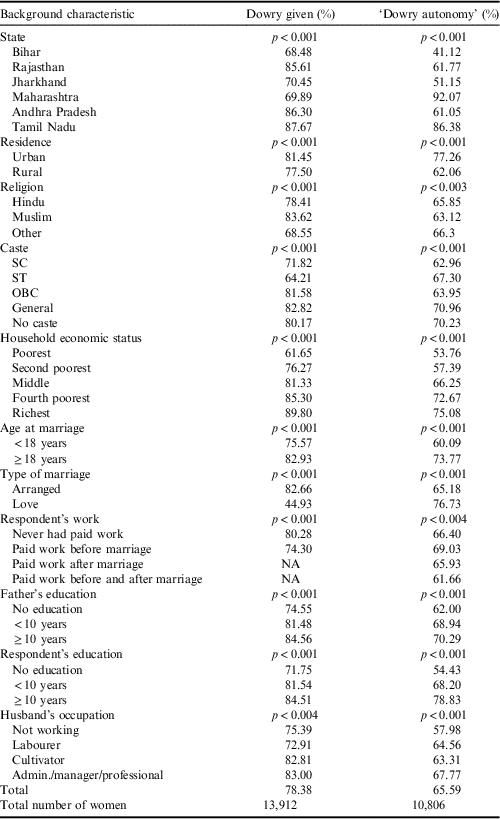
Table 2 shows the percentage distribution of married women aged 15–24 years according to whether they had received cash, gift(s), jewellery and/or other items by way of dowry. Overall, about 78% of survey women reported receiving a dowry at their marriage. Note that in this study dowry received after marriage was not included.
Percentage (weighted) of women reporting being given a dowry and ‘dowry autonomy’ at time of marriage by background characteristics, selected Indian states, 2006–07

SC=Scheduled Castes; ST=Scheduled Tribes; OBC=Other Backward Classes.
The percentage of women reporting receiving a dowry in Rajasthan, Andhra Pradesh and Tamil Nadu was significantly higher (85–88%) compared with Bihar, Jharkhand and Maharashtra (68–70%). Of those who received a dowry, about 66% reported that they could exercise ‘dowry autonomy’. The percentage of women with ‘dowry autonomy’ was highest in Maharashtra (92%) followed by Tamil Nadu, Rajasthan, Andhra Pradesh, Jharkhand and Bihar (41%). There were significant rural–urban differences in both dowry giving and ‘dowry autonomy’. A higher percentage of women from urban areas reported receiving a dowry (82%) than those from rural areas (78%). Similarly, significantly more women in urban areas (77%) reported ‘dowry autonomy’ compared with their rural counterparts (62%).
Religion was found to be significantly associated with dowry giving and ‘dowry autonomy’. Dowry giving was highest among Muslims (84%) followed by Hindus and ‘other’ religious groups (69%). ‘Dowry autonomy’ was highest among ‘other’ religious groups (66%), followed by Hindus and Muslims (63%). Thus, although Muslims had a higher incidence dowry practice, fewer women had the autonomy to use it. Among the various caste groups, dowry giving was lowest among the Scheduled Tribes (64%) followed by Scheduled Castes, Other Backward Classes and the General category (83%). More women from the General class (71%) reported ‘dowry autonomy’ compared with Scheduled Tribes, Other Backward Classes and Scheduled Castes (63%).
The percentage of women reporting receiving a dowry increased with household economic status. For example, for women from the poorest households (according to husband’s income) about 61% reported receiving a dowry compared with 90% among women from the richest households. A similar pattern was found for ‘dowry autonomy’, with 54% of the women married to the poorest households having ‘dowry autonomy’ compared with 75% of women in the richest households according to husband’s income.
The percentage of women reporting receiving a dowry was lower among women who married below the age of 18 years (76%) compared with those who married at 18 years or above (83%). ‘Dowry autonomy’ was also lower among women who married below the age of 18 (60%) compared with those who have married at age 18 years or above (74%). The percentage of women reporting receiving a dowry was higher among those who married in a traditional way (i.e. had a marriage arranged by family) (83%) compared with those who married in a non-traditional way, i.e. those who had a ‘love marriage’ (45%). However, ‘dowry autonomy’ was higher (77%) among women who had a ‘love’ marriage compared with those who had an ‘arranged’ marriage (65%).
The percentage of women reporting receiving a dowry increased with level of education. For example, among women who had no education dowry giving was lower (71%) compared with women who had less than 10 years of schooling (82%) and those with 10 or more years of schooling (85%). Further, the percentage of women reporting receiving a dowry increased with ‘dowry autonomy’. For example, among women who had no education, only about 46% had ‘dowry autonomy’ compared with 79% of those who had 10 or more years of schooling. Overall, women whose fathers had no education reported lower dowry practice compared with women whose fathers were educated. For example, for women whose fathers had 10 or more years of schooling about 85% reported receiving a dowry compared with 74% for those whose fathers had no education. Similarly, for women whose fathers were schooled, a higher percentage reported ‘dowry autonomy’ compared with women whose fathers were uneducated.
Among women who have never worked for pay, the percentage reporting receiving a dowry was higher (80%) compared with those who had never worked for pay before marriage (74%). Interestingly, ‘dowry autonomy’ was lower among those who were in paid jobs both before and after marriage (62%) compared with those who never had paid work (66%). However, those who were in paid work before marriage had the highest ‘dowry autonomy’ (69%).
Dowry practice was significantly higher among women married to men who were administrators/professionals or cultivators (83%) compared with those married to men who were not working (75%) or who worked as labourers (73%). A similar pattern was observed for ‘dowry autonomy’. For example, among women married to administrators or professionals, about 68% had ‘dowry autonomy’ compared with 57% of women married to men who were not working.
Factors associated with dowry giving and ‘dowry autonomy’
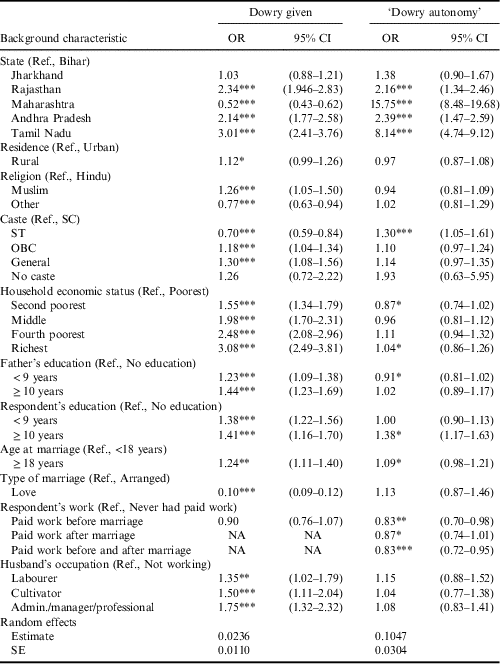
Table 3 provides the odds ratios for dowry giving and ‘dowry autonomy’ by women’s background characteristics.
Multilevel logistic regression results (adjusted odds ratios, ORs) of dowry giving (no, yes) and ‘dowry autonomy’ (no, yes) by background characteristics, India 2006–07

OR=odds ratio; SE=standard error; CI=confidence interval; Ref.=reference category.
*p<0.01; **p<0.005; ***p<0.001.
There were differences in dowry practice between the states. The odds of dowry giving were significantly higher in Tamil Nadu (OR=3.01), Andhra Pradesh (OR=2.14) and Rajasthan (OR=2.34) compared with the reference state Bihar. Maharashtra was the only state of those included in the study that had lower odds (OR=0.52) for dowry giving than Bihar. There was no significant difference in the odds of dowry giving between Bihar and Jharkhand. Further, there was no significant difference between rural and urban areas with regard to dowry giving. ‘Dowry autonomy’ too was significantly different between states. Women in Maharashtra (OR=15.75), Tamil Nadu (OR=8.14), Andhra Pradesh (OR=2.39) and Rajasthan (OR=2.16) had higher odds of having ‘dowry autonomy’ compared with women in Bihar. There was no significant difference in odds of ‘dowry autonomy’ among women in Bihar and Jharkhand. As in the case of dowry giving, there was no significant difference in women’s ability to use their dowry between rural and urban areas.
Religion and caste were found to be significantly associated with the practice of dowry. Muslims were more likely to practise dowry (OR=1.26) than Hindus. Other religious groups (Christian, Sikh, Buddhist, Jain, Jewish, etc.) were less likely (OR=0.77) to practise dowry than Hindus. Scheduled Tribes were less likely to practise (OR=0.70) dowry than Scheduled Castes. However, the odds of dowry practice were higher (OR=1.18) among Other Backward Classes (OR=1.18) and General classes (OR=1.30) compared with SCs. It is interesting to note that religion had no independent effect on ‘dowry autonomy’. However, caste had a significant association. For example, ST women had higher odds (OR=1.30) of ‘dowry autonomy’ than SC women. None of the other caste groups showed significant association.
The economic status of a household was found to be associated with dowry practice. Overall, there was a steady and significant increase in the odds of dowry practice with greater economic status of the household. For example, compared with the poorest, the likelihood of practising dowry was almost three times higher among the richest families (OR=3.08). However, the economic status of a household did not have any independent effect on ‘dowry autonomy’.
An important factor that was found to be associated with dowry practice was father’s education. This had a positive and significant association with dowry practice. For example, women with fathers with less than 10 years of schooling had higher odds (OR=1.23) of receiving a dowry compared with those whose fathers had no education. Further, the odds were higher (OR=1.44) among women whose fathers had 10 or more years of schooling. Similar associations were noted with regard to respondent’s education. Respondents with less than 10 years of schooling had higher odds (OR=1.38) of receiving a dowry compared with those with no education. The odds of receiving a dowry for women with 10 and more years of schooling were higher (OR=1.41) than for women without any education. ‘Dowry autonomy’ was not found to be significantly associated with father’s education. However, women with more than 10 years of schooling had higher odds (OR=1.38) of ‘dowry autonomy’ than women who did not have any education.
A woman’s age at the point of marriage was found to be significantly associated with the likelihood of receiving a dowry. Women who married at the age of 18 years or above had higher odds (OR=1.24) of receiving a dowry compared with women who married below the age of 18. Also, type of marriage was found to be associated with dowry giving; women who chose their partners without parental involvement (‘love’ marriages) had lower odds (OR=0.10) of receiving a dowry compared with those who married in a traditional way (‘arranged’ marriages). Age at marriage and type of marriage did not have any significant effect on women’s ‘dowry autonomy’.
Women’s work status – whether she was in employment or not – did not have any significant association with dowry practice. However, women’s work status was found to be significantly associated with her ‘dowry autonomy’. For example, women who had a paid job before marriage, or even before and after marriage, had significantly lower odds (OR=0.83) of ‘dowry autonomy’ compared with women who never had a paid job.
Husband’s occupation was found to have a significant association with dowry giving. For example, compared with women whose husbands were non-workers, those whose husbands were administrators/professionals had higher odds (OR=1.75) of receiving a dowry. Further, women whose husbands were cultivators (OR=1.50) or labourers (OR=1.35) had higher odds of receiving a dowry than those whose husbands were non-workers. However, a husband’s work status did not have any significant effect on the ‘dowry autonomy’ of women.
Table 3 also shows the estimated variance in dowry giving and ‘dowry autonomy’ between districts. Since the variance estimates were significantly higher than standard error, there is evidence of significant variation across districts. This suggests that district-level variance remained unexplained in the model after accounting for the factors included in the models.
Dowry giving and physical domestic violence
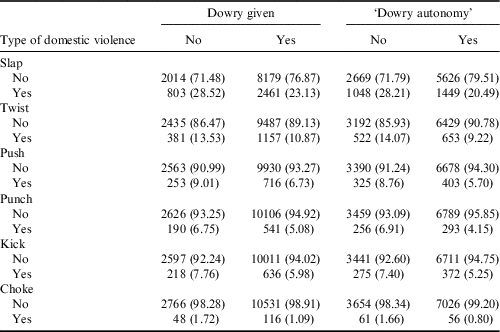
Table 4 shows the percentage distribution of the sample women according to whether dowry was given at marriage and whether they could exercise ‘dowry autonomy’ by types of physical domestic violence women ever experienced from their husbands. Six types of domestic violence were considered in the analysis. However, the violence form ‘choking’ was excluded from the multivariate analysis as the number of cases were too small. Overall, about a quarter of women reported experiencing physical domestic violence. About 11% reported only one form of violence; 5% any two forms; 3% any three forms; 2% each for any four or five forms; and 1% for all six forms of domestic violence (not shown in Table 4).
Dowry giving and ‘dowry autonomy’ by whether experienced domestic violence among young married women aged 15–24 years, selected Indian states, 2006–07

About a quarter of the women reported being slapped by their husbands. This was the most common form of violence among the various physical domestic violence forms examined in this study. Among women who did not receive a dowry about 28% reported being slapped compared with 23% among those who had received a dowry. Among women who could not exercise ‘dowry autonomy’ about 28% reported being slapped by their husbands compared with 20% among those who could exercise ‘dowry autonomy’.
About 11% of the women reported being twisted by their husbands. Among those who did not receive a dowry about 13% reported being twisted compared with 11% among those who had received a dowry. Among women who could not exercise ‘dowry autonomy’, about 14% reported being twisted compared with 10% among women who could exercise ‘dowry autonomy’.
About 7% of the women reported being pushed by their husbands. The percentage of women reporting this form of violence was higher (9.0%) among those who did not receive a dowry compared with those who had received a dowry (7.0%). Among women who could not exercise ‘dowry autonomy’ about 9% reported being pushed compared with 6% among those who could exercise ‘dowry autonomy’.
About 5% of the women in the study reported being punched by their husbands. Among those who received a dowry about 5% reported being punched compared with 7% among those who did not receive a dowry. Among those who had no ‘dowry autonomy’, about 7% reported being punched compared with 4% among those who had ‘dowry autonomy’.
About 6% of the women reported being kicked by their husbands. Among those who had received a dowry about 6% reported being kicked compared with 8% of those who had not received a dowry. Similarly, among those who could exercise ‘dowry autonomy’ about 7% reported being kicked compared with 5% among those who could exercise ‘dowry autonomy’.
Relatively few women reported being choked by their husbands (1%). Among those who had received a dowry about 1% reported being choked compared with about 2% among those who did not receive a dowry. Among those who could not exercise ‘dowry autonomy’, about 2% reported being choked compared with 1% among those who could exercise ‘dowry autonomy’.
Factors associated with domestic violence: role of dowry and other factors
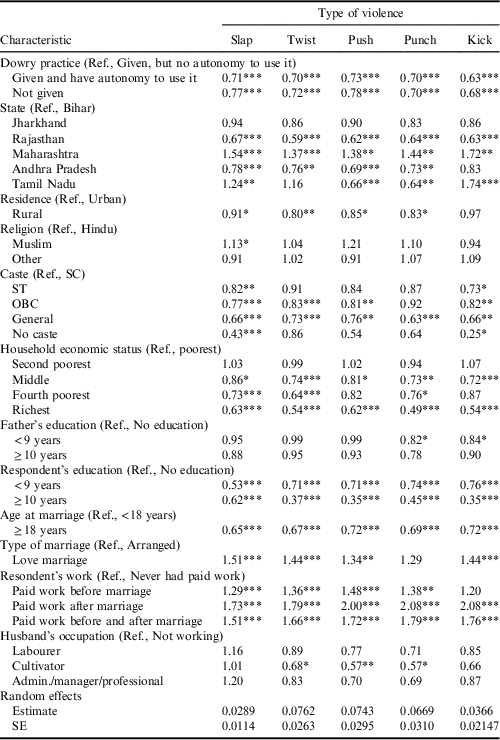
Multilevel logistic models were developed to study the role of dowry giving in the five types of physical domestic violence against women. In the models, the dowry-related variable had three categories: (1) dowry received but no autonomy to use it, (2) dowry received and autonomy to use it, and (3) dowry not given. The results are provided in Table 5.
Multilevel logistic regression results (adjusted odds ratios, ORs) for various forms of domestic violence among married women aged 15–24 years, selected Indian states, 2006–07

OR=odds ratio; SE=standard error; CI=confidence interval; Ref.=reference category.
*p<0.01; **p<0.005; ***p<0.001.
In the four multilevel logistic models women who had ‘dowry autonomy’ had significantly lower odds of experiencing physical domestic violence (OR=0.63–0.73) compared with women who had received a dowry but had no autonomy to use it. Similarly, women who did not receive a dowry had significantly lower odds of experiencing physical domestic violence (OR=0.68–78) compared with women who had received a dowry but did not have the autonomy to use it.
In general, women from Rajasthan (OR=0.59–0.67) and Andhra Pradesh (OR=0.69–0.78) had lower odds of experiencing physical domestic violence compared with those from Bihar. Interestingly women from Maharashtra had higher odds of experiencing physical domestic violence (OR=1.37–1.72) compared with those from Bihar. Women from Tamil Nadu had lower odds for ‘push’ (OR=0.66) and ‘punch’ (OR=0.64) compared with those from Bihar. But the odds for ‘slap’ and ‘kick’ were higher: 1.24 and 1.74, respectively. There was no statistically significant difference in ‘twist’ between the two states. There was no difference in the odds of experiencing physical domestic violence between Jharkhand and Bihar. There were reduced odds for ‘twist’ in rural areas compared with urban areas (20% lower) but no significant differences for other forms of violence.
Religion did not show any significant association with any form of physical domestic violence. However, caste had a significant association with domestic violence. Scheduled Tribes had lower odds of experiencing physical domestic violence compared with Scheduled Caste for ‘slap’ (OR=0.82) and ‘kick’ (OR=0.73). Compared with Scheduled Castes, Other Backward Classes had lower odds for ‘slap’ (OR=0.77), ‘twist’ (OR=83) ‘push’ (OR=0.81) and ‘kick’ (OR=0.82). The General Class had lower odds (OR=24–37% lower) for all forms of domestic violence compared with SCs.
In general, the odds of women experiencing physical domestic violence decreased with increased household economic status, as determined by husband’s income. There was no difference in domestic violence between the poorest and second poorest groups. Among the middle income group, the odds for ‘slap’ (OR=0.81), ‘twist’ (OR=0.74) and ‘kick’ (OR=0.72) were significantly lower compared with those for the poorest women. The odds of ‘slap’, ‘push’ and ‘punch’ were not significantly different from those of the poorest group. Women belonging to the fourth poorest group had lower odds for ‘slap’ (OR=0.73) and ‘twist’ (OR=0.64) compared with the poorest women. There was no difference in other forms of violence. The richest group had significantly lower odds for all forms of physical domestic violence compared with the poorest (OR=0.49–0.63).
Father’s education was not found to have any significant association with the odds of women experiencing physical domestic violence. However, women’s education had a significant association with all forms of physical domestic violence. The odds of women experiencing physical domestic violence showed a significant decline with their increasing education level. For women who had less than 10 years of schooling, the odds of experiencing physical domestic violence in all forms were lower (OR=0.53–0.76) compared with women who had no schooling. Women who had more than 10 years of schooling also had significantly lower odds of experiencing physical domestic violence (OR=0.35–0.62) compared with women who had no schooling.
Age at marriage had a significant association with the odds of women experiencing physical domestic violence. Women who were married at 18 years or above had significantly lower odds of experiencing all forms of physical domestic violence compared with women who were married below the age of 18 years (OR=0.65–0.72). Women who had ‘love’ marriages had significantly higher odds of experiencing all forms of physical domestic violence (OR=1.34–1.51), with the exception of being punched, compared with those with ‘arranged’ marriages.
Women who had ever worked in a paid job had a significantly increased risk of experiencing physical domestic violence compared with women who had never had a paid job. For example, women who had a paid job before marriage had higher odds of ‘slap’ (OR=1.29), ‘twist’ (OR=1.36), ‘push’ (OR=1.48) and ‘punch’ (OR=1.38) compared with those who never had a paid job. There was no significant difference between the two groups with regard to the odds of ‘kick’. Women who had a paid job after marriage had significantly higher odds of experiencing physical domestic violence compared with women who never had a paid job (OR=1.73–2.08). Those who had a paid job before and after marriage also had significantly higher odds (OR=1.51–1.76) of experiencing all forms of physical domestic violence compared with those who never had a paid job. Interestingly, a husband’s occupation did not have a significant association with any form of physical domestic violence, with the exception of ‘push’ where ‘cultivators’ had lower odds (OR=0.57).
The estimated variances in domestic violence between districts are given in Table 5. Except for ‘kick’, all variance estimates were more than twice the size of their standard errors. This suggests that there was significant variation in domestic violence across districts suggesting that contextual-level variance remained unexplained in the models after accounting for the factors included in the models. For the domestic violence form ‘kick’, there was no significant variation across districts.
Discussion
This study used large-scale data to examine the association between ‘dowry autonomy’ and domestic violence in India. A number of previous studies have demonstrated a link between dowry and domestic violence, but these were small-scale qualitative or quantitative studies. ‘Dowry autonomy’ is an important dimension of dowry as it demonstrates women’s ability to exercise autonomy over dowry – an aspect that has not been explored in previous studies. This paper examined the prevalence of dowry practice, ‘dowry autonomy’ and their association with various forms of physical domestic violence experienced by young married women in six states representing four Indian regions and 39% of the population in India.
More than three-quarters of the sample women reported that they received a dowry at the time of their marriage. Overall, dowry giving was found to be more common in the southern states than in the northern states of India. This may be attributable to geographical differences in kinship patterns and levels of female autonomy. In southern India women exercise a higher degree of autonomy than their northern counterparts (Dyson & Moore, Reference Dyson and Moore1983; Dalmia & Lawrence, Reference Dalmia and Lawrence2005). This increased autonomy seems to go hand in hand with the belief that dowry represents a woman’s pre-mortem inheritance right. Woman in the south seem far more proactive in demanding a dowry from their parents, seeing it as necessary for a good, high status marriage (Srinivasan & Lee, Reference Srinivasan and Lee2004; Srinivasan & Bedi, Reference Srinivasan and Bedi2007).
The study clearly shows that dowry practice in India is not confined to any particular religious group. One striking finding is the higher prevalence of dowry practice among Muslims compared with Hindus. A media report has recorded increasing dowry practice among Muslims (Mishra, Reference Mishra2006). Muslims have traditionally followed mehr or traditional Islamic bride-price. In Bangladesh and Pakistan, dowry practice has in fact replaced mehr over the last 50 years (Ambrus et al., Reference Ambrus, Field and Torero2010). In India, this move away from mehr towards dowry is much more recent (Ashraf, Reference Ashraf1997; Waheed, Reference Waheed2009). It is unclear whether the escalation of dowry practice among Muslims in India is a reflection of their economic progress or the adoption of social practices from other religious communities; this is an area where more research would be useful.
Caste and tribe differences in dowry practice still exist in India. Dowry practice was found to be lower among the Scheduled Tribes compared with other castes. This may be because in many tribal communities bride-price is still observed (Xaxa, Reference Xaxa2004). As more integration of the tribal population with mainstream India occurs it is possible that dowry will increase, perhaps replacing bride-price; this is another area where further research would be helpful.
This study found that Scheduled Castes had a lower prevalence of dowry practice than other caste groups, supporting the findings of Dalmia and Lawrence (Reference Dalmia and Lawrence2005). This could be explained by the fact that women in the lower castes contribute to household income and hence have higher economic value, which is deemed to compensate for dowry. This trend may well shift as families no longer require wives to work. Research conducted by the authors in Kerala recorded widespread dowry practice among Scheduled Castes. In these households women tend not to work, suggesting that as the earning capacity of husbands increases, women no longer need to work and demand for dowry increases (Bradley & Pallikadavth, Reference Bradley and Pallikadavath2013). This research also recorded significant dowry inflation with huge amounts of gold being given.
This study revealed that educated women tend to receive higher dowries. This may well be because parents will pay large dowries in order to ensure a financially secure marriage for their educated daughters. This interpretation is supported by the research conducted in Uttar Pradesh by Dalmia and Lawrence (Reference Dalmia and Lawrence2005). The impact of women’s education on dowry is another area where further research is needed. There is clearly a need to go further in incorporating social issues such as dowry into the school curriculum; healthy debates should be encouraged at school.
The study found that the older the woman at the point of marriage the more likely she was to have a dowry. The increased expectation of a dowry as a woman gets older could explain why so any parents prefer to marry their daughters at a younger age (see also Anderson, Reference Anderson1995). Thus, increasing the legal age of marriage in India may have significant consequences for dowry giving, intensifying the pressure felt by parents as they try to meet rising expectations. These pressures will impact more on poorer families. This is a difficult issue as clearly child marriage must be eradicated.
About 66% of the women who had received a dowry at marriage had the autonomy to use it. In other words they had ‘dowry autonomy’. There were marked differences between states in this regard. While women in Tamil Nadu and Maharashtra had very high ‘dowry autonomy’, women in Bihar, Jharkhand, Rajasthan and Andhra Pradesh had low ‘dowry autonomy’. In Bihar, only 41% of the women had ‘dowry autonomy’. Unlike dowry practice, there was no clear south–north divide on ‘dowry autonomy’. While women’s education increased ‘dowry autonomy’, women’s participation in paid work decreased her ‘dowry autonomy’. District-level factors, not included in the model, also play a significant role in shaping ‘dowry autonomy’.
The study confirmed the results of other studies carried out in India, which have reported levels of physical domestic violence against married women ranging between 20 and 54% (Jeyaseelan et al., Reference Jeyaseelan, Kumar, Neelakantan, Peedicayil and Pillai2007; Rocca et al., Reference Rocca, Rathod, Falle, Pande and Krishnan2009). In this study about a quarter of women reported experiencing physical domestic violence from their husbands. ‘Slap’ was the most common form of violence (24%), followed by ‘twist’ (11%), ‘push’ (7%), ‘kick’ (6%), ‘punch’ (5%) and ‘choke’ (1%). Further, about 13% of the women reported multiple forms of violence. Women who are subject to one form of physical domestic violence are more prone to experiencing multiple forms of physical domestic violence.
An important question that this study sought to answer was whether or not dowry practice is associated with physical domestic violence. The study found that giving a dowry without women’s autonomy to use it did not have any protective value for physical domestic violence; indeed, it increased women’s vulnerability to violence. It was also found that not giving dowry can decrease women’s exposure to physical domestic violence. This supports findings from other studies where dowry payment did not show any decrease in domestic violence compared with those who did not receive a dowry, or received a smaller dowry (Suran et al., Reference Suran, Amin, Huq and Chowdury2004; Naved & Persson, Reference Naved and Persson2010). Thus, the perception that dowry will protect women from potential physical domestic violence (Srinivasan & Bedi, Reference Srinivasan and Bedi2007) is not supported by this study.
‘Dowry autonomy’ was found to have significant association with physical domestic violence. Women who could exercise ‘dowry autonomy’ had about 27–37% lower odds of experiencing all forms of physical domestic violence compared with women who could not exercise ‘dowry autonomy’. Marital property ownership has been reported as a protective factor against domestic violence (Sinha et al., Reference Sinha, Mallik, Sanyal, Dasgupta, Pal and Mukherjee2012). Other reported protective forces in India are women’s education and marrying beyond 18 years of age (Kimuna et al., Reference Kimuna, Djamba, Ciciurkaite and Cherukuri2013). Thus, efforts to increase women’s education and encouraging parents to marry their daughters beyond the minimum legal age should be supported by the government and non-governmental and civil society groups.
Two important social changes that increased physical domestic violence identified in this study were women’s increased participation in paid employment and the increase in ‘love’ marriages. In love marriages parents seldom approve the marriage and women retain only limited or sometimes no ties with the natal home. Women who marry for love and are subsequently cut off from their natal families have reduced protection and limited exit options if violence occurs. This suggests that appropriate counselling services and support systems should be focused on this group of women.
Given these findings, what then is the way forward? Rao (Reference Rao2012) argued: ‘It is important that women make incremental gains within the existing social order, rather than struggling for wider transformative changes’. This seems like a sensible route – the levels of violence against women recorded in this study demonstrate an urgency to improve women’s position and security within marriage, but radical transformation is not going to happen quickly. The study also revealed unexplained community factors at district level in all forms of domestic violence. These suggest that interventions to improve women’s lives need to be responsive to different levels and contexts. Much more research is needed to try to understand the factors that contribute to the diversity in rates and instances of domestic violence. In sum, giving a dowry does not protect women from physical violence but women’s autonomy to use their dowry could protect them from physical domestic violence. Not giving a dowry is more protective than giving a dowry that women can’t use.
Acknowledgments
The authors would like to thank Sam Page, Dr Reuben Ogollah, Dr Abhishek Singh and Professor Andy Thorpe for their comments on an earlier version of the paper. They would like to thank the Population Council, New Delhi, and the International Institute for Population Sciences (IIPS), Mumbai, for providing the data set.
Ethical Approval. As no identifiable information on survey participants was included in the data set used in this study no ethical approval was required for the use this publically available data set. The authors assert that all procedures contributing to this work comply with the ethical standards of the relevant national and institutional committees on human experimentation and with the Helsinki Declaration of 1975, as revised in 2008.
Conflicts of Interest. The authors have no conflicts of interest to declare.
Funding. This project was supported by a research grant from the Research Development Fund (RDF), University of Portsmouth, UK.