

Introduction
Research is the systematic investigation into, and the study of, materials, sources, etc in order to establish facts and reach new conclusions.Reference Birnbaum, Daily and O’Rourke 1 Research generates evidence, evidence contributes to the science, and science contributes to the design and selection of risk-reduction interventions and the creation of best practices and standards.
Various stakeholders have different needs for the findings from disaster research. For example, donors look to research findings to support those interventions demonstrated to produce beneficial results with maximal efficiency and minimum waste. Responders look to evidence from research to choose appropriate interventions. All stakeholders require knowledge from the studies of the epidemiology of disasters that define what to expect when a hazard becomes manifest as an event and progresses to a disaster.
Although there is an abundance of information regarding health changes in relation to disasters, most of the information exists in the non-scientifically peer-reviewed, grey literature and lacks the structure necessary for comprehensive analyses and comparisons. It is impossible to build a science without evidence. And, the development of best practices and standards is not possible without the evidence, which can only come from scientific research and not from unstructured reports of experiences.
Unfortunately, conducting disaster research has had a remarkably low priority. Some reasons for the lack of research of disasters include: (1) research requires time, which is a scarce commodity, as responders are too busy responding to needs; (2) personnel in most operational disaster health organizations are not educated and trained in research methods; (3) there is no universally accepted language of disasters, making communication difficult; (4) there are few partnerships between governments, operational organizations, and the academic community; (5) operational organizations fear they may lose funding if negative impacts of interventions are reported; (6) no two events, and the disasters that result, are exactly the same; (7) baseline, pre-event inventories often are not available, which complicates the interpretation of the findings; and (8) it is difficult to document the effects of risk-reduction interventions as their impacts cannot be truly evaluated until the next event occurs. Very few studies of the effects (outputs), outcomes, impacts (including benefits), and costs of interventions relative to the health aspects of disasters currently exist.Reference Thompson 2 But, in order to develop best practices and standards, studies of disaster interventions are essential. Not only is it necessary to evaluate the effects, outcomes, impacts, and costs of specific interventions, it is important to study the processes used in order to identify critical points of success and/or failure, improve the efficiencies and effectiveness associated with the intervention, reduce costs and barriers, and avoid future failures.
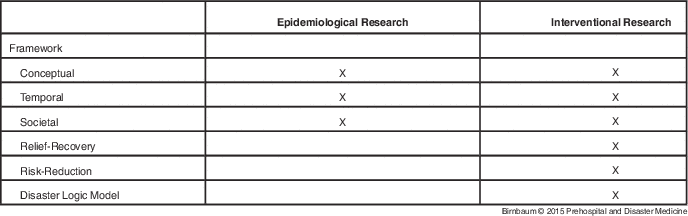
In an effort to move out of the current morass in disaster health research, five Frameworks (Conceptual; Temporal; Societal; Relief/Recovery; and Risk-Reduction) and a Disaster Logic Model for structuring the study of disasters are provided (Table V-1). The use of these structures will facilitate comparisons of similar and dissimilar disasters, as well as analysis, reporting, and development of a scientific database.
Applications of the Disaster Logic Model and the Five Frameworks for Research and Evaluation in Disaster Health in the Two Major Branches (Epidemiological, Interventional) of Disaster Research

Goals of Disaster Research/Evaluation
The ultimate goals of conducting disaster research are to: (1) reduce the risks that a future disaster will occur; (2) prevent or limit the damages created from an existing hazard; (3) decrease the mortality associated with existing hazards; (4) decrease disaster-related morbidity, including pain and suffering; (5) enhance the recovery of the affected population; and/or (6) build evidence to enhance the science associated with disasters. Findings from structured analyses and systematic reviews of disasters will result in a better understanding of the epidemiology of disasters and will improve risk-reduction, relief, and recovery interventions upon which planning and best practices and standards will be based. These best practices and standards will direct appropriate education and training. The evidence derived from research is used to define the goals for interventions provided during any temporal phase of an emergency or disaster.
Types of Disaster Research and Evaluations
The two principal and inter-related branches of disaster research and evaluation are: (1) epidemiological; and (2) interventional. Epidemiology is the science concerned with the study of factors determining and influencing the frequency and distribution of disease, injury, and other health-related events and their causes in a defined human population for the purpose of establishing programs to prevent and control their development and spread;Reference Adibhatia, Dudek, Ramsel-Miller and Birnbaum 3 the study of the incidence and distribution of diseases and of other factors related to health.Reference Anderson 4 Interventions are action(s) by humans to prevent, attenuate, create, or enhance change.Reference Thompson 5 To evaluate means to assess or appraise; to ascertain or fix a value to; to examine and judge carefully.Reference Thompson 6 Thus, evaluation is the process used to place a value on something. Therefore, interventional disaster studies consist of evaluations that aim to determine the effects, outcomes, costs, impacts (including benefits), and processes of interventions provided during any phase of a disaster or development. Interventional disaster research is discussed in a subsequent paper.Reference Pickett 7
All research aims to answer one or more questions, or to prove or disprove a hypothesis. For both epidemiological and interventional disaster research, these questions consist of: (1) Who?; (2) Where?; (3) When?; (4) Why?; (5) What?; (6) How?; and importantly, (7) So What? Although the context and subtleties of these questions will vary somewhat according to the type of study (ie, epidemiological or the evaluations of interventions directed at relief, recovery, or risk reduction), they serve as essential components in data collection and analysis and fit with the structures provided by the Frameworks.
Epidemiological Disaster Research
Epidemiological disaster studies attempt to define the causes of disasters and the progression from a hazard to a disaster as outlined in the Conceptual Framework.Reference Birnbaum and Daily 8 (pp56-68), 9 They describe what happened, where and when it occurred, who was affected, and why and how it was managed. The purposes of epidemiological research are to be able to: (1) understand the mechanisms by which hazards evolve into a disaster; (2) determine ways to mitigate the risk(s) that a specific hazard will progress into a disaster; (3) predict the likely damages and needs of the population-at-risk for an event; and (4) identify potential measures to increase the resilience of a community to future events. Although epidemiological studies tend to be event-specific, commonalities between disasters from different events must be identified in order to develop some all-hazards strategies.
The information obtained from epidemiological studies of disasters is used to define what will be required and where and when interventions could mitigate/prevent a hazard from producing a disaster. To date, most of the available information related to the epidemiology of the health aspects of disasters have consisted of case, situation, progress, after-action, and final reports.Reference Birnbaum, O’Rourke and Daily 10 Although many of these reports contain important information, for the most part, the information is unstructured, making analysis difficult. The assimilation of the epidemiological information contained within these reports is inconsistent, and thus, difficult to compare with that from other reports. Furthermore, most of the reports are widely dispersed; 11 much has been published in the non-peer-reviewed, non-scientific, grey literature. Currently, the most accessible repository for reports relative to the epidemiology of disaster health is maintained by the Center for Research on the Epidemiology of Disasters (CRED) at Louvain University in Brussels.Reference Smith, Wasiak, Sen, Archer and Burkle 12 However, the utility of the available information regarding the epidemiology of the health aspects of disasters has not been optimal as the available reports lack any universally accepted structure and standard terminology. Much more can be gleaned from the information contained and catalogued in CREDReference Smith, Wasiak, Sen, Archer and Burkle 12 and other repositories, such as the Regional Disaster Information Center (CRID; San José, Costa Rica) supported by the Pan-American Health Organization of the World Health Organization (AMRO/WHO; Washington, DC USA), by organizing the available information in accordance with the Conceptual, Temporal, and Societal Frameworks provided in this series of papers. 9 , 13 , Reference Birnbaum, O’Rourke and Daily 14
A model for assimilating and analyzing existing information using the Conceptual, Temporal, and Societal Frameworks can be found in the South East Asia Regional Office of the WHO (New Delhi, India) publication relative to the health aspects of the disasters that followed the earthquake and tsunami of 2004.Reference Birnbaum, O’Rourke and Daily 10 Using the Frameworks in this work allowed both an analysis and comparisons of the damages created by the earthquake and tsunami between five countries in South East Asia. The process consisted of working through the components of the Conceptual Framework for two of the Societal Systems (Medical Care and Public Health) within the context provided by the Temporal Framework for each of the five countries studied. The data and information for each of the countries were sorted into the following categories: (1) pre-event status; (2) event (specific to the country); (3) Structural Damage (focused primarily on the Medical Care and Public Health Systems); (4) Functional Damage (related specifically to the Medical Care and Public Health Systems and those Systems upon which they were dependent); (5) the needs derived from the Functional Damage(s); and (6) the overall Relief and Recovery Responses to the needs. Although little information was found regarding the actual interventions/responses provided, much was learned of the epidemiology of the disasters in the five countries that were substantially damaged from the two events (earthquake and tsunami).Reference Birnbaum, O’Rourke and Daily 10 The use of this same structure was endorsed by the European Regional Office of the WHO (EURO; Copenhagen, Denmark) in its publication of a format, Guidelines for Reports on Health Crises and Critical Health Events, that should be used for all reports of the epidemiology of disasters.Reference Birnbaum, O’Rourke and Daily 15
The development and validation of a data collection tool that uses uniform terminology and a structure for reporting epidemiological studies, reports, and summaries are essential. Since the completion of the analysis of the earthquake and tsunami, the Academy of Emergency Management and Disaster Medicine (EMDM) assembled an international group of experts that, in March 2012, published an “Utstein-Style Template for Uniform Data Reporting for Acute Medical Responses to Disasters.”Reference Kulling, Birnbaum, Murray and Rockenschaub 16 The group identified 15 data elements with appropriate indicators, and included the pre-event, event, description of damages, performance in the field and during transport to a medical facility, and services (including triage) provided within the emergency department and the hospital. Some outcome/impact indicators were provided. In addition, the tool can be used to assess the performance of medical Coordination and Control. Its scope is limited to assessments of the Medical Care Societal System, and it applies only to the Relief Phase of a sudden-onset (high intensity at onset) event and subsequent disaster. However, it is a comprehensive tool for this aspect of disasters and should serve as a model for the development of similar instruments for describing the responses in an epidemiological disaster study involving any of the Societal Systems. The “Template” does not address the evaluations of specific disaster interventions, and its use remains to be tested and validated. However, it is a powerful beginning and fits well within the Relief-Response components of the Conceptual Framework.
Placing assessments and their findings into the most appropriate Temporal Phase and Societal System also facilitates the cataloguing of information so that the information from multiple studies can be synthesized and compared. Without using the structure provided by these Frameworks, the comprehensive study of the health aspects of the 2004 earthquake and tsunami in South East AsiaReference Birnbaum, O’Rourke and Daily 10 would not have been possible.
An important aspect of epidemiological studies of disasters is the identification of areas of strengths and weaknesses of the resilience of the community(ies) affected by or at-risk for an event (ie, the existing absorbing, buffering, and response capacities) and where and why they were effective or ineffective. Also of value is the identification of potential methods to mitigate the risk that a hazard will produce another event. This information will direct future disaster-related interventions. Knowledge of the epidemiology of disasters should support predictions of the effects of the energy released from a hazard for the area-at-risk for an event, as well as where, within the Conceptual Framework, interventions are likely to improve the resilience of the population to cope with the next event.
Application of the Frameworks to Epidemiological Disaster Studies
The Conceptual, Temporal, and Societal System Frameworks provide the structure necessary for systematically gathering, processing, and reporting disaster-related data/information. The Conceptual Framework defines the structural elements that must be described in an epidemiological study of any disaster. 9 The Temporal Framework is utilized in all disaster studies to identify the particular phase(s) of the disaster being addressed. 13 And, the Societal System Framework defines the specific focus of the disaster investigation.Reference Birnbaum, O’Rourke and Daily 14 It is difficult, and generally not useful, to try to characterize an emergency or disaster by examining all, or even multiples, of the Societal Systems of the community affected, as the findings often are too general. There are abundant, broadly-based studies of the epidemiology of disasters in the peer-reviewed and grey literature.Reference Thompson 2 A disaster is a complex occurrence in a complex environment; without narrowing the focus of the study on one or two of the Societal Systems (or subsystems) affected, the task becomes overwhelming, the information obtained becomes difficult to synthesize or categorize, comparisons become challenging, and replication becomes impossible. For these reasons, epidemiological studies of disasters should focus on one or (at the most) two of the Societal Systems (or a component of the System) and its relationships with other Societal Systems. This not only focuses the study, but also allows it to be reproducible and the findings to be codified into the science.
Undertaking any epidemiological disaster study begins with: (1) identifying the event and subsequent disaster to be studied; (2) articulating the objective of the study; and (3) defining the Societal System(s) or subsystems to be studied. The following discussion details the information to be provided in an epidemiological study of a disaster utilizing the Conceptual, Temporal, and Societal System Frameworks.
Pre-event
The pre-event functional state is one of the disaster phases described in the Temporal Framework. 13 It includes a description of the functional status of the population and the Societal System(s) being studied prior to the event, and establishes the baselines for each of the subsequent phases of the disaster. The pre-event state includes identifying the hazard(s) responsible for the resulting event, as well as the type of energy contained in the hazard (mechanical, chemical, nuclear, thermal, electrical, biological, or psychological).Reference Birnbaum and Daily 8 (pp56-68) Describing the location (Where?) of the hazard relative to the community being studied is important, and estimating the vulnerability of the community to events related to the hazard may be a substantial factor in predicting likely, future damages associated with that hazard. In addition, a general description of any hazard mitigation interventions that had been undertaken prior to the event should be provided.
If possible, the perceived risks (likelihood and potential consequences) for the progression of the hazard to an emergency/disaster should be iterated as well as any risk-reduction (capacity-building) measures employed prior to the event. This information has relevance regarding the effectiveness of the risk-reduction interventions.
Of key importance is the documentation of the pre-event levels of function(s) of the specific Societal System(s) being studied, as well as the goods, services, personnel, other resources, and infrastructure required for its functions. Without this information, it is difficult, if not impossible, to define any changes in function(s) caused by the Structural Damage from the event, and hence, impossible to identify the needs and responses required to limit the progression of damage (Relief) or return functions to their respective pre-event level (Recovery).
Lastly, the functional status and roles of Coordination and Control prior to the precipitating event should be documented, including its mandate, authority, and available resources. Was there a Disaster Response Plan available? What was the relationship between the Societal System and the Coordination and Control entity?
Indicators of Function
Assessments of functions require the identification and use of indicators that have good construct validity for reflecting the levels of functions (LOFs) of the Societal System in the affected population. Each Societal System has specific indicators of function used to describe its expected contributions to the community. Although the parameters of the indicators of function for each System will be unique to each community, the indicators themselves should be common to all communities. An essential element of all assessments is the utilization of common indicators so that all of the data collected will be identical in format of the content, and thus, will facilitate comparisons. Using appropriate indicators of LOFs for specific components of each of the Societal Systems is essential for the conduct of such assessments.
Selecting appropriate indicators is a complicated process, and ideally should involve multiple stakeholders and should be undertaken as part of capacity building. Ultimately, a standardized set of indicators of function should evolve, some of which may be event-type specific and others that will cross-cut all types of hazards. Indicators are characterized, in part, by their respective specificity and sensitivity. 17
Indicators of function may be quantitative, qualitative, or a combination of both; some qualitative indicators may be scaled into semi-quantitative measures.Reference Birnbaum and Daily 8 (pp118-122) Indicators of impact and benefit likely will be different from those of function, and have yet to be developed. All indicators used must be understood, be practical to assess and collect, and be reproducible.
During the last decade, many organizations have put forth sets of health indicators. Prior to 2002, protocols for conducting epidemiological assessments relative to disasters were provided by at least nine organizations including the WHO; United Nations (UN) High Commissioner for Refugees (UNHCR; UN Agency for Refugees; Geneva, Switzerland); UN Children’s Fund (UNICEF; New York, New York USA); International Federation of the Red Cross (IFRC; Geneva, Switzerland); the Sphere Project (Geneva, Switzerland); Médecins sans Frontières (MSF; Geneva, Switzerland); Epicenter: US Office of Foreign Disaster Assistance (US-OFDA; Washington, DC USA); and the US-Centers for Disease Control and Prevention (CDC; Atlanta, Georgia USA).
In 2002, Bradt and Drummond synthesized the assessment protocols of these nine organizations into one simplified instrument to be used for the Rapid Epidemiological Assessment of Health in Displaced Populations.Reference Overtveit 18 They proposed this instrument as the beginning of a standardized, minimum, essential data set, with incorporated indicators that could be used for initial assessments, as well as for monitoring progress. The indicators derived from their synthesis were grouped according to: (1) population; (2) security; (3) site management; (4) water; (5) sanitation; (6) food; (7) non-food; (8) shelter; and (9) medical. These groups correspond to the Societal Systems of the Societal Framework. The indicators reported are associated primarily with public health. Unfortunately, to date, there are no publications regarding the use of this exact set of indicators.
Since the earthquake and tsunami that devastated many areas in South East Asia in 2004, at least five additional attempts have been made to identify a universal set of health indicators for use in assessing/describing/evaluating the health aspects of disasters. These include, but are not limited to, the: (1) Initial Rapid Assessment Tool (IRA);Reference Bradt and Drummond 19 (2) the Tsunami Recovery Impact and Monitoring System (TRIAMS); 20 (3) the Health Resources Availability Mapping System (HeRAMS); 21 , 22 (4) the Multi-Cluster/Sector Initial Rapid Assessment (MIRA);Reference Zagaria 23 and (5) the Health Cluster Guide. 24 As noted above, the Academy of EMDM has developed a template for evaluation and reporting of the medical aspects of sudden-onset events.Reference Kulling, Birnbaum, Murray and Rockenschaub 16 The Foreign Medical Teams Working Group of the Global Health Cluster is developing a set of indicators to be used in the evaluation of the interventions provided by foreign medical teams. 25 In addition, the Sphere Project has developed a set of indicators in support of its standards. 26
Event
The event refers to the change in, or release of, energy from the hazard; it also defines that specific phase of a disaster. As the Structural Damage sustained is the result of the effects of the change in the energy released, it is essential to define the type of energy (mechanical, chemical, nuclear, thermal, electrical, biological, or psychological) associated with the hazard, as well as the amount, the mechanism of the release, and reasons that the energy was or was not released from the hazard. The characteristics of the event to be described include: the type; mechanism; number of events; onset; amplitude; duration; intensity; scope; magnitude; scale; progression; and propagation of the event. 9 Standardized characterization of the event is essential in order to compare the event and its consequences with other events and their consequences.
In addition, the absolute time of onset and termination of the event, including the hour of the day, the day of the week, the month, and the season, should be annotated (When?). Lastly, the geographical location of the event, as well as the population density, urban, suburban, or rural location of the affected area, should be described (Where?).
Structural Damage
Structural Damage is the next occurrence in the progression from a hazard to a disaster. 9 Structural Damage should be defined in terms of overall damage to goods, infrastructure, personnel, and natural environment, as well as specific damage to those elements of the particular Societal System(s) being studied. It is important to recall that injuries to humans and other beings are part of Structural Damage. To the extent possible, the mechanisms for the damage also should be determined. This information is essential for the development of absorbing capacity-building interventions for future events, and for determining the value of any absorbing capacities that were in place before the onset of the event.
Additional important information is a description of any measures undertaken prior to the event to increase the absorbing capacity of the community and the Societal System(s) being studied.
Functional Damage
A disaster only can occur if Functional Damage results from the Structural Damage sustained. The relationships between damage to goods, services, infrastructure, and personnel and functions provided by the Societal System being studied have been described in the Conceptual Framework paper in this series. 9 All changes in LOF of a Societal System are based on its level of functioning prior to the event, and at the time of the last assessment of function(s), using the same indicators of function. It is essential to recognize that Functional Damage can occur in a given Societal System (or its components) without Structural Damage occurring within that Societal System (ie, Functional Damage occurred in a Societal System upon which that Societal System is dependent). The effects of changes in the LOF of other Societal Systems on the System(s) being studied are important to note (eg, decreased availability of fuel results in decreased transportation of essential medical supplies for the medical facility).
Since needs are based on LOF, documenting the essential functions of the Societal System(s) being studied, particularly the critical functions that were and were not compromised, is essential. For those functions and sub-functions that were compromised, it is important to relate the LOF to the Structural Damage sustained and to the Functional Damage in other Societal Systems upon which the System is dependent, and any measures undertaken to increase the buffering capacity of the System(s) prior to the event. This provides a mechanism to codify the respective buffering capacities provided for the functions/sub-functions, and directs future development of relief, recovery, and risk-reduction interventions.
Needs
Needs are created by diminished or absent essential functions (Functional Damage). All needs are determined by converting the changes in the LOF of a Societal System(s) to the goods, services, infrastructure, and personnel required to mitigate or prevent further damages, fill gaps in levels of essential function(s), and/or return the levels of essential function(s) to their respective pre-event state. A dynamic assessment of the functional damage and the respective priorities for the Societal System(s) being studied should be documented, including the assessment tool and indicators utilized. A description of the integrative processes utilized to determine the needs from the Functional Damage is important, as is the accuracy that the needs identified reflected the true needs of the affected community. 27 The time (phase) of assessment and determination of the needs relative to the Temporal Framework also must be documented.
Emergency
Functional Damages and their subsequent needs require interventions (responses) to restore function. An emergency occurs when the extra-ordinary needs can be met by local responders without outside assistance. Thus, this component of the Conceptual Framework relates to the local responses provided. All responses must be related to defined needs and should be described in such a manner; responses that were not related to defined needs must be annotated. The respective local responders should be identified as well as the goods, services, financial resources, personnel, and infrastructure that comprised the Local Response Capacity. While the overall effects of the responses to the emergency should be described, an evaluation of effects of the responses/interventions provided is not included in an epidemiological disaster study. Basically, the study should describe the local responses, who provided them, and whether or not the local relief responses were adequate to return the LOF of the Societal Systems to their respective pre-event levels.
Disaster
A disaster is the final element in the Conceptual Framework and occurs when the local responses are inadequate to meet the needs of one or more Societal Systems. Therefore, it is essential to document which components of the local response capacity were unable to meet the needs of the System(s) being studied, as well as how, why, and when the local response capacities of the Societal System were overwhelmed. If outside assistance is provided, the providers and nature of the outside assistance responses must be described, as well as what they contributed to the Relief and/or Recovery of the Societal System(s) being studied. The duration of the outside responses also must be noted. Key to the study of a disaster is a description of the role of Coordination and Control in all disaster responses. When was Relief complete (ie, further deteriorations in function ended), the disaster over (ie, outside assistance no longer required) for the specific Societal System being studied, and when did Recovery (ie, restoration of pre-event levels of essential functions) occur?
Examples of Epidemiological Disaster Studies
Example 1: A Comprehensive Epidemiological Disaster Study
The following hypothetical example of a health-related study of a disaster is provided to illustrate the application of the Frameworks for research into the epidemiology of the health aspects of disasters.
In this comprehensive hypothetical example, disasters caused by earthquakes of similar magnitude in two different communities are being compared.
-
1. Provide the reasons for the study and pertinent background information.
Example: What are the existing gaps in knowledge and the reasons for the study? What information was used to design the study?
-
2. Identify the question or hypothesis (purpose/objective of the study).
Example: What were the differences in Structural and Functional Damages caused by an earthquake of similar magnitude in the two affected communities?
-
3. Choose a Societal System to study.
Example: The Medical Care System will be studied.
-
4. What was the pre-event status of the Medical Care System in each community?
Example: From city/county/state and/or country building records of the two affected communities, obtain information on the number, type, and structural integrity of their buildings and local infrastructure. From public records, obtain the number, demographics, and public health profile of the people residing in the affected communities and any pertinent historical information regarding similar events. For the Medical Care System, identify the number and types of hospitals, clinics, Emergency Medical Services, and health care providers in existence prior to the earthquakes.
-
5. What was the event that led to the disaster?
Example: Describe the two earthquakes in terms of the hazards that caused them, their onset, duration, amplitude, intensities, scope, and scale. 9
-
6. What was the Structural Damage from each of the events?
Example: Describe the overall Structural Damage as well as specific damage to the buildings, infrastructure(s), and number of persons injured, as well as the number and types of injuries sustained in each of the affected communities. For the Medical Care System, describe the number of hospitals, clinics, Emergency Medical Services, and health care providers damaged/injured from the event. Include descriptions of any actions that had been taken in each community to increase the absorbing capacity, such as enforced building codes and use of earthquake-resistant materials, earthquake preparedness educational programs, and warning systems.
-
7. What was the Functional Damage (loss of function(s)) of the specific Societal System being studied in each community, and how was it assessed? What components of the functional damage were related to functional damage in other Societal Systems?
Example: For the Medical Care System, determine and compare the functional status in terms of services of existing hospitals, clinics, and Emergency Medical Services post-earthquake compared to the pre-event state. From information obtained from health care providers, hospitals, morgues, and official records, compare the mortality rates and direct and indirect injuries between the two affected countries. Differentiate injuries/deaths specific to health care personnel. Describe Functional Damages sustained by other Societal Systems (eg, Water and Sanitation or Energy Supply Systems) that impacted the function of the Medical Care System. Define the phase of the disaster in which assessments of damage occurred (ie, Relief or Recovery). Include descriptions of any actions that had been taken to increase the buffering capacity of the Medical Care System. For example, the buffering capacity for the Medical Care System may have been augmented by the creation of alternate care sites, the stockpiling of drugs and medical supplies, cross-training of medical personnel, backup power and water supply systems, and community education efforts.
-
8. Describe the needs identified due to the Functional Damages sustained.
Example: For the Medical Care System, describe the goods and services (including personnel) needed to fill the gap in health care services or to restore function to the Medical Care System. Define the phase of the disaster (ie, Relief or Recovery) in which these needs were determined and how they were determined.
-
9. Briefly describe the local responses to the loss of function(s) of the specific Medical Care System.
Example: From information obtained from hospitals, clinics, Emergency Medical Services, and other available information, describe the responses provided by the affected community. Include descriptions of any actions that had been taken to increase the capacities of the local medical response system, such as cross-training of health care personnel, local Disaster Medical Assistance Teams (DMAT) training, memoranda of understanding (MOUs) with neighboring health care and Emergency Medical Services, and decontamination units.
-
10. Describe the outside responses provided to the Medical Care System.
Example: Define the specific inadequacies of the local responses of each community to meet the needs, when they occurred, and who requested the outside assistance. Describe the outside responses/interventions provided, who provided them, where they were provided, when they were provided, and to whom they were provided. Include the duration of the responses provided, as well as the phase in which they were provided (ie, Relief or Recovery).
-
11. Define the recovery of the Medical Care System.
Example: For the Medical Care System, define if and when the System returned to its pre-event LOF. Describe any recovery interventions that were undertaken to increase the resilience of the System (eg, use of earthquake resistant materials in rebuilding).
-
12. Synthesize the findings, compare with results with from other studies, and provide recommendations.
Example: Summarize results, compare findings between the two communities, compare with findings from other relevant studies, and define its contribution to the science of disaster health. From the findings, recommend future activities/interventions to reduce damages and/or risks of disasters resulting from future events.
Using the above hypothetical example for a study of the health aspects of two earthquakes would be ideal. The results would be comprehensive, would include essential comparisons between the consequences of two earthquakes of similar magnitude, and would provide data that readily could be compared to other studies of similar events. However, the design and implementation of such a very broad-based study would be complex and very expensive in terms of time required, as well as financial, human, and opportunity costs. In addition, the volume of data produced by such a study could be overwhelming.
A more practical and economical approach would be to focus the study into smaller components that ultimately could be synthesized into the same big picture. For this reason, it is prudent to focus any study on only one (at the most two) Societal Systems, including those elements of other Societal Systems upon which the Societal System(s) being studied is (are) dependent. It may be even more practical and easier to place the focus of the study on one or two sub-functions, units, or subunits of a Societal System, and on those other sub-functions, units, or subunits upon which they are dependent. Further narrowing of the topic may result in examining only one component of the Conceptual Framework: Hazard, Event, Structural Damage, Functional Damage and needs, or Local and Outside Responses. In such focused, well-structured studies, the answers to the essential questions (Who, What, Where, When, Why, How, and So What?) may be easier to obtain and have substantial value.
However, use of these essential questions must be preceded by background information that defines the problem being studied. Each study must have a clearly stated objectiveReference Rubin, Heuvelmans, Tomic-Cica and Birnbaum 28 and description of the methods used for collection of the data/information. The following examples may help with the design of focused studies of the epidemiology of the health aspects of disasters.
Example 2: A Limited Epidemiological Disaster Study
The following is a hypothetical example of a limited epidemiological disaster study that is focused on one element of the Conceptual Framework: Structural Damage. This component has been further narrowed to assess only the Structural Damages to humans in a single community following an earthquake.
-
1. Provide the reasons for the study and pertinent background information.
Example: What are the existing gaps in knowledge and the specific reasons for the study?
-
2. Identify the question or hypothesis (purpose/objective of the study).
Example: What was the Structural Damage to humans caused by an earthquake of a specific magnitude?
-
3. What was the event that led to the disaster?
Example: Describe the earthquake in terms of the hazard that caused it, its onset, duration, amplitude, intensities, scope, and scale. 9
-
4. What was the Structural Damage to humans from the event?
Example: Describe the structural damages by answering the following questions:
-
∙ Who—Who was injured (number of injured/unit of population; demographics of the victims)? How many died?
-
∙ What—What injuries were sustained? What were the Injury Severity Scores? What were the resulting burdens on the Medical Care System?
-
∙ How—How were the injuries sustained (mechanism of injury)? How did the injured get to a medical facility?
-
∙ When—When (relative to onset of the event) and in which Temporal Phase did the injuries occur? When were the victims transferred? When did they die?
-
∙ Where—Where were the victims when they were injured? Where were they transferred? Where did they die (prehospital, clinic, hospital)?
-
∙ Why—Why were they injured (exposure)? Why were some not injured? Why were they transferred? Why did they die?
-
∙ So What—How does the information obtained in this study contribute to the science of the health aspects of disasters?
-
The information obtained using the essential questions would add much to the existing studies of epidemiology of the victims from the event and will contribute to developing an essential database. Using the suggested format also will facilitate comparisons and result in the designation of interventions that could modify the epidemiology for future events.
Example 3: A Limited Epidemiological Disaster Study
The following is a hypothetical example of an epidemiological disaster study that is focused on two elements of the Conceptual Framework: Structural Damage and Functional Damage. These components have been further narrowed to assess only these damages in one sub-function (a medical facility) of one Societal System (Medical Care).
-
1. Provide the reasons for the study and pertinent background information.
Example: What are the existing gaps in knowledge and the reasons for the study?
-
2. Identify the question or hypothesis (purpose/objective of the study).
Example: What Structural and Functional Damages, and subsequent needs, occurred in the specific medical facility following an earthquake of a specific magnitude?
-
3. What was the event that led to the disaster?
Example: Describe the earthquake in terms of the hazard that caused it, its onset, duration, amplitude, intensities, scope, and scale. 9
-
4. What was the Structural Damage to the medical facility from the event?
Example: Describe the Structural Damages by answering the following questions:
-
∙ Who—Who was injured (staff, patients, or visitors)?
-
∙ What—What structures (including life lines, equipment, and supplies) in the medical facility were damaged (directly/indirectly)? What was the extent of the damage to each? What structures in the medical facility were not damaged? What associated structures on which the medical facility was dependent were damaged (collateral damage)? What types of injuries were sustained by the victims?
-
∙ How —How were the damages sustained (mechanism of damages)?
-
∙ When (relative to onset of the event)—When did the damages occur? When did the structure(s) collapse?
-
∙ Where—Where is the medical facility located relative to the epicenter and other damaged structures? Where in the facility were victims injured?
-
∙ Why—Why were the damages sustained? Why were some structures not damaged? Had the facility undertaken any measures to increase its absorbing capacity prior to the event?
-
∙ So What—Compare the Structural Damages sustained to the medical facility with the structural damages to other related facilities, as well as any damage from previous events to the same facility or related facilities. What damage could have been mitigated prior to the event by augmenting the absorbing capacities of the facility? Given the findings, what measures could be implemented to enhance the absorbing capacity of the facility for the next event? What were the recovery costs?
-
-
5. Describe the Functional Damage (services compromised/curtailed) to the medical facility from the event.
Example: Describe the Functional Damages by answering the following questions:
-
∙ Who—Who did the Functional Damage affect (patients, staff, or public)?
-
∙ What—What specific services were compromised/curtailed as a consequence of the Structural Damages in the facility, or in Systems upon which the facility was dependent; what services/functions were not affected? What buffering capacities were tested? Which services were threatened but continued to function despite the structural damage incurred (buffering capacity)? What were the impacts of the lost/curtailed services? What goods, services, and/or resources were not available or inadequate?
-
∙ How—How did the services become compromised (mechanism of damage)? How did structural damage of other components of the Medical Care System or other Systems affect the functioning of this medical facility? How were functions preserved (buffering capacity?)
-
∙ When—When were the respective services lost/compromised/curtailed (Relief Response Phase) and when were they restored (Recovery Response Phase)?
-
∙ Where—Where were the services compromised/curtailed and where were services continued?
-
∙ Why—Why did the services become compromised and/or curtailed? What structural damages were responsible for the compromised levels of function? Were services compromised because of a surge of victims? Were services and functions maintained because of augmented buffering capacity (eg, generators or alternate care sites)?
-
∙ So What—Compare the Functional Damages sustained by the medical facility with Functional Damages to other related facilities, as well as from previous events to the same facility or related facilities. What Functional Damages could have been mitigated prior to the event by augmenting the buffering capacities of the facility? Given the findings, what measures could be implemented to enhance the buffering capacity of the facility for the next event? What were the recovery costs?
-
-
6. Describe the needs (goods, services, and other resources) of the medical facility as a result of the functional damages from the event.
Example: Describe the needs by answering the following questions:
-
∙ Who—Who transformed the compromised LOF into specific needs? Whose needs were they?
-
∙ What—What specific goods, services, and/or other resources were required and for what purpose?
-
∙ How—How were LOF transformed into specific needs (process used)? How were the needs prioritized for actions/interventions?
-
∙ When—When were the specific needs determined relative to the time of onset of the event?
-
∙ Where—Where were the needs (specific functional area)?
-
∙ Why—Why did the identified needs exist (relate to damages sustained)?
-
∙ So What—Compare the needs identified with needs reported in other related facilities, as well from previous events to the same facility or related facilities. Could the needs be met by ordinary, day-to-day operations, or was the extra-ordinary (reserve) local response capacity used, or was use of outside response capacity required? What needs might be anticipated in planning for future events?
-
Parts 5 and 6 above comprise an extended, comprehensive study. It would be useful to study the transition from Structural to Functional Damage, or only the identification of the Functional Damage and its transformation into needs.
The questions posed in the above two limited epidemiological study examples constitute a guide to gathering information essential for determining the epidemiology associated with a given event. If information is gathered using these essential questions, little will be missed. Additionally, the information obtained will be well structured, and therefore, will lend itself to synthesis with findings from other studies of the epidemiology of similar and dissimilar disasters. Thus, the information obtained can be compared and synthesized with what already is known. Only after synthesis does the information become evidence that can be used to determine what to expect in the future; this is the function of epidemiological disaster studies. The key to practical, useful, and successful epidemiological disaster studies is to assure that the project is focused and not so broad as to make synthesis difficult.
Summary
Five Frameworks provide the structure required to systematically study disasters, and in particular, the health aspects of disasters. The use of three of the Frameworks (Conceptual, Temporal, and Societal Systems) forms the cornerstone of all disaster research and facilitates the undertaking as well as utility of studies of the science of disaster health (disaster epidemiology). Using these Frameworks in reporting and studying disasters will provide information that can be compared with other similar or dissimilar disasters in other areas, and will contribute to building the science of disaster health. Ultimately, this will lead to an improved understanding of the mechanisms by which hazards evolve into a disaster; the ability to predict likely damages and needs of at-risk populations; and the discovery of measures that may mitigate or prevent a hazard from becoming a disaster (risk reduction).