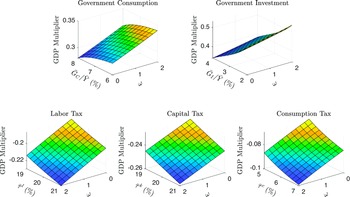
1. Introduction
With the outbreak of the global financial crisis in 2008, the government authorities found that blindly following the complete rationality of micro agents and overly relying on the spontaneous regulation of the market couldn’t predict and explain the crisis. Academics began to reflect on the appropriateness of market freedom and government laissez-faire for modern economic development, and the research on proactive fiscal policy has been gradually emphasized, with consideration given to the influence of micro agents’ behaviors on the policy transmission. In parallel, the emergence of a liquidity trap in the wake of the financial crisis has also amplified the focus of countries on fiscal policy. Nevertheless, there is no consensus on the measurement of the fiscal multiplier. Existing research suggests that fiscal multipliers are affected by various factors, including the way fiscal spending is financed, monetary policy activity, and microstructure. Research on fiscal multipliers is often not independent of fiscal policy itself but is linked to a wide range of economic factors, leading to considerable differences in multiplier values.
The motivation for this paper stems from the far-reaching impact of micro agents’ private behavior preferences on macro policy, which is considerable and multichannel, whether induced based on their own expectations of the economic circumstances (Fuster et al. Reference Fuster, Laibson and Mendel2010; Czudaj, Reference Czudaj2024), or acting through their decision-relevant consumption or investment behaviors (Fuhrer, Reference Fuhrer2000; Taylor and McNabb, Reference Taylor and McNabb2007; Gabaix, Reference Gabaix2020). With this in mind, this paper aims to enrich the micro-foundations for fiscal multipliers in terms of their transmission channels. We construct a New Keynesian model containing rich micro-foundations to engage in multiplier measurement. On the transmission channel of fiscal policies, the research perspective of this paper revolves around the liquidity trap and changes in private behavior preferences. We first explore the impact of the liquidity trap on fiscal multipliers under different Taylor-rule activeness, showing that a liquidity trap can affect micro agents’ behaviors through their expectations. Then, the paper conducts a series of analyses for private behavior preferences to provide a new micro-transmission horizon for fiscal multiplier dynamics.
In terms of hypothesis and research on private behavior preferences, this paper focuses on two main dimensions, habit formation and investor confidence. On the one hand, existing evidence indicates that habit formation contributes to the explanation of classical economic facts, and its intensity and variety have a significant impact on economic activity and fiscal policy effectiveness (Ravn et al. Reference Ravn, Schmitt-Grohé and Uribe2006; Havranek et al. Reference Havranek, Rusnak and Sokolova2017; Afsar et al. Reference Afsar, Gallegos, Jaimes and Silgado-Gómez2024). Accordingly, we analyze the influence of habit formation on the transmission effects of different fiscal instruments and examine the differences in multipliers under superficial habits and external deep habits respectively. On the other hand, evidence is emerging that investor confidence affects the economy, and the concept of investor confidence is crucial for explaining a variety of typical facts in macroeconomics and finance (Bachmann and Sims, Reference Bachmann and Sims2012; Bannier and Schwarz, Reference Bannier and Schwarz2018). However, there is still no uniformity regarding the construction of confidence in macro models. This paper constructs and provides empirical evidence for an endogenous investor confidence channel that affects investment efficiency, which shows a significant effect on the fiscal multiplier.
In this paper, the fiscal multipliers are mainly financed based on endogenous government debt (deficit financing) and take into account the effect of distortionary taxes to stabilize the debt as in Leeper et al. (Reference Leeper, Traum and Walker2017). The multipliers are measured in a New Keynesian dynamic stochastic general equilibrium (DSGE) model through Bayesian estimation and are cumulative in present value. We measure five types of multipliers, and the specification of the various fiscal instruments helps us to better understand the differences in their transmission channels and impacts. Specifically, the model incorporates unproductive government consumption and productive government investment. Both types of government spending crowd out private spending through interest rate transmission and deficits, with multipliers ranging from 0.3 to 0.9 over five years. Government investment through the supply side contributes to the durability of the multiplier effect, but its multiplier decreases rapidly as the spending size expands, and the proportion of government purchases skewed toward productivity should not be too high. We classify three types of taxes, labor, capital, and consumption, and in consequence dissect the impact of the micro-foundation on the different taxes. Tax multipliers range from −0.04 to −0.3 over five years, slightly smaller than expenditure multipliers in absolute terms. The multipliers numerically overlap with the measurement intervals of the existing literature (Kilponen et al. Reference Kilponen, Pisani and Schmidt2019; Ramey, Reference Ramey2019; Ferriere and Navarro, Reference Ferriere and Navarro2024).
The first contribution of this paper is to provide a new perspective on fiscal multiplier dynamics in the liquidity trap. We argue that the impact of the liquidity trap on fiscal policy incorporates a precautionary saving effect, realized by the expectations of micro agents, that causes fiscal multipliers under a liquidity trap to experience contraction. The existing literature suggests that the liquidity trap or the zero lower bound binding can expand the fiscal effect and significantly amplify the government spending multiplier and the tax multiplier, by crowding out private savings and crowding in private expenditures through a lower real interest rate (Christiano et al. Reference Christiano, Eichenbaum and Rebelo2011; Miyamoto et al. Reference Miyamoto, Nguyen and Sergeyev2018; Kilponen et al. Reference Kilponen, Pisani and Schmidt2019). Our benchmark estimation model reproduces this phenomenon, where the government spending multiplier can substantially exceed one in periods of the liquidity trap, and we call it the interest rate transmission effect. On this basis, we increase the activity of the Taylor rule and make it detectable by micro agents. To a greater extent, micro agents’ expectations of future interest rate hikes lead them to raise savings during the liquidity trap, which can significantly weaken the fiscal effect. This result is consistent with the fact that the liquidity trap is profoundly affected by private expectations with an active Taylor rule, which ultimately limits the role of fiscal policy (Benhabib et al. Reference Benhabib, Schmitt-Grohé and Uribe2002; Mertens and Ravn, Reference Mertens and Ravn2014). The tradeoff between the interest rate transmission effect and the precautionary saving effect jointly shapes the fiscal multipliers in the liquidity trap.
The second contribution of this paper is to expand the micro-transmission paths and mechanisms of fiscal policy. For model construction, we innovatively introduce an investor confidence channel based on the identification of interest rate spreads and output volatility, and we validate it with empirical evidence. In terms of research dimensions, we explore the effects of habit formation and investor confidence on different fiscal instruments. Specifically, habit formation initially amplifies government consumption and government investment multipliers while contracting labor and consumption tax multipliers, but hardly affects capital tax multipliers. Deep habits lead to a smoother fiscal multiplier than superficial habits, delaying the impact of fiscal shocks on private consumption to a greater extent. However, due to the portfolio rebalancing of households, consumption smoothed by deep habits allows for a substitution effect on private investment. Thus changing from superficial to deep habits fails to result in higher multipliers, a finding that differs from Ravn et al. (Reference Ravn, Schmitt-Grohé and Uribe2006) and Aloui (Reference Aloui2024). We argue that the increase in multipliers from deep habits is modest. On the other hand, investor confidence significantly amplifies all multipliers in the later period. We also expand on the effects of habit and confidence on the multiplier movement under a liquidity trap, something that has been little studied in the existing literature. The presence of habit formation limits the liquidity trap’s impact on multipliers, especially in the short run. In contrast to habit formation, investor confidence slightly amplifies the impact of the liquidity trap and its influence is more persistent. A series of analyzes can help the government to rationalize the implementation of different fiscal instruments to achieve better effectiveness based on the microstructure of the economy.
Literature. We next present the existing literature in terms of the liquidity trap, habit formation, and investor confidence. First, a liquidity trap is when an economy experiences a zero lower bound (ZLB), in which the central bank cannot stimulate economic activity by lowering the nominal interest rate. Much of the literature finds that the government spending multiplier is usually less than one, but during a liquidity trap, it can expand and far exceed one. (Farhi and Werning, Reference Farhi, Werning, Farhi and Werning2016; Miyamoto et al. Reference Miyamoto, Nguyen and Sergeyev2018; Kilponen et al. Reference Kilponen, Pisani and Schmidt2019). Christiano et al. (Reference Christiano, Eichenbaum and Rebelo2011) analyze the mechanism involved: When the zero bound is tightly constrained, an increase in government spending leads to a rise in output, marginal costs and expected inflation. Since the nominal interest rate is fixed, a rise in expected inflation lowers the real interest rate, which increases private spending and leads to a further rise in output, marginal costs and expected inflation, as well as a further fall in the real interest rate. This economic spiral allows for a dramatic increase in the government spending multiplier. It is also argued that this expansionary effect on fiscal policy is limited by the causes of the liquidity trap (Mertens and Ravn, Reference Mertens and Ravn2014). Caramp and Silva (Reference Caramp and Silva2023) suggest that the response of fiscal policy to natural rate shocks is a crucial component of both economic dynamics in a liquidity trap and the effectiveness of forward guidance. They further argue that, without a robust contractionary fiscal response to natural interest rate shocks, the economic impact in a liquidity trap would be significantly weaker. Considering the importance of the behavior of micro agents, in recent years, many scholars have introduced private expectations or behavior into the study of the liquidity trap under the New Keynesian framework. Gabaix (Reference Gabaix2020) models the agents’ partial myopia toward distant atypical events and argues that this micro behavior reduces the cost of the ZLB and enables the effectiveness of fiscal policy under the ZLB. This distinguishes it from the traditional New Keynesian model in which conventional fiscal policy is ineffective and only forward guidance or quantitative easing is effective in the ZLB due to the establishment of Ricardian equivalence. Woodford and Xie (Reference Woodford and Xie2019) and Woodford and Xie (Reference Woodford and Xie2022) show that when households and firms are able to engage in explicit forward planning to a limited extent, credible announcements about future policy can influence their behavior, which in turn yields implications for the effects of the ZLB versus countercyclical fiscal stimulus.
Second, under the modern fiscal and monetary system, habit formation has been incorporated into the macroeconomic analysis framework composed of government spending, taxation, monetary policy, and credit rules to analyze the dynamic equilibrium path and policy transmission mechanism as an important research perspective. The habit formation helps to explain the dynamics of macro variables and is key to obtaining macro estimates that are more consistent with micro counterparts (Christiano et al. Reference Christiano, Eichenbaum and Evans2005; Afsar et al. Reference Afsar, Gallegos, Jaimes and Silgado-Gómez2024). Leith et al. (Reference Leith, Moldovan and Rossi2012) and Leith et al. (Reference Leith, Moldovan and Rossi2015) show that the additional distortions created by deep habits create new tradeoffs for optimal policy and significantly increase the government spending multiplier. Kliem and Kriwoluzky (Reference Kliem and Kriwoluzky2014) incorporate consumption habits into a DSGE model to investigate the optimal Taylor rule and tax multipliers. They estimate the US consumption habits parameter to be 0.56 using the Markov chain Monte Carlo algorithm, but do not delve into the relationship between habits and tax multipliers. Liu (Reference Liu2020) constructs an endogenous growth model to analyze the impact of fiscal policy and public capital congestion on economic growth under the framework of habit formation. The study reveals that habit formation and public capital jointly determine multiple equilibria, and the effect of habit formation on the equilibrium growth rate depends on the relative risk aversion coefficient. Gollier (Reference Gollier2021) proposes that the persistence of habits significantly reduces risk aversion by studying the dynamic portfolio and saving choice problems of two preference structures. Hajdini (Reference Hajdini2022) argues that frictions such as consumption habits in the New Keynesian model of rational expectations generate internal persistence and amplify economic fluctuations under exogenous shocks. For fiscal policy, Kilponen et al. (Reference Kilponen, Pisani and Schmidt2019) point out that a lower degree of habit formation renders private consumption more sensitive and leads to an increase in the consumption tax multiplier in the subsequent year. Most studies based on the DSGE approach show that habit formation contributes to the expansion of government spending shocks and that deeper habits and active monetary policy lead to higher government spending multipliers (Ravn et al. Reference Ravn, Schmitt-Grohé and Uribe2006; Leeper et al. Reference Leeper, Traum and Walker2017; Aloui, Reference Aloui2024). It can be seen that the introduction of habit formation is of great significance for explaining economic phenomena or estimating policy effects.
Third, investor confidence refers to an investment idea or spirit formed by investors in real life based on their cognition and identification of macroeconomic cycles, regulatory policy changes, capital market fluctuations, and reactions to economic activities. Confidence initially entered the economic field from the perspective of human behavioral motivation or psychological expectations. Keynes (Reference Keynes1936) stated in the “General Theory” that due to the formation of consumer habits, the adjustment of consumer demand is slower, so the economic cycle oscillation is mainly caused by the fluctuation of investment demand in the capital market, and it divides investors’ investment motives into spontaneous “animal spirits” driven by capital and rational decision-making after being aware of capital market information but does not discuss its impact on the economy or policy in depth. Existing research shows that macroeconomic fluctuations will have an impact on the confidence of investment subjects (Mehra and Sah, Reference Mehra and Sah2002; Beaudry and Portier, Reference Beaudry and Portier2006), and the self-driving of investor confidence will also affect the cyclical oscillation of the economic system (Farmer and Guo, Reference Farmer and Guo1994; Harrison and Weder, Reference Harrison and Weder2006). Taylor and McNabb (Reference Taylor and McNabb2007) used a series of methods such as the Granger causality test, variance decomposition, and forecast probability to test the business investor confidence indicators in the United Kingdom, France, Italy, and the Netherlands. The analysis shows that the investor confidence index shows a trend of the pro-economic cycle, and its prediction degree for the turning point of the economic cycle is better than other research indicators. Barsky and Sims (Reference Barsky and Sims2011) based on the New Keynesian DSGE model including information shocks and animal spirits, the variance decomposition results found that fundamental information shocks shake public confidence and explain output fluctuations to a greater extent. Bachmann and Sims (Reference Bachmann and Sims2012) established a vector autoregressive model including government spending and investor confidence. By comparing the counterfactual impulses under the confidence-free mechanism, it was confirmed that investor confidence is the key channel for the transmission of fiscal policy shocks to economic activities, and its effect is more pronounced during economic downturns. Bassanin et al. (Reference Bassanin, Faia and Patella2021) introduced uncertainty of investor confidence and attitude into a model with collateral constraints and exogenous debt supply and estimated the ambiguity of investor confidence through the generalized method of moments (GMM). The analysis concludes that optimism exacerbates the cumulative effect of debt and asset prices before economic crises, enhancing the procyclicality of leverage, while pessimism exacerbates deleveraging during recessions. Based on the existing literature mentioned above, this paper further builds a DSGE model to examine the micro-foundation of fiscal multipliers from the perspectives of a liquidity trap and private behavior preferences of both consumer habit formation and investor confidence.
2. Model
This section constructs a New Keynesian DSGE model by incorporating private behavior preferences of both consumer habit formation and investor confidence based on Kliem and Kriwoluzky (Reference Kliem and Kriwoluzky2014) and Leeper et al. (Reference Leeper, Traum and Walker2017). The dynamic stochastic general equilibrium model consists of households, manufacturers of intermediate goods and final goods, and the government. It includes market frictions such as private consumption habits, private investment adjustment costs, and private capital utilization, as well as the nominal rigidity of prices and wages. The fiscal policy chosen by the government includes two types of fiscal expenditures: government consumption and government investment, and three types of taxation: labor tax, capital tax, and consumption tax. The categorization of fiscal instruments helps us understand the differences among their transmission effects. Most importantly, we extend the model by adding a liquidity trap and then further examine the transmission effectiveness of monetary policy on fiscal multipliers. We also innovatively construct an endogenous investor confidence channel, which is supported by empirical evidence.
To describe the model, we define the notation where
 $\bar {a}$
represents the steady state of a variable
 $a_t$
, and
 $\hat {a}_t$
denotes the deviation rate from the steady state. Below are the specific settings of the model.
2.1. Households
Assuming that there are a large number of continuous households indexed by
 $i \in [0,1]$
in the economy. In general equilibrium, households are homogeneous in consumption, investment and bond holdings, but heterogeneous in wages and labor. Households maximize their utility by choosing consumption
 $C_{t}$
Footnote
1
and labor supply
 $l_{t}\left (i\right )$
. A representative household’s utility function takes the form,
 \begin{align} E_{0}\sum \limits _{t=0}^{\infty }\beta ^{t}\left [\varepsilon _{c,t}\frac {\left (C_{t}-hS_{t-1}\right )^{1-\sigma _{c}}}{1-\sigma _{c}}-\frac {l_{t}(i)^{1+\sigma _{l}}}{1+\sigma _{l}}\right ] \end{align}
where
 ${\beta }$
is the household’s subjective discounting factor and
 $\sigma _{c}$
is the inverse of the consumption elasticity of substitution, which is also defined as coefficient of relative risk aversion.
 $\sigma _{l}$
is the inverse of the labor supply elasticity.
 $h$
measures the habit formation intensity of household effective consumption. The greater the habit formation intensity, the more residents tend to maintain the previous consumption level, and
 $h\in \left [0,1\right ]$
.
 $S_{t}$
denotes the stock of consumption habit and
 $S_{t}=\rho _{s}S_{t-1}+\left (1-\rho _{s}\right )C_{t}$
, which references Ravn et al. (Reference Ravn, Schmitt-Grohé and Uribe2006)’s setting. Here
 $\rho _{s}$
measures the extent to which the stock of habit is dependent on itself, i.e., it reflects the reliance of habit on the aggregate of past consumption.
 $S_{t}$
is normal (superficial) habit when
 $\rho _{s}=0$
and external deep habit when
 $\rho _{s}\in \left (0,1\right )$
.
 $\varepsilon _{c,t}$
is a consumer demand shock that follows a first-order autoregressive process.
The household budget constraint is given by
 \begin{align} \left (1{ +}\tau _{t}^{c}\right )C_{t}+I_{t}+b_{t}\le \left (1-\tau _{t}^{l}\right )w_{t}(i)l_{t}(i)+\left (\left (1-\tau _{t}^{k}\right )r_{t}^{k}u_{t}-\phi _{t}(u_{t})\right )k_{t-1}+\frac {R_{t-1}b_{t-1}}{\pi _{t}}+G_{TR,t} \end{align}
On the left side of the equation,
 $\tau _{t}^{c}$
is the consumption tax rate,
 $I_{t}$
is the private investment, and
 $b_{t}$
is the current government bond balance, which can also be seen as government debt. On the right side,
 $\tau _{t}^{l}$
denotes the labor tax rate,
 $w_{t}$
is the real wage,
 $\tau _{t}^{k}$
denotes the capital tax rate,
 $r_{t}^{k}$
is the capital return rate, and
 $k_{t}$
is the private capital stock. Refer to Kliem and Kriwoluzky (Reference Kliem and Kriwoluzky2014) to set the regulatory private capital utilization rate
 $u_{t}$
, and the cost of capital utilization is expressed in
 $\phi (u_{t})=\frac {\bar {r}^{k}\left (1-\bar {\tau }^{k}\right )}{\sigma _{u}}\exp\! \left (\sigma _{u}(u_{t}-1)-1\right )$
. In addition,
 $R_{t}$
is the nominal interest rate,
 $\pi _{t}$
is the inflation rate, and
 $\pi _{t}=P_{t}/P_{t-1}$
, where
 $P_t$
is nominal price.
 $G_{TR,t}$
denotes the government transfer payments.
We incorporate endogenous investor confidence variables into the model. Many studies within the framework of New Keynesian models consider investment efficiency shocks or investment demand shocks, which are typically integrated into the capital accumulation equation and follow an exogenous process (Justiniano et al. Reference Justiniano, Primiceri and Tambalotti2011; Kliem and Kriwoluzky, Reference Kliem and Kriwoluzky2014). Intuitively, investment demand and investment efficiency are associated with the investor confidence or beliefs of micro agents. The investor confidence of micro agents influences their investment preferences or trends, shapes the capital market, and affects the macroeconomy by distorting investment adjustment costs (Christiano et al. Reference Christiano, Eichenbaum and Evans2005; Bassanin et al. Reference Bassanin, Faia and Patella2021). Therefore, we introduce investor confidence into the capital accumulation equation, expressed as,
 \begin{align} k_{t}=\left (1-\delta \right )k_{t-1}+\left (\eta _{i,t}\right )^{\omega }\left [1-v\left (\frac {I_{t}}{I_{t-1}}\right )\right ]I_{t} \end{align}
where
 ${\delta }$
is the capital depreciation rate. Private investment is adjusted by the investment adjustment cost
 $v\left (\frac {I_{t}}{I_{t-1}}\right ){ =}\frac {\sigma _{I}}{2}\left (\frac {I_{t}}{I_{t-1}}-1\right )^{2}$
, with
 $\sigma _{I}$
representing the adjustment cost parameter.
 $\eta _{i,t}$
is the investor confidence, and
 $\omega$
is the investor confidence elasticity on the investment adjustment cost. Much of the literature sets up exogenous investment demand or investment efficiency shock for the same position of
 $\eta _{i,t}$
, and we endogenize such shock by assuming a confidence feedback mechanism. The setting of elasticity
 $\omega$
contributes to the estimation of the intensity of the confidence channel. In addition, considering that the interest rate spread
 $r_{t}^{sp}=r_{t}^{k}/R_{t}$
and the output volatility may have a greater impact on investor confidence in reality, we assume that the confidence feedback mechanism follows,
 \begin{align} \hat {\eta }_{i,t}{ =}\rho _{\eta }\hat {\eta }_{i,t-1}+\left (1-\rho _{\eta }\right )\left (\kappa _{y}\hat {y}_{t}^{GDP}+\kappa _{r}\hat {r}_{t}^{sp}\right )+\hat {\zeta }_{\eta, t} \end{align}
where
 $\rho _{\eta }$
is the investor confidence smoothing coefficient. The coefficient of investor confidence response to output (
 $\kappa _{y}$
) measures the intensity of investor confidence as affected by economic cycles, the coefficient of investor confidence response to spreads (
 $\kappa _{r}$
) measures the intensity of investor confidence as affected by investment spreads, and
 $\zeta _{\eta, t}$
is the investor confidence shock. In the next section, we provide empirical evidence for equation (4) and validate that
 $\kappa _{y},\kappa _{r}\gt 0$
which implies that the investor confidence fluctuates in the same direction as output and spreads.
2.2. Firms
2.2.1 Final good manufacturers
Assuming that the final good manufacturers in the economy face perfect competition, and use the Dixit-Stiglitz Aggregator production function to produce the final good
 $y_{t}$
:
 \begin{align} y_{t}=\left [\int _{0}^{1}y_{t}(j)^{\frac {\theta _{p}-1}{\theta _{p}}}dj\right ]^{\frac {\theta _{p}}{\theta _{p}-1}} \end{align}
where
 $y_{t}(j)$
is the intermediate goods produced by intermediate product manufacturer
 $j$
, and
 $\theta _{p}$
is the substitution elasticity between different intermediate products. The final good manufacturer decides the amount of intermediate goods input to maximize its profit
 $P_{t}y_{t}-\int _{0}^{1}P_{t}(j)y_{t}(j)dj$
, where
 $P_{t}(j)$
is the price level of intermediate good
 $y_{t}(j)$
. By solving for the above profit maximization, the demand function for intermediate good can be obtained as
 $y_{t}(j)=\left (\frac {P_{t}(j)}{P_{t}}\right )^{-\theta _{p}}y_{t}$
, and price level of the final good is
 $P_{t}=\left (\int _{0}^{1}P_{t}(j)^{1-\theta _{p}}dj\right )^{1-\theta _{p}}$
.
2.2.2 Intermediate good manufacturers
Assuming that a continuum of intermediate good manufacturers, indexed by
 $j\in \left [0,1\right ]$
, face monopolistic competition in the economy, and produce intermediate products utilizing public capital provided by the government along with private capital and labor supplied by the household sector, the production function can be expressed as:
 \begin{align} y_{t} (j)=\left (k_{g,t-1} (j)\right )^{\alpha _{g}}\left (u_{t}k_{t-1} (j)\right )^{\alpha _{p}}\left (l_{t}(j)\varepsilon _{z,t}\right )^{1-\alpha _{g}-\alpha _{p}}-\Omega \end{align}
where
 $k_{g,t-1}(j)$
,
 $k_{t-1}(j)$
,
 $l_{t}(j)$
are respectively the public capital demand, private capital demand, and labor demand of intermediate product manufacturer
 $j$
.
 $\alpha _{g}$
is the elasticity of public capital to output,
 $\alpha _{p}$
is the elasticity of private capital to output, and
 $(1-\alpha _{g}-\alpha _{p})$
is the elasticity of labor supply to output,
 $\Omega$
representing the fixed cost of production.
 $\varepsilon _{z,t}$
is the labor productivity shock that obeys the first-order autoregressive process. In addition, public capital is accumulated by government investment through:
 \begin{align} k_{g,t}=\left (1-\delta \right )k_{g,t-1}+\left [1-v\left (\frac {G_{I,t}}{G_{I,t-1}}\right )\right ]G_{I,t} \end{align}
Referring to Calvo (Reference Calvo1983)’s staggered pricing mechanism, we introduce price stickiness for intermediate good manufacturers. That is, rather than being able to freely set or change prices solely based on inflation, each intermediate goods manufacturer has only a probability of
 $\left (1-{{\gamma _{p}}}\right )$
of adjusting its prices in each period.
2.3. Government
The government finances spending through the labor tax
 $x_{l,t}$
, capital tax
 $x_{k,t}$
, consumption tax
 $x_{c,t}$
, and government bonds
 $b_{t}$
, with the budget constraint as follows,
 \begin{align} G_{C,t}+G_{I,t}+G_{TR,t}+\frac {R_{t-1}b_{t-1}}{\pi _{t}}=x_{l,t}+x_{k,t}+x_{c,t}+b_{t} \end{align}
where
 $x_{l,t}=\tau _{t}^{l}w_{t}l_{t}$
,
 $x_{k,t}=\tau _{t}^{k}r_{t}^{k}u_{t}k_{t-1}$
and
 $x_{c,t}=\tau _{t}^{c}C_{t}$
. The government bonds
 $b_t$
is endogenously determined by the government budget constraint. Referring to Leeper et al. (Reference Leeper, Traum and Walker2017), the tax rate feedback rules are as follows,
 \begin{align} \hat {\tau }_{t}^{l}=\rho _{l}\hat {\tau }_{t-1}^{l}+\left (1-\rho _{l}\right )\kappa _{b}^{l}\hat {b}_{t-1}+\hat {\zeta }_{\tau ^{l},t} \end{align}
 \begin{align} \hat {\tau }_{t}^{k}=\rho _{k}\hat {\tau }_{t-1}^{k}+\left (1-\rho _{k}\right )\kappa _{b}^{k}\hat {b}_{t-1}+\hat {\zeta }_{\tau ^{k},t} \\[-20pt] \nonumber \end{align}
 \begin{align} \hat {\tau }_{t}^{c}=\rho _{c}\hat {\tau }_{t-1}^{c}+\left (1-\rho _{c}\right )\kappa _{b}^{c}\hat {b}_{t-1}+\hat {\zeta }_{\tau ^{c},t} \\[-8pt] \nonumber \end{align}
where
 ${\rho _{l}}$
,
 ${\rho _{k}}$
and
 ${\rho _{c}}$
denote the smoothing parameter of labor tax, capital tax and consumption tax, respectively. We assume that tax rates will be adjusted according to the economic cycle and government debt, thus
 $\kappa _{y}^{l}$
,
 $\kappa _{y}^{k}$
, and
 $\kappa _{y}^{c}$
denote three types of response coefficients to output, while
 $\kappa _{b}^{l}$
,
 $\kappa _{b}^{k}$
, and
 $\kappa _{b}^{c}$
denote three types of response coefficients to government debt. The labor tax rate shock
 $\hat {\zeta }_{\tau ^{l},t}$
, capital tax rate shock
 $\hat {\zeta }_{\tau ^{k},t}$
and consumption tax rate shock
 $\hat {\zeta }_{\tau ^{c},t}$
are independent and identically distributed.
In addition, discretionary fiscal policy includes government consumption, government investment and transfer payments. The three fiscal policies all follow the exogenous first-order autoregressive process evolution,
 \begin{align} {\hat {G}_{C,t}=\rho _{gc}\hat {G}_{C,t-1}+\hat {\zeta }_{gc,t}} \\[-20pt] \nonumber \end{align}
 \begin{align} {\hat {G}_{I,t}=\rho _{gi}\hat {G}_{I,t-1}+\hat {\zeta }_{gi,t}} \\[-20pt] \nonumber \end{align}
 \begin{align} \hat {G}_{TR,t}=\rho _{tr}\hat {G}_{TR,t-1}+\hat {\zeta }_{tr,t} \\[-8pt] \nonumber \end{align}
where
 ${\rho _{gc}}$
,
 ${\rho _{gi}}$
and
 ${\rho _{tr}}$
denote the smoothing parameters of government consumption, government investment and transfer payments, respectively. The three types of policy shocks
 $\hat {\zeta }_{gc,t}$
,
 $\hat {\zeta }_{gi,t}$
and
 $\hat {\zeta }_{tr,t}$
are independent and identically distributed.
Assuming that the monetary department of the government adopts a price-based monetary policy, with the nominal interest rate serving as the means off regulation, this policy is embodied in the standard Taylor rule, which is articulated as follows:
 \begin{align} \hat {R}_{t} = \rho _{R}\hat {R}_{t-1} +\left (1-\rho _{R}\right )\left (\rho _{\pi }\hat {\pi }_{t}+\rho _{y}\hat {y}_{t}^{GDP}\right )+\hat {\zeta }_{m,t} \end{align}
where
 $\rho _R$
denotes the nominal interest rate smoothing parameter,
 ${\rho _{\pi }}$
and
 ${\rho _{y}}$
denote the response coefficients of nominal interest rate to inflation and output, respectively.
 $\hat {\zeta }_{m,t}$
denotes the monetary policy shock, which obeys independent and identical distribution.
2.4. Market clearing and shocks
In equilibrium, the market clearing condition is given by
 \begin{align} y_{t}=C_{t}+I_{t}+G_{C,t}+ G_{I,t} + \phi \left (u_{t}\right )k_{t-1} \end{align}
The GDP adjusted by the cost of capital utilization is expressed as
 $y_{t}^{GDP}$
, which follows
 \begin{align} {y_{t}^{GDP}=y_{t}-\phi \left (u_{t}\right )k_{t-1}} \end{align}
Moreover, the consumption demand shock (
 $\varepsilon _{c,t}$
) and labor productivity shock (
 $\varepsilon _{z,t}$
) follow the exogenous first-order autoregressive process,
 \begin{align} \hat {\varepsilon }_{c,t}=\rho _{cd}\hat {\varepsilon }_{c,t-1}+\hat {\zeta }_{cd,t} \\[-20pt] \nonumber \end{align}
 \begin{align} \hat {\varepsilon }_{z,t}=\rho _{z}\hat {\varepsilon }_{z,t-1}+\hat {\zeta }_{z,t} \\[-8pt] \nonumber \end{align}
where
 $\rho _{cd}$
is the consumption demand shock smoothing parameter,
 $\rho _{z}$
is the productivity shock smoothing parameter.
 $\hat {\zeta }_{cd,t}$
and
 $\hat {\zeta }_{z,t}$
obey independent and identical distribution.
2.5. Fiscal multiplier definition
This paper refers to the method of Leeper et al. (Reference Leeper, Traum and Walker2017) to describe the present value multipliers of the five types of fiscal policies: government consumption, government investment, labor tax, capital tax, and consumption tax. The formula for calculating the present value multiplier is as follows,
 \begin{align} \psi _{k} =\frac {E_{t}\Sigma _{j=0}^{k}\left (\Pi _{i=0}^{j}\left (R_{t+i}^{r}\right )^{-1}\right )\Delta Y_{t+j}}{E_{t}\Sigma _{j=0}^{k}\left (\Pi _{i=0}^{j}\left (R_{t+i}^{r}\right )^{-1}\right )\Delta G_{t+j}} \end{align}
where
 $\psi _{k}$
is the present value multiplier in period
 $k$
,
 $R_{t}^{r}$
is the real interest rate,
 ${\Delta Y_{t + j}}$
is the deviation value of the
 $j$
-period output from a given fiscal policy shock, and
 $\Delta G_{t+j}$
is the deviation value of the
 $j$
-period fiscal policy impact on the same unit.
3. Parameter calibration and estimation
This section implements calibration and estimation for the DSGE model. We utilize econometric methods to estimate the investor confidence mechanism, followed by the setting of commonly used model parameters with reference to existing literature. We use actual data to calibrate the steady-state parameters and adopt the Bayesian method to estimate dynamic parameters. The actual data are mainly derived from the National Income and Product Accounts (NIPA) of the Bureau of Economic Analysis, the Federal Reserve Board, and the Organization for Economic Co-operation and Development (OECD), including the quarterly output, interest rate, private investment, government consumption, government investment, transfer payments, labor tax, capital tax, consumption tax, and investor confidence. The complete data sources and data treatment are detailed in Appendix A. We calibrate and estimate the DSGE model separately for two sample periods: Model I for 1960–2023 and Model II for 1960–2008, since after the subprime crisis the US economy may face ZLB constraints. Model I contains more recent estimated information up to 2023, and Model II is used to study all the simulations regarding the ZLB.
3.1. Empirics for investor confidence feedback mechanism
We begin by providing empirical evidence on the investor confidence channel. The investor confidence feedback mechanism in equation (4) can be written in the following form for empirical estimation:
 \begin{align} \hat {\eta }_{i,t}{ =}\rho _{\eta }\hat {\eta }_{i,t-1}+\left (1-\rho _{\eta }\right )\left (\kappa _{y}\hat {y}_{t}^{GDP}+\kappa _{r}\left (\hat {r}_{t}-\hat {R}_{t}\right )\right )+\hat {\epsilon }_{\eta, t} \end{align}
where
 $\hat {\epsilon }_{\eta, t}$
is the error term, and the other notations have the same meaning as in equation (4). Given the strong endogeneity problem in the above equation, we select two methods, GMM and Two-Stage Least Squares (2SLS), to eliminate the effect of endogeneity on model estimation. In terms of data selection, considering that all private investment by households in the model serves for production, investor confidence is in fact production confidence as well. Thus the investment confident volatility (
 $\hat {\eta }_{i,t}$
) is measured by manufacturing production tendency in Business Tendency and Consumer Opinion Surveys from the OECD, and this quarterly data is expressed in units of deviation rate. The investment return rate is measured by the quarterly return rate of Dow Jones Industrial Average. The nominal interest rate is measured by the effective federal funds rate (EFFR) from the Federal Reserve Board. We convert this monthly data to quarterly data by taking the mean. The GDP is the quarterly gross domestic product from NIPA.
In this case, instrumental variables are selected to model explanatory variables lagged from 1 to 6 periods. The GMM model is based on the Heteroskedasticity and Autocorrelation Consistent Weighting Matrix to obtain robust standard errors for the parameters (see Table 1). From the results of the Hansen J-statistic test, it can be seen that the P-values corresponding to the two methods can’t reject the original hypothesis at the 5% significance level which indicates that there is no over-identification of instrumental variables, therefore, the selection of instrumental variables in this paper is reasonable and effective. Meanwhile, the D.W. statistics of the two methods are close to 2, indicating that there is no autocorrelation in the residuals of the models and the estimation results are robust and reliable.
Investor confidence feedback mechanism

Note: The robust standard errors are in parentheses
 $(\cdot )$
. P-values are in the parentheses
 $[\cdot ]$
. Instrumental variables: explanatory variables lagged from period 1 to 6. The notation
 $^{***}$
indicates rejection of the null hypothesis at the 1% significance level.
From the estimated parameters for the whole samples from 1960 to 2023, all the estimated parameters reject the null hypothesis of zero at a significance level of 1%. For the GMM and 2SLS models, the estimated parameters of rho are significantly to be 0.7033 and 0.7151, respectively, indicating that investor confidence has strong smoothness. The parameters for targeting to investor excess returns are significantly to be 0.0146 and 0.0192, while the parameters for targeting to economic cycles are significantly to be 0.1820 and 0.1940, respectively. It can be seen that investor confidence has a strong feedback mechanism for targeting to economic cycles and excess returns. In addition, the conclusions of the samples from 1960 to 2008 do not significantly change the estimated results compared to the whole sample, showing that the setting of the investor confidence feedback mechanism is reasonable.
3.2. Calibration
For the parameters commonly used in the model, this paper refers to the existing literature or estimates based on actual data. We refer to McManus et al. (Reference McManus, Ozkan and Trzeciakiewicz2021) and set the US household discount factor
 $\beta$
to 0.995. We firstly assume that normal (superficial) habit consistent with Kliem and Kriwoluzky (Reference Kliem and Kriwoluzky2014) and Leeper et al. (Reference Leeper, Traum and Walker2017), thus setting
 $\rho _{s}$
to 0, and changed
 $\rho _{s}$
in subsequent study to examine deep habit similar to Ravn et al. (Reference Ravn, Schmitt-Grohé and Uribe2006). Referring to Leeper et al. (Reference Leeper, Traum and Walker2017) and McManus et al. (Reference McManus, Ozkan and Trzeciakiewicz2021), the capital output elasticity
 ${\alpha _{p}}$
is set to 0.33, and the public capital output elasticity
 ${\alpha _{g}}$
is set to 0.02. Referring to Kliem and Kriwoluzky (Reference Kliem and Kriwoluzky2014), we set the price markup
 ${\theta _{p}}$
to 6, the wage markup
 ${\theta _{w}}$
to 11, and the capital depreciation rate
 ${\delta }$
to 0.025.
We estimate the three coefficients (
 $\rho _{\eta }$
,
 $\kappa _{r}$
and
 $\kappa _{y}$
) for the investor feedback mechanism by using methods GMM and 2SLS in the previous subsection, and we now take the average of the estimates from the two methods as a calibration value for the DSGE model. With respect to the steady-state value, we use the U.S. data from 1960 to 2023 (Model I) and from 1960 to 2008 (Model II) to calculate the average quarterly nominal interest rate
 $\bar {R}$
, the share of government consumption to output
 ${\bar {G}_C}/\bar {y}$
, the share of government investment to output
 ${\bar {G}_I}/\bar {y}$
, and the share of transfer payments to output
 ${\bar {G}_{TR}}/\bar {y}$
, the labor tax rate
 $\bar {\tau }^{l}$
, the capital tax rate
 $\bar {\tau }^{k}$
, and the consumption tax rate
 $\bar {\tau }^{c}$
, respectively. Table 2 summarizes the calibration results of the above parameters.
Calibration of some parameters

3.3. Bayesian estimation
We estimate remaining dynamic parameters by Bayesian estimation method, and we refer to previous studies to set the prior distribution (Leeper et al. Reference Leeper, Plante and Traum2010; Kliem and Kriwoluzky, Reference Kliem and Kriwoluzky2014; Leeper et al. Reference Leeper, Traum and Walker2017; McManus et al. Reference McManus, Ozkan and Trzeciakiewicz2021). Specifically, the prior setting of habit formation intensity, inverse of the consumption elasticity, and inverse of the labor supply elasticity are referring to Leeper et al. (Reference Leeper, Plante and Traum2010). The priors of investment adjustment cost and capital utilization cost then follow Kliem and Kriwoluzky (Reference Kliem and Kriwoluzky2014). For setting of price stickiness and the Taylor rule, we refer to Leeper et al. (Reference Leeper, Traum and Walker2017)’s priors as well as estimated intervals. We set the prior mean of confidence channel intensity to be 1 based on the assumptions of the model, and we further assume that its distribution and standard deviation are Gamma and 0.1. In the literatures, the prior mean and estimated levels of the tax rate response to debt range between 0 and 0.5 (Leeper et al. Reference Leeper, Plante and Traum2010; Kliem and Kriwoluzky, Reference Kliem and Kriwoluzky2014; McManus et al. Reference McManus, Ozkan and Trzeciakiewicz2021). We therefore set the prior mean of our three types of tax rate response to debt to 0.25, and their distribution and standard deviations are consistent with Kliem and Kriwoluzky (Reference Kliem and Kriwoluzky2014). Finally, the remaining priors of the AR parameters and the exogenous shocks also follow Kliem and Kriwoluzky (Reference Kliem and Kriwoluzky2014).
The actual observation data used in Bayesian estimation mainly include the output, government consumption, government investment, private investment, labor tax, capital tax, and consumption tax. In Bayesian estimation, all observations are logged, first-order differenced, and then the mean is subtracted. The Metropolis-Hastings algorithm is used to randomly sample 40,000 times. Table 3 shows the prior setting and Bayesian estimation results.
The prior setting and posterior results of Bayesian estimation

4. Fiscal multipliers: understanding the transmission mechanism
After parameter calibration and steady-state solution of the model, we measure the five types of fiscal multipliers for the two sample periods and analyze the transmission mechanism of different fiscal instruments. We further explore the effect of the liquidity trap (zero lower bound, ZLB) on the multipliers. We observe the same amplification of the ZLB on the multipliers through the interest rate transmission channel as in Christiano et al. (Reference Christiano, Eichenbaum and Rebelo2011). In addition, we provide a new perspective, that is, the precautionary saving effect based on the realization of micro agents’ expectations.
4.1. Multipliers in the benchmark model
We firstly measure five types of fiscal multipliers for 1960–2023 (Model I). An excessively long horizon weakens the significance of the study and the reference value of the policy, thus we report multipliers over 80 quarters as in Leeper et al. (Reference Leeper, Traum and Walker2017). The results are presented in Table 4, which also show the effects of fiscal policy on private consumption
 $\Delta C$
and private investment
 $\Delta I$
in order to illustrate and compare the fiscal effects more clearly.
Present value multipliers of fiscal policies in Model I: 1960–2023

Firstly, we found that the government consumption multiplier of GDP showed a decline after the shock, indicating a more pronounced contribution of government consumption to output in the short run. As a result of changes in the real interest rate and higher distortionary taxes under expansionary government spending, then the boost to income from government consumption fails to outweigh the extent to which it stimulates aggregate demand, thereby crowding out households’ spending. In the long run, the effect of government consumption is diluted by the crowding-out effect of private spending, and the boost to the economy declines significantly.
Secondly, the government investment multiplier of GDP is a U-shaped curve that first declines and then rises. This is because an increase in government investment may push up the real interest rate and, at the same time, prompt an increase in distortionary taxes, both of which together crowd out the level of private spending. Then the policy effect of government investment diminishes slightly in the short term. In addition to directly affecting aggregate demand, government investment also acts on aggregate supply through the accumulation of public capital, thereby the cumulative effect of positive shocks to government investment gradually emerging over time to enhance output. The results corroborate the view of Bachmann and Sims (Reference Bachmann and Sims2012) that government investment growth is conducive to future productivity growth and is more persistent in its effect on output. In addition, the productive government investment multiplier is close to the unproductive government consumption multiplier in the early stages, but is much larger than the government consumption multiplier in the later stages.
Thirdly, the labor and capital tax multipliers of GDP are negative and significantly decreasing in the short to medium term, suggesting that an increase in private income taxation has a contractionary effect on the economy and that the effect is more pronounced in the long term. Both labor and capital taxes crowd out disposable income. Labor taxes dampen the willingness of households to work and contract the labor market. Capital taxes, on the other hand, significantly discourage investment, and the reduction in private investment leads to a gradual decline in the level of capital accumulation, thus presenting an increasingly pronounced dampening effect on output.
Finally, the consumption tax multiplier of GDP is also negative and tends to fall and then rise in the 20-quarter perspective, indicating that the policy effect of the consumption tax increases in the short term but weakens in the medium to long term. This is because the rise in the consumption tax rate cuts the level of private consumption, but due to the presence of habit formation, private consumption does not fall much at the moment of the tax shock, and continues to decay after the shock has occurred, so that the contractionary effect of the consumption tax on the economy becomes more pronounced in the short term. As households adjust their spending decisions to shift some of the reduced consumption to investment, private capital increases and mitigates the degree of output decline, weakening the negative effect of consumption tax in the medium to long term.
We then measure five types of fiscal multipliers for 1960–2008 (Model II) and present them in Table 5. Compared to Table 4, it can be seen that the two government spending multipliers decline to a faster extent, probably due to the more active financing properties of the distortionary taxes during 1960–2008. Although the government investment multiplier cannot rise in the long run, it declines much less than the government consumption multiplier, which also suggests that the effect of productive government spending is more durable. It also clearly shows that three distortionary taxes play a more prominent role as automatic stabilizers in 1960–2008, and thus their multipliers converge to positive values; that is, tax financing has positive benefits in the forward period.
Present value multipliers of fiscal policies in Model II: 1960−2008

In addition, we carefully compared our multiplier results with previous studies, such as Ramey (Reference Ramey2019) et.al, which is organized as Table C.1. Much of the literature demonstrates changes in multipliers over a 20-quarter or 40-quarter period, as too long a horizon would make the study less meaningful. We therefore show, in the last sample in Table C.1, the range of our benchmark multipliers within 40 quarters. From previous studies, the range of the multipliers is strongly influenced by the model setting, with government spending multipliers ranging from 0.05 to 1.5, tending to be larger in the initial period and lower in the long run. At the same time, some literature distinguishes between unproductive government consumption and productive government investment (or infrastructure investment), and the result is generally that the government investment multiplier is expected to be higher than the government consumption multiplier (Ramey, Reference Ramey2019; McManus et al. Reference McManus, Ozkan and Trzeciakiewicz2021). Our estimates of the two government spending multipliers support this conclusion and are within a reasonable range. On the other hand, the existing literature has a wide range of estimates on tax multipliers, from −1 to 0.6. Most of the literature measures negative short-term tax multipliers. However, in a debt- or deficit-financed environment, taxes provide a source of revenue for the government, mitigating the effects of debt and deficits in the long run, and therefore the tax multiplier may turn positive at a later stage. Similarly, our estimated tax multipliers are consistent with the level of estimates in the existing literature. In summary, the multipliers in this paper are reasonable and credible compared to the existing literature.
4.2. Multipliers under the liquidity trap
The fiscal impact on household expenditures is obviously related to interest rate, which affects the multipliers to a greater extent. Therefore, we try to close the monetary policy channel in order to further investigate the importance of the interest rate transmission effect for fiscal policy. The presence of a liquidity trap in a zero lower bound (ZLB) constraint invalidates the central bank’s ability to regulate the economy through traditional monetary policy, i.e., micro agents’ preferences affect the effectiveness of the monetary policy (Eggertsson and Woodford, Reference Eggertsson and Woodford2003; Woodford, Reference Woodford2003). Based on this, we extend the study of fiscal multipliers based on the dimension of the liquidity trap. Referring to Guerrieri and Iacoviello (Reference Guerrieri and Iacoviello2015) and Caramp and Silva (Reference Caramp and Silva2023), we consider that the equilibrium economy suffers from a liquidity trap lasting for
 $T^{*}$
periods. When
 $T^{*}=0$
, there is no ZLB constraint in the economy. And when
 $T^{*}\gt 0$
, the interest rate rule in equation (15) is replaced by:
 \begin{align} {\hat {R}_{T}{ =}0;\qquad T=0,1,\ldots, T^{*}-1} \\[-20pt] \nonumber \end{align}
 \begin{align} \hat {R}_{t+T^{*}}{ =}\rho _{R}\hat {R}_{t+T^{*}-1}{ +}\left (1-\rho _{R}\right )\left (\rho _{\pi }\hat {\pi }_{t}+\rho _{y}\hat {y}_{t}^{GDP}\right )+\hat {\zeta }_{m,t} \\[-8pt] \nonumber \end{align}
Given that the interest rates in the U.S. have fallen to near zero since the first quarter of 2009 (which implies the occurrence of ZLB), we estimate the model based on the 1960–2008 sample period (Model II) to exclude the realistic effect of ZLB on the model measurement. Getting rid of the sample period after 2009 helps to better conjecture the economic status before the ZLB and more accurately simulate the movement of fiscal multipliers when the ZLB occurs in that environment. We then compare the multipliers for the liquidity trap maintained for 0 (no ZLB), 4 quarters, and 8 quarters in Model II, as shown in Figure 1.
Multipliers under ZLB in Model II’s estimated level.

It can be seen that the multiplier effects of all fiscal instruments are dramatically amplified, both within and after the ZLB. The results are similar to the findings of existing studies (Christiano et al. Reference Christiano, Eichenbaum and Rebelo2011; Miyamoto et al. Reference Miyamoto, Nguyen and Sergeyev2018; Kilponen et al. Reference Kilponen, Pisani and Schmidt2019) that the ZLB leads to an expansion of the fiscal effect. Specifically, the government consumption multiplier is less than 1 at the baseline, but is substantially greater than 1 within the ZLB, which is also in line with Christiano et al. (Reference Christiano, Eichenbaum and Rebelo2011)’s conclusion. The reason is that, due to the failure of the Taylor rule under ZLB, the nominal interest rate is unable to rise along with inflation induced by the government consumption shock, resulting in a sharp fall in the real interest rate. Since households earn less interest on their savings, they reduce savings and choose to spend more. Consequently, the crowding-out effect of government consumption on household spending is substantially reduced or transformed into a crowding-in effect. This greatly amplifies the government consumption multiplier. Our specifications of fiscal instruments do not affect this conclusion, as both government investment, which is productive in nature, and the three types of taxes, which have negative multipliers, have substantially amplified their original effects in the ZLB. Thus, the ZLB changes private spending preferences by distorting the interest rate transmission mechanism of fiscal policy, ultimately amplifying the fiscal shocks, which turns out to be very robust, at least for the estimation based on the data of 1960–2008.
The above results raise another question: does the existence of ZLB surely strengthen the fiscal policy multiplier? From the existing literature and our benchmark analysis, it is significant that the ZLB amplifies the fiscal multiplier through the interest rate effect. But imagine if micro agents (households) had been able to anticipate the end of the ZLB: the central bank had quickly reverted to the Taylor rule, and the nominal interest rate had moved rapidly higher in line with inflation, somewhat leaving a contraction in the economy. In that case, micro agents may have scaled back their expenditures and shifted to more savings during the ZLB in order to withstand the post-ZLB economic situation and prevent the arrival of the nominal interest rate hikes. Micro agents’ expectations of the extent of future interest rate hikes can also influence their behavior preferences at the moment. This precautionary saving effect may be implicit in the impact of the ZLB on the multiplier, but is not perceived by the benchmark simulation in Figure 1. To check this hypothesis, we increase the coefficient of interest rate response to inflation
 $\rho _{\pi }$
from the estimation level 1.0047 to counterfactual 1.5 in equation (23), thereby increasing the extent of interest rate hikes after the end of the ZLB. The equation (23) confers the ability for future nominal interest rates to be able to affect the current economy through expected inflation and be perceived by micro agents. Our intuition comes from the fact that private expectations with a more active Taylor rule profoundly influence the occurrence of the liquidity trap (Benhabib et al. Reference Benhabib, Schmitt-Grohé and Uribe2002). We then display the multipliers results of the counterfactual raising
 ${\rho _{\pi }}$
in Figure 2.
Multipliers under ZLB with counterfactual higher
 $\rho _{\pi }$
.

Under the counterfactual simulations in Figure 2, the expansionary effect of the ZLB on fiscal multipliers is dramatically weakened. For the government consumption, government investment, and labor tax, the multiplier effect contracts during the ZLB, which is contrary to existing research and Figure 1’s results. This validates the existence of a precautionary saving effect, that is, if micro agents anticipate the end of the ZLB and a rise in the nominal interest rate through policy inertia or by some means (e.g., the Federal Open Market Committee), then they have reduced spending and increased savings during the ZLB. When the post-ZLB Taylor rule is more active and can be perceived by micro agents, the effect of precautionary saving is much stronger and leads to a substantial weakening of the fiscal effect. As a result, the ZLB impacts on the fiscal multipliers is divided into two paths: (i) the interest rate transmission effect, which is able to reduce households’ savings through a lower real interest rate, ultimately encouraging private spending and amplifying the fiscal multipliers; (ii) and the precautionary savings effect, which influences private behavior preferences via expectations of interest rate hikes, finally increasing the level of private savings and weakening the multipliers. The tradeoff between the two paths together shapes the fiscal multipliers under the ZLB. In the baseline estimation, Figure 1, the interest rate transmission effect dominates, while precautionary saving is not significant, contributing to a dramatic expansion of the multiplier effect. However, in the Figure 2’s economic system with stronger policy inertia (more active Taylor rule), the precautionary saving effect caused by the ZLB may be larger, resulting in a contraction of the fiscal multipliers.
To explore the mechanism of the ZLB’s impact on the multipliers even further, Figure 3 shows the impulse response functions of a positive shock of government consumption, with a shock size of 1% from its steady-state. We compare different ZLB cases from a perspective of the government consumption shock. At the estimation level, the ZLB significantly dampens the crowding-out effect of government consumption shocks on private consumption and leads to a crowding-in of private investment, which further reduces private saving through the interest rate transmission effect, resulting in a stronger stimulus to output from government consumption. When the Taylor rule is more active (
 $\rho _{\pi }=1.5$
), the ZLB instead leads to a rise in private savings. In this case, private spending is crowded out more by government consumption, weakening the increase in output. At the same time, the economy experienced lower levels of inflation during the liquidity trap as in Mertens and Ravn (Reference Mertens and Ravn2014). Thus, the ZLB is able to contract the economy with aggregate demand shocks through the precautionary saving effect.
The government consumption shock and IRFs under different ZLB cases.

Our results help explain two things about the real data (as in Figure C.1): the rapid rise in nominal interest rates after the ZLB, and the fact that the private saving ratio stayed high during the ZLB (especially in 2020). Overall, our study broadens the channels through which the ZLB affects the fiscal multiplier and provides new perspectives based on private preferences and precautionary saving motivation.
5. Micro-foundation and fiscal multipliers
In this section, we provide insights into the role of the micro-foundations of both habits and investor confidence on the fiscal multipliers. We demonstrate the importance of micro-foundations on the impact of multipliers through the lens of habit formation intensity, habit variety, investor confidence channels, and confidence feedback.
5.1 Habit and multipliers
5.1.1. Habit formation intensity
The habit formation intensity
 $h$
in this paper is estimated to be 0.5935 for Model I (1960–2023) and 0.6189 for Model I (1960–2008). According to Havranek et al. (Reference Havranek, Rusnak and Sokolova2017), the mean value of habit formation in the macro literature is 0.58, while the value estimated using the DSGE method is 0.67, and thus our habit formation estimates are in line with this range of estimates. To investigate the impact of changes in habit formation on the effects of fiscal policy, we counterfactually simulate the absence of habit formation (
 $h=0$
) or sufficiently large habit formation (
 $h=0.9$
) and analyze differences in fiscal multiplier curves for benchmark Model I. The simulation results are shown in Figure 4.
Fiscal multipliers at different habit formation intensities.

Firstly, under a positive government consumption shock, an increase in the habit formation intensity leads to a rise in the multiplier of government consumption, implying a more pronounced stimulative effect of government consumption on GDP. It appears that government consumption shocks affect household expenditure through two channels: On the one hand, government consumption increases aggregate demand and raises inflation. Changes in the real interest rate, which is a measure of the risk-free rate of return for households, have crowding out or crowding in effects on private spending based on the activation of the Taylor rule. On the other hand, expansionary fiscal policy has triggered a rise in government debt, causing distortionary taxes to increase and crowding out household disposable income. Under both channels, the initial boost to output from government consumption is significant, but will diminish significantly as private spending falls, resulting in the multiplier showing a decline from the moment of the shock to the long term. In this process, the persistence of habit formation smooths out the effect of government consumption shocks on household consumption through the interest rate mechanism. The greater the habit formation intensity, the less households’ consumption will be affected by the shock. When the habit formation is sufficiently high (
 $h=0.9$
), the government consumption multiplier is higher than the benchmark estimate in all periods. Furthermore, at the time level, the enhancement of habit formation on the government consumption effect is more pronounced within 20 quarters, while after 40 quarters, the increasing habit formation only leads to a slight increase in the government consumption multiplier. This is because habit formation cannot smooth out the crowding effect of the interest rate transmission mechanism on private investment. Therefore, the presence of habit formation in the short run can affect the government consumption multiplier to a large extent, while in the long run, habit formation has a weaker effect on the government consumption multiplier.
Secondly, the government investment multiplier is also positively correlated with the strength of habit formation. In addition to causing an increase in aggregate demand, productive government investment also directly affects aggregate supply through public accumulation capital. The presence of habit formation also weakens the crowding-out effect of government investment on private consumption. As a result, habit formation in the early period substantially enhances the policy effect of positive government investment shocks. This difference in government investment multipliers due to habit formation diminishes over time because habit formation discourages households from adjusting their consumption levels too much in the face of shocks. Instead, changes in private expenditure are realized more by adjusting private investment; that is, the smoothing of household consumption by habit formation is converted into a high sensitivity of household investment to shocks. As private investment adjusts more, the spread in the government investment multiplier induced by habit gradually narrows until the economy returns to a steady state. Again, the results indicate the importance of habit formation as a measure of the short-term effects of government investment.
Thirdly, for labor taxes, the occurrence of a positive tax rate shock will inevitably lead to a decline in disposable labor income and reduce the willingness of private spending, resulting in a significant reduction in the demand for consumption and investment in the economy, which in turn will lower the level of output. After the fall in labor disposability, even if the households want to earn more capital returns by investing, they have no source of funds to compensate for this, and besides, capital returns are inherently lagging. Therefore, the reduction in labor income caused by the labor tax rate shock is difficult to compensate for, and the effect on private consumption is significant. Since the presence of habit formation mitigates the dampening effects of declining labor income on consumption, higher habit formation helps to mitigate the initial negativity of the labor tax multiplier. Similarly, the effect of habit formation on the labor tax multiplier diminishes over time.
Fourthly, for capital taxes, the multiplier trend is similar to the labor tax multiplier, but the negative effect is greater. Clearly, the very small effect of habit formation on the capital tax multiplier suggests a relatively weak effect of capital taxes on private consumption. It basically only affects private investment and is almost independent of habit formation.
Finally, in contrast to capital taxes, the consumption tax effect is significantly influenced by habit formation. Habit formation effectively weakens the consumption tax multiplier effect and maintains this effect in the long run. The reason for this is that, unlike labor and capital taxes, the size of consumption tax revenues depends directly on the households’ consumption. When habit formation is absent (
 $h=0$
), the elasticity of household consumption in response to the consumption tax is very high, and households will counteract the impact of consumption tax rate shock by shifting their spending to investment, which rises much less than the reduction in consumption, and eventually the consumption tax multiplier will be reflected in a negative value. The increase in habit formation intensity irons out the volatility of the consumption tax for changes in the expenditure side of the population and attenuates the policy effect of changes in the consumption tax rate. When the intensity of habit formation is sufficiently high (
 $h=0.9$
), the multiplier of the consumption tax is positive after 30 quarters.
5.1.2. Deep habit
In the benchmark model, we set
 $\rho _s=0$
and assume a normal (superficial) habit consistent with Kliem and Kriwoluzky (Reference Kliem and Kriwoluzky2014) and Leeper et al. (Reference Leeper, Traum and Walker2017). Here, we also consider a external and deep habit, and set
 $\rho _{s}=0.85$
with reference to Ravn et al. (Reference Ravn, Schmitt-Grohé and Uribe2006) to compare the effect of different types of habit on multipliers. The results are shown in Figure 5.
Multipliers under different types of habits.

It is clear that the multipliers of government consumption, government investment and consumption tax are generally smoother in the deep habit compared to the superficial habit, suggesting that deep habits lead to further flattening of households’ consumption fluctuations. Theoretically, deep habits, based on the stock of all past consumption, have a stronger smoothing effect on private consumption than superficial habits, which would consequently make the multipliers smoother. However, the transformation from superficial to deep habits does not change the nature of habit and the overall values of five types of multipliers.
Moreover, Figure 6 provides the impulse response functions of a 1%-size positive government consumption shocks with different types of habit. In terms of impulse response, the deep habits do significantly reduce the crowding-out effect of private consumption from government consumption shocks. At the same time, government consumption crowds out private investment more, which largely offsets the effect of deep habits on private consumption. Since households offset the deep habit effect through portfolio rebalancing, the overall multipliers do not change significantly.
The government consumption shock and IRFs with different types of habits.

The above results suggest that habit formation amplifies the multiplier effect of both types of government spending, while it weakens the policy effect of labor and consumption taxation, but hardly affects the output effect of capital tax. Moreover, habit formation has different mechanisms and maintenance periods for different fiscal policies. Compared to the normal (superficial) habits, the external and deep habits lead to flatter multipliers. However, due to the portfolio rebalancing of households, the difference in multiplier values due to changes in the habit types is modest overall. Totally, the importance of habit formation in an economy cannot be ignored, and its existence and intensity are closely relevant to the measurement of fiscal multipliers.
5.2. Investor confidence and multipliers
In addition to consumption, households also play the role of investors in the economy, and their investment confidence is inevitably related to economic fluctuations and policy effects. Based on the endogenous system of investor confidence influenced by spreads and economic cycles incorporated in the model, we simulate changes in the relevant parameters to capture the policy effects and better enrich the micro-foundations of macroeconomic policies.
5.2.1. The role of investor confidence channel
Investor confidence shocks can drive longer-term isotropic fluctuations in output (see Appendix C.3). The investor confidence channel intensity
 $\omega$
in equation (3) measures the activity of the investor confidence channel. The estimated results of the benchmark in Model I show that
 $\omega =1.0287$
. When
 $\omega = 0$
, the investor confidence channel is completely closed and has no influence to economy. To investigate the effect of the confidence channel on the multipliers, we consider three intensity of the channel: no influence (
 $\omega =0$
), the baseline (
 $\omega =1.0278$
), and a greater influence (
 $\omega =2$
). Figure 7 shows the difference in fiscal multipliers resulting from changes in this coefficient.
The investor confidence influence and fiscal multipliers.

The results suggest that the investor confidence channel amplifies the five types of multipliers, and therefore ignoring the role of investor confidence in the economy may underestimate the fiscal effectiveness. Unlike habit formation, the effect of investor confidence on multipliers is initially weak and increasingly significant in the long run. Fiscal shocks trigger endogenous investor confidence fluctuations in the same direction as output and interest rate spreads. This effect is not obvious in the initial period because of the lag in private capital accumulation. However, through the positive cycle of output, confidence, and investment rising together, investor confidence will continue to provide a multiplier expansionary effect in the medium to long term. In the meantime, the nominal interest rate will rise to reduce spreads and weaken confidence to avoid a herd behavior in the economy. From this point of view, the Taylor rule can also countercyclically regulate the economy through the investor confidence channel. As a result, a more active investor confidence channel contributes to the increased effectiveness of long-term fiscal policy, but the increase is limited due to the Taylor rule.
5.2.2. Investor confidence feedback mechanism
In Section 3.1, we provide empirical evidence of the investor confidence feedback mechanism in equation (4). We now explore the effect of parameters
 $\kappa _{y}$
and
 $\kappa _{r}$
on the multipliers through a counterfactual simulation. This helps us understand how endogenous investor confidence transmits its impact to the multipliers. We recall from Table 2 that the estimation of
 $\kappa _{y}$
and
 $\kappa _{r}$
for model I is 0.1880 and 0.0169. Then Figure 8 illustrates three scenarios regarding
 $\kappa _{y}$
: no response (
 $\kappa _{y}=0$
), estimated level (
 $\kappa _{y}=0.1880$
), and twice the estimated level (
 $\kappa _{y}=2\times 0.1880$
). Figure 9 presents a similar simulation for
 $\kappa _{r}$
.
The investor confidence response to output and fiscal multipliers.

First, Figure 8 shows that the confidence-to-output response mechanism significantly expands the five types of multipliers. The positive channel through which confidence acts on the output is intuitive based on the implications of the output multipliers. At the same time, the empirical estimates suggest a larger
 $\kappa _{y}$
(compared to
 $\kappa _{r}$
), so that the confidence-to-output response mechanism is particularly active and has a significant impact on the multiplier.
The investor confidence response to spreads and fiscal multipliers.

Second, Figure 9 reveals that the confidence-to-spread response mechanism on the overall multiplier is almost negligible due to the small estimate of
 $\kappa _r$
. Within the five types of multipliers, capital tax is relatively more affected. Specifically, an increase in
 $\kappa _r$
causes the capital tax multiplier to contract, which is the opposite effect of an increased
 $\kappa _y$
. The reason is that capital taxes dampen households’ willingness to invest, leading to a higher marginal cost of capital for firms, higher return on capital, and wider interest rate spreads. The larger the
 $\kappa _r$
, the stronger the boost to investor confidence from widening spreads, which in turn mitigates the negative impact of capital taxes on private investment. Therefore, the confidence-to-spread response mechanism can weaken the negative effect of capital tax. As a whole, the investor confidence channel primarily increases the fiscal effect in the medium to long term by identifying output fluctuations.
5.3. The micro-foundation and liquidity trap on multipliers
From Section 4.2, we know that the multiplier effect expands in an economy that moves from no ZLB to a certain period ZLB at the estimated level of Model II. We define the multiplier difference between the two states as the multiplier movement; that is
 \begin{align} \mathrm {Multiplier}\,\,\mathrm {Movement=Multiplier_{ZLB}-Multiplier_{no \, ZLB}} \end{align}
We first compare the multiplier movements of 4 and 8 quarters ZLB constraint, with the habit formation as the estimated level (
 $h=0.6189$
, in Model II) versus non-existent (
 $h=0$
), respectively, to analyze the impact of habit formation on fiscal effect under ZLB. Figure 10 shows the results.
Multiplier movements in the ZLB based on habit formation perspective.

It can be seen that the liquidity trap leads to the positive multiplier movements of five types of fiscal policies. And the multiplier movements are notably larger as the ZLB period increases, as in Figure 1. The presence of habit formation significantly shrinks the multiplier movements during the ZLB period compared to an economy without habit formation. In particular, for both types of government spending, habit formation, while expanding the government spending multipliers (as shown in Figure 1), weakens the amplifying effect of the liquidity trap on government spending multipliers. Thus in systems with high intensity of habit formation, the economic stimulus effect of government spending policies on the onset of a liquidity trap may be overestimated. Moreover, after the end of the ZLB, as the Taylor rule comes back into effect, the nominal interest rate rises rapidly, restarting the crowding-out effect on private spending, and hence the multiplier movement declines. At this point, the difference in multiplier movements due to changes in habit formation also contracts. This indicates that the effect of habit formation on multipliers with ZLB is more pronounced in the early period, but weakens in the later period.
Similarly, we next compare the multiplier movements based on investor confidence perspective in Figure 11. We simulate two cases of confidence channel: the estimated level (
 $\omega =1.0720$
, in Model II) and closing the channel (
 $\omega =0$
), for 4 and 8 quarters ZLB’s multiplier movements, respectively.
Multiplier movements in the ZLB based on investor confidence perspective.

It is worth noting, on the one hand, that the overall impact of the investor confidence channel on multiplier movements is smaller compared to habit formation. Its impact is mainly realized in the medium to long term, rather than during the period when the ZLB occurs. On the other hand, the investor confidence channel amplifies the multiplier movements. Since the nominal interest rate cannot move, fiscal policies in the ZLB allow for greater volatility of interest rate spread. At the same time, the confidence-to-output mechanism is also able to amplify the multiplier movements caused by the interest rate transmission effect of the ZLB.
In summary, the two micro-foundations of private behavior preference have opposite effects on the multiplier under the liquidity trap. Habit formation, based on a mechanism that smoothes out fluctuations in micro agents’ consumption, contracts the multiplier movements under the liquidity trap. Investor confidence, by contrast, is based on the output and spread response mechanism, which slightly amplifies the multiplier movement. The effect of habit is considerable and more pronounced in the initial period, while the investor confidence continues to have an impact in the long run due to the nature of capital accumulation. From this perspective, government decisions based on a modern fiscal and monetary policy framework should focus on the role of micro-foundations in the policy transmission mechanism to enhance the effectiveness and stability of policy coordination.
6. Conclusion
In this paper, we construct a New Keynesian model that innovatively introduces an endogenous investor confidence channel and enriches the micro-foundations. We study five types of fiscal multipliers, the specification of which helps to understand the differential micro-transmission mechanisms that different fiscal instruments have. We explore the fiscal multiplier dynamics in a liquidity trap or with micro-foundation changes, demonstrating how fiscal policy alters private decisions based on nominal interest rates, private expectations, habits and confidence, thereby shaping the multipliers. In particular, our exploration of the precautionary savings effect helps to understand the high private saving ratio during the zero lower bound periods in real data. A series of sensitivity analyses based on micro-foundations can also lead to a better comprehension of the fiscal transmission effects. The conclusions of this paper are as follows.
First, the effect of a liquidity trap on fiscal policy consists of two components. On the one hand, since the nominal interest rate is fixed during the ZLB, it crowds out private savings and crowds in private spending, which is called the interest rate transmission effect. On the other hand, as the nominal interest rate will rise rapidly at the end of the ZLB which also will be perceived by the micro agents, in this condition, the micro agents will increase their savings right during the ZLB to counteract future interest rate hikes and economic contractions, which can be named as the precautionary savings effect. The former transmission effect amplifies the fiscal multiplier while the latter transmission effect weakens it. The precautionary saving effect helps explain the real data and deepens our understanding of the transmission mechanism of fiscal policy in the liquidity trap.
Second, the existence and strength of habit formation are closely relevant to the measurement of fiscal multipliers. Specifically, habit formation reduces the willingness of households to adjust their consumption, especially presents a significant contribution at the beginning of the shock. Its increase amplifies government consumption and government investment multipliers while contracting labor and consumption tax multipliers, but hardly affects the capital tax multiplier. External and deep habits result in flatter multipliers than normal (superficial) habits, but changes in habit types generally have a modest impact on the multiplier value due to portfolio rebalancing by households. In addition, the presence of habit formation substantially shrinks the expansionary effect of a liquidity trap on fiscal shocks through the interest rate transmission effect.
Third, our empirical findings reveal that investor confidence exhibits a stronger correlation with output volatility and displays limited responsiveness to interest rate spreads. This pattern emerges because the Taylor rule narrows the disparity between the capital return rate and the nominal interest rate. The investor confidence channel significantly enhances the overall fiscal multipliers, albeit initially showing a muted effect due to a lag in capital accumulation. Notably, this channel becomes particularly effective after ten quarters following the shock, as endogenous confidence enables the fiscal effect to persist by engaging with the economic cycle. In contrast to habit formation, the investor confidence channel modestly augments the expansionary impact of a liquidity trap on multipliers. This study offers policy insights on how to bolster the fiscal multiplier from a micro-foundation perspective.
Acknowledgements
C. Chen acknowledges the financial support from the National Natural Science Foundation of China (72071094), Natural Science Foundation of Guangdong (2024A1515012673), and Technology Elite Navigation Project of Guangzhou (2024A04J6373). Dong acknowledges the financial support from the National Natural Science Foundation of China (72122011).
A. Data Appendix
We obtain the data from the Bureau of Economic Analysisquoteright NIPA, the Organisation for Economic Co-operation and Development, the Federal Reserve Board, and the Wind database. Except for the interest rate, investor confidence and investment return rate, all data at the nominal levels are transformed into real values by diving the GDP deflator (NIPA table 1.1.4 line 1).
Interest rate: The nominal interest rate is the effective federal funds rate (EFFR) from the Federal Reserve Board. We convert the monthly data to quarterly data by taking the mean.
Nominal output: Nominal output is the gross domestic product in NIPA table 1.1.5 line 1.
Private investment: The private investment includes the gross private domestic investment (NIPA table 1.1.5 line 7) and personal consumption expenditures on durable goods (NIPA table 1.1.5 line 4).
Government consumption: The government consumption
 $G_{C}$
is the government consumption expenditures in NIPA Table 3.2 line 25.
Government investment: The government investment
 $G_{I}$
is the gross government investment in NIPA table 3.2 line 45.
Transfer payments: The transfer payments
 $G_{TR}$
include the government current transfer payments (NIPA table 3.2 line 26) and subsidies (NIPA table 3.2 line 36).
Capital and labor tax: Following Leeper et al.(Reference Leeper, Plante and Traum2010), the capital tax rate
 $\tau ^{k}$
is constructed as:
 \begin{equation*} \tau ^{k}=\frac {\frac {IT}{WS+PRI/2+CI}CI+CT}{CI+PT} \end{equation*}
where
 $IT$
is personal current taxes in NIPA table 3.2 line 3,
 $WS$
is wages and salaries in NIPA table 1.12 line 3,
 $PRI$
is Proprietors’ income in NIPA table 1.12 line 9, and
 $CI$
is capital income including rental income (NIPA table 1.12 line 12), corporate profits (NIPA table 1.12 line 13), interest income (NIPA table 1.12 line 18), and
 $PRI/2$
.
 $CT$
is taxes on corporate income in NIPA table 3.2 line 8 and
 $PT$
is property taxes in NIPA table 3.3 line 9.
The labor tax rate
 $\tau ^{l}$
is computed as:
 \begin{equation*} \tau ^{l}=\frac {\frac {IT}{WS+PRI/2+CI}\left (WS+PRI/2\right )+CSI}{EC+PRI/2} \end{equation*}
where
 $CSI$
is contributions for government social insurance in NIPA table 3.2 line 10 and
 $EC$
is compensation of employees in NIPA table 1.12 line 2.
Furthermore, the capital tax revenues are
 $x^{k}=\tau ^{k}\left (CI+PT\right )$
and the labor tax revenues are
 $x^{l}=\tau ^{l}\left (EC+PRI/2\right )$
.
Consumption tax: The consumption tax revenues
 $x^{c}$
is composed of excise taxes (NIPA table 3.2 line 5), customs duties (NIPA table 3.2 line 6), and sales taxes (NIPA table 3.2 line 7). In the model, consumption taxes are all borne by households. And the consumption tax rate
 $\tau ^{c}$
is calculated as:
 \begin{equation*} \tau ^{c}=\frac {x^{c}}{C-x^{c}} \end{equation*}
where
 $C$
is personal consumption expenditures on nondurable goods (NIPA table 1.1.5 line 5) and on services (NIPA table 1.1.5 line 6).
Investment confident: The investment confident volatility is defined as manufacturing production tendency in Business Tendency and Consumer Opinion Surveys from the Organisation for Economic Co-operation and Development.
Investment return rate: The investment return rate is defined as the quarterly return rate of Dow Jones Industrial Average, which can be obtain from Wind database.Footnote 2
B. Model Solution and Equilibrium
B.1 Households
Maximize the problem of household utilization for the construction of the Lagrangian function and first-order conditions:
 \begin{align} \varepsilon _{c,t}\left (C_{t}-hS_{t-1}\right )^{-\sigma _{c}}-h\beta E_{t}\left [\varepsilon _{c,t+1}\left (C_{t+1}-hS_{t}\right )^{-\sigma _{c}}\right ]=\lambda _{t}\left (1+\tau _{t}^{c}\right ) \\[-24pt] \nonumber \end{align}
 \begin{align} \frac {1}{R_{t}}=\beta E_{t}\frac {\lambda _{t+1}}{\lambda _{t}\pi _{t+1}} \end{align}
 \begin{align} Q_{t}=\beta E_{t}\frac {\lambda _{t+1}}{\lambda _{t}}\left [\phi ^{\prime }\left (u_{t+1}\right )u_{t+1}-\phi \left (u_{t+1}\right )+(1-\delta )q_{t+1}\right ] \end{align}
 \begin{align} Q_{t}=\frac {1-\beta E_{t}\left [\frac {\lambda _{t+1}}{\lambda _{t}}q_{t+1}\eta _{i,t+1}^{\omega }\left (\frac {I_{t+1}}{I_{t}}\right )^{2}v^{\prime }\left (\frac {I_{t+1}}{I_{t}}\right )\right ]}{\eta _{i,t}^{\omega }\left (1-v\left (\frac {I_{t}}{I_{t-1}}\right )-v^{\prime }\left (\frac {I_{t}}{I_{t-1}}\right )\frac {I_{t}}{I_{t-1}}\right )} \end{align}
 \begin{align} \phi ^{\prime }\left (u_{t}\right )=\left (1-\tau _{t}^{k}\right )r_{t}^{k} \end{align}
where the stock of habit
 $S_{t}$
is given by
 $S_{t}=\rho _{s}S_{t-1}+\left (1-\rho _{s}\right )C_{t}$
. The functional forms of
 $v\left (\cdot \right )$
and
 $\phi \left (\cdot \right )$
are follow
 \begin{align} v\left (\frac {I_{t}}{I_{t-1}}\right )=\frac {\sigma _{I}}{2}\left (\frac {I_{t}}{I_{t-1}}-1\right )^{2} \end{align}
 \begin{align} v^{\prime }\left (\frac {I_{t}}{I_{t-1}}\right )=\sigma _{I}\left (\frac {I_{t}}{I_{t-1}}-1\right ) \end{align}
 \begin{align} \phi \left (u_{t}\right )=\frac {\bar {r}^{k}\left (1-\bar {\tau }^{k}\right )}{\sigma _{u}} \exp \left (\sigma _{u}\left (u_{t}-1\right )-1\right ) \end{align}
 \begin{align} \phi ^{\prime }\left (u_{t}\right )=\bar {r}^{k}\left (1-\bar {\tau }^{k}\right )\exp \left (\sigma _{u}\left (u_{t}-1\right )\right ) \end{align}
B.2 Firms
We define
 $z_t$
as the marginal cost and
 $w_t^+$
as the loss in output that results from considering wage dispersion. By solving the profit maximizing problem of the intermediate product manufacturer, we can derive the first-order conditions:
 \begin{align} z_{t}\left (1-\alpha _{p}-\alpha _{g}\right )\left (k_{g,t-1}\right )^{\alpha _{g}}\left (u_{t}k_{t-1}\right )^{\alpha _{p}}\left (\frac {l_{t}}{w_{t}^{+}}\right )^{-\alpha _{p}-\alpha _{g}}\varepsilon _{z,t}^{1-\alpha _{p}-\alpha _{g}}=w_{t} \end{align}
 \begin{align} z_{t}\alpha \left (k_{g,t-1}\right )^{\alpha _{g}}\left (u_{t}k_{t-1}\right )^{\alpha _{p}-1}\left (\varepsilon _{z,t}\frac {l_{t}}{w_{t}^{+}}\right )^{1-\alpha _{p}-\alpha _{g}}=r_{t}^{k} \end{align}
B.3 Wages
This article refers to the Calvo (Reference Calvo1983)’s model to introduce wage stickiness, that is, assuming the probability
 $(1-\gamma _{w})$
of adjusting the wage in the
 $t$
-stage, and the equation of the wage adjustment:
 \begin{align} \hat {\pi }_{t}^{w}=\beta \hat {\pi }_{t+1}^{w}+\frac {\left (1-\gamma _{w}\right )\left (1-\beta \gamma _{w}\right )}{\gamma _{w}}\cdot \frac {\sigma _{l}\hat {l}_{t}-\hat {\lambda }_{t}-\hat {w}_{t}+\frac {\bar {\tau }^{l}\hat {\tau }_{t}^{l}}{1-\bar {\tau }^{l}}}{1+\theta _{w}\sigma _{l}} \end{align}
Among them,
 $\pi _{t}=P_{t}/P_{t-1}$
is the inflation,
 $w_{t}=W_{t}/P_{t}$
is the actual wage,
 $\theta _{w}\gt 1$
is the elasticity of the labor replacement. For families who have not adjusted their wages, their wages determine the rules:
 \begin{align} \hat {\pi }_{t}^{w}=\hat {w}_{t}-\hat {w}_{t-1}+\hat {\pi }_{t} \end{align}
B.4 NKPC Curve
Assume that the intermediate product manufacturer follows the pricing rules of Calvo (Reference Calvo1983) to introduce price viscosity, that is, the probability
 $(1-\gamma _{p})$
of each period of the intermediate product manufacturer can readjust the price and get the NKPC equation:
 \begin{align} \hat {\pi }_{t}=\beta \hat {\pi }_{t+1}+\frac {\left (1-\gamma _{p}\right )\left (1-\beta \gamma _{p}\right )}{\gamma _{p}}\hat {z}_{t} \end{align}
B.5 Equilibrium
Based on the model settings and the optimal paths described above, the log-linearized model include 32 endogenous variables (
 $\hat {C}_{t}$
,
 $\hat {S}_{t}$
,
 $\hat {k}_{t}$
,
 $\hat {l}_{t},$
 $\hat {I}_{t},$
 $\hat {\eta }_{i,t}$
,
 $\hat {u}_{t}$
,
 $\hat {\lambda }_{t}$
,
 $\hat {q}_{t}$
,
 $\hat {w}_{t}$
,
 $\hat {r}_{t}^{k}$
,
 $\hat {r}_{t}^{sp}$
,
 $\hat {x}_{l,t}$
,
 $\hat {x}_{k,t}$
,
 $\hat {x}_{c,t}$
,
 $\hat {\tau }_{t}^{l}$
,
 $\hat {\tau }_{t}^{k}$
,
 $\hat {\tau }_{t}^{c}$
,
 $\hat {G}_{C,t}$
,
 $\hat {G}_{I,t}$
,
 $\hat {G}_{TR,t}$
,
 $\hat {b}_{t}$
,
 $\hat {y}_{t}$
,
 $\hat {y}_{t}^{GDP}$
,
 $\hat {R}_{t}$
,
 $\hat {R}_{t}^{r}$
,
 $\hat {\pi }_{t}$
,
 $\hat {\pi }_{t}^{w}$
,
 $\hat {k}_{g,t}$
,
 $\hat {z}_{t}$
,
 $\hat {\varepsilon }_{c,t}$
,
 $\hat {\varepsilon }_{z,t}$
) and 10 exogenous shocks (
 $\hat {\zeta }_{\eta, t}$
,
 $\hat {\zeta }_{\tau ^{l},t}$
,
 $\hat {\zeta }_{\tau ^{k},t}$
,
 $\hat {\zeta }_{\tau ^{c},t}$
,
 $\hat {\zeta }_{gc,t}$
,
 $\hat {\zeta }_{gi,t}$
,
 $\hat {\zeta }_{tr,t}$
,
 $\hat {\zeta }_{m,t}$
,
 $\hat {\zeta }_{cd,t}$
,
 $\hat {\zeta }_{z,t}$
). All the log-linearised equations of the model include the following:
 \begin{align} \frac {\hat {\varepsilon }_{c,t}-\frac {\sigma _{c}}{1-h}\left (\hat {C}_{t}-h\hat {S}_{t-1}\right )-h\beta \left [\hat {\varepsilon }_{c,t+1}-\frac {\sigma _{c}}{1-h}\left (\hat {C}_{t+1}-h\hat {S}_{t}\right )\right ]}{1-h\beta }=\hat {\lambda }_{t}{ +}\frac {\bar {\tau }_{t}^{c}\hat {\tau }_{t}^{c}}{1+\bar {\tau }_{t}^{c}} \end{align}
 \begin{align} \hat {S}_{t}=\rho _{s}\hat {S_{t-1}}+\left (1-\rho _{s}\right )\hat {C}_{t} \end{align}
 \begin{align} \hat {k}_{t}=\left (1-\delta \right )\hat {k}_{t-1}+\delta \hat {I}_{t}+\delta \omega \hat {\eta }_{i,t} \end{align}
 \begin{align} \hat {R}_{t}+\hat {\lambda }_{t+1}-\hat {\lambda }_{t}-\hat {\pi }_{t+1}=0 \end{align}
 \begin{align} \hat {\lambda }_{t}-\hat {\lambda }_{t+1}+\hat {q}_{t}=\beta \left [\bar {r}^{k}\left (1-\bar {\tau }^{k}\right )\hat {r}_{t+1}^{k}-\bar {r}^{k}\bar {\tau }^{k}\hat {\tau }_{t+1}^{k}+\left (1-\delta \right )\hat {q}_{t+1}\right ] \end{align}
 \begin{align} \hat {I}_{t}=\frac {\hat {I}_{t-1}}{\left (1+\beta \right )}+\frac {\beta \hat {I}_{t+1}}{\left (1+\beta \right )}+\frac {\hat {q}_{t}}{\sigma _{I}\left (1+\beta \right )}+\frac {\omega \hat {\eta }_{i,t}}{\sigma _{I}\left (1+\beta \right )} \end{align}
 \begin{align} \sigma _{u}\hat {u}_{t}=\hat {r}^{k}-\frac {\bar {\tau }^{k}}{1-\bar {\tau }^{k}}\hat {\tau }_{t}^{k} \end{align}
 \begin{align} \hat {\eta }_{i,t}{ =}\rho _{\eta }\hat {\eta }_{i,t-1}+\left (1-\rho _{\eta }\right )\left (\kappa _{y}\hat {y}_{t}^{GDP}+\kappa _{r}\hat {r}_{t}^{sp}\right )+\hat {\zeta }_{\eta, t} \end{align}
 \begin{align} \bar {y}\hat {y}_{t}=\left (\bar {k}_{g}\right )^{\alpha _{g}}\left (\bar {k}\right )^{\alpha _{p}}\left (\bar {l}\right )^{1-\alpha _{g}-\alpha _{p}}\left [\alpha _{g}\hat {k}_{g,t-1}+\alpha _{p}\left (\hat {u}_{t}+\hat {k}_{t-1}\right )+\left (1-\alpha _{g}-\alpha _{p}\right )\left (\hat {\varepsilon }_{z,t}+\hat {l}_{t}\right )\right ] \end{align}
 \begin{align} \hat {k}_{g,t}=\left (1-\delta \right )\hat {k}_{g,t-1}+\delta \hat {G}_{I,t} \end{align}
 \begin{align} \hat {z}_{t}+\alpha _{g}\hat {k}_{g,t-1}+\alpha _{p}\left (\hat {u}_{t}+\hat {k}_{t-1}\right )+\left [\left (1-\alpha _{g}-\alpha _{p}\right )-1\right ]\hat {l}_{t}+\left (1-\alpha _{g}-\alpha _{p}\right )\hat {\varepsilon }_{z,t}=\hat {w}_{t} \end{align}
 \begin{align} \hat {z}_{t}+\alpha _{g}\hat {k}_{g,t-1}+\left (\alpha _{p}-1\right )\left (\hat {u}_{t}+\hat {k}_{t-1}\right )+\left (1-\alpha _{g}-\alpha _{p}\right )\hat {l}_{t}+\left (1-\alpha _{g}-\alpha _{p}\right )\hat {\varepsilon }_{z,t}=\hat {r}_{t}^{k} \end{align}
 \begin{align} \hat {\pi }_{t}^{w}{ =}\beta \hat {\pi }_{t+1}^{w}{ +}\frac {\left (1-\gamma _{w}\right )\left (1-\beta \gamma _{w}\right )}{\gamma _{w}}\cdot \frac {\sigma _{l}\hat {l}_{t}-\hat {\lambda }_{t}-\hat {w}_{t}+\frac {\bar {\tau }^{l}\hat {\tau }_{t}^{l}}{1-\bar {\tau }^{l}}}{1+\theta _{w}\sigma _{l}} \end{align}
 \begin{align} \hat {\pi }_{t}^{w}{ =}\hat {w}_{t}-\hat {w}_{t-1}+\hat {\pi }_{t} \end{align}
 \begin{align} \hat {\pi }_{t}{ =}\beta \hat {\pi }_{t+1}{ +}\frac {\left (1-\gamma _{p}\right )\left (1-\beta \gamma _{p}\right )}{\gamma _{p}}\hat {z}_{t} \end{align}
 \begin{align} \hat {x}_{l,t}=\hat {\tau }_{t}^{l}+\hat {w}_{t}+\hat {l}_{t} \end{align}
 \begin{align} \hat {x}_{k,t}=\hat {\tau }_{t}^{k}+\hat {r}_{t}^{k}+\hat {u}_{t}+\hat {k}_{t-1} \end{align}
 \begin{align} \hat {x}_{c,t}=\hat {\tau }_{t}^{c}+\hat {C}_{t} \end{align}
 \begin{align} \bar {G}_{C}\hat {G}_{C,t}+\bar {G}_{I}\hat {G}_{I,t}+\bar {G}_{TR}\hat {G}_{TR,t}+\frac {\bar {R}\bar {b}}{\bar {\pi }}\left (\hat {R}_{t-1}+\hat {b}_{t-1}-\hat {\pi }_{t}\right )=\bar {x}_{l}\hat {x}_{l,t}+\bar {x}_{k}\hat {x}_{k,t}+\bar {x}_{c}\hat {x}_{c,t}+\bar {b}\hat {b}_{t} \end{align}
 \begin{align} \hat {\tau }_{t}^{l}=\rho _{l}\hat {\tau }_{t-1}^{l}+\left (1-\rho _{l}\right )\kappa _{b}^{l}\hat {b}_{t-1}+\hat {\zeta }_{\tau ^{l},t} \end{align}
 \begin{align} \hat {\tau }_{t}^{k}=\rho _{k}\hat {\tau }_{t-1}^{k}+\left (1-\rho _{k}\right )\kappa _{b}^{k}\hat {b}_{t-1}+\hat {\zeta }_{\tau ^{k},t} \end{align}
 \begin{align} \hat {\tau }_{t}^{c}=\rho _{c}\hat {\tau }_{t-1}^{c}+\left (1-\rho _{c}\right )\kappa _{b}^{c}\hat {b}_{t-1}+\hat {\zeta }_{\tau ^{c},t} \end{align}
 \begin{align} \hat {G}_{C,t}=\rho _{gc}\hat {G}_{C,t-1}+\hat {\zeta }_{gc,t} \end{align}
 \begin{align} \hat {G}_{I,t}=\rho _{gi}\hat {G}_{I,t-1}+\hat {\zeta }_{gi,t} \end{align}
 \begin{align} \hat {G}_{TR,t}=\rho _{tr}\hat {G}_{TR,t-1}+\hat {\zeta }_{tr,t} \end{align}
 \begin{align} \hat {R}_{t}{ =}\rho _{R}\hat {R}_{t-1}{ +}\left (1-\rho _{R}\right )\left (\rho _{\pi }\hat {\pi }_{t}+\rho _{y}\hat {y}_{t}^{GDP}\right )+\hat {\zeta }_{m,t} \end{align}
 \begin{align} \hat {R}_{t}^{r}=\hat {R}_{t}-\hat {\pi }_{t+1} \end{align}
 \begin{align} \hat {r}_{t}^{sp}=\hat {r}_{t}^{k}-\hat {R}_{t} \end{align}
 \begin{align} \bar {y}\hat {y}_{t}=\bar {C}\hat {C}_{t}+\bar {I}\hat {I}_{t}+\bar {G}_{C}\hat {G}_{C,t}{ +}\bar {G}_{I}\hat {G}_{I,t}{ +}\bar {r}^{k}\left (1-\bar {\tau }^{k}\right )\bar {k}\hat {u}_{t} \end{align}
 \begin{align} \bar {y}\hat {y}_{t}^{GDP}=\bar {C}\hat {C}_{t}+\bar {I}\hat {I}_{t}+\bar {G}_{C}\hat {G}_{C,t}{ +}\bar {G}_{I}\hat {G}_{I,t} \end{align}
 \begin{align} \hat {\varepsilon }_{z,t}=\rho _{z}\hat {\varepsilon }_{z,t-1}+\hat {\zeta }_{z,t} \end{align}
 \begin{align} \hat {\varepsilon }_{c,t}=\rho _{cd}\hat {\varepsilon }_{c,t-1}+\hat {\zeta }_{cd,t} \end{align}
C. Supplementary Analysis
C.1 Fiscal Multipliers
Based on Ramey (Reference Ramey2019), we present studies on fiscal multipliers in Table C.1. As can be seen, multipliers are affected by a variety of factors, and our benchmark multipliers in Table 4 overlap with the existing literature. To some extent, it proves the credibility of our study.
Estimates of fiscal multipliers

C.2 the Zero Lower Bound in the U.S
Figure C.1 presents the nominal interest rate and the private saving ratio for the U.S. from 2000-2023. We omit data before 2000 from the figure because the ZLB we focus on occurred after 2008. As can be seen, the U.S. experienced a ZLB from 2009Q3 through 2015Q3 and from 2020Q2 to 2022Q4. During the ZLB period, the private saving ratio of the households remained high. In particular, a sharp rise in the private saving ratio happened in 2020Q1. In the years following the end of the ZLB, the nominal interest rate rose rapidly. Our study in Section 4.2 helps to explain these phenomena, based on the Taylor rule’s properties, and precautionary saving effect.
The nominal interest rate and the private saving ratio for the U.S. from 2000-2023.

C.3 the Investor Confidence Shock
The endogenous investor confidence feedback mechanism (4) is included in the model. In order to identify the mechanism of investor confidence on the economic system, and to analyze the impact of habit formation on the fluctuation effect of investor confidence, we imposed a 0.01-unit shock (
 $\hat {\zeta }_{\eta, t}=1\%$
) of investor confidence on the model steady state, and simulate the impulse response of the system under the condition that the habit formation does not exist (
 $h=0$
), the estimated level (
 $h=0.5935$
, in Model I), and is sufficiently large (
 $h=0.9$
). The result is shown in Figure C.2.
First, under the positive impact of investor confidence, household investment demand increases, prompting them to adjust expenditure decisions and reduce consumption, that is, there is a substitution effect of shifting consumption to investment, and the change in output is determined by both investment and consumption. Output has shown an upward trend at the moment of shock, and has maintained a high degree of boost over 20 quarters. To sum up, rising investor confidence will make output reach its peak around the 20-period and maintain a prosperous level for a longer period of time.
The investor confidence shock and IRFs.

Second, changes in habit formation will change households’ choices in investment and consumption. At the moment of shock, the increase in investment demand driven by the strengthening of investor confidence is less affected by habit formation, but consumption is more affected. When the habit formation is large enough, households are reluctant to adjust their consumption levels too much. At this time, because the household disposable income does not change too much, the room for investment growth is compressed, and its growth rate is lower than that when the habit formation is smaller in the 10-quarter. During this process, since the household’s balance of payments has not been changed too much, the impact of final investor confidence shocks reflected in output fluctuations is very weakly affected by the intensity of habit formation, and there is only a large difference at the initial moment of the pulse, and tend to be consistent in the medium and long term. Overall, the habit formation and investor confidence are two significant micro foundations of the economy, and their interactive effects are small due to the portfolio rebalancing of households. Our research furthers the understanding of investor confidence impact and the interaction between habits and confidence.
C.4 Robustness
Habit formation and fiscal size
To further explore the factors influencing the fiscal multiplier effect, here we analyse the impact of changes in fiscal size paired with different habit formation intensities on the multiplier effect of fiscal policy. We set the adjustment ranges of the government consumption size, government investment size, labor tax rate, capital tax rate, and consumption tax rate at [6%, 8%], [2%, 4%], [19%, 21%], [19%, 21%], and [5%, 7%] respectively. The simulation results are shown in Figure C.3.
Habit formation, fiscal size and multiplier effects.

When the size of both types of government spending increases, their multipliers decline, suggesting that the increase in their size induces more crowding out effects on private expenditures. The government investment multiplier is more sensitive to its size than government consumption, which implies that the size of productive government expenditures should not be too large, or else they will easily lead to excessive attenuation of the multiplier. This explains why the government investment size is much smaller than the government consumption size in real data. For the three types of taxes, a rise in tax rates crowds out more social resources, which increases the negativity of their multipliers, but the change is relatively small. Finally, changes in fiscal size hardly affect the nature of the habit to multipliers, and then the study in Section 5.1 is robust.
Investor confidence and fiscal size
Similarly, we also set the adjustment ranges of fiscal sizes as in Figure C.3, and simulate the investor confidence channel intensity
 ${\omega }$
from 0 to 2. The results are shown in Figure C.4. Clearly, the findings on the impact of the investor confidence channel on multipliers are also robust with changes in fiscal size.
Investor confidence, fiscal size and multiplier effects.

Micro foundation in a real business cycle (RBC) model
In order to verify the robustness of the role of the micro foundation on the multiplier, we simplify the benchmark model in the main text to an RBC-based model. We eliminate price stickiness, wage stickiness, and cost of capital utilization. We retain the settings to be studied, including habit formation, and investor confidence mechanisms (3) and (4). Also, to measure the multiplier, we keep the five types of fiscal instruments as well as the debt financing channels in the model. The simplified RBC-based model is set up as follows.
Fiscal multipliers at different habit formation intensities in a simplified model.

The investor confidence influence and fiscal multipliers in a simplified model.

The representative household’s utility function form is the same as the function (1). The main modeling adjustment for the household lies in its budget constraint, which is given by
 \begin{align} \left (1{ +}\tau _{t}^{c}\right )C_{t}+I_{t}+b_{t}\le \left (1-\tau _{t}^{l}\right )w_{t} l_{t}+\left (1-\tau _{t}^{k}\right )r_{t}^{k} k_{t-1}+R_{t-1}b_{t-1}+G_{TR,t} \end{align}
where the meaning of each variable is the same as in the main text. In order to investigate the role of investor confidence, the simplified model maintains the capital accumulation equation (3) and the confidence mechanism (4) unchanged.
Next, the firm use the production function of
 \begin{align} y_t = k_{g,t-1}^{\alpha _g} k_{t-1}^{\alpha _p} l_{t}^{1-\alpha _g-\alpha _p} \end{align}
where
 $k_{g,t-1}$
,
 $k_{t-1}$
,
 $l_{t}$
are respectively the public capital demand, private capital demand and labor demand of the firm. The public capital is accumulated by
 $ k_{g,t}=\left (1-\delta \right )k_{g,t-1}+G_{I,t}$
.
In the absence of price stickiness, the government budget constraint satisfies
 \begin{align} G_{C,t}+G_{I,t}+G_{TR,t}+R_{t-1}b_{t-1}=x_{l,t}+x_{k,t}+x_{c,t}+b_{t} \end{align}
where
 $x_{l,t}=\tau _{t}^{l}w_{t}l_{t}$
,
 $x_{k,t}=\tau _{t}^{k}r_{t}^{k} k_{t-1}$
and
 $x_{c,t}=\tau _{t}^{c}C_{t}$
. All fiscal rules are the same as in the main text, following equations (9) - (14). The simplified model does not have a monetary policy rule.
In equilibrium, the market clearing condition is given by
 \begin{align} y_{t}^{GDP}=y_{t}=C_{t}+I_{t}+G_{C,t}+ G_{I,t} \end{align}
From the above settings, we construct a simplified RBC-based model that in turn analyzes the impact of habit formation and investor confidence. We set the parameters appearing in the simplified model to be consistent with those of the benchmark model I in the main text. Then, the experiments in Figures 4 and 7 in the main text are reproduced and displayed in Figures C.5 and C.6. As can be seen, habit formation significantly amplifies both government spending multipliers and dampens the effects of labor and consumption taxes in the early period, but has a smaller effect on capital taxes. The absence of price stickiness and monetary policy causes the effect of habits on multipliers to disappear or even rebound slightly in the later periods. Investor confidence, on the other hand, consistently amplifies all multipliers. In summary, our findings on habit formation and investor confidence in the New Keynesian DSGE model hold true in the simplified RBC model as well.