Introduction
Mineral availability is an important problem in poultry nutrition and the mineral metabolism disorders which occur in high-producing laying hens and broiler chickens, often lead to the deterioration of eggshell and bone quality.
Eggshell quality is one of the most crucial issues in the poultry industry, influencing both the economic profitability of egg production and hatchability. It has been shown that eggs with damaged shells (cracked or broken) account for 6-10% of all eggs produced, which can lead to considerable economic losses (Washburn, Reference WASHBURN1982; Roland, 1988). An experiment conducted in order to evaluate the quality of eggs at the retail level showed that 45% of all the cartons examined had at least one cracked egg (Bell et al., Reference BELL, PATTERSON, ANDERSON, KOELKEBECK, CAREY and DARRE1997). A high eggshell breaking strength and a lack of shell defects are essential for protection against the penetration of the eggs by pathogenic bacteria such as Salmonella sp. One of the main concerns is the decrease in eggshell quality as the hen ages (Rodriguez-Navarro et al., Reference RODRIGUEZ-NAVARRO, KALIN, NYS and GARCIA-RUIZ2002), and egg weight increases without a corresponding increase in the amount of calcium carbonate deposited in the shells.
The symptoms of osteoporosis are often observed in modern flocks of high-productive laying hens, especially in the second part of laying cycle. Osteoporosis can be defined as a decrease in the fully mineralised structural bone in which Ca is mobilised from bone in order to contribute to eggshell formation (Whitehead and Fleming, Reference WHITEHEAD and FLEMING2000). The condition leads to increased bone fragility and susceptibility to fracture. The consequences of this syndrome, namely bone weakness, deformities and breakage, spinal bone collapse and paralysis, are an important welfare concern because of the acute and chronic pain and distress caused to the birds (Webster, Reference WEBSTER2004). It has been demonstrated that, in six high-producing layer lines at 65 weeks of age, the incidence of hens with at least one bone fracture showed an overall mean of 15.7% (Clark et al., Reference CLARK, COX and SILVERSIDES2008). A study carried out by McCoy et al. (Reference McCOY, REILLY and KILPATRICK1996) attributed 35% of mortality in commercial laying hens to osteoporosis.
Bone abnormalities and lameness caused by metabolic disorders are also considerable problems in rapid-growing broilers, leading to considerable economic losses and having a negative impact on animal welfare (Julian, Reference JULIAN1998; Waldenstedt, Reference WALDENSTEDT2006; Dibner et al., Reference DIBNER, RICHARDS, KITCHELL and QUIROZ2007). It has been reported that bones in modern broiler lines are characterised by poor calcification and high porosity, which may cause an increased affinity for bone damage (Williams et al., Reference WILLIAMS, SOLOMON, WADDINGTON, THORP B. and FARQUHARSON2000). The reduced walking ability caused by bone disorders can lead to difficulties in feed intake and a decreased body weight in chickens in production.
Nutrition is one of the factors that can have an influence on the process of eggshell mineralisation and development of bone disorders and thus its optimisation may be one of the strategies for maintaining good eggshell quality throughout the laying cycle and decreasing the severity of leg lesions in high-producing hens and broilers. Most of the studies on the effects of nutrition on eggshell quality in laying hens have focused on macrominerals, which is to say Ca, P, and vitamin D3. For example, use of particulate limestone as a source of Ca for layers had a positive effect on bone strength and structure (Koreleski and Swiatkiewicz, Reference KORELESKI and SWIATKIEWICZ2004; Fleming, Reference FLEMING2008). Dietary inclusion of an active metabolite of vitamin D3 (25-OH-D3), which is necessary for the hen's proper Ca metabolism, was also shown to have a beneficial effect on selected biomechanical characteristics of tibia bones (Swiatkiewicz and Koreleski, Reference SWIATKIEWICZ and KORELESKI2005a). Similar results were found in broilers, where diet supplementation with 25-OH-D3 decreased the incidence of tibial dyschondroplasia (Rennie and Whitehead, Reference RENNIE and WHITEHEAD1996; Fritts and Waldroup, Reference FRITTS and WALDROUP2003) and improved the bone quality in broilers (Swiatkiewicz and Koreleski, Reference SWIATKIEWICZ and KORELESKI2005b).
There is also some evidence in the scientific literature that poultry diet supplementation with feed additives increasing the availability of Ca and other minerals may have a beneficial influence on eggshell and bone quality. This article reviews and discusses the results of poultry studies where the effects of such feed additives as prebiotics and organic acids on mineral utilisation and/or eggshell and bone quality were estimated.
Prebiotic fructans
Prebiotics are defined as non-digestible feedstuffs that beneficially affect the host by selectively stimulating the growth and/or activity of one, or a limited number, of bacteria in the colon (Gibson and Roberfroid, Reference GIBSON and ROBERFROID1995). Inulin and oligofructose; in other words storage fructans that occur naturally in many plants, but are most often extracted from chicory roots (Cichorium intibus L), are considered to have strong prebiotic properties. Inulin is a long chain, linear polymer containing up to 60 fructose molecules linked by a β (2, 1) linkages, whereas oligofructose is a partial enzymatic hydrolysate of inulin, with a chain length of between three and eight (Chen et al., Reference CHEN, NAKTHONG and CHEN2005). Because of its β glycosidic bonds, fructans are not digested by the enzymes of monogastric animals, so they are completely available for fermentation by intestinal microflora and may selectively stimulate the growth of lactic acid bacteria, mainly Bifidobacterium, and suppress the growth of certain undesirable bacteria species, in this way improving overall health status (Gibson and Roberfroid, Reference GIBSON and ROBERFROID1995; Roberfroid, Reference ROBERFROID2005).
One of the potential effects of prebiotic fructans in the intestinal tract is its positive influence on mineral utilisation. According to Scholz-Ahrens et al. (Reference SCHOLZ-AHRENS, SCHAAFSMA, VAN DER HEUVEL and SCHREZENMEIR2001), the mechanism of this effect is complex and could be due to such factors as the increased solubility of minerals resulting from the production of short chain fatty acids by probiotic bacteria through the increased supply with fructans. This would cause a beneficial alteration of intestinal mucosa leading to an increase in the absorption surface by means of the positive influence of bacterial fermentation products on the proliferation of enterocytes, the increased expression of Ca-binding proteins, the release of bone modulating factors, the hydrolysis of phytate complexes by probiotic bacteria enzymes, namely phytases, and an overall improvement in gut health. The results of several studies carried out on laboratory rodents have proved the beneficial effect of prebiotic fructans on mineral absorption, mainly calcium (Delzenne et al., Reference DELZENNE, AERTSSENS, VERPLAETSE, ROCCARO and ROBERFROID1995; Morohashi et al., Reference MOROHASHI, SANO, OHTA and YAMADA1998), bone mineralisation (Roberfroid et al., Reference ROBERFROID, CUMPS and DEVOGELAER2002; Nzeusseu et al., Reference NZEUSSEU, DIENST, HAUFROID, DEPRESSEUX, DEVOGELAER and MANICOURT2006) and bone architecture, measured as femoral bone volume (Takahara et al., Reference TAKAHARA, MOROHASHI, SANO, OHTA, YAMADA and SASA2000). On the basis of their model study, Zafar et al. (Reference ZAFAR, WEAVER, ZHAO, MARTIN and WASTNEY2004) reported that the protective effects of fructans on bone was established through increased Ca absorption and Ca balance, increased bone mineralisation and decreased bone turnover rate. In an experiment carried out on mice, Wang et al. (Reference WANG, ZENG, WANG, WANG, WANG and YU H.X.2010) indicated that fructans alleviated the negative effect of dietary phytic acids on mineral apparent absorption, probably by means of a better hydrolysis of phytates promoted by enhanced caecal fermentation.
laying hens
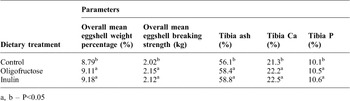
The number of published studies conducted on poultry with fructans is significantly lower than that on model animals. In their study with laying hens, Chen et al. (Reference CHEN, NAKTHONG and CHEN2005) found that inulin or oligofructose included to the layer's diet at a 10 g/kg level significantly improved egg production, cumulative weekly egg weight and feed conversion ratio as compared to the control, unsupplemented group. However, studies by several other authors have not confirmed any such beneficial effect of supplemental dietary fructans on laying performance (Yildiz et al., Reference YILDIZ, SACAKLI and GUNGOR2006; Shang et al., Reference SHANG, HU, LU Y.J. and WU2010; Swiatkiewicz et al., Reference SWIATKIEWICZ, KORELESKI and ARCZEWSKA2010a). The aim of Chen and Chen's experiment (2004) was to study the effect of prebiotic fructans on mineral utilisation in layers. They reported that supplementing the diet with 10 g/kg oligofructose or inulin significantly increased serum calcium concentration after four weeks of feeding. Similarly, both fructans positively affected eggshell weigh percentage, eggshell breaking strength and tibia ash, calcium and phosphorus content (Table 1), which the authors attributed to an increasing Ca absorption as a result of the addition of the fructans. They concluded that the increased Ca utilisation achieved after the inclusion of fructans in the diet, not only had a beneficial effect on eggshell quality, but also resulted in a decrease in the occurrence of bone fracture and osteoporosis (Chen and Chen, Reference CHEN and CHEN2004).
Effect of layer's diet supplementation with prebiotic fructans on eggshell properties and tibia mineralisation (adapted from Chen and Chen, Reference CHEN and CHEN2004).

a, b – P<0.05
Li et al. (Reference LI, LIU, LI, HAO and XU2007) reported numerical improvements of shell thickness when prebiotic fructans, namely fructooligosaccharides, were added to the hen's diet, and attributed this effect to the favourable environment in the intestinal tract, which may have helped to assimilate more Ca. Swiatkiewicz et al. (Reference SWIATKIEWICZ, KORELESKI and ARCZEWSKA2010a) evaluated the influence of prebiotic fructans on eggshell quality when added to the layer's diet with different levels of Ca and P. They found a positive effect of fructans on some eggshell quality parameters, namely eggshell percent, density and breaking strength, in older hens at 46, 58 and 70 weeks of age, and posited that the beneficial influence of inulin was far more significant than oligofructose. There was no significant interaction between Ca and P dietary level and added fructans (Swiatkiewicz et al., Reference SWIATKIEWICZ, KORELESKI and ARCZEWSKA2010a). Correspondingly, Kruger et al. (Reference KRUGER, BROWN, COLLET, LAYTON and SCHOLLUM2003) indicated that the effects of fructans with various degree of polymerisation (DP) on Ca bioavailability and bone mineralisation in rats were different. Long chain inulin (DP>23) increased the bone mineral density and bone mineral content in the femur and the spine to a considerably greater extent than oligofructose.
In a subsequent work, Swiatkiewicz et al. (Reference SWIATKIEWICZ, KORELESKI and ARCZEWSKA2010b) reported that in older layers, at 70 weeks of age, fed a diet supplemented with oligofructose, the tibia bones had a higher breaking strength and yielding load than the hens fed the control diet; however no effect of fructans was shown when the biomechanical and geometrical parameters of the femurs were determined. In moulted layers, the supplementation of an alfalfa diet with fructooligosaccharides (0.75%) prevented a decrease in tibia and femur breaking strength and in tibia mineral content during moulting (Kim et al., Reference KIM, DONALSON, MITCHELL, KUBENA, NISBET and RICKE2006). The authors of that study concluded that it is probably due to their beneficial effect on Ca absorption that fructooligosaccharides have the potential to maintain bone strength, which is often reduced by structural bone loss during moulting. However, no positive effect of inulin included in the layer's diet was observed by Yildiz et al. (Reference YILDIZ, SACAKLI and GUNGOR2006). During a 16-week trial they found no statistically confirmed influences of inulin from dried Jerusalem artichoke on the weight, thickness and breaking strength of eggshells.
broiler chickens
Several authors have observed the positive effects of prebiotic fructans included in the broiler's diet. Rebole et al. (Reference REBOLE, ORTIZ, RODRIGUEZ, ALZUETA, TREVINO and VELASCO2010) reported that chickens fed a diet supplemented with inulin at 10 or 20 g/kg had a higher body weight gain and colony counts of intestinal Bifidobacteria and Lactobacillus than in the control, unsupplemented group; however, no effect of inulin on the feed conversion ratio was found. In their recent study, Park and Park (2011) found that microencapsulated inulin, prepared from Korean Jerusalem artichoke, significantly increased growth performance and dressing percentage, breast and thigh muscle weight, the levels of blood immunoglobulin IgG, IgM, and IgA, thymus and the bursa of Fabricius weight, the colony counts of the beneficial intestinal microorganisms Bifidobacteria and Lactobacillus and decreased both abdominal fat weight and the counts of harmful E. coli and Salmonella. Similarly, the positive influence of inulin or oligofructose on body weight gain, feed conversion and carcass weight was noted in an experiment with female broiler chickens (Yusrizal and Chen, Reference YUSRIZAL and CHEN2003). Results of a study conducted by Alzueta et al. (Reference ALZUETA, RODRIGUES, ORTIZ, REBOLE and TREVINO2010) showed that inulin supplementation improved the digestibility of protein and fat in a diet based on maize-and soybean-meal, but had no effect on body weight gain and feed conversion in broilers. Velasco et al. (Reference VELASCO, ORTIZ, ALZUETA, REBOLE, TREVINO and RODRIGUEZ2010) found a beneficial influence of inulin on body weight gain at 5 g/kg but not at a 10 g/kg dietary level. Others authors, however, have not shown any positive effects of fructans on broiler performance (Biggs et al., 2007; Ortiz et al., Reference ORTIZ, RODRIGUEZ, ALZUETA, REBOLE and TREVINO2009; Swiatkiewicz et al., Reference SWIATKIEWICZ, KORELESKI and ARCZEWSKA-WLOSEK2011). Józefiak et al. (Reference JÓZEFIAK, KACZMAREK and RUTKOWSKI2008) even reported that inulin at a 3 g/kg inclusion level worsened body weight gain and feed conversion in broilers. They speculated that this negative influence of inulin could be related to its stimulating effect on native microflora, the increased activity of which leads to the deconjugating of bile salts and competition with the host for nutrients. Differences in the growth performance of broilers fed diets supplemented with prebiotic fructans may be related to the fact that their efficiency depends on many factors, such as the composition of the basal diet, the source and dietary concentration of the additives used, the characteristics of the animal and the farm's environmental and hygiene conditions (Verdonk et al., Reference VERDONK, SHIM, VAN LEEUVEN and VERSTEGEN2005).
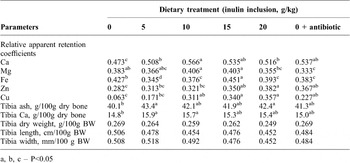
The mineral retention and tibia characteristics of broilers fed diets supplemented with different levels of inulin, from 5 to 20 g/kg, were evaluated in the study carried out by Ortiz et al. (Reference ORTIZ, RODRIGUEZ, ALZUETA, REBOLE and TREVINO2009). The inclusion of inulin positively affected the relative apparent retention of Ca, Zn and Cu and the content of ash and Ca in tibias. This effect was not, however, reflected in the bone morphology, in other words tibia weight, length and width (Table 2). The authors concluded that the results obtained in their study, namely the beneficial influence of inulin on the absorption of Ca and microelements, and on tibia mineralisation, suggest that the feeding of inulin may have a beneficial influence on bone quality (Ortiz et al., Reference ORTIZ, RODRIGUEZ, ALZUETA, REBOLE and TREVINO2009). However, in a study on broilers, Swiatkiewicz et al. (Reference SWIATKIEWICZ, KORELESKI and ARCZEWSKA-WLOSEK2011) did not confirm the beneficial effect of prebiotic fructans on bone quality observed in experiments with model animals and they found no significant effect of inulin or oligofructose on the biomechanical and geometrical parameters of tibia and femurs in chickens fed a diet with standard or reduced levels of Ca and P. Several authors have reported that fructans had a positive effect on intestinal morphology in broilers, as in, for example, the increased height of the villus (Xu et al., Reference XU, HU, XIA, ZHAN and WANG2003; Rehman et al., Reference REHMAN, ROSENKRANZ, BOHM and ZENTEK2007), which might stimulate the absorption of minerals.
Supplemental dietary inulin in a corn- and soybean-meal diet had a positive effect on intrinsic iron utilisation in young pigs, and this benefit was associated with increased soluble Fe concentration in the digesta and increased blood haemoglobin concentration, as compared with the control group (Yasuda et al., Reference YASUDA, RONEKER, MILLER, WELCH and LEI2006).
Effect of broiler's diet supplementation with inulin on mineral retention and tibia characteristics (adapted from Ortiz et al., Reference ORTIZ, RODRIGUEZ, ALZUETA, REBOLE and TREVINO2009).

a, b, c – P<0.05
Diet supplementation with probiotics can have a similar effect on mineral utilisation in poultry. Mutus et al. (Reference MUTUS, KOCABAGLI, ALP, ACAR, ERAN and GEZEN2006) reported that diet supplementation with the probiotic bacteria Bacillus licheniformis and Bacillus subtilis significantly improved the thickness of the medial and lateral wall of the tibia, the tibiotarsal index, percentage ash, and P content, without any effect on tibia weight, length, and weight/length index, robusticity index, diaphysis diameter, modulus of elasticity, yield stress parameters, and percentage Ca content. Probiotic inclusion in the broiler's diet with low calcium and phosphorus levels significantly increased the retention of Ca and P and the tibia breaking strength and ash content (Angel et al., Reference ANGEL, DALLOUL and DOERR2005). The beneficial influence of probiotic bacteria on tibia breaking strength and mineralisation in broilers, attributed by the authors to the higher assimilation of calcium in the bone, was also shown when a diet with standard levels of Ca and P was used (Panda et al., Reference PANDA, RAMA RAO, RAJU and SHARMA2006). In experiments with laying hens, a probiotic addition beneficially affected eggshell breaking strength, thickness and weight (Xu et al., Reference XU, JI, MA, HAO, JIN and LI2006; Yousefi and Karkoodi, Reference YOUSEFI and KARKOODI2007; Panda et al., Reference PANDA, RAMA RAO, RAJU and SHARMA2008). Nahashon et al. (Reference NAHASHON, NAKAUE and MIROSCH1994) reported that probiotic bacteria added to a layer's diet increased retention of Ca and P.
Organic acids
Organic, which is to say formic, propionic, acetic, sorbic, citric, fumaric, malonic and other acids, are widely used in animal nutrition as feed acidifiers. They are added to poultry diets in order to reduce feed buffering capacity and decrease and maintain the optimum pH of feed, crop and intestinal contents, and thus to inhibit the growth in the intestine of such pathogenic bacteria as Salmonella spp., E. coli, Clostridium perfringens and Campylobacter. The results of several model studies with rats have showed that, by means of the reduction of intestinal pH, and the increase in the activity of digestive enzymes and the solubility of minerals, organic acids may have a positive effect on mineral absorption, primarily of calcium (Lutz and Scharrer, Reference LUTZ and SCHARRER1991; Mineo et al., Reference MINEO, HARA, KIKUCHI, SAKURAI and TOMITA2001). Dietary acetic acid increased the Ca absorption and Ca content of the femur in ovariectomised rats, suggesting that this acid may reduce the bone turnover caused by ovariectomy and be helpful in preventing osteoporosis (Kishi et al., Reference KISHI, FUKAYA, TSUKAMOTO, NAGASAWA, TAKEHANA and NISHIZAWA1999). The positive effects of organic acids on mineral retention and bone ash were also found in experiments performed on pigs (Radclife et al., 1998; Jongbloed et al., Reference JONGBLOED, MROZ, VAN DER WEIJ-JONGBLOED and KEMME2000; Mroz et al., Reference MROZ, JONGBLOED, PARTANEN, VREMAN, KEMME and KOGUT2000).
To date, much of the work on the effect of organic acids on mineral utilisation in poultry has focused on ascorbic citric acid. For example, the results of a study conducted by Orban et al. (Reference ORBAN, ROLAND, CUMMINS and LOVELL1993) suggested that large doses of ascorbic acid could have a beneficial effect on Ca calcium metabolism, and eggshell and bone mineralisation in poultry. They reported that supplementation of the diet with large doses of ascorbic acid, at 2,000 or 3,000 ppm, increased the specific gravity of the eggs and femur strength in hens, which was connected with the higher concentration of Ca in the blood (Orban et al., Reference ORBAN, ROLAND, CUMMINS and LOVELL1993). The beneficial effect of citric acid on mineral utilisation and bone mineralisation has been found in several other studies (Brenes et al., Reference BRENES, VIVEROS, ARIJA, CENTENO, PIZARRO and BRAVO2003; Snow et al., Reference SNOW, BAKER and PARSONA2004; Chowdhury et al., Reference CHOWDHURY, ISLAM, KHAN, KARIM, HAQUE, KHATUN and PESTI2009).
laying hens
The experimental data on the effect of acids other than citric or ascorbic organic on mineral metabolism in poultry is limited. In a recent study conducted with laying hens, the addition of 2.5 g/kg of medium chain fatty acids (MCFA) (caproic + capric acid) or, to a lesser extent, 5 g/kg of short chain fatty acids (SCFA) (a blend of formic, propionic and acetic acid) improved eggshell characteristics, in other words eggshell percent, density and breaking strength, at 46, 58 and 70 weeks of age (Swiatkiewicz et al., Reference SWIATKIEWICZ, KORELESKI and ARCZEWSKA2010a). The authors speculated that this influence could be attributed to an increased availability of Ca and P brought about by a decrease in pH in the upper part of the intestinal tract and the stimulating effect of organic acids on villus height which had previously been observed in broilers by Garcia et al. (Reference GARCIA, CATALA-GREGORI, HERNANDEZ, MEGIAS and MADRID2007) and Senkoylu et al. (Reference SENKOYLU, SAMLI, KANTER and AGMA2007). On the basis of the results of a study carried out with old, breeder hens, Sengor et al. (Reference SENGOR, YARDIMCI, CETINGUL, BAYRAM, SAHIN and DOGAN2007) reported that eggshell breaking strength was increased and the number of dirty, cracked and misshapen eggs was reduced when SCFA were included to the diet. Similarly, Soltan (Reference SOLTAN2008) found that organic acids, namely a blend of formic acid and butyric, propionic and lactic acid salts, had a beneficial effect on eggshell thickness in 70-week-old hens and reduced the number of broken eggs, without having any impact on eggshell weight. The author indicated that the improvement in eggshell quality was connected with an increase of Ca concentration in serum, which can be attributed to the beneficial effect of organic acids on Ca absorption. In another experiment with older laying hens, at 75-80 weeks of age, organic acids, namely the commercial product Lactacid, at 2 g/kg dietary level, lowered soft-shell and broken egg production, but had no significant effect on eggshell strength and thickness (Park et al., Reference PARK, RHEE, UM and PAIK2009). In contrast, in a study conducted with Lohmann layers, Yesilbag and Colpan (Reference YESILBAG and COLPAN2006) observed no influence of SCFA (formic and propionic acids) on the thickness and breaking strength of eggshells.
The effect of organic acids on bone quality parameters in laying hens has also been studied. At 70 weeks of age, high-producing layers fed diets supplemented with 0.25% MCFA or 0.50% SCFA displayed, a significantly higher bone breaking strength in the tibia and femurs and yielding load in the tibia bone, in comparison to the control group, (Swiatkiewicz et al., Reference SWIATKIEWICZ, KORELESKI and ARCZEWSKA2010b). However, the acids used had no statistically significant effects on the geometrical parameters of either bone. The authors concluded that, by lowering the pH of the diet and intestinal content, organic acids can beneficially affect the biomechanical parameters of the bones in high-producing laying hens. Similarly, in an experiment with quails, SCFA (formic + lactic at 2.5 g/kg) improved both the absorption of dietary phosphorus and tibia bone mineralisation (Sacakli et al., Reference SACAKLI, SEHU, ERGUN, GENC and SELCUK2006).
broiler chickens
In their experiment with broiler chicks, Abdel-Fattah et al. (Reference ABDEL-FATTAH, EL-SANHOURY, EL-MEDNAY and ABDEL-AZEEM2008) reported that birds fed a diet supplemented with organic acids had a significantly higher Ca and P blood concentration, which the authors attributed to the lowering of gut pH and the increase in the absorption of these macroelements by the utilisation of the acids. Liem et al. (Reference LIEM, PESTI and EDWARSD2008) found that the addition of citric, malic or fumaric acid increased tibia mineralisation in chickens fed a P deficient diet; however, only the influence of citric acid was statistically significant. They also indicated that citric and malic acid decreased incidences of P-deficiency rickets. In a recent experiment, feeding broilers with a low-Ca diet had a negative effect on performance and tibia characteristics, whereas the addition of organic acids had a positive effect on these indices and helped the birds to overcome the problems related to a low-Ca diet (Houshmand et al., Reference HOUSHMAND, AZHAR, ZULKIFLI, BEJO, MEIMANDIPOUR and KAMYAB2011). In contrast, in chickens fed a diet with different levels of Ca, Vieira et al. (Reference VIEIRA, KESSLER and RIBEIRO2010) found no effect of SCFA (formic acid, acetic acid, propionic acid or butyric acid) on Ca and P balance and tibia ash percentage.
Conclusions
In summing up the published data presented in this review article, it can be concluded that feed additives decreasing the pH of intestinal content, such as prebiotic fructans and organic acids, may have a beneficial influence on mineral metabolism in poultry and may thus have a positive impact on eggshell breaking strength and bone quality in high-producing laying hens and broiler chickens.