Introduction
Peatlands are of great topical interest in the light of climate change because of their role in carbon sequestration and storage. Peatlands can be found within the Maritime Antarctic: the area of Antarctica with an oceanic climate comprising the western side of the Antarctic Peninsula, the South Shetland Islands, the South Orkney Islands and the South Sandwich Islands. Such peat accumulates under moss-dominated plant communities, principally those formed by one of both of the mosses Chorisodontium aciphyllum Brotherus and Polytrichum strictum Menzies ex Bridel (syn. P. alpestre Hoppe), although other mosses and liverworts can be very minor components. The communities consist of a surface layer of actively growing moss shoots that are directly linked to a layer of dead and decaying shoots below. Smith (Reference Smith1972) has classified the moss communities of the Maritime Antarctic, with the peat-forming Polytrichum-Chorisodontium community listed under the ‘moss-turf sub-formation’.
The greatest extent of the moss-turf sub-formation is on Signy and Moe islands in the South Orkney Islands, although it also occurs down the west side of the Antarctic Peninsula as far south as northern Alexander Island at latitude ~69°S. It has been described by Fenton (Reference Fenton1980, Reference Fenton1982a), by Fenton & Smith (Reference Fenton and Smith1982) and, more recently, by Cannone et al. (Reference Cannone, Fratte, Convey, Worland and Guglielmin2017). A more informal description of these moss turves is given in Lucibella (Reference Lucibella2020).
Because of their simple structure, a study of the dynamics of the Antarctic moss banks can help elucidate peat-forming processes generally, some of which are not intuitive. This paper illustrates various instances in which the understanding of the dynamics of Antarctic peat contributes to the understanding of peatlands elsewhere in the world.
Physical structure
As their rate of decomposition is slow, dead moss remains build up over time and the deeper remains become incorporated into the permafrost. Hence, the biological processes of growth and decomposition are restricted to the active layer: the surface layer that thaws out in the summer to a depth of 20–30 cm. It should be noted that even the incorporation of old moss shoots into the permafrost does not necessarily kill the moss because viable shoots > 1000 years old have been found at a depth of 138 cm (Roads et al. Reference Roads, Longton and Convey2014).
The moss in the permafrost has a high water content so that the frozen peat is equivalent to a block of ice and is strong enough to support the whole structure as the plant remains build up over time. Hence, the dead moss remains can rise above the landscape into structures known as ‘moss peat banks’. In the South Orkney Islands, these moss banks can be up to 2500 m2 in area, 2 m deep and 5000 years old (Fenton Reference Fenton1982a), and the deepest, on Elephant Island, is 3.4 m thick and 5500 years old (Björck et al. Reference Björck, Malmer, Hjort, Sandgren, Ingólfsson and Wallén1991). A characteristic of the deeper moss banks is a vertical edge of exposed peat, as described below.
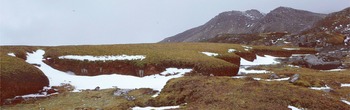
The ability of the moss peat to arise above the landscape makes it equivalent to temperate raised bogs and blanket peats, which have a similar ability (Fig. 1). However, in temperate regions it is not frozen peat that supports the whole peatland but unfrozen waterlogged peat: capillary action becomes a stronger force than gravitational drainage, so water cannot drain out of the peat but stays in place, holding the whole structure together (Fenton Reference Fenton2021). Vertical edges are also characteristic of such temperate peats.
Turves of Chorisodontium aciphyllum-Polytrichum strictum on Signy Island in the South Orkney Islands. The image shows a deep turf underlain by permafrost rising above the landscape to form a moss peat bank, with its characteristic vertical edge, and also a younger shallow turf in the foreground (a moss carpet community is also visible at the bottom left). These characteristics make the moss-turf sub-formation akin to the blanket peat of temperate locations (i.e. peat that blankets the landscape).

Unlike the permafrost peat, the active layer of the moss banks is not permanently waterlogged and hence is likely to be aerobic in summer. Any rain or snowmelt quickly drains out of the turf because P. strictum and C. aciphyllum are acrocarpous mosses with an erect growth form. This is in contrast to pleurocarpous mosses that, in Antarctica, comprise the ‘moss-carpet sub-formation’ (Smith Reference Smith1972). Moss carpets occur in permanently waterlogged locations such as runnels and hollows, but, in contrast to the turves, these communities do not form deep peat in Antarctica, although limited accumulation can occur (Loisel et al. Reference Loisel, Yu, Beilman, Kaiser and Parnikoza2017). Any peat forming under such carpets is akin to valley peats in temperate regions: peat that forms in locations where topography results in a permanently high water table (Fenton Reference Fenton2021).
Measuring peat growth rates
Peat, which is the accumulation of dead plant material, occurs when the annual addition of biomass to the system is greater than its annual removal through decomposition. It occurs when the plant material at depth is either waterlogged or, in polar climates, frozen, so that decomposition in effect ceases before all the plant material has decayed. In temperate regions, the surface layer that can dry out at times is called the ‘acrotelm’ and the lower permanently waterlogged layer is called the ‘catotelm’. In the active layer of Antarctic peat or the acrotelm of temperate peat decomposition will generally be aerobic, and in the permafrost or catotelm the decomposition (if any) will be anaerobic.
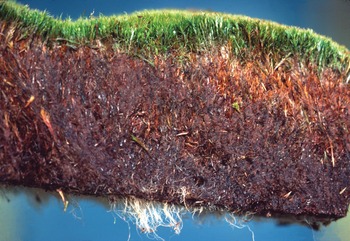
In Antarctic moss peat, all shoot growth is vertically upwards from the surface. In most peats, assessment of annual biomass growth is complicated because annual shoot growth can be difficult to determine, there is litter input to the soil surface and the roots of vascular plants can add biomass at depth. It should be noted, though, that P. strictum can translocate biomass down the peat profile to a minor extent through the growth of rhizoids (Fig. 2); this has not been quantified but is assumed to be an order of magnitude less than the annual growth at the surface. Such translocation is unlikely in Chorisodontium, which does not possess such a sophisticated translocation system.
Two years' growth of rhizoids growing from the underside of a 5 cm-thick section of an Antarctic Polytrichum strictum turf. The image shows that although most growth is at the surface, there is some translocation to lower levels.

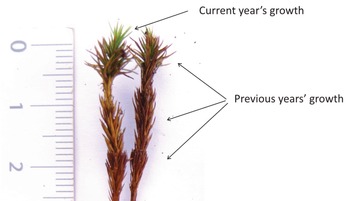
At the end of the growing season, if the annual growth increment of the Antarctic moss is cropped, dried and weighed, it is relatively easy to determine the annual biomass added to the system, as can also be done with Sphagnum moss in temperate regions (Clymo Reference Clymo1970). This is made simple with P. strictum because, unlike Sphagnum, the length of the leaves increases as the growing season progresses so that annual growth increments can be determined as shown in Fig. 3, even in dead shoots far down the peat profile (Longton Reference Longton and Holdgate1970). This is not possible with C. aciphyllum, although in most moss banks there is also some P. strictum that can be used to determine annual growth rates, or occasionally the associated moss Pohlia nutans (Hedw.) Lindb. can be used to do this.
Shoots of Polytrichum strictum from a site in Scotland showing annual growth increments. Scale is millimetres. At the end of the growing season, the current year's growth can be cropped to determine annual productivity (excepting rhizoid growth).

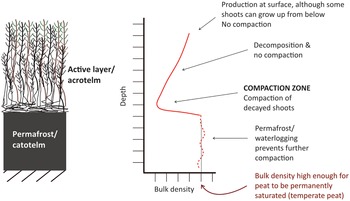
Therefore, the relative ease with which both annual shoot extension growth and annual biomass input can be determined makes estimation of the annual primary productivity of these moss banks relatively straightforward compared to most peatland ecosystems. In addition to annual growth, there are two factors that determine the overall rate of peat accumulation: the overall loss in weight of the original plant material (the amount of decomposition) and the overall loss in volume by the time the moss enters the permafrost or catotelm (the amount of compaction). Measuring decomposition is never straightforward but has been done in the Antarctic moss banks by using litter bags: removing material from a given depth, drying and weighing it, then reburying it and weighing it again after 1 or 2 years in the ground. The annual rate of decomposition can then be calculated down the profile (Fenton Reference Fenton1980). Decomposition can also be determined by measuring how the dry bulk density changes down the profile and relating this to the amount of compaction. Without compaction, the bulk density will decrease down the profile owing to loss of material through decomposition. However, once the shoots are weakened by decomposition, compaction of the shoots is likely to occur, causing the bulk density to increase (Fig. 4).
Diagram illustrating how bulk density changes down the profile of an Antarctic moss turf, or the acrotelm of temperate peat (from fig. B.1 in Fenton Reference Fenton2021).

In contrast to most peats where the amount of compaction is impossible to measure directly, in Antarctic moss peat the amount of compaction is easily determined because the structure of the decayed shoots is still visible at depth and the thickness of a layer of compressed shoots can be compared with their original length when vertical at the surface. The compressed shoots are often all compressed in the same direction owing to downhill creep of the active layer ('rotational compaction' in Fenton Reference Fenton2021), although if there is no creep then compression may be more random ('vertical compaction').
The above determinations of Antarctic peat growth rates are based on direct physical measurements and enable the current rate of peat growth to be measured, something that is difficult to do in most peatlands. Carbon dating is a useful method for measuring peat growth rates over longer timescales and has been used in Antarctica (e.g. Royles Reference Royles, Ogée, Wingate, Hodgson, Convey and Griffiths2012), but other proxy measures that have been used in Antarctica, such as measuring oxygen update down the profile (Davis Reference Davis1980), have their limitations.
In summary, a cross-section of an Antarctic moss bank shows shoot growth at the surface, decaying shoots below, visible compaction of shoots and a lower layer where decomposition has ceased (Fig. 5); hence, they provide a simple illustration of peat growth generally. With knowledge of the annual biomass input, the annual rate of decomposition and/or bulk density down the profile and the overall amount of compaction, the annual rate of peat growth can be determined both in terms of the biomass increase and the height increase. See Fenton (Reference Fenton1980) for an application of this process, which concluded that, in the 1970s, the upward growth of the moss banks as a whole of 0.9–1.3 mm year-1 was approximately half the annual shoot extension growth, and similarly that the rate of peat accumulation of 89–159 g m-2 year-1 was approximately half the net annual primary production.
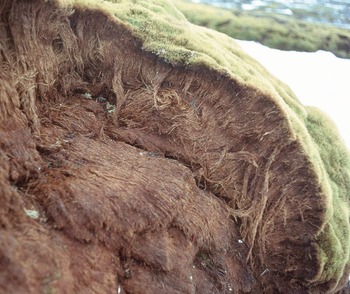
Cross-section of the surface layers of an Antarctic Chorisodontium aciphyllum turf showing how downhill creep causes the lower shoots to be compressed and rotated downhill (rotational compaction). Location: Signy Island, South Orkney Islands.

Physical dynamics of peatlands
When considered in timescales of centuries, peatlands are dynamic systems. The already-mentioned dynamic of growth, decomposition and compression results in the vertical growth of the peat in the first place. But thereafter the dynamics of both gravity-induced downhill movement (creep) and of erosion processes can shape the physical structure of the peatlands. There is little published literature on the later erosive phases of the life cycle of Antarctic moss peat. However, Fenton (Reference Fenton1978) demonstrates surface erosion, wind erosion, catastrophic slip and vertical edge collapse for moss banks on Signy and Moe islands in the South Orkney Islands.
Regarding temperate peatlands, there has been a lot of discussion over the years about the causes of erosion in terms of how much is natural and how much is anthropogenic. However, the fact that erosion occurs in Antarctic peat in the absence of any direct human influence shows that it can be a natural process.
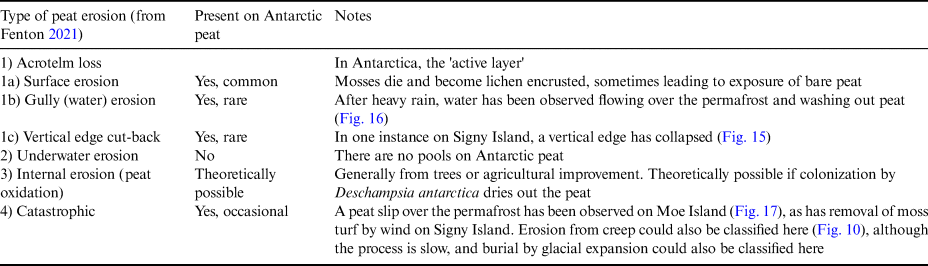
Table I shows a classification of peat erosion types and their presence in Antarctic moss peat. The different types that can be observed in the Antarctic are 1) surface erosion through cessation of peat growth or mechanical damage, 2) water erosion (rare), 3) collapse of vertical edges (rare) and 4) catastrophic erosion, including loss of peat through creep. These are also illustrated in appendix D of Fenton (Reference Fenton2021).
Classification of peatland erosion types.

Surface erosion
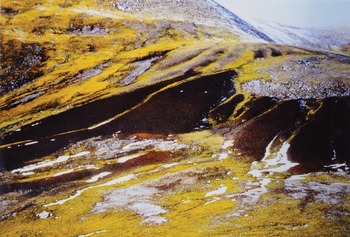
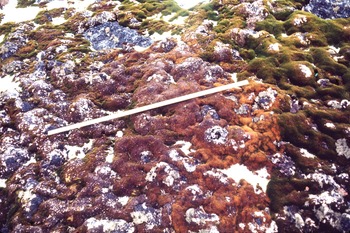
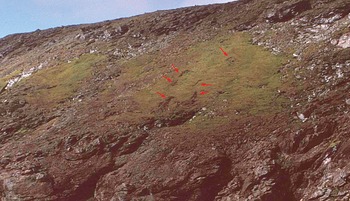
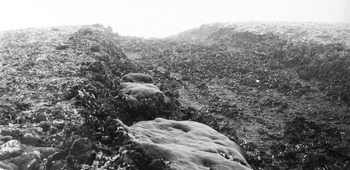
In Antarctic moss banks, the moss can die and become lichen-encrusted, and thereafter frost heave can result in exposed surface peat (Figs 6 & 7). It is not clear why the moss growth stops, although it could be because the deeper peat banks become more exposed to wind and frost action as they rise above the surrounding landscape (Cannone et al. Reference Cannone, Fratte, Convey, Worland and Guglielmin2017) or because the mosses die of old age or, in some cases, of fungal infection as shown in Fig. 8 (Fenton Reference Fenton1983). Similar cessation of peat growth occurs in blanket peat in both the UK and the Falkland Islands, and again the reason for this is unclear, although Fenton (Reference Fenton2021) speculates that it might occur because the peat has become so thick that capillary action has reached its maximum potential to raise the water table any higher, so new, waterlogged catotelm can no longer form. This would not apply to Antarctic peat as in practice there is no physical limit to permafrost depth.
Surface erosion in 1975 of moss banks on Moe Island, South Orkney Islands.

Frost heave resulting in surface erosion of an Antarctic moss bank on Signy Island.

Fungal infection of a Chorisodontium aciphyllum turf on Signy Island resulting in the death of the moss. Healthy moss (green) is visible on the right, moss infected in the current year is bright orange, that infected in earlier years is brown/orange and dead moss visible on the far left is black. Lichen encrustation (white) of both healthy and dead moss is visible, mainly by Ochrolechia frigida, which may increase significantly on the dead moss. The moss turf may eventually recover from shoots still viable at depth, but it is also possible that frost heave will cause surface erosion. Scale marker is a metre rule.

Trampling by people or animals can damage temperate peatlands as it can those in the Antarctic. In recent years, there has been a major expansion of the range of fur seals Arctocephalus gazella both in the South Orkney Islands and down the west side of the Antarctic Peninsula, and their trampling can destroy the moss communities, including moss turves (Cannone et al. Reference Cannone, Fratte, Convey, Worland and Guglielmin2017). However, to date, the deepest and oldest moss peat banks on Signy Island have escaped any damage.
Surface creep and vertical edges
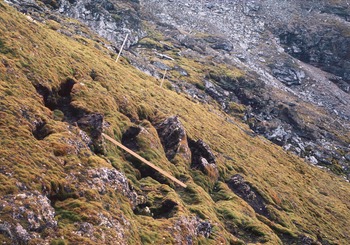
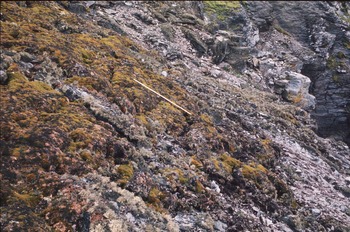
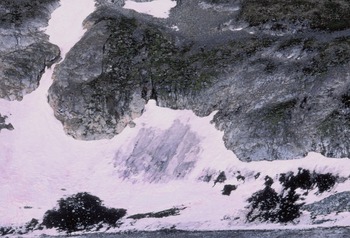
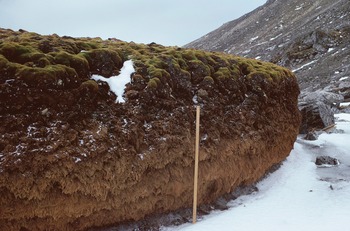
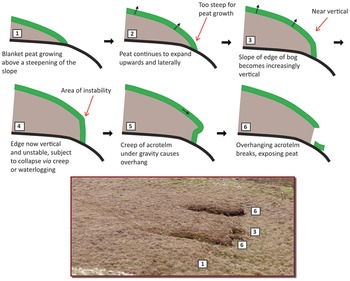
Because shoots at depth can be traced back to the surface, any downhill creep of the surface layers can be easily observed in a cross-section of Antarctic moss peat (Fig. 5). Creep is an important process in these moss banks where, under gravity, the active layer slides over the stationary permafrost peat. It occurs on both gentle and steep slopes, in the latter resulting in crevasse-like surface features (Fig. 9), and it can result in loss of peat to the system if the creeping peat moves beyond the area of permafrost peat and subsequently erodes (Fig. 10) or falls over cliffs (Fig. 11). On gentle slopes, creep can result in vertical edges up to 3.4 m tall (Fig. 12). How these edges form is described in detail in Fenton (Reference Fenton1982a), with a summary given in Fenton (Reference Fenton2021); it is very similar to the process shown here in Fig. 13 for temperate peats. These vertical edges are not erosion features sensu stricto because they do not result in any loss of peat to the system and the vertical edges can be stable for at least 1000 years (Fenton Reference Fenton1982a). In contrast, vertical edges on temperate blanket peat tend to erode backwards into the peat over time, which is termed ‘vertical edge cut-back’ in Fenton (Reference Fenton2021).
Downhill creep of the active layer of a steep Antarctic Polytrichum strictum turf over the permafrost, resulting in regularly spaced ‘crevasses’. This is a close-up of the turf shown in Fig. 16, located on Signy Island. Scale marker is a metre rule.

The lower end of the Polytrichum strictum turf shown in Figs 9 & 16. This shows how downhill creep has resulted in the surface layers moving beyond the area underlain by permafrost peat, resulting in its breaking up. There is a cliff below, over which the peat in some areas is falling into the sea. Scale marker is a metre rule.

The black areas amongst the snow drifts are deposits of peat that have been dislodged by ice falls from above and possibly also from downhill creep of a moss turf over a cliff (see Fig. 10). Location: Cuverville Island on the west side of the Antarctic Peninsula.

The vertical edge of a moss peat bank on Signy Island. Scale marker is a metre rule.

Example showing how creep of the acrotelm (green) over the catotelm (grey) in temperate blanket peat can result in a vertical edge as in an Antarctic moss bank; in the latter case, this is due to the creep of the active layer over the permafrost (from fig. 3.11 in Fenton Reference Fenton2021).

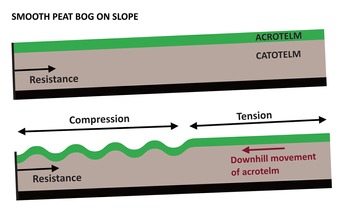
The presence of creep in Antarctic peat suggests that the same could occur in other peatlands, although in the case of temperate peat it would be the acrotelm moving downhill with respect to the stationary catotelm (held in place by capillary forces). Vertical edges are common in temperate ombrotrophic peatlands, both in the Falkland Islands and the UK, and Fenton (Reference Fenton2021) postulates that the origin of many of these could be creep, as it is with Antarctic peat (Fig. 13). Fenton (Reference Fenton2021) also postulates that creep is the mechanism for the creation of temperate patterned bogs: peat bogs with a regular system of pools parallel to the slope. If any movement downhill of the acrotelm meets with resistance (e.g. at the edge of the bog), then the acrotelm will deform into sinusoidal waves on the surface peat, the bottom of which become pools if the acrotelm is forced below the water table as shown in Fig. 14.
Diagram showing how creep can result in sinusoidal waves on the surface of a temperate peat bog. When there is creep of the acrotelm (green) over the stationary catotelm (grey) then waves form if there is resistance to movement (e.g. from the edge of the bog). Where the acrotelm is forced below the water table at the top of the catotelm then regularly spaced pools will form in the hollows that are parallel to the contours, creating patterned bogs (from fig. 2.7 in Fenton Reference Fenton2021).

Antarctic peat and climate change
As peat bogs increase in thickness over time, they provide a record of the environmental conditions prevailing at the time the peat was laid down. This applies to Antarctic peat, and the Polytrichum-Chorisodontium moss banks have been used to help unravel climate change in the Maritime Antarctic. Moss turves buried by the expansion of permanent snow patches and glaciers during colder periods in the past have now re-emerged in recent decades as the ice has retreated. Carbon dating of the now-exposed moss can give an indication of when the cooling took place (Fenton Reference Fenton1982b, Yu et al. Reference Yu, Beilman and Loisel2016), and there have been several other studies relating the rate of peat growth to climate change, with the rate of growth increasing in warmer periods (Royles et al. Reference Royles, Ogée, Wingate, Hodgson, Convey and Griffiths2012, Reference Royles, Amesbury, Convey, Griffiths, Hodgson, Leng and Charman2013, Cannone et al. Reference Cannone, Fratte, Convey, Worland and Guglielmin2017, Charman et al. Reference Charman, Amesbury, Roland, Royles, Hodgson, Convey and Griffiths2018). These studies confirm a continuing increase in annual average air temperature in the Maritime Antarctic.
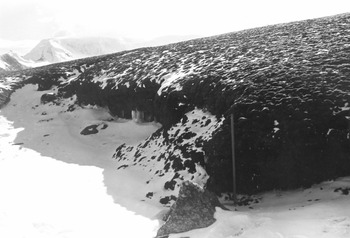
The warming of the area could result in erosion of the moss banks becoming more common. Cannone et al. (Reference Cannone, Fratte, Convey, Worland and Guglielmin2017) conclude that the depth of the active layer is increasing on Signy Island (South Orkney Islands) through melting of the permafrost. In temperate ombrotrophic peats, it is the increase in bulk density to a level that allows capillary action to hold water permanently that causes peat (the catotelm) to form in the first place (Fenton Reference Fenton2021). In the Antarctic system, the decayed and compressed shoots within the permafrost form a solid frozen block, similarly indicating a high water content; in other words, rainfall or snowmelt does not drain out of the compressed lower shoots before they become frozen. If the permafrost melts due to climate change, it is unclear whether the previously frozen peat will remain saturated through capillary action, as in temperate peat, with the whole structure thereafter being held in place by capillary action, or whether the moss banks will collapse. One scenario is that in thawed moss banks the weight of the surface layers will cause enough compression for capillary action to be the dominant force. There has been no research on this aspect of Antarctic peat, although Fig. 15 does illustrate one instance of the collapse of a vertical edge noted on Signy Island in 1975. Additionally, it is likely that moss banks on steep slopes will be liable to increased rates of creep as the previously frozen peat thaws and slumps downhill. Antarctic peat banks can be on slopes of 30°, such as those illustrated in Figs 9 & 16, whereas the limit for temperate blanket peat (i.e. peat held together by capillary action) is of the order of 20°.
A collapse of a section of a vertical edge of a moss bank on Signy Island in the South Orkney Islands, observed in 1975. Scale marker is a metre rule.

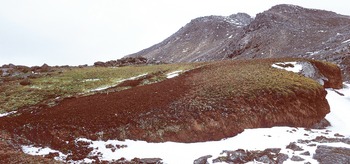
If warming results in increased rainfall, then water may increase in importance as an erosive force for Antarctic peat (Figs 16 & 17), as is the case for temperate peats. Additionally, warming is causing an increase in abundance of the native grass Deschampsia antarctica, including its colonization of some moss turves on Signy Island (Cannone et al. Reference Cannone, Fratte, Convey, Worland and Guglielmin2017). This colonization will change the dynamics of the peat-forming system owing to the penetration of grass roots into the active layer. It is possible that the roots will extract water from the turf, drying it out and increasing the rate of decomposition, perhaps so much so that peat no longer forms ('internal erosion' in Table I). In other words, carbon sequestration could cease, although this is speculation.
A steep turf of Polytrichum strictum on Signy Island showing erosion of peat after heavy rain in February 1974. The arrowed areas indicate where rainwater running over the surface of the permafrost has emerged onto the surface, depositing eroded peat. Above the cliff at the bottom of the slope on the right, the turf can be seen breaking up owing to creep as shown in Fig. 10.

A catastrophic slip of the active layer of a Chorisodontium aciphyllum turf over the permafrost at a site on Moe Island in the South Orkney Islands. This was possibly instigated by heavy loading of the surface by water during heavy rain; if so, such slips could become more common with increased rainfall resulting from climate warming.

Landscape-scale carbon balance
Mosses can be seen as a store of carbon, and Lucibella (Reference Lucibella2020) suggests that in Antarctica mosses in total sequester 30,000 tons of carbon per year. Fenton (Reference Fenton2021) postulates that in mature landscapes of blanket peat (ombrotrophic peat) there may come a time when overall peat growth is matched by overall peat erosion; in other words, at the landscape scale, there might arise a maximum amount of carbon storage in blanket peat.
The Chorisodontium-Polytrichum moss banks can be seen as a form of blanket peat in that they arise above the surrounding landscape and can expand in extent to blanket the land (Fig. 1), although on Signy Island this amounts to only ~34 ha or 2.5% of the snow-free land (Fenton & Smith Reference Fenton and Smith1982). In areas where such peat has been a feature for thousands of years, particularly the South Orkney Islands, it would be interesting to determine whether the amount of new peat being formed is matched by the erosion of the older peats (i.e. there is a maximum carbon storage potential). For this exercise, it would be necessary to exclude the areas being eroded by the increasing fur seal population and also the new areas of suitable habitat being opened up by ice retreat.
Conclusion
The Chorisodontium-Polytrichum moss peat banks represent one of the simplest peat-forming systems in the world, with both their structure and their rate of peat growth being relatively easy to determine compared to other types of peat. In particular, they have similar characteristics to temperate blanket peat. Hence, their study can lead to insights into peatland processes that are not so immediately obvious elsewhere. These include how the balance of growth, decomposition and compaction leads to the development of a waterlogged catotelm in temperate peats, as well as how downhill creep of the surface layers of a peat bog can result in the development of vertical edges, which are common features of both Antarctic moss peat banks and temperate blanket peat. Such creep can also be used to explain the development of regular pool systems on blanket peat (patterned bogs).
Erosion is a feature of many temperate blanket peats and there has been much debate as to whether this is largely natural or anthropogenic. The fact that Antarctic peat growth can cease and surface erosion can set in without any anthropogenic influence indicates that erosion can be a natural part of the life cycle of a peatland. However, although there have been several studies of the growth of Antarctic peat, there have been few on the later stages of the life cycle of the moss peat banks.
The historical time depth of peatlands means that their study, both in the Antarctic and elsewhere, can provide useful insights into climate change in the Holocene. Climatic warming in the Maritime Antarctic is likely to result in a more erosive phase for the moss banks owing to both the melting of permafrost and the increased likelihood of water-caused erosion through increasing rainfall.
Acknowledgements
I must thank the British Antarctic Survey who, by originally employing me, provided me with an opportunity to research Antarctic moss peat. I also thank all of the people with whom I have discussed peatland issues over the years, the valuable contributions to the final text of those who reviewed early drafts and two peer reviewers for their comments.
Author contribution
I certify that I am the sole author of this paper and am solely responsible for its content.