1. The context and scope of foreign language education research in Portugal
Current European policies that recommend the inclusion of three languages in the school curriculum – the native language (NL) and two foreign languages (FL) – have long been implemented in Portugal. Foreign language education (FLE) was introduced into the curriculum by the end of the nineteenth century (Latin, French, English, German and, later, Greek). From the 1970s until very recently, two to three FL were offered (French, English and German) from grade 5. More recently, the range of FL was broadened to include Spanish, and from 2005/2006 onwards primary schools were obliged to offer English. At present, all students learn at least two FLs. English is mandatory until grade 9 (the end of compulsory schooling). French, German and Spanish are offered from grade 7 to grade 12 as second FL.
FLE research emerged in close association with pre-service teacher education, which became a priority in the 1980s. From the mid-1970s, new universities and polytechnic institutes were created to respond to the need to train schoolteachers for all levels and subject areas, through programmes that integrated disciplinary and educational components and a period of teaching practice in schools. Later on, research also became associated with postgraduate teacher education, mostly within departments or schools of education in higher education institutions.
This background explains why FLE research is primarily located in the educational domain and understood as FL ‘teaching methodology’ or ‘didactics’ rather than ‘applied linguistics’. Although older universities also train teachers, it was in the new universities (two in particular) that FL didactics developed as an educational field of inquiry, focused on two major aspects that define its scope in broad terms: school pedagogy and teacher education. A few researchers have also invested in review studies of the nature and evolution of language didactics (FL/NL) in Portugal.
Because the research field is strongly connected to teacher education, it has developed in relation to the FLs that are part of school curricula: mostly English, but also French, German and, more recently, Spanish. However, there has also been a tendency over the last decade to conceptualise the domain of language didactics more broadly, in tune with current European policies on the promotion of plurilingualism, intercultural competences and cross-linguistic aspects of language education. The growing number of immigrants in the school system also calls for the examination of Portuguese as a non-native language (PNNL), an emerging research theme.
Although FL pedagogy and teacher education play an important role in our educational system, the academic FLE research community is very small in terms of the number of tenure-track faculty who have developed their careers in the field. Most research is done in a few educational research units financed by the state (FCT – Fundação para a Ciência e a Tecnologia/Foundation for Science and Technology) and in public institutions that provide teacher education programmes. Because the funding of such units depends on external and internal research assessments, they invest more in research and publication. A large proportion of research is conducted by FL schoolteachers who attend academic M.A. and Ph.D. programmes and by non tenure-track researchers who obtain research scholarships from the FCT. These younger researchers are usually supervised by senior researchers and integrated into their research units, and can remain in universities for many years carrying out their Ph.D. and post-doctoral projects. Their publications are usually co-authored by faculty members.
Dissemination of FLE research takes place in specialised and general education journals and conferences. Opportunities for publication in national specialised forums are rather limited and researchers have published quite a lot abroad. There is only one established academic journal that specialises in FL/NL didactics: Intercompreensão – Revista de Didáctica das Línguas Footnote 1. Two new journals were launched in 2010: e-TEALS, an e-journal of Teacher Education and Applied Language Studies and Linguarum Arena. FL teacher associations are quite active (especially that of English teachers) but their publications are not research-oriented. In 2002, a national academic association for language and literature didactics (FL/NL) was created (SPDLL – Sociedade Portuguesa de Didáticas das Línguas e Literaturas), but it has not been very active since 2004, which signals the rather fragmented nature of the field.
In the following section we describe the rationale and scope of the review presented in section 3. Given the above scenario, we decided to focus primarily on publications and dissertations produced in financed educational research units in public universities where FL didactics research has been conducted on a systematic basis, since they are more representative of the field in Portugal. However, we also looked for other publications, especially in journals and conference proceedings, within the four major themes we identified: intercomprehension and plurilingualism; teacher and learner autonomy; Portuguese as a non-native language; and technology-based learning and teaching.
Our main goal is to inquire into the transformative potential of research by looking at its scope, purposes, nature, outcomes (findings and shortcomings/constraints), implications and emerging directions. Since our corpus does not include international publications and focuses on only some of the country's scientific output, we are aware of its limitations in coverage, but we hope that the overview presented here can promote reflection on the social relevance of FLE research, an issue that has received little attention in Portugal and needs further investigation.
2. Rationale and scope of the review
One of the main issues regarding the quality of educational research is its transformative potential for pedagogy, teacher education, policies and research itself. This potential depends on the scope and purpose of inquiry, its conceptual and methodological frameworks, its outcomes (findings and shortcomings/constraints) and its implications. For example, how and to what extent does research seek to transform current discourses and practices, allowing participants and readers to challenge and re-shape established regimes? What is the relevance of its outcomes and implications to the understanding and enhancement of teaching, teacher education, the policies affecting both of these, and research itself?
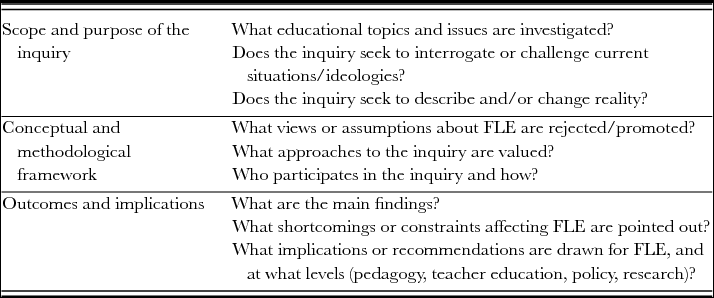
These concerns guided our analysis of FLE research in Portugal. Rather than describing the studies, we present an overview in terms of major themes, combining a descriptive approach with an interpretative stance on the transformative potential of research, and taking into account the questions presented in Table 1. We focused primarily on texts that draw on empirical data, but also on those whose authors theorise about or inquire into relevant aspects of FLE. The latter were analysed along the same lines, except for issues related to methodology and outcomes.
Guiding questions for the review

To access the texts we made contact with FLE researchers, who then sent us their CV and some of their publications, and we consulted online databases, FLE journals, educational conference proceedings and a few review studies referring to FL/NL didactics research conducted before 2006. Online information is dispersed and not all databases are updated and easily accessible, which hampers this kind of study.
The review involved: a) selecting a corpus of studies from available texts; b) designing a grid to analyse the corpus to gain answers to the questions in Table 1 (content analysis); c) interpreting those answers in terms of the transformative potential of FLE research, d) identifying emerging directions for FLE research on the basis of the review.
For the selection of our corpus (2006–2011), we took into account the scope of FLE research in Portugal, focussing on research that is produced and disseminated nationally, and the number of texts to review as indicated by the editor (around 100). Our cumulative criteria related to the content, location of production, authors and type of texts:
1. Texts produced in Portugal in the fields of FL pedagogy and/or FL teacher education, on themes whose recurrence signals current areas of interest and activity.
2. Texts mostly produced within educational research units in higher education institutions that conduct systematic FLE research and FL teacher education (around 85% of the corpus).
3. Texts produced by a) educational researchers/teacher educators from higher education institutions or b) external researchers and schoolteachers involved in postgraduate programmes and research projects in those institutions.
4. Texts that a) report on empirical (data-based) studies or draw directly on empirical research or b) theorise about or inquire into FLE with a sound theoretical framework for FL pedagogy and/or FL teacher education.
5. Published texts (books, book chapters, journal articles and conference papers) and unpublished MA/Ph.D. dissertationsFootnote 2.
From an initial selection of around 150 texts we excluded some that were not sufficiently clear or sound in terms of theoretical background and/or methodological procedures. In order to increase author variety and representativeness of themes, we also excluded texts that reproduced ideas from other texts by the same authors. Nevertheless, the reader will find that some authors recur quite frequently as they belong to the academic FLE research community which has been active in project coordination and publication. The final corpus includes a total of 133 texts by 114 authors: eight books, 38 book chapters, 23 journal articles, 22 papers from conference proceedings, 27 M.A. dissertations and 15 Ph.D. dissertations. The final references also include a few texts related to two review studies carried out by researchers from two research units, published in the period under analysis and focussing on FL/NL didactics research in Portugal before 2006. These studies did not take the interpretative stance adopted here. We decided not to include them in the corpus because they refer to earlier research and do not focus exclusively on FLE or on research produced and disseminated in the national context. However, they represent a relevant (though marginal) research trend by providing descriptions of the foci, nature and evolution of language didactics in our country. We will refer to some of their conclusions where appropriate.
3. Overview of FLE research
The following review includes two interrelated areas of FLE research: FL pedagogy and FL teacher education. Four themes were identified:
• Intercomprehension and plurilingualism
• Teacher and learner autonomy
• Portuguese as a non-native language
• Technology-based learning and teaching
The delimitation of each theme was not always easy, since more than one theme may overlap in the same study. Our decisions were made on the basis of what we considered to be the major focus of the texts in terms of content and purpose. Each theme incorporates research on both FL pedagogy and FL teacher education.
The first two themes are less recent and have been developed mainly by two universities: those of Aveiro and Minho. It is in these universities that FL didactics research has developed most over the years, especially the first, where a large number of non tenure-track researchers have worked and published with senior researchers within postgraduate programmes and national/international projects. Although the plurilingual approach adopted by the research team over the years has included FL and NL education, our corpus excluded texts that referred exclusively to the NL.
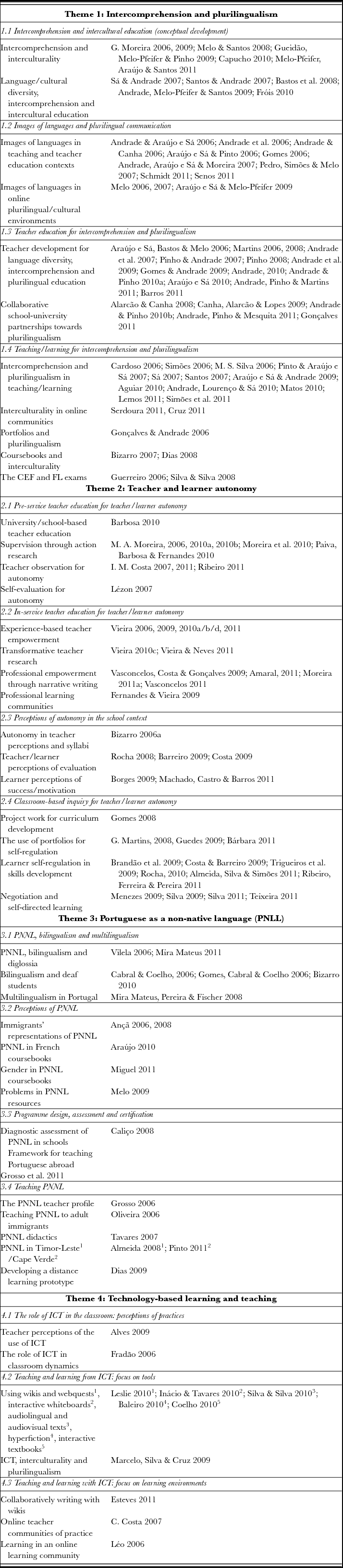
For each theme, we present a synthetic overview of the foci and purposes of inquiry, the views of FLE underpinning it, the methodological approaches used, its outcomes (findings and shortcomings/constraints) and its implications. A detailed account of how the corpus is organised into themes, sub-themes and topics is presented in the Appendix. Our approach to analysis is both descriptive and interpretative, with a focus on the transformative potential of FLE research (see Table 1). In section 4 of the paper we summarise our main conclusions about this potential and point out emerging directions for FLE research in Portugal.
3.1 Intercomprehension and plurilingualism
The first theme is covered by 60 papers that focus on the promotion of intercomprehension and plurilingualism in FLE (see Appendix). The concept of ‘intercomprehension’ is multidimensional and subject to diverse theoretical interpretations, but is broadly understood as an interactive process in which interlocutors using different languages/language varieties seek to build common understandings by resorting to and expanding their plurilingual, intercultural repertoires (Andrade, Pinho & Martins Reference Andrade, Pinho, Martins, Pinho and Andrade2011: 59–60). Although intercomprehension can be seen as a sub-dimension of a plurilingual approach, the studies reviewed give prominence to both concepts, the former being explored primarily in relation to language/culture diversity and intercultural education. For these reasons, in labelling this theme we decided to keep both concepts in the given order.
European advances in language education policies, in particular the Common European Framework of Reference for Languages (Council of Europe 2001) and the European Language Portfolio (www.coe.int/t/dg4/education/elp), had an impact on national policies and research, encouraging attention on plurilingualism and intercultural competence in the school context. Language learning is seen as a lifelong task and language education is aimed at providing opportunities for contact with diverse languages and the development of a plurilingual competence based on the expansion of a linguistic repertoire in which all linguistic abilities interrelate and interact (Council of Europe 2001: 4–5).
According to two reviews of language didactics research (FL/NL) in Portugal before 2006, covering national and international publications and unpublished master and doctoral dissertations (Alarcão et al. Reference Alarcão, Andrade, Moreira, Sá, Pereira, Canha, Ançã, Araújo e Sá, Cardoso, Geraldi, Gamito and Pinto2004; Alarcão Reference Alarcão and Bizarro2008, Reference Alarcão2011; Alarcão & Araújo e Sá Reference Alarcão and Araújo e Sá2010; Alarcão et al., Reference Alarcão, Andrade, Araújo e Sá, Melo-Pfeifer and Santos2010), this has been an expanding research theme. The latest review involved a selective analysis of national and international publications reporting on empirical studies (n = 113) and the abstracts of M.A. (n = 130) and Ph.D. (n = 17) dissertations produced between 1996 and 2006 in the field of FL/NL research. One of the conclusions refers to a growing focus on ‘languages’ or ‘plurilingualism’ didactics (Alarcão & Araújo e Sá Reference Alarcão and Araújo e Sá2010: 47–48). According to this study, ‘plurilingualism didactics’ is intended to give prominence to cross-curricular educational and social values and competences. Intercomprehension and plurilingualism are seen as pillars for a renewed understanding of language didactics (Alarcão et al. Reference Alarcão, Andrade, Araújo e Sá, Melo-Pfeifer and Santos2010: 24).
This line of research integrates FL pedagogy and FL teacher education. It has been conducted mainly in one university (Aveiro), in close association with teacher education programmes and European projects, two of which were coordinated there: ILTE (Intercomprehension in Language Teacher Education, 1998–2002) and Galapro (Trainer Development for Intercomprehension in Languages, 2008–2010). The university team runs a small unit created in 1999 that integrates young researchers (non tenure-track postgraduate students) – LALE (Laboratório Aberto para a Aprendizagem das Línguas Estrangeiras/Open Laboratory for Learning Foreign Languages) – and edits a regular publication that disseminates work done in the unit (Cadernos do LALE).
Within this theme four sub-themes were identified:
• Intercomprehension and intercultural education (conceptual development)
• Images of languages and plurilingual communication
• Teacher education for intercomprehension and plurilingualism
• Teaching/learning for intercomprehension and plurilingualism.
Overall, the papers that were analysed have three major purposes:
a. Justifying the linguistic, cultural, social and political relevance of a plural approach to language education in which learners acquire intercultural competence and develop communicative repertoires in a multi/cross-linguistic perspective;
b. Investigating teacher education and pedagogical contexts and resources to see how intercomprehension and plurilingualism are understood (perceptions) and enacted (practices) in learning environments;
c. Proposing, developing and evaluating practical approaches in teacher education and pedagogical contexts that promote intercomprehension and plurilingualism.
These purposes have a transformative potential, as they challenge dominant monolinguistic approaches and propose more plural and inclusive ways to teach and learn languages, with implications for teacher education. Developing appropriate teacher education curricula has been a major concern within this theme, with a focus on the concept of intercomprehension (Andrade, Pinho & Martins Reference Andrade, Pinho, Mesquita and Silva2011).
The researchers’ stance within this theme is based on a diverse theoretical background that draws on various disciplinary fields from educational and language sciences. Current European language policies on plurilingualism are also a major source of reference, and the significant increase in immigration is also invoked to justify a plural, inclusive approach in schools. Language education is seen as an opportunity to develop cultural and linguistic awareness, intercultural competence, inclusiveness, citizenship and social cohesion in a globalised world. A major constraint on these educational goals is the fact that languages are independent subjects in school curricula, which means that a multi/cross-curricular approach is advocated to reach across language barriers and promote language/cultural awareness and the plurilingual development of language skills, as well as the integration of language issues in other school subjects.
Research within this theme is clearly intended to instigate pedagogical change. Its focus has progressively shifted from theoretical developments and the investigation of languages in face-to-face and online multilingual environments to teacher education and teaching strategies. A more marginal development is the direct collaboration between researchers and schoolteachers within a school-based approach to the promotion of plurilingualism. Two small-scale projects were developed as part of Ph.D. studies in 2004–2007 (Canha Reference Canha2012, not considered in this review, but see Alarcão & Canha Reference Alarcão, Canha, Cardoso, Martins and Paiva2008; Canha, Alarcão & Lopes Reference Canha, Alarcão and Lopes2009) and in 2004–2006 (Gonçalves Reference Gonçalves2011), involving collaboration between one or more academics and a small group of teachers in one school. The first project inspired the development of a larger project – Línguas e Educação/Languages and Education (2007–2010) – which involved setting up a professional learning community in which 20 university-based researchers/teacher educators worked in sub-teams with 50 FL/NL schoolteachers for one year, developing 15 action research projects in a number of schools (Andrade & Pinho Reference Andrade and Pinho2010b). The results of these collaborative projects show that university–school partnerships can promote change and should be expanded. Nevertheless, they also show that there is a difference between research and teacher development goals and that working with teachers entails a shift from academic to school interests and a greater consideration of the constraints affecting FLE and the involvement of schoolteachers in pedagogical inquiry. Furthermore, when the projects ended, the university–school partnerships also came to an end, though two small-scale projects have been started in individual schools as an extension of the last project (Andrade, Pinho & Mesquita Reference Andrade, Pinho, Mesquita and Silva2011). Overall, there have been difficulties in sustaining inter-institutional partnerships beyond the lifespan of the projects and this can be seen as limiting their transformative potential.
Most empirical research on this theme is undertaken within the compulsory school (grades 1 to 12) and teacher education programmes within the university by university-based researchers belonging to LALE and schoolteachers enrolled in postgraduate programmes. Most takes the form of descriptive or intervention case studies in which dominant FL teaching/teacher education practices are scrutinised and alternative approaches are explored. Intervention studies are more directed towards change than descriptive studies, but both take a critical stance towards educational contexts, seeking to challenge the absence of a plurilinguistic framework for pedagogical action. Established practices in coursebooks and external exams, for example, reveal that there is still a long way to go before European language policies are implemented (Guerreiro Reference Guerreiro2006; Bizarro Reference Bizarro2007; Dias Reference Dias2008; Silva & Silva Reference Silva and Silva2008). Teachers’ and learners’ views of languages and cultures tend to be ethnocentric, stereotyped, instrumental and monolithic, requiring interventions that sensitise them to intra/interlinguistic and intra/intercultural diversity (e.g. Andrade, Araújo e Sá & Moreira Reference Andrade, Araújo e Sá and Moreira2007; Pinho & Andrade Reference Pinho, Andrade and Capucho2007).
The languages primarily involved in the studies are English, German and languages from the Romance group (e.g. French, Spanish, Catalan, Italian, Latin and Portuguese). Although the national curriculum only includes four languages, researchers have explored teacher/learner sensitisation towards other languages (including minority languages) as a way of expanding linguistic repertoires and encouraging the development of intercultural/plurilingual competences. Online environments, such as chats, involving teachers and learners from different countries, are seen as particularly useful in encouraging and promoting language/cultural awareness, intercomprehension and teacher–student involvement in collaborative projects (e.g. Cruz Reference Cruz2011; Serdoura Reference Serdoura2011). In teacher education contexts, (prospective) teachers’ participation in, and analysis of, multilingual communication environments helps them understand how intercomprehension develops between interlocutors, what images of languages emerge and what strategies are used to overcome communication breakdowns. Discourse and materials analysis is used as a major strategy to sensitise teachers to plurilingualism, not only in formal teacher education programmes but also in self-directed professional learning (e.g. Andrade & Pinho Reference Andrade and Pinho2010a).
Empirical research methodologies are mostly naturalistic (sometimes of an ethnographic nature), assuming a close relation between the researcher's stance and the purpose, context and results of inquiry. This is in tune with the intention to understand and transform local representations and practices, though the researcher is often an outsider rather than a participant action researcher, which may limit the impact of change.
Qualitative and quantitative methods are used to analyse data collected from questionnaires, interviews, observation, audio/video/online recordings of discourse, reflective records (e.g. portfolios, language biographies and life histories) and official documents (e.g. policies, coursebooks and syllabuses). Data collected from participants play an important role in the analysis of educational phenomena, although many of the studies treat the participants as informants rather than decision-makers or co-researchers.
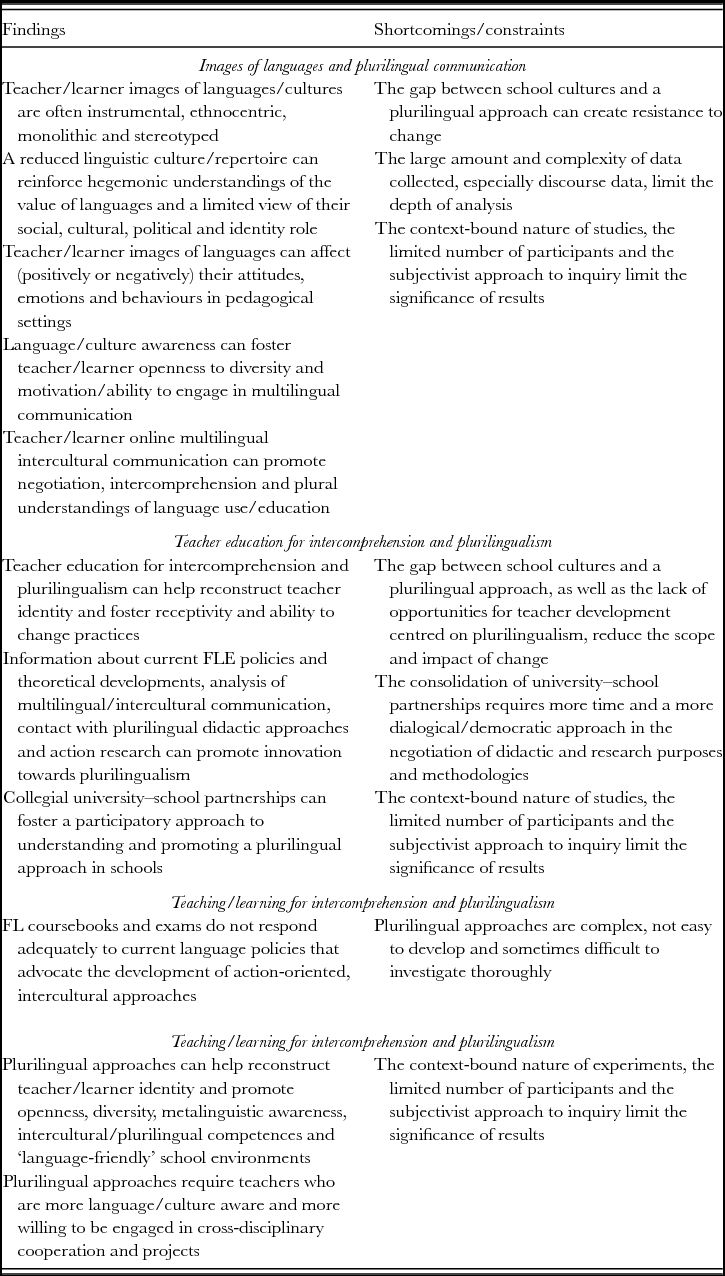
Table 2 points out the chief outcomes (findings and shortcomings/constraints) of these empirical studies as regards images of languages, teacher education and classroom-oriented inquiry.
Intercomprehension and plurilingualism: Outcomes
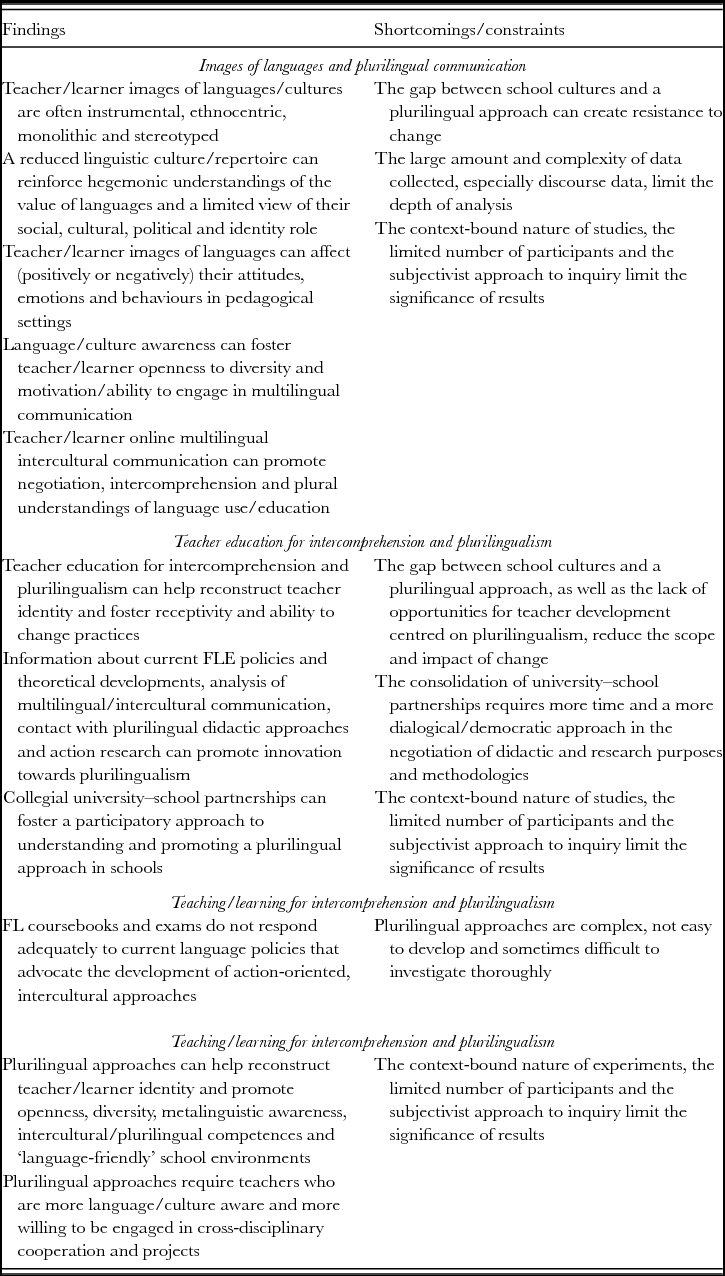
Descriptive studies signal the need for change, while intervention studies illustrate change. Despite the positive results achieved by intervention studies towards a plurilingual approach, limitations are imposed by the gap between the desired approach and established school cultures. Melo-Pfeifer, Araújo e Sá & Santos (Reference Melo-Pfeifer, Araújo e Sá, Santos, Pinho and Andrade2011) outline 12 ‘myths’ in a European teacher development project (Galapro 2008–2010) that should be dismantled if a plurilingual approach is to be developed in schools. These myths relate to a limited, rigid view of languages, language teachers and language education, which, according to these and other authors, should be replaced by a more open understanding of the language curriculum, whose main purpose should not be to teach languages but rather to educate for, and through, languages.
Naturalistic inquiry also limits the significance of results, although that approach does not claim universal validity, but, at best, plausible transferability to similar contexts. One way to increase the significance of results within this line of research has been the publication of review studies focused on different aspects of long-term projects (e.g. Andrade & Araújo e Sá Reference Andrade and Araújo e Sá2006; Andrade, Pinho & Martins Reference Andrade, Pinho, Mesquita and Silva2011; Andrade, Pinho & Mesquita Reference Andrade, Pinho, Mesquita and Silva2011; Simões et al. Reference Simões, Lourenço, Sá, Sá, Pinho and Andrade2011). This strategy can reinforce the transformative potential of research, as it provides participants and readers with syntheses of the research undertaken and proposals for further developments.
The implications and recommendations pointed out by the authors relate in particular to the need for further research to confirm or expand findings, and teacher education programmes that prepare teachers for a more plurilingual approach in schools. More collaboration between university researchers/teacher educators and schoolteachers is also advocated. Policy recommendations in empirical studies are rather scarce, though the approach suggested seems to imply a radical change in language curricula. This line of research is strongly supported by European policies but less so by national policies. A more critical stance towards the latter might therefore be expected, in order to enhance the transformative potential of research.
As stated above, research on this theme has been promoted mostly by one university, which indicates that it is not widely studied despite the large number of related dissertations and publications. The movement towards school–university partnerships may be a promising road for expanding not only research but also, and perhaps more importantly, school-based experimentation. Nevertheless, consolidating such partnerships appears to have been rather difficult so far and to require a more flexible approach in which the schoolteachers’ working cultures and agendas can be more fully acknowledged and accommodated.
3.2 Teacher and learner autonomy
The second theme refers to a group of 43 texts that focus on teacher and/or learner development towards autonomy (see Appendix). Concerns with autonomy in FLE in Europe date back to Holec's seminal paper ‘Autonomy and foreign language learning’ (Council of Europe 1981, first published in French in 1979) and have informed language policies since then, although the Common European Framework of Reference for Languages (CEFR, Council of Europe 2001) prioritises plurilingualism as a means of enhancing intercultural communication and mobility across Europe. Autonomy has been identified in previous national literature reviews, although less frequently than the first theme and only in connection to FL, not NL, didactics.
This line of research integrates FL pedagogy and FL teacher education. Like the first theme, it has been conducted mostly in one university (Minho) and primarily associated with local projects that involve pre-service and in-service/postgraduate teacher education. Since 1997, the university team has coordinated a multidisciplinary professional learning community that brings together schoolteachers (mostly FL teachers) and a few academic researchers/teacher educators – the GT-PA (Grupo de Trabalho–Pedagogia para a Autonomia/Working Group–Pedagogy for Autonomy). This community organises local meetings and national conferences at which the members’ work is disseminated and published in proceedings and in a regular local publication launched in 1999 (Cadernos do GT-PA).
Four sub-themes were identified within this theme:
• Pre-service teacher education for teacher/learner autonomy
• In-service (mostly postgraduate) teacher education for teacher/learner autonomy
• Perceptions of autonomy in the school context
• Classroom-based inquiry for teacher/learner autonomy
These texts have three major purposes:
a. Justifying the linguistic, pedagogical, social and political relevance of promoting teacher and/or learner autonomy in FLE by articulating reflective practice (often involving the teacher as researcher) with learner development;
b. Investigating pedagogical and teacher education contexts and strategies to find out how autonomy is understood (perceptions) and enacted (practices);
c. Proposing, developing and evaluating practical approaches in pedagogical and teacher education contexts that promote teacher and/or learner autonomy.
These purposes have a transformative potential, because they entail a critical stance towards dominant teacher/teacher educator-centred approaches and the defence of an alternative way to teach and educate teachers. A major characteristic of this theme is the authors’ commitment to democratic values in FLE, which are perceived as largely absent from professional contexts. There is a clear ideological stance about what FLE is and should be, and a clear intention to subvert dominant views and practices. Theoretical frameworks underpinning the studies relate primarily to democratic education, pedagogy for autonomy, reflective/critical teacher education, and teacher research.
Language learning is seen not only in terms of communicative development but also as a vehicle for the development of self-determination, social responsibility and critical awareness of teaching and learning processes, requiring teachers who have a critical view of language education, focus their teaching on learning, are able to identify and transcend constraints, and interact in the educational community. The interconnection between learner and teacher autonomy is a salient feature of this research theme and may enhance its transformative potential. Rather than seeing pedagogy for autonomy as the application of prescribed theories or methods, authors understand it as a co-constructed and context-sensitive phenomenon, involving teachers in reflective work with students, mainly through awareness-raising, negotiation and consensus-building in class. This explains why great emphasis is put on pre-service and in-service/postgraduate teacher education, which are two major sub-themes in the corpus, and also on teacher-initiated inquiry.
As in the first theme, the primary context in which empirical research is undertaken is the compulsory school (mainly grades 5 to 12) and teacher education. Only one study (Bárbara Reference Bárbara2011) refers to a language course in higher education (English in a biotechnology programme). As regards the FL in question, English dominates and only a few studies refer to French or German.
Non-empirical research within the corpus aims at developing ethical-theoretical frameworks for teacher education and pedagogy for autonomy. It is undertaken by a few academics/teacher educators who are also the research supervisors of most of the dissertations reviewed. Empirical research is mostly undertaken by teachers within postgraduate M.A. and Ph.D. programmes under the supervision of senior researchers, taking the form of descriptive or participant action research case studies in which autonomy-oriented approaches to FL teaching or teacher education are scrutinised or developed. Although intervention studies are more directed towards change than descriptive studies, some of the latter focus on autonomy-oriented practices in order to understand their potential and shortcomings (e.g. S. D. Silva Reference Silva2009; Moreira et al. Reference Moreira, Paiva, Vieira, Barbosa, Fernandes and Vieira2010; Paiva, Barbosa & Fernandes Reference Paiva, Barbosa, Fernandes and Vieira2010; J. B. Silva Reference Silva, Vieira, Oliveira, Morgado, Almeida, Moreira, Melo and Alves2011; Vieira & Neves Reference Vieira, Neves and Silva2011) and both take a critical stance towards educational contexts by challenging transmissive approaches.
The fact that around 80% of the authors are in-service schoolteachers is evidence of their involvement in the production and dissemination of educational knowledge within this theme. Teacher participation in research directed to educational change may have a transformative potential because it counteracts the traditional divide between theory and practice, research and teaching, knowing and doing. In pre-service and in-service/postgraduate programmes in which some of the authors act as teacher educators, teacher research is understood as an ideological activity that should lead to the questioning of ineffective educational practices and support teacher empowerment towards the exploration of autonomy in schools (Barbosa Reference Barbosa2010; Moreira Reference Moreira2010b; Moreira et al. Reference Moreira, Paiva, Vieira, Barbosa, Fernandes and Vieira2010; Vieira Reference Vieira and Vieira2010c; Vieira & Neves Reference Vieira2011). Teachers who attend postgraduate programmes are strongly encouraged and supported in the initiation of intervention pedagogical inquiry, usually taking the form of small-scale collaborative action research projects with a focus on promoting learner participation in self-regulation for skills development (Brandão et al. Reference Brandão, Ribeiro, Monteiro, Alvim and Vieira2009; Costa & Barreiro Reference Costa2009; Trigueiros et al. Reference Trigueiros, Menezes, Silva, Campos and Vieira2009; Rocha Reference Rocha2010; Almeida, Silva & Simões Reference Almeida, Silva, Simões and Silva2011; Ribeiro, Ferreira & Pereira Reference Ribeiro, Ferreira, Pereira and Silva2011).
Teacher participation in innovation towards autonomy also occurs in informal settings such as the multidisciplinary community (GT-PA) described by Fernandes & Vieira (Reference Vieira2009). This community was formed in 1997 and involves schoolteachers in self-initiated pedagogical inquiry, seeking to develop university–school partnerships and encouraging teachers to become pedagogical inquirers and partners in the construction and dissemination of pedagogical knowledge. The community is not primarily research-oriented, but some members have been engaged in research and some of the dissertations and publications in our corpus were written by teachers who belong to the group. A Ph.D. research study referred to by Fernandes & Vieira (Reference Vieira2009), conducted by the first author, was started in late 2011 with the aim of investigating the cultures and dynamics of this community, as well as the extent to which it fosters teacher empowerment towards pedagogy for autonomy in schools.
This theme also integrates self-study research into pre-service and in-service/postgraduate teacher education practices. For example, Barbosa (Reference Barbosa2010), Moreira (Reference Moreira2011b) and Vieira et al. (Reference Vieira, Moreira, Barbosa, Paiva and Fernandes2010) present studies undertaken in different teacher education contexts where the authors were involved as teacher educators and researchers, thus illustrating an approach to teacher education that is intended to add coherence to and enhance the transformative potential of the work undertaken, by developing and validating democratic ethical-conceptual frameworks that can guide FL teacher education, teaching, and research into FL teaching and teacher education.
Empirical research methodologies are naturalistic, like those in the first theme, assuming a close relation between the researcher's stance and the purpose, context and results of inquiry. This is in tune with the intention to question and transform local discourses and practices. Qualitative and quantitative methods are used to analyse data collected from questionnaires, interviews, observation, audio/video recordings of discourse, reflective records (e.g. journals, portfolios, narratives) and official documents (e.g. policies and syllabuses). Data collected from participants (teachers and/or learners) are given prominence in the analysis of educational phenomena, and the participants’ role in intervention studies is quite active, as they are asked to take part in decision-making, self-regulation and the evaluation of interventions. Nevertheless, they do not assume the role of co-researchers.
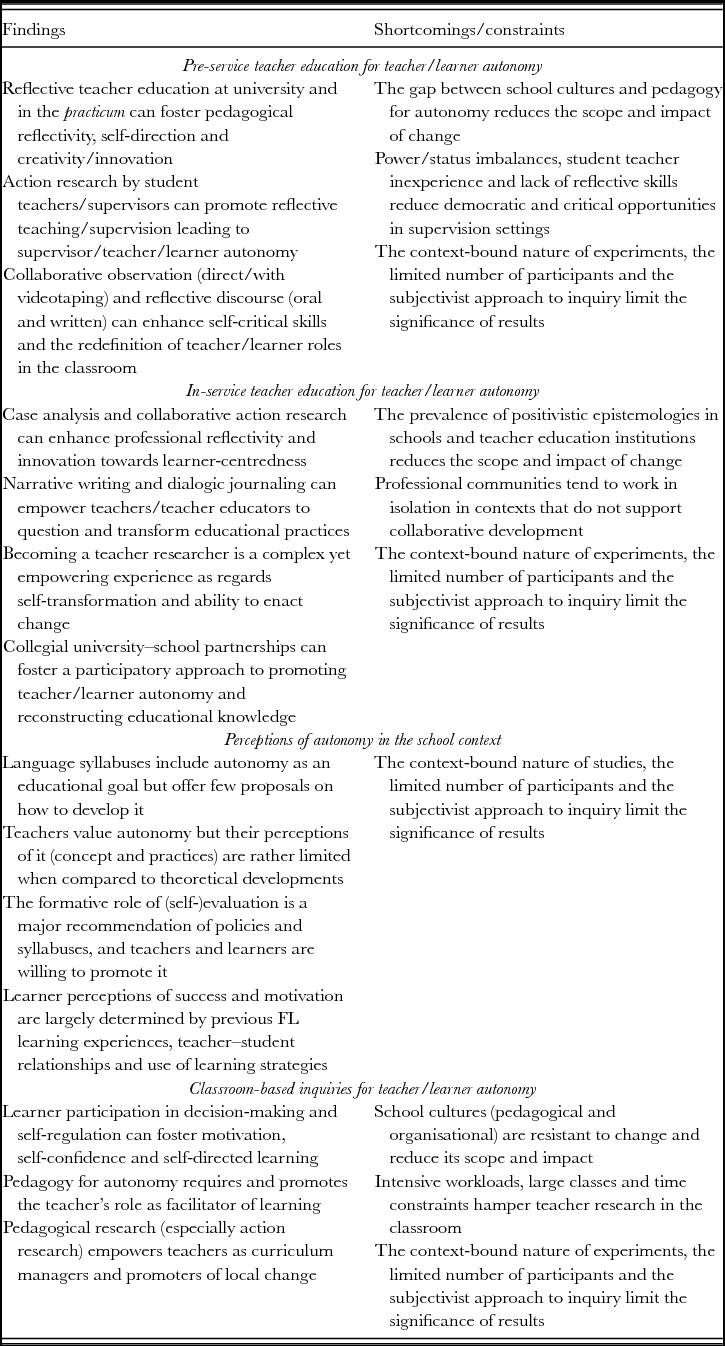
Table 3 summarises the chief outcomes (findings and shortcomings/constraints) of the empirical studies in the four sub-themes identified.
Teacher and learner autonomy: Outcomes
As in the first theme, descriptive studies signal the need for change, whereas intervention studies illustrate change, the main difference being that in this theme there is a greater focus on teacher agency and on what FLE should be rather than on what it is. For example, all intervention studies involve participant action research, and some descriptive studies focus on exemplary practices in order to highlight their potential and constraints.
Despite the positive results achieved in intervention studies as regards learner/teacher autonomy, constraints are noted, relating primarily to the gap between established pedagogical and organisational cultures and the proposed approaches. Moreover, intensive workloads, large classes and time constraints hamper teacher research in the classroom. Limitations to the significance of findings resulting from naturalistic inquiry are also mentioned, although this kind of inquiry does not necessarily assume universal applicability.
The possibility of transfer of methodologies and results to similar contexts is pointed out by most authors, and there are efforts to articulate different studies within postgraduate programmes so as to increase the significance of results. For example, Paiva, Barbosa & Fernandes (Reference Paiva, Barbosa, Fernandes and Vieira2010) report on and compare one intervention and two descriptive case studies conducted by them at the same time in one teaching practice context. The three researchers examined different aspects of pre-service teacher development towards teacher/learner autonomy: collaborative observation, supervisor discourse and student teacher reflective writing. Barreiro (Reference Barreiro2009) and M. M. Costa (Reference Costa2009) undertook two parallel studies with a group of FL teachers in their school, investigating perceptions of and promoting formative (self-) evaluation as a requisite for autonomy; yet another example can be found in classroom-based research, where one action research study conducted by Menezes (Reference Menezes2009) to promote self-directed learning was simultaneously investigated by S. D. Silva (Reference Silva2009) from an outsider perspective with a focus on negotiation processes, and later expanded in another action research study on negotiation for self-directed learning (Teixeira Reference Teixeira2011). A follow-up study was conducted by J. B. Silva (Reference Silva, Vieira, Oliveira, Morgado, Almeida, Moreira, Melo and Alves2011) in order to compare teacher and learner perceptions of self-directed learning in the teaching approach developed by Menezes after she concluded her dissertation. This kind of networking can increase the transformative potential of teacher research by reducing the fragmentation of knowledge without entailing a replication model that is perhaps more typical of academic agendas aimed at expanding areas of knowledge within postgraduate programmes. Indeed, many texts defend and illustrate the empowering effect of teacher research based on real pedagogical concerns rather than on external agendas.
The implications and recommendations pointed out by the authors relate to further research that confirms or expands their findings, pedagogical practices that increase reflective teaching for learner-centeredness, and teacher education approaches that promote professional empowerment. However, policy recommendations are scarce, probably because autonomy has long been established as an educational goal at the level of official discourse. In fact, innovative approaches are perceived to be in tune with progressive policies, but the authors often voice discontent towards the absence of conditions that can enable those policies to be put into practice. To a certain extent, this view leaves policies unchallenged, when in fact they could be questioned for not being directed at changing existing conditions.
As with the first theme, research on teacher/learner autonomy has been promoted mostly by one university, which indicates that it is not a widespread research area. It seems to be directly dependent on a few academic researchers/teacher educators who have worked in this area for a long time, seeking to bring it to the attention of schoolteachers and the teacher educators who work with them. The professional learning community referred to (Fernandes & Vieira Reference Fernandes, Vieira and Vieira2009) indicates a desire to extend autonomy in schools through teacher-initiated inquiry, even though the group is not primarily research-oriented.
3.3. Portuguese as a non-native language
The third theme relates to Portuguese as a non-native language (PNNL) and is covered by 19 texts in the corpus (see Appendix). PNNL is the official designation used in Portugal for all the situations that involve the teaching and learning of Portuguese as L2, FL and heritage language. PNNL became a significant phenomenon back in the 1980s after the arrival of immigrants from the former Portuguese colonies in Africa, following the 1974 revolution that ended 48 years of dictatorship. As the official language of those countries (Angola, Mozambique, Cape Verde, S. Tomé e Príncipe and Guiné-Bissau) was Portuguese, the students that entered the Portuguese educational system were not regarded as bilingual. The same had been happening to the Roma and Traveller communities and to the deaf (only in 1997 was Portuguese Sign Language recognised as an official language). In recent decades immigration, especially of those coming from eastern European countries, Brazil and China, has greatly increased.
The governmental organisation ACIDI (Alto Comissariado para a Imigração e Diálogo – Intercultural/High Commissioner for Immigration and Intercultural Dialogue) has been active in the promotion of information on access to public services, financial support for programmes and projects for intercultural education, integration and inclusion for immigrants and ethnolinguistic communities, as well as language courses for immigrants (e.g. the programme Português para Todos/Portuguese for All). Professional organisations such as the APP (Associação de Professores de Português/Portuguese Teachers’ Association) and the APEDI (Associação de Professores para a Educação Intercultural/Association of Teachers for Intercultural Education) have also been active in the dissemination of information and in the organisation of meetings and conferences (the first national conference on PNNL was organised by the APP in 1999). Nevertheless, research and teacher education programmes in this area are still scarce. They have been conducted in a range of universities, especially those of Lisbon, Oporto and Aveiro.
This is a recent field of inquiry and not much is known about the school population, informal schooling contexts, teachers’ qualifications or the needs of a highly diverse target population that includes foreigners as well as nationals, children as well as young adults and adult learners, immigrants, and learners living not only in Portugal but elsewhere. Most studies in our corpus have a descriptive purpose and are designed to problematise the current status of teaching and learning PNNL both in Portugal and abroad. The studies aiming at intervention explore ways to develop bilingual programmes or teaching approaches that are task-based, action-oriented and communicative.
The researchers’ stance is based on a diverse conceptual background that draws on various disciplines, including sociology, philosophy, educational policy studies and language sciences. As in the first theme, current European language policies for intercomprehension, plurilingualism and intercultural awareness are a major source of reference, especially the CEFR (Council of Europe 2001). Multi/intercultural perspectives are evoked to promote inclusiveness, citizenship and social cohesion in a globalised Portuguese-speaking world. Although we find some connections between this and the first theme in terms of their conceptual frameworks, their focus is rather different: in the first theme there is a move from monolingual to plurilingual FL education whereas the main concern for PNNL is with a particular language, its status as a non-native language in diverse, multilingual contexts, and the need to foster bilingual approaches in those contexts or to revise the way materials and resources are designed and offered and teacher training is conducted. The research settings can be diverse, as PNNL is a global language, an official language (e.g. in Cape Verde and Timor-Leste) and a language learnt in countries with a significant presence of Portuguese communities resulting from emigration, such as France (mainly as a heritage language).
Four sub-themes were identified:
• PNNL, bilingualism and multilingualism
• Perceptions of PNNL
• Programme design, assessment and certification
• Teaching PNNL
The texts reviewed have five major purposes:
a. Describing the current situation of multilingualism and of PNNL learners in diverse (school) contexts, as well as the situation of PNNL teachers;
b. Establishing and describing a common reference framework for teaching PNNL, as well as appropriate assessment tools and certification;
c. Analysing materials and resources to find out how well they align with the plurilingual and intercultural approaches advocated by both national and international educational policies;
d. Justifying the linguistic, cultural, social and political relevance of a bilingual approach to language education in Portugal and in Portuguese-speaking countries;
e. Trying out approaches to and methodologies for the teaching of PNNL in a variety of settings.
Most empirical research is undertaken in the context of compulsory schooling in Portuguese-speaking countries (grades 1 to 12), and mostly by teachers enrolled in postgraduate programmes, in the form of descriptive, small-scale case studies in which dominant teaching/teacher education practices are scrutinised. Intervention studies combine experimentation with task-based, action-oriented, communicative approaches, or explore bilingual teaching and appropriate learning and assessment materials, accompanied by teacher training. Data are collected from questionnaires, interviews, document analysis and classroom observation. In the majority of the studies, the researcher is a non-participant, and teachers and learners act as informants.
Despite the fact that most research studies have descriptive and not intervention purposes, they have transformative potential for teaching and learning contexts, as they challenge the dominant representations of Portugal as a monolingual country and of schools as monolingual settings. The studies emphasise the global status of the Portuguese language, remind us that there are three official languages in the country (Portuguese, Mirandese and Portuguese Sign Language), characterise the growing diversity of its sociolinguistic landscape, promote a growing awareness of the richness of multilingualism in schools and develop appropriate PNNL teaching approaches and learning materials. They also problematise the direct transfer of approaches used to teach/learn Portuguese as a NL (Almeida Reference Almeida2008; Melo Reference Melo2009) or of NL teachers’ competences and profile (Grosso Reference Grosso, Bizarro and Braga2006; Vilela Reference Vilela and Bizarro2006) to the highly diverse, globalised contexts of PNNL teaching and learning.
The team from the University of Lisbon carried out between 2003 and 2007 the most comprehensive national study of PNNL (Mira Mateus, Pereira & Fischer Reference Mira Mateus, Pereira and Fischer2008). Based on a survey undertaken in 410 basic education schools in the Lisbon area, the authors mapped linguistic diversity in schools in that area, where they found 58 languages spoken. They also studied the linguistic production of several PNNL students in order to draw out the implications for the preparation of teachers and the production of materials. Following this study, an intervention project on bilingualism in the Portuguese context coordinated by Dulce Pereira – Bilinguismo, Aprendizagem do Português L2 e Sucesso Educativo/Bilingualism, PL2 Learning, and Educational Success – was carried out between 2008 and 2010, involving the production of materials for PNNL and bilingual teaching in a primary school (one class) in both Portuguese and Cape Verdian Creole (see Mira Mateus Reference Mira Mateus2011).
Some of the studies focus on PNNL teaching and teacher education in Portuguese-speaking countries. For example, Pinto (Reference Pinto2011) studies the situation of PNNL teaching in Cape Verde and draws attention to the lack of appropriate resource materials, as well as to the teachers’ lack of preparation and the large class sizes. Almeida (Reference Almeida2008), analysing the situation in Timor-Leste, describes similar constraints but takes a more critical perspective by discussing the ideological and political factors engrained in a context where the official language is not a mother tongue for any of the ethnic groups. Other studies focus on the situation of immigrant groups in Portugal, seeking to understand their learning experiences with the PL and how Portuguese institutions are responding to their social, cultural and linguistic needs (Ançã Reference Ançã and Bizarro2006, Reference Ançã2008; Oliveira Reference Oliveira2006). Oliveira (Reference Oliveira2006) concludes that institutions lack the conditions needed to integrate immigrants. In spite of good pedagogical practices, there are no systematic integration strategies or sound teacher preparation programmes.
The fact that we identified only three texts on bilingual education for deaf people (Cabral & Coelho Reference Cabral, Coelho, Bizarro and Braga2006; Gomes, Cabral & Coelho Reference Cabral, Coelho, Bizarro and Braga2006; Bizarro Reference Bizarro, Bizarro and Moreira2010) demonstrates the scarcity of research in this area. The research that has been carried out shows the need for a paradigm shift, as the education of deaf people has traditionally been seen from a deficit, rehabilitative point of view that treats them as ‘special needs’ people rather than as members of a linguistic minority. The authors argue for equal rights for deaf and hearing people, as the prevailing ethnocentric educational model restricts the former's access to social places and roles, and thus to full citizenship. Teacher preparation is a major constraint, as the national legislation does not recognise the need for a specific profile for PNNL, including a profile for Portuguese Sign Language. There is a pressing need for more studies on bilingual and bicultural models and the preparation of more qualified teachers and better resources.
The papers on programme design, assessment and certification (Caliço Reference Caliço2008; Grosso et al. Reference Grosso, Soares, Sousa and Pascoal2011) are not based on empirical data and describe a framework for the teaching and learning of PNNL in terms of levels of proficiency, learning outcomes, communicative competences, activities, resources and assessment procedures. They are based mainly on the work of the Council of Europe (CEFR and European Language Portfolio) and ALTE (Association of Language Testers in Europe), but also question the alignment of that work with national legislation and curricula and the direct transfer of European descriptors into a highly diverse worldwide field of application.
The researchers’ proposals for programme design, assessment and certification, as well as the analysis of coursebooks and the practices of PNNL teaching/learning, conform to an action-oriented, task-based approach that includes the development not only of linguistic and communicative competences (Oliveira Reference Oliveira2006; Tavares Reference Tavares2007; Dias Reference Dias2009; Pinto Reference Pinto2011), but also of sociocultural knowledge and citizenship within a critical gender analysis perspective (Almeida Reference Almeida2008; Miguel Reference Miguel2011) and a holistic view of content, methodology and evaluation proposals (Araújo Reference Araújo2010). PNNL education is seen as capable of supporting a major shift in social and cultural representations of the self and other, viewing language and cultural diversity as among the democratic values of a globalised citizenship.
Some studies aim to transform concrete learning situations. The project on dual-language education (Mira Mateus Reference Mira Mateus2011) presents a proposal for changing traditional teaching that undervalues learners’ home languages. Dias (Reference Dias2009) built a prototype for an 80-hour course for adult foreign students using Information and Communication Technologies (ICT), showing that it is possible to use distance education technologies with PNNL learning, within a communicative, task-oriented approach. Pinto (Reference Pinto2011) argues that such an approach increases diversity and motivation for learning, as well as for teaching.
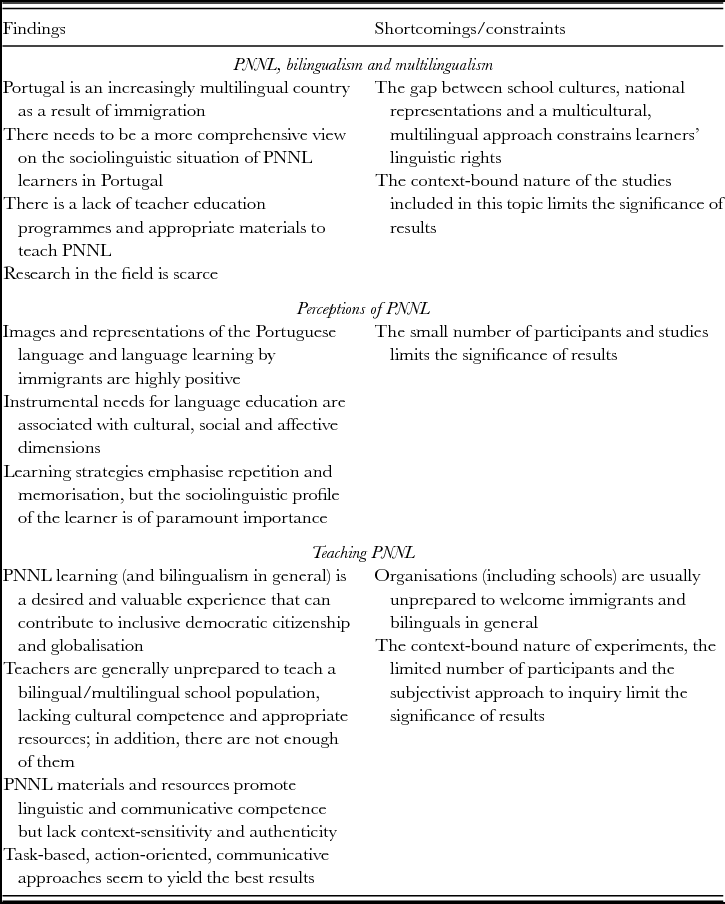
Table 4 summarises the chief outcomes (findings and shortcomings/constraints) of the empirical studies in three of the four sub-themes identified (there were no empirical studies related to the sub-theme of programme design, assessment and certification).
Portuguese as a non-native language: Outcomes
In sum, as already mentioned, descriptive studies signal the need for more intervention studies and educational innovation at the policy and practical levels. Several goals for the future are identified: map the sociolinguistic situation of PNNL students and deaf learners in Portugal; develop learners’ communicative and intercultural competences in a culturally relevant and socially appropriate way; produce appropriate materials and resources for the teaching and learning of PNNL; and invest in pre-service and in-service teacher education programmes and projects aimed at preparing teachers to deal with a linguistically and culturally diverse population of school children and adult learners.
3.4 Technology-based FL learning and teaching
This theme is covered by 11 texts in the corpus (see Appendix) and relates to the use of ICT in FLE, a research area that is clearly more influenced by global technological advances and general educational policies than by theoretical frameworks specific to language education. Although some studies from other themes also include the use of ICT, their focus and purpose is more language-specific. On the other hand, although some concerns are shared by this and other themes (e.g. learner-centeredness), here the focus is primarily on how ICT can promote innovation rather than how particular views of FLE can be enhanced.
Since the mid-1980s computers have been available in Portuguese schools for educational purposes, especially as a result of the Minerva Project (1985–1994), financed by the Ministry of Education. More recently, as a result of European recommendations and the goals of the Lisbon Strategy for technological expansion in schools (www.estrategiadelisboa.pt), schools have been better equipped with new hardware and software and some training of teachers in its use has been carried out. The European Framework for Key Competences for Lifelong Learning (2007) also seems to have had an impact on national policies as regards the need to support the development of lifelong learning competences, including ICT skills. As a result of these developments, ICT is now emerging as a field of research in all academic subjects, including FLE, although, given its close connection with advances unrelated to particular disciplines, it is not conducted exclusively within the area of didactics.
Three sub-themes were identified within this theme:
• The role of ICT in the classroom: perceptions of practices
• Teaching and learning from ICT: focus on tools
• Teaching and learning with ICT: focus on learning environments
These sub-themes reflect Jonassen's (Reference Jonassen2000) chronological typology for the introduction of digital technologies in schools. Each of the three phases indicated by Jonassen depends on the learning theory that supports classroom learning strategies, and on the kind of relationship established between learners and technology: learning ‘from’ computers, learning ‘about’ computers (not found in this review), and learning ‘with’ computers. This last phase emphasises the value of flexible curricula, learner-centeredness, socio-constructivism as the privileged learning theory, self-directed learning and authentic formative assessment (Reeves Reference Reeves1998; Jonassen Reference Jonassen2000; Peralta & Costa Reference Peralta and Costa2007; Costa, Peralta & Viseu Reference Costa, Peralta and Viseu2008).
The texts analysed have three major purposes:
a. Justifying the pedagogical, social and political relevance of using ICT in FLE by articulating reflective practice with learner development;
b. Investigating pedagogical contexts and strategies to see how ICT tools and environments are understood (perceptions) and enacted (practices);
c. Proposing, developing and evaluating practical approaches in pedagogical and professional development contexts that provide new insights on learning from/with ICT.
These purposes have a transformative potential because they entail the exploration of new media for enhancing learner-oriented approaches that may develop pedagogical roles and processes. ICT is seen not only as a tool for language learning but also as a vehicle for the development of digital skills, self-direction, critical thinking, collaboration and awareness of teaching and learning processes, requiring teachers who are more open to new modes of instruction, less dependent on pre-defined materials and more able to manage curricula flexibly, focus teaching on learning and interact in the educational community. However, unlike other themes, the emphasis is not on teacher education but on language activities mediated by digital technologies supported by specific tools or digital environments. This may limit transformation, since the use of ICT with clear educational purposes requires critical teacher development in order to avoid an unprincipled approach that emphasises the medium of instruction rather than its purpose and the quality of learning.
The primary research context is the elementary and secondary school (grades 7 to 12), though one study was carried out in a primary school (Marcelo, Silva & Cruz Reference Marcelo, Silva and Cruz2009); another entailed the creation of a community of practice formed by EFL teachers (C. I. Costa Reference Costa2007), which is also the only one that focused on teacher development within this theme. Most studies deal with English teaching, with a few references to French and Creole.
Empirical research is mostly conducted through case studies with a naturalistic design that assumes a close relation between the researcher's stance and the purpose, context and results of inquiry. Most studies incorporate both description and intervention, illustrating examples of what the different authors, for different reasons, consider as good, significant or innovative ways to teach and learn a foreign language from/with ICT. The experiments are local, but the transferability of findings, tools and methodologies to similar contexts is often mentioned.
Most empirical research is undertaken by teachers within postgraduate programmes, some of them researching their own practice (Léo Reference Léo2006; C. I. Costa Reference Costa2007; Esteves Reference Esteves and Silva2011), acting as reflective practitioners, making their practice explicit, describing, interpreting and, sometimes, evaluating it. Data are collected from observation (direct, indirect and participant), questionnaires, interviews, field notes, digital environments and official documents (e.g. policies and syllabuses). There is only one quantitative study of teachers’ perceptions of ICT based on a survey questionnaire (Alves Reference Alves2009).
Central to this theme is a concern with innovation, seeing technologies as an opportunity to enact change in the FL classroom. Innovation varies from learning from technologies by using specific tools or software, with the overall aim of trying new pedagogical approaches (project, task-based and self-directed learning), improving learners’ knowledge and/or competence, promoting classroom dynamics and encouraging critical reflection (Marcelo et al. Reference Marcelo, Silva and Cruz2009; Baleiro Reference Baleiro2010; Coelho Reference Coelho2010; Inácio & Tavares Reference Inácio and Tavares2010; Leslie Reference Leslie2010; Silva & Silva Reference Silva and Silva2010), to learning with technologies, which entails more radical changes, such as learning collaboratively in a community and developing self-directed learning schemes in which learners become active participants in the process of selecting strategies, solving problems and taking decisions (Léo, Reference Léo2006; C. I. Costa, Reference Costa2007; Esteves Reference Esteves and Silva2011).
C. I. Costa (Reference Costa2007) investigated how an international online community of English teachers enhanced a constructivist approach to the language curriculum and provided opportunities for collaborative professional development. Rich learning environments – the use of digital platforms and the organisation of digital communities of practice for teaching or learning foreign languages – seem to have transformative potential since they entail a deconstruction of the traditional classroom structure, with new patterns of interaction, new learning activities and new forms of curriculum development that can be negotiated and (re)constructed collaboratively by participants. This represents a radical change of roles and power distribution in language pedagogy.
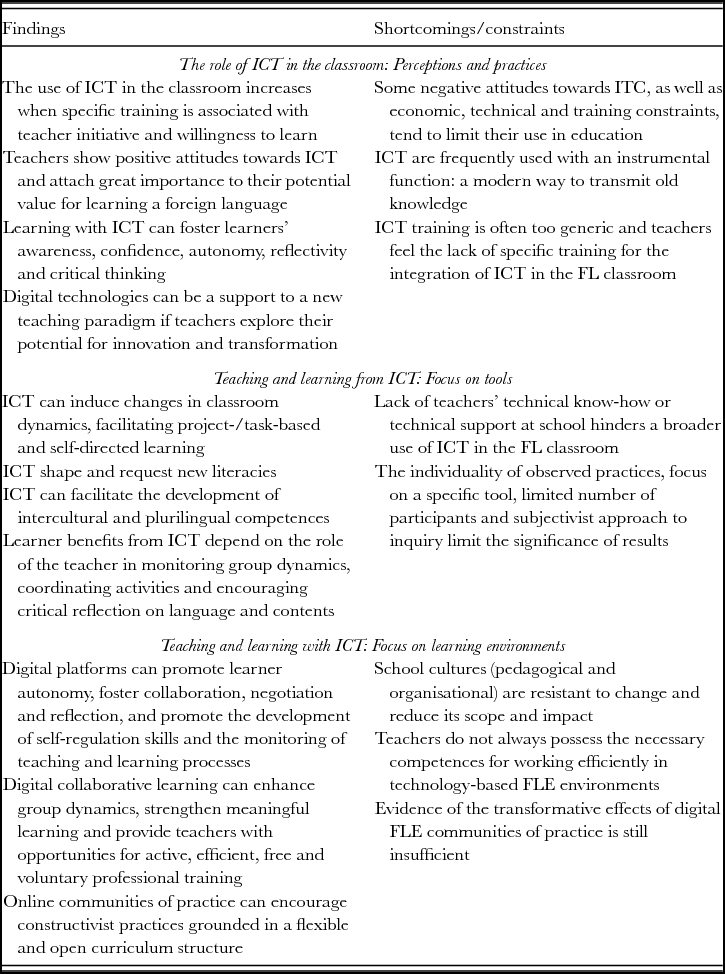
Table 5 summarises the chief outcomes (findings and shortcomings/constraints) of the empirical studies in the three sub-themes identified.
Technology-based learning and teaching: Outcomes
Like the previous themes, intervention studies show encouraging results. Any shortcomings relate mainly to the dominant school culture and the lack of appropriate teacher preparation, as well as to the context-bound nature of studies and the focus on specific tools/software. Concerns with the educational potential and outcomes of ICT are also voiced.
The implications and recommendations noted by the authors are associated with further research that confirms or expands their findings, pedagogical practices that increase the learning impact of ICT, and programmes that prepare teachers to use them more purposefully and confidently. Policy recommendations are rare, probably because the use of ICT has long been advocated in official discourses. Despite some limitations, innovative approaches are perceived to be in tune with current national and international educational policies. As in previous themes, the political implications of research outcomes are also less evident.
Digital technologies have transformed the world but, despite their transformative potential, have not yet changed the conservative structure of the classroom. As regards research on the use and impact of ICT in FLE, there is still a long way to go, and teacher education will certainly play a decisive role. It is not so much the technology as the teacher's willingness and ability to use it in a principled way that can make the difference.
4. The transformative potential of FLE research: Insights from the review
The review shows that FLE research in Portugal has been concerned with, and directed at, change in teaching and teacher education, that is, researchers focus on the social relevance of inquiry. This was already clear from previous review studies, which highlighted a growing connection between research, pedagogy and teacher education as a major characteristic of the language didactics field in Portugal (Alarcão & Araújo e Sá Reference Alarcão and Araújo e Sá2010). The fact that this field developed in close association with teacher education explains this connection and may enhance its transformative potential. Nevertheless, FL teaching in higher education has been overlooked and needs future attention.
As regards pedagogy in schools, the purposes of research within the different themes indicate the desire to challenge established practices and propose alternative approaches that respond well to educational, cross-disciplinary goals related to a more plural, inclusive and democratic understanding of language education. This can be seen to distance research from language-specific issues, but it can also be understood as an attempt to reshape FLE in the light of broad political and conceptual frameworks based on social values that are considered valid for schooling in general, thus enhancing the role of language education within the school curriculum and society at large.
Although teacher education is a central concern in FLE research in Portugal, there are some variations in the way it is understood and/or put into practice. Some approaches are primarily research-based and entail the transference of academic knowledge to teacher development programmes, aiming at sensitising teachers to specific approaches and helping them carry out change in a pre-determined direction, whereas other approaches are more concerned with promoting teacher-led, classroom-based inquiry and the exploration of pedagogy so as to empower teachers and learners as co-agents of change. The former are based on an idea of what teachers need to know, while the latter rely more on the belief that the direct participation of teachers in the construction of pedagogical knowledge is the best way to reshape their role as curriculum managers. This second perspective is particularly evident in the second theme – teacher and learner autonomy – and challenges dominant academic cultures by assuming the value of practical knowledge for teacher empowerment for change and by seeking to reshape university–school relationships as regards academics’ and schoolteachers’ roles in the production and dissemination of knowledge. This is, however, not easy to put into practice, which may explain why such partnerships are often perceived to be difficult to create and sustain, even though researchers acknowledge their value for enacting change in schools. In fact, although inter-institutional collaboration is a cross-thematic concern, it tends to develop with the purpose of expanding particular academic views and approaches, rather than as a strategy to increase teacher inquiry and community building in schools. Further efforts to expand, reshape and investigate university–school partnerships are needed. Even if these partnerships are not primarily research-oriented, they may play a decisive role in school-based change and help academics better understand what their own role might be as facilitators of innovation in schools.
We assume that the advancement of FLE depends not only on a close relation between (research on) school pedagogy and (research on) teacher education, but also on the development of a scholarship of teacher education, in which academic researchers who are also teacher educators form communities of practice to inquire into and disseminate their own pedagogies, seeking to refine coherent ethical-conceptual frameworks for FL teaching, teacher education and research. This movement is somewhat marginal, which suggests that academic teacher educators still resist investigating their own practices, even when they advocate teacher research in schools. This is hardly surprising, given the rather secondary role of pedagogy in academic settings in Portugal. However, a research community for teacher education would enhance not only the development of sound pedagogies but also the coherence between teacher education and research, and would certainly empower teacher educators as reflective professionals and agents of transformation.
Although the researchers’ ideological assumptions as regards FLE vary across themes and even between texts within each theme, a critical stance towards dominant approaches in teaching and teacher education contexts is a common feature, which also accounts for the transformative potential of research, not only because it fosters innovation but also because it helps identify what can facilitate or hamper it in particular contexts. Although the proposed changes are perceived to be in tune with current international and national policies for education in general and FLE in particular, constraints related to transmissive teaching and teacher education cultures are often referred to. One often gets the impression that researchers seek to implement those policies in the face of dominant practices, which may partly explain why the implications and recommendations resulting from research are seldom of a political nature, except in the case of PNNL teaching, where the absence of appropriate policies is evident. Leaving policies unchallenged can significantly reduce the transformative potential of research. The scarcity of political implications had already been pointed out in a review study of didactics research undertaken before 2006 (Alarcão & Araújo e Sá, Reference Alarcão and Araújo e Sá2010: 42–44). Our review shows that there appears to have been no significant improvement in this regard, so we need to look more critically at this shortcoming.
First of all, researchers might address the absence of political measures that facilitate the implementation of the progressive policies they support and draw on to justify their proposals, thus questioning the progressive nature of those policies. For example, how can plurilingualism be enacted when languages continue to be isolated subjects in the school curriculum, or when English is the only mandatory language in primary school education? How can learner autonomy be developed when coursebooks are compulsory and do not focus on the students’ ability to manage learning, or when schools are not properly equipped with language resource centres? Furthermore, the fact that research tends to highlight progressive language policies should not turn researchers’ attention away from other more general policies that may act against them, such as the increasing focus on content rather than competence in current school reforms of syllabuses and external exams, the bureaucratic assessment of teachers’ performance in schools, the increasing devaluation of postgraduate training in teacher career development, the reduction of teaching time in post-BolognaFootnote 3 pre-service teacher education, or the increasing demands on academics to internationalise research and publish in English, which can lead them to overlook local problems and the dissemination of knowledge within national communities. Policies on these issues clearly affect the transformative potential of educational research, including FLE research, and should not be ignored.
Perhaps one of the most important requirements of transformative research is the transformation of research methodologies themselves, even though this aspect is not frequently discussed by the researchers in our corpus. We identified important signs of a paradigmatic shift towards context-sensitive, qualitative research designs in which teachers play a central role in the construction of educational knowledge and change. This is related to the concern with the social relevance of research and had already been pointed out as an emerging trend in previous review studies. However, the context-bound nature of descriptive and intervention studies, the limited number of participants and the subjectivist approach to inquiry limit the significance of results. Strategies should be developed to remedy this shortcoming, and we identified some important ones: descriptive review studies that systematise knowledge within long-term projects; a networking approach to teacher research that fosters the expansion and triangulation of knowledge about innovative practices; and the development of collaborative professional communities within and between schools, and between schools and universities, so as to foster the advancement of knowledge and enhance teachers’ role as critical agents of change. We believe that these strategies, together with the development of state-of-the-art review studies in the FLE field, can be extremely useful in avoiding the excessive fragmentation of research and increasing its resonance. Furthermore, the development of follow-up studies would improve our understanding of the real impact of research in the contexts where it is conducted, an aspect that has perhaps been neglected in Portugal.
While one of the conclusions of this review is that different universities tend to focus on different research themes, there seems to be consistency and continuity within themes, which is a positive note on research development. However, since FLE research is coordinated by a small academic community, the development of networks might strengthen the field by allowing researchers to make thematic connections more intentional and evident, and by facilitating the comparison and systematisation of results. Furthermore, researchers from institutions where FLE research is less developed would have more opportunities to carry out their work. Collaboration between researchers from different universities does take place, but may need to be taken a step further by increasing inter-institutional projects and communities of practice. Although we are aware of constraints related to a growing competitive environment and the pressure for internationalisation in higher education, networks are needed to enhance a greater sense of community among national researchers and increase the impact of research.
Overall, our review points out encouraging signs as regards the transformative potential of FLE research, as well as directions for enhancing that potential. Despite its limitations in terms of comprehensiveness, we hope it will help researchers attend more to the social relevance of their work, and develop more productive strategies to accomplish such relevance.
Overview of corpus: Themes and foci of inquiry (subthemes and topics)
Acknowledgements
We would like to thank the anonymous reviewers for their useful comments and suggestions, as well as Dr. Graeme Porte for his continuous support in the production of this article. We also thank all the colleagues who collaborated with us by sending their CV and publications. The second author would also like to thank the Foundation for Science and Technology for funding her sabbatical leave, which allowed her to work in this text (FCT: SFRH/BSAB/1147/2011).
Flávia Vieira (Ph.D. in Language Education, University of Minho, 1997) is full professor in the University of Minho. She works as a teacher educator and has been involved in research projects and publications in the areas of pedagogy for autonomy in foreign language education, reflective teacher education and pedagogy at university.
Maria Alfredo Moreira (Ph.D. in Language Education, University of Minho, 2001) is an assistant professor in the University of Minho. She works as a teacher educator and has been involved in research projects and publications in the areas of foreign language education, teacher supervision and action research as a teacher development strategy.
Maria Helena Peralta (Ph.D. in Curriculum Development and Evaluation, University of Lisbon, 2000) is an assistant professor in the University of Lisbon. She worked as a teacher educator and has been involved in research projects and publications in the areas of foreign language curriculum and assessment, ICT in foreign language education and research in foreign language education.