




No CrossRef data available.
Article contents
A feasibility study of Dignity Psychotherapy delivered via telemedicine
Published online by Cambridge University Press: 04 April 2005
Abstract
Objective: Dignity Psychotherapy has shown great promise as a value-affirming intervention for patients with advanced disease. We delivered the Dignity Psychotherapy intervention in a feasibility study of a series of eight cancer patients via videophone technology to deliver the therapy into their homes.
Methods: Once eligible patients were consented on this IRB-approved study, they completed baseline assessments and were scheduled to have the videophone placed in their homes. The Dignity Therapy sessions then encompassed a first session, which was transcribed and edited, followed by a second session to go over the edited transcript and allow the patient to make changes. Patients then filled out follow-up questionnaires and had the telemedicine equipment removed from their homes, and their legacy document delivered.
Results: Participants had a mean age of 56.32 years (range = 41–66, SD = 7.65) and were diagnosed with lung (n = 5, 62.5%), breast (n = 2, 25%), or colon cancer (n = 1, 12.5%). They reported overall benefit from the intervention along with a high level of satisfaction. We were able to deliver the intervention in a timely fashion, with minimal length between sessions and transcript delivery and few technical difficulties.
Significance of results: Telemedicine can greatly extend the benefits of Dignity Psychotherapy by bringing it to patients who are dying at home. Our very preliminary work suggests that delivering the intervention to patients who are too ill to leave their homes or who are in rural locations may be a feasible way to help them.
Keywords
Information
- Type
- Research Article
- Information
- Copyright
- © 2004 Cambridge University Press
INTRODUCTION
One of the great challenges facing palliative care today is how to address suffering in patients nearing the end of life, particularly suffering that derives from psychosocial, spiritual, or existential domains of patients' experience. Distress among patients with advanced cancer, based on symptoms such as pain, depression, and anxiety, has been the focus of some targeted research (Bruera et al., 1989; Mahon et al., 1990; Hopwood et al., 1991; Pinder et al., 1993; Glover et al., 1995; Northouse et al., 1995; Zabora, 1998). Patients with advanced cancer face a series of clinical complications that can have a profound impact on their lives. They often identify self-care, mobility, and role activities as the most important aspects of quality of life (Sutherland et al., 1990). The management of physical symptoms that can limit a patient's potential to stay functional in these domains is crucial. In these areas, relatively effective treatment strategies have been developed and can be applied with reasonable therapeutic efficacy (Spiegel et al., 1981, 1989; Watson et al., 1988; Bindemann et al., 1991; Decker et al., 1992; Devine & Westlake, 1995; Sheard & Maguire, 1996; Passik et al., 2002). However, few empirical studies have been conducted on how to address sources of distress arising outside of these traditional domains. One potential, empirically based approach is through Dignity Psychotherapy (Chochinov et al., 2002a, 2002b), which has shown promise as a value-affirming intervention for dying patients. Ironically, just when our patients are often most in need of such an intervention, they become less functional and are physically unable to come to the center for psychosocial interventions.
Although existential and spiritual issues have not received the same level of research attention as the strictly psychiatric entities, they are recognized as important domains in quality of life (Cohen et al., 1995). This is particularly true for those individuals with advanced cancer as their physical condition continues to deteriorate (Gotay, 1985). Interventions are needed to manage physical and psychological symptoms and to recognize the importance of the existential domain of meaning-making and of maintenance of dignity. This intervention addresses a neglected area in end-of-life care, particularly for patients with advanced cancer. Heretofore, only patients in palliative care units or those who could travel were able to receive this form of help.
Dignity Psychotherapy
Qualitative research (Chochinov et al., 2002b) has identified three major categories of dying patients' perceptions of dignity. These categories refer to broad issues that determine how individuals experience dignity as death approaches. Each of these categories contains several carefully defined themes and subthemes. The categories are: illness-related issues/concerns (issues that derive from the illness itself that threaten to impinge on the patients' sense of dignity), dignity conserving repertoire (including dignity conserving perspectives or worldview and dignity conserving practices or techniques used to bolster a sense of dignity), and social dignity inventory (the quality of interactions with others that enhance or detract from one's sense of dignity).
Dignity Psychotherapy is a newly developed intervention based on an empirical model of dignity in the dying, derived from research conducted by Dr. Harvey Chochinov's group over the last 5 years (Chochinov, 2002; Chochinov et al., 2002a, 2002b). Over 200 terminally ill patients at several sites in Canada and Australia have been enrolled in their recent studies, enabling the careful examination of various factors that either support or undermine a dying patient's sense of dignity (Chochinov et al., 2002b). The Dignity Model emerging from this work provides the foundation for the content and structure of the Dignity Psychotherapy intervention.
The psychotherapy intervention is based on the Dignity Model. As such, it incorporates those facets from this model that are most likely to bolster the dying patients' desire to live, to lessen their desire for death or overall level of distress, or to improve their quality of life. Dignity Psychotherapy sessions are taped, transcribed, edited, and the transcription returned within 2 to 3 days to the patient. The creation of a tangible product that will live beyond the patient acknowledges the importance of generativity (i.e., the notion that something of one's life will be transcendent of death) as a salient dignity issue. The immediate return of the transcript is intended to bolster the patient's sense of purpose, meaning, and worth, while tangibly demonstrating that their thoughts and words have value. In most instances, these transcripts are created for family or loved ones, and ultimately form part of a personal legacy that the patient will have actively participated in creating and shaping.
Our group has extensively studied depression, boredom, and, more recently, shame in patients with advanced cancer and has examined psychotropic medications and other interventions for these problems. We, as others, have highlighted the shortcomings of a major depression model in explaining the distress of advanced cancer. We have thus been studying various interventions to relieve distress that go beyond medications. Dignity Psychotherapy is perfectly suited for this purpose. Additionally, our group, working in palliative care in a cancer center drawing from distant and rural areas, needs to find ways to deliver these interventions to homebound patients and patients who live at a distance from the Markey Cancer Center. This intervention lends itself well to meeting this need.
Telemedicine
Telemedicine allows people in outlying, rural areas access to medical care and is becoming a more viable option in such instances, including the recent advent of reimbursement by Medicare (Gutierrez, 2001; Sumner, 2001). In addition, patients who are too ill to come to the hospital can obviously benefit from such an intervention. Often, patients who are very ill are especially lacking in support, and unfortunately mental health interventions are often the weakest link in home hospice care. The use of videophones allows us to deliver this intervention to the very ill and/or the geographically distant patient. It is not clear whether the videophone method will provide as satisfying an experience as the face-to-face psychotherapy, but this is an empirical question for evaluation in the future.
We completed a feasibility study (n = 8) that includes the use of videophone technology to deliver the therapy into the homes of dying patients. As part of this feasibility project, Dr. Chochinov came to Kentucky to train our staff on delivery of the intervention. The purpose of this feasibility study was to determine if telemedicine is a feasible way to make Dignity Psychotherapy available to patients who are dying at home.
METHODS
Participants
To be eligible to participate in this IRB-approved feasibility study, the participants had to: (1) be at least 18 years of age, (2) be enrolled in hospice or a palliative care program, (3) be able to read and speak English, (4) have expressed an interest in a psychotherapy intervention, (5) have a life expectancy of less than 6 months in the opinion of their oncologist or palliative care provider, and (6) be competent to provide valid written consent. Patients with any diagnosis of cancer were eligible and convenience sampling methodology was used to enroll the eight patients for this study.
Instruments
In addition to examining the feasibility of delivering the intervention via videophone, we also examined the feasibility of conducting assessments at baseline and completion. Thus, the instruments used to pilot such an assessment are described below. We utilized fairly typical assessments in this pilot not to conduct statistical analyses of the assessments, but to “road test” the battery of measures to see how burdensome it might be for advanced cancer patients to complete these assessments two times, once in their homes. In this way, we were examining multiple aspects of a trial in the event that it was deemed feasible to deliver Dignity Psychotherapy this way and then subject it to randomized trials in the future, to, for example, examine the equivalency of Dignity Psychotherapy conducted via telemedicine and face to face.
- Medical, demographic, and practice information. All pertinent demographics (age, gender, weight, socioeconomic status) and medical data were recorded for patients participating in the study. This was collected at baseline only.
- Zung Self-Rating Depression Scale (ZSDS). The ZSDS (Zung, 1967a, 1967b) is a 20-item self-report measure of the symptoms of depression. Subjects rate each item regarding how they felt during the preceding week using a 4-point Likert scale, with 4 representing the most unfavorable response. Higher total scores are more indicative of depressive symptomotology. Overall, the ZSDS has been shown to be valid and to have high internal consistency, exhibiting an alpha coefficient of 0.84. The ZSDS was chosen to assess mood at baseline and follow-up.
- Purposelessness, Understimulation and Boredom Scale (PUB). The PUB Scale (Passik et al., 2003; Theobald et al., 2003) is a 14-item scale designed to assess boredom in cancer patients, with response choices ranging from 1, indicating “none of the time,” to 4, indicating “all of the time.” Total scale internal consistency, when all 14 items were included in the analysis, yielded a coefficient alpha of 0.84 and good test–retest reliability (r = 0.80, p < 0.001). The PUB was chosen to assess boredom at baseline and follow-up.
- Single-item screens. A series of five single items were developed by Wilson and colleagues (2000) covering issues of desire for death, depression, suicidal ideation, suffering, and hopelessness. The items are based on the SADS interview and have shown excellent interrater reliability (r = 0.93–0.98). In addition, a sixth item has been added based on Chochinov's (2002) work with dignity. It has been administered to hundreds of palliative care patients, and was found to be easily tolerated by this patient population (see Chochinov et al., 2002b).
- Satisfaction survey. A survey was utilized at the end of the therapy to assess satisfaction with the type of therapy along with the use of the technology.
Apparatus: Videophone
Although videophone technology can be expensive, the utility of bringing this trial to fruition, along with possible widespread use in the future clinically, lies in the fact that it is to be completed using inexpensive technology that still retains the needed functionality. The videophones used (TeleEye SV or AE videoconference device) are self-contained units with a small video monitor and camera that plug into existing phone lines. These phones work over standard analog phone lines and transmit at a range of approximately 24–48,000 bps. For those with a need for a larger viewing screen, the videophone can easily be set up with a standard television set to display the picture on a larger scale.
Procedure
Once patients agreed to participate, signed consent was obtained and the patient completed the baseline assessments and had the appointment made for the placement of the videophones in their home. The first session was then scheduled as soon as the participant was able and willing to do so, usually within the next 24–48 h.
Session 1
Participants who expressed particular content preferences were invited to begin their audiotape-recorded session by addressing those particular themes. In Chochinov's experience, most patients prefer to be guided through a series of questions, which were available to the research assistant. At the conclusion of the initial taped session, the participant was given time to reflect on their feelings toward the experience. Detailed written field notes of these comments were kept, as a way of further refining the intervention and protocol. A time within the next 4–5 days was set up for another session.
Transcription and Editing
The Dignity Psychotherapy sessions were transcribed immediately (within 24–48 h) following their completion. A verbatim transcription of the complete interview was created in both a hard copy and in an electronic form for editing. The editing process, which is a critical component of the intervention, was then undertaken by the research team. It allows patients to speak more freely during the course of the therapy, knowing that it will be possible to address any changes, perceived imperfections, and errors of omission or commission. In general, the editing portion of the manuscript preparation consisted of basic cleaning of the transcript, chronology corrections, removal of “ugly stories” or items which might cause harm to manuscript recipients, and the development of a cohesive and logical ending.
Session 2: Dignity Psychotherapy
The timing of the second session was scheduled within 4–5 days after the first session. This was done to establish a sense of “immediacy” and “attentiveness” that is needed in responding to patients who may be experiencing distress. It also reinforces the value of their words, which reinforce many of the themes and subthemes of the therapy. This session typically consisted of three parts, including manuscript delivery and editing, participant qualitative feedback, and participant quantitative feedback.
As a final step, the videophone was picked up from the homes of the patients when the legacy transcript was delivered. The initial assessment tools were repeated along with a satisfaction survey discussing the use of the technology.
RESULTS
A convenience sample of eight patients (six men and two women) participated in the study. They had a mean age of 56.32 years (range = 41–66 years, SD = 7.65 years) and were diagnosed with lung (n = 5, 62.5%), breast (n = 2, 25%), or colon cancer (n = 1, 12.5%). It should be noted that an effort was made to overrecruit lung cancer patients to test out the feasibility of telemedicine equipment with very ill patients who often have difficulty breathing and speaking loudly. All of the patients were Caucasian (n = 8, 100%) and split between being married (n = 3, 37.5%) or divorced (n = 3, 37.5%). Most often, the patients lived with their spouse (n = 3, 37.5%), children (n = 2, 25%), or alone (n = 2, 25%).
All subjects were able to complete the assessment two times, including once in their homes (except for one patient who died before the first session took place). None considered the battery too burdensome. We did not analyze their data due to the small sample size, but did find their responding to be complete and nonrandom. This can be seen from the following highlights: The mean of the Zung was 43.0 (SD = 10.62) at baseline and 47.86 (SD = 9.12) at study end. The mean of the PUB was 30.13 (SD = 7.57) at baseline and 35.0 (SD = 6.46) at study end. The question regarding feeling a lack of dignity or self-respect had a mean of 3.75 (SD = 1.83) at baseline and 2.14 (SD = 1.95) at study end. Thus, although these numbers should not be subject to analysis, they do indicate they were answered thoroughly and in a nonrandom manner.
Additionally, the results of the satisfaction questionnaire are also illuminating. While many of the questions drew noncommittal answers (i.e., 3 on a 1–5 scale from strongly disagree to strongly agree), a few of the items stand out as being informative. For instance, most felt that Dignity Psychotherapy was at least somewhat helpful (mean = 3.29, SD = 1.38) and believed that it would help their family and loved ones (mean = 3.86, SD = 0.89). Also, they reported that they were largely comfortable with the videophone technology (mean = 4.43, SD = 0.79) and would not necessarily have preferred to engage in Dignity Psychotherapy in a face-to-face format (mean = 2.43, SD = 0.79).
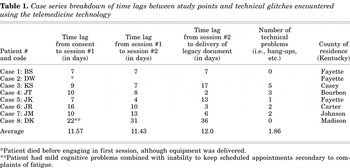
With regard to logistical and technical aspects of the project, most issues were minor and able to be resolved quickly. Although the distances involved made turnaround and delays longer than Chochinov has experienced in face-to-face delivery of Dignity Psychotherapy, we felt it was acceptable. We could deliver the intervention and legacy document within 14 days (see Table 1). Additionally, we experienced a unique problem with two potential participants that eventually could not take part in the study. Both of these potential participants were without home telephones and lived too far away to easily get to any of the Kentucky Telemedicine outreach sites.
Case series breakdown of time lags between study points and technical glitches encountered using the telemedicine technology

DISCUSSION
We believe that this study demonstrates that Dignity Psychotherapy can be feasibly delivered via videophone. Technical difficulties were minor and resolvable, time lags were manageable, and patients indicated their satisfaction with the program.
Staff Issues
We would like to highlight staff issues and experiences along with case material to further describe this exercise. Although this was a new experience for staff, therapists, and telemedicine personnel alike, the overall process was considered a success. One common complaint, however, was the amount of time necessary to devote to editing the transcripts and polishing them to a more coherent document. However, this was likely due to the aforementioned novelty and “growing pains” of starting on a new project. Also, one of the therapists had a difficult time adapting to the motion blur inherent in the video picture whenever she or the patient moved excessively. Although the videophone technology is improving rapidly, it does take some time to adapt and realize the limitations that are still apparent.
Selected Case Summaries
Case 1
Mr. BS, like the abovementioned potential participants, did not have a home telephone. However, he did live close to an established Kentucky Telemedicine site and was able to participate in the study by using their facility. This did, however, entail some extra planning and assistance to help the patient, who had severe mobility issues and need for oxygen.
Case 2
Mr. DW was an endearing patient to our clinic who gladly agreed to take part in the study but consistently put off scheduling to have the telemedicine device placed in his home. After several attempts, we finally discovered that he lived with his grandson in a trailer park and was a bit embarrassed to have staff know his current living conditions. Once this was resolved, the equipment was installed in the trailer, but another television needed to be brought in because Mr. DW's was not compatible with the telemedicine equipment. We then had difficulty having the patient answer the phone for the scheduled sessions. After several attempts, we eventually learned that the patient was deceased and had been so for some time as his grandson was away and did not discover the body for 2 weeks. Thus, although he completed baseline assessments, he was never able to complete the study. On a side note, due to the death, it became an issue to try to resecure the telemedicine equipment and make sure that it was not placed into probate with the rest of Mr. DW's effects.
Case 3
Although Mr. KS had a working phone line and compatible television, his sessions were interrupted by a total of five breaks in service. This created issues of “flow” and frustration at times with the sessions. Also, the participant only had a Post Office box for an address, which created issues for delivering the legacy document in an expedient fashion. Although the goal is to turn transcripts around in 2–3 days, utilizing outreach technology necessitates the use of overnight delivery services, most of which will not deliver to a Post Office box address. Finally, this participant was very upset and initially refused to fill out the satisfaction questionnaire because it used the term “Dignity Psychotherapy” and he was adamant that he did not need “psychotherapy,” which still has a stigma attached to it, especially in rural Appalachian cultures such as those found in Kentucky.
Case 8
The final case to highlight here was also the most difficult. Mr. DK was a man with a mild thought disorder, which we were initially unaware of, that he labeled as “ADD” for his difficulties with maintaining focus and attention. However, his presentation was more closely aligned to a cyclothymia/bipolar spectrum disorder or organic mental syndrome. This led to numerous difficulties in getting the participant to schedule the sessions and to complete the questionnaires, as he became perseverative on individual items and would seem to get “stuck” on them for long periods of time. In addition, he clearly had the most difficult transcript to transcribe and edit. Indeed, his initial transcript was over 42 pages long and prone to rambling and disjointed thought. On a final note, although a very difficult document to transcribe and edit, it also became one of the shining examples of how the editing process can be a means for patients to focus and evolve their message to their survivors. The final document was 5 pages long and was highly appreciated by the participant.
Although there were some definitive challenges in conducting the study, the overall impression of both staff and participants was positive. One of the most important aspects of conducting this study via telemedicine was shown in the satisfaction questionnaire discussed above, in which the participants showed an overall preference for using the telemedicine technology. Although they would have likely benefited from a face-to-face experience as traditionally designed, participants reported that they liked being able to participate from the comfort of their own home and not have to travel to the medical center for yet another visit. Also, as members of this typically stoic culture, it was impressive to hear several of the participants comment: “that was more than I ever said to anyone else in my life.”
Overall, this feasibility case series has helped us to refine and also appreciate the need for this new and potentially exciting delivery system for Dignity Psychotherapy. For instance, it has become apparent that we need to more thoroughly screen for cognitive disorders and other potential organic phenomena. In the case of organic mental syndromes, care must be taken to acknowledge that it is a “moving target” of sorts, meaning that patients who might be intact during the consent process might have organic mental changes by the time of the first session. Also, as is the case with many forms of psychotherapy, those patients who responded the best were those with a greater degree of insight and coherence initially. Third, the title “Dignity Psychotherapy” needs to be changed for a rural population that still attaches a great deal of stigma and perceived weakness to anything that might indicate mental disturbance. Finally, in accommodating the reality of engaging in long-distance communication, turnaround time for the transcripts needs to be more along the lines of 4–5 days to keep the intervention as timely as possible given the constraints of shipping documents and the making of other logistical arrangements (although our average was 11.43 days, this can easily be condensed to the proposed number given the other changes and more routine practice).
CONCLUSION
We undertook a small case series of patients to examine the feasibility of delivering Dignity Psychotherapy via telemedicine technology. In the course of the study, we gained valuable experience in the administration of this therapy through telemedicine. Although the use of this combination does show great promise, it was not without its difficulties. Our intent was to utilize the technology to perform outreach services to rural patients with advanced disease who often become isolated and out of touch with support services exactly when they need them the most. However, this is also a typically impoverished group, and as in the case with a couple of potential participants in this study, some of these patients do not have phones or easy access to telemedicine centers. Our group came away with a greater appreciation and understanding for both Dignity Psychotherapy as an intervention and the use of telemedicine within the unique culture of rural Appalachian Kentucky. Future trials are currently being planned.
ACKNOWLEDGMENTS
This project was funded by the Kentucky Lung Cancer Research Program. We would also like to thank Dr. Harvey Chochinov for his support and guidance, and the families and patients who allowed us to enter their lives for this project.
References
REFERENCES
Bindemann, S.,
Soukop, M., &
Kaye, S.B.
(1991).
Randomised control study of relaxation training.
European Journal of Cancer,
27,
170–174.Google Scholar
Bruera, E.,
Brenneis, C.,
Michaud, M.,
et al.
(1989).
Association between asthenia and nutritional status, lean body mass,
anemia, psychological status, and tumor mass in patients with advanced
breast cancer.
Journal of Pain Symptom Management,
4,
59–63.Google Scholar
Chochinov, H.M.
(2002).
Dignity-conserving care—A new model for palliative care:
Helping the patient feel valued.
JAMA,
287,
2253–2260.Google Scholar
Chochinov, H.M.,
Hack, T.,
Hassard, T.,
et al.
(2002a).
Dignity in the terminally ill: A cross-sectional, cohort
study.
Lancet,
360,
2026–2030.Google Scholar
Chochinov, H.M.,
Hack, T.,
McClement, S.,
et al.
(2002b).
Dignity in the terminally ill: A developing empirical model.
Social Science and Medicine,
54,
433–443.Google Scholar
Cohen, S.R.,
Mount, B.M.,
Strobel, M.G.,
et al.
(1995).
The McGill Quality of Life Questionnaire: A measure of quality of
life appropriate for people with advanced disease. A preliminary study of
validity and acceptability.
Palliative Medicine,
9,
207–219.Google Scholar
Decker, T.W.,
Cline-Elsen, J., &
Gallagher, M.
(1992).
Relaxation therapy as adjunct in radiation oncology.
Journal of Clinical Psychology,
48,
388–393.Google Scholar
Devine, E.C. &
Westlake, S.K.
(1995).
The effects of psychoeducational care provided to adults with
cancer: Meta-analysis of 116 studies.
Oncology Nursing Forum,
22,
1369–1381.Google Scholar
Glover, J.,
Dibble, S.L.,
Dodd, M.J.,
et al.
(1995).
Mood states of oncology outpatients: Does pain make a
difference?
Journal of Pain Symptom Management,
10,
120–128.Google Scholar
Gotay, C.C.
(1985).
Why me? Attributions and adjustments by cancer patients and their
mates at two stages in the disease process.
Social Science Medicine,
20,
825–831.Google Scholar
Gutierrez, G.
(2001).
Medicare, the Internet, and the future of telemedicine.
Critical Care Medicine,
29(Suppl. 8),
N144–150.Google Scholar
Hopwood, P.,
Howell, A., &
Maguire, P.
(1991).
Psychiatric morbidity in patients with advanced cancer of the
breast: Prevalence measured by two self-rating questionnaires.
British Journal of Cancer,
64,
349–352.Google Scholar
Mahon, S.M.,
Cella, D.F., &
Donovan, M.I.
(1990).
Psychosocial adjustment to recurrent cancer.
Oncology Nursing Forum,
17(suppl.),
47–54.Google Scholar
Northouse, L.L.,
Laten, D., &
Reddy, P.
(1995).
Adjustment of women and their husbands to recurrent breast
cancer.
Research Nursing Health,
18,
515–524.Google Scholar
Passik, S.D.,
Inman, A.,
Kirsh, K.L.,
et al.
(2003).
Initial validation of a scale to measure purposelessness,
understimulation, and boredom in cancer patients: Toward a redefinition of
depression in advanced disease.
Palliative and Supportive Care,
1,
41–50.Google Scholar
Passik, S.D.,
Kirsh, K.L.,
Theobald, D.,
et al.
(2002).
Use of a depression screening tool and a fluoxetine-based algorithm
to improve the recognition and treatment of depression in cancer patients:
A demonstration project.
Journal of Pain Symptom Management,
24,
318–327.Google Scholar
Pinder, K.L.,
Ramirez, A.J.,
Black, M.E.,
et al.
(1993).
Psychiatric disorder in patients with advanced breast cancer:
Prevalence and associated factors.
European Journal of Cancer,
29A,
524–527.Google Scholar
Sheard, T. &
Maguire, P.
(1996).
The effects of psychological interventions on anxiety and depression
in oncology: Results of two meta-analyses (Abstract). In
Proceedings of the Third World Congress of Psycho-Oncology,
October 3–6. New York.
Spiegel, D.,
Bloom, J.R.,
Kraemer, H.C.,
et al.
(1989).
Effect of psychosocial treatment on survival of patients with
metastatic breast cancer.
Lancet,
14,
888–891.Google Scholar
Spiegel, D.,
Bloom, J.R., &
Yalom, I.
(1981).
Group support for patients with metastatic cancer.
Archives of General Psychiatry,
38,
527–533.Google Scholar
Sumner, C.R.
(2001).
Telepsychiatry: Challenges in rural aging.
Journal of Rural Health,
17,
370–373.Google Scholar
Sutherland, H.J.,
Lockwood, G.A., &
Boyd, N.F.
(1990).
Ratings of quality of life variables: Therapeutic implications for
patients with metastatic breast cancer.
Journal of Clinical Epidemiology,
43,
661–666.Google Scholar
Theobald, D.E.,
Kirsh, K.L.,
Holtsclaw, E.,
et al.
(2003).
An open label pilot study of citalopram for depression and boredom
in ambulatory cancer patients.
Palliative and Supportive Care,
1,
71–77.Google Scholar
Watson, M.,
Denton, S., &
Baum, M.
(1988).
Counselling breast cancer patients: A specialist nurse
service.
Counselling Psychology Quarterly,
1,
25–34.Google Scholar
Wilson, K.G.,
Scott, J.F.,
Graham, I.D.,
et al.
(2000).
Attitudes of terminally ill patients toward euthanasia and
physician-assisted suicide.
Archives of Internal Medicine,
160,
2454–2460.Google Scholar
Zabora, J.
(1998).
Screening procedures for psychosocial distress. In
Psycho-oncology,
Holland, J. (ed.), pp.
653–661.
New York:
Oxford University Press.
Zung, W.
(1967b).
Factors influencing the self-rating depression scale.
Archives of General Psychiatry,
16,
543–547.Google Scholar
Case series breakdown of time lags between study points and technical glitches encountered using the telemedicine technology
 You have
Access
- 33
- Cited by