Milking machine characteristics and milking procedures can affect udder health status, milk somatic cell count (SCC) and teat conditions (Barkema et al. Reference Barkema, Schukken, Lam, Beiboer, Benedictus and Brand1999; Rasmussen et al. Reference Rasmussen, Baines, Neijenhuis and Hillerton2004; Zecconi & Hamann, Reference Zecconi and Hamann2006). Machine milking can promote new udder infections by affecting teat integrity, by transferring bacteria from the environment to the teat and by dispersing them within the udder (O'Shea et al. Reference O'Shea1987; Hamann et al. Reference Hamann, Mein and Wetzel1993). Teat is the first line of defence against mastitis and during milking, and it represents the interface between mammary gland and milking machine (Weiss et al. Reference Weiss, Weinfurtner and Bruckmaier2004). As a consequence, milking machine and milking techniques applied by the milker have an influence on teat conditions and teat-end callosity (Rasmussen, Reference Rasmussen1993; Shearn & Hillerton, Reference Shearn and Hillerton1996; Neijenhuis et al. Reference Neijenhuis, Barkema, Hogeveen and Noordhuizen2001).
The shape and the parameters of the milk flow curve depend on various factors, such as cow genetic traits, teat anatomy, parity number and stage of lactation. However, milking conditions (i.e. machine characteristics, milking routine, milking interval) are probably the most important external factors affecting milk emission patterns (Rasmussen et al. Reference Rasmussen, Frimer, Galton and Petersson1992; Bruckmaier, Reference Bruckmaier2001; Tančin et al. Reference Tančin, Ipema, Hogewerf and Mačuhová2006; Sandrucci et al. Reference Sandrucci, Tamburini, Bava and Zucali2007). Moreover recent studies on milk flow traits showed an association with udder health or SCC (Mijic et al. Reference Mijic, Knezevic, Domacinovic, Ivankovic and Ivkic2005; Sandrucci et al. Reference Sandrucci, Tamburini, Bava and Zucali2007; Tančin et al. Reference Tančin, Ipema and Hogewerf2007). A good example of the complex interrelations existing among milk flow parameters, milking condition and equipment, and udder health is represented by the phenomenon of bimodality of milk flow curves. Tactile teat stimulation before cup attachment (e.g. teat cleaning) activates a neuroendocrine mechanism resulting in oxytocin release that induces contraction of myoepithelial cells surrounding the alveoli and ejection of alveolar milk (Bruckmaier, Reference Bruckmaier2001). In the case of milking without prestimulation, alveolar milk ejection reflex is delayed and a transiently reduced milk flow generally occurs after the removal of the milk contained in the mammary cistern that is always ready for milking. This anomaly, revealed by the bimodal shape of milk flow curve, has negative effects on milking efficiency causing an extension of machine-on time (Bruckmaier & Blum, Reference Bruckmaier and Blum1996), modifies some milk flow parameters (Sandrucci et al. Reference Sandrucci, Tamburini, Bava and Zucali2007) and can negatively affect teat conditions and udder health because of its similarity to overmilking (Rasmussen, Reference Rasmussen2004).
Similarly machine milking vacuum level and overmilking affect both milk flow characteristics and teat conditions. As the milking vacuum increases, milking times shorten, the average and peak milk flow rates increase (Bade et al. Reference Bade, Reinemann, Zucali, Ruegg and Thompson2009) and the stress of teat tissue is enhanced (Hamann et al. Reference Hamann, Mein and Wetzel1993). Overmilking due to incorrect setting of the automatic cluster removal device causes an unnecessary increase in machine-on time, leads to oedema and bad teat conditions and can predispose cows to subclinical mastitis under field conditions (Østerås & Lund, Reference Østerås and Lund1988; Hamann, Reference Hamann1990; Hillerton et al. Reference Hillerton, Pankey and Pankey2002).
The role of milking machine characteristics and milking procedures in maintaining teat tissue integrity and preventing udder infections is particularly important in primiparous cows (Zucali et al. Reference Zucali, Bava, Sandrucci, Tamburini, Piccinini, Daprà, Tonni and Zecconi2009): an impairment of teat and udder health status could potentially affect the cow performance not only in the current lactation, but also in the next ones (Rupp et al. Reference Rupp, Beaudeau and Boichard2000). Moreover, the first part of lactation is a crucial period, in particular for primiparous cows. High SCC during early lactation in heifers is associated with an increased probability of subsequent clinical mastitis (Rupp & Boichard, Reference Rupp and Boichard2000), lower milk production throughout the whole lactation (De Vliegher et al. Reference De Vliegher, Barkema, Stryhn, Opsomer and de Kruif2005b) and increased risk of being culled during the first lactation (De Vliegher et al. Reference De Vliegher, Barkema, Opsomer, de Kruif and Duchateau2005a).
Although there are a few studies on the relationship between milking machine, milk flow traits and udder health, very few are focused on primiparous cows. This paper reports the results of a field study aimed at investigating the relationships between milk flow traits and udder health status in primiparous cows, throughout their first lactation.
Materials and Methods
Herds and milking characteristics
A total of 74 primiparous Holstein cows (28·5±3·8 months calving age) were randomly selected in 5 herds with free-stall barns. The number of primiparous cows and milking parlour characteristics are shown in Table 1. In all the herds milking procedures included: pre-milking cleaning of the teats with detergent and single-use paper towel, fore-milking and teat dipping at the end of milking with an approved teat-disinfectant.
Primiparous cows and milking parlour characteristics for each farm

Sampling and analyses
Primiparous cows enrolled in the study calved between September and December 2005 and they were monitored monthly from the beginning of lactation until the month 10 of lactation. Quarter milk samples (QMS) were collected before milking with an aseptic procedure and immediately delivered to the laboratory in a refrigerated container for analyses.
Teat conditions were assessed by scoring digital pictures of teat apex following the procedure described by Zecconi et al. (Reference Zecconi, Casirani, Binda, Migliorati and Piccinini2006).
Teat thickness was assessed with a cutimeter, which is a spring-loaded caliper device, as described by Hamann & Mein (Reference Hamann and Mein1990). Teat thickness change (▵) was calculated as the difference between teat thickness after and before milking [100*(thickness after–thickness before)/thickness before].
Bacteriological analysis was performed on 0·01 ml of QMS, colonies were isolated and identified according to National Mastitis Council (NMC, 1999). Lysozyme and N-acetyl-β-glucosaminidase (NAGase) were assessed in duplicate with the procedures described by Piccinini et al. (Reference Piccinini, Binda, Belotti, Daprà and Zecconi2007).
Somatic cells were counted following standardized procedures (IDF, 1995) using Bentley Somacount 150 (Bentley, USA).
Categorization of quarter and mammary gland health status
Quarter health status was assessed and scored based on SCC and bacteriological status of each QMS, as shown in Table 2. The SCC threshold of 100 000 cells/ml was suggested by Pyörälä (Reference Pyörälä2003). Udder health status was obtained by the log-transformed (log10) sum of the four scores of the quarters.
Quarter and udder health status classification

Milk flow measurements
Milk flow curves of the whole udder of each primiparous cow were registered once a month throughout the evening milking, with a continuous electronic milk flow meter (Lactocorder, WMB, Balgach, Switzerland). The instrument measured milk flow, milk yield and electrical conductivity (EC) every 0·7 s and saved these data at intervals of 2·8 s, as described by Sandrucci et al. (Reference Sandrucci, Tamburini, Bava and Zucali2007). Bimodality of milk flow was detected when a curve had a flow pattern with 2 increments separated by a clear drop in milk flow for more than 200 g/min within 1 min after the start of milking (Dzidic et al. Reference Dzidic, Macuhova and Bruckmaier2004). Stimulation time was measured using Lactocorder from the first touch of the teat to the beginning of milk flow emission (including teat cleaning operations). Total milking time and the duration of milk curve phases were calculated as indicated by Sandrucci et al. (Reference Sandrucci, Tamburini, Bava and Zucali2007). Duration of plateau phase was expressed both as minutes and as percentage of time of milk flow (pTPL). Time of milk flow was defined as total milking time minus stimulation time.
Statistical analysis
Data collected during lactation were analysed by ANOVA using a generalized linear model (GLM procedure; SAS, 2001). The model was:

where Y=dependent variables; μ=general mean; Hi=effect of herd (i=1–5); Aj(Hi)=effect of animal nested in herd (j=1–14); Mk=effect of milk production level (k=<30; 30–36; >36 kg/d); Sl=effect of stage of lactation (l=<100; 100–200; >200 d); Cm=effect of udder health status (m=healthy, latent, inflamed, subclinical); eijklm=residual error.
A multivariate logistic analysis was performed (LOGISTIC procedure; SAS, 2001) to identify the variables associated with udder health status and to assess the odds ratios for a cow not to be ‘healthy’ (latent, inflamed or subclinical). Logistic regression analyses examined all possible interactions among variables. Variables or combinations of variables (interaction terms) were excluded in a stepwise backward method based on a 5% significance level. The end results of the analyses were final models comprising those variables (risk factors) that were significantly associated with udder health status. The final models were described in terms of odds ratios, 95% confidence intervals, and underlying frequency distributions from which the unadjusted odds ratios can be calculated.
Results
Udder health status
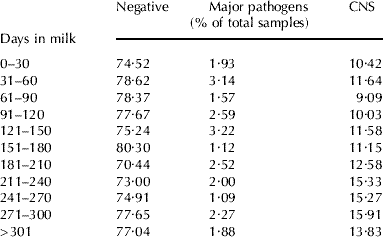
During the follow-up period, 2902 QMS were collected. Among them 2276 (78·4%) were bacteriologically negative, while among the positive ones, coagulase-negative staphylococci (CNS) were the most frequently isolated pathogens. When quarter health status classification was applied as described, 1999 (68·9%) quarters were healthy, 414 (14·3%) with a latent infection, 190 (6·6%) inflamed and only 299 (10·3%) were classified as subclinical.
Table 3 reports the distribution of bacteriological results for the three most numerous classes by days in milk (DIM). CNS-positive quarters slightly increased after 180 DIM, while bacteriologically negative quarters were within the interval of 73–81% (on total quarters) without a clear trend during lactation.
Frequency of bacteriologically negative quarters and quarters positive for major pathogens and coagulase-negative staphylococci (CNS) by days in milk

The results of milk electrical conductivity (EC) at peak flow, lysozyme content, NAGase content, teat thickness change during milking and teat apex score by udder health status are reported in Table 4. As expected, EC was higher in subclinical cows than in the others, but not all the contrasts were significant. Lysozyme content in milk was not different among udder health groups, even if values observed in healthy udders were slightly higher than in the other groups. NAGase content in milk was significantly different for the different classes of udder health; in particular it increased as udder health worsened (P<0·001). Teat thickness changes and teat apex scores did not show significant differences among groups.
Effect of udder health status on peak electrical conductivity, lysozyme, NAGase, average teat apex score and ▵ teat thickness in primiparous Holstein cows (least-squares means)

Means within a row with different superscripts differ (P<0·05)
† difference between teat thickness after and before milking [100*(thickness after−thickness before)/thickness before]
Udder health category and milk flow traits
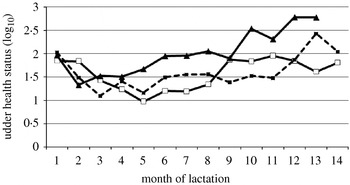
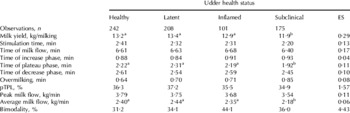
Milk flow parameters for each udder health category are shown in Table 5. Milk production was significantly lower for cows in the subclinical group than for the others (P<0·001). Milk flow curve of subclinical cows was characterized by shorter time of plateau phase than the others (2·22; 2·31; 2·19; 1·92 min, for healthy, latent, inflamed and subclinical cows, respectively; P<0·05), while durations of increase and decrease phases were not different among the four categories. Cows of the subclinical group had longer overmilking phase than the other cows, even if not significantly. Peak milk flow did not vary with health status while average milk flow was significantly lower for subclinical cows in comparison with the others (P<0·05). Also bimodality frequency was higher in inflamed and subclinical udders, but significant differences among groups were not observed. A significant increase (P<0·001) of the frequency of bimodal curves was observed throughout lactation with average values of 26%; 30%; 46%, in the first 100 DIM, 100–200 DIM and after 200 DIM, respectively. To analyse the relationship between bimodality and udder health status, all cows were classified by frequency of bimodal curves during the first 100 DIM as follows: never bimodal, just 1 time bimodal, more than 1 time bimodal. Fig. 1 shows the changes of udder health status throughout the whole lactation for the three different bimodality classes. Least-squares means for udder health status, expressed as log10 sum of the scores of the quarters, in the three bimodality classes were 4·26; 4·24; 4·70 log10 (P<0·01) and animals with a high frequency of bimodal curves in the first 100 DIM showed the worst udder status during the entire lactation.
Udder health status during lactation of the cows classified on the basis of milk flow bimodality in the first 100 d of lactation: never bimodal (□), just 1 time bimodal (▪), more than 1 time bimodal (▴) (least-squares means).

Effect of udder health status on milk yield and milk flow traits in primiparous Holstein cows (least-squares means)

Means within a row with different superscripts differ (P<0·05)
Milk flow traits and udder status for udder health categories in early lactation
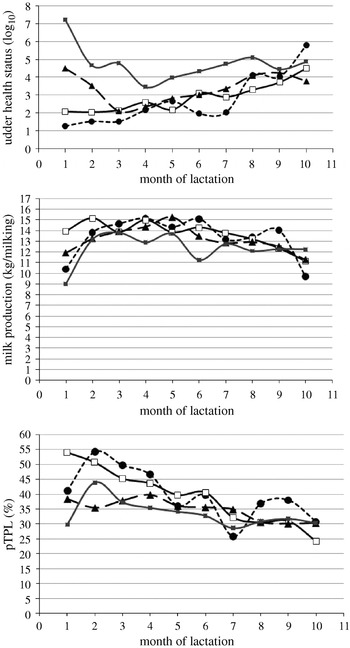
To explore whether udder health status in the first 3 months after parturition could influence the following part of lactation, cows were classified in four groups as follows: healthy when their udders were always healthy in the first 3 months, inflamed or subclinical when udders were classified at least one time as inflamed or subclinical, respectively, and latent in all the other combinations. Fig. 2 shows the trends throughout the whole lactation of udder health status (log10 sum of quarter scores), milk production and pTPL for the four categories of cows. Animals classified as subclinical in early lactation had the worst udder health status during the whole lactation (P<0·001) and showed significantly lower milk production (P<0·05) when compared with the other cows. Moreover the initial udder health status influenced the shape of milk flow curve: in particular cows in the subclinical group in the first 3 months of lactation had higher peak milk flow than the others (3·48; 3·69; 3·67; 3·81 kg/min for healthy, latent, inflamed and subclinical cows, respectively) with a statistically significant difference between subclinical and healthy cows (P<0·05).
Udder health status, milk production and pTPL during lactation of cows classified as healthy (•), latent (□), inflamed (▴) and subclinical (▪) on the basis of udder health status in the first 3 months of lactation (least-squares means).

Duration of plateau phase, expressed both as minutes and as pTPL, was significantly shorter (P<0·001) for cows classified as subclinical in the first 3 months (1·83 min equal to 33·4%) in comparison with healthy and latent cows (2·81, 2·39 min and 39·6, 39·4% for healthy and latent cows, respectively).
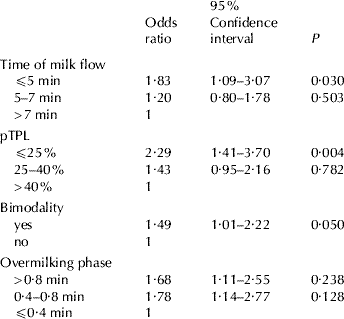
Logistic regression analysis (Table 6) showed that the presence of bimodality was significantly associated with a not-healthy udder condition (OR=1·49; P<0·05). Similar patterns were observed when time of milk flow was ⩽5 min (OR=1·83; P<0·05) and when pTPL was <25% (OR=2·29; P<0·01). An overmilking phase longer than 0·4 min seems to be undesirable, but the OR was not significant unless this parameter resulted significant in the model (Wald chi-square P=0·023).
Risk factors for udder health status (stepwise logistic regression)

Discussion
Peak EC, NAGase and lysozyme contents of milk have been proposed as diagnostic tools for mastitis detection (Pyörälä, Reference Pyörälä2003). The present results showed higher EC values only in subclinical animals, while among the other udder health classes, EC pattern was not related to mammary health status. This confirms that EC is a good signal in the case of subclinical mastitis but is not a reliable indicator for latent and inflamed health status (Hamann & Zecconi, Reference Hamann and Zecconi1998; Pyörälä, Reference Pyörälä2003; Bansal et al. Reference Bansal, Hamann, Grabowski and Singh2005). As expected, NAGase content in milk was significantly higher in subclinical animals in comparison with the others (Piccinini et al. Reference Piccinini, Binda, Belotti, Daprà and Zecconi2007) while lysozyme content was not significantly different among udder health groups. Both NAGase and lysozyme are secreted by neutrophils during the phagocytosis process, but they are also produced by mammary epithelial cells of healthy glands. The antibacterial activity of these substances could play an important role within the innate immunity of the udder (Zecconi & Smith, Reference Zecconi and Smith2003). However, the secretory patterns of NAGase and lysozyme are different, because lysozyme levels significantly increase only in presence of inflammation (Piccinini et al. Reference Piccinini, Binda, Belotti, Daprà and Zecconi2007).
Significant differences among classes of udder health status were not observed when teat thickness changes and teat apex scores were considered. These results suggest that in this study the influences of milking machine and milking procedures on udder health status were not related to a severe impact on teat tissue or teat apex, although a more subtle and less evident effect could not be excluded.
Milk flow patterns showed some notable variations depending on udder heath status. As expected, milk production was significantly lower in subclinical cows (Sandrucci et al. Reference Sandrucci, Tamburini, Bava and Zucali2007), while duration of increase and decrease phases were not significantly different among udder health categories. This is in accordance with Tančin et al. (Reference Tančin, Ipema and Hogewerf2007) who demonstrated a positive correlation between SCC and the duration of decrease phase only at quarter level, but not at udder level. In fact the decrease phase at udder level increases when one or more single quarters stop milk flow before the others (Weiss et al. Reference Weiss, Weinfurtner and Bruckmaier2004; Tančin et al. Reference Tančin, Ipema, Hogewerf and Mačuhová2006). Therefore a long udder decrease phase is associated with overmilking of low-producing quarters. Subclinical cows had significantly shorter duration of plateau phase in comparison with the other cows, according to Mijic et al. (Reference Mijic, Knezevic, Domacinovic, Ivankovic and Ivkic2005) and Tančin et al. (Reference Tančin, Ipema and Hogewerf2007) who reported that time of plateau phase was negatively correlated with SCC. It can be useful to consider plateau phase as a parameter for selection; by prolonging this phase, milkability would improve without excessive increase of milk flow rate, which is associated with high SCC and high susceptibility to bacterial infections (Grindal & Hillerton, Reference Grindal and Hillerton1991; Gäde et al. Reference Gäde, Stamer, Bennewitz, Junge and Kalm2007). Duration of plateau phase was shorter in cows with poorer udder health status in the first 3 months of lactation, therefore the evaluation of this parameter could be important as an indicator of mammary health status. The increase in the frequency of bimodal curves throughout lactation is in accordance with other studies (Pfeilsticker et al. Reference Pfeilsticker, Bruckmaier and Blum1996; Sandrucci et al. Reference Sandrucci, Tamburini, Bava and Zucali2007) and is caused by the reduction of cisternal milk and the delay of alveolar milk ejection due to low alveoli filling, as production level decreases (Bruckmaier & Hilger, Reference Bruckmaier and Hilger2001; Weiss & Bruckmaier, Reference Weiss and Bruckmaier2005). Cows characterized by bimodal curves in the first 100 DIM had poorer udder health status than the others, as found by Dodenhoff et al. (Reference Dodenhoff, Sprengel, Duda and Dempfle1999), perhaps as the result of lower milk production and lower udder filling of subclinical cows. Moreover according to a previous study (Sandrucci et al. Reference Sandrucci, Tamburini, Bava and Zucali2007) bimodality is associated with a reduced duration of plateau phase and a higher milk flow rate both related to high SCC or unhealthy udder conditions, as previously discussed. Bimodality has been proposed as an indicator of incorrect milking routine (Sandrucci et al. Reference Sandrucci, Tamburini, Bava and Zucali2007) but the results of this study showed that it could be also considered as a signal of altered milk emission and a risk factor for intramammary infections.
Udder health status at the beginning of lactation is crucial in order to reach and maintain a high milk production during the whole lactation, particularly for primiparous cows. This study showed that animals characterized by poor udder health in the first 3 months post calving had the worst mammary health condition during the whole lactation. Indeed, cows characterized by poorer udder health status in the first 3 months of lactation showed higher peak milk flow, as found by Gäde et al. (Reference Gäde, Stamer, Bennewitz, Junge and Kalm2007) and Sandrucci et al. (Reference Sandrucci, Tamburini, Bava and Zucali2007), confirming that this parameter could represent an indicator for mammary health status. These results could be linked to the anatomy of the teat canal, indeed a wider teat canal should be associated with a higher peak milk flow but could also facilitate bacterial invasion. Multivariate logistic analysis showed that several factors are associated with udder health status (time of milk flow, duration of plateau phase, bimodality, duration of overmilking phase). Plateau phase expressed as pTPL <25% was related to a higher risk of poor udder health conditions. Time of milk flow shorter than 5 min was associated with worse udder health status, probably because of the effect of the higher peak milk flow and lower production of not-healthy cows in comparison with the others. Similarly, the presence of bimodality and a long overmilking phase (>0·8 min) were associated with an increased risk of udder health.
In conclusion, the study of milk flow traits can be a useful tool to predict the risk of poor udder health status. In particular, some parameters such as time of plateau phase (expressed as percentage of time of milk flow), time of milk flow, bimodality and duration of overmilking phase can be predictive indicators of udder health status; time of plateau phase can also be a useful parameter for animal selection.
This research was supported by Plan for R&S (Research and Development), Region of Lombardy, Italy. Project n. 819. The authors thank Dr. L Zanini (SATA, Animal Breeders' Association of Lombardy) for his precious help.