


Introduction
Forced migrants have often experienced distressing events before claiming asylum. This group presents with a wide range of mental health problems which can be a challenge to the mental health system of their host nation (see Pollard and Howard, Reference Pollard and Howard2021). A common diagnosis is post-traumatic stress disorder (PTSD), with individuals having experienced war, torture, rape and persecution. These events are often severe and sustained and result in high levels of PTSD, with a recent review indicating a prevalence of 31% (Blackmore et al., Reference Blackmore, Botle, Fazel, Ranasinha, Gray and Fitzgerald2020). The individuals are also likely to experience other stressors, such as housing problems and social isolation whilst facing the challenge of acclimatising to a new culture.
The UK guidelines for the treatment of PTSD (National Institute for Health and Care Excellence, 2018) indicate the use of trauma-focused psychological interventions, such as trauma-focused cognitive behavioural therapy (CBT) and eye movement desensitisation and reprocessing (EMDR). However, this guideline is based on clinical trials that typically have not included refugees or asylum seekers. Psychological interventions for this group have been developed from cognitive behavioural approaches to PTSD (Grey and Young, Reference Grey and Young2008). To date the most widely researched intervention for PTSD in this group is narrative exposure therapy (NET) (Lely et al., Reference Lely, Smid, Jongedijk, Knipscheer and Kleber2019; Raghuraman et al., Reference Raghuraman, Stuttard and Hunt2021), which involves up to 12 sessions of 90 minutes (Schauer et al., Reference Schauer, Schauer, Neuner and Elbert2011). The most recent review and meta-analysis of psychological interventions for PTSD in refugees and asylum seekers identified 15 studies, each of which had some form of control group or waitlist comparison in order to be eligible (Thompson et al., Reference Thompson, Vidgen and Roberts2018). There was a large effect size for the outcome of interventions consisting of CBT, EMDR and NET. However, follow-up data were limited to two NET studies which produced a moderate effect.
There are a number of treatment protocols under the umbrella term ‘trauma-focused CBT’. These approaches typically involve a phase of work in which the individual ‘relives’ the traumatic incident in order to integrate events back into memory and reduce emotional distress (Ehlers and Clark, Reference Ehlers and Clark2000). Imagery rescripting (ImRs) is a technique aimed at reducing unwanted intrusions through modifying the meaning and emotions attached to a distressing memory. The process involves getting the individual to first vividly imagine the start of the traumatic memory and then to incorporate a new, rewritten, safer ending with the aid of the therapist. ImRs has been shown to be effective in reducing PTSD symptoms (e.g. Alliger-Horn et al., Reference Alliger-Horn, Zimmermann and Mitte2015; Arntz et al., Reference Arntz, Tiesema and Kindt2007; Boterhoven de Haan et al., Reference Boterhoven de Haan, Lee, Fassbinder, Van Es, Menninga and Meewisse2020; Ehlers et al., Reference Ehlers, Clark, Hackmann, McManus, Fennell and Herbert2003; Grunert et al., Reference Grunert, Weis, Smucker and Christianson2007; Hackmann, Reference Hackmann2011; Smucker et al., Reference Smucker, Dancu, Foa and Niederee1995). ImRs is also associated with a reduction in intrusive cognitions (i.e. images, nightmares, flashbacks, voices, thoughts) within a number of other conditions, such as social phobia, snake phobia, depression, obsessive compulsive disorder, body dysmorphic disorder, eating disorders and personality disorders (for literature review and meta-analysis, see Arntz, Reference Arntz2012; Morina et al., Reference Morina, Lancee and Arntz2017). To date, there has been one published case series reporting large effects of ImRs in reducing PTSD within a refugee population (Arntz et al., Reference Arntz, Sofi and van Breukelen2013). This group were based in The Netherlands during their treatment. Given that research into the treatment of PTSD in refugees and asylum seekers is limited, it would seem important to build on this case series and explore options for a choice in treatments (alongside NET) which will be of value to both patients and clinicians. This is due both to the fact that no current treatment is 100% successful, as well as ImRs requiring less training for current CBT therapists than either NET or EMDR. Also, although based on clinical experience rather than empirical data, there is a hypothesis that the mechanism of change through the use of ImRs relates to the meaning of the traumatic event (rather than re-contextualising a memory), which is an issue that this clinical group often struggle with. In addition, positive emotions are more likely to be experienced through a rescript, which may encourage therapists to undertake a trauma-focused intervention with refugees and asylum seekers.
The current study aims to assess the effectiveness of ImRs for PTSD within asylum seekers being treated within a UK National Health Service (NHS) setting. Alongside effectiveness outcomes, information will be obtained which informs the development of the treatment for this group, including the appropriate number of sessions. The intervention package included up to five sessions of psychoeducation and preparing people for treatment and up to 10 sessions of ImRs. A case series design was adopted to embed the study within the routine delivery of an NHS service set up specifically for asylum seekers. A variable baseline design was employed to enhance the extent to which any changes observed during the treatment phase could be attributable to the treatment and not to non-treatment changes which may occur over time. This is because using different baseline wait-periods reduces the likelihood that changes occur after a specific amount of time (as the hypothesis is that changes start with the switch from baseline to treatment, rather than after a specific time), and randomisation of participants to different baseline wait-periods reduces the likelihood that specific people would spontaneously change after a specific baseline wait-period (which might occur with non-random allocation). The psychoeducation and treatment preparation phase enabled comparison with a phase on non-specific treatment effects.
Method
Participants
Participants were recruited from the treatment waiting list of a London NHS clinic set up specifically to treat the mental health problems of asylum seekers and based in London, UK. Participants were eligible if they (a) were aged 18–65 years, (b) provided informed consent, (c) had a current presentation consistent with a DSM-5 diagnosis of PTSD as assessed by the Clinician Administered PTSD Scale (CAPS; Weathers et al., Reference Weathers, Blake, Schnurr, Kaloupek, Marx and Keane2013) based on traumas experienced prior to entry to the UK, (d) had a score of >20 on the PSS (Foa et al., Reference Foa, Riggs, Dancu and Rothbaum1993) at screening, (e) had the ability to communicate with therapist, either in English or through an interpreter, and (f) had a fixed residence (i.e not homeless, a temporary residence was eligible). Exclusion criteria were (a) a current diagnosis of schizophrenia or bipolar disorder type 1, (b) an IQ under 80, (c) presented with an acute suicide risk, (d) substance dependence, (e) had started a new medication within 3 months before start of the study and (f) if more than one of the weekly assessments during the wait-list period was missed, then the participant was excluded from the study and offered treatment as usual within the service.
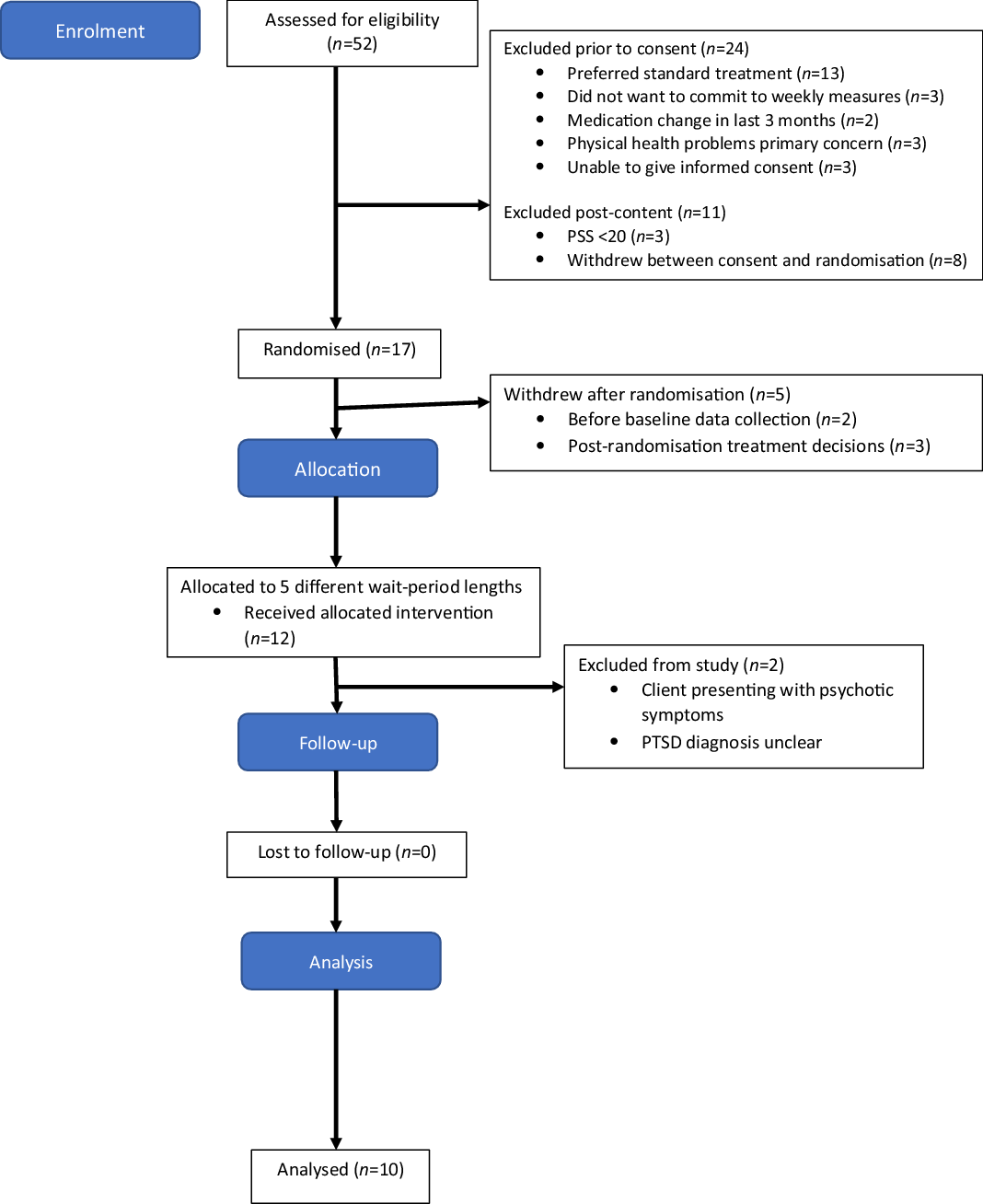
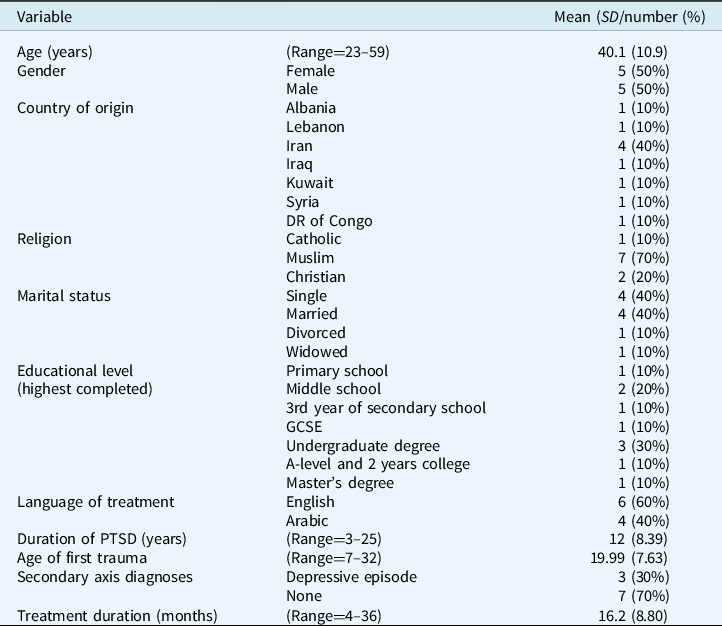
Fifty-two potential participants were considered for eligibility, while 23 service-users gave consent to participate in the study between January 2017 and March 2019. At the time of providing consent, the length of time individuals had already been on the service treatment waiting list was between 4 and 36 months. Eight people withdrew from the study before being randomised to a wait-list length. Post-randomisation, two individuals withdrew before baseline data collection started, and three withdrew as more detailed clinical information indicated that they were not eligible and different treatment options were agreed. Two participants began ImRs sessions, but during treatment clinical information indicated that they were not eligible and ImRs may therefore not be the appropriate treatment option. They were offered alternative interventions. Figure 1 presents the study consort diagram. Table 1 gives an overview of the participant demographics of the participants including country of origin. The types of trauma reported included torture, rape and being forced to watch executions.
CONSORT flow diagram.

Baseline characteristics of the sample

Procedure
All referrals to the service were routinely screened for PTSD using the CAPS (Weathers et al., Reference Weathers, Blake, Schnurr, Kaloupek, Marx and Keane2013), with those reaching the diagnostic threshold being placed on a waiting list for trauma-focused treatment. The main treatment offered by the service was NET, which is recommended for refugees with PTSD by NICE (National Institute for Health and Care Excellence, 2018). Individuals on the treatment waiting list were approached and given the opportunity to receive psychological treatment in the form of ImRs as part of the current study. Potential participants were provided with information about their treatment choice, i.e. standard treatment in the form of NET or ImRs, including the typical number of sessions involved and the approach to working with trauma memories. Information was provided both verbally and in writing. Translation was provided where needed, and at least 48 hours were given before informed consent was obtained.
The baseline assessment included the CAPS, PSS, PHQ-9, and the collection of socio-demographic data. The patient was told that they would be randomly allocated to a wait-period of either 5, 6, 7, 8 or 9 weeks after baseline assessment before the intervention began. Patients were not immediately told the wait-period length, to minimise the impact on their presentation of the expectation of therapy commencing. They were told that a member of the team would be in contact two weeks prior to the start of therapy, and that they would not know the wait-period until that contact. When the baseline assessments were complete, a member of the service would contact a study team member (C.S.) who would use an online random number generator to inform the service of the length of wait-period required. Data were collected by assistant psychologists during all phases of the study.
Design
The study design is a multiple baseline case series design with a randomised duration of wait-list. The functioning of the individual in the treatment phase, and changes in functioning, are compared with his/her functioning, and changes in functioning, during the baseline phase (on an individual and a group level).
Following baseline assessment (CAPS, PSS and PHQ-9), each participant was randomised (single-block) to a wait-period of 5, 6, 7, 8 or 9 weeks. The PSS and PHQ-9 were then administered every week via a telephone call during the baseline phase. If more than one of the weekly assessments during the waiting period was missed, then the participant was excluded from the study and offered alternative treatment within the service.
During the week prior to the intervention starting, and the week after it completed, data were collected via the daily recording of the frequency of spontaneous intrusive trauma memories, gained either by telephone contact, using a mobile phone or an online platform with daily reminders.
Following the wait-period phase, a ‘Psychoeducation and Treatment Preparation’ phase was provided (hereafter called preparation phase), which included five sessions to be completed within up to 8 weeks. Then a ‘Treatment’ phase commenced, immediately after the previous phase was complete, and included up to 10 sessions within up to 20 weeks. Follow-up assessments (PSS and PHQ-9) took place, either in-person or via telephone, at weekly intervals for 5 weeks post-intervention and again at 12 weeks post-intervention. A follow-up CAPS assessment took place in person at 5 weeks post-intervention.
Instruments
Primary outcomes
Post-traumatic Symptom Scale (Foa et al., Reference Foa, Riggs, Dancu and Rothbaum1993)
The PSS was administered to assess PTSD symptom severity. The PSS is a 17-item self-report questionnaire measuring PTSD symptoms of re-experiencing, avoidance and arousal. Respondents rate the frequency of symptoms on a 5-point scale (0=not at all, 4=five or more times per week/almost always). The PSS has demonstrated good construct validity, internal consistency, and test–retest reliability (Cronbach’s α=.91; Foa et al., Reference Foa, Riggs, Dancu and Rothbaum1993). The total score constituted the measure of PTSD severity.
The Physical Health Questionnaire-9 (Kroenke and Spitzer, Reference Kroenke and Spitzer2002)
The PHQ-9 is the major depressive disorder (MDD) module of the full PHQ-9, which scores each of the nine DSM-IV criteria as ‘0’ (not at all) to ‘3’ (nearly every day). The scale has been demonstrated to be a valid and reliable measure of depression severity (Kroenke et al., Reference Kroenke, Spitzer and Williams2001).
Secondary outcomes
Clinician-Administered PTSD Scale (Weathers et al., Reference Weathers, Blake, Schnurr, Kaloupek, Marx and Keane2013)
The CAPS-5 was used for the diagnosis of PTSD. CAPS is one of the most frequently used interviews for establishing PTSD (Blake et al., Reference Blake, Weathers, Nagy, Kaloupek, Gusman and Charney1995). The interview covers the diagnostic criteria for PTSD according to DSM-V. For each criterion, intensity and frequency over the previous month is measured on a scale from 0 to 4. An internal consistency of α=.88 is reported (Weathers et al., Reference Weathers, Bovin, Lee, Sloan, Schnurr and Kaloupek2018).
Daily measure of intrusions
A one-week diary in which the self-reported frequency of daily spontaneous trauma-related intrusions is recorded. Participants also rated the accuracy of their records on a 0 (none recorded) to 10 (all recorded) scale.
Treatment and therapists
All participants received practical support from the service alongside the study treatment protocol, including help with housing and immigration issues. This included access to routine symptom management and activity groups and a support worker. No other active trauma-focused treatment was offered to participants whilst they were involved in the study. Prior to being in the study, all participants would have been offered support in the form of psychoeducation about PTSD, grounding and behavioural activation. Aside from basic grounding strategies, participants had not received any other stabilisation for emotion regulation interventions from the service.
The preparation phase (five sessions) involved psychoeducation about PTSD, teaching grounding skills to manage dissociation and preparing the participant for the process of imagery rescripting. The therapist and patient then developed a list of discrete traumatic events which the patient wanted to rescript. These were then placed in a preliminary order.
During the treatment (imagery rescripting) phase (10 sessions), the therapist explained the technique in detail, and started the application. Examples of imagined rescripting included: imagining pushing their torturer from a cliff; stabbing or shooting their torturer; imagining abusers being sealed up below the earth; being rescued by a therapist or another safe person and then flying away from prison; imagining torturers having to wear a dress and dance for them; telling abusers that they are shameful and seeing them rejected by others; receiving forgiveness from loved ones; providing decent and loving burials for loved ones who have been murdered; imagining Superman stopping a beheading.
The intervention was delivered by five therapists. All were clinical psychologists with between 4 and 20 years of experience in delivering trauma focused interventions with this population. Initial training was delivered by team member A.A. over 2 days. All sessions were recorded, where consent was given, and used for weekly supervision.
Statistical analysis
The weekly measures (PSS, PHQ-9) were analysed with mixed regression, following Vlaeyen et al. (Reference Vlaeyen, De Jong, Geilen, Heuts and Van Breukelen2001), Ferron et al. (Reference Ferron, Bell, Hess, Rendina-Gobioff and Hibbard2009), and Arntz et al. (Reference Arntz, Sofi and van Breukelen2013). With this method results of individual cases are statistically pooled, while controlling for autocorrelation (caused by repeated assessments over time). For the repeated part (autocorrelation) the best fitting covariance structure was chosen from the AR1 and ARMA11 options. For the fixed part the initial predictors were phase [wait-period (which was the reference category), preparation, treatment, post-treatment, follow-up] and time centred within each phase (except for the 12-week follow-up assessment that was a single measurement). If estimation convergence allowed, random parts (slope of time, intercept) were added. Non-significant time-within-phase predictors were deleted from the model stepwise, at p>.10. The resulting model was compared with a model with time as only fixed predictor, to test the hypothesis that changes due to treatment offer a superior explanation of the data than the mere passage of time. Model comparisons were based on ML estimation, the other models were based on REML estimation (Verbeke and Molenberghs, Reference Verbeke and Molenberghs2000). Residuals of the final model were checked on the assumption of normal distribution. Effect sizes Cohen’s d were estimated on the basis of the parameter estimates of the fixed part and the standard deviation of the baseline.
The change in CAPS scores was tested by a paired t-test, the effect size of the change expressed as the average change divided by the SD of the baseline assessment. The change in number of intrusions per week was tested with negative binomial regression, suitable for counts, with SPSS Generalized Linear Models for repeated measures (Generalized Estimating Equations). The analysis was repeated controlling for the accuracy ratings by participants as a running covariate.
Results
All ten participants completed the number of treatment sessions that was considered suitable and provided follow-up data. Three participants had a 5-week wait-period, two had 6-weeks, two had 7-weeks, one had 8-weeks and two had 9-weeks. The preparation (psychoeducation and treatment preparation) phase included all five sessions for all participants, delivered within 5 to 9 weeks (M=6.8, SD=1.3). The ‘Treatment’ phase included a range of 6–10 sessions (M=9.2, SD=1.4) delivered within 8 to 19 weeks (M=13.6, SD=3.4). All participants received the number of sessions required to deliver the protocol, which was under 10 sessions for four participants. No participants dropped out of treatment after receiving their first session, and no serious adverse events were attributable to the intervention.
PTSD symptoms
PSS
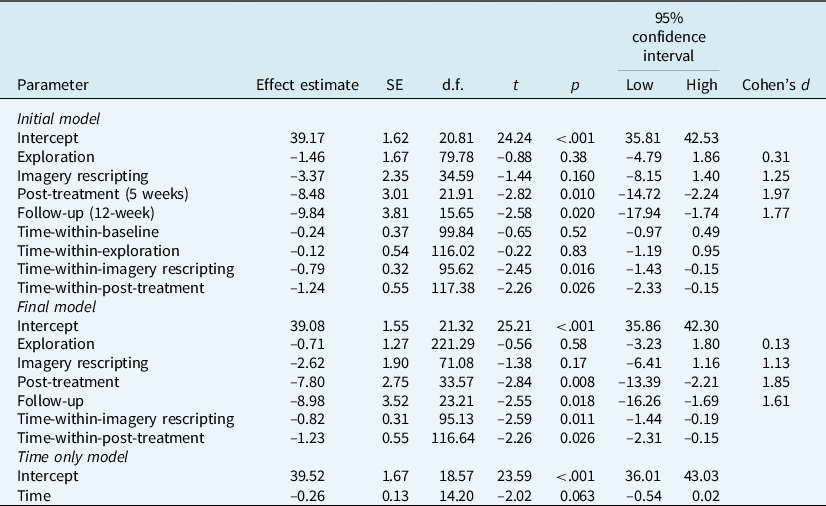
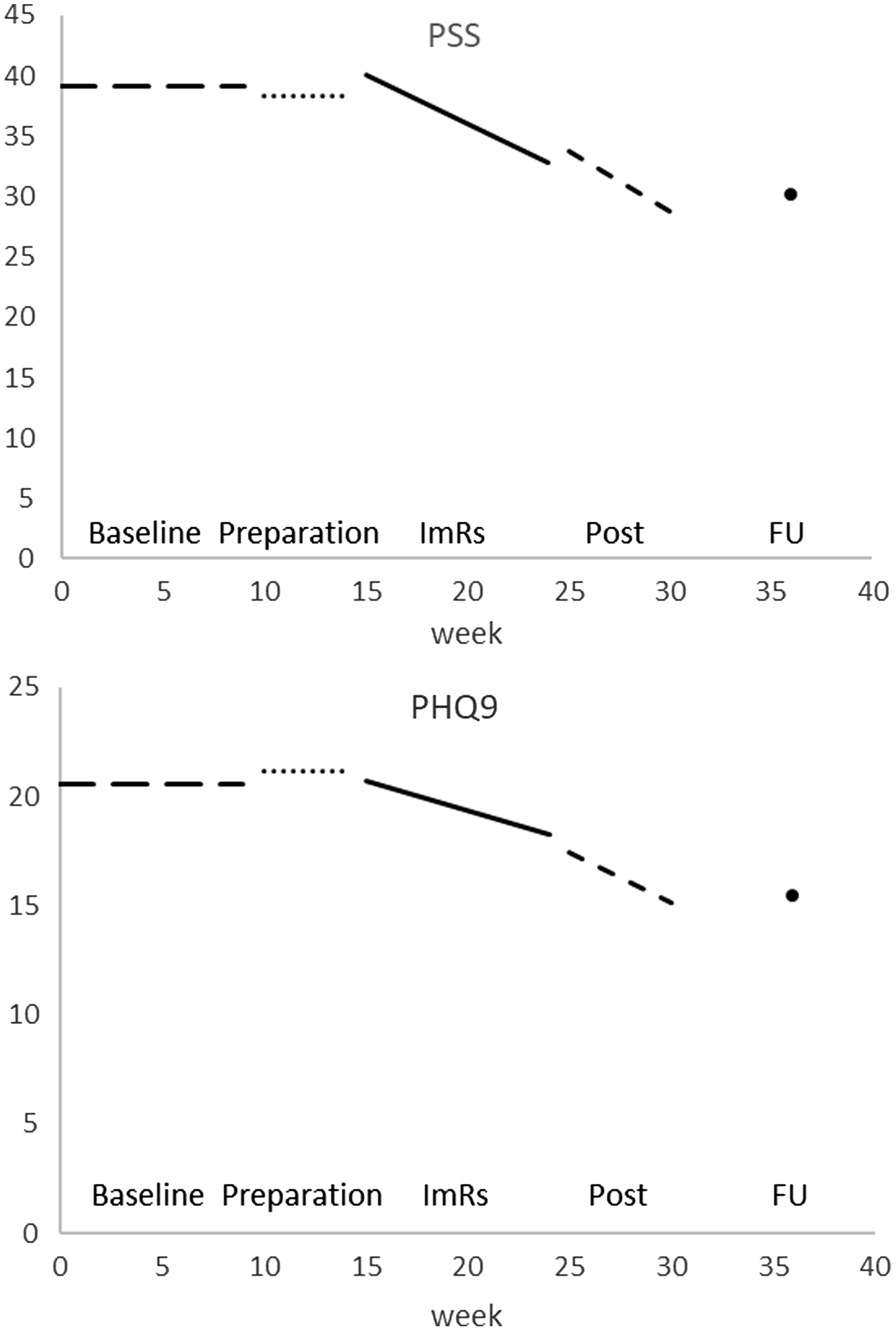
ARMA11 had the best fit and was therefore used as the covariance structure for the repeated part. A random slope for week was added to the model. Table 2 shows the results of the fixed part, for the initial (full) model, for the reduced model after stepwise deletion of the N.S. time-within-preparation and time-within-baseline effects, and for the model with only time as predictor. Note that main effects of phase are estimated at the midpoint of phase, not at the end. However, effect sizes represent the effect at the end of each phase, compared with wait-period. The fit of the final model (phase, time-within-treatment, time-within-follow-up; –2LL=1566.72) was superior to the fit of the model with time only (–2LL=1578.24), χ2(5)=11.52, p=.042. The distribution of the residuals showed no remarkable deviation from the normal distribution. Figure 2 illustrates the results of the mixed regression analysis, i.e. the general pattern of the PSS scores over time. What can be seen is that during the wait-period (baseline), there was on average no change in PSS, nor was there in the preparation phase. With the application of ImRs, PSS scores started to reduce, which continued during the 5 weeks post-treatment. The mean PSS score at 12-week follow-up indicates a stable effect on the PSS.
Results of the fixed part of the mixed regression analyses of the PSS

REML estimations. Baseline was the reference category. Time in weeks. Main phase effects are estimated at the mid-point of the phase, not at the end. Cohen’s d (=mean change/SD) based on model estimations at the end of the pertinent phase, with respect to baseline (numerator), and baseline SD (denominator). The phase effects represent the average difference between that phase and baseline (estimated by the intercept). For example, in the initial model the post-treatment effect is a decrease of –8.48 at the middle of the post-treatment phase, compared with halfway baseline (39.17). Hence, the estimated PSS score halfway post-treatment is 39.17–8.48=30.69. The time within phase effects represents the average change in PSS scores per week during the pertinent phase. For example, a time-within-post-treatment effect of –1.24 in the initial model means that every week in the post-treatment period there was a mean reduction of 1.24 points on the PSS.
Estimated fixed means for the PSS and PHQ 9 from the final mixed regression model.

The results indicate that PTSD symptoms did not reduce because of the passage of time, or because of treatment preparation (i.e. non-specific attention and empathy). Rather, treatment brought about a reduction in PTSD symptoms, which continued during the weeks after treatment had ended. This pattern of results is in support of the hypothesis that ImRs brought about the reduction of PTSD symptoms, rather than time or non-specific attention.
CAPS
A paired t-test showed a significant reduction on the CAPS-total score, from a baseline mean of 45.92 (SD=7.0) to a follow-up mean of 26.88 (SD=10.9), t 9=5.11, p<.001, Cohen’s d=2.72. Six of the ten participants’ CAPS scores fell below the diagnostic threshold for PTSD at the follow-up assessment.
Intrusion diary
The mean number of intrusions recorded in a self-report diary during the week prior to treatment starting was 32.4 (SD=30.6) compared with 19.3 (SD=17.4) during the week following treatment (Cohen’s d=0.43). The GEE Negative Binomial Regression indicated a non-significant reduction, Wald χ2(1)=2.73, p=.099. When controlled for accuracy of recording, the difference became significant, Wald χ2(1)=6.63, p=.01.
Mood
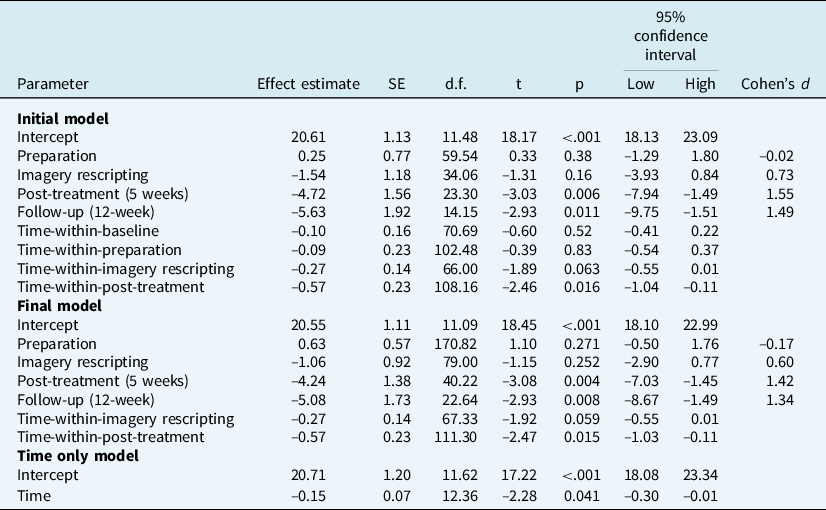
ARMA11 was the best fitting covariance structure for the repeated part. A random slope for week was added to the model. Table 3 shows the results of the fixed part, for the initial (full) model, for the reduced model after stepwise deletion of the N.S. time-within-preparation and time-within-baseline effects, and for the model with only time as predictor. (Again, main effects of phase are estimated at the midpoint of phase, not at the end; and effect sizes represent the effect at the end of each phase, compared with wait-period.) The fit of the final model (phase, time-within-treatment, time-within-follow-up; –2LL=1155.865) was superior to the fit of the model with time only (–2LL=1169.106), χ2(5)=13.24, p=.021. The distribution of the residuals showed no remarkable deviation from the normal distribution. Figure 2 illustrates the results of the fixed part of the mixed regression analysis of the PHQ9. During wait (baseline), there was on average no change in PHQ-9 scores, or in the preparation phase. With the application of ImRs, PHQ-9 scores started to reduce, which continued during the 5 weeks post-treatment. The mean PHQ-9 score at 12-week follow-up indicates a stable effect on the PHQ-9. Individual participants PSS scores over each phase can be seen in the Supplementary material.
Results of the fixed part of the mixed regression analyses of the PHQ-9

REML estimations. Baseline was the reference category. Time in weeks. Main condition effects are estimated at the mid-point of the phase, not at the end. Cohen’s d (=mean change/SD) based on model estimations at the end of the pertinent phase, with respect to baseline (numerator), and baseline SD (denominator).
The findings indicate that mood did not improve due to time or non-specific therapist attention. The ImRs treatment phase is associated with mood improvement.
Discussion
A large effect size was obtained using imagery rescripting for the treatment of PTSD symptoms within asylum seekers, along with a reduction in the self-report of intrusive memories. These results are in line with the outcomes obtained using ImRs to treat PTSD within the non-refugee populations (Morina et al., Reference Morina, Lancee and Arntz2017) and those obtained using other trauma-focused psychological interventions within refugee populations (Thompson et al., Reference Thompson, Vidgen and Roberts2018). It is also in line with the one previous case series published using ImRs to treat PTSD in refugees (Arntz et al., Reference Arntz, Sofi and van Breukelen2013). Whilst larger studies are required to replicate this result, it would seem reasonable to conclude that ImRs is a viable and promising treatment option for this group.
The evidence base for the maintenance of treatment gains is limited within this population (Thompson et al., Reference Thompson, Vidgen and Roberts2018). It is therefore quite striking that the symptom reduction gained during the treatment phase of this study was not only maintained, but continued during the 5-week post-treatment phase at a similar rate to the treatment phase, and was maintained at 12 weeks. Studies using ImRs to treat PTSD in other populations have shown similar patterns of outcome (Boterhoven de Haan et al., Reference Boterhoven de Haan, Lee, Fassbinder, Van Es, Menninga and Meewisse2020). Although the mechanisms for this effect are yet to be determined, it may be that the direct focus on the meaning of the trauma within this approach results in secondary changes in mood and anxiety, which produce a positive cycle of change over a period of time. However, it should also be noted that this group exhibited severe levels of PTSD. Although a large treatment effect was obtained, the mean CAPS score of 27 at follow-up suggests that significant clinical needs remained. This is further demonstrated by four participants still exhibiting diagnostic levels of PTSD symptoms at follow-up. These outcomes are in line with recent systematic reviews which evidenced the effectiveness of psychological interventions in this group, but concluded that wider social and welfare interventions are also likely to be required (Hamid et al., Reference Hamid, Patel and Williams2019; Tribe et al., Reference Tribe, Sendt and Tracy2019). It should be noted that the current study was conducted within a multi-disciplinary service, with ImRs being evaluated as the core psychological intervention. However, it is not proposed that ImRs would be, or should be, the only help offered to asylum seekers presenting with PTSD.
The clinicians delivering the ImRs intervention in this study observed that the most likely reasons for some participants benefiting less were the same as those associated with a non-refugee population. These reasons included avoidance, in the form of passive engagement within the rescripting or recalling non-vivid memories. In some cases, there was difficulty in distinguishing between rumination and intrusive memories, with the former not being responsive to the current intervention. Also, in common with other complex cases with high levels of varied traumatic experiences, a 10-session limit was not always sufficient. Future studies should test whether more sessions of ImRs leads to a reduction in CAPS scores to within the non-clinical level, at least for those that show a response to the initial 10 sessions. However, it may also be the case that ImRs has the potential for large effects over a relatively short number of sessions within individuals where one main specific target can be readily identified. Thus, a treatment protocol will ultimately require a flexible number of sessions based on clinical presentation.
Although there was no control group, the varied wait-period (baseline) and repeated measures design did allow for analysis to control for the expected symptom change over time without treatment. The largest limitation of the current study was that the assessments were conducted by service staff who were not blind to the phase of the study, i.e. whether the participant was in a treatment phase. This may have led to inflated effect size outcomes, if the awareness of phase biased assessments in line with our hypothesis (i.e. treatment should reduce symptoms). Although adequate for a case series, the current sample was small and therefore reduces generalisability of the results. There were varied reasons that those who were assessed for eligibility did not take part in the study. Thirteen people decided to take the standard treatment offered by the service (NET). Anecdotally, this was most likely to be due to the long waiting-list already experienced, and a desire to stick with what was considered routine treatment rather than ‘experimental’. A relatively large number of potential participants withdrew from the study after consent, which may have also impacted on generalisability. However, we are familiar with people from this group frequently needing to delay and stagger their interventions to accommodate difficulties in their lives. It is likely that this group would be more adversely affected by the research methodology restrictions that others. Whilst generalisability is limited, our main conclusion from this issue is the need for flexibility in the delivery of ImRs within routine services, as with all other interventions. A final limitation was the use of PSS, based on the DSM-IV, while the CAPS-5 is based on the DSM-5. It is of note that the CAPS-5 demonstrated symptom reduction while the PSS suffered a ceiling effect.
The results of the current study contribute to two important debates in the field; the role of stabilisation within trauma-focused interventions, and the trans-cultural suitability of such treatments. There has been a longstanding view that individuals who have experienced severe trauma require a period of stabilisation (including emotion regulation coping strategies) in order to cope with the emotional demands of a trauma-focused intervention (Cloitre et al., Reference Cloitre, Courtois, Ford, Green, Alexander and Briere2012). This assumption has been questioned (de Jongh et al., Reference de Jongh, Resick, Zoellner, van Minnen, Lee and Monson2016), with the current results suggesting that there were no adverse effects due to the lack of a prolonged stabilisation phase.
There is an important debate about whether psychological interventions developed in the West are appropriate for non-Western cultures. Issues raised include the potential for the underlying assumptions embedded within Western interventions to be discordant with other cultures. A review of psychological interventions for torture survivors (Patel et al., Reference Patel, Williams and Kellezi2016) refers to a number of ethical concerns regarding research in this area, mainly around assessment using unfamiliar cultural frameworks and language, and that drop-out rates may indicate harm (although harm itself was not evidenced). Conversely, researchers who have developed culturally appropriate treatments for PTSD, such as NET (Schauer et al., Reference Schauer, Schauer, Neuner and Elbert2011), caution against denying evidence-based treatment to refugees on the basis of culture. Arguably, imagery rescripting is a culturally appropriate intervention. It is led by the patient and they can rescript in line with their own values, beliefs and cultures. The current study did produce measurable benefits in terms of distress reduction, and no participants dropped out of the intervention once they had received their first session, suggesting a level of acceptability. Given the objective benefits obtained we would argue that removing the opportunity for the intervention should only be based on observed and documented adverse events.
To conclude, the current study suggests that imagery rescripting is a viable, effective and culturally flexible treatment option for PTSD within an NHS clinical service.
Supplementary material
To view supplementary material for this article, please visit: https://doi.org/10.1017/S1352465822000650
Data availability statement
The data that support the findings of this study are available on request from the corresponding author, C.S. The data are not publicly available due to data containing information that could compromise the privacy of research participants.
Acknowledgements
We would like to thank the service-users and staff at the Woodfield Trauma Service London; in particular Bahar Pourghobad, Rachel Clarke, Lynette Meredith, Aminah Cheema, Hibah Hassan, Katy Trevithick, Beth Adams, Harriet Ward, Eleanor Forrester and Roisin McCarthy for their help in data collection.
Author contributions
Craig Steel: Conceptualization (equal), Formal analysis (supporting), Investigation (lead), Methodology (equal), Project administration (equal), Writing – original draft (lead); Kerry Young: Conceptualization (equal), Project administration (equal), Supervision (equal), Writing – original draft (supporting); Sameena Akbar: Project administration (equal), Supervision (equal), Writing – original draft (supporting); Millay Vann: Project administration (equal), Supervision (equal), Writing – original draft (supporting); Zoe Chessell: Project administration (equal), Supervision (equal), Writing – original draft (supporting); Adele Stevens: Project administration (equal), Supervision (equal), Writing – original draft (supporting); Arnoud Arntz: Conceptualization (equal), Formal analysis (lead), Methodology (equal), Supervision (equal), Writing – original draft (equal).
Financial support
This research did not receive any specific grant form any funding agency, commercial or not-for-profit sectors.
Conflicts of interest
A.A. offers training in ImRs, mainly for trial therapists of scientific studies. The renumeration goes to the university to support research. K.Y. and S.A. have been paid to provide ImRs training as part of UK CPD programmes.
Craig Steel is an Associate Editor of Behavioural and Cognitive Psychotherapy. He was not involved in the review or editorial process for this paper, on which he is listed as an author.
Ethical standards
The authors have abided by the Ethical Principles of Psychologists and the Code of Conduct as set out by the APA. The study protocol was approved by NHS South Central Research Ethics Committee (15/SC/0402). Ethical approval included informed consent for the results to be published.




Comments
No Comments have been published for this article.