1. Introduction
Based on studies of granitic batholiths from the Lachlan Fold Belt (SE Australia), Chappell & White (Reference Chappell and White1974) divided granitoids into two groups: I- and S-type. The S and I imply specific sources: metasedimentary and (meta-)igneous protoliths, respectively (Chappell & White, Reference Chappell and White1974). Subsequently, an additional group of granites with distinctive characteristics was termed A-type granite by Loiselle & Wones (Reference Loiselle and Wones1979). The term emphasizes the anorogenic setting, the enrichment in alkaline composition and the anhydrous signature of the magmas. Similar to A-type granite, there are also A-type eruptive lavas, which are common and closely associated with the equivalent intrusion (e.g. Clemens et al. Reference Clemens, Holloway and White1986; Turner et al. Reference Turner, Foden and Morrison1992; Frost & Frost, Reference Frost and Frost1997; Liu et al. Reference Liu, Zhou, Lai, Qing, Li, Wu and Xia2015; Zhou et al. Reference Zhou, Liu, Lai, Wang, Liao, Li, Wu, Wang and Qing2018). In contrast to huge S- and I-type batholiths, A-type rocks commonly form small subvolcanic intrusions or occur as eruptive lavas (Clemens et al. Reference Clemens, Holloway and White1986; Bonin, Reference Bonin2007; Shellnutt & Jahn, Reference Shellnutt and Jahn2010). A typical extrusive rock association that includes A-type rocks is the bimodal suite of rhyolite and basalt (Clemens et al. Reference Clemens, Holloway and White1986; Liu et al. Reference Liu, Zhou, Lai, Qing, Li, Wu and Xia2015; Zhou et al. Reference Zhou, Liu, Lai, Wang, Liao, Li, Wu, Wang and Qing2018). Although A-type rocks are insignificant in volume, they have received much attention because of their tectonic implications and economic potential for Be, Li, Mo, Sn, W, Nb, Ta and rare earth element (REE) mineralization. In the study of Loiselle & Wones (Reference Loiselle and Wones1979), these rocks were considered as emplaced in rift zones and within stable continental blocks. On the trace-element discriminant diagrams of Pearce et al. (Reference Pearce, Harris and Tindle1984), almost all the data for A-type granites plot in the field of ‘within-plate granites’. The field was delineated by geochemical data from felsic rocks from tensional environments, including cratons, continental rift zones and oceanic islands. Besides the within-plate setting, A-type granites are also found at the end of orogenic cycles and in back-arc zones (Brown et al. Reference Brown, Thorpe and Webb1984; Eby, Reference Eby1990; Jiang et al. Reference Jiang, Zhao, Zhou, Liao and Jin2011, Reference Jiang, Wang, Liu, Ni, Qing and Zhang2015). Eby (Reference Eby1990, Reference Eby1992) recognized two chemical subgroups of A-type granitoids: A1 and A2. The A1-type granitoids were considered as differentiates of magmas derived from oceanic island basalt (OIB)-like sources and emplaced in within-plate settings. The A2-type granitoids were interpreted as crustal source-derived products and emplaced in continent–continent collision or island-arc settings (Eby, Reference Eby1992). A1- and A2-type rocks have long been used to constrain plate tectonic reconstructions.
In this paper, we investigated some Late Mesoproterozoic felsic lavas from the Huili Group in the southwestern Yangtze Block. New laser ablation inductively coupled plasma mass spectrometry (LA-ICP-MS) zircon U–Pb dating, whole-rock geochemical and isotopic data, and in situ zircon Hf isotopic data for these rocks are presented to explore their petrogenesis. Based on these new data, we suggest that these felsic lavas erupted at the same time and comprise A1 and A2 subtypes. The identification of these A-type lavas provides convincing evidence that A1- and A2-type felsic rocks can be generated in the same tectonic setting.
2. Geological context
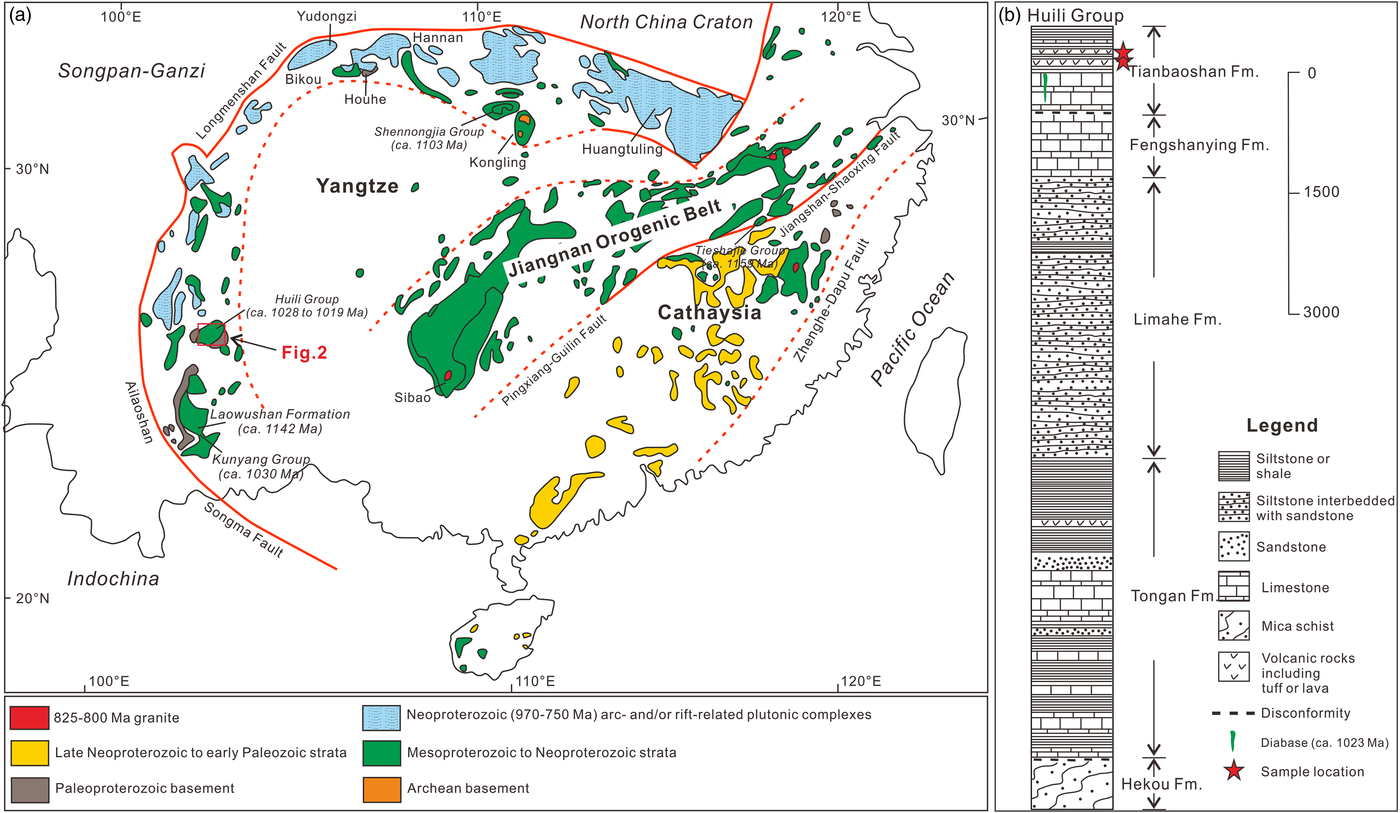
The South China Block (SCB) consists of two blocks: the Yangtze and Cathaysia. The collision between the two blocks produced the Jiangnan Orogen, with the formation of abundant Neoproterozoic volcano-sedimentary successions (Fig. 1a). The collision occurred at c. 1000 Ma (e.g. Li et al. Reference Li, Li, Zhou and Kinny2002) or between 830 and 800 Ma (e.g. Zhao & Cawood, Reference Zhao and Cawood2012). The SHRIMP zircon U–Pb ages (∼968 Ma; Li et al. Reference Li, Zhou, Zhao, Fanning and Compston1994) of the Xiwan plagiogranites within the NE Jiangxi ophiolites imply that the orogen is part of the Grenvillian orogenic belt. Based on new data concerning magmatic rocks and sedimentary strata, however, most researchers consider that the final collision occurred at c. 830–800 Ma (e.g. Wang et al. Reference Wang, Zhao, Zhou, Liu and Hu2008, Reference Wang, Zhou, Wan, Kitajima, Wang, Bonamici, Qiu and Sun2013), obviously younger than the Grenvillian period.
(a) Geological map showing the distribution of Precambrian rocks in the South China Block (Zhao, Reference Zhao2015). (b) Sedimentary succession of the Upper Mesoproterozoic Huili Group in the southwestern Yangtze Block (modified from Greentree et al. Reference Greentree, Li, Li and Wu2006).

The Yangtze Block has a poorly exposed Archaean to Palaeoproterozoic basement, which is unconformably overlain by variably deformed and metamorphosed Neoproterozoic to Mesozoic volcanic-sedimentary successions (Zhao & Cawood, Reference Zhao and Cawood2012). The oldest rocks in the Yangtze Block are the c. 3.3–2.7 Ga protoliths of the Kongling tonalite–trondhjemite–granodiorite (TTG) gneisses (Cawood et al. Reference Cawood, Zhao, Yao, Wang, Xu and Wang2018; Fig. 1a). In the Cathaysia Block, its metamorphic basement is composed of Palaeoproterozoic sedimentary and igneous rocks (Zhao & Cawood, Reference Zhao and Cawood2012), and ancient strata dominated by Neoproterozoic to lower Palaeozoic sedimentary successions (Fig. 1a).
Mesoproterozoic rocks are rarely exposed in the SCB and occur mainly along the margins of the Yangtze Block (Fig. 1a). In the western Yangtze Block, they are exposed to the north of the Ailaoshan–Red River Fault, and include the Laowushan Formation, Upper Kunyang Group, Huili Group and Julin Group (Greentree et al. Reference Greentree, Li, Li and Wu2006). Mesoproterozoic mafic and felsic lavas occur as interlayers in these strata. Recently, Ren et al. (Reference Ren, Pang, Pan, Wang, Sun, Yin, Cui, Wang, Deng and Ren2017) identified the Caiziyuan ophiolitic mélange along the Guanhe–Tongan area. LA-ICP-MS zircon U–Pb dating on a gabbro from the mélange yielded a Mesoproterozoic age of 1375 ± 7 Ma (MSWD = 1.2, n = 21). The Huili Group is a sequence of slate, siltstone, sandstone and carbonate and felsic volcanic interlayers. It consists of the Tongan, Limahe, Fengshanying and Tianbaoshan formations, unconformably underlain by the Hekou Formation. The Tianbaoshan Formation is composed of pelitic schists, meta-sandstones, dacitic to rhyolitic lavas and tuffaceous rocks (Fig. 1b). In the dacitic to rhyolitic samples, the phenocrysts (10–∼20 %) are mainly quartz with minor plagioclase and mafic minerals. The plagioclases are locally altered to sericite, and mafic minerals are altered to chlorite. The groundmass (80–∼90 %) in our samples includes glass and the aforementioned minerals.
3. Sampling and analytical methods
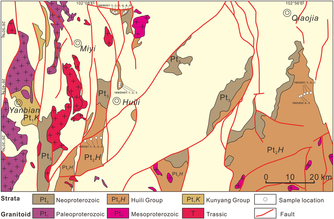
Fifteen samples were collected from the Tianbaoshan Formation of the Huili Group (Fig. 2). Zircons were separated from four samples (10KMZ01-6, 10HCQ01-1, 10WDH01-1 and 10XSX02-4) through conventional heavy liquid and magnetic separation methods, and then handpicked under a binocular microscope. Representative zircon crystals were prepared and placed on a glass slide and covered with epoxy resin in a cylindrical frame. The surface of this slide was polished for further cathodoluminescence (CL) investigations. CL images were obtained using a GATAN MINI probe placed on a JSM 6510 electron microprobe, with an accelerating potential of 10 kV at Beijing GeoAnalysis Co. Ltd, China. LA-ICP-MS U–Pb analyses for these zircons were conducted at the State Key Laboratory for Mineral Deposits Research, Nanjing University (SKLMDR, NJU), determined by an Agilent 7500a ICP-MS equipped with a New Wave Research 213 nm laser ablation system. Analytical procedures are described by Xu et al. (Reference Xu, Griffin, Ma, O’Reilly, He and Zhang2009) and Jackson et al. (Reference Jackson, Pearson, Griffin and Belousova2004) in detail. We corrected for mass discrimination of the mass spectrometer and residual elemental fractionation through calibration against a homogeneous standard zircon, GEMOC/GJ-1 (608.53 ± 0.37 Ma, n = 8, 2σ; Jackson et al. Reference Jackson, Pearson, Griffin and Belousova2004). The Mud Tank zircon standard (TIMS age = 732 ± 5 Ma, n = 5, Black & Gulson, Reference Black and Gulson1978; LA-ICP-MS 206Pb–238U age = 732.4 ± 1.4 Ma, n = 359 at 95 % confidence; Jackson et al. Reference Jackson, Pearson, Griffin and Belousova2004) was measured as an independent control on reproducibility and instrument stability. We evaluated common Pb contents and corrected common Pb following the method introduced by Andersen (Reference Andersen2002).
Geological map of the studied area.

Major-element contents were analysed using X-ray fluorescence (XRF) on fused glass beads at SKLMDR, NJU, with a precision better than 5 %. In regards to analysing the trace elements, for each sample, ∼50 mg of powder was dissolved in a screw-top Teflon beaker, mixed with HF + HNO3 acid mixture and then heated at ∼160 °C for 48 h. We determined whole-rock trace-element contents using a Finnigan Element II ICP-MS at the State Key Laboratory of Continental Dynamics, Northwest University (SKLCD, NWU), with a precision better than 10 %. Detailed methods for trace-element analyses are presented in Gao et al. (Reference Gao, Lu, Lai, Lin and Pu2003).
The Sr–Nd isotopic ratios were measured using a Finnigan Triton TI thermal ionization mass spectrometer (TIMS) at SKLMDR, NJU. For Sr–Nd isotopic analyses, ∼100 mg of powder was dissolved in Teflon beakers with a HF + HNO3 acid mixture, and Sr and Nd were then separated and purified by conventional cation-exchange techniques. Detailed analytical procedures are described by Pu et al. (Reference Pu, Zhao, Ling and Jiang2004, Reference Pu, Gao, Zhao, Ling and Jiang2005). The mass fractionation corrections regarding the 87Sr/86Sr and 143Nd/144Nd ratios are on the basis of 86Sr/88Sr = 0.1194 and 146Nd/144Nd = 0.7219, respectively. During the analyses, measurements of the La Jolla standard gave 143Nd/144Nd = 0.511842 ± 4 (2σ, n = 5), and for the NBS-987 Sr standard gave 87Sr/86Sr = 0.710260 ± 10 (2σ, n = 30). Total analytical blanks were 5 × 10⁻¹¹ g for Sm–Nd and (2–5) × 10−10 g for Rb–Sr.
In situ Hf isotopic analyses of zircons were carried out using a 193 nm laser attached to a Neptune multi-collector ICP-MS (LA-MC-ICP-MS) at the Institute of Geology and Geophysics, Chinese Academy of Sciences, Beijing. The technique is described in detail by Wu et al. (Reference Wu, Yang, Xie, Yang and Xu2006). Most analyses were carried out in a He carrier gas with a beam diameter of 44 μm. For the calculation of ϵHf we used the chondritic values of Bouvier et al. (Reference Bouvier, Vervoort and Patchett2008).
4. Results
4.a. LA-ICP-MS zircon U–Pb dating
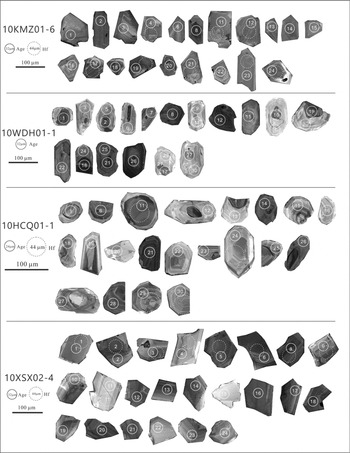
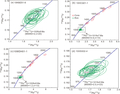
Zircons in our samples have regular oscillatory zoning, with lengths ranging from 40 µm to 120 µm (Fig. 3). Some zircons from 10WDH01-1 and 10HCQ01-1 exhibit a core–rim texture (Fig. 3). All the analytical results yield high Th/U ratios of between 0.2 and 1.7 (online Supplementary Material Table S1), consistent with those of magmatic zircons (Williams et al. Reference Williams, Buick and Cartwright1996). Most of the U–Pb analyses cluster on or near the concordant curve (Fig. 4). Analyses of zircon rims yield weighted mean 206Pb–238U ages of 1026 ± 8 Ma (2σ, MSWD = 2) for sample 10KMZ01-6; 1019 ± 7 Ma (2σ, MSWD = 0.9) for sample 10HCQ01-1; 1028 ± 9 Ma (2σ, MSWD = 1.2) for sample 10WDH01-1; and 1019 ± 5 Ma (2σ, MSWD = 2.0) for sample 10XSX02-4. These weighted ages indicate that the studied felsic lavas erupted in Late Mesoproterozoic time. In sample 10HCQ01-1 and sample 10WDH01-1, U–Pb analyses of zircon cores yield 206Pb–238U ages ranging from 1115 Ma to 1857 Ma.
Typical CL images of analysed zircons for the felsic volcanic rocks.

LA-ICP-MS zircon U–Pb concordant curves for the felsic volcanic rocks.

4.b. Whole-rock major and trace elements
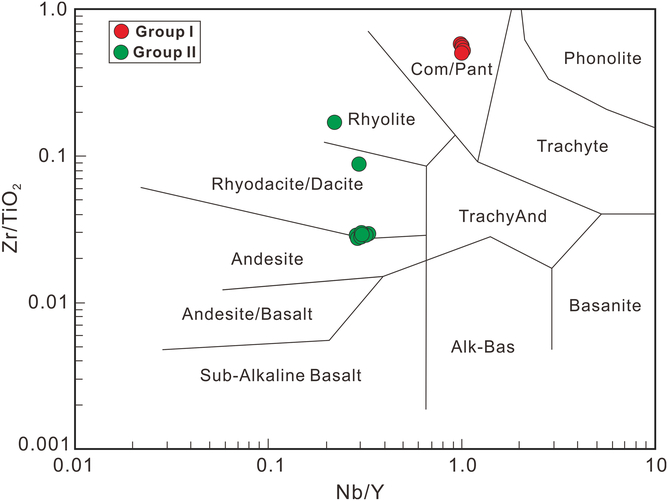
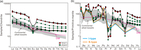
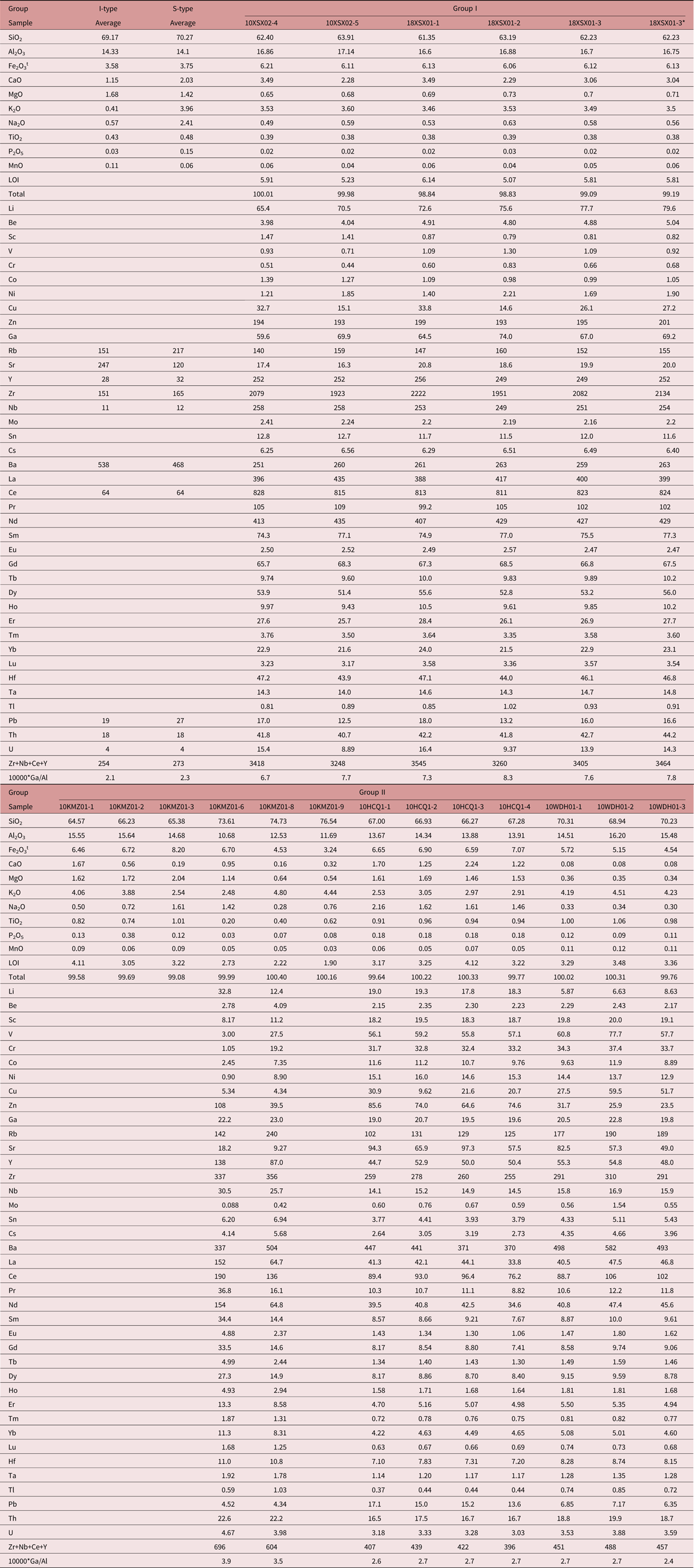
All the Tianbaoshan samples are felsic with SiO2 contents of between 64.57 and 76.54 wt%. They plot in the dacite, rhyolite and comendite/pantellerite fields in the Zr/TiO2 versus Nb/Y plots (Fig. 5). Chondrite-normalized REE patterns for these rocks are enriched in light rare earth elements (LREEs) relative to heavy rare earth elements (HREEs), with negative Eu anomalies (Fig. 6a). In addition, they exhibit negative anomalies in Nb, Ta, Ba, Sr, Eu and Ti when data are plotted in primitive mantle (PM)-normalized spidergrams (Fig. 6b). Compared to typical I-type and S-type granitoids, all the samples are characterized by extremely high high-field-strength element (HFSE) contents, with high 10 000*Ga/Al ratios (mostly greater than 2.6) as well as Zr + Nb + Y + Ce greater than 350 ppm (Table 1). They can be divided into two groups: Group I and Group II. The former has lower Si, higher Nb/Y and more enriched large ion lithophile elements (LILEs) and HFSEs (except Eu, Ti, Rb, Sr and Ba) than the latter (Figs 5, 6).
Plots of Zr/TiO2 versus Nb/Y for the felsic volcanic rocks (modified from Winchester & Floyd, Reference Winchester and Floyd1977). Com – comendite; Pant – pantellerite.

(a) Chondrite-normalized (Sun & McDonough, Reference Sun, McDonough, Saunders and Norry1989) REE patterns and (b) primitive mantle-normalized (Sun & McDonough, Reference Sun, McDonough, Saunders and Norry1989) trace-element patterns for the felsic volcanic rocks. The field of continental alkali basalts is also shown for comparison. Data sources are from Zeng et al. (Reference Zeng, Chen, Xu, Jiang and Hofmann2010, Reference Zeng, Chen, Hofmann, Jiang and Xu2011, Reference Zeng, Chen, Hu and Xu2013).

Major (wt%) and trace (ppm) elements of the studied felsic rocks

Note: Average compositions of I-type and S-type granitoids are from Whalen et al. (Reference Whalen, Currie and Chappell1987); * – duplicate; LOI – loss on ignition.
4.c. Isotopic analysis
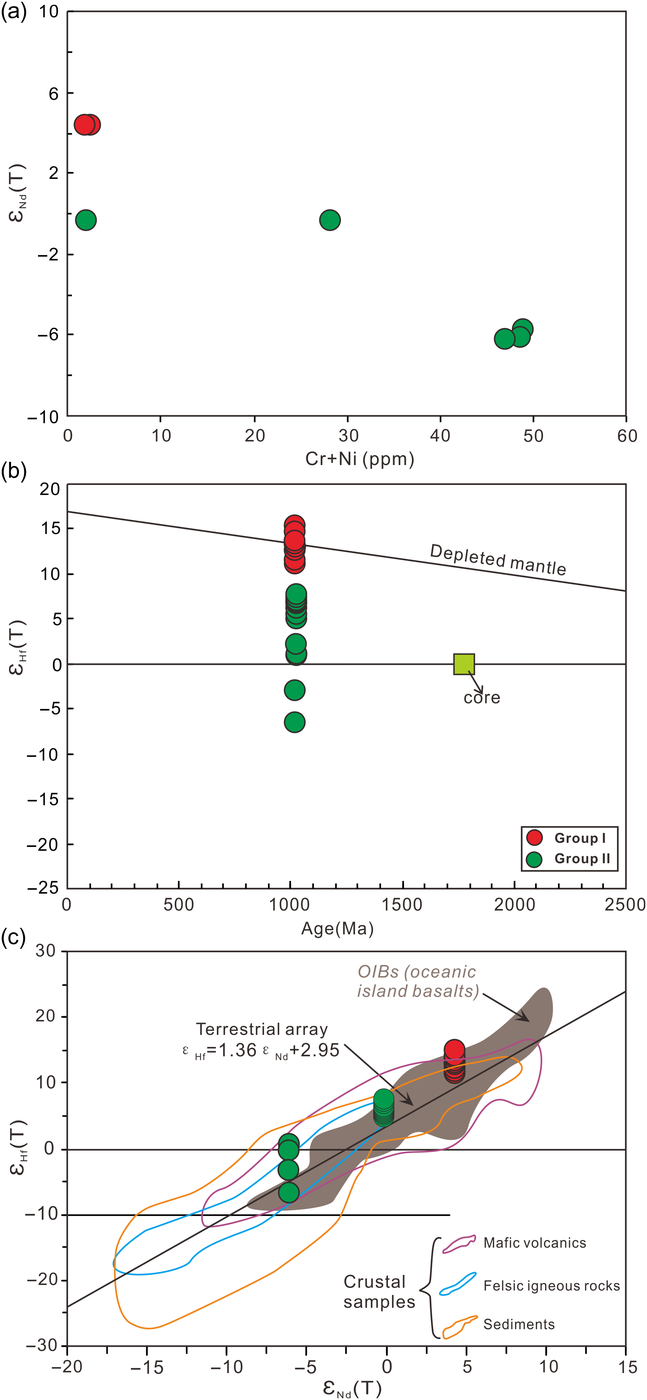
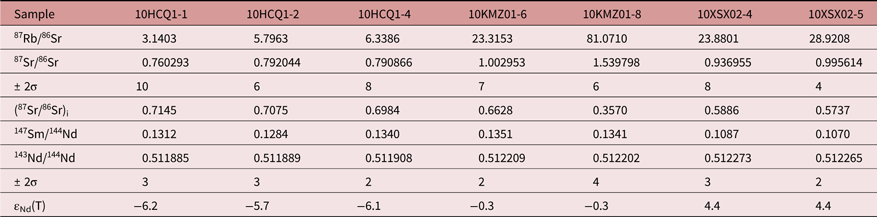
Group I samples exhibit positive ϵNd(T) values of +4.4 (Fig. 7a). The 87Sr/86Sri values are unrealistically low, ranging from 0.5737 to 0.5886 (Table 2). Group I zircons have positive ϵHf values of +11.2 to +14.7 (Fig. 7b). In contrast with Group I, Group II samples have negative ϵNd(T) values ranging from −6.2 to −0.3 (Fig. 7a). The 87Sr/86Sri values are unrealistically variable, ranging from 0.3570 to 0.7145 (Table 2). The variation might be associated with post-magmatic alteration and the extremely high Rb/Sr ratios of the samples. Zircon grains from these felsic samples show evident variation in Hf isotopic composition, with ϵHf varying from +7.7 to −6.4 (Fig. 7b). One zircon core from sample 10HCQ1-1 was also analysed, and its ϵHf value is −0.1 (online Supplementary Material Table S1).
(a) ϵNd(T) versus Cr + Ni and (b) zircon Hf isotopic compositions of the felsic volcanic rocks. (c) Whole-rock ϵHf versus ϵNd zircon diagram (modified after Vervoort et al. Reference Vervoort, Patchett, Blichert-Toft and Albarede1999).

Sr–Nd isotopic components of the studied felsic rocks

5. Discussion
5.a. Post-magmatic alteration
Petrographic features reveal that all the samples have undergone low-degree post-magmatic alteration, including sericitization and chloritization. The alteration is also indicated by the relatively high loss on ignition (LOI) values of 1.90 to 6.14. During the low-degree alteration, some major and trace elements, such as Ti, Fe, Al, P, Mn, REEs and HFSEs (e.g. Zr, Nb, Ta, Ti, Th, and Y) are not generally transported, while Mg, Ca, Na, K and LILEs (e.g. Sr, Ba and Rb) are easily disturbed (e.g. Smith & Smith, Reference Smith and Smith1976; Bédard, Reference Bédard1999). As a result, just those undisturbed elements are referred to in subsequent discussions.
5.b. Petrogenesis of the felsic lavas from the Tianbaoshan Formation
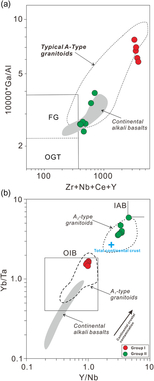
Zircon U–Pb dating results indicate that the investigated felsic rocks were simultaneously emplaced in Late Mesoproterozoic time. These samples have some similar geochemical signatures. Compared to typical I- and S-type granitoids, all of them are characterized by low Sr and Eu and high HFSE contents, enriched REE compositions and negative Eu anomalies (Fig. 6). The discrimination diagram of 10 000*Ga/Al versus Zr + Nb + Y + Ce (Fig. 8a) plots these samples within the A-type granite field. On the trace-element discriminant diagrams of Pearce et al. (Reference Pearce, Harris and Tindle1984), all the data are plotted in the field of ‘within-plate granites’ (Fig. 9). Thus, the studied felsic lavas can be classified as A-type rocks.
(a) 10 000*Ga/Al versus Zr + Nb +Ce + Y (ppm) discriminant diagram (Eby, Reference Eby1990) and (b) plots of Y/Ta versus Yb/Nb (Eby, Reference Eby1992) for the felsic volcanic rocks from the Huili Group. FG – fractionated I-type granitoids; OGT – I-, S- and M-type granitoids; OIB – oceanic island basalt; IAB – island-arc basalt. Data sources for continental alkali basalts are from Zeng et al. (Reference Zeng, Chen, Xu, Jiang and Hofmann2010, Reference Zeng, Chen, Hofmann, Jiang and Xu2011, Reference Zeng, Chen, Hu and Xu2013).

Two main genetic models for the generation of A-type rocks have been proposed: (1) fractional crystallization of alkaline OIB-like basaltic magmas with or without significant crustal contamination (e.g. Turner et al. Reference Turner, Foden and Morrison1992; Bonin, Reference Bonin2007); and (2) partial melting of crustal sources including residual felsic granulite (Collins et al. Reference Collins, Beams, White and Chappell1982) and tonalitic to granodioritic rocks (Creaser et al. Reference Creaser, Price and Wormald1991). Based on experimental studies, metaluminous A-type melts could be produced by dehydration melting of hornblende- and biotite-bearing granitoids at low pressure (P < 4 kbar) (Patiño Douce, Reference Patiño Douce1997). Furthermore, mixing of mantle-derived magmas with crustal material also generates A-type rocks with ‘mixed’ source characteristics (Poitrasson et al. Reference Poitrasson, Duthou and Pin1995).
5.b.1. Group I
Y/Nb ratio is insensitive to most magmatic processes (e.g. fractional crystallization and partial melting) and can reflect source nature (Eby, Reference Eby1990). A-type melts (A1) derived from an OIB-like mantle source generally exhibit low Y/Nb ratios (< 1.2), whereas others (A2) originating from a crustal source have relatively high Y/Nb ratios (> 1.2) (Eby, Reference Eby1990, Reference Eby1992). Relative to Group II, the Group I samples exhibit higher REE (except for Eu) and HFSE abundances and lower Y/Nb ratios of 0.99 to 1.02, consistent with A1 granitoids (Fig. 6). The granitoids and volcanic rocks defining the A1 field in Figure 8 are from oceanic islands. The Group I samples plot within the OIB field and along the AFC (assimilation and fractional crystallization) trends emanating from the field of continental alkali basalts, indicating an OIB-like mantle source. Compared to the continental alkali basalts, the Group I samples have higher Yb/Ta and Y/Nb ratios (Fig. 8b). The higher ratios could be attributed to continental crustal contamination due to total continental crust exhibiting relatively high Yb/Ta and Y/Nb ratios (Fig. 8b). The initial ϵNd(T) of +4.4 and ϵHf(T) of +11.2 to +14.8 also indicate a significant contribution of a mantle source. This speculation is supported by the Nd–Hf similarity between Group I and OIBs (Fig. 7c). Considering that our samples are exposed in a continental area, they cannot be derived from OIBs through the AFC process. However, continental alkali basalts exhibit close geochemical similarities to OIBs, characterized by enrichment in incompatible elements, positive Nb–Ta anomalies and depleted Nd–Hf isotopic components (Fig. 6; Chen et al. Reference Chen, Zeng, Hu, Yu and Chen2012). Asthenospheric mantle modified by recycled crustal components (e.g. eclogite, garnet pyroxenite and carbonatite) is more fertile. Partial melting of such metasomatic mantle can produce continental alkali basalts (Farmer, Reference Farmer and Rudnick2003; Zeng et al. Reference Zeng, Chen, Xu, Jiang and Hofmann2010, Reference Zeng, Chen, Hofmann, Jiang and Xu2011, Reference Zeng, Chen, Hu and Xu2013). Thus, we consider that differentiation of continental alkali basaltic magmas produced the Group I lavas. Although similar basaltic magmas are absent in the studied area, it is possible that these basaltic lavas have been eroded and worn away. This speculation is supported by the observation that Mesoproterozoic magmatic rocks occur rarely in the Yangtze Block. Compared to continental alkali basalts, the Group I samples contain high SiO2 and low MgO (0.65 to 0.68 wt%) as well as small amounts of V (∼0.7 to 0.9 ppm), Cr (∼0.4 to 0.5 ppm), Co (∼1.3 to 1.4 ppm) and Ni (∼1.2 to 1.9 ppm), suggesting significant removal of mafic minerals (Yan et al. Reference Yan, He, Beier and Klemd2018). In the chondrite-normalized REE patterns and primitive mantle-normalized spidergrams (Fig. 6b), Group I is relatively depleted in Eu, Ba, K, Nb, Ta, Pb, Sr, P and Ti, not reconciling with the continental alkali basalts. Depletion of these elements can be attributed to differentiation of feldspars, apatite and ilmenite (Yan et al. Reference Yan, He, Beier and Klemd2018). In sum, the Group I felsic lavas were produced by AFC of alkaline basaltic magmas that originated from a fertile asthenospheric mantle source modified by recycled crustal components.
5.b.2. Group II
Relative to Group I, the Group II samples have lower ϵNd and ϵHf and higher REEs and HFSEs, as well as Y/Nb ratios of 3.0–4.5, indicating a different origin (Figs 6, 7). The Nd–Hf isotopic differences between Group I and Group II require that Group II originated from a different source (Fig. 7). Furthermore, Group I samples have lower SiO2 but lower compatible element abundances than Group II. Accordingly, Group II could not be produced by further differentiation of the Group I magmas. The high Y/Nb ratios are similar to those of the A2-type granitoids and total continental crust (Fig. 8b), revealing that they were likely derived from a crustal source. This viewpoint is supported by the negative ϵNd(T) values (−0.3 to −6.2) and negative Nb–Ta–Ti anomalies. Recently, Zhu et al. (Reference Zhu, Zhong, Li, Bai and Yang2016) reported that some coeval diabasic dykes (1023 ± 6.7 Ma) intruded the Tianbaoshan Formation (Fig. 1b). They exhibit contrasting isotopic components with positive ϵNd(T) values of +0.41 to +1.6 and positive ϵHf(T) values of +7.0 to +10.3, indicating that the Group II lavas were not derived from a mantle source. Alternatively, if they did have a mantle source, their elevated Y/Nb ratios could be attributed to continental crustal contamination. However, our samples have higher Y (44.7 to 138 ppm) and Nb (14.1 to 30.5 ppm) contents than upper continental crust (Y, 21 ppm; Nb, 12 ppm) (Rudnick & Gao, Reference Rudnick, Gao and Rudnick2003), indicating that their Y and Nb contents are also insensitive to crustal contamination and the high Y/Nb ratios were not produced by crustal contamination. Zircons from these felsic rocks have variable ϵHf(T) values ranging from −6.4 to +7.7. The large variation in ϵHf indicates that magmatic evolution occurred in an open system. In addition, some zircons exhibit positive ϵHf values, requiring a mantle contribution. In general, typical A2-type granitic rocks are derived from a depleted residual source (granulite), which has undergone previous partial melting (e.g. Collins et al. Reference Collins, Beams, White and Chappell1982) or high-Si igneous rocks (tonalitic to granodioritic) (e.g. Creaser et al. Reference Creaser, Price and Wormald1991). Thus, their MgO and compatible element contents are evidently lower than I-type granites of comparable SiO2 content. For example, the metaluminous Gabo and Mumbulla A-type suites from the Lachlan Fold Belt of southeastern Australia have extreme high SiO2 (71.46 to 77.77 wt%) and low MgO (∼0.03 to 0.43 wt%), V (∼2 to 8 ppm), Cr (≤ 2 ppm), Co (∼1 to 4 ppm) and Ni (≤ 2 ppm). The relatively lower SiO2 (64.57 to 74.73 wt%) and higher MgO (∼0.34 to 2.04 wt%), V (∼3 to 78 ppm), Cr (∼1 to 37 ppm), Co (∼2 to 11 ppm) and Ni (∼1 to 16 ppm) contents in our samples also supports the input of mantle material (Table 1). Thus, we consider that the Group II felsic rocks were derived from partial melting of a crustal source with mixing of mantle-derived magmas.
5.c. Tectonic setting
A-type rocks have peculiar characteristics that distinguish them from calc-alkaline granitoids, which are generally emplaced in an active continental margin subduction setting. A distinctive feature is emplacement in extensional tectonic environments, such as continental rift, back-arc, post-orogenic and within-plate settings (e.g. Eby, Reference Eby1990; Sun et al. Reference Sun, Liu, Zhang, Li and Qi2017; Zhou et al. Reference Zhou, Liu, Lai, Wang, Liao, Li, Wu, Wang and Qing2018), commonly postdating calc-alkaline magmatism. In terms of geochemical signatures, A-type granitoids have been divided into two subtypes: A1 and A2 (Eby, Reference Eby1992). Eby (Reference Eby1992) suggested that the A1 group is emplaced in continental rifts or during within-plate magmatism, whereas the A2 group is generally restricted to arc or back-arc to post-collisional extension. In this work, however, coeval A2-type and A1-type magmas were emplaced in the southwestern Yangtze Block. Therefore, the coexistence of the two subtypes indicates that a variety of A-type granites can be emplaced in the same tectonic setting. Similarly, the 260 Ma perakaline Panzhihua and Taihe intrusions, 260 Ma metaluminous Woshui intrusion and 251 Ma peraluminous A-type intrusion occurred in the Panxi region (SW China), spatially and temporally associated with the same tectonic-thermal event (Emeishan mantle plume activity) (Shellnutt & Zhou, Reference Shellnutt and Zhou2007). Owing to the absence of a large igneous province in the Late Mesoproterozoic Yangtze Block, the Group I and Group II A-type rocks were not emplaced in a continental rift triggered by mantle plume activity.
5.c.1. A post-collisional rift setting?
Based on the recognition that the initial collision between the Yangtze and Cathaysia blocks occurred in Late Mesoproterozoic time, Zhu et al. (Reference Zhu, Zhong, Li, Bai and Yang2016) considered that the Tianbaoshan felsic lavas and coeval intruded mafic dykes were emplaced in a post-collisional continental rift setting. One key piece of evidence for the Late Mesoproterozoic collision is the ages of ophiolite suites along the suture between the two blocks. In earlier studies, the Sm–Nd mineral isochron of the gabbros within the ophiolites along the suture between the Yangtze and the Cathaysia blocks yielded ages of 1.034 ± 0.024 Ga, 1.02 ± 0.03 Ga and 1.024 ± 0.030 Ga (Zhou et al. Reference Zhou, Zou, Yang and Wang1989; Chen et al. Reference Chen, Foland, Xing, Xu and Zhou1991). On the basis of that work, the collision between the two blocks producing the Jiangnan Orogen was suggested to have occurred at between 1.3 Ga and 1.0 Ga (Li et al. Reference Li, Li, Zhou and Kinny2002; Greentree et al. Reference Greentree, Li, Li and Wu2006). Using more accurate LA-ICP-MS dating, however, new investigations of the Fuchuan ophiolite suite indicate that it was formed between 827 Ma and 819 Ma and exhibits typical features of suprasubduction zone (SSZ)-type ophiolites (Zhang et al. Reference Zhang, Wu and Zheng2012, Reference Zhang, Santosh, Zou, Li and Huang2013), which argues against the Mesoproterozoic amalgamation. The other evidence is a population of c. 1400 Ma detrital zircons in c. 1000 Ma quartzites from the western Yangtze Block that are thought to be equivalent to the Kunyang Group. These detrital zircons were considered to have been sourced from the Cathaysia Block, suggesting that the amalgamation may have begun by c. 1000 Ma (Li et al. Reference Li, Li, Zhou and Kinny2002). However, it is not necessarily so that the c. 1400 Ma zircons were sourced from the Cathaysia Block. They might also have been sourced from India and Australia of eastern Gondwanaland (Cawood et al. Reference Cawood, Zhao, Yao, Wang, Xu and Wang2018). Palaeobiogeographic analysis on small shelly fossils revealed a strong relationship between the Yangtze Block and the Eastern Gondwanan continental fragments such as India and Iran (Steizner et al. Reference Steizner, Li, Qian, Zhu and Erdtmann2007). Furthermore, Jiang et al. (Reference Jiang, Sohl and Christie-Blick2014) compared uppermost Neoproterozoic rocks in the Lesser Himalaya (NW India) with ones in the Yangtze Block and identified remarkably similar facies assemblages, carbonate platform architecture and distinctive karstic unconformities at comparable stratigraphic levels. These similarities indicate that the Yangtze Block may have been located close to NW India during Late Neoproterozoic time. Thus, we prefer the interpretation that the population of c. 1400 Ma detrital zircons in the western Yangtze Block was sourced from eastern Gondwanaland. Thus, the occurrence of these zircons does not reveal that collision had begun before c. 1000 Ma. In general, crustal melting caused by continent–continent collision would be enhanced by decompression due to uplift and fluids which transfer from the lower to the upper thrust sheet. The resulting granitic melts are thus peraluminous and dominated by S-type granites (Pearce, Reference Pearce1996). However, Late Mesoproterozoic peraluminous S-type granites are absent in the SCB. In contrast, there are abundant c. 830–820 Ma S-type granites along the Jiangnan Orogen, indicating that the collision occurred during this period rather than during Late Mesoproterozoic time (Wang et al. Reference Wang, Zhou, Wan, Kitajima, Wang, Bonamici, Qiu and Sun2013). Thus, the Tianbaoshan A1 and A2 felsic lavas might not have been emplaced in a post-collisional continental rift setting.
5.c.2. A continental back-arc setting?
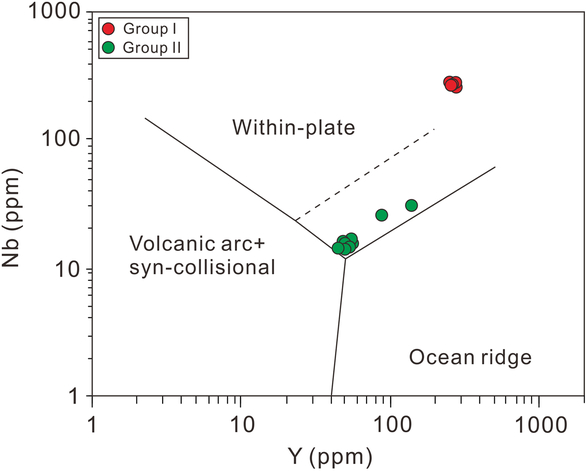
Recent studies suggest that a Late Mesoproterozoic arc system developed along the western and northern margins of the Yangtze Block (Qiu et al. Reference Qiu, Ling, Liu, Kusky, Berkana, Zhang, Gao, Lu, Kuang and Liu2011; Deng et al. Reference Deng, Peng, Polat, Kusky, Jiang, Han, Wang, Huang, Wang, Zeng and Hu2017; Hu et al. Reference Hu, Zhai, Wang, Tang and Ren2017). In the northern margin of the Yangtze Block, the Shennongjia volcanic sequence (c. 1103 Ma) is proposed to have developed in an island-arc setting based on an understanding that calc-alkaline rocks are restricted to subduction settings (Qiu et al. Reference Qiu, Ling, Liu, Kusky, Berkana, Zhang, Gao, Lu, Kuang and Liu2011). Furthermore, the gabbros within the Miaowan ophiolite (c. 1002 to 973 Ma) exhibit arc geochemical signatures with negative Nb–Ta–Ti anomalies, supporting an island-arc setting or an active continental margin (Deng et al. Reference Deng, Peng, Polat, Kusky, Jiang, Han, Wang, Huang, Wang, Zeng and Hu2017). In the western Yangtze Block, gabbros from the c. 1066 Ma (SHRIMP U–Pb) Shimian SSZ-type ophiolite display similar geochemical characteristics to back-arc basin basalt (BABB), suggesting a back-arc setting associated with oceanic subduction (Hu et al. Reference Hu, Zhai, Wang, Tang and Ren2017). On the Nb versus Y diagram (Fig. 9a), the data from the Tianbaoshan felsic samples plot in the field of within-plate granites, which is evidently distinct from volcanic arc calc-alkaline granites. Actually, a subduction-related convergence system can produce both arc and within-plate magmatic rocks (He & Xu, Reference He and Xu2012). For example, abundant Late Mesozoic magmatism occurred in SE China to form a volcanic-intrusive complex belt c. 600 km in width, in response to Palaeo-Pacific subduction and slab roll-back (He & Xu, Reference He and Xu2012; Zeng et al. Reference Zeng, He, Li, Xu and Chen2016; Yan et al. Reference Yan, He, Beier and Klemd2018). The subduction-related magmatic belt comprises abundant within-plate magmatic rocks, including Early Jurassic, Late Jurassic, Early Cretaceous and Late Cretaceous A-type granite belts. These within-plate magmatic rocks have been attributed to slab roll-back (Jiang et al. Reference Jiang, Wang, Liu, Ni, Qing and Zhang2015). Eruption of the felsic layers in the Tianbaoshan Formation was followed by deposition of massive siltstone interbedded with sandstone of the Limahe Formation. Similar sedimentary sequences are also present in the Lugumo and Fenghuangshan formations of the equivalent Julin Group (Chen et al. Reference Chen, Sun, Wang, Zhao and Zhou2014). These sedimentary sequences are consistent with the stratigraphic pattern occurring in a back-arc system in the southern Andes (Suárez & Pettigrew, Reference Suárez and Pettigrew1976). In brief, we consider that the Tianbaoshan A1-type and A2-type felsic lavas were most likely formed in a continental back-arc setting.
Nb versus Y diagram (Pearce et al. Reference Pearce, Harris and Tindle1984) for Late Mesoproterozoic felsic rocks in the SCB.

5.d. Implications for A-type rocks
A-type magmatic rocks are exposed in various tensional settings on both continents and ocean floors: continental rifts, hotspots and plumes for the A1 group, and post-collisional or post-orogenic environments for the A2 group (Eby, Reference Eby1992; Jiang et al. Reference Jiang, Zhao, Zhou, Liao and Jin2011; Liu et al. Reference Liu, Jiang, Jia, Zhao, Zhou, Wang and Ni2014). As shown in this paper, the Huili Group contains both A1- and A2-type magmatic rocks. They were emplaced in the same tectonic setting (back-arc), in response to oceanic subduction. Thus, A1-type magmatic rocks can occur in other tectonic settings. Similarly, A2-type magmatic rocks have been also recognized in continental rift zones or hotspots that were in response to mantle plume activities. In the Comei area, eastern Tethyan Himalaya, the 132 Ma Laguila granitic rocks (A2-type), associated with initial activities of the Kerguelen mantle plume, have relatively high Y/Nb ratios (1.93 to 1.99) and nonradiogenic Sr–Nd isotopic components (87Sr/86Sri = 0.7171 to 0.7204; ϵNd(T) = −11.6 to −10.0) (Liu et al. Reference Liu, Zhou, Lai, Qing, Li, Wu and Xia2015). In the Panxi region (SW China), the 251 Ma Ailanghe pluton (A2-type), associated with the Emeishan mantle plume, is strongly peraluminous and has a crustal isotopic signature (ϵNd(T) = −5.7 to −6.7) (Shellnutt & Zhou, Reference Shellnutt and Zhou2007). Thus, we consider that the names ‘A1-type’ and ‘A2-type’ cannot refer to specific tensional settings.
6. Conclusions
(1) Late Mesoproterozoic (∼1028 to 1019 Ma) felsic lavas of the Tianbaoshan Formation from the Huili Group are A-type and can be divided into two groups: A1- and A2-types. They were emplaced in a continental back-arc setting.
(2) The Group I felsic lavas were produced by AFC of alkaline basaltic magmas that originated from an asthenospheric mantle source modified by recycled crustal components. In contrast, the Group II felsic rocks were derived from partial melting of a crustal source with mixing of mantle-derived magmas.
(3) The coexistence of A1- and A2-type rocks in the southwestern Yangtze Block suggests that they can occur in the same tectonic setting.
Author ORCIDs
Dong-Bing Wang 0000-0001-9052-2707
Acknowledgements
We thank Chad Deering (editor) and two anonymous reviewers for their helpful and constructive reviews. This study is financially supported by the National Natural Science Foundation of China (grants 41302157, 41302170, 41703022), the Geological Survey Project of China (grants DD20160016, DD20160017) and the Fundamental Research Funds for the Central Universities (grants lzujbky-2018-52).
Supplementary material
To view supplementary material for this article, please visit https://doi.org/10.1017/S0016756818000882.