1. Introduction
Heritage speakers typically do not reach native-like attainment in specific aspects of their heritage languages. For example, unlike their monolingual counterparts, heritage speakers often display a relatively better command of phonological and syntactic aspects of their heritage languages than of lexical, morphological, and morphosyntactic areas (Bar-Shalom & Zaretsky, Reference Bar-Shalom and Zaretsky2008; Montrul, Reference Montrul2004; Silva-Corvalán, Reference Silva-Corvalán1994, Reference Silva-Corvalán, Montrul and Ordóñez2003; Sorace, Reference Sorace, Howell, Fish and Keith-Lucas2000; Tsimpli & Sorace, Reference Tsimpli, Sorace, Bamman, Magnitskaia and Zaller2006). Likewise, it has been reported that, even within a single linguistic area, they are often more accurate in deploying unmarked forms than in using marked categories (Albirini, Benmamoun & Saadah, Reference Albirini, Benmamoun and Saadah2011; Cornips & Hulk, Reference Cornips, Hulk, Lefebvre, White and Jourdan2006; Laleko, Reference Laleko2010; Polinsky, Reference Polinsky1997; Suh, Reference Suh, Bowles, Foote, Perpiñán and Bhatt2008). These asymmetries have generated considerable interest in understanding the properties of heritage grammars that are prone to incomplete acquisition or attrition/loss as well as the underlying causes of their non-convergent acquisition or retention patterns.
This paper explores two factors that present themselves as potential contributors to these asymmetries, namely the age at which a structure is typically acquired as well as its morphosyntactic complexity. Age/order of acquisition is a variable that has been recognized for its role in the initial acquisition and stability of different forms in heritage languages (Albirini & Benmamoun, Reference Albirini and Benmamoun2014; Cornips & Hulk, Reference Cornips, Hulk, Lefebvre, White and Jourdan2006; Lynch, Reference Lynch2003; Montrul, Reference Montrul2008). The claim is that aspects of heritage languages that are acquired early are more likely to endure than those acquired late because of the very nature of heritage language development. The majority of heritage speakers shift to the second, non-heritage language (L2) at a relatively early stage in their language development (often primary school age), which leads to the interruption of their first language (L1) acquisition and, sometimes, the gradual erosion of some previously acquired L1 forms. For example, in their study of plural formation by Arabic heritage speakers, Albirini and Benmamoun (Reference Albirini and Benmamoun2014) found that the participants display a strong command of sound feminine plurals, which is reported to be acquired completely by monolingual children at around the age of three, whereas they exhibit significant gaps in some broken plural forms (such as the geminate and defective), which are often mastered beyond the age of six. The sound plural forms in Arabic involve the affixation of a plural morpheme to a stem, while the broken plural forms involve extracting the root and prosodic units below the word level and mapping them onto templates, clearly a more complex process.
Albirini and Benmamoun (Reference Albirini and Benmamoun2014) argue that forms that are acquired at or after the age of six, such as the broken plural forms in Arabic, may not have been acquired completely because speakers may have shifted to L2 by then. While heritage speakers, such as Arabic heritage speakers in the US, may be expected to face difficulties with forms that are acquired beyond school age (between five and six years) because of insufficient input and usage opportunities (Albirini, published online January 17, 2013), the question that the current study seeks to address is whether the age of acquiring different L1 forms is decisive even in constructions that emerge in the early stages of language development (before school age) and are considered part of the core aspects of syntax. This question is critical for understanding why certain aspects of these languages are more unstable than others and how this affects final attainment in heritage languages.
Another explanation relates the unbalanced acquisition of different linguistic forms to their varying degrees of difficulty. This factor operates mainly in the areas of morphology, syntax, and interface domains where input from one linguistic domain, such as syntax, is mapped and adjusted to the requirements and constraints of another linguistic domain, such as morphology. Morphological simplicity refers to the number and nature of morphological markings on a word. In fact, the notion of “default” or “unmarked” categories often rests on the argument that unmarked/default forms are representationally simpler than marked forms (McCarthy, Reference McCarthy2008). For example, Cornips and Hulk (Reference Cornips, Hulk, Lefebvre, White and Jourdan2006) found that heritage speakers overextend the unspecified, default value of non-neuter for the Dutch definite determiner, which is acquired early by monolingual children.
Relative syntactic difficulty refers to the number and nature of processes governing the relationship between the components of a given linguistic structure. Montrul (Reference Montrul2004) found that heritage speakers overuse overt pronouns in contexts where their monolingual counterparts use null pronominals. Montrul argues that heritage speakers’ knowledge of the pragmatic constraints on null/overt subject distribution is not as robust as that of their monolingual counterparts because establishing the relationship between the null pronominal and its reference falls within the syntax–pragmatics interface. While previous studies compared difficulty across different domains (e.g., syntax–semantics interface vs. syntax–pragmatics interface; Montrul, Reference Montrul2004) or in the morphological domain (e.g., affixation vs. consonantal root and pattern mapping; Albirini & Benmamoun, Reference Albirini and Benmamoun2014), the question that the present study explores is whether heritage speakers’ knowledge of different syntactic patterns (such as phrase structure, dependencies and licensing relations, and word order asymmetries) display different degrees of vulnerability. This question is important because previous studies suggest that areas that fall within narrow syntax and syntax proper are relatively less vulnerable to language loss and attrition than other linguistic areas (Benmamoun, Montrul & Polinsky, Reference Benmamoun, Montrul and Polinsky2013; Montrul, Reference Montrul2008; Tsimpli & Sorace, Reference Tsimpli, Sorace, Bamman, Magnitskaia and Zaller2006). It is therefore necessary to see whether syntactic structures of varying degrees of difficulty display comparable stability or resilience to attrition/loss.
The present study seeks to explore the impact of these two factors (namely, typical age of acquisition of the L1 forms and morphosyntactic difficulty)Footnote 1 on the retention of the syntactic properties of sentential negation in heritage Arabic. As we will outline below, negation in Arabic involves a number of linguistic processes and features, including lexical selection, the cliticization of negation, the deployment of person agreement, and establishing syntactic dependencies between negation and lexical and/or functional heads. These aspects and processes vary in terms of acquisition age and complexity. Hence, they provide an interesting testing ground for the role of these two factors in the differential acquisition rates and patterns reported in heritage language research. The study involves heritage speakers of the Egyptian dialect of Arabic. According to the Arab American Institute (2009), Egyptian Americans are the second largest Arab national sub-ancestry (12% of all Arab Americans). Speakers of the Egyptian dialect of Arabic are exposed mainly to their colloquial variety in the home, although some may have been exposed to Standard Arabic – the language of education, literacy, and major media channels – in some formal contexts (e.g., Sunday school). The fact that most heritage speakers have limited exposure and use opportunities outside their homes makes the possibility of incomplete acquisition or loss of their heritage language very likely (Albirini, published online January 17, 2013). In the next two sections, we present an overview of negation in Egyptian Arabic and relevant previous research before we discuss the experiments.
2. Negation in Egyptian Arabic
In this section, we provide a brief background to introduce the main syntactic aspects of the clause and sentential negation in Egyptian Arabic that are relevant to this paper. Main Egyptian Arabic sentences may or may not contain a verbal head, a typical feature of Arabic varieties and some of their related Semitic languages, such as Hebrew. We will refer to sentences with a verbal head as verbal sentences and sentences without a verbal head as verbless sentences. Verbless sentences can be matrix sentences whose main predicate is a nominal, adjectival, or prepositional constituent, as in (1a), (1b), and (1c), respectively:
-
(1)


Verbless sentences usually have a present-tense interpretation. In verbal sentences (when a verb is present), the unmarked word order in Egyptian Arabic is SVO, and the canonical position of the direct and indirect objects is after the verb, as in (2).
-
(2)

The verb may carry affixes and could be preceded by temporal proclitics depending on the tense. In the present tense, the verb carries the so-called imperfective morphology, which consists of agreement prefixes (usually carrying person) and suffixes (usually carrying number) and may also carry the proclitic b- if the interpretation is progressive or habitual.
-
(3)

In the future tense, the same imperfective form of the verb is used but the verb is preceded by a proclitic ħa/ha:
-
(4)

In the past tense, the verb is in the so-called perfective form, which consists of a different set of agreement suffixes (no prefixes).
-
(5)

In imperative sentences, the imperfective form of the verb is used with negative and non-negative commands. Only in negative imperatives, however, does the verb occur with the second person prefix,Footnote 2 as illustrated in the following sentences from Eisele (Reference Eisele1988, p. 133) with a slightly modified transcription to reflect the IPA conventions used in this paper:
-
(6)

Existential constructions are marked by the use of the existential particle fii(h), which precedes the indefinite subject and predicate (Jelinek, Reference Jelinek1981). Like verbless sentences in general, verbless existential sentences have a present-tense interpretation, as illustrated in (7).
-
(7)

Turning to the main topic of this paper, sentential negation in Egyptian Arabic is realized by the two-part particle ma-š and mi-š/mu-š. The two parts can respectively be realized as a proclitic and enclitic on the lexical host, as in (8), or they can both combine on their own and realize negation as a morphological independent marker, as in (9).
-
(8)
-
(9)


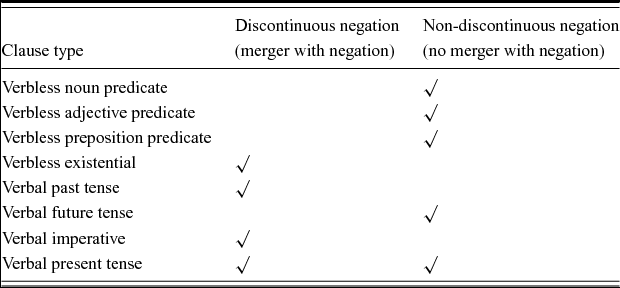
We will refer to the pattern in (8) as discontinuous negation and the pattern in (9) as non-discontinuous negation. Which pattern occurs in a particular construction depends on tense and the head of the clause. In past-tense sentences such as (8b) and imperative sentences such as (8a), the discontinuous pattern is obligatory.Footnote 3 In verbless sentences, which may have nominal, adjectival or prepositional predicates, the non-discontinuous pattern is typically used, as in (9a).
In existential sentences (10), the discontinuous pattern is obligatory while in future-tense sentences the non-discontinuous pattern is obligatory (11).
-
(10)
-
(11)


The present tense is interesting in that the discontinuous pattern is dominant but the non-discontinuous pattern is also available as the following examples from Jelinek (Reference Jelinek1981) illustrate:
-
(12)

There is a consensus within all recent approaches within the Principles and Parameters framework to sentential negation in Egyptian Arabic and other Arabic varieties with similar types of sentential negation (e.g., Moroccan Arabic) that the discontinuous negative is due to syntactic head movement of the lexical host to merge with negation (Aoun, Benmamoun & Choueiri, Reference Aoun, Benmamoun and Choueiri2010; Benmamoun, Reference Benmamoun1992, Reference Benmamoun2000; Benmamoun, Abunasser, Al-Sabbagh, Bidaoui & Shalash, Reference Benmamoun, Abunasser, Al-Sabbagh, Bidaoui and Shalash2013; Shlonsky, Reference Shlonsky1997; Soltan, Reference Soltan2007). Analyses vary with regard to whether the two parts of sentential negation are located within the same projection (Aoun et al., Reference Aoun, Benmamoun and Choueiri2010; Benmamoun, Reference Benmamoun2000) or different projections (Soltan, Reference Soltan, Choi, Hague, Punske, Schertz and Trueman2012) but for present purposes we will assume that they are located within the same syntactic phrase that hosts sentential negation. We will also assume with Benmamoun et al. (Reference Benmamoun, Abunasser, Al-Sabbagh, Bidaoui and Shalash2013) and Soltan (Reference Soltan2007) that the negative projection in Egyptian Arabic is located above the projection of tense. Thus, the structure of sentential negation we assume in this paper is the one in (13)
-
(13)

Given this structure, if no head merges with negation, we get the non-discontinuous pattern, but if a head merges with negation we get the discontinuous pattern. According to this analysis then, merger with negation is obligatory in the past-tense, imperative, and existential constructions. It is not possible with predicates that are headed by nouns, adjectives and prepositions.Footnote 4 No merger is allowed in the context of the future tense, but such merger is obligatory in existential sentences. The present tense can, but does not have to, merge with negation. The patterns of negation are summarized in Table 1. For present purposes, it is not critical for us whether the discontinuous pattern is captured through a syntactic movement operation or through a morphological merger operation. Both are complex operations that need to reference notions such as tense and lexical category. For the rest of the paper, we will simply refer to the operation that combines negation with a lexical head as merger.Footnote 5
Patterns of sentential negation in Egyptian Arabic.

From the above description, it is clear that there is a complex relation between the head of T, the head of the predicate domain, and negation. The critical operation involved in this relation is merger.Footnote 6 The availability of merging negation with a lexical head depends on tense but also on the nature of the head below tense. With regard to tense, past tense and imperatives (which we assume contain a head in T) force merger of T with negation. The present tense does not seem to force merger with negation, but does not block it. With regard to the head below T, only the existential head forces merger with negation while nouns, adjectives, and prepositions do not.
Thus, knowledge of the syntax of negation in Egyptian entails knowing clause structure, the location of the projection of sentential negation (which is different from English, where the common assumption is that negation is located between the projection of tense and the predicate), and the syntactic and morphological factors that govern the interplay between negation, tense, and the predicate. In this paper, we seek to examine heritage speakers’ knowledge of the syntax of sentential negation, particularly its location relative to tense and the predicate. In addition, we investigate whether they deploy the merger option, which is presumably more complex since it involves a discontinuous negative pattern that occurs at opposite edges of the verb, at the same rate as native speakers. Moreover, we assess their performance on the present-tense pattern where merger with negation is optional, though it is the option preferred by native speakers (Soltan, Reference Soltan2007).
Apart from the issues of the morphological realization of negation, an important aspect of sentential negation is word order asymmetries and the interaction between sentential negation and its nominal dependents. Word order asymmetries arise with negative elements, such as maħaddiš, literally, “one + negation; no one”, and they determine the grammaticality of sentences. We will consider maħaddiš, a negative quantifier, though the exact label is not critical since we are only interested in its interaction with negation.Footnote 7 We will limit the discussion and experiment to one negative element, namely, maħaddiš “no one”.
Maħaddiš is a nominal element that can occur only in the preverbal subject position.Footnote 8
-
(14)

Both (14b) and (14c) are ungrammatical because maħaddiš occurs, respectively, in the object position and in a negated sentence. The negative quantifier maħaddiš seems to require that it occupy the negative projection, which may explain the absence of negation and its restriction to the preverbal position. However, the word ħadd “one/someone” can occur on its own in the postverbal position with sentential negation overtly realized as illustrated in (15):
-
(15)

Thus, when ħadd is combined with negation into a single word, it must occur higher in the clause with no overt realization of sentence negation. However, when it occurs in the postverbal position, sentential negation is obligatory. Thus, maħaddiš and ħadd have opposite word order requirements and constraints. The distribution of maħaddiš and ħadd will allow us to test heritage Egyptian Arabic speakers’ knowledge of these restrictions, which may reflect their knowledge of the interplay between negation, its dependents and the relevant word order asymmetries.
Another negative element that enters into an intimate relation with negation is ʕumr “never” (Soltan, Reference Soltan, Choi, Hague, Punske, Schertz and Trueman2012). As Soltan shows, when ʕumr precedes sentential negation, the negative enclitic -š is obligatorily absent.Footnote 9
-
(16)

While maħaddiš completely precludes the overt presence of the sentential negative, ʕumr only precludes the presence of the enclitic part of negation, which adds to the complexity of the syntax of sentential negation. The distribution of these two elements provides robust testing grounds to gauge heritage speakers’ knowledge of the complex behavior of sentential negation in the language. Morphologically, sentential negation is complex because it consists of two elements that can form a single unit or occur at opposite edges of a lexical host. Syntactically, negation occupies a position higher than its English counterpart and does attract heads such as verbs and the existential marker, a behavior that is clearly different from what we find in English. The interaction between negation and its hosts also depends on tense, which means that at least three syntactic projections are at play: negation, tense, and the predicate. Finally, the distribution of sentential negation and its realization depends on the nature of the negative elements that precede it. We saw that, with maħaddiš, sentential negation is absent. However, with ʕumr, only the enclitic š is absent, while the proclitic is present. These different facets of Egyptian Arabic sentential negation will be the focus of the experimental production and acceptability judgment tests that we report on below.
3. Studies on the acquisition of negation
Most of the early L1 studies on the acquisition of negation have proposed fixed developmental stages for the acquisition of negation in different languages, usually proceeding from holophrastic negation to incomplete multi-word negation and then to successful multi-word negation (Klima, Reference Klima, Fodor and Katz1964; Klima & Bellugi, Reference Klima, Bellugi, Lyons and Wales1966; Lange & Larsson, Reference Lange and Larsson1973; Wode, Reference Wode1977; among many others). In the English language, these three stages are often typified by examples (17), (18), and (19), respectively.
-
(17) No the sun shining.
-
(18) I no/not like milk.
-
(19) I don't like milk.
Although the number and specific delineation of these stages have been widely debated in the literature, the idea of the existence of different stages for the acquisition of negation and their progression from morphosyntactically simpler to more complex forms is still widely accepted (see Dimroth, Reference Dimroth and Horn2010, for a review).Footnote 10
In Arabic L1 research, Omar (Reference Omar1973) investigated the language development of thirty-one Egyptian children ranging in age from six months to fifteen years. The analysis of her data, collected from conversations and elicitation tasks, shows that the acquisition of negation goes through three stages. In the first stage, children produce the free form laʔ “no” by itself or in the sentence-final or sentence-initial position, as in (20) (the examples in (20)–(22) are from Omar (Reference Omar1973, pp. 12–26)).
-
(20)

In the second phase, children (age three) start using the non-discontinuous morpheme miš and overgeneralizing it to various verbal and verbless sentences, as in (21a, b).
-
(21)

The third stage (staring at age 3;6) marks the use of the discontinuous morpheme ma-š, beginning with imperative sentences such as that in (22).
-
(22)
-
ma-tišrab-š
-
neg-drink.3sf-neg
-
“(She) is not drinking.”
-
Omar observes that children continue to make errors in using the discontinuous negation marker even beyond the age of five. She also notices that children use the discontinuous morpheme very accurately with the expletive fii “there” even by the age of 2;8. Omar argues that the negative existential construction ma-fii-š “there isn’t/aren’t” is learned as a whole unit (i.e., not as “expletive + negative”) because it is found early in the children's linguistic output and because it is acquired quickly and used flawlessly by children at an early age. On the other hand, children take more time to master the use of the discontinuous particle with verbal sentences.
Similar findings were reported in studies on other Arabic dialects. For example, Smadi (Reference Smadi1979) examined the development of negation by a Jordanian child, who was 19 months old at the beginning of the study and three years old at the end. The data was collected by means of diary and tape recordings in two-week intervals. Smadi found that the earliest form of negation was the free morpheme la “no”, which appeared at around the age of 19.5 months. The next stage is marked by (i) the emergence of negative imperatives (often without person/imperfective marker on the verb), (ii) the deployment of the morpheme mu “not”, which is mainly used in verbless sentences and before modals, and (iii) the occurrence of the negative enclitic -š by itself (i.e., without the proclitic ma-). The last phase is characterized by the emergence and successful implementation of the different negation paradigms, except the discontinuous morpheme ma-š, which was not acquired fully by the time the study was completed (when the child was three years old).
A number of patterns emerge from these studies. First, the non-discontinuous form of negation emerges before, and is mastered earlier, than the discontinuous negation. This suggests that the negation of verbless sentences may be easier than that of verbal sentences. Second, although the discontinuous morpheme is used in the negative existential construction ma-fii-š “there isn’t/aren’t”, this form of negation seems unproblematic to Arabic-speaking children either because it is learned as a single unit and/or because it is frequent. Third, negative imperatives emerge earlier than other forms of verbal negation – possibly because of the frequency of imperatives in parents’ input – although it sometimes lacks the person/imperfective morpheme. Previous studies do not report on more nuanced forms of negation (e.g., negative polarity) possibly because these forms may have emerged after both the non-discontinuous and discontinuous forms. Since most heritage speakers may have shifted to an L2 at an early stage of their lives, it is theoretically interesting to examine whether heritage speakers display patterns similar to those of monolingual Arabic-speaking children.
The subject of negation has received little scholarly attention in heritage language research, especially when compared to such areas as aspect, gender and number agreement, and tense (see Alhawary, Reference Alhawary2009 for the acquisition of negation by L2 learners). A recent “preliminary” study was carried out by Zhang (Reference Zhang2013), who explored the semantic and morphosyntactic aspects of negation in heritage Mandarin Chinese in an attempt to identify aspects of attrition and transfer under incomplete Mandarin language acquisition. Ten heritage speakers completed a written nine-item task requiring negative responses (using only the two negative markers bu and mei). The responses of the heritage speakers were compared to those of ten native speakers of Mandarin Chinese. The results of the study point to notable gaps in the semantics of negation (e.g., connotations of “never”), some of the aspectual features associated with negation, and the syntactic positioning of the negation markers in the sentence.
The current study seeks to examine the areas of resilience and vulnerability in Egyptian heritage speakers’ knowledge of sentential negation. In particular, the study seeks to assess heritage speakers’ knowledge of (i) the syntactic location of negation within clause structure, (ii) its interaction with predicates and lower heads and the related issues of discontinuity and morphological merger, (iii) the interaction between negative elements (e.g., maħaddiš and ʕumr), negation, and word order asymmetries, and (iv) the licensing properties of negation and the complementary distribution between the enclitic and the negative dependents it licenses. In addition, the study seeks to investigate the underlying causes of any potential gaps in their knowledge of this linguistic area and their wider theoretical implications for understanding the asymmetries found in heritage language acquisition and maintenance. Based on the patterns found in child acquisition of Arabic negation and on patterns in heritage language research, we hypothesize that performance on configurational properties of negation (its location in the clause) will be almost identical to that of native speakers. Areas of vulnerability have to do with processes that are sensitive to dependencies and interactions between syntactic elements. These involve complex syntactic relations and constraints that include interface conditions, typically vulnerable areas of heritage grammars. These hypotheses were tested through the oral tasks outlined below.
4. The study
The study focused on sentential negation, using two production experiments and an acceptability judgment experiment. The experiments were conducted over two semesters and in three different universities in the United States. The production tasks consisted of narrative tasks and experimental tasks. The narrative tasks were used to obtain a preliminary picture of heritage Egyptian speakers’ use of sentential negation in comparison to their native speaker counterparts. The experimental production tasks aimed to test sentential negation in verbal and verbless sentences. Verbal sentences in this study include verbs marked as present, past, future, and imperative. On the other hand, verbless sentences comprise those with nominal, adjectival, and prepositional predicates as well as existential constructions starting with fii “there”. The acceptability judgment experiment was meant to test speakers’ knowledge of two specific aspects of negation, including single negation (without the enclitic -š) and two-part negation (both the proclitic ma- and the enclitic -š) with the negative particle ʕumr “never” as well as word order asymmetries in constructions involving a negative particle and the indefinite noun ħadd “one”.
4.1 Production experiment 1
Participants
Twenty-three participants completed the narrative tasks, thirteen of whom were heritage speakers of Egyptian Arabic, along with 10 native speakers of the same language variety. The thirteen heritage speakers consisted of eight males and five females. Twelve of them were born in the U.S., and one subject moved to the U.S. in the same year she was born. All the heritage speakers were undergraduate college students at the time of the experiment, ranging in age from 19 to 23 years (average age = 20;8). According to self-report, eleven of these subjects still spoke Arabic at home. Ten native speakers formed the comparison group. All of the ten native speakers came to the U.S. as adults and after having completed high school in an Arab country. Arabic was the language of instruction in these schools. The Egyptian control group consisted of four males and six females with an age range of between 23 and 34 years (average age = 29 years).
Procedure
The tasks focused on eliciting naturalistic data that may allow us to explore the use of sentential negation in context. We asked the participants to complete three oral production tasks. The first task involved an oral description of a series of 16 pictures, detailing the story of a boy, his dog and his lost pet frog (Mayer, Reference Mayer1969). The speakers had to describe the events of the story as they unfolded in the pictures. The second task involved an elicited narrative of Aladdin's story. The subjects were instructed to narrate the story from memory. For the third task, the subjects were asked to speak about themselves and their family in an open-ended format. The speakers were requested to provide as much detail as possible in completing the narratives. Each subject was tested individually in a quiet room, and their narratives were audio-recorded with a digital recorder.
Results
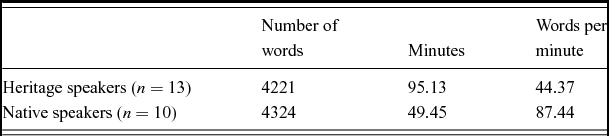
Each of the recorded narratives was transcribed verbatim on paper and then typed as a separate Word document. A summary of the data obtained from the three narratives appears in Table 2.
Summary of the narrative data.

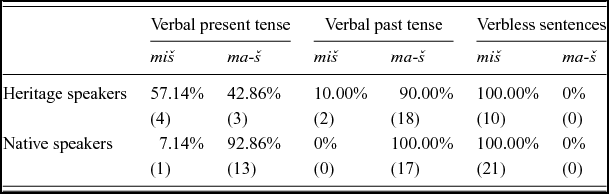
In terms of sentential negation, we mainly examined the distribution of discontinuous and non-discontinuous forms of negation by counting the occurrence of miš and ma-š in different sentence types. As Table 3 shows, in present-tense sentences, the heritage speakers used the unmarked form ma-š at a rate of 42.86%, compared to 57.14% for the marked miš form, whereas the native speakers relied predominantly on the unmarked form (92.86%). The disparity in the performance of the two groups was less evident in past-tense sentences; the accuracy percentages of the heritage and native speakers were 90% and 100%, respectively. Both groups performed at ceiling on verbless sentences.Footnote 11 Mann-Whitney U tests showed that the two groups differed marginally in terms of the distribution of miš and ma-š in present-tense sentences (U = 11.500, Z = –1,909, p = .056), but not in past-tense (p = .371) or verbless (p = 1.00) sentences.
Distribution of miš and ma-š in the narratives. The numbers in parentheses represent the token counts in the narratives.

The narrative task provided us with a general idea about the distribution of the discontinuous and non-discontinuous negative markers in the narratives. However, because some sentence types (e.g., future and imperative) were not represented in the narratives, we used the experiments below to elicit all of the target forms.
4.2 Production experiment 2
Participants
Thirty-nine Egyptian heritage speakers completed this set of production tasks. At the time of the study, all of these participants were undergraduate (31) and graduate (8) students. The heritage speakers consisted of 20 males and 19 females, and they ranged in age between 18 and 30 years (average age = 22;5). Nine of the participants were born in Egypt but moved with their families to the USA at the ages of one year (n = 1), three years (n = 3), six years (n = 2) and seven years (n = 3), and the rest were born in the USA. According to self-report, ten of the heritage speakers were exposed to their Arabic dialects and English from birth, and the rest remained monolingual in their dialects until the ages of two (1), three (3), four (7), five (10), six (5), and seven (3) years. The heritage speakers were asked to indicate the level of their proficiency in their dialects using the following six categories: excellent, very good, good, fair, poor, and unable to communicate. In terms of self-reported level of proficiency, only eight heritage speakers reported having an “excellent” proficiency, twelve a “very good” proficiency, sixteen a “good” proficiency, and three a “fair” proficiency.Footnote 12 All of the heritage speakers identified English as the dominant language and marked elementary school as the beginning of their major shift to English.
The 39 heritage participants were compared to 29 native speakers of Egyptian Arabic, who formed the control group. The control group consisted of 17 males and 12 females. The average age of the control group was 26;7 years (ranging between 23 and 44 years). All of the native speakers completed high school in Egypt. Eighteen of the native speakers or their spouses were completing their graduate education, seven had settled in the US after completing their graduate education, one was visiting the USA, and three were residing in Egypt at the time of the experiment.Footnote 13
Procedure
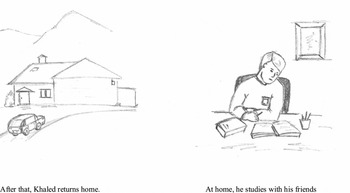
The participants had to complete five oral-production tasks. For the first task, the subjects were shown 10 drawings of a hypothetical Arab American student named Khaled, who is involved in 10 different daily activities (Figure 1). After listening to a statement about each of Khaled's activities (recorded on a laptop), the subjects had to confirm or negate the statement depending on whether it matched the action displayed in the drawings. Five of the statements required negative responses and five required affirmative responses (fillers). The following instructions were given orally to the subjects before eliciting the data:
Sample pictures and sentences used in the task.

The following set of pictures depicts some of the daily activities of Khaled, who is an Arab American student living in Chicago. As you view the pictures, you will hear sentences that are supposed to reflect what is happening in the pictures. However, some of the sentences that you will hear report false information about the pictures and the activities themselves. You need to negate the ones that do not reflect the events in the corresponding pictures.
The second task involved 10 drawings of Khaled and ten statements (including five fillers) about a previous trip that he made to Cairo (past tense). The subjects were provided with the following instructions:
The following set of pictures depicts some of the activities that Khaled did during his visit to Cairo (Egypt) last year. As you view the pictures, you will hear sentences that are supposed to reflect what is happening in the pictures. However, some of the sentences that you will hear report false information about the pictures and the activities themselves. You need to negate the ones that do not reflect the events in the corresponding pictures.
Similarly, the third task included ten drawings of Khaled and ten oral statements about his plans after graduation. The directions given to the subjects were as follows:
The following set of pictures depicts what Khaled is planning to do after graduation. Omar, who is Khaled's friend, is trying to guess what Khaled will be doing after graduation. As you will notice, Omar's guesses are not always accurate. You need to negate the ones that do not reflect what Khaled will actually be doing. . . as shown in the pictures.
The fourth task was similar to the previous tasks in the sense that it included ten statements, five of which were fillers. However, no pictures were used because the task focused on negative imperatives. The participants were given the following instructions:
Khaled is not doing well at school this semester. Khaled has been given different pieces of advice by a number of friends to improve his performance. Some of them are useful and some are misleading. Correct the misleading ones by negating them.
For the fifth (last) task, the subjects were shown a picture of a room with several objects. They were orally provided with 40 sentences about the pictures and were asked to indicate whether these statements correctly reflect what is in the picture. If not, they had to negate the sentences, based on the instructions:
The sentences you will hear describe whether an object exists in the picture below, how it is, or its locations. If you hear a wrong sentence about an object, you need to correct the sentence by negating it.
All of the stimuli in this task were verbless sentences of four types: 10 with nominal predicates, 10 with adjectival predicates, 10 with prepositional predicates, and 10 existential constructions starting with fii “there”. Twenty of the 40 verbless sentences in this task were fillers (five in each category). All sentences had a subject in the singular.Footnote 14
Before eliciting their responses to the first three tasks, we provided the subjects with two examples in the present tense demonstrating the expected responses. Two examples were also provided before the imperative-negation task, and two others before the verbless-sentence tasks. All examples were in English, as in (23).
-
(23) Khaled studies with his friends at home → Khaled doesn't study with his friends at home.
None of the examples occurred (in translation) in the test items. Before we ran the experiment, we consulted three heritage speakers to ensure that all the words used in the tasks (and in the acceptability judgment experiment below) were familiar to heritage speakers. Only the negative responses were analyzed. In addition to the two tasks, the subjects were asked to complete a questionnaire about their family and language background.
Results
The participants’ responses to the first three tasks (past, present, and future) were transcribed separately in an excel sheet. Their responses to the fourth task (imperative sentences) were transcribed in a separate sheet along with the existential sentences in the fifth task because imperatives and existentials have unique structures (as we explain below). The remaining responses to the fifth task were also transcribed independently, and then they were divided into three categories representing the three forms of negation in the verbless sentences under study (nominal-, adjectival-, and prepositional-predicate sentences). Each sentence was assigned one point when the correct form of negation was used in the correct sentence position and with the correct morphemes and verb; otherwise zero points were given to the response. In addition to counting the correct and incorrect instances, we also coded and then analyzed the patterns of errors across tokens and negation types. We computed the mean accuracy percentages of the heritage and comparison groups on verbal versus verbless negation types, on each of the six negation categories within verbal and verbless sentence types, and on imperatives and existentials.
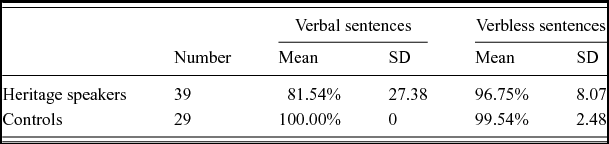
Table 4 summarizes the accuracy percentages and standard deviations of the two groups on verbal (present, past, and future) and verbless (noun-, adjective-, and preposition-predicated) negation.
Verbal and verbless sentences: mean accuracy percentages and standard deviations.

As Table 4 shows, the heritage group was less accurate than the control group in terms of ability to deploy sentential negation in verbal and verbless sentences. Moreover, unlike the native controls, who demonstrated an invariably full command of negation in verbal and verbless sentences, the heritage speakers were more accurate in deploying negation in verbless sentences than in verbal sentences. Their accuracy percentages on the verbless and verbal forms were 96.75% and 81.54%, respectively. A repeated-measures ANOVA was carried out to assess the effects of negation type (verbal and verbless) in the two groups. The results revealed a main effect of negation type, F(1,66) = 11.954, p < .01; the participants’ accuracy scores varied significantly based on sentence type. There was also a significant effect of group, F(1,66) = 11.724, p < .01; the heritage group was significantly less accurate than the control group. A significant interaction was found between group and negation type, F(1,66) = 13.491, p < .0001; the accuracy disparity between verbal and verbless negation was significant only in the case of heritage speakers.
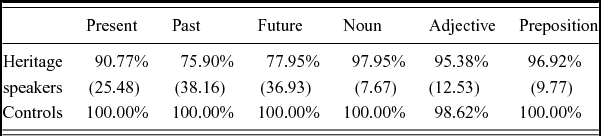
The performance of the heritage group on sentential negation was not consistent across the six types of verbal and verbless sentential negation under study, namely, negation in present-tense, past-tense, future-tense, nominal predicate, adjectival predicate, and prepositional predicate sentences (Table 5). The heritage speakers encountered little difficulty in deploying negation in the three types of verbless sentences; their accuracy scores on nominal, adjectival, and prepositional sentences were 97.95%, 95.38%, and 96.62%, respectively. However, they displayed greater variability in verbal negation, which is reflected in their accuracy rates on present-tense (90.77%),Footnote 15 past-tense (75.90%), and future-tense (77.95%) sentences. A repeated-measures ANOVA was used to determine possible differences between the two groups in the six negation sentences. The results pointed to a significant effect of sentence type, F(1,66) = 6.236, p < .0001. There was also a significant effect of group, F(1,66) = 11.724, p < .01. An interaction was found between sentence type and group, F(1,66) = 6.698, p < .0001; the accuracy disparity among the six types of sentential negation was only significant in the case of heritage speakers. Pairwise comparisons (Bonferroni tests) revealed that differences between the six types of sentential negation was significant or marginally significant only between past-tense negation, on one hand, and, on the other, nominal, adjectival, and prepositional negation types (p = .023, p = .08, and p = .05, respectively) as well as between future-tense negation and the three verbless negation types (p = .04, p = .10, and p = .72), respectively. No other significant differences were found.
Negation across the six sentence types: accuracy percentages and standard deviations.

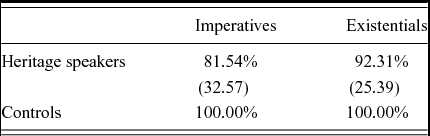
As for imperative and existential constructions, both of which deploy the discontinuous negative particle, the heritage speakers had higher accuracy scores on the verbless existentials (92.31%) than on the verbal imperatives (81.54%) (Table 6). A paired-sample t-test showed that their performance on existential structures was significantly better than their performance on imperatives, t(38) = –2.322, p < .05. Moreover, independent-samples t-tests showed that the heritage speakers differed significantly from their native counterparts only in negation of imperatives (t(66) = –3.047, p < .01), but not in existential negation (t(66) = –1.629, p = .108).
Imperative and existential structures: accuracy percentages (and standard deviations).

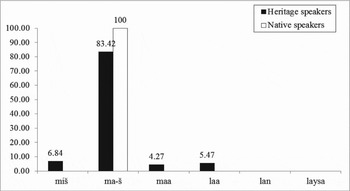
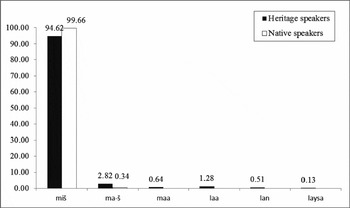
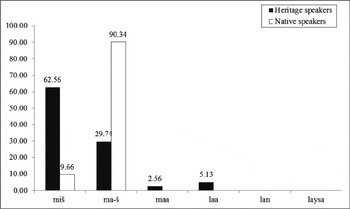
We also examined the distribution of the discontinuous and non-discontinuous negation particles in obligatory and optional contexts. As Figure 2 shows, the heritage speakers relied primarily (83.42%) on discontinous negation in contexts that require merger between negation and the lexical dependent. However, they displayed even a stronger tendency to use the non-discontinuous particle miš (94.62%) in sentences where no merger is needed (Figure 3). Thus, in obligatory contexts, they converged with the native speakers more on the non-discontinuous particle than on the discontinuous one. Moreover, when both miš and ma-š are allowed, which is the case in the present tense (Figure 4), the heritage speakers showed a strong preference for the marked, syntactically and morphologically less complex, miš option (62.56%) compared to native speakers, who relied mainly on the unmarked, syntactically more complex form (90.34%).
Percentage of miš and ma-š when ma-š is obligatory (past-tense sentences, imperatives, existentials).

Percentage of miš and ma-š when miš is obligatory (future-tense sentences and noun-, adjective-, and preposition-predicate sentences).

Percentage of miš and ma-š in optional context (present tense).

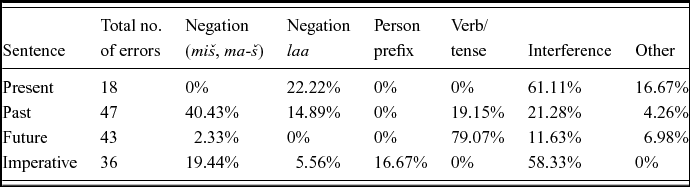
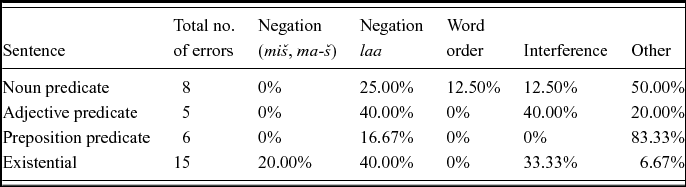
An analysis of the errors made by the heritage speakers revealed seven different types of errors, which include (i) negation errors with ma-š and miš, (ii) negation errors with laa “no/not”, (iii) person prefix errors, (iv) verb/tense errors, (v) word order errors, (vi) interference errors, and (vii) other errors. The first type of errors involves the inaccurate exchange of ma-š and miš. The second type of errors occurs when speakers use the negative particles laa instead of ma-š or miš. Person prefix errors refer to the omission of the person morpheme t- in negative imperatives. Word order errors violate the order in which the negative particle should appear relative to the other components of the sentence. Interference errors occur when the correct non-Egyptian forms of negation are used (particularly Standard forms and Levantine forms). Other errors did not conform to any of the patterns mentioned so far. Examples (24) through (30) illustrate (in order) these seven types of errors:
-
(24)
-
(25)
-
(26)
-
(27)
-
(28)
-
(29)
-
(30)


In (24), the speaker infelicitously uses the non-discontinuous particle miš instead of the discontinuous ma-š. Negation in (25) involves the inaccurate substitution of miš with laa. In (26), the person morpheme, namely t-, is not prefixed to the verb daxxinš “smoke”. In (27), the speaker drops the future-tense marker ħa- and uses the habitual/progressive b- morpheme instead. The positioning of the negative particle miš between the noun and its modifying number makes (28) syntactically incorrect. Example (29) deploys a form of negation that is exclusively used in Standard Arabic (i.e., not in the Egyptian dialect). The last example involves a unique error that does not conform to any of the previous patterns, namely, the use of an existential construction to negate a stimulus with an overt subject and an adjectival predicate.
An examination of the errors in present-tense sentences (Table 7) reveals that the majority of negation errors are due to borrowing from other Arabic varieties (61.11%) or are lexical, i.e., resulting from the substitution of the negative particles miš and ma-š with laa (22.22%). In past-tense sentences, however, speakers resort mainly to the syntactically less complex miš instead of ma-š (40.43%) and then to borrowing (21.28%). In future-tense sentences, a major portion of the errors comes from the use of the wrong tense or verb (79.07%). Borrowing and lexical errors accounted for 58.33% and 19.44%, respectively, of the total errors in negative imperatives. As for verbless sentences (Table 8), the participants’ errors were mainly lexical (40%) and borrowing-related (40%) in adjectival-predicate sentences. The same applies to existential sentences, where miš (20%), laa (40%), and non-Egptian Arabic negatives (33.33%) were introduced instead of ma-š. In verbless sentences with nominal and prepositional predicates, however, the majority of the errors fell into the Other category (50.00% and 83.33%, respectively). Lexical errors came next with a percentage of 25.00% in sentences with nominal predicates and 16.67% in sentences with prepositional predicates.
Negation errors in the verbal domain: numbers, types and percentages.

Negation errors in the verbless domains: numbers, types and percentages.

In sum, the data suggests that heritage speakers’ knowledge of negation in verbless contexts may be more robust than their knowledge of verbal negation. In terms of errors, heritage speakers seem to find difficulty in the selection of the correct negation particles and often overuse the non-discontinuous morpheme in optional contexts. However, they seem to have no problem in positioning the negative markers in their proper place in the sentence (i.e., in a projection higher than tense). Thus, this aspect of their knowledge of sentential negation seems to be on a par with that of native speakers. Heritage speakers have more difficulties with discontinuous negation than with non-discontinuous negation, which is to be expected since the former is more complex morphologically and syntactically than the latter. Morphologically, it involves both prefixation (procliticization) and suffixation (encliticization) of the same syntactic marker (negation). Syntactically, it involves merger between elements that belong to different syntactic projections, which is a more complex operation in the sense that it requires establishing a dependency between the two positions and deploying a merger operation to realize them as a single unit with its own specific morphological form.
4.3 Acceptability judgment experiment
Participants
The acceptability judgment experiment was completed by 24 Egyptian heritage speakers, all of whom also completed the production experiment. All of these participants were undergraduate (21) and graduate (3) students at the time of data collection. The heritage speakers consisted of 13 males and 11 females (average age = 23;2). Only two of the participants were born in Egypt but moved with their families to the USA at the age of six, and the rest were born in the USA. According to self-report, eight of the heritage speakers were exposed to their Arabic dialects and English from birth, and the rest remained monolingual in their dialects until the ages of three (2), four (3), five (7), six (3), and seven (1) years. In terms of self-reported level of proficiency, five heritage speakers reported having an “excellent” proficiency, eight “very good” proficiency, ten “good” proficiency, and one “fair” proficiency. The 24 heritage participants were compared to 15 native speakers of Egyptian Arabic (10 males and five females), who formed the control group.
Procedure
The acceptability judgment experiment aimed to examine the participants’ knowledge of two aspects of negation:
-
(i) Word order in negation with the indefinite noun ħadd“one” based on four orders:
-
(31)
-
a. (neg + ħadd) + V + O ✓
-
b. V + (neg + ħadd) + O ✗
-
c. S + V + (neg + ħadd) ✗
-
d. S + (neg + V) + ħadd ✓
-
-
(ii) Single and two-part negation using the negativeparticle ʕumr “never” with and without the enclitic -š, as in (32a, b):
-
(32)
-
a. ʕumru ma-V ✓
-
b. ʕumru ma-V-š ✗
-
These two patterns and the associated negation types are illustrated in (33) and (34) in the order parallel to (31) and (32) above:
-
(33)
-
(34)


The participants were presented orally with 60 recorded sentences (30 tokens and 30 fillers) and were asked to judge the acceptability of each sentence. The 30 tokens represented the six negation types illustrated in examples in (33) through (34). There were five tokens per negation type, and these tokens were randomized before being presented orally to the subjects (from a laptop). Fifteen of the tokens were grammatical (types (31a, d) and (32a)) and the other fifteen were ungrammatical (types (31b, c) and (32b)). The fillers were affirmative sentences, as in (35), and these were not analyzed.
-
(35)

Results
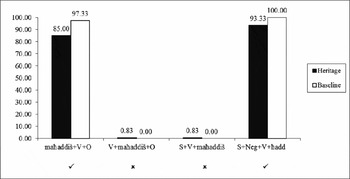
The responses of the participants were transcribed in an excel sheet. Each response was assigned one point when the correct judgment was made; otherwise no points were given to the response. Figure 5 presents the percentage of affirmative responses in the first area examined in the acceptability judgment experiment, namely word order in sentences containing the maħaddiš/ħadd constructions. As Figure 5 shows, the heritage and native groups had a somewhat comparable performance on word order in negation with ħadd constructions, thus producing, respectively, 85% and 97.33% affirmative responses on pre-verbal, subject maħaddiš, 0.83% and 0% on post-verbal subject and post-verbal object maħaddiš, and 93.33% and 100% on ma-V-š + ħadd constructions. Because our purpose was mainly to determine whether the heritage speakers diverged/converged with the native speakers with respect to each of these four forms, we carried out four independent-sample t-tests (with Bonferroni corrections). The tests showed that the heritage and native groups differed only marginally in judging the pre-verbal subject maħaddiš; t(37) = –1.797, p = .081. There was no significant difference between them in the post-verbal subject maħaddiš (p = .437), the post-verbal object maħaddiš (p = .437), and ma-V-š + ħadd (p = .229) word orders.
Percentage of affirmative responses on word order with a negative particle and maħaddiš and ħadd.

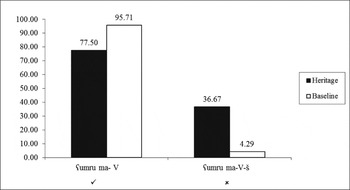
The two groups diverged notably with respect to the use of single and two-part negation with ʕumr (Figure 6). Thus, whereas 95.71% of the native speakers judged single negation with ʕumr to be acceptable, only 77.50% of the heritage speakers endorsed this form of negation to be acceptable. Likewise, while only 4.29% of the native speakers approved the presence of the negative enclitic -š, 36.67% of the heritage speakers approved this ungrammatical addition. Two independent-samples t-tests were carried out to assess the significance of the difference between the heritage and native speakers. The t-tests showed a significant difference in the two groups’ judgment of single negation (t(37) = –3.096, p < .05) and two-part negation (t(37) = 4.089, p < .01).
Percentage of affirmative responses on single versus double negation with negative particle ʕumr.

Overall, the Egyptian Arabic heritage speakers seem to diverge from their native speaker counterparts in areas that require specific knowledge about negation in their dialect, such as the licensing properties of negation and the complementary distribution between the enclitic and the negative dependents it licenses. The overall pattern seems to be that aspects of sentential negation that require complex mapping processes between syntax and morphology or deployment of complex syntactic operations that are sensitive to word order and related asymmetries are more vulnerable, which is consistent with previous findings on heritage grammars. We expand on these implications in the discussion section.
5. Discussion
In this paper, we examined heritage speakers’ knowledge of different properties and forms of sentential negation in Egyptian Arabic. Sentential negation in Egyptian Arabic is an optimal construction to tease apart different aspects of heritage speakers’ knowledge of syntax. It involves phrase structure configuration, particularly the issue of the placement of the negative projection relative to other grammatical and lexical projections. Negation enters into dependencies and licensing relations which are sensitive to word order asymmetries and licensing constraints. It interacts with other heads and may merge with them. Moreover, it has interface properties in that the output of merger or lack of merger is spelled-out as a discontinuous or non-discontinuous marker. Finally, due to the presence of negation in different types of clauses with varying ages of acquisition, its study in heritage grammars can provide insights about the role of age of L1 acquisition in deploying negative constructions that may be more marked.
A main goal of the study was to examine whether heritage speakers display comparable competencies with regard to the various forms and features of sentential negation and to explore the theoretical reasons behind any potential asymmetries. For example, a number of studies indicate that the core syntactic properties of heritage grammars are relatively more resilient than other aspects (e.g., inflectional morphology) (Albirini, Benmamoun & Chakrani, Reference Albirini, Benmamoun and Chakrani2013; Bar-Shalom & Zaretsky, Reference Bar-Shalom and Zaretsky2008; Major Reference Major1992; Montrul, Reference Montrul2008; Silva-Corvalán, Reference Silva-Corvalán1994, Reference Silva-Corvalán, Montrul and Ordóñez2003; Sorace, Reference Sorace, Howell, Fish and Keith-Lucas2000; Tsimpli & Sorace, Reference Tsimpli, Sorace, Bamman, Magnitskaia and Zaller2006). Another group of studies, however, has recently shown that not all syntactic knowledge in heritage grammars is resilient (Albirini et al., Reference Albirini, Benmamoun and Saadah2011; Cuza & Frank, Reference Cuza and Frank2011; Kim, Montrul & Yoon, Reference Kim, Montrul and Yoon2009; Polinsky, Reference Polinsky2009; Sherkina-Lieber et al., Reference Sherkina-Lieber, Pérez-Leroux and Johns2011). Thus, such aspects as word order, subject-verb agreement, and phrase structure seem to be maintained more than the pro-drop feature, dependency agreements between a resumptive pronoun and its antecedent, and binding relations (Albirini et al., Reference Albirini, Benmamoun and Saadah2011; Albirini & Benmamoun, Reference Albirini and Benmamoun2014; Choi, Reference Choi2003; Montrul, Reference Montrul2004; Polinsky, Reference Polinsky2009; Silva-Corvalán, Reference Silva-Corvalán1994). The findings of the present study confirm these asymmetric patterns in the acquisition of the different properties and forms of sentential negation. For example, the heritage speakers in this study have a generally more robust knowledge of negation of verbless sentences than verbal sentences. Likewise, the study shows that negation of past-tense sentences poses notable difficulty for the participants, compared to negative sentences with nominal, adjectival, and prepositional predicates. Similarly, the discontinous negation in existentials and imperatives seems to be more maintained than the discontinous negaton in past-tense and present-tense sentences.
An examination of these asymmerties suggests that they may be the result of developmental factors (e.g., age/order of acquisition) and factors related to the very nature of the morphosyntactic properties and forms in question (e.g., their phrase-structure configuration, their syntactic complexity, their morphological representation, and the nature of their interaction with other lexical and functional heads). From a developmental point of view, the heritage speakers seem to display child-like patterns in the acquisition of sentential negation. They display robust knowledge of the non-discontinuous form of negation, which is mastered earlier by monolingual Arabic-speaking children, yet they are less accurate in using the discontinuous pattern, which is not acquired until much later by Arab children. Following Albirini and Benmamoun (Reference Albirini and Benmamoun2014), we suggest that heritage speakers display gaps in their knowledge of the discontinuous form possibly because it was not stable by the time they shifted to English.Footnote 16 Two points seem to motivate this explanation. First, a significant proportion of the errors made by the heritage speakers involves the use of laa “no/not” which emerges and is acquired earlier than the other negation markers and is used in frozen expressions and anaphoric negation.Footnote 17 Secondly, heritage speakers seem to have no problems deploying the discontinuous form with existentials and (to a lesser degree) imperatives, which have been found to be acquired very early in the language development route of monolingual Egyptian children (Omar, Reference Omar1973), even though existentials and imperatives use the discontinuous pattern.
What we find intriguing is that, although heritage speakers seem to have mastered the discontinuous forms in imperatives and existentials, that knowledge did not carry over to the other contexts such as the present and past-tense constructions. It, thus, seems that the imperative and existential constructions are not sufficient to bootstrap the acquisition of discontinuous negation and hence morphological merger. We believe that this is the case because the syntax of imperatives and existentials is different from the syntax of other constructions. Imperatives lack subjects and deploy different morphology (for example, unlike present-tense verbs, positive imperatives do not carry person agreement, though the language normally requires it for pro-drop). The same applies to existential constructions. The existential marker is a preposition that is obligatorily followed by an indefinite subject in the predominantly SVO Egyptian Arabic variety. We believe that these significant differences between imperatives and existentials, on the one hand, and other constructions, on the other, make them less optimal candidates for bootstrapping acquisition of the morphosyntactic constraints on the interaction between negation and lexical heads. The relatively early age at which they are acquired most likely helps in their maintenance as specific constructions but that knowledge does not carry over to other constructions. Nevertheless, we believe that only a longitudinal study with a special focus on the development of sentential negation can provide a more definite answer to these important questions, so the explanation must remain tentative.
However, it is also possible that the discontinous forms of negation were learned completely by heritage speakers and then underwent a greater rate of attrition than the non-discontinuous form. This explanation is plausible if we conceptualize the process of language attrition as the reverse of language acquisition (e.g., Hansen, Reference Hansen and Hansen1999; Keijzer, Reference Keijzer2010), as suggested by Jakobson's (Reference Jakobson1941) Regression Hypothesis. Irrespective of whether this is a case of incomplete acquisition or a case of gradual attrition, the age of acquisition of the L1 forms seems to play a role in their differential acquisition patterns observed in this study.
The picture becomes more complicated when we consider the asymmetric linguistic abilities of the heritage speakers with regard to the eight sentence types under study (present, past, future, nominal predicate, adjectival predicate, prepositional predicate, imperatives, and existentials). The basis of the asymmetry seems also to lie in the very nature of negation forms themselves and their syntactic and interface properties, including their phrase-structure configuration, the interaction between negation and predicates and lower heads, and their dependencies and licensing relations. As far as phrase structure and word order is concerned, Egyptian Arabic heritage speakers seem to have a full grasp of the location of negation relative to other syntactic projections, particularly tense. Thus, in verbal sentences, they always locate negation before the future-tense, aspect, and agreement markers. We did not find a single error of the speakers placing negation in the wrong position. Similarly in verbless sentences where negation is located between the subject and the predicate, the heritage speakers follow that rule almost flawlessly. Even when they make lexical selection errors and use negation from Standard Arabic or a different variety of Arabic, they still place it in the right position, which shows clearly that they have fully acquired the phrase structure and word order properties of sentential negation.
The lexical choice errors reveal another syntactically significant feature that has not been extensively discussed in heritage language research. Like other heritage speakers, Egyptian Arabic heritage speakers may get exposed to other Arabic varieties in their families, communities, and through the media. Some of them are also exposed to Standard Arabic in weekeend community schools and in colleges and universities. However, as Benmamoun (Reference Benmamoun2000) has shown, though the surface forms of sentential negation may vary across dialects, their syntax is essentially the same. This is certainly the case with regard to the location of negation in the Arabic clause (Benmamoun et al., Reference Benmamoun, Abunasser, Al-Sabbagh, Bidaoui and Shalash2013; Soltan, Reference Soltan2007). This could potentially explain why the lexical choice errors do not adversely affect the placement of negation in the clause. The implication is that knowledge of Egyptian Arabic negation should make it easier for heritage speakers to learn Standard Arabic negation, particularly its phrase structure and word order properties. We should also note that, as far as the phrase structure aspects of Egyptian Arabic heritage negation are concerned, we did not find any cases of interference or transfer from English, where the widespread assumption, particularly within the Principles and Parameters framework in both its pre-minimalist and minimalist versions, is that it is located between tense and the lexical projection (Pollock, Reference Pollock1989).
With regard to the interaction between negation and other grammatical and lexical categories, the speakers display gaps in their knowedge of the syntax of sentential negation. They do very well on the syntax of negation in sentences which deploy the non-discontinuous form and does not involve morphological merger. By contrast, they do not do as well on sentences that involve the discontinuous form and require morphological merger. Thus, the merger option, particularly in the context of the past tense and present tense, seems to pose difficulties for heritage speakers. In fact, the most illuminating construction in this respect is the present tense. Present-tense verbs may optionally merge with negation in Egyptian Arabic, though the merger (discontinuous) option is preferred (Benmamoun, Reference Benmamoun2000; Brustad, Reference Brustad2000). As Benmamoun (Reference Benmamoun2000) argues, verbal present-tense constructions in Arabic are odd in that they should be like verbless sentences that also have a present-tense interpretation; they do not force the presence of a verb and yet when a thematic verb is present, it obligatorily undergoes merger with negation in some dialects such as Moroccan Arabic or optionally as in Egytian Arabic.
As far as we know, there is no convincing explanation as to why this is case. One possibility is that the present-tense verb is basically behaving like the past-tense verb which must merge with negation through a process of syntactic leveling. Though the merger of the present-tense verb and negation is not motivated syntactically, the system forces the present-tense verb to align with other verbs. This could explain why the process is optional, which could reflect a historical process that is gradually forcing morphological merger in present-tense contexts, on a par with dialects such as Moroccan Arabic, where this process has completed its course. If this is on the right track, then the high rate of the non-discontinuous negative in the present tense in heritage Egytian Arabic may be a tendency on their part to opt for the less marked pattern, which does not involve extra grammatical steps such as morphological merger. We should note that this explanation is tentative but certainly the finding is intriguing. It is as if heritage speakers are lagging behind their native counterparts in pushing the form along its diachronic path. It is possible that due to limitations in input heritage speakers’ grammars do not fully reflect the change in progress that the native languages are naturally undergoing (through exposure to sufficient input in different contexts).
We turn next to syntactic dependencies. Here again, Egyptian Arabic heritage speakers do not perfom as well as native speakers. For example, in the case of the negative quantifier maħaddiš, which is restricted to the preverbal or pre-predicate position and does not allow the overt realization of sentential negation, heritage speakers show some vulnerabilty. Some heritage participants accept it in the postverbal position and some tolerate the presence of negation. This could underline vulnerabilities in establishing dependencies between negation and negative elements that enter into dependency and licensing relation with them. In the case of ʕumr, which precludes the presence of the negative enclitic -š, heritage speakers again seem to have difficulties mastering the intricacies of the dependency relation between ʕumr and sentential negation. These vulnerabilities could be syntactic and/or interface problems. Negation has semantic content and takes scope over the element that it licenses and with which it enters into a dependency relation. Those semantic dependencies have phrase structure dimensions (where the element should occur in the phrase structure) and they determine how it is morphologically spelled-out. It may turn out that the interface properties of these dependencies are what make them more vulnerable, a conclusion that would be consistent with recent findings in heritage language research (see Montrul, Reference Montrul2011, for a review).
In conclusion, the findings show that not all syntactic forms and properties of sentential negation are equally vulnerable and that the degree of vulnerability is determined by a host of competing factors. The paper suggests that the age at which different L1 forms are acquired, morphology, and nature of syntactic processes (e.g., syntactic complexity) seem to play an important role in determining the patterns of (in)stability in sentential negation. As one of the reviewers suggested, future research could manipulate these variables independently in order to determine more concretely their individual impact on heritage language acquisition.