Cameroon today is arguably the most stable electoral autocracy in sub-Saharan Africa, and President Paul Biya, who came to power in 1982, is one of the longest ruling civilian presidents in the world. Though the country has had just two presidents since independence, it has always held regular elections: single party elections from 1965–1990, and multiparty elections from 1992 until today. In international reports on Cameroon, it is generally argued that the Biya regime is domestically unpopular, or, at best, unhappily tolerated. Because Cameroon is clearly an autocracy and the ruling party dominates politics, many analysts assume that Cameroonian citizens are deeply unsatisfied with the level of democracy in their country, and therefore displeased with the president and the regime itself.
For example, a recent International Crisis Report on Cameroon, titled ‘Cameroon: The Dangers of a Fracturing Regime', claims that ‘the Biya regime has a serious handicap in its total lack of popular legitimacy’ (International Crisis Group 2010: 2). Drawing on elite interviews, the report contends that Biya has little support amongst ordinary citizens. While it is possible that commentators have an accurate sense of Cameroonian public opinion, it is likely that their impressions are heavily predicated on their own personal beliefs about the regime. While elite-level accounts and interviews with opposition leaders imply that the Biya regime is deeply illegitimate, the near total black box on public opinion surveys leaves the regime's actual popularity an open question.
By analysing the results of a public opinion survey conducted by the author in 2014–15, this article offers the first systematic account of public opinion in Cameroon. The results indicate that public opinion is far from homogeneous. Cameroonians have extremely bifurcated views of democracy, the government, and President Biya himself. It is clear from the data that the regime is not uniformly despised, but instead that citizens hold diverse views about the level of democracy in Cameroon and the general legitimacy of the government itself. What explains this diversity of opinions? The regime's autocratic stranglehold on political communications and elections in general has largely been interpreted as a sign of public dissatisfaction with the regime, but it is exactly this hegemony that has given rise to pockets of support over the past 20 years. In many areas of the country, citizens have access to just one side of the political story: the stance of the regime in power. It is exactly in these low-information geographic environments that citizens express the strongest support for the regime.
In democratic regimes, scholars primarily consider demographic factors, such as gender, age, education, income and urban/rural locality when explaining variation in political attitudes. While demographic factors are certainly a key factor to consider in Cameroon, this article contends that in electoral autocracies, political geography is also of critical importance when understanding public opinion. In the context of autocracies, political geography refers to the historical dominance of political parties in specific areas of the country. By definition, ruling parties are a hegemonic ruling force in most electoral districts. But importantly, opposition parties have also been able to dominate local politics in a handful of districts. I argue that in autocratic regimes, the historical supremacy of different political parties in local geographic areas has had profound effects on everyday citizens’ views of the state and democracy.
Regardless of gender, age, education, income, urban/rural locality and even partisanship, Cameroonians from opposition strongholds – areas where the opposition has always won in multiparty elections – are far more likely than citizens from ruling party strongholds to distrust the institutions of government, to believe that elections are rigged, and to rate the overall level of democracy poorly. Citizens living in ruling party strongholds, on the other hand, are far more willing to accept the legitimacy of the government and support the stability of the regime over democratic reform. I argue that political geography affects ordinary citizens’ perceptions of politics through ideological diffusion. Opposition parties in autocratic regimes base their legitimacy on the conviction that the national government is undemocratic and illegitimate. Inversely, the ruling party is deeply invested in cultivating the opposite narrative; that (although perhaps not perfect) the regime is democratic and representative of the people. In fiefs dominated by one side or the other, ordinary citizens are more likely to be exposed to these ideas and internalise them.
This article argues that political geography is important because of the diffusion of party narratives, but not confounding factors, such as government spending or ethnicity. Some would argue that public opinion should be more favourable in areas where the state is better able to invest resources (Blaydes Reference Blaydes2011; Koter Reference Koter2013). While the presence of the state matters to public perceptions of it, party narratives contextualise the effects of local spending and patronage on public attitudes. Where citizens believe the state is legitimate, even small investments can boost public opinion; where citizens believe the state is illegitimate, local spending is rarely ever enough. Others would argue that ethnicity is what causes the rise of opposition or ruling party strongholds in the first place, and is therefore more important than political geography itself (Posner Reference Posner2005). While there is no doubt that identity politics are entrenched in party politics in Cameroon (and Africa more broadly), political geography does not perfectly map onto ethnic geography, and ethnic coalitions are often a happenstance of proximity – a function of political geography.
This article explores legitimacy and perceptions of democracy in Cameroon and argues that Cameroonians hold deeply conflicting views of the state of democracy in Cameroon. The first section of this article discusses the national context of public opinion in Cameroon and existing theories of public opinion in Africa. The second section explains the concept of political geography and presents the historical context that gave rise to the current opposition and ruling party strongholds – political geography – in Cameroon. The third section describes the sampling design of an original public opinion survey conducted in Cameroon and presents the findings of this survey, showing how political geography can help us to better understand bifurcated views of the autocratic state. Finally, I discuss the implications of these findings for the future of politics in Cameroon.
PUBLIC OPINION IN CAMEROON AND AFRICA
In most accounts of the modern political landscape in Cameroon, commentators have argued that the Biya regime is broadly unpopular amongst ordinary Cameroonians. For example, in his account of the 2002 elections, Takougang (Reference Takougang2003) discusses the potential reasons for the ruling party's overwhelming dominance in the election results. Citing President Biya's manipulation of the political landscape, the weakness of the opposition parties, and support from France, Takougang does not consider the possibility that the ruling party or President Biya won the elections because they enjoyed favourable public opinion. Another example is Pigeaud's scathing analysis of the corruption and fraud of the Biya regime. Within her analysis, she posits that, ‘Even if the general spirit is one of demobilisation, pockets of resistance still exist within Cameroonian society’ (Reference Pigeaud2011: 215, author's translation). Her work does not imply the inverse; that pockets of support may exist as well.
I propose that this assumption of popular disapproval derives primarily from two sources. First, the transition to multipartyism in 1990–2 featured massive popular unrest, including sustained strikes and anti-government protests in many parts of the country. President Biya only won the first multiparty presidential elections with 39·98% of the vote, and credible sources contend that due to electoral fraud, it is possible he lost the election altogether (National Democratic Institute for International Affairs 1993). Though the popular unrest and well-organised opposition of the transition years was completely suppressed by the regime during the 1990s, observers may assume that the original anger and frustration of the 1990s is still simmering under the surface of Cameroonian popular opinion. In some ways, this is true; many of the original areas of unrest during the transition remain disaffected by the political system. However, public opinion in these areas provides only a partial account of public opinion in Cameroon as a whole, and further, the political landscape, and public opinion with it, has changed considerably over the past 25 years.
Second, most reports of the state of Cameroonian politics rely heavily on elite interviews of party officials, civil servants and NGO leaders (International Crisis Group, 2010). Using any measure of democracy, Cameroon is most certainly an autocratic regime. This is abundantly clear to outside observers and elite political commentators in Cameroon. This uncontested fact likely biases the assessments of commentators, who assume that all Cameroonians must also understand and believe that Cameroon is an autocracy. It is natural for observers to project their understanding of politics onto society as whole, but it is not clear that Cameroonians have the same understandings of the definition and practice of democracy in Cameroon today.
Overall, these two explanations of popular beliefs about public opinion are enabled by the near vacuum of public opinion research in Cameroon. The implementation of national public opinion surveys in Cameroon is only a recent phenomenon. As far as I am aware, the Afrobarometer conducted the first national public opinion survey in Cameroon in 2013 (Round 5) and returned in 2015 (Round 6; Afrobarometer 2015). These surveys offer general measures of popular beliefs about democracy in Cameroon and trust in the government, and reveal that in contrast to the popular narrative about public opinion, Cameroonians are in fact divided in their thoughts about democracy and the state. Regarding beliefs about democracy in Cameroon in 2015, 48·3% of those who provided a response thought that Cameroon was either a ‘full democracy’ or ‘a democracy, but with minor problems’. Forty per cent believed Cameroon's democracy had ‘major problems’, and 11·2% said Cameroon was ‘not a democracy at all’. Further, 39·6% were either ‘very’ or ‘fairly satisfied’ with the way democracy works in Cameroon, while 58·3% were ‘not very’ or ‘not at all satisfied’ with democracy in Cameroon.Footnote 1
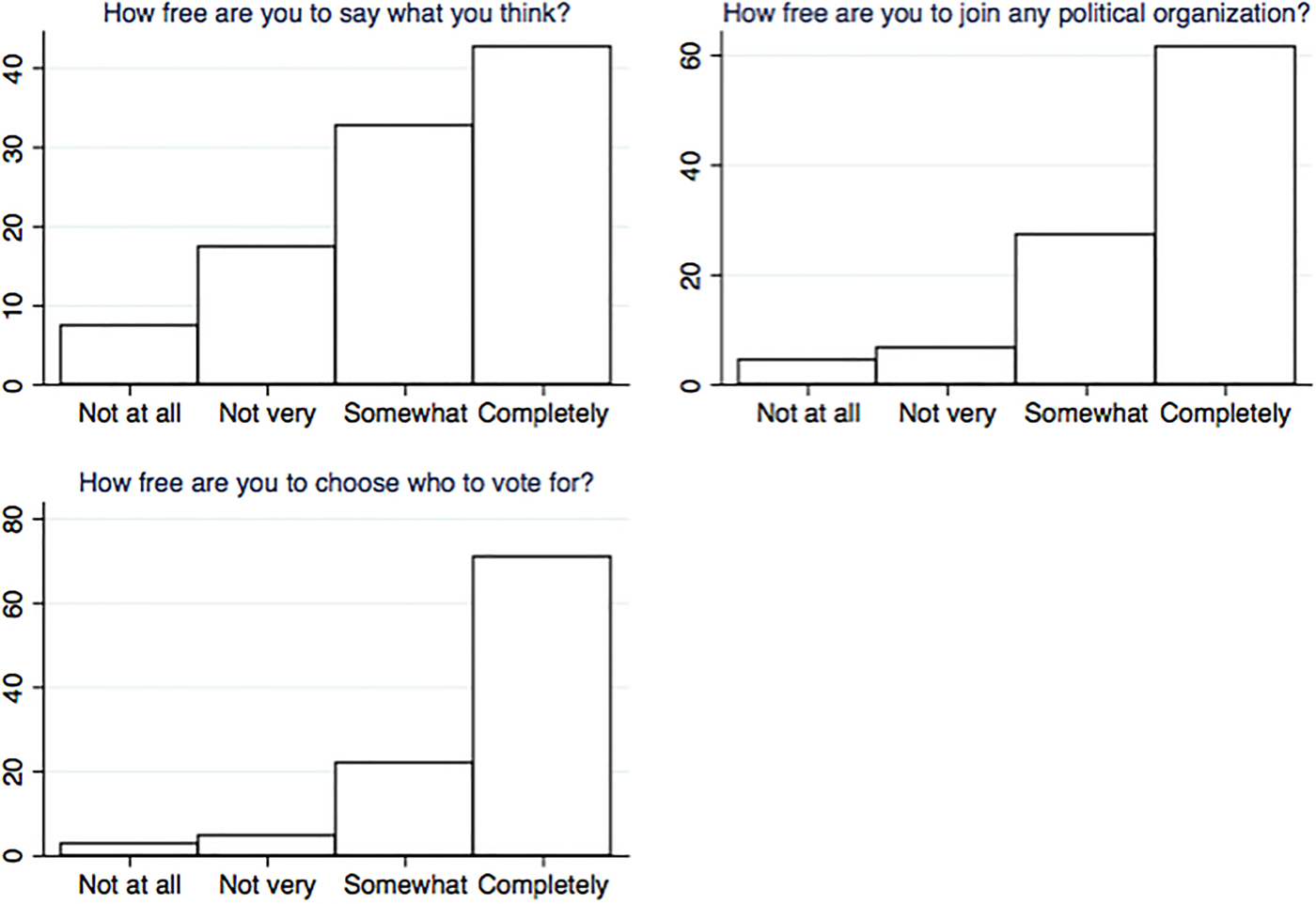
Figure 1 summarises opinions about different types of freedoms in Cameroon, revealing that Cameroonians are again divided in their beliefs about their rights. A large majority of Cameroonians feels completely free to vote how they want and join any political organisation. Seventy-five per cent feel ‘somewhat’ or ‘completely free’ to say what they think. Nonetheless, opinion is divided, and many believe that these rights do not exist at all. The data reveal that while many feel adamantly that Cameroon is not a democracy, others feel just as strongly that Cameroonians are generally free.
Beliefs about freedoms in Cameroon, Afrobarometer Round 6.

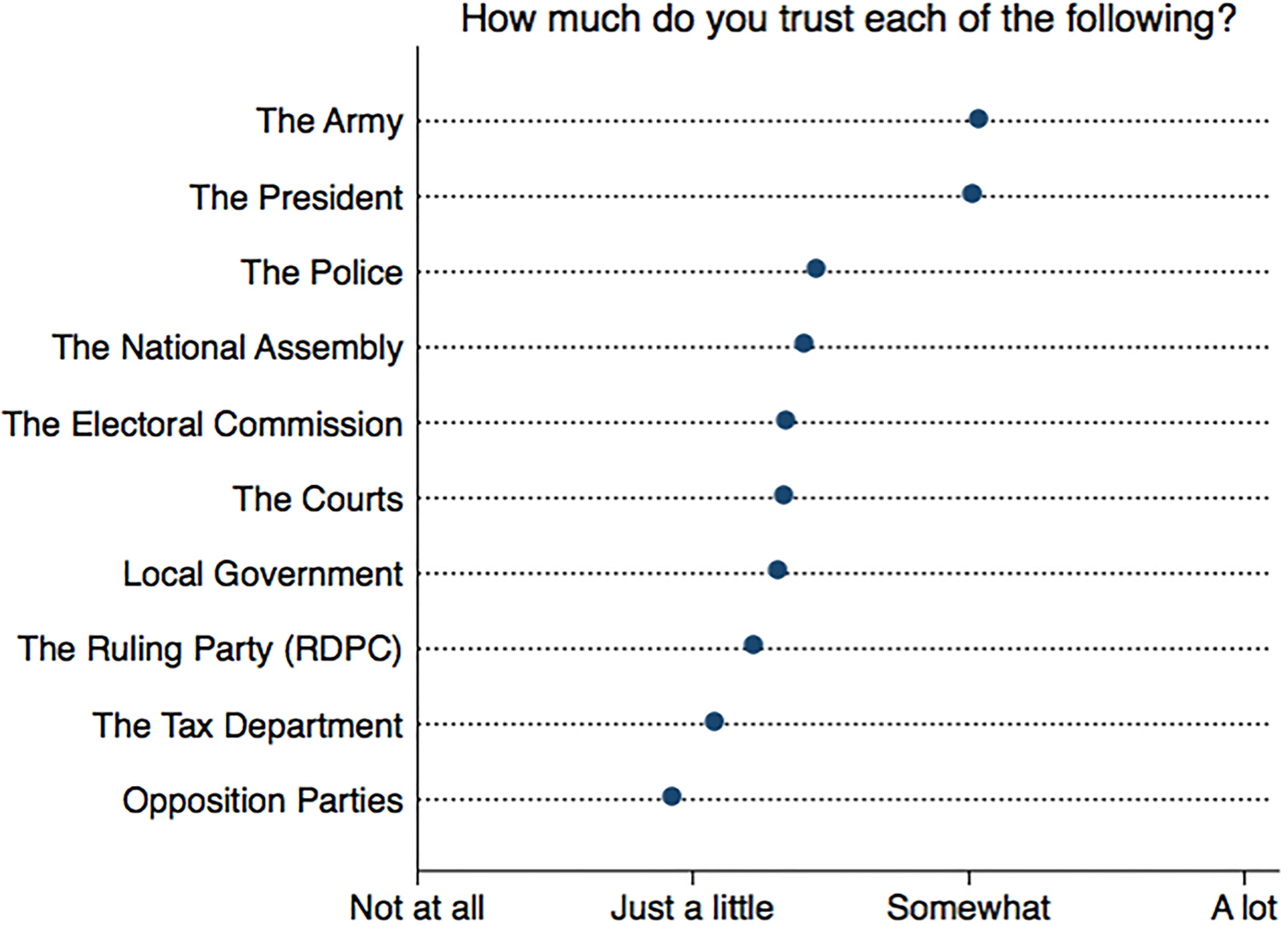
More specifically, in regards to their thoughts on the government itself, Cameroonians continue to hold mixed opinions. Citizens are polarised on the trustworthiness of the government as a whole, and even more so of its different institutions. Just with considerations of democracy in general, Cameroonians are divided in their trust in the government. Further, as a group, they are also divided by which institutions of government they trust the most. Figure 2 presents the average level of Cameroonians’ trust in various branches of government. Interestingly, the most trusted branches of government, from the vantage point of outside observers, are the most autocratic institutions: the President and the military, followed by the police.
Cameroonian trust in the government, Afrobarometer Round 6.

Of those who responded, 41·1% of Cameroonians trust the president ‘a lot’, compared with just 18·6% who trust the National Assembly ‘a lot’. Even worse, only 8·0% trust the opposition ‘a lot’. For an autocratic regime with one of the longest-standing dictators in the world, these findings are surprising. However, looking at these figures in the aggregate masks a wide range in variation. Though on the whole the presidency is more trusted than most other institutions of government, 11·2% of Cameroonians report not trusting the president ‘at all’.
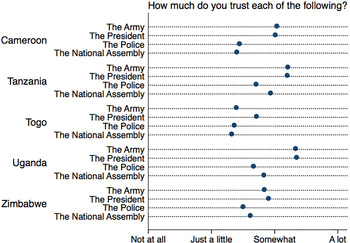
These findings are not unique to Cameroon, and, with some variation, are quite similar to other electoral autocracies in Africa. Figure 3 replicates the data from Figure 2, including the Afrobarometer Round 6 data from four other electoral autocracies: Tanzania, Togo, Uganda and Zimbabwe. Looking at trust in the army, the President, the police and the National Assembly, not only do we find variation in levels of trust across these institutions, but we also consistently find that the President and the military are, on average, the most trustworthy. Further, in terms of national averages, Cameroon seems like an average case: although public opinion varies across all of these countries, trust does not appear particularly high or low in Cameroon in comparison to similar regimes. Most importantly, it is clear that opinions are split across all of these electoral autocracies.
Comparative levels of trust in the government.

What accounts for this variation in public support for the regime? Existing work contends that the most important factors explaining variation in political beliefs should be demographic factors, such as rural or urban locality, gender, age, education and income (Norris & Mattes Reference Norris and Mattes2003; Lindberg & Morrison Reference Lindberg and Morrison2005; Koter Reference Koter2013; Croke et al. Reference Croke, Grossman, Larreguy and Marshall2016). Unfortunately, there are very few studies of public opinion in autocratic regimes. What little work does exist tends to focus on explaining general preferences for democracy. For example, Ansell and Samuels (Reference Ansell and Samuels2014) empirically test the long-standing assumption that income and class have the most important influence on preferences for democracy in autocratic regimes. They find that socioeconomic status is most important to understanding preferences for democracy in autocratic regimes.
Although it is primarily focused on democratic regimes, there is a growing literature on regime support in Africa, largely centred on explaining partisanship. For example, Lindberg & Morrison (Reference Lindberg and Morrison2005) find in Ghana that core supporters of the incumbent are demographically distinct from core supporters of the opposition. These different partisans are structurally divided by their level of education, income, occupation, and rural/urban status. Koter (Reference Koter2013) argues that in Senegal from 1978–2012, one of the most important factors of pro-incumbent support was living in a rural area. She argues that rural citizens were more closely linked to the regime through clientelist networks, and therefore more likely to support the incumbent government. Although their focus is primarily on ethnicity, Norris & Mattes (Reference Norris and Mattes2003) find that gender, age, education, rural/urban status and social class all have significant relationships with support for the incumbent government within the Afrobarometer data (Round 1). Older male citizens, those with more education and from rural areas, as well as citizens from poorer socioeconomic classes, are all more likely to support the incumbent. Croke et al (Reference Croke, Grossman, Larreguy and Marshall2016) argue that in Zimbabwe, support for the regime is largely explained by education. Education endows citizens with the cognitive skills to critically evaluate the political communications of the state and reject autocratic propaganda. They show that educated citizens are more interested in politics, more supportive of democracy in general, and less supportive of the incumbent regime.
In their seminal book on public opinion in Africa, Bratton et al (Reference Bratton, Mattes and Gyimah-Boadi2005: 182) find from Round 1 Afrobarometer data that gender, age, urban/rural status and income are all significant predictors of overall commitment to democracy, and that income and urban/rural status are the most important demographic factors predicting the perceived extent of democracy for each respondent's home country. Overall, however, the authors argue that the most important influence on attitudes toward democracy and liberalisation is political learning. In explaining perceptions of democracy, the authors find that the most important explanatory factor is evaluation of recent government performance (Bratton et al. Reference Bratton, Mattes and Gyimah-Boadi2005: 278). Respondents who believe that their government is delivering on political and economic promises are more likely to see the regime as democratic; these factors appear to be more important than demographic or cultural factors. However, most of the analysis comes from surveys conducted in democratic regimes.
I contend that evaluations of government performance in autocratic regimes are related, though analytically posterior to, political geography. In autocratic regimes, where you come from deeply influences not just your evaluation of how well the government is performing, but how you view the level of democracy in general. Where the opposition dominates, narratives of economic hardship and autocratic governance guide local perceptions of the regime. Where the ruling party has always been in power, the state narrative of national unity, economic growth and democratisation tend to dominate. The next section discusses the concept of political geography, and how it affects public opinion in autocratic regimes.
POLITICAL GEOGRAPHY
Individual-level demographic factors such as gender, age, education and income certainly play an important role in explaining attitudes toward the state in Cameroon. However, I argue that in long-standing electoral autocracies such as Cameroon, it is necessary to also understand the role that political geography and party narrative diffusion plays in shaping public opinion. In most electoral autocracies, the opposition is not widely or evenly dispersed across the country, but instead thrives in strongholds or fiefs (Wahman Reference Wahman2015). Analysing Burkina Faso under the Compaoré regime, Stroh (Reference Stroh2010) notes that political parties – particularly opposition parties – will focus their scant resources on a strategy of localisation; instead of following a pattern of ethno-regional campaigning, parties double down in constituencies where they can run ‘un fils du terroir’ and ignore completely constituencies where they lack native elite representatives.
Due to their monopoly on state resources, ruling parties are far more nationalised, enjoying strong electoral showings in most, if not all, constituencies. However, they also feature traditional strongholds (though, by definition, many more of them than the opposition). Outside of these opposition and ruling party strongholds are ‘swing’ areas, which see some genuine local competition between the parties during elections. In Cameroon, since the opening of multiparty politics in 1992, the number of opposition strongholds has been steadily waning over the past 20 years, and now remains largely concentrated in the Northwest region of the country. Before discussing the role that political geography plays in shaping public opinion, this section provides a brief history of these strongholds in Cameroon.
Historical background
Although it has taken different names over different historical periods, the ruling party in Cameroon has been in power since independence in 1960. Originally the Union camerounaise (UC) under Cameroon's first president, Ahmadou Ahidjo (and renamed the Union nationale camerounaise (UNC) in 1966 when Cameroon became a single party system), President Biya rebranded and renamed the party as the Rassemblement démocratique du peuple camerounais (RDPC) in 1985, just three years after succeeding Ahidjo. Though the party has never been a mass-mobilising party like the CCM in Tanzania or FRELIMO in Mozambique, it has been the central organ for co-opting elites and maintaining the delicate intra-ethnic political balance that has marked Cameroon's unique stability over the past 50 years (Bayart Reference Bayart1979).
Since the British Southern Cameroons voted to reunify with French Cameroun in 1961 (Ardener Reference Ardener1962; LeVine Reference LeVine1964), Cameroon's political history has revolved around a ‘divide and conquer’ strategy of elite-level ethnic balancing, developed by Ahidjo and perfected by Biya (Nyamnjoh Reference Nyamnjoh1999). Through the ‘ethnicisation’ of elite networks (Nyamnjoh & Rowlands Reference Nyamnjoh and Rowlands1998) and the funnelling of resources through regional linkages (Bayart Reference Bayart1979), the party has become the central hub for political ascendancy. Elites who wish to accumulate political power must do so through loyalty to the party. During the Ahidjo era, the party was largely believed to favour his northern constituencyFootnote 2 while under Biya, the Southerners – and particularly the Beti – have found themselves in the position of dominance. But the need for ethno-regional balancing has curbed tendencies towards extreme favouritism. For the most part, however, this ethno-regional calculus has remained an elite-centred game, and poverty remains the status quo for ordinary citizens across every ethnic group and region. Further, while the party has been successful at managing elite ambitions, it has not been overly interested in mass mobilisation, at least before the multiparty era.
At the time of Biya's ascendency in the 1980s, the RDPC was the only legal political party in Cameroon. Eventually, as international events unfolded with the fall of the Berlin Wall, demands for multiparty democracy in Cameroon reached a boiling point. The scandalous arrest in February 1990 of the ‘Douala Ten’, a group of lawyers led by Yondo Mandengue Black (former president of the Cameroon Bar Association) who founded a pro-multipartyism civil society group, the National Coordination for Democracy and a Multi-party System, set off the beginning of the democratisation era in Cameroon (Takougang & Krieger Reference Takougang and Krieger1998).
The first major opposition leader to emerge at the time was John Fru Ndi, a populist from Bamenda in the Anglophone Northwest region. Around 80% of Cameroon is Francophone, and the Anglophone Northwest and Southwest regions of the country (who voted to reunify with Cameroon in 1961) have long been marginalised from national politics (Fonchingong Reference Fonchingong2005). In May 1990, Fru Ndi attempted to register his newly formed Social Democratic Front (SDF) with the Ministry of the Interior as an official political party. The government refused to grant recognition of the SDF. In response, Fru Ndi rallied 20,000 peaceful protesters in Bamenda on 26 May 1990. The rally was met brutally by the police, who shot and killed six protestors (Krieger Reference Krieger1994). The killing of the ‘Bamenda six’ catalysed opposition forces into action. Within a month, Maïgari Bello Bouba, a Muslim Northerner in exile in Nigeria, launched his own political party, the Union nationale pour la démocratie et le progrès (UNDP). The northern constituency had been side-lined by Biya and the RDPC after the 1984 coup attempt, and the UNDP built itself on the regional rift created by the rocky Ahidjo-Biya transition era. Meanwhile, Adamou Ndam Njoya arose as a strong opposition figure in the heart of the Bamoun Kingdom in the Noun department in the West Region. His Union démocratique du Cameroun (UDC) was an early ally of the SDF (Takougang & Krieger Reference Takougang and Krieger1998).
Following months of well-organised strikes and protests, Biya finally conceded, scheduling Cameroon's first multiparty legislative elections for 1 March 1992. The SDF and UDC boycotted the elections, but the UNDP stood against the RDPC, winning 68 seats out of 180 across the Far North, North, Adamawa, West, Southwest, even making inroads into the East. From a historical perspective, most opposition leaders regret the SDF/UDC decision to boycott the election. The RDPC swept the SDF and UDC constituencies on extremely low voter turnout (for example, 23% of registered voters in Mezam (Bamenda) and 16% in Noun), giving the ruling party a majority of seats it would not have had if the SDF and UDC had fielded candidates.
Learning from this experience, the opposition attempted to come together for the presidential elections later that year. Unfortunately, however, early calls for a unified opposition candidate quickly evaporated into squabbles amongst the party leaders. Fru Ndi was challenged within his party by the Douala Ten's defence lawyer, Bernard Muna, fracturing the party and signalling the start of many future defections from the SDF (Takougang & Krieger Reference Takougang and Krieger1998). Further, Fru Ndi and Ndam Njoya had a major falling out, as each one saw himself as the legitimate leader of the opposition. With support splintering around Fru Ndi, Bello Bouba, empowered by his showing in the legislative elections, decided to run under the UNDP banner. Against the fractured opposition, Biya won the presidential election with 39·98% of the vote (an outcome still intensely disputed by all opposition leaders). Officially, Fru Ndi won 36% of the vote, Bello Bouba won 19% and Ndam Njoya won just under 4%.
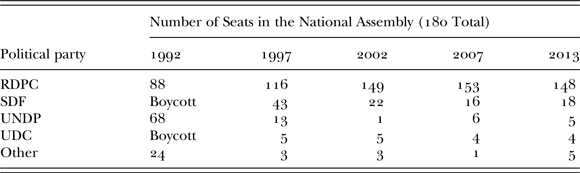
The 1992 presidential elections marked the last time the opposition threatened the Biya regime. In the 1997 legislative elections, the SDF entered the National Assembly with 43 seats, but in the context of newly gerrymandered electoral districts, the RDPC added 21 seats to their majority. The opposition boycotted the presidential election several months later, handing Biya victory with 93% of the vote, and re-anchoring his firm grip on political power. As the RDPC continued monopolising its institutional advantages, it made even stronger inroads in the 2002 legislative elections, now gaining majorities in nine of ten regions of the country; the sole exception being the Northwest where the SDF won the largest number of its opposition seats (Takougang Reference Takougang2003). In 2004, Biya won 71% of the vote nationally, cementing his unrivalled station. He then revised the constitution to abolish term limits and won re-election in 2011 with 78% of the vote. The number of seats of each party has won in the National Assembly during each election is presented below in Table I.
Historical electoral results for the Cameroon National Assembly

Today, in terms of vote totals, the SDF remains the strongest opposition party in Cameroon. Virtually everyone, however, agrees that the opposition is deeply demoralised. In 2013, the RDPC ran uncontested in 13 electoral districts. The most popular explanation in Cameroon for this outcome is the RDPC's ability to co-opt the opposition (Nyamnjoh Reference Nyamnjoh1999). For example, in 1997, after losing 55 seats in the elections for the National Assembly, Bello Bouba of the UNDP accepted a cabinet position from Biya. Though the UNDP continues to run in municipal and legislative elections, it no longer fields a presidential candidate, and its MPs vote in conjunction with the RDPC. Further, the RDPC has successfully split northern popular support for the UNDP by playing on the frustration of non-Fulani minority groups, who have long begrudged the Fulani dominance of not just the UNDP, but of the UNC under Ahidjo.
In addition to co-optation, the regime has also deeply disadvantaged the opposition through various legal and extra-legal channels. Access to the media (especially television broadcast) remains dominated by the state; the conflation between the ruling party and the state gives the RDPC unparalleled access to resources and campaign funding; gerrymandering continues to make winning structurally more difficult for the opposition; and although outright electoral fraud has become increasingly rare, it certainly played a decisive role in keeping Biya in power throughout the 1990s (Albaugh Reference Albaugh2011).
Contemporary political geography in Cameroon
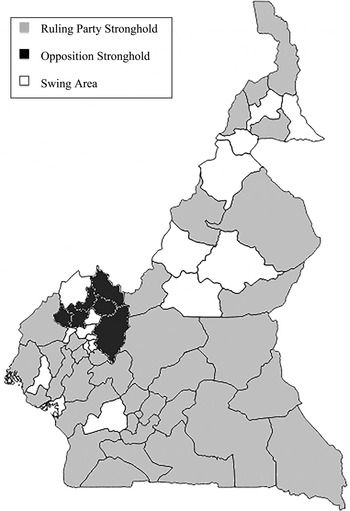
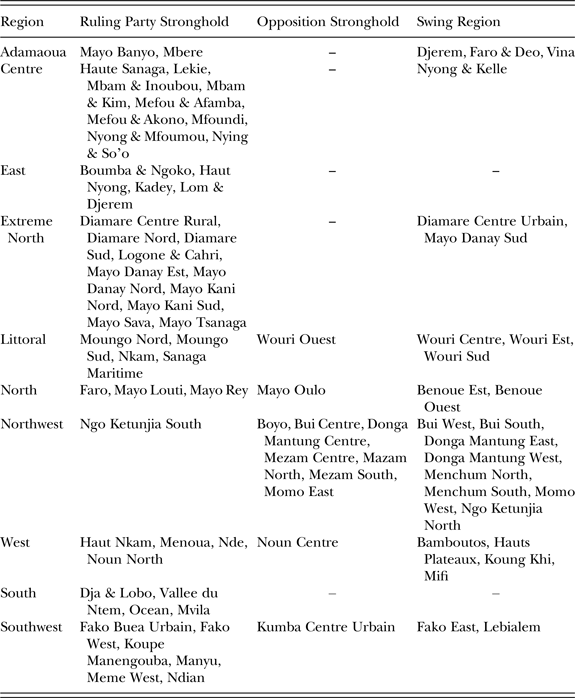
Although the number of opposition fiefs has shrunk in the past 20 years in Cameroon, there is a still a hard-core area of opposition support, particularly for the SDF in the Northwest. If ‘opposition stronghold’ is defined as an electoral department where an opposition party has continuously won a seat in the National Assembly since the 1997 election, and a ‘ruling party stronghold’ as a department where the RDPC has continuously won a seat since 1997, there are 11 opposition strongholds, 47 ruling party strongholds and 26 swing areas, as presented in Figure 4. Apart from one electoral district in the North, one in Douala, one in the Southwest and the UDC stronghold in Noun in the West, all of the opposition strongholds lie within the Northwest Region. Table II lists these strongholds.
Historical electoral map of strongholds in Cameroon.

Types of electoral districts in Cameroon by region

What has been the effect of this local party dominance on public opinion in these regions? I argue that political parties have had a strong influence on interpretations of democracy and beliefs about the national government in the localities where they are dominant. Having ruled over these fiefs for more than 20 years, the narratives these parties have adopted and espoused affect the ways that citizens in these jurisdictions view politics, regardless of how political a particular citizen is.
The narratives of the opposition parties in Cameroon have always focused on criticising the legitimacy of the national government and exposing the autocratic nature of the state (Nyamnjoh Reference Nyamnjoh1999: 103). This is true of almost all electoral autocracies, where the opposition builds its legitimacy almost exclusively on its democratic credentials (Schedler Reference Schedler2002; Riedl Reference Riedl2014). In sub-Saharan Africa, where valence issues dominate, most political communications are built on developing one's credibility in an issue area, such as democracy or development (Bleck & van de Walle 2013). With little control over development outcomes, opposition parties tend to focus heavily on their credentials as democrats (Bleck & van de Walle Reference Bleck and van de Walle2013: 1406).
During separate interviews with John Fru Ndi of the SDF and Patricia Tomaino Ndam Njoya, senior MP of the UDC (and wife of Adamou Ndam Njoya), both opposition figures noted their core issue was related to democracy. For Fru Ndi and the SDF, ‘Our main message has been about federalism, which we hope can also curb embezzlement by making things more local. Our message is to have clean elections to give you power to vote your own leaders, make your own budgets, and have policemen and administrators work locally.’Footnote 3 Similarly, Njoya noted that her number one priority in the National Assembly is to, ‘change the constitution in order to give more power to the Prime Minister and make it an elected position as well as reinstate two-term presidential limits and two-round voting in presidential elections’.Footnote 4 Issues of democratisation and transparency are the bread and butter issues of opposition parties in autocratic regimes, and their platforms are dominated by these matters.
In contrast, the RDPC platform is largely built upon countering these claims and developing a narrative that puts issues of democratisation as secondary to more important problems like economic development, peace and stability.Footnote 5 In an interview with Jacques Fame Ndongo, the long-time Secretary of Communications for the RDPC in charge of developing campaign messages, he noted that, ‘The most difficult part of the job is to convince people that the RDPC is a party of hope and the future. People forget that you built the roads and the hospitals. It is easier for them to point to the problems.’Footnote 6 Ndongo's comments reveal the difficulty the RDPC faces in countering the opposition's narrative of an autocratic state, and the ruling party's effort to shift the conversation to economic achievements.
A direct example of this strategy was the RDPC electoral slogan for the 2011 presidential election: ‘Une Cameroun des Grandes Réalisations’. The campaign highlighted the progress made on large infrastructure investments in the past few years, arguing that only the ruling party has the experience and resources to successfully follow through with long-term development projects. The recent security issues related to the terrorist activity of Boko Haram in the north of the country has also become a major talking point for the RDPC elite; only President Biya is capable of delivering protection from these foreign terrorists. The ruling party often compares Cameroon's stability to their chaotic neighbours (the Central African Republic, Chad, Congo and Nigeria), taking full credit for Cameroon's peaceful post-independence history.
The ruling party also actively attempts to discredit the democratic credentials of the opposition. In a separate interview with an RDPC MP representing Yaoundé, Simon Ongola Omgba echoed Ndongo's frustration with countering the opposition narratives. ‘Even though we have been in power for 32 years, we still have to find a way to inspire hope and faith amongst voters. The opposition is so corrupt that we try to point out these faults and especially the problems they have in their own fiefs.’Footnote 7 Implicitly recognising the difficulty of a 32-year-old ruling party claiming to be democratic, Omgba reveals that the RDPC relies more heavily on developing the narrative of an autocratic opposition incapable of economic development or good governance.
These two party narratives paint very different pictures of the world. This article argues that the two worldviews have deep impacts on political attitudes in areas that are dominated by one party or the other. This is important because unlike in democratic regimes, where political geography – the spatial variation in party strongholds – may affect regional ideological opinions on public policy (i.e. level of taxation, local spending issues, social policy, etc.), political geography in Cameroon alters the fundamental beliefs citizens have of the state itself. However, not only are the messages of political parties in autocratic regimes distinctly different from those in democracies, the information environment of autocracies also enables near-monopolies for these parties regionally. While in democracies a free media landscape facilitates the geographic penetration of political messages from all sides of the ideological spectrum, in autocratic regimes such as Cameroon, an exceedingly weak media landscape results in the local domination of political communications, particularly for the ruling party. In the most recent 2013 legislative elections, the RDPC ran completely unopposed in 13 electoral districts. This meant that in these districts, there was no opposition campaign at all. In many of these ruling party strongholds, there is no opposition headquarters or opposition presence whatsoever. The combination of geographically situated party strongholds coupled with a weakly institutionalised independent media means that by happenstance of birthplace, some Cameroonians grow up believing that the government is perfectly legitimate and elections are free and fair, whereas others believe that the state is entirely illegitimate and the country is thoroughly autocratic. This divide has important implications for the meaning of citizenship in Cameroon.
Alternative explanations
I argue that political geography should be more important to understanding public opinion than structural factors such as government spending and ethnicity in electoral autocracies. While in many ways political geography is built upon government spending and identity issues, political geography is greater than the sum of its parts in explaining the diffusion of political beliefs. In terms of government spending, many scholars have argued that patronage is the glue that holds together public support in autocratic regimes (Magaloni Reference Magaloni2006; Blaydes Reference Blaydes2011; Koter Reference Koter2013). It is an open question as to whether incumbent leaders favour spending in their core districts to reward supporters or in competitive districts where they hope to garner votes (Kasara Reference Kasara2007; Banful Reference Banful2011; Kramon & Posner Reference Kramon and Posner2013). Nonetheless, the literature on voting behaviour in Africa and in autocratic regimes more broadly has relied heavily on the argument that public spending is the primary tool that incumbents use to influence public opinion and electoral behaviour (Magaloni Reference Magaloni2006; Blaydes Reference Blaydes2011). I argue that while local spending is important to understanding party politics in Cameroon, it cannot fully explain the chasm between beliefs about the state and democracy.
Relatedly, many scholars of African politics would contend that ethnicity is the most important factor to understanding political geography and public opinion (Posner Reference Posner2005; Eifert et al. Reference Eifert, Miguel and Posner2010). Indeed, the opposition parties in Cameroon are broadly associated with identity groups affiliated with language, ethnicity and religion (though in Cameroon, parties do not map neatly onto ethnic identities as the ethnic geography of Cameroon – with over 200 distinct ethnic groups – is exceedingly fragmented): the Anglophones of the SDF, the Bamoun Kingdom for the UDC, and the Muslim ‘grand north’ constituency of the UNDP. It would be foolish to think that identity politics are not central to opposition politics in Cameroon, and perhaps most autocratic regimes. But ethnicity alone cannot explain the divides we see in public opinion in Cameroon today. This is largely because ethnicity and identity do not strongly overlap with opposition activity. Indeed, as Basedeau & Stroh (Reference Basedau and Stroh2009, Reference Basedau and Stroh2012) demonstrate in Burkina Faso, region tends to be far stronger than ethnicity for predicting partisanship and vote choice. Their findings are echoed in Cameroon, where the intersection of ethnic and linguistic identities have complicated the regional character of political geography.
Although the SDF's platform is intimately tied to issues at the heart of the Anglophone minority issue, the majority of the Southwest (Anglophone) constituencies are RDPC strongholds. Both Ahidjo and Biya have gone to great lengths to fracture the Northwest-Southwest linguistic alliance by playing up specific ethnic and regional cleavages (Nyamnjoh Reference Nyamnjoh1999: 108). However, if linguistic identity were more important than political geography, we would expect public opinion to be more similar between Northwest and Southwest constituencies than between RDPC strongholds in the Southwest and RDPC strongholds in, for example, the East. While the regime has relied on identity politics to divide the opposition, and the opposition has used identity politics to garner votes, identity – neither ethnic nor linguistic – can fully explain which citizens support the state and which do not. Ethnicity and public spending can help to explain the origins and dynamics of political geography, but neither factor is strong enough to explain the chasm in public opinion concerning the legitimacy of the regime and democracy in Cameroon. The following section discusses the sampling design of an original public opinion survey conducted in Cameroon, and presents the results of that survey. The data indicate that political geography plays a critical role in explaining public opinion in Cameroon.
PUBLIC OPINION AND POLITICAL GEOGRAPHY IN CAMEROON
Sampling design and survey questions
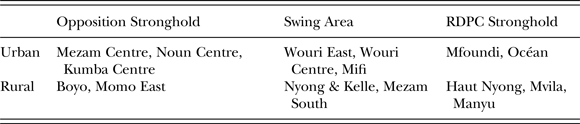
The 85-question public opinion survey was administered in seven of Cameroon's ten regions between September 2014 and April 2015. The three northern regions were largely inaccessible due to the terrorist activity of Boko Haram. The sampling design was maximised to reach an equal number of respondents living in (1) ruling party strongholds, (2) opposition strongholds and (3) swing areas. Within each category, 50% of the sampling sites were urban and 50% were rural. The sampling design can be viewed in Table III.
Sampling design

The survey was administered by myself and five research assistants to a total of 2399 willing and informed respondents of at least 23 years of age in arrondissements in each electoral district. Within each sampling site, enumerators began at a randomly chosen starting point in a populated area, and walked in opposite directions away from one another. In urban areas, enumerators stopped at every fifth household or business; in rural areas, enumerators stopped at every dwelling. Where there was an adult present, the enumerator interviewed the adult who initially responded, or another adult in the household if the original respondent was unable. Randomisation did not occur at the household level because I did not want to take a ‘census’ of the household before beginning the interview. It was critical to convince the respondents of our neutrality, and beginning with a household census would quickly heighten suspicions.
As with all surveys, there is some concern that social sensitivity bias may affect how ordinary people respond to questions about their political beliefs. Nonetheless, several steps were taken to mitigate this bias. First and foremost, the relatively lenient political environment in Cameroon largely facilitated the implementation of this survey. Low-level repression is virtually non-existent in Cameroon today, and citizens are largely free to speak their minds without fear of monitoring or reprisals. For example, if you listen to call-in radio shows or read independent newspapers, it is extremely common to hear scathing critiques of the regime. In addition, the instrument was specifically designed with the most sensitive questions about political beliefs at the end of the survey, so that the enumerators could build a rapport with the interviewer over the course of the interview before asking their opinions about the regime. In addition, the experience of conducting the survey myself helped to assuage doubts about fears of reporting negative beliefs about the regime. On many occasions, in all types of electoral districts across the country, I listened to unprompted tirades against the regime. Although it is impossible to say that all respondents felt completely free to express their thoughts, these common expressions of disapproval led me to conclude that most people felt free enough to openly express dissatisfaction with the government.
It is also important to note that while the empirical strategy takes into account a number of important confounding factors, such as ethnicity and public spending, it does not offer a definitive causal inference strategy for isolating the impact of political geography and political party narrative on public opinion. It is possible that some unobserved factor has caused both the political geography we see in Cameroon today as well as the spatial distribution of beliefs about the regime. Nonetheless, the analysis controls for the two clearest alternative explanations for this relationship (ethnicity and spending) and gives us leverage on the relative importance of political geography vis-à-vis other common predictors of public opinion, such as gender, age or education. In addition, it sheds light on a subject that has heretofore received very little attention in the scholarly literature: public opinion in Cameroon.
With these concerns in mind, the following statistical analysis attempts to determine how well political geography explains variation in political attitudes in comparison to demographic factors as well as local public spending and ethnicity. Thus the primary independent variable is a set of three dichotomous measures: (1) Ruling party stronghold, (2) Opposition stronghold and (3) Swing area. Because the survey explicitly sampled on these three types of districts, there are roughly 800 respondents per district type. The base category is ruling party stronghold; therefore coefficients for ‘opposition stronghold’ and ‘swing area’ are in reference to responses in ruling party areas.
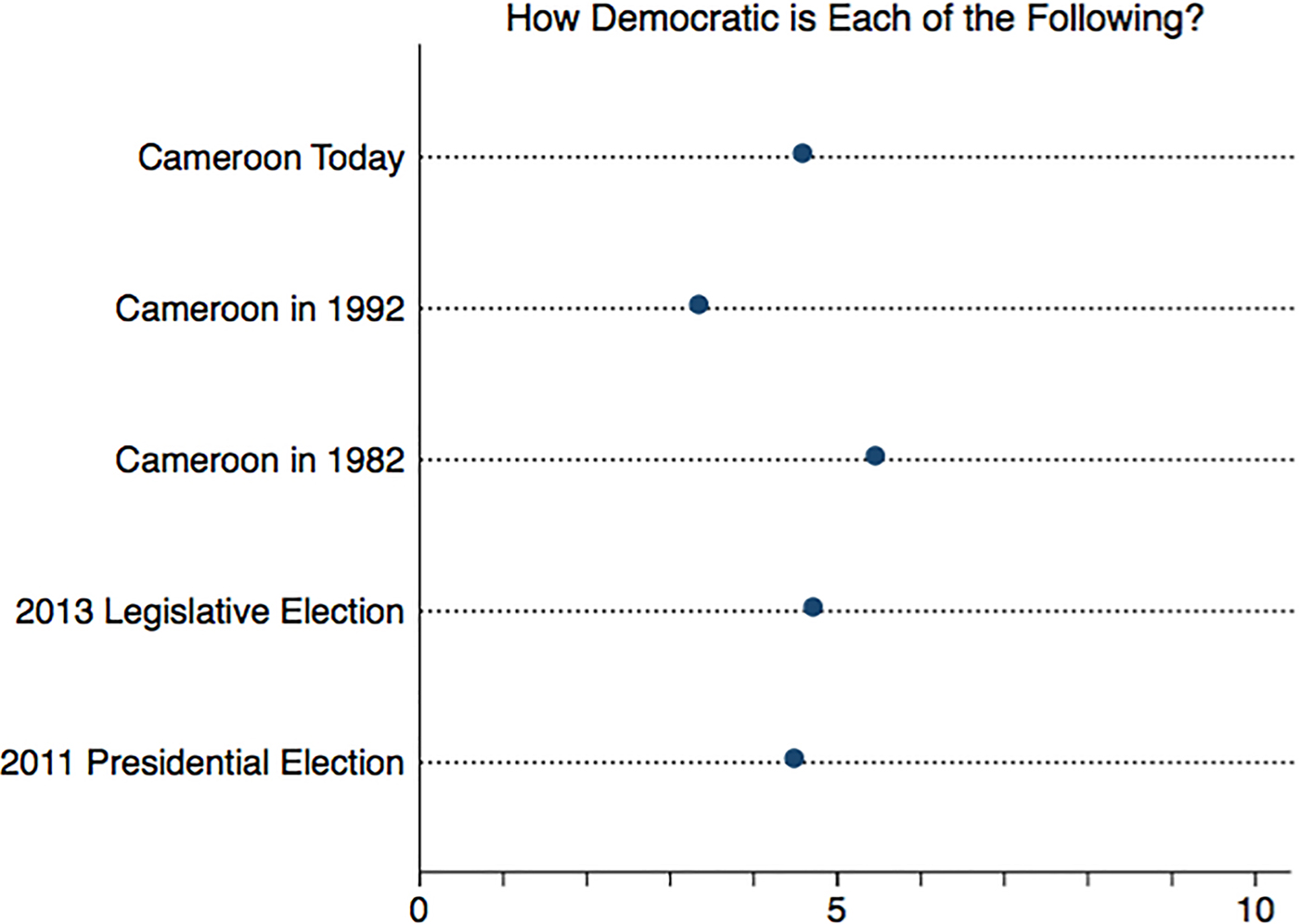
The analysis uses several dependent variables to gauge variation in political beliefs about democracy and the state. First is a series of questions about the level of democracy in Cameroon: ‘On a scale between 0 and 10, where 0 means completely undemocratic and 10 means completely democratic, where would you place each of the following: (1) The last municipal and legislative elections held in September 2013, (2) The last presidential election held in 2011, (3) Our country as a whole, (4) Our country in 1992, (5) Our country in 1982, when Paul Biya became President?’ This series of questions was designed to provide a dynamic assessment of democracy in Cameroon. While asking about the general level of democracy in Cameroon today provides important insight into baseline beliefs about democracy, the series of five questions provides more information about what Cameroonians think about elections as well the historical development of democracy in their country. On average, as presented in Figure 5, scores for all of these questions clustered around a mean of 5 out of 10 points. It is interesting to note that the average Cameroonian gives the highest democracy scores to the country in 1982 – objectively the most autocratic period of the three options.
Average assessments of level of democracy.

Second, the survey replicates the Afrobarometer questions about regime trust in order to measure the relationship between political geography and trust in the government itself. These questions ask the respondent how much they trust the following institutions: the National Assembly, the Electoral Commission (ELECAM), the ruling party (RDPC), the opposition political parties and the President of the Republic. For all of these institutions, the average response for the entire sample lay somewhere between ‘just a little’ and ‘somewhat’, except for the opposition parties, who on average received a lower score.
The final dependent variable strikes at the heart of the issue of regime legitimacy in Cameroon. The question was designed to go beyond surface-level assessments of democracy and trust in order to explain how exactly the respondent understands the legitimacy of the regime in power. The question asks the respondent to choose between three different explanations for the longevity of the current regime: ‘If you had to choose just one, which of the following explanations is closest to your opinion: (1) The RDPC always wins elections because it is genuinely popular amongst a majority of Cameroonians, (2) If there were a credible opposition party, the RDPC would lose elections because it is not very popular, or (3) The RDPC would still win against a credible opposition because the electoral system is rigged.’ Within the entire sample of respondents, 40·6% chose the first option, 26·0% chose the second option and 33·4% chose the third option. The raw results indicate, again, that Cameroonians are deeply divided in how they view the function and legitimacy of their government.
While the primary independent variable used to explain this variation is political geography, control variables are also included to compare the explanatory power of political geography to traditional explanations of public opinion. First, a number of demographic variables are included: whether the respondent was interviewed in an urban or a rural area, the respondent's gender, age, level of education, and the respondent's wealth – a measure of the number of items the respondent owns (including a radio, television, car/truck, motorcycle, mobile phone, laptop, indoor or outdoor toilet, and piped or well water). In order to arbitrate between the role of party diffusion and closeness to a political party, I also include a measure of partisanship: whether or not the respondent reported feeling close to a particular political party.
In addition, I also measure local government spending at the level of the arrondissement. These spending figures were taken from Cameroon's Ministry of Economy, Planning, and Regional Development (MINEPAT) for 2012, and include all government spending in each local district (including everything from education spending to infrastructure investment). Finally, a series of dummy variables are included to measure the respondent's ethnicity. The question was open ended, and I received more than 200 different responses to the question ‘To which ethnic group do you belong?’. I therefore include the top ten ethnic groups represented in the survey: all groups that had 50 or more respondents, plus a category for ‘other’. The President's ethnic group, the Beti, are the base category, so that all the coefficients for the other ethnic groups are in relation to the Beti.
Results
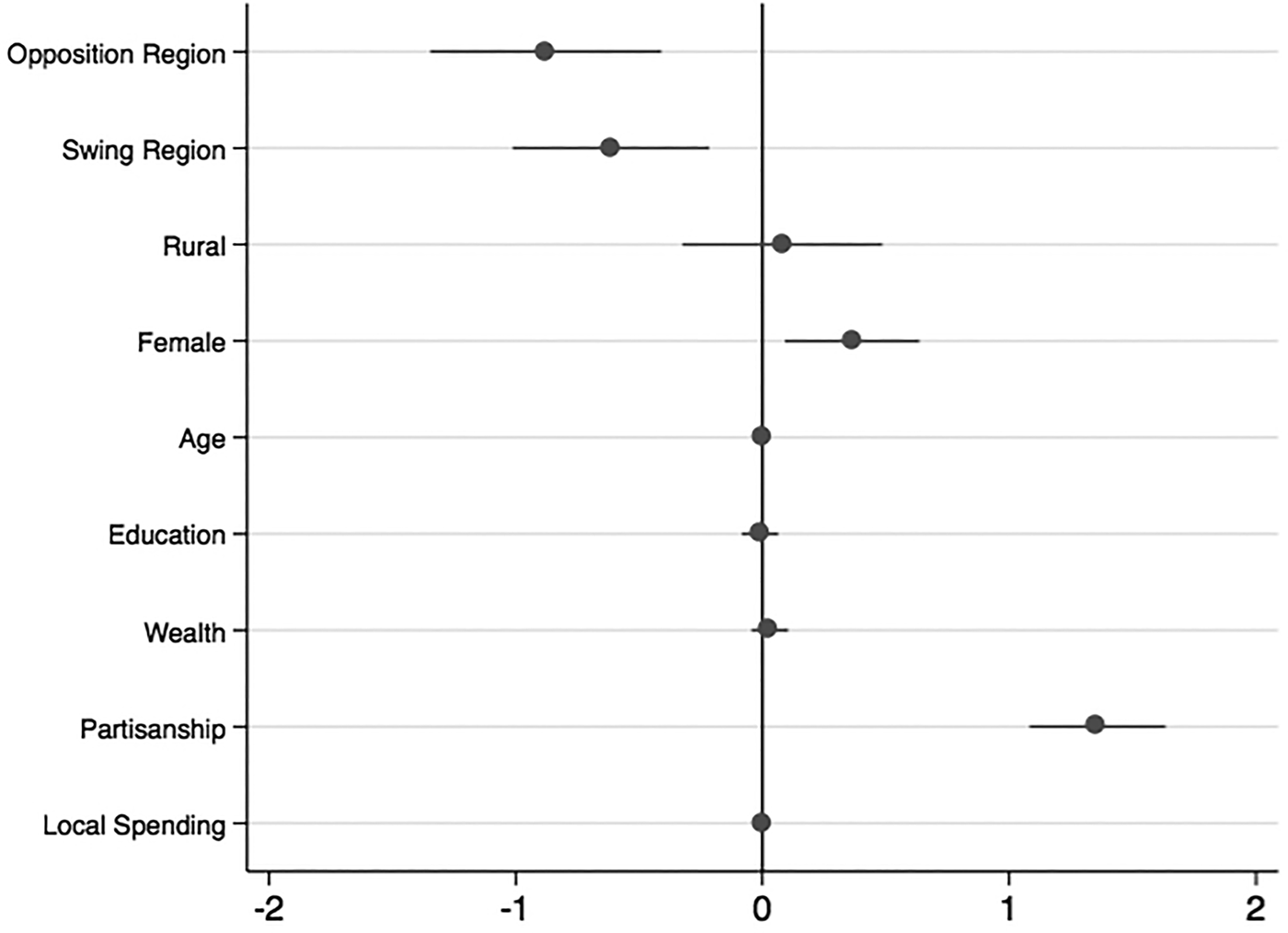
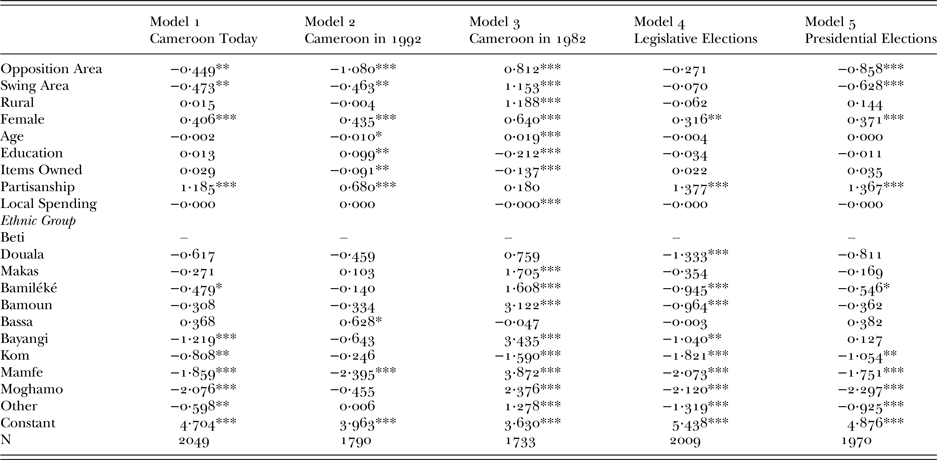
Using ordinary least squares regression, the first set of analyses measures the relationship between political geography and the respondent's assessment of the level of democracy in Cameroon on a scale from 0 to 10. The results of this series of regressions are presented in Models 1–5 of Table IV. With the exception of the previous legislative election (Model 4), the region in which a respondent lives has a statistically significant impact on their assessment of democracy in Cameroon. On average, and controlling for rural/urban locality, gender, age, education, wealth, partisanship, ethnicity and local government spending, citizens living in opposition regions rate the level of democracy in Cameroon as lower both today (Model 1) as well as in 1992 (Model 3), and they also provide a lower democracy score for the most recent presidential elections (Model 5). The coefficients for Model 5 (assessments of the 2011 presidential elections) are presented graphically in Figure 6.
Plotted coefficients for Model 5, level of democracy of the 2011 presidential election.

Political geography and assessments of democracy

*p < 0·10, **p < 0·05, ***p < 0·01.
All other factors held constant, the average citizen living in a ruling party stronghold rates the level of democracy in Cameroon today about half a point higher than the average citizen in an opposition stronghold. For their score of democracy in 1992 as well as scores for the 2011 presidential election, there is almost a one-point difference between citizens in these different regions. Figure 6 shows the magnitude of this effect (for the 2011 election) relative to the effects of other demographic factors. Interestingly, citizens in opposition strongholds, on average, rate the level of democracy in 1982 more highly than citizens in ruling party strongholds. Given the opposition narrative about the corruption and mismanagement of the Biya regime, it is possible that citizens in these regions remember the single party era under Ahidjo as more democratic than multipartyism under President Biya. The average opposition stronghold respondent rates democracy in Cameroon today as a 4·2 out of 10 compared with the level of democracy in 1982 as a 5·6.
Further, citizens living in opposition strongholds do not appear to rate the previous legislative elections higher or lower than citizens in ruling party strongholds. This is likely because opposition candidates win legislative elections in opposition strongholds (by definition), and therefore citizens see them as more competitive and more democratic than presidential elections. A 38-year-old man in Boyo said it was more important to vote in legislative elections than in presidential elections, ‘Because I know the candidates’.Footnote 8 Inversely, in ruling party strongholds, many RDPC candidates run uncontested in legislative elections. Presidential elections, however, are nationwide contests, and therefore citizens always have multiple candidates between which to choose, regardless of where they live. Highlighting this logic of voting in Cameroon, a 62-year-old man in the RDPC stronghold of Haut Nyong rated the legislative elections a 0 and the presidential elections an 8 because in the legislative elections, ‘We only had one ballot!’Footnote 9 Similarly a 50-year-old respondent from Mvila near President Biya's hometown noted, ‘The presidential election was more democratic because we actually had choices between candidates’.Footnote 10 These findings highlight the differences in experiences with democracy that citizens in different strongholds have.
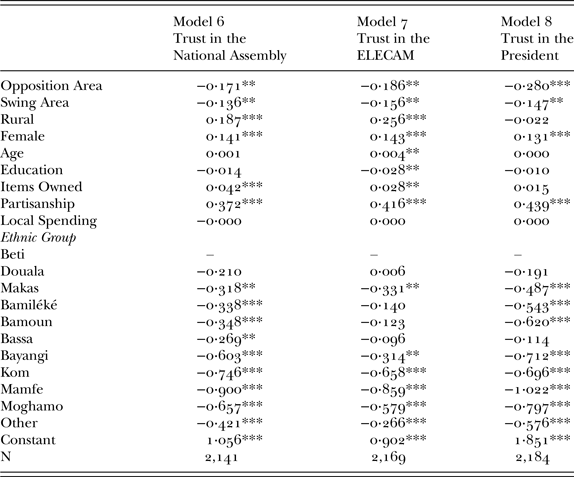
In addition to beliefs about democracy, it also appears that citizens have different levels of trust in the regime itself. Controlling for all the other demographic factors, citizens living in opposition strongholds have less trust than citizens of ruling party strongholds in the National Assembly, the electoral commission (ELECAM), the ruling party and the president himself. Table V presents the full regression analysis for trust in the National Assembly (Model 6), ELECAM (Model 7), and the president (Model 8). The dependent variable is measured on a 4-point scale, where 0 represents ‘trust not at all’ and 3 is ‘trust a lot.’
Relationship between trust in the government and strongholds.

*p < 0·10, **p < 0·05, ***p < 0·01.
The gap in trust is largest for the president; on average (and all else held equal), citizens from opposition strongholds score their trust nearly a third of a point lower than citizens from ruling party strongholds. All else equal, citizens of swing areas are also less likely than citizens of RDPC areas to trust the institutions of government, though this gap is smaller than for opposition strongholds. Citizens of rural areas, women and wealthier citizens profess higher levels of trust in the government, though these relationships do not offset the effect of political geography.
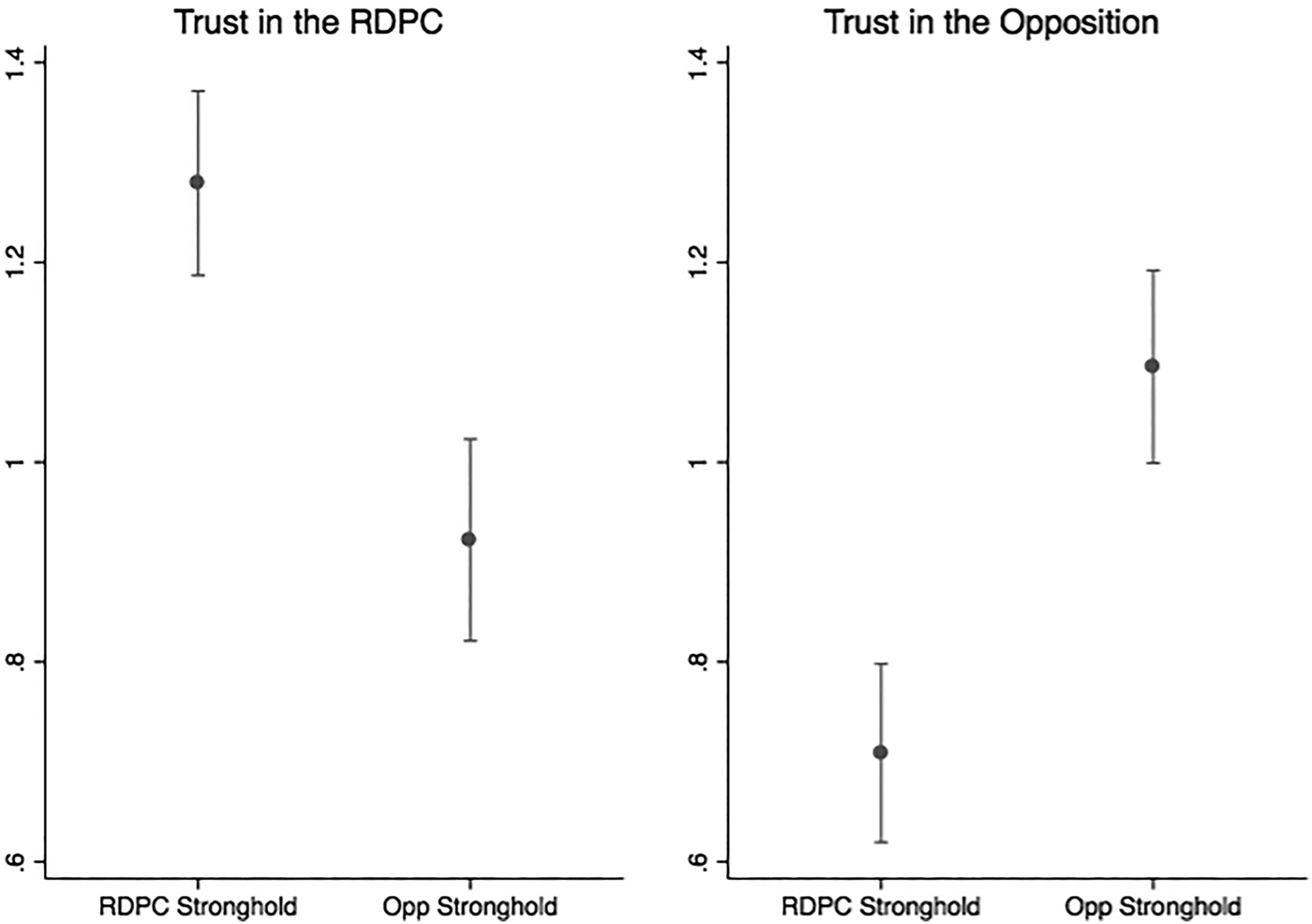
Citizens of opposition strongholds are much less likely to trust the RDPC and much more likely to trust the opposition than citizens in ruling party strongholds. The difference in trust levels for the different political parties is represented in Figure 7, which plots the predicted value of trust in the RDPC versus trust in the opposition parties for respondents in RDPC strongholds and opposition strongholds. For both trust in the RDPC and trust in the opposition, there is, all else held equal, a nearly 0·5-point difference between responses in ruling party strongholds versus opposition strongholds.
Predicted probabilities of trust in RDPC vs. trust in the opposition in RDPC and opposition strongholds.

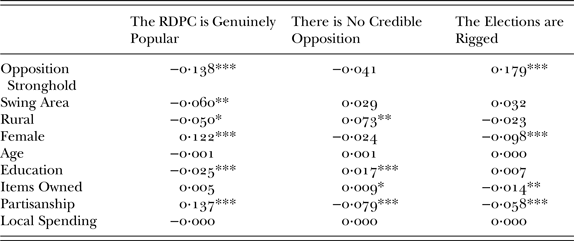
The final analysis looks at the question of why the ruling party has been able to remain in power since the transition to multipartyism. Respondents were able to choose from three response options: (1) The RDPC always wins elections because it is genuinely popular amongst a majority of Cameroonians, (2) If there were a credible opposition party, the RDPC would lose elections because it is not very popular, or (3) The RDPC would still win against a credible opposition because the electoral system is rigged. Because the dependent variable has three response options, a multinomial logit model was used to determine which types of respondents were most likely to choose each of the three options. The marginal effects are presented in Table VI, and can be interpreted as the odds of choosing option 1 versus option 2 or 3.
Strongholds and beliefs about the RDPC: marginal effects of multinomial logistic regression

Multinomial logit. Marginal effects reported.
Model includes ethnicity dummies (coefficients not reported).
*p < 0·10, **p < 0·05, ***p < 0·01, n = 2079.
This question drives at the logic behind how people believe politics works in Cameroon. The belief that elections are rigged undermines the legitimacy of the government and the rule of law. In general, citizens living in opposition strongholds are far more likely to believe that the RDPC rigs elections in Cameroon. All else being equal, someone living in an opposition stronghold has a 29·0% chance of believing that the RDPC is genuinely popular and a 50·2% chance of believing that the elections are rigged. Citizens living in areas dominated by the ruling party, on the other hand, are far more likely to believe that the RDPC is in power because it is genuinely popular amongst the majority of Cameroonians. Citizens in RDPC strongholds have a 43·4% chance of believing the RDPC is genuinely popular, compared with 31·5% who believe the elections are rigged. Regardless of any other demographic factors, citizens who have grown up with the legitimising narrative of the RDPC are more likely to believe that the ruling party is democratically legitimate.
Political geography is not the only factor driving differences in opinions about government legitimacy. Women, who are also more likely to trust the government and to believe that Cameroon is democratic, tend to believe that the RDPC is genuinely popular, and disinclined to believe that elections are rigged. Wealthier respondents are also less likely to think that elections are rigged. In addition, citizens with higher levels of education are more likely to believe that the RDPC has remained in power because there is no credible opposition. Well-educated citizens are perhaps better able to reject both party narratives, believing that neither the ruling party nor the opposition are particularly popular or credible in Cameroon today. However, education does not explain much other variation in regime trust or assessment of democracy, and political geography appears to have a stronger effect overall.
In general, the results indicate that while the traditional explanations for public opinion, such as gender, age, education, income and rural/urban locality, go some way toward explaining variation in public opinion in Cameroon, political geography also explains variation in assessments of democracy, trust in the institutions of government and beliefs about the political status quo. Further, the variation appears to be a function of geography itself – what I argue is the dissemination of party narratives – and not confounded by local spending patterns or ethnicity. In autocratic Cameroon, where you live in proximity to party strongholds has just as strong an effect on your beliefs about the legitimacy of the state as your education, income or ethnicity.
CONCLUSIONS
Until recently, very little was known about public opinion in Cameroon. Analysis focused on elite conjectures and historical telescoping largely assumed that the current government in Cameroon is deeply illegitimate amongst ordinary Cameroonians. While this study does not contest that lots of Cameroonians feel alienated from the state, it also shows that many other citizens feel close to the ruling party and believe that the president and his government are perfectly legitimate, and even democratic. Public opinion in Cameroon, if anything, is deeply divided around the question of democracy and regime legitimacy.
This article has endeavoured to explain this division, and has argued that political geography plays an important role in Cameroon of explaining ordinary assessments of the government. A citizen's proximity to a political party stronghold has an impact on perceptions of regime legitimacy that is similar to the importance of a citizen's gender, age, education, income, or urban/rural locality. Further, political geography is not simply a function of government spending or ethnic patterns; the role that political parties play in cultivating narratives about regime legitimacy and democracy have lasting effects not just on partisans, but also on the apolitical citizens living in their jurisdictions.
These findings are important for a number of reasons. First, this party effect on political attitudes is important because while in democratic regimes it might affect ideological opinions about public policy, in autocratic regimes such as Cameroon, it affects more fundamental beliefs about the legitimacy of the government itself. Citizens who live in opposition strongholds grow up believing that they live in a dictatorship that holds rigged elections and is largely inept and untrustworthy. Citizens in ruling party strongholds, on the other hand, are much more likely to buy the ruling party's narrative that, while not perfect, elections reflect the will of the people, that the ruling party is genuinely popular. This divide is critical to understanding the meaning of citizenship and democracy in autocratic regimes.
Though the findings do not shed light on the general stability of the regime, they do cast some doubt on the idea that President Biya and the RDPC are deeply unpopular. While it is clear that they are not overwhelming popular either, pockets of support remain, and in many ways outnumber the more vocal opponents of the regime. Nonetheless, Cameroon is an autocracy, and regime change or continuity does not occur based on popular consensus. While a general acceptance of the status quo may enable the regime to stumble on in its waning years, an unexpected uprising by a small but organised minority can quickly lead to regime change, as seen in Burkina Faso in 2014.