In the United States, racially/ethnically diverse residents often experience higher rates of mortality, morbidity, and economic loss after public health emergencies.Reference Messias and Lacy1Reference Carter-Pokras, Zambrana, Mora and Aaby2Reference Perilla, Norris and Lavizzo3Reference Fothergill, Maestas and Darlington4Reference Andrulis, Siddiqui and Gantner5Reference Hutchins, Fiscella, Levine, Ompad and McDonald6 A growing body of evidence suggests that these disparities largely are the result of broad inequalities in underlying social and economic conditions such as low literacy, high poverty, and substandard housing.Reference Masozera, Bailey and Kerchner7Reference Bolin and Stanford8Reference Pastor, Bullard and Boyce9Reference Steege, Baron, Davis, Torres-Kilgore and Sweeney10Reference Ablah, Konda and Kelley11 Failure to weigh the importance of cultural beliefs and norms in these communities, limited English proficiency, and legacies of distrust in government also have been identified as significant, contributing factors.Reference James, Hawkins and Rowel12Reference Mathew and Kelly13Reference Cordasco, Eisenman, Glik, Golden and Asch14Reference Eisenman, Glik and Gonzalez15
Along with federal agencies and national organizations, many states have come to recognize these disparities and their consequences, attention propelled by more recent events such as Hurricane Katrina. Before the present article, no comprehensive review has focused explicitly on a state's efforts to reach and engage these populations in emergency preparedness priorities. This article presents the first statewide analysis and assessment, considering disaster planning resources and strategies targeting California's diverse communities.
By necessity, California has devoted significant attention at state and local levels to address and integrate the disaster needs of diverse communities into planning and response. Being among the most culturally diverse states in the United States, nearly 40% of California's population identifies as nonwhite and 42% speaks a language other than English at home.16 At the same time, California residents confront a range of natural disasters each year, including an average of 5000 wildfires and nearly 15 major earthquakes (magnitude in excess of 4.0) annually.1718
To document and review California's present programs and practices and barriers to meeting the needs of diverse communities, we used a multifaceted methodology involving a review of the literature, an environmental scan of Internet-based programs, and key informant interviews. Our findings cut across multiple sectors, including state and local government, private nonprofits, academic organizations, and community-based organizations, and identified a core set of priorities for future program and policy development across the state. We used an all-hazards definition of preparedness to ensure that our findings were broadly applicable across various types of disasters and emergencies. Although this article focuses on 1 state, we believe that it provides a methodological framework that can guide similar assessments for other states and their communities.
METHODS
Study Design
Our research design was intended to address 4 questions about preparedness and diversity:
1. What are the major barriers and challenges to meeting the needs of racially/ethnically diverse communities in preparing for disasters?
2. What promising programs and strategies exist at the state and local levels for addressing barriers?
3. What gaps remain in current programs and policies?
4. What are the priorities for future program and policy development?
Our approach used complementary methods, including a state-focused review of research and reports, an Internet-based environmental scan, and key informant interviews to document related experience and issues.
Literature Review
Through a multistep process, we identified and conducted a review of the literature focusing on disasters and diverse communities in California. We identified peer-reviewed articles through a search of the PubMed/MEDLINE database for English-language articles for 1979–2009 using combinations of the following key terms: race, ethnicity, minority, immigrant, language, culture, Hispanic, Latino, African American, Asian, Native, disaster, emergency, preparedness, earthquake, flood, wildfire, California, Loma Prieta, and Northridge. We also searched major government, for-profit, not-for profit, community-based, academic, and foundation Web sites for relevant reports and publications. The bibliographies of resources that were identified as relevant to the theme and focus of our study were reviewed for additional references. Our literature review included only publications and peer-reviewed studies that explicitly addressed racially/ethnically diverse communities within the context of emergency and disaster events in California.
Web-Based Environmental Scan
Between June and August 2008, we conducted an online environmental scan of organizations, including state/local government agencies, private for-profit and nonprofit entities, academic institutions, and community-based organizations, to identify preparedness programs and initiatives for racially/ethnically diverse populations. To this end, we referred to a range of resources, including the Web sites of 58 county departments and 54 county health departments in California; peer-review literature and other state/local publications; the online National Resource Center on Advancing Emergency Preparedness for Culturally Diverse Communities; recommendations from key informants and California-based members of the National Consensus Panel on Emergency Preparedness and Cultural Diversity; and links provided through identified Web sites. Additional programs were identified by conducting a series of key word searches using Google and the aforementioned key terms.
The criteria for including Web sites in our study were they offer information or resources on both racially/ethnically diverse communities and preparedness and their sponsoring organization be based in California. A total of 148 Web sites met these criteria and were categorized into 7 program areas, developed based on the programmatic priorities that were most commonly cited in the literature, national reports, and initiatives: language assistance services, training and education, research and evaluation, collaboration building, promising practices, funding and program development, and policy and advocacy. In addition, findings were categorized geographically, on the basis of the physical and/or mailing address provided on the Web site, across the state's 11 public health regions to identify areas leading or lacking in efforts. Initiatives spanning multiple regions were categorized as being at the state level.
Key Informant Interviews
We conducted 17 semistructured telephone-based key informant interviews between June and August 2008 to elicit information on barriers and challenges to meeting the needs of culturally diverse communities in disasters; current practices adopted by organizations, particularly related to community engagement, training and education, research and evaluation, and collaborative partnerships; the role that different sectors can play to better meet the needs of diverse communities; and specific policy changes or resources that would enable organizations to better serve and reach these communities. Key informants were identified through recommendations made by the National Consensus Panel on Emergency Preparedness and Cultural Diversity19 as well as the environmental scan. Seventeen individuals completed the interview process. They represented 6 nonprofit agencies, 3 county public health departments, 3 community-based organizations, 2 local emergency management and response organizations, 2 state agencies and 1 academic researcher. Key informants represented 4 regions across the state—Central Coast, Bay Area, Central Valley, and Los Angeles—as well as the state of California.
Literature and Internet-based findings guided the development of a semistructured interview protocol. Qualitative data from each interview were manually coded, sorted, and analyzed in 2 stages. The first round involved the extraction of overarching and recurring themes expressed within the aforementioned 4 areas of inquiry. The second round of analysis identified subthemes. To validate and corroborate themes and subthemes, data from each interview were analyzed by 2 independent researchers.
RESULTS
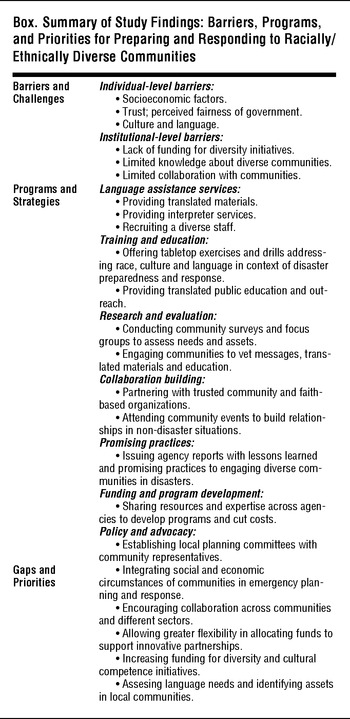
Findings from the content review and qualitative analysis distinguished 2 dimensions of barriers impeding effective engagement and actions of diverse communities in preparing for and responding to emergencies: individual barriers often characteristic of racially/ethnically diverse communities; and organization- or agency-related institutional barriers. Sources also identified strategies intended to mitigate the effect of these barriers and priorities for related programs and policies. Findings are summarized in the Box.
Summary of Study Findings: Barriers, Programs, and Priorities for Preparing and Responding to Racially/Ethnically Diverse Communities

Individual/Community-Level Barriers to Preparing and Responding to Diverse Communities
Three broad-based individual-level barriers were most often cited as encumbering efforts to effectively plan for and respond to these populations in disasters: socioeconomic factors and an ability to follow disaster preparedness and response guidelines; trust and perceived fairness of government response; and culture and language. Although we use the term individual, we acknowledge that these barriers are inextricably related to and reflect the social, economic, and environmental circumstances of communities.
Socioeconomic Factors and Ability to Follow Disaster Preparedness and Response Guidelines
Fifteen key informants cited socioeconomic factors as inhibiting effective preparedness and response for minorities. These included, for example, limited or lack of financial resources to prepare disaster supply kits or take protective action such as boarding up windows before a hurricane, limited access to public transportation or lack of a personal vehicle for evacuation, and limited time for preparedness education and mitigation actions because of long work hours and multiple jobs. The inability to perform housing mitigation also was cited as a barrier because many people in low-income minority groups rent their homes and are thus prohibited from making structural modifications. Our review of the literature confirmed these challenges. For example, a Transportation Research Board report that assessed the present capacity of public transportation systems in the Los Angeles-Long Beach-Santa Ana area acknowledged that geographically isolated immigrant communities, often with limited English-speaking proficiency, would be largely reliant on public transportation to evacuate at-risk areas.20 The literature review also identified substandard housing conditions and low literacy levels as further encumbering the ability of minority communities to prepare for and respond effectively to disasters.Reference Fothergill, Maestas and Darlington4Reference Masozera, Bailey and Kerchner7Reference Bolin and Stanford8
Trust and Perceived Fairness of Government Response
Eleven respondents identified low levels of trust in service providers and government officials as a barrier to accepting and adhering to warnings and recommended actions. This finding mirrored numerous reports that emerged after California's major disasters, citing the reluctance of these individuals, particularly immigrants, to follow evacuation orders and access assistance programs.Reference Bolin and Stanford8Reference Mathew and Kelly13Reference Wang and Yasui21Reference Nunez-Alvarez, Konana and Ramos22 In addition, results from both the interviews and literature review indicated that mistrust in government responders was particularly prevalent among undocumented immigrants, who feared their interaction would lead to deportation.Reference Mathew and Kelly1323 Recent reports also suggested that experiences and feelings of discrimination among racially/ethnically diverse communities contributed to perceptions of distrust.Reference Wray, Rivers and Whitworth24 Furthermore, 1 study found that racial/ethnic minorities, particularly African Americans, were less likely to believe that the government would respond fairly to their public health emergency needs.Reference Eisenman, Wold and Setodji25
Culture and Language
Eight key informants stressed specific cultural and linguistic factors as major challenges. In particular, they identified limited English-speaking proficiency; a lack of familiarity with US culture, customs, and service programs; and reliance on ethnic, nonmainstream, or both types of media sources as creating barriers across all disaster phases. Our analysis of reports and publications reinforced these conclusions and suggested that linguistic isolation in parts of California created additional barriers. For example, migrant farm workers in San Diego's hillsides and canyons are not only hard to reach physically but also linguistically isolated because they speak indigenous languages, such as the Mixtecan languages.Reference Martinez26
Institutional-Level Barriers for Preparing and Responding to Diverse Communities
Our analysis identified 3 significant institutional barriers within public health and emergency management systems, distinct from individual and community characteristics, that may inhibit effective preparedness and response for diverse communities and individuals: lack of support for culturally and linguistically appropriate services and programs, limited interorganizational collaboration, and limited knowledge about diverse communities.
Lack of Support for Culturally and Linguistically Appropriate Services and Programs
Nine respondents cited little or no organizational support and funding for culturally and linguistically appropriate services, such as hiring bilingual staff, ensuring workforce diversity, offering translated disaster education materials, and providing cultural competence training. An inconsistency in funding between years was also cited as limiting the ability of agencies to hire and train diverse staff and implement programs. In 2008, only 3 (2%) Web sites included in the environmental scan provided funding opportunities to address the preparedness needs of diverse communities. These findings are reinforced by a growing body of literature that has highlighted the lack and importance of building the cultural and linguistic capacity of preparedness and response organizations.Reference Fothergill, Maestas and Darlington4Reference Pastor, Bullard and Boyce9Reference Mathew and Kelly1327 For example, after the 1989 Loma Prieta earthquake, signs stating the occupancy status of buildings were provided only in English, despite the large number of multilingual individuals inhabiting affected neighborhoods.Reference Pastor, Bullard and Boyce9 During the 2007 Southern California wildfires, children were often used as interpreters when bilingual staff were unavailable, raising a number of concerns about the accuracy of complex information being translated in high-risk situations.Reference Mathew and Kelly13
Limited Interorganizational Collaboration
Eight of the key informants cited a lack of collaboration and coordination between organizations as a major barrier to engaging and incorporating diverse residents in preparedness and response. Specifically, respondents suggested that little sharing of information and experiences occurs between emergency management/public health agencies and the communities of concern, including groups that work with and represent racial/ethnic minorities (eg, faith- and community-based organizations). Rigid funding structures that limit how and to whom funds can be allocated also were cited as a barrier to interorganizational collaboration. In addition, informants stated that formal disaster preparedness plans tend to be esoteric and unclear to representatives of community-based organizations, who are unfamiliar with the language and acronyms used in the field.
Limited Knowledge About Diverse Communities
Misconceptions and lack of knowledge about the culturally specific needs of diverse communities reportedly served as another major obstacle for first responders and emergency planners seeking to provide socioeconomically, culturally, and linguistically appropriate response and services. Areas identified as lacking included knowledge about religious beliefs and customs, death rituals, and nontraditional medicine. Insufficient or inaccurate working knowledge about immigration policies, particularly related to evacuation and access to recovery services was found to be a barrier to organizations serving recent and undocumented immigrants in Southern California.Reference Mathew and Kelly13
California-Based Programs for Preparing and Responding to Diverse Communities
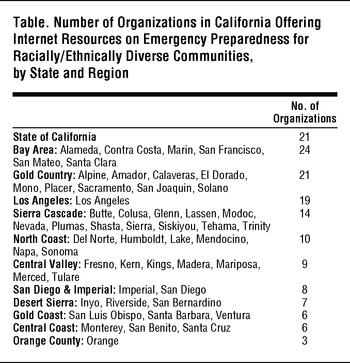
Interviews, analysis of literature, and, in particular, our review of 148 public health and emergency management Web sites in California identified 4 major areas of initiatives and strategies to address diversity-specific concerns. Our review of organizational Web sites identified regional differences in the number and types of programs and strategies being offered across the state (Table). For example, we found that organizations providing training and education programs that target the needs of diverse communities were concentrated in coastal regions and within major cities. Of the 24 organizational Web sites identified as providing training and education, 5 (21%) were in the San Francisco-Oakland Bay Area region and 6 (25%) were in the Los Angeles region. A similar trend emerged for organizations that provided translated materials on their Web sites, with a concentration of translated resources in the Bay Area, Los Angeles, and Gold Coast regions. Northern regions were lacking largely in providing online translated resources. Of the 24 organizations identified in the North Coast and Sierra Cascade regions, 4 (17%) provided translated materials directly on their Web sites.
Number of Organizations in California Offering Internet Resources on Emergency Preparedness for Racially/Ethnically Diverse Communities, by State and Region

Language-Assistance Services
Of the organizations included in this study, 107 (72%) provided links to Web sites offering translated preparedness education materials, 62 (42%) offered foreign language materials directly on their Web sites, and 16 (11%) provided a foreign language version of its Web site. Of the organizations providing online translated materials, all 62 (100%) provided Spanish-language resources, with 17 (27%) providing materials in Vietnamese, 16 (25%) in Chinese, 14 (22%) in Tagalog, and 11 (18%) in Korean, Russian, and/or Hmong. Beyond online materials, 12 (8%) organizations offered language interpretation services, predominantly through teleinterpreters. In addition, 8 key informants indicated that they actively recruit bilingual and multilingual staff to encourage and ensure appropriate interpretation and translation services in disaster situations.
Community Engagement
Seven key informants identified community engagement as invaluable in reaching diverse residents. Strategies cited as being implemented by respondents' agencies included creating advisory groups comprising members appointed from the local community, community-based organizations, and faith institutions to advise and guide public health and emergency management agencies in tailoring plans and programs for local areas; requiring participation of public health and emergency personnel in local community events to foster mutual trust; and working with community-based health workers or promotores to facilitate disaster information dissemination and training. Our environmental scan identified some organizations in California, although few in number, leading in maintaining objectives related to partnering with and engaging communities as core to their mission. For example, Collaborating Agencies Responding to Disasters in the Bay Area is recognized for advancing “fear-free” preparedness in diverse communities by acting as a liaison between nonprofit/community agencies and county public health/emergency management organizations.
Measurement and Evaluation
Six key informants described using measurement tools to assess the needs, challenges, and barriers of diverse residents and examine methods through which they could be reached. Survey methods, focus groups, and interviews in health care settings were identified as the primary sources of measurement and evaluation. Only 5 (3%) of the Web sites in our environmental scan offered such tools of assessment.
Interorganizational Collaboration
Despite an expressed need for increased collaboration, only 3 key informants indicated their involvement in collaborative public–private initiatives. The NICOS Chinese Health Coalition, a community-based and culturally focused health institution in San Francisco's Chinatown, reportedly partnered with local public and private responder agencies to coordinate an annual large-scale disaster drill in Chinatown. This multiorganization and multisector exercise brought together local area members, community-based organizations, and the public sector to simulate a series of disaster-response scenarios.
Program and Policy Priorities for Improving Preparedness and Response for Diverse Communities
Key informants and reports identified common program and policy priorities for improving preparedness for racially/ethnically diverse individuals and their communities. A common theme across recommendations stressed the importance of integrating socioeconomic and cultural realities throughout the program and policy development process, from incipiency to implementation.
Enhance Collaboration
Most key informants cited fragmentation and lack of communication between, within, and across sectors as major impediments to serving diverse communities effectively across all disaster phases. Although the need for greater collaboration among all of the agencies was emphasized, respondents particularly stressed the need for increased communication between community-based organizations and government agencies, such as county public health departments and offices of emergency services. Faith-based settings, neighborhood councils, and other community-based organizations, with intimate knowledge of the specific needs of their racially/ethnically diverse neighborhoods and residents, were perceived as having great potential to improve disaster preparedness planning. Respondents also encouraged collaboration and coordination across agencies and sectors, including establishing mandatory steering committees for emergency and public health agencies to ensure the inclusion of community representatives, giving a greater voice to neighborhood councils and schools, encouraging jointly funded projects, providing financial incentives for collaborative initiatives, and subsidizing travel expenses for meetings and conferences.
Increase Flexibility for Program Development and Allocation of Funds
Multiple respondents recommended that organizations be given greater latitude in developing emergency preparedness and response plans and allocating related public and philanthropic support that can be tailored to consider the distinct characteristics and circumstances of these communities. Key informants described instances in which strong community partnerships were developed, but rigid funding restrictions hindered the full execution of preparedness plans and partnerships, a finding that was reinforced by the literature.Reference Mathew and Kelly13 Respondents also suggested that amendments be made to the Federal Tort Claims Act to expand and clarify the liability coverage of community health center physicians who want to travel across state lines to provide services to culturally diverse populations after a major disaster. The vast majority of respondents stressed the need for additional funding to advance plans and programs for these populations. Specific recommendations for the reallocation of existing funding included increased support for multisectoral regional conferences and direct preparedness funding for community- and faith-based organizations.
Improving Organizational Capacity
Respondents offered organizational strategies to incorporate into and engage racially/ethnically diverse individuals in preparedness activities and programs. A prevalent theme was the need to ensure cultural and linguistic diversity within organizations. Despite legislation such as the Dymally-Alatorre Services Act, which requires California state agencies to employ a sufficient number of qualified bilingual personnel, efforts to increase organizational linguistic competence are lacking because such legislation is not enforced.27 Developing relationships with diverse communities in nondisaster scenarios was cited as a promising strategy to build trust and increase knowledge of distinct community needs. Requiring or encouraging emergency management agency and public health department staff to attend local cultural festivals, sporting events, and other community activities were mentioned as potential opportunities.
COMMENT
Our review identified a number of barriers to integrating California's racially/ethnically diverse communities in preparedness planning and response, it profiled current services, research, and programs, and it documented related gaps and priorities across the state. We recognize that because the field is dynamic, programs and initiatives in progress or in nascent stages may not have been captured in this review. The potential geographic reach of programs beyond the defined boundaries of designated regions also should be considered when interpreting regional findings. Furthermore, relevant regional, local, and community-based organizations that did not have Web sites or did not reflect programmatic updates on their Web sites may not have been captured in this review. Finally, although our key informant interview process was intended to engage sectors and perspectives central to our study, it was limited in the number of individuals.
Nonetheless, the multiple qualitative methods used in this study both complemented perspectives and sources and worked to validate information. Our results also paralleled many of the findings from national studies conducted on this topic.Reference Fothergill, Maestas and Darlington4Reference Andrulis, Siddiqui and Gantner5Reference Pastor, Bullard and Boyce9 These results not only reinforce the complex interplay of socioeconomic, cultural, political, and institutional factors that hinder effective preparedness and response for diverse communities but they also reveal strategies and actions that offer directions for future research, programs, and policies. Our synthesis of barriers, strategies, and needs and their implications suggests at least 4 intervention priorities for California and its residents and for other diverse communities across the United States.
Engaging Diverse Communities
Conclusions from our review strongly reinforced that racially/ethnically diverse communities must be engaged in all aspects of preparedness planning implementation and evaluation to foster trust, understanding, and adherence to policies and actions. Achieving this objective will require public health and emergency management agencies to partner with trusted entities in these communities or entities that are familiar with these communities to elicit their feedback and integrate issues around culture, language, trust and literacy into communication strategies, drills and exercises, and procedures and protocols. Trusted entities include religious leaders, promotores de salud in Hispanic communities, cultural organizations, neighborhood councils, and other community members. Depending on existing assets in the community, building new partnerships may not be necessary because community engagement in disaster events can be just as effective or more effective when integrated within established social, economic, or health-related programs.Reference Schoch-Spana, Franco, Nuzzo and Usenza28 For example, the Healthy Black Family Project, based at the University of Pittsburgh's School of Public Health, has successfully incorporated disaster preparedness education in its outreach programs that target African Americans with diabetes and hypertension.Reference Schoch-Spana, Franco, Nuzzo and Usenza28 Key to achieving success is the recognition that community engagement is not a one-time effort but an ongoing, collective learning process involving iterative exchanges that must be established well in advance of an emergency event and endured in the aftermath.Reference Schoch-Spana, Franco, Nuzzo and Usenza28 To that end, effective community engagement will require an institutional commitment and explicit allocation of funding, dedicated staffing, and resources to support community participatory planning.
Mitigating Stigma and Fear
The documented lack of trust, and in some cases fear, of public agencies and service providers is a notable barrier to effectively preparing and responding to diverse populations, in particular undocumented immigrants, linguistically isolated populations, and racial/ethnic minority groups that have a history of facing neglect and discrimination. Building trust and maximizing compliance among these groups will require a thoughtful reevaluation of policies, such as limiting the presence of uniformed government officials at emergency service centers and temporarily suspending local immigration enforcement activities that require identity checks for basic disaster services.Reference Wang and Yasui21 In addition, communities with many undocumented immigrants will benefit from aggressive communication, public education and outreach programs that ensure eligibility for short-term federal disaster assistance and a broader range of services provided by nonprofit organizations that are not required to verify immigration status. This is especially critical for dispelling fear concerning detention, deportation, and public charge for participation in preparedness, response, and relief programs. Furthermore, agencies must ensure that content embedded in messages and media reports do not single out or stigmatize communities based on their race, religion, nationality, citizenship, or other socioeconomic and cultural factors. These issues must be considered in any specific strategy to reach diverse communities before, during, and after an emergency.
Building Cultural Competence
A breadth of research in the field of health care has highlighted the benefits of applying the principles of cultural competence to reduce racial/ethnic disparities in health and health care.Reference Smedley, Stith and Nelson29Reference Saha, Komaromy, Koepsell and Bindman30 These principles hold similar potential and promise for disaster and public health preparedness. For example, the National Standards on Culturally and Linguistically Appropriate Services issued by the Department of Health and Human Services' Office of Minority Health in 2001, provide guidance concerning such actions as cultural competence training, work force diversity initiatives, use of on-site interpreters, and evaluation of cultural/linguistic appropriateness of programs, which agencies can adapt and integrate, to varying degrees, into their plans, protocols, and procedures.31 In addition, the Office of Minority Health's recently released free, online Cultural Competency Curriculum for Disaster Preparedness and Crisis Response offers added and specific guidance on the application of the National Standards on Culturally and Linguistically Appropriate Services to real-life disaster scenarios.32 Key to achieving cultural competence in programs and services is the need to assess and build organizational capacity, including identifying and eliciting support from agency heads and dedicating funding, staffing, and resources. The Cultural Competence Self-Assessment, developed initially for hospitals and health care systems, is a tool that can be adapted and used to assist public health and emergency management agencies in systematically evaluating cultural competence across a range of organizational activities, including human resources, training and education, communication between personnel and clients, collaboration with external organizations, community outreach and engagement, and systems for collecting data on diversity.Reference Andrulis, Delbanco, Avakian and Shaw-Taylor33Reference Andrulis34 These and other promising tools should be considered in the context of core preparedness functions to ensure and build cultural/linguistic appropriateness in programs and services.
Coordinating Information and Resources
Conclusions from our review reaffirm that fragmented information, resources, and programs on diversity and preparedness is a major obstacle to effectively and efficiently plan for and respond to racially/ethnically diverse residents. Because of the complexity and range of population needs and the scarcity of funding for diversity-related objectives in preparedness, there is a significant need to centralize and share information, intellectual capital (including individual experts on cultural competence and disparities reduction), and community assets (eg, community-based organizations, religious institutions) to achieve objectives. The online National Resource Center on Advancing Emergency Preparedness for Culturally Diverse Communities serves as a model that states and local entities can draw from and replicate to harness real-time information and resources, such as translated materials, reports and peer-review literature, training opportunities, and assessment tools, to encourage agencies to share best practices and lessons learned and to network and collaborate on programs of mutual need and interest across regions and sectors. Collaborative efforts may be further strengthened by adapting the National Consensus Panel on Emergency Preparedness and Cultural Diversity model,19 which requires broad and equal participation of players in developing priorities, interventions, and solutions. In addition, agencies should consider pooling funds to support the development of shared resources, such as centralized electronic inventories of bilingual providers, volunteer interpreter pools, and third-party interpreter services such as telephonic language lines. Part of this coordination effort should include ongoing in-person and online educational forums focused explicitly on exchanging experiences and lessons learned about diversity and related issues of culture, language, and trust in the context of preparedness.
CONCLUSIONS
State, local, and community-based organizations in California offer a richness of knowledge, resources, and assistance for integrating race, culture, and language priorities into emergency preparedness planning and implementation in areas facing the threat of natural or other disasters across the United States. Our findings confirm that, although they target many of the documented barriers to preparedness and response, these initiatives are at best only partly meeting the needs of the state's growing racially/ethnically diverse populations. Nonetheless, we believe this work, by its design, identification of state/community priorities, and consideration of assets and challenges, offers guidance for other states to undertake related research and assessment on disaster preparedness. Finally, its recommendations are intended to provide insight into and direction for potential initiatives and policy development for those committed to creating healthier and more secure communities for all residents of California and other diverse regions across the United States.
Funding: The authors wish to acknowledge their funders, the California Endowment and the U.S. Department of Health and Human Services Office of Minority Health.
Author Disclosures: The authors report no conflicts of interest.