INTRODUCTION
The goldblotch grouper Epinephelus costae (Steindachner, Reference Steindachner1878), formerly known as E. alexandrinus, frequents the Mediterranean Sea and Eastern Atlantic, from Morocco to southern Angola and the southern coast of Portugal (Heemstra & Randall, Reference Heemstra and Randall1993). It is most frequent in the western Mediterranean, mainly on North African coasts.
Epinephelus costae is a demersal and territorial fish (Neill, Reference Neill1967; Chauvet, Reference Chauvet, Boudouresque, Avon and Gravez1991), whose size can reach 140 cm SL (Heemstra & Randall, Reference Heemstra and Randall1993). This protogynous hermaphrodite species frequents mixed bottoms of rocks and Posidonia seagrass beds (Heemstra & Randall, Reference Heemstra and Randall1993; Derbal et al., Reference Derbal, Francour, Thibault and Kara2013), but also sandy (Louisy et al., Reference Louisy, Ganteaume and Francour2007) and muddy bottoms (Craig et al., Reference Craig, Sadovy de Mitcheson and Heemstra2011), at depths of between 10 and 300 m (Bauchot, Reference Bauchot, Fischer, Bauchot and Schneider1987). Indeed, its landings are occasional and it is considered as ‘Data Deficient’ in the IUCN red list of marine fish species in the Mediterranean (Abdul Malak et al., Reference Abdul Malak, Livingstone, Pollard, Polidoro, Cuttelod, Bariche, Bilecenoglu, Carpenter, Collette, Francour, Goren, Kara, Massuti, Papaconstantinou and Tunesi2011).
In general, knowledge on E. costae biology is scattered. In Mediterranean, the rare performed studies have been made on its morphometry (Wadie et al., Reference Wadie, Ezzat and Mikail1985), growth (Wadie et al., Reference Wadie, Hashem, Mikail and Ezzat1981; Ezzat et al., Reference Ezzat, Mikhail, Wadie and Hashem1982; Bouaïn, Reference Bouaïn1986) and reproduction (Bouaïn & Siau, Reference Bouaïn and Siau1983). However, except for preliminary studies of Gracia López & Castelló-Orvay (Reference Gracia López and Castelló-Orvay2005), Diatta et al. (Reference Diatta, Bouain, Clotilde-Ba and Capape2003) and Derbal & Kara (Reference Derbal and Kara2004), no detailed study has been made on the diet of E. costae.
Epinephelus costae is not only known for its organoleptic qualities and high commercial value (1000–1200 DA kg−1 in eastern Algeria), but also for its attraction in underwater tourism, along with Epinephelus marginatus and Sciaena umbra (Harmelin, Reference Harmelin2013). In aquaculture, this species has also definite interest via farmed fish diversification programmes. The last two decades have shown the possibilities of captive setting Serranidae in general (Barnabé, Reference Barnabé1999; Annalie et al., Reference Annalie, Roberts and Hawkins2000) and Epinephelus groupers in particular (Gracia, Reference Garcia1996; Hassin et al., Reference Hassin, De Monbrison, Hanin, Elizur, Zohar and Popper1997; Glamuzina et al., Reference Glamuzina, Glavic, Skaramuca and Kozul1998a, Reference Glamuzina, Skaramuca, Glavic and Kozulb, Reference Glamuzina, Skaramuca, Glavic, Kozul, Dulcic and Kraljevicc; Spedicato et al., Reference Spedicato, Contegiacomo, Carbonara and Lembo1998). In addition to their voracity and their almost exclusive ichthyophagy, groupers of the genus Epinephelus contribute, as do many Epinephelidae, in maintaining the equilibrium of benthic ecosystems (Parrish, Reference Parrish, Polovina and Ralston1987).
In Algeria, most of its catch comes from artisanal fisheries (fixed trammel nets, longlines) and recreation (spearfishing) (Derbal et al., Reference Derbal, Kara and Faure2007). Only the ecology and behaviour of E. costae by visual surveys was studied (Derbal et al., Reference Derbal, Francour, Thibault and Kara2013). However, this paper aims to meet a need for information on Epinephelus genus in the Mediterranean. In particular, we provide here the first complete study on the composition and variations of the diet of E. costae.
MATERIALS AND METHODS
Sampling
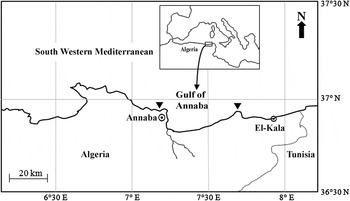
The diet of E. costae was studied monthly between March 2011 and February 2012. A total of 275 individuals whose length varies between 21.10 and 79.9 cm and weight between 103.13 and 5390.00 g were examined. The fish comes from artisanal and recreational fishing carried out in the Gulf of Annaba, between the Capes Garde (36°58′11.18″N 7°47′31.08″E) and Rosa (36°56′55.84″N 8°74°14′27″E) (Figure 1), and purchased from fish traders and fishmongers of the cities of Annaba and El Kala. Fishing gears which fishermen used are: (i) Gillnets and longline with a mesh size of 22 mm, which are removed only 7–8 h after they have been in water, (ii) Speargun with which more than 50% of individuals was sampled. These two fishing gears are complementary and allowed us to sample specimens with different sizes.
Sampling sites of the goldblotch grouper Epinephelus costae in the eastern coast of Algeria (▾).

In the laboratory, each fish was measured for standard length (SL) to the nearest millimetre and weighed to the nearest gram. Digestive tracts, taken from fresh fish, were preserved in a solution of 5% formalin. Each digestive tract was sectioned longitudinally and emptied of its contents. The number of empty guts was noted. Ingested prey were identified either by naked eye or under a dissecting microscope. They were then counted, weighed to the nearest hundredth of a gram and recorded. The determination of plant and animal prey was carried out in accordance with the criteria proposed by Derbal & Kara (Reference Derbal and Kara2007).
Statistical analyses
Quantitative analysis of the diet consists of calculating the coefficient of digestive vacuity (C v), which is the percentage of empty digestive tracts compared with the total number of digestive tracts examined. Significant changes in the digestive vacuity depending on sexual maturity, sex, size and seasons were evaluated by the χ2 test using SPSS software (version 21).
Species richness (RS) is the number of species identified in the digestive tracts of all individuals. The different prey were classified using three simple methods (numerical, gravimetric and frequency of occurrence) to calculate the index of relative importance (IRI) of Pinkas et al. (Reference Pinkas, Oliphant and Iverson1971), modified by Hacunda (Reference Hacunda1981). This blended index has the advantage of integrating in its expression the three main descriptors of the presence of a prey: the digital percentage Cni (%), weight percentage Cpi (%) and the index of relative frequency F i (%). The equation is written as follows:
 $${\rm IRI} = {F_{\rm i}}{\rm.} \left( {{\rm C}{{\rm n}_{\rm i}} + {\rm C}{{\rm p}_{\rm i}}} \right), {\rm with:}$$
 $$\eqalign{{F_{\rm i}}(\% ) & = \hbox{frequency of prey} \cr & = \displaystyle{\matrix{\hbox{Number of digestive tracts } \hfill \cr \quad \hbox{containing prey i or Ni} \hfill} \over {\hbox{Number of full digestive tracts examined}}} \times 100} $$
 $$\eqalign{{\rm Cn}_{\rm i}{\rm (\% )} & = \hbox{numerical percentage of prey} \cr & = \displaystyle{{\hbox{Number of individuals of prey i or ni}} \over {\hbox{Total number of prey}}} \times {100}} $$
 $$\eqalign{{\rm Cp}_{\rm i}{\rm (\% )} & = \hbox{weight percentage of prey} \cr & = \displaystyle{{\hbox{Total weight of prey i or pi}} \over {\hbox{Total weight of prey}}} \times {100}} $$
To better appreciate the taxonomic proportions ingested by this predator, these values were converted to percentages of relative index (%IRI) (Rosecchi & Nouaze, Reference Rosecchi and Nouaze1987), then the prey were ordered in descending order of their contribution to the diet.
 $${\rm \% IRI} = \left( {{\rm IRI/}\sum {{\rm IRI}}} \right){\rm. 100}$$
In this order, the percentage of relative index of the first food was added progressively until obtaining 50% or more. These items were called preferential foods. The calculation was continued until obtaining 75% or more and these items were classified as secondary foods. Other items on the list were considered accidental or accessory food.
The composition and variations in the diet of E. costae were also compared according to sexual maturity (immature and mature individuals), sex (males and females), size (small <25 cm SL, medium: 25 < SL < 50 cm, large >50 cm SL) and seasons. Sex determination and maturity stages were determined from gonadal morpho-anatomical criteria (Hastings, Reference Hastings1981; Mayer et al., Reference Mayer, Shackley and Ryland1988). First maturation size is 29 cm in the eastern coast of Algeria (Zaidi et al., unpublished data). The statistical significance of these changes was evaluated by the Spearman correlation coefficient (Fritz, Reference Fritz1974), applied over the ranks occupied by the different prey.
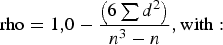 $${\rm rho} = {\rm 1,\!0} - \displaystyle{{\left( {{\rm 6}\sum {{d^{\rm 2}}}} \right)} \over {{n^{\rm 3}} - n}}, {\rm with:}$$
n, number of ingested items, d, difference between ranks.
The prey were ranked in descending order of index to obtain two matched series. The number rank must be the same in both samples, so that if one of the categories of taxa does not appear in any of the samples, it's still assigned a rank. If the percentage of relative importance index is identical within the taxonomic series, we assign each item to a common rank, which will be the average of the ranks that prey would have been if there was no tie. Statistical significance is known through the distribution of Student's t at n−2 degrees of freedom (Dagnelie, Reference Dagnelie1975):
 $$t = \left[ {\displaystyle{{\rm \rho} \over {{{\left( {{\rm 1} - {{\rm \rho} ^{\rm 2}}} \right)}^{{\rm 1/2}\;}}{\rm.}}}} \right]{\rm.} {\left( {n - {\rm 2}} \right)^{{\rm 1/2}}}$$
RESULTS
Qualitative and quantitative composition
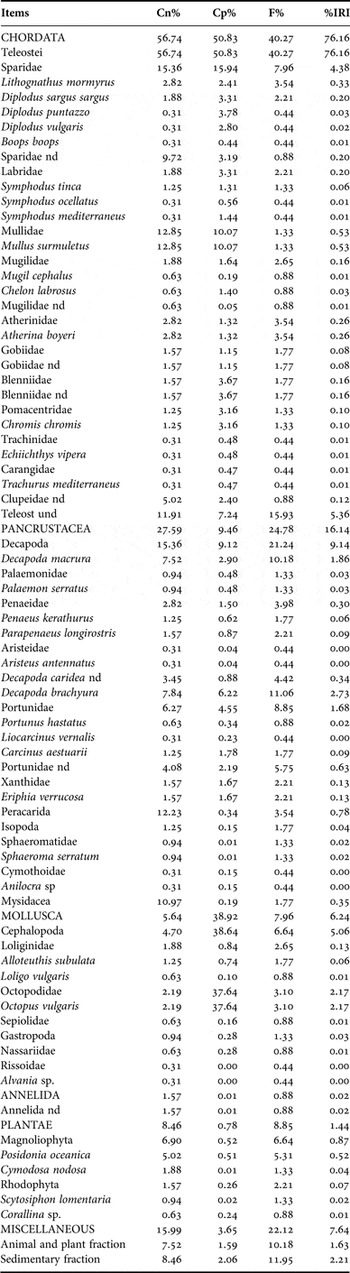
Out of 275 digestive tracts examined, 49 were empty, which corresponds to an average annual digestive vacuity of 17.82%. Table 1 reports the overall results of the qualitative and quantitative analysis of prey ingested by E. costae on the eastern coast of Algeria. We identified a total of 319 prey for an overall weight of 934.85 g, which correspond to an average number and weight of prey of 1.40 and 4.14 g respectively by full digestive tract. In total, 33 species (29 animals and four plants) were identified in the digestive tracts of animals (Table 1).
Qualitative and quantitative composition of the diet of the goldblotch grouper Epinephelus costae of the eastern coast of Algeria.

N = 275. F i%, prey frequency; Cni%, prey numeric percentage; Cpi%, prey weighting percentage; IRI, importance relative index; %IRI, percentage of relative importance index.
This predator feeds mainly on teleosts (%IRI = 76.16), including Sparidae (%IRI = 4.38). The other fish families (Labridae, Mullidae, Mugilidae, Atherinidae, Gobiidae, Blennidae, Pomacentridae, Trachinidae, Carangidae, Clupeidae) are consumed in negligible quantities (%IRI < 0.53). However, a significant proportion of fish consumed are represented by indeterminate teleosts (%IRI = 5.36). Pancrustacean (decapod and peracarid crustaceans) come in second rank (%IRI = 16.14) well before molluscs (%IRI = 6.24). These two taxa are also considered secondary prey. Accessories and accidental food are represented by plants (%IRI = 1.44) and annelids (%IRI = 0.02) respectively.
Ontogenetic diet changes
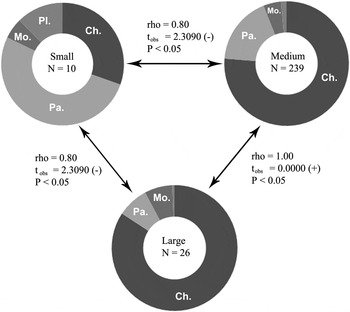
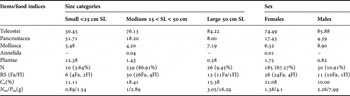
Digestive vacuity varies between 11.11 for small individuals and 18.41 for those of medium size. The variations in this ratio as function of size are presented in Table 2. No significant difference was observed in the digestive vacuity according to fish's size (χ2 = 2.24; P ≥ 0.05). Specific diversity of prey is richness in individuals of medium size (RS = 30) than in small (RS = 6) and large goldblotch (RS = 12). However, the average number (N m) and weight (W m) of ingested preys increases proportionally with the size of the predator (small: N m = 0.89, W m = 1.54 g; medium: N m = 1, W m = 2.89 g; large: N m = 3, W m = 16.29 g). Small specimens focus mainly on pancrustaceans (%IRI = 51.71) then teleosts (%IRI = 30.43), plants (%IRI = 12.38) and molluscs (%IRI = 5.48). Large and medium-sized individuals eat primarily teleosts (%IRI = 84.22 and 71.13, respectively) then pancrustaceans (%IRI = 8.00 and 18.20, respectively) and molluscs (%IRI = 7.19 and 4.21, respectively). Annelids (%IRI = 0.04) and macrophytes (%IRI = 1.43) are probably accidentally consumed by individuals of medium size. Macrophytes are also probably accidentally consumed by small and large size classes (%IRI = 12.38 and 0.58, respectively) (Table 2). Statistical comparison of the diet based on the three categories of size show that it is heterogeneous for the two pairings: small/medium and small/large, which implies that the diet of small fish is different from those of medium and large sized fish (Figure 2).
Statistical comparison of the diet of the goldblotch grouper Epinephelus costae of the eastern coast of Algeria according to size. ρ: Spearman correlation coefficient (+: homogeneous diet, −: heterogeneous diet; Ch.: Chordata, Pa.: Pancrustacea, Mo.: Mollusca, Pl.: Plantae). Colour proportions present the IRI% shown in Table 2.

Variations in percentage of index of relative importance of the main items ingested by goldblotch grouper Epinephelus costae off the eastern coast of Algeria, according to the size and the sex.

n = 275. RS, specific richness (Fa, faunistic; Fl, floristic;) C v(%), vacuity coefficient; N m/W m, mean number and weight of prey.
Sexual diet changes
The variations in the digestive vacuity as a function of sex are presented in Table 2. Digestive vacuity is higher in females than in males. No significant difference was observed according to sexes (χ2 = 2.02; P ≥ 0.05). If the food spectrum of females is more diverse (RS = 28) than males (RS = 11), the latter however ingest almost twice as large prey (N m♂ = 2.26 – W m♂ = 7.99 g) than females (N m♀ = 1.38 – W m♀ = 4.10 g). Whatever the considered sex, teleosts (%IRI♂ = 85.88, %IRI♀ = 74.49), pancrustaceans (%IRI♂ = 4.39, %IRI♀ = 17.43) and molluscs are always the main prey (%IRI♂ = 8.9, %IRI♀ = 6.32). Plants are probably incidentally consumed by both females (%IRI = 1.75) and males (%IRI = 0.82) (Table 2). The Spearman correlation coefficient confirms the homogeneity of the diet between the two sexes (rho = 0.9; t obs = 3.5762; P > 0.05).
Sexual maturity diet changes
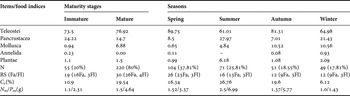
The variations in the digestive vacuity as a function of maturity are presented in Table 3. No significant difference was observed according to maturity. Immature individuals have a less diverse food intake (RS = 19) than mature (RS = 30), and they consume smaller prey (N m = 1.10 – W m = 2.31 g) than mature individuals (N m = 1.50 – W m = 4.64 g). Feeding of immature and mature individuals is composed mainly of teleosts (%IRI = 73.50 and 76.92, respectively) and pancrustaceans (%IRI = 24.22 and 14.70, respectively). Molluscs are probably consumed incidentally for both immature (%IRI = 0.94) and mature (%IRI = 6.88) (Table 3). The significant coefficient of rank correlation confirms the homogeneity of the diet between immature and mature individuals (rho = 0.9; t obs = 3.5762; P > 0.05).
Variations in percentage of index of relative importance of the main items ingested by the goldblotch grouper Epinephelus costae of the eastern coast of Algeria, according to the maturity stages and the seasons.

n = 275. RS, specific richness (Fa, faunistic; Fl, floristic); C v(%), vacuity coefficient; N m/W m, Nm mean number and weight of prey.
Seasonal diet changes
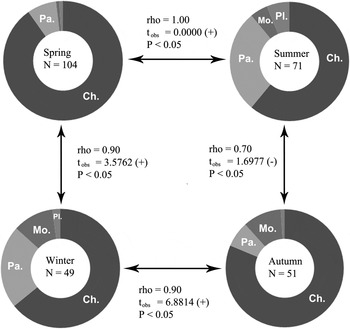
The variations in the digestive vacuity as a function of seasons are presented in Table 3. Seasonal variations show higher vacuity in summer (C v = 26.76%) and lowest in winter (C v = 6.12%). No significant difference was observed according to seasons (χ2 S/S = 0.127; χ2 S/A = 0.396; χ2 A/W = 0.072; χ2 W/S = 0.121; P ≥ 0.05). During spring, E. costae still diversify their diet (RS = 26) and ingest an average number and weight of 1.52 and 3.37 g respectively. In summer, they target fewer species (RS = 16) but consume larger and heavier prey (N m = 2.5 – W m = 6.99 g). This feeding habit continues until autumn (RS = 12, N m = 1.37, W m = 5.77 g), but the weight of prey becomes lighter in winter (RS = 12, N m = 1.0 – W m = 1.43 g) (Table 3). Seasonal comparison of Spearman correlation coefficients on prey rank shows heterogeneity between summer and autumn (rho = 0.7; t obs = 1.6977; P < 0.05) (Figure 3).
Statistical comparison of the diet of the goldblotch grouper Epinephelus costae of the eastern coast of Algeria with seasons. ρ: Spearman correlation coefficient (+: homogeneous diet; −: heterogeneous diet; Ch.: Chordata, Pa.: Pancrustacea, Mo.: Mollusca, Pl.: Plantae). Colour proportions present the IRI% shown in Table 3.

DISCUSSION
Sampled during the day using gillnets, longlines and speargun, specimens analysed in our study have a global digestive vacuity of 17.82%. This value is slightly lower than that found by Derbal & Kara (Reference Derbal and Kara2004) in the same study area, but on a total of 74 specimens measuring between 19 and 90 cm (C v = 21.60%). On the Spanish coast, Gracia López & Castelló-Orvay (Reference Gracia López and Castelló-Orvay2005) found a stomach vacuity of 12.50%, which is not the case on the Senegalese coast where Diatta et al. (Reference Diatta, Bouain, Clotilde-Ba and Capape2003) recorded a mean value of 73.60%. However, these vacuities should be considered with caution due to the small number of analysed individuals (24 and 38 individuals, respectively). Fluctuations in the digestive vacuity depend on many factors. Gracia López & Castelló-Orvay (Reference Gracia López and Castelló-Orvay2005) using the speargun found low vacuity in E. marginatus and E. costae, whereas with a longline and trawl, Brulé & Rodriguez-Canche (Reference Brulé and Rodriguez-Canche1993) and Diatta et al. (Reference Diatta, Bouain, Clotilde-Ba and Capape2003) recorded higher values (>50%) in E. marginatus, E. costae, E. aeneus and Mycteroperca rubra. Also, fish regurgitation during capture with line-like fishing gear can affect the vacuity values (Kouassi et al., Reference Kouassi, N'da and Diaha2010). Diel variation in feeding activity is another factor who can explain these differences (Abel, Reference Abel1962; Neil, Reference Neill1967). Weak digestive vacuities confirm the strong intensity of predation of E. costae. Thus, they seem to reliably reflect the availability of prey in the study area. According to Quiniou (Reference Quiniou1978), the low values of vacuity are a feature of voracious predators generally hunting on the lookout.
In E. costae from Annaba's Gulf, vacuity is minimal in winter (C v = 6.12%), reflecting its voracity in cold periods. The increase in the vacuity from spring seems to coincide with the breeding of this species, which runs from June to September in the Gulf of Annaba (Zaidi et al., unpublished data). Increased volume of gonads during the breeding season could compress the gut, thus reducing the ability of fish to ingest prey. According to Chauvet (Reference Chauvet, Boudouresque, Avon and Gravez1991), the dusky grouper E. marginatus feeds throughout the year with a maximum feeding activity in autumn.
Along with the majority of Epinephelus genus from the Mediterranean, E. costae is a carnivorous fish (Stergiou & Karpouzi, Reference Stergiou and Karpouzi2002). The Sparidae Lithognathus mormyrus, Diplodus sargus sargus, D. puntazzo, D. vulgaris, Boops boops and Mullidae Mullus surmuletus, which are the most common habitants of coastal demersal ecosystems in the study area (Derbal & Kara, Reference Derbal and Kara2010; Hannachi et al., Reference Hannachi, Derbal, Boubekeur and Kara2014) are the most targeted prey. The piscivory of E. costae is not limited to fish (76.16%), but also extends to invertebrates, including decapods (Natantia and Reptantia) (16.14%) and cephalopods (6.24%). In addition to teleost fish (MFI = 40.14%), Derbal & Kara (Reference Derbal and Kara2004) in the same area reported the presence of ascidians its diet (MFI = 31.27%). Some of those taxa are present in the diet of E. marginatus (Derbal & Kara, Reference Derbal and Kara1996; Barreiros & Santos, Reference Barreiros and Santos1998; Renõnes et al., Reference Reñones, Polunin and Goni2002; Linde et al., Reference Linde, Grau, Riera and Massuti-Pascual2004; Gibran, Reference Gibran2007; Machado et al., Reference Machado, Daros, Bertoncini, Hostim-Silva and Barreiros2008; Condini et al., Reference Condini, Elisa Seyboth, Vieira and Garcia2011) and E. aeneus (Kyrtatos, Reference Kyrtatos1982; Dah et al., Reference Dah, Girardin and Vall1991; Stergiou & Karpouzi, Reference Stergiou and Karpouzi2002; Kouassi et al., Reference Kouassi, N'da and Diaha2010). According to Tortonese (Reference Tortonese, Whitehead, Bauchot, Hureau, Nielsen and Tortonese1986), E. costae differ from other Epinephelus by an almost exclusive piscivory, as is the case in E. marginatus of the Portuguese coast (Barreiros & Santos, Reference Barreiros and Santos1998) and Spanish Mediterranean areas (Gracia López & Castelló-Orvay, Reference Gracia López and Castelló-Orvay2005) which feed mainly on molluscs. Also, Mycteroperca rubra from Northern Charlestone Harbor feeds mainly on crustaceans. The presence of vertebrate (Chordata) and invertebrate (Decapoda, Peracarida, Cephalopoda, Gastropoda, Annelida) prey in its alimentation, including demersal (Lythognathus, Diplodus, Symphodus) and pelagic midwater teleost (Chromis, Trachurus, Clupeidae), assumes that this predator is erratic with a large capacity of vertical and horizontal movement. Indeed, some authors found by scuba diving bell that this species could both settle on the bottom and live a few metres above the substrate (Louisy et al., Reference Machado, Daros, Bertoncini, Hostim-Silva and Barreiros2007; Derbal et al., Reference Derbal, Francour, Thibault and Kara2013). This adaptation to various aquatic habitats allows this species to acquire this benthopelagic nutritional behaviour. This predation on benthopelagic preys have already been reported in large groupers Epinephelus (>100 cm) in the Azores, where they feed from the surface down to 100 m depth (Santos et al., Reference Santos, Porteiro and Barreiros1997).
Epinephelus costae from the eastern coast of Algeria feed on 33 species, 29 animals and four plants. On the Senegalese coast, the range of food of E. costae is limited to only two zoological taxa, the teleost Sardinella aurita (during the cold period) and the crustacean Penaeus notialis (in the hot period) (Diatta et al., Reference Diatta, Bouain, Clotilde-Ba and Capape2003). In our region, Clupeidae are probably occasionally ingested by midsize individuals who focus mainly on Sparidae, including marbled L. mormyrus and common sar D. sargus sargus. However, the carcinocological preys targeted are represented mainly by macruran decapods (Palaemonidae, Peneidae, Aristeidae) and Brachyura (Portunidae). On the Spanish coast, crustaceans are practically absent in the diet of this Serranidae (Gracia López & Castelló-Orvay, Reference Gracia López and Castelló-Orvay2005). The other taxa i.e. molluscs, annelids and plants are present in the diet of this species of the present study throughout the year as accessory or accidental food. Finally, the significant proportion of ‘other’ foods (animal and plant fractions undetermined, sedimentary particles) in the digestive tract examined (%IRI = 7.5) can reach values of 10% or more, especially in the goldblotch grouper of medium size (%IRI = 11.4), female (%IRI = 10.7) and immature (%IRI = 11.7). It is due, firstly, to the advanced state of digestion despite the volumetric importance of ingested prey, and secondly, to the voracity of this predator in the capture of its benthic prey.
Unlike large goldblotch grouper, the predominance of pancrustaceans characterizes the diet of smaller individuals. These prey would be easier to capture compared with teleost fish. In general, the gradual evolution of food preferences during ontogenetic development to increasingly larger prey is a characteristic of predatory fish. Thus, it could be considered an adaptation for optimizing the balance between the energy required to capture prey and that provided by food. On the other hand, the ability to catch large prey is proportional to the opening of the oral cavity, thus proportional to the size of individuals. Therefore, the diet that would be initially generalist evolves towards specialization over time as is the case with the sea bass Dicentrarchus labrax (Ktari et al., Reference Ktari, Bouain and Quignard1978; Kara & Derbal, Reference Kara and Derbal1996), Sciaena umbra (Derbal & Kara, Reference Derbal and Kara2007) and the dusky grouper E. marginatus (Kara & Derbal, Reference Kara and Derbal1999; Linde et al., Reference Linde, Grau, Riera and Massuti-Pascual2004; Machado et al., Reference Machado, Daros, Bertoncini, Hostim-Silva and Barreiros2008). In addition, for access to small prey, we assume that the gill may not be efficient enough to retain small invertebrates. In contrast, the opening of the mouth of the small specimens does not facilitate massive grasper preys which would explain the orientation of predation of grouper of large size, to demersal and/or benthiclarger prey such as teleost fish and decapod Natantia and Reptantia. On our coasts, small goldblotch grouper, even if their number is limited (n = 10), have a heterogeneous diet unlike large goldblotch grouper and medium-sized ones, which do not seem to diversify their diet. On the other hand, the infrequent presence of plants in the stomach contents among small individuals is due to its voracity in seizing its prey from the seagrass Posidonia habitat on the subtidal floor, or residing in hard rhizomes of seagrasses. This behaviour of benthic prey on seafloors covered with vegetation is also observed in other coastal teleosts, as is the case with brown meagre S. umbra (Chakroun & Ktari Reference Chakroun and Ktari1981; Derbal & Kara, Reference Derbal and Kara2007), sea bass Dicentrarchus labrax (Kara & Derbal, Reference Kara and Derbal1996) and the dusky grouper E. marginatus (Derbal & Kara, Reference Derbal and Kara1995).
Fish is the taxa most represented in the diet of the two sexes in number and weight. Ingestion by males of larger prey (N m♂ = 2.26, W m♂ = 7.99) is due to the reproduction mode of this species (protogynous hermaphrodite). The goldblotch groupers E. costae are females first then males, which means that males are generally of greater size than females, which is why they have to consume larger prey than do females.
The comparison depending on the maturity of individuals (immature and mature) revealed a homogeneous diet. This diet is characterized by a preference for fish for both stages followed by pancrustaceans. Prey that change rank in the composition are molluscs, annelids and plants. A comparison to previous work carried out on E. costae or its congener E. marginatus cannot be made due to insufficient data.
Teleost fish are the largest prey, these have the highest presence in the stomach of the goldboltch grouper of the eastern coast of Algeria. They are much more numerous than other taxa in winter and spring, whereas they are positioned after the molluscs in the other two seasons. This dominance of fish is observed for individuals E. costae sampled by Diatta et al. (Reference Diatta, Bouain, Clotilde-Ba and Capape2003), during the cold season, whereas this species feeds almost entirely on crustaceans in the hot season. Food intake and food choice depend on the availability of different prey of different sizes in the environment.
This study has shown that E. costae is an important rocky shore predator whose diet in eastern Algeria comes mainly from benthic food sources and less from mesopelagic ones, with ontogenetic and seasonal changes in the feeding strategy. The diet of this predator in eastern Algeria is composed of fish, crustaceans and molluscs. Fish dominate the diet during the entire life cycle, except for small goldblotch which focus on pancrustaceans. Small goldblotch ingest more prey of small sizes compared with large ones which target larger prey.
These data could give us more information on food habits of E. costae and possibly on the phenomenon of trophic competition between the different populations of Epinephelus on the eastern coast of Algeria. However, these early results provide a basis of fundamental data for a species of ecological status ‘Data Deficient’ (Abdul Malak et al., Reference Abdul Malak, Livingstone, Pollard, Polidoro, Cuttelod, Bariche, Bilecenoglu, Carpenter, Collette, Francour, Goren, Kara, Massuti, Papaconstantinou and Tunesi2011). Additional information on its growth, sexuality and exploitation would be needed for better management of natural stocks of Epinephelus in the Algerian coast.