A global pandemic was declared in March, 2020 due to a novel coronavirus identified as SARS-CoV-2, which causes mild disease in children. A post-infectious inflammatory response to COVID-19 was described in children in April, 2020 and is known as multisystem inflammatory syndrome in children. Children may present with fever, gastrointestinal symptoms, rash, conjunctivitis, mucous membrane involvement, neurocognitive symptoms, respiratory symptoms, pharyngitis, myalgia, swollen extremities, and lymphadenopathy. Reference Riphagen, Gomez and Gonzalez-martinez1–Reference Feldstein, Rose and Horwitz4 Patients also have elevated acute phase reactants and inflammatory markers. Reference Riphagen, Gomez and Gonzalez-martinez1–Reference Feldstein, Rose and Horwitz4 Patients may have elevated cardiac markers, including troponin and B-natriuretic peptide as well as abnormal echocardiographic findings of myocardial dysfunction, coronary artery abnormalities, pericardial effusion, myocarditis, and mitral valve regurgitation. Reference Henderson, Canna and Friedman2–Reference Belhadjer, Méot and Bajolle6 Rarely arrhythmias have been reported, but have included premature atrial and ventricular beats, QTc prolongation, ST/T wave abnormalities, non-sustained ventricular tachycardia, and first/second-degree atrioventricular block. Reference Henderson, Canna and Friedman2,Reference Deza Leon, Redzepi and McGrath5,Reference Whittaker, Bamford and Kenny7–Reference Belhadjer, Méot and Bajolle9 The finding of a left axis idioventricular relative bradycardic rhythm in the setting of severe hypotension has not been previously reported. We present a patient with profound hypotension and an inappropriate heart rate response, with a left bundle idioventricular bradycardia in the setting of multisystem inflammatory syndrome in children.
Case report
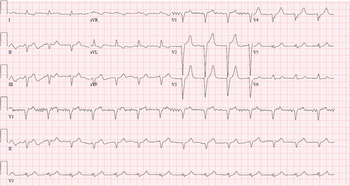
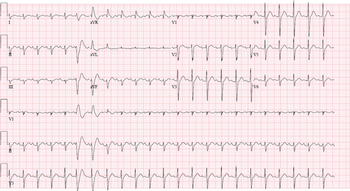
A 13-year-old Hispanic male presented to the emergency department with several days of fevers, listlessness, abdominal pain, vomiting, diarrhoea, headache, and rash. He was hypothermic (36.2°C) and hypotensive (63/34 mmHg) in uncompensated shock with a heart rate of 92 beats per minute. His initial electrocardiogram (Fig 1) showed an idioventricular rhythm with left axis deviation and with no discernible P waves. He denied any illicit drug use to explain his bradycardia and the toxicology report was negative. His initial troponin was 0.65 ng/ml (normal: <0.05 ng/ml) and B-natriuretic peptide was 1154 pg/ml (normal: 0–100 pg/ml), thus suggestive of a myocardial inflammatory process. He was resuscitated with intravenous fluids and started on an epinephrine infusion. Despite a fever (39.4°C), hypotension, and an epinephrine drip for several hours, he remained in an idioventricular escape rhythm between 92 and 110 bpm. Occasional P waves occurred while on telemetry with an appropriate shortening of the RR interval. His initial transthoracic echocardiogram on epinephrine showed a structurally normal heart, mildly dilated aortic valve annulus and root, normal proximal coronary arteries diameter, left ventricular ejection fraction of 57%, and a small posterior pericardial effusion. He had a negative COVID-19 PCR, negative COVID-19 IgM antibody, and positive COVID-19 IgG and IgA antibodies. He received treatment of 2 g/kg of intravenous immunoglobulin for a presumed multisystem inflammatory syndrome. A follow-up transthoracic echocardiogram 12 hours later while still on epinephrine showed a stable left ventricular ejection fraction of 64%, mild dilation of the aortic root, trivial posterior pericardial effusion, and no coronary artery dilation. An electrocardiogram on hospital day 2 showed sinus tachycardia with fusion beats (Fig 2) though still with left axis deviation. Cardiac markers were measured daily due to his myocardial involvement, which improved following immunoglobulin administration (Table 1). Additionally, the patient’s sinus rate eventually increased and overcame the relatively slower idioventricular rhythm. Furthermore, his blood pressure stablized, epinephrine was discontinued, and his fever curve normalized. His transthoracic echocardiogram at discharge showed no coronary artery dilation, mildly dilated left ventricle with left ventricular ejection fraction of 53%, and persistent dilated aortic valve annulus and aortic root. The electrocardiogram on the day of discharge revealed sinus rhythm and a normal QRS axis. A follow-up electrocardiogram in the cardiology clinic 4 weeks after hospital discharge revealed sinus rhythm. Interestingly, the patient had a 24-hour cardiac Holter monitor completed at this time that showed a normal sinus rhythm with a heart rate range of 52–179 bpm, but with an ectopic wandering atrial pacemaker. Laboratory studies affirmed a normalised B-natriuretic peptide and troponin I, and the patient had no ongoing cardiovascular symptoms. Unfortunately, the patient was lost to cardiology follow-up at 6 weeks post-discharge and a repeat electrocardiogram and Holter monitor was not performed. The patient remained on low-dose aspirin post-hospitalisation.
Initial ECG obtained in the emergency department showing left axis deviation with a rate of 87 bpm. Notable for accelerated idioventricular rhythm.

ECG obtained on hospital day 2 showing sinus rhythm with left axis deviation with a rate of 137 bpm with premature ventricular contractions having a right bundle branch morphology suggestive of a left ventricular origin.

BNP and troponin I trend. IVIG given on hospital day 2. Discharged on hospital day 5

Discussion
We report the first case of idioventricular cardiac rhythm while in uncompensated shock with multisystem inflammatory syndrome in children. Patients presenting with marked hypotension typically have sinus tachycardia in order to preserve cardiac output. The initial default to an idioventricular rhythm in the clinical setting of fever and hypotension while on an epinephrine is atypical. Commonly, in paediatric shock cases, the sinus rate is increased so as to preserve cardiac output. However, in the MIS-C case presented, the idioventricular escape rhythm was the dominant rhythm with resultant loss of AV synchrony. While idioventricular rhythm with extreme left axis deviation is the most likely diagnosis, junctional rhythm with aberrancy cannot absolutely be excluded. In patients with clinical myocarditis and either an idioventricular or junctional escape rhythm, it is important to also entertain the possibility of complete AV block. In this particular case, the presence of an occasional conducted P waves seen on telemetry with an appropriate shortening of the RR interval ruled out complete AV block.
The suppression of the sinus node and the finding of an idioventricular rhythm with profound hypotension suggests that the inflammatory process seen in MIS-C can transiently affect the sinus node region leading to a paradoxical heart rate response. The absence of an appropriate sinus response with an atrial rate over 100 bpm suggests some inflammatory effect on the sinus node or on the autonomic input into the sinus node. A cardiac MRI was not obtained, though may have been helpful to assess for myocardial oedema and scaring. Clinical discussions were entertained at the time of admission regarding placement of a temporary transvenous atrial pacemaker so as to provide AV synchrony, and this is an important adjunct in the care of a child with myocarditis. However, the improvement in the patient’s blood pressure on epinephrine, absence of a metabolic acidosis, acceptable end-organ perfusion, and return to sinus rhythm the following day negated the need for a temporary pacing catheter.
When caring for patients with MIS-C, the potential inflammatory effect on the sinus node and loss of AV synchrony should be carefully followed. Loss of AV synchrony, either with a junctional/idioventricular response or complete AV block, should be managed with temporary pacing if there is any concern about end-organ perfusion, acidosis, or hypotension not responsive to standard intravenous therapies. Interestingly, in the patient discussed, the inflammatory process was rather quickly dampened following immunoglobulin administration and resolution of symptomatology occurred. As clinicians caring for patients with shock, tachycardia is the typical response during hypotension. Sinus node injury in the midst of an acute hypotensive COVID-19-induced multisystem inflammatory syndrome in children presentation has not been previously reported. Clinicians caring for children with MIS-C should be mindful of possible abnormalities in sinus node function that are disparate from the typical tachycardia response seen in paediatric shock.
Acknowledgements
None.
Financial support
This research received no specific grant from any funding agency, commercial or not-for-profit sectors.
Conflicts of interest
None.
Ethical standards
None.