Some species can be found in many different habitats due to their capacity to exploit broad niches (Futuyma & Moreno Reference FUTUYMA and MORENO1988). Among them, certain species show particular adaptations to human-modified landscapes (e.g. tolerance towards humans, high productivity), are often associated with urban environments, and can have broad distribution ranges (Møller Reference MØLLER2009). At the same time, specialization to any one environment may limit a species’ ability to exploit multiple environments and have a wide range (Futuyma & Moreno Reference FUTUYMA and MORENO1988).
Animal species that live in tropical and subtropical regions have specific morphological, life-history and behavioural traits that may be different from species living in temperate regions. For example, tropical birds are highly territorial, are longer lived and have lower reproductive investment per breeding attempt than temperate bird species (Stutchbury & Morton Reference STUTCHBURY and MORTON2001). Species present in both temperate and tropical areas, and in multiple habitat types, may be particularly suitable to study the adaptations or plasticity required to inhabit a wide range of environments.
We studied the breeding ecology of an urban population of the barn swallow Hirundo rustica gutturalis in Southern China, which, although south of the Tropic of Cancer, is humid and cool towards the end of the non-breeding season (November–March), and is considered ‘subtropical’ in the Köppen climate classification. The barn swallow is a suitable species with which to perform comparative studies given its broad distribution across the whole northern hemisphere (Dor et al. Reference DOR, SAFRAN, SHELDON, WINKLER and LOVETTE2010). Barn swallow breeding performance is strongly affected by seasonal variation of meteorological factors (Ambrosini et al. Reference AMBROSINI, FERRARI, MARTINELLI, ROMANO and SAINO2006, Arai et al. Reference ARAI, HASEGAWA, NAKAMURA and WAKAMATSU2015, Hasegawa et al. Reference HASEGAWA, ARAI, WATANABE and NAKAMURA2010). The barn swallow is only present in certain human-modified open habitats and displays a particular (or specialized) feeding behaviour. Therefore, we hypothesized that birds in Southern China would have a similar breeding ecology to their conspecifics in temperate regions. Moreover, the barn swallow is a migratory species meaning that individuals can fly long distances after the breeding season when local conditions may not be suitable for survival. We assessed whether one of the southernmost breeding populations of barn swallows showed specific adaptations or not to this urban tropical environment.
We conducted our study in Nanning (Guangxi Zhuang Autonomous Region, South China, 22º49′N, 108º19′E), from April to July of 2015. The barn swallow in Southern China belongs to H. r. gutturalis (Dor et al. Reference DOR, SAFRAN, SHELDON, WINKLER and LOVETTE2010), which is the only subspecies present in Asia and ranges over almost the whole continent. We searched within the Guangxi University Campus from early April to the end of June for nests under the eaves of buildings, which is the typical nest location in our area.
When we found a nest, it was assigned a number and subsequently checked every 3–4 d to ascertain the laying date, clutch size, hatching date, clutch size and breeding success (number of fledgings/clutch size after its arcsine-square root transformation). We also recorded whether the nest belonged to a colony, defined as multiple nests within 3–5 m, or bred alone. We found 18 nests, 13 forming two separate colonies (of six and seven nests each) and five solitary nests. We carried out observations of parental feeding behaviour (defined as when parents gave food to the nestlings, and not including the parents feeding themselves) using binoculars, in good weather conditions, with the observers stationed 5–10 m from the nest. As a proxy of parental effort, we recorded the number of feeding events in a period of 10 min when the nestlings were 16–20 d of age. We considered this time period sufficient because of the frequent feeding visits to the nest (mean of 0.46 ± 0.23 visits per min), and started the period after seeing parents complete two feeding visits. We carried out these observations between 15h00 and 16h00 (China Standard Time), the time of the day with the lowest human activity. Parents fed their nestlings at a constant rate at this time of the day. We determined each parent's sex when it returned to the nest by using their tail length, as there is no strong overlap between the sexes (Svensson Reference SVENSSON1992).
After carrying out these observations, we then caught and measured the nestlings. Between 4 May and 4 July, we caught 58 nestlings at the nest when they were 16–20 d of age. To minimize the chances of premature fledging, we immediately covered the nestling with a cloth bag (so they remained quiet and could not fledge), and after measurement released the nestlings so that they were facing the building wall. We measured their wing length and body mass as indicators of offspring quality (Ayala et al. Reference AYALA, MARTINELLI and SAINO2006). These nests were first, second and third broods. That is, although we did not identify the parents, we recorded up to three consecutive successful breeding attempts in the same nest (such third broods were observed in three different nests).
Our main objective was to test whether the date determined parental investment strategies and offspring body condition, after controlling for related factors. We used a general linear modelling (GLM) approach to assess the major determinants of parental feeding rates and of offspring body mass. We used feeding rates as our dependent variable. We used the number of nestlings, the date (measured as the number of days from 1 May), nestling age, body mass (g) and wing length (mm) as continuous predictors. We included whether the pair bred alone or in a colony as a categorical factor. We conducted a similar analysis using offspring body mass as dependent variable and including feeding rates as a continuous predictor.
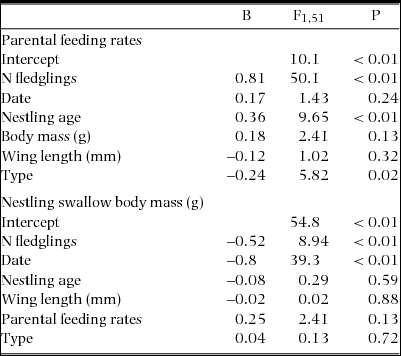
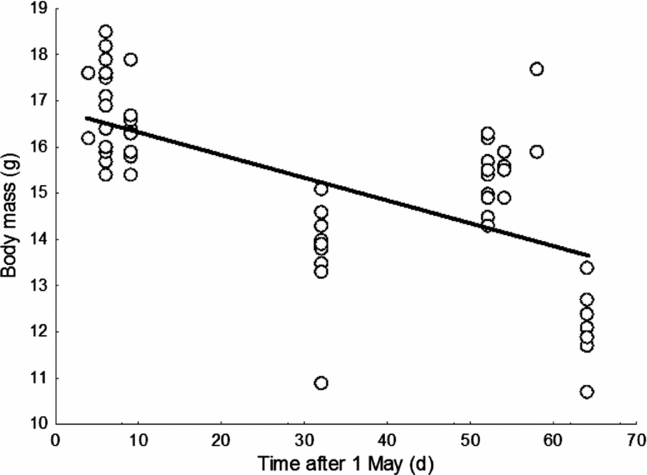
Results of our GLM showed that parental feeding rates was positively related with the number of nestlings and increased with nestling age (Table 1). Parents breeding alone showed lower feeding rates than parents breeding in colonies. There was no significant relationship between parental feeding rate and nestling body mass, nestling wing length or breeding date. However, offspring body mass decreased with the number of nestlings in the nest and with the date (Figure 1). There was also no significant relationship between nestling body condition and nestling age, wing length or parental feeding rate. Breeding in colonies or alone did not influence nestling body condition. Breeding success correlated negatively with the date (r = −0.42, P < 0.01).
General linear model using parental feeding rates of the barn swallow Hirundo rustica gutturalis (measured in Nanning, Guangxi, China) as the dependent variable, and the number of fledglings, the date (measured as the number of days from 1 May), nestling age (d), nestling body mass (g) and nestling wing length (mm) as continuous predictors. As a categorical predictor factor we used the type of nest (colonial or non-colonial). A second model placed nestling swallow body mass (g) as the dependent variable, and included parental feeding rates as a continuous predictor.

Relationships between body mass (g) of barn swallow Hirundo rustica gutturalis nestlings at 16–20 d old and the date of capture (measured as the number of days from 1 May) (N = 58). The line represents a linear correlation (r = −0.62, P < 0.01).
In this study we found that barn swallows breeding in a tropical and urban environment showed similar breeding dates and brood sizes to barn swallows from temperate areas of the China (Du Reference DU1958, Tian et al. Reference TIAN, ZHOU, YI and HU2005, Wang Reference WANG1959, Wang & Zhao Reference WANG and ZHAO2010, Yu et al. Reference YU, ZHANG and LIU2007, Zhang et al. Reference ZHANG, GAO and ZHANG1988, Zhao Reference ZHAO1982, Zhou & Li Reference ZHOU and LI1959). We recorded a strong influence of the time of breeding on nestlings' body mass, while parental feeding behaviour and maternal nest defence showed a certain degree of autonomy with respect to this pattern of seasonality. Although we did not measure food abundance at our study site, tropical areas are thought to have higher levels of food abundance compared with temperate regions (Stutchbury & Morton Reference STUTCHBURY and MORTON2001). However, we found that brood size negatively influenced offspring body condition at our study site, which is similar to what is found in temperate environments. This suggests that barn swallows breeding in tropical environments suffer similar constraints from limited food availability as do barn swallows breeding in temperate regions (Ambrosini et al. Reference AMBROSINI, FERRARI, MARTINELLI, ROMANO and SAINO2006, Arai et al. Reference ARAI, HASEGAWA, NAKAMURA and WAKAMATSU2015, Hasegawa et al. Reference HASEGAWA, ARAI, WATANABE and NAKAMURA2010), although it is possible that random variations in weather conditions contributed to this pattern.
Nestlings in our area appeared to have lower body masses and longer wings than nestlings from temperate regions, although we must acknowledge this conclusion is based on small sample sizes (body mass comparisons to Tian et al. Reference TIAN, ZHOU, YI and HU2005, Wang Reference WANG1959, Yu et al. Reference YU, ZHANG and LIU2007; wing comparison to Tian et al. Reference TIAN, ZHOU, YI and HU2005). These lower weight nestlings could have been a factor allowing three sets of swallow parents to have three broods, more than the two broods than have been reported in other parts of China (Du Reference DU1958, Tian et al. Reference TIAN, ZHOU, YI and HU2005, Wang Reference WANG1959, Wang & Zhao Reference WANG and ZHAO2010, Yu et al. Reference YU, ZHANG and LIU2007, Zhang et al. Reference ZHANG, GAO and ZHANG1988, Zhao Reference ZHAO1982, Zhou & Li Reference ZHOU and LI1959). This result also could be related to differences in temperature and to the different migratory strategies among populations (Ashton Reference ASHTON2002, Hahn et al. Reference HAHN, KORNER-NIEVERGELT, EMMENEGGER, AMRHEIN, CSÖRG, GURSOY, ILIEVA, KVEREK, PÉREZ-TRIS, PIRRELLO, ZEHTINDJIEV and SALEWSKI2015, Rodríguez et al. Reference RODRÍGUEZ, OLALLA-TÁRRAGA and HAWKINS2008; unfortunately, the location where our population migrates during the non-breeding season is unknown). Barn swallows from southern populations might need to invest less energy in feather production, or could need less energy if they have shorter migrations, than northern populations. Latitudinal variation in ambient temperature and food availability may also have contributed to this pattern, and further research is clearly needed.
The subspecies H. r. gutturalis has a broad distribution area that is restricted to Asia, and covers all of China. The barn swallow is highly appreciated by the Chinese people, who often provide nesting sites and do not disturb breeding pairs of this species. China indeed provides excellent opportunities to perform studies of continental-wide ecological gradients (urban-rural, coastal-inland, tropical-temperate-cold and lowland-mountain). This study emphasizes the need for further studies on the ecology of common urban species across the whole of China and Asia. Several species such as the barn swallow, or the tree sparrow Parus montanus, could serve this purpose. Such studies would enable comparisons across several environmental gradients or habitats to investigate whether these species, which show broad distributions, have developed local adaptations (or show environmentally induced plasticity) to this great variety of environments.
ACKNOWLEDGEMENTS
We are very grateful to Guangxi University for allowing us to work in the University Campus, and to Craig A. Barnett and two anonymous reviewers for reviewing a previous version of the manuscript. This study was funded by the 1000 Plan Recruitment Program of Global Experts from the People's Republic of China and The Special Talent Recruitment Program of Guangxi University (GXU) to EG, and the Postdoctoral Research Fund of GXU to EPN.