INTRODUCTION
The date palm is one of the oldest known fruit crops. It is subtropical in origin and cultivation. It may have originated in Mesopotamia (southern Iraq), where it has been cultivated for at least 5000 years. The subsequent spread of the date palm east through Iran to India and Pakistan, and west across North Africa to Spain, and its current distribution (dates were introduced from Spain to California in the 17th or 18th century) are well documented (e.g. Chao and Krueger, Reference Chao and Krueger2007; Pareek, Reference Pareek, Bose and Mitra1990). The date palm not only provided a concentrated energy food, which could be easily stored and carried on long journeys across the deserts, it also provided shade and protection from desert winds (Barreveld, Reference Barreveld1993). Date palm is a crop best suited to hot, arid regions. It does not grow well in the wet tropics where rain prevents pollination and the palms are completely sterile (Purseglove, Reference Purseglove1972). An old saying describes the date palm as ‘growing with its feet in the water and its head in the fire’, conditions found in the wadis and oases of West Asia where it is believed to have originated.
Dates are now widely grown in the arid regions between latitudes 15°N and 35°N and from Morocco in the west to India in the east. In 2010, according to the Statistics Division of Food and Agriculture Organization of the United Nations (FAOSTAT, 2012), the leading five countries in terms of production were Egypt (1.35 million t from 420,000 ha), Saudi Arabia (1.08 million t from 172,000 ha), Iran (1.02 million t from 156,000 ha), United Arab Emirates (0.83 million t from 197,000 ha) and Pakistan (0.76 million t from 72,000 ha). Before the 2003–2011 conflict, Iraq produced a similar quantity of dates to each of these three leading countries. In 2010, the total planted area in the world was 1,195,000 ha producing 7.9 million t of fruit. Of this, West Asia and North Africa together produced nearly three-quarters (74%) of the world total. It should be noted that many of these production and land area figures are ‘estimates’.
Not only do dates provide food and nutrition for people and animals, the palms themselves are the source of materials for building and thatching roofs and for household utensils. Dates also play an integral role in the daily cultural and religious life of people. In Iran, for example, growing dates bestows authority on farmers, while dates are used by almost all Muslims to break their fasting during the holy month of Ramadan. Date palm cultivation is a labour intensive industry that makes a valuable contribution to improving and sustaining livelihoods in poor rural areas. Processing and packing facilities also create jobs, particularly for women. In Egypt, for example, the date industry supports the livelihoods of over one million people (FAO, 2008). When considered as a fresh fruit, the date ranks number five in the production list of tropical and subtropical crops after citrus, mango, banana and pineapple and, as a dried fruit, it is first (Barreveld, Reference Barreveld1993).
In 2007, in order to find out more about what is happening to the date palm industry across the West Asia and North Africa region, FAO (2008) commissioned country studies in Algeria, Egypt, Iran, Libya, Morocco, Oman, Saudi Arabia, Tunisia, United Arab Emirates, and Yemen. All these countries are largely arid (with some winter rainfall), and the date palm is therefore dependent on irrigation or a shallow water table for survival. Most dates (>90%) in the region are grown for local consumption and are extremely important as a subsistence crop. The overall trend has been a gradual move from mixed and random oasis date palm cultivation to a more intensive plantation system of production (Barreveld, Reference Barreveld1993). In Saudi Arabia, where there is price support for low grade varieties and subsidies for the most important production variables such as fertilizers, farmers still find it difficult to make an investment decision on new plantings or replanting existing orchards because of the long-term nature of the financial returns (Alshuaibi, Reference Alshuaibi2011).
Countries in the West Asia and North Africa region suffer from severe water shortages with some 16 countries below the internationally accepted ‘water poverty limit’ of 500 m3 year−1 person−1. This compares with a global average of 7000 m3 year−1 person−1. These countries have rising populations demanding more water per capita and rely heavily on irrigated agriculture, which in many cases absorbs more than 80% of the available water resources for economic growth, employment and food security (FAO, 2008).
Despite water being a scarce resource in all the main producing countries, the water relations and irrigation requirements of such an important crop have been the focus of only a limited amount of research. This paper attempts to collate the information that has been reported (in diverse sources) and to interpret the results of this research, and related experience, in practically useful ways. It follows the format used in previous reviews in this series (Carr, Reference Carr2012), including two other palms, coconut (Carr, Reference Carr2011a) and oil palm (Carr, Reference Carr2011b). The paper begins by describing the stages of crop development (including that of roots) in relation to water availability, followed by reviews of plant water relations, water requirements and water productivity, salinity and irrigation systems. The issues identified as important in the FAO (2008) study are also summarised at appropriate places in the text.
CROP DEVELOPMENT
There are thousands of named date palm cultivars but exact numbers are not known, since we still depend mainly on tree morphology and fruit characters to distinguish between them. Using a molecular marker system, Elshibli (Reference Elshibli2010) has studied the phenotypic and genetic diversity in date palm, principally in Sudan. Although there was a significant differentiation between groups of cultivars from Sudan and Morocco, the major feature was a complete lack of clustering, and the absence of cultivars representing specific clones. Date palm populations such as these have evolved with the aid of man over the millennia. In a review of biodiversity in date palm, Jaradat (Reference Jaradat2011) highlighted the importance of conserving the genetic diversity that exists in date palm both within and between the isolated oasis agro-ecosystems. Scientific breeding programmes, such as the one in Morocco (El Hadrami et al., Reference El Hadrami, Daayf, El Hadrami, Jain, Al-Khayri and Johnson2011), will hasten the process of plant improvement, while the role of biotechnology in the further development of date palm has been described in a recent book by Jain et al. (Reference Jain, Al-Khayri and Johnson2011).
Some cultivars have become predominant in the world market. These include Deglet Noor from the Algerian Sahara, Medjool believed to be from Morocco, Barhee from Iraq, Halawy also from Iraq, Hayany from Egypt and Khadrawy and Zahidi, both from Iraq (Chao and Krueger, Reference Chao and Krueger2007).
Vegetative
As Tomlinson (Reference Tomlinson2006) highlights, palms as a family are unique, possessing distinctive features of leaf development, vascular structure and anatomical properties of the stem. There is no cambium layer. The single stem develops entirely from cells derived from the apical meristem. Its structure means that it is not only a conductor of water to the leaves but also, because of its volume, acts as an important water store, or capacitor.
The date palm is propagated from seed, offshoots, the most common method, or, more recently, by tissue culture. Population densities vary from 100 palms ha−1 (10 × 10 m) to 400 palms ha−1 (5 × 5 m), while intercropping of date palm with fruits, vegetables and pasture is common in traditional areas of date production.
During the palm's juvenile phase, offshoots develop from axillary buds at the base of the trunk. After three to five years, the suckers grow their own roots and can then be removed and planted. The trunk, with a terminal crown of 100–120 leaves, grows up to 20–30 m in height. From 10 to 30 new leaves, each originating from the apical meristem, are produced each year. Each leaf has a variable life span of up to seven years, depending on conditions. At the base of each leaf there is an axillary bud. In mature trees, most of those just below the growing point develop during the winter as flower buds. Under cultivation, dead or old leaves are removed, leaving the leaf bases attached to the trunk. (Barreveld, Reference Barreveld1993; Chao and Krueger, Reference Chao and Krueger2007; Purseglove Reference Purseglove1972; Zaid and de Wet, Reference Zaid, de Wet and Zaid2002a).
The early work on the responses of date palm to water stress, conducted in the Coachella Valley, California, was reviewed by Hilgeman and Reuther (Reference Hilgeman, Reuther, Hagan, Haise and Edminster1967). In summary, Aldrich (Reference Aldrich1942) and Reuther and Crawford (Reference Reuther and Crawford1945) showed that, using the rate of elongation of the central unexpanded spear leaf as an index, a shortage of soil water in the summer limited leaf extension within four weeks after an irrigation (loam soil; cv. Deglet Noor). This corresponded to about a 50% depletion of the available water in the ‘major’ root zone. It was also shown that reducing spear leaf extension rates by 15–20% through withholding irrigation also reduced fruit size by 10–15%, reduced the water content of the fruit and induced earlier ripening (Aldrich et al., Reference Aldrich, Crawford, Nixon and Reuther1942; Furr et al., Reference Furr, Currlin, Hilgeman and Reuther1951; Reuther and Crawford, Reference Reuther and Crawford1945). Although it is not possible to specify absolute values of leaf extension, relative values were considered to be a good index of water availability.
Flowering
The date palm is dioecious, meaning that it has separate male and female trees. A much branched inflorescence, which is a cluster of 8000–10,000 individual flowers, develops in the axil of a leaf that developed in the previous year. The inflorescence is enclosed in a deciduous hard fibrous cover (a spathe). In commerce, the palm is pollinated artificially, with pollen taken from male trees (Chao and Krueger, Reference Chao and Krueger2007).
Fruiting
The date fruit is a berry, with a single seed. The fruits are borne in clusters known as bunches. Female palms start to produce flowers and fruit within three to four years from planting. Natural fruit drop occurs 25–35 days after the cracking of the spathe and the emergence of the inflorescence. Fruit thinning is sometimes practised in order, for example, to decrease alternate bearing (heavy fruiting in one year followed by sparse fruiting in the next), to increase fruit size, to improve quality, and to advance ripening (e.g. Al-Saikhan, Reference Al-Saikhan2008). The date fruit goes through four distinct ripening phases. These are known by their Arabic names: Kimri (immature green), Khalal (mature soft coloured), Rutab (soft brown) and Tamar (hard raison-like). From pollination to maturity takes 150–200 days. In the principal producing countries, the harvest lasts from mid-August until the end of October. Fruits harvested before they are fully ripe are known as soft dates, or, if they are allowed to dry out, as hard or dry dates. Rainfall (early) during the final stages of fruit maturation can cause direct physical damage or result in secondary adverse effects, including insect and fungal infections (Barreveld, Reference Barreveld1993). Restricting irrigation during fruit stalk development reduced the incidence of premature drying and dropping of fruit bunches (cv. Medjool) experienced in Israel (Cohen et al., Reference Cohen, Freeman, Zveibil, Zvi, Nakache, Biton and Soroker2010)
The climatic requirements of date palm have been partly reviewed and summarised by Zaid and de Wet (Reference Zaid, de Wet and Zaid2002b). For the production of good quality fruit, the palm requires high temperatures (an average of 30 °C for proper ripening (although it can survive extreme temperatures from <–6 °C to >50 °C), low humidity, ample sunshine (whatever that may mean) and adequate supplies of underground water or irrigation (Purseglove, Reference Purseglove1972). According to Pareek (Reference Pareek, Bose and Mitra1990), the ideal mean air temperature during flowering and ripening of the fruit is 25–29 °C, depending on cultivar. For successful fruit maturation 3000 d °C are required (in this case summed above a base temperature of 10 °C counted from flowering). Citing other sources, Barreveld (Reference Barreveld1993) gave a figure of 1800–1900 d °C (this time above a base temperature for the flowering process of 18 °C, which is considered to be more realistic than 10 °C) from pollination to harvest.
The sensitivity of date palm to the soil type was recorded by Reuther (Reference Reuther1944) in Coachella Valley, California. Palms growing in deep sandy soils (2.7–4.8 m) responded, in terms of tree vigour, fruit yield and quality, to the application of additional frequent applications of water compared with those growing in a soil with a deep (0.9–1.8 m) silt subsoil layer.
A fully productive tree can support at least 30 bunches. In round figures, an average yield of about 40 kg tree−1 is equivalent to eight bunches of 250 dates with each fruit weighing 25 g. Yields of more than 100 kg palm−1 are possible. Full commercial yields are reached within 10 years after planting. The average economic life of a tree is 50–60 years (Chao and Krueger, Reference Chao and Krueger2007; Erskine et al., Reference Erskine, Moustafa, Osman, Lashine, Nejatian, Badawi and Ragy2005; Zaid and de Wet, Reference Zaid, de Wet and Zaid2002a, Reference Zaid, de Wet and Zaidb).
Roots
Offshoots that develop at the base of the stem have a relatively high survival rate when transplanted to the field, once they have a well-developed root system. Aerial offshoots that arise higher up the main stem lack such a root system and their survival rate is lower. They are usually discarded, but can be encouraged to root by wrapping the base of the offshoot in a polyethylene bag containing wet wood shavings, while still attached to the tree. No periodic watering is needed. Cultivars differ in the capacity of their aerial offshoots to form roots (Al-Obeed, Reference Al-Obeed2005).
In California (and Arizona), where there is a demand for date palms in the lucrative landscape market, successful establishment of (valuable) offshoots is important. In a detailed study of root development, Hodel and Pittenger (Reference Hodel and Pittenger2003) found considerable variability between offshoots in establishment, which was explained by differences in root generation. Offshoots possessing more roots (>28) when removed from the mother plant had a greater capacity to regenerate a root system and to establish successfully than those with fewer roots (<24). This was in part because two-thirds of all new roots grew from the existing cut roots (those damaged in the process of excision from the mother palm). Also important was the size and shape of the root initiation zone on the offshoot. Leaf extension was found to be a good indicator of root growth.
In the field, the date palm has a fibrous root system, with a mass of mainly horizontal roots in the surface 0.25 m. These roots have numerous and large air spaces, which may be why date palm tolerates flooding. Other roots extend vertically to depths of at least 2 m (Barreveld, Reference Barreveld1993), sometimes even down to 10 m.
Root extension rates of four species of palm, but not including Phoenix dactylifera L., were recorded in a rhizotron in southern Florida by Broschat (Reference Broschat1998). Roots grew continuously over the two years of observation, but less fast during the winter months. There was no evidence of alternating flushes of shoot and root growth in any of the species.
The sensitivity of the roots of the date palm to soil compaction was highlighted by Abdul-Baki and Aslan (Reference Abdul-Baki and Aslan2004). The average number of fibrous roots per mature tree was reduced from 4000 to 1100 to 520 as the degree of compaction increased. Compacted soils make date palms even more susceptible to damage by the strong winds experienced in Coachella Valley, California.
Summary: crop development
1. The single stem develops from cells derived from the apical meristem.
2. The date palm is usually propagated from offshoots that grow from axillary buds at the base of the trunk (of juvenile trees). After three to five years of attachment, these offshoots develop their own roots.
3. There is a terminal crown of 100–120 leaves; 10–30 new leaves are produced each year. Relative leaf extension is a good indicator of the degree of water stress.
4. At the base of each leaf there is an axillary bud. In the winter, in mature trees most of those just below the growing point develop as flower buds. The date palm is dioecious.
5. Inflorescences develop on female trees in the axils of leaves that developed in the previous year. Each inflorescence can contain 8000–10,000 individual flowers. In commerce, the palm is pollinated artificially.
6. Palms start to produce fruit three to four years after planting. There are four recognised ripening phases. A productive tree can support at least 30 bunches, yielding >100-kg fresh fruit per tree. From pollination to maturity takes 150–200 days.
7. The date palm has a fibrous root system, dense in the surface 0.25 m. Roots can extend vertically to soil depths of >2 m. Root growth is sensitive to soil compaction.
PLANT WATER RELATIONS
Stomata occur on both leaf surfaces in approximately equal numbers, 182 mm−2 on the upper surface and 166 mm−2 on the lower surface (cv. Haiani) in parallel rows (Hussein et al., Reference Hussein, Mohsen, Meligi and Rizk2007). There are no hairs on the leaf.
Very little research on the water relations and gaseous exchange of the date palm has been reported. In Saudi Arabia, Al-Whaibi (Reference Al-Whaibi1988) monitored diurnal changes in CO2 assimilation and stomatal conductance of two cultivars (Sikkeri and Osaila), while Al-Khateeb et al. (Reference Al-Khateeb, Al-Khateeb and Ali-Dinar2003), in a comparison of five cultivars (Kheneeizi, Khalas, Shahel, Shisho and Helali), assessed seasonal differences in photosynthesis and transpiration on leaves of different ages. In both examples there were indications of differences between cultivars in instantaneous water use efficiencies. More recently, the effects of water stress on photosynthesis in five, one-year old, half-sibs date palm cultivars have been explored by Elshibli (Reference Elshibli2009) in Finland. Operating under conditions of controlled leaf temperature (25 °C) and light intensity (1000 μmol m−2 s−1), the ratio of the intercellular CO2 concentration to the ambient CO2 level was found to be higher than that expected for a C3 plant species, being closer to that of a C4 species. Soft and dry (hard) phenotypes (based on differences in fruit characteristics) varied in their responses to water stress. For example, soft phenotypes had higher stomatal conductances than dry phenotypes at all levels of water stress. Soft phenotypes could fix more CO2 under dry conditions than dry ones. A variety of morphological responses to water stress were also observed. These included accelerated leaf senescence, fewer leaflets (pinnae) and reductions in plant height.
In Israel, Cohen et al. (Reference Cohen, Alchanatis, Prigojin, Levi, Soroker and Cohen2012) developed a methodology to estimate the water status of individual palm trees within a commercial orchard from aerial thermal images. The system was evaluated by comparing the canopy temperatures of well-irrigated palms with those of similar trees irrigated with only 20% of that amount of water (deficit irrigation) at three sites in the northern Dead Sea region during two months in the winters of 2007 and 2008. Since palm trees have large canopies with virtually no exposed soil beneath them, minimum mutual shading of leaves and no overlapping of the crowns of neighbouring trees, it was possible to monitor the relative water status of individual trees. This was achieved even though the temperature differences between the two irrigation treatments at all three sites were only 1 °C. Differences in the elongation rate of the spear leaf (youngest, visible, still folded leaf, spiky in appearance) were not observed until about eight weeks after differential watering regimes were imposed. Since the yields from both treatments were similar, water savings in the winter months may be possible. An automated system of thermal imaging would allow blockages in a drip irrigation system to be identified, and could also be developed for irrigation scheduling.
Summary: plant water relations
1. Only a limited amount of research has been reported on the water relations, and gas exchange processes, of date palm.
2. Stomata occur on both leaf surfaces in approximately equal numbers.
3. Interesting observations that require confirmation include
(i) the photosynthetic process of date palm may be closer to a C4 pathway than a C3 one,
(ii) soft and dry date palm phenotypes may differ in their responses to water stress and
(iii) thermal imaging could perhaps be developed to determine the relative water status of individual palm trees.
CROP WATER REQUIREMENTS
The early work in the United States on the water requirements of the date palm was reviewed by Hilgeman and Reuther (Reference Hilgeman, Reuther, Hagan, Haise and Edminster1967). Based on gravimetric soil sampling at Indio, California, Furr and Armstrong (Reference Furr and Armstrong1956) estimated the annual water use of palms (cv. Khadrawy) to be 1300–1600 mm, with monthly totals ranging from 60 mm in January (winter) to 190 mm in July (summer). Water was extracted from depths beyond 2 m. After allowing for direct evaporation from the soil surface, transpiration by weeds, irrigation inefficiencies and leaching requirements, the total annual depth of water required was estimated to be a massive 2700–3000 mm (Abdul-Baki and Aslan, Reference Abdul-Baki and Aslan2004).
Since this early work in the United States, several attempts have been made to measure the actual water use (ET) of palms in West Asia and North Africa, using different techniques with mixed success. Too often the research outputs are of (limited) local value only, such as those reported by Saeed et al. (Reference Saeed, Etewy, Duheash and Aly-Hassan1986). Measuring the water use of a tree is not an easy task, but it can be done. For example, Kassem (Reference Kassem2007) successfully monitored the water use of date palm over a season on a commercial farm in Saudi Arabia (Burida City: 26°18′N 43°58′E; alt 720 m). Using both the Bowen ratio energy balance method and a soil water balance approach, he calculated the actual annual water use of drip-irrigated 15-year-old palms (cv. Sukariah) to be 1780 and 1640 mm respectively. Daily ET rates (averaged over a minimum of 20 d) varied between about 2.4 mm d−1 in February (at pollination) and about 7.6 mm d−1 in July (at the Khalal – mature soft fruit stage). The corresponding crop coefficients (Kc = ETc/Eto) were 0.63 (February) and 0.70 (Khalal). USWB Class A evaporation rates peaked at 14.1 mm d−1 in July.
This research was followed up by a comprehensive analysis of the water use of date palm at seven representative sites in Saudi Arabia (Al-Amoud et al., Reference Al-Amoud, Mohammad, Saad and Alabdulkader2012). At each site, which extended from Najran in the south (17°28′N 44°06′E; alt. 1264 m) to Qseem in the north (26°20′N 43°59′E; alt. 179 m), the actual water use by a reference crop (alfalfa), ETr, was measured over a three-year period (2005–2007) with drainage lysimeters (measuring 2 × 2 × 1.5 m deep). These data were compared with estimates of reference crop evapotranspiration (ETo) calculated with the FAO version of the Penman-Monteith equation (Allen et al., Reference Allen, Pereira, Raes and Smith1998), using data collected by automatic weather stations at each site. At the same time, the actual water use of (drip)-irrigated palms (ETc) was measured using the water balance method. The results were averaged over the three years. The measured (ETr) and calculated (ETo) reference crop evapotranspiration followed the same monthly trend during the year, but ETo estimates were consistently less than ETr (by about 20%). Daily ETr values across the seven sites ranged from 1.7 mm d−1 (in January) to 11.7 mm d−1 (in mid-summer), while the annual totals fell within the range 2254 mm (at Makkah) and 3024 mm (at Wadi Addwaser). By comparison, the corresponding totals for the actual water use of date palm were 2136 mm and 2829 mm. After allowing for the partial wetting of the root zone using drip irrigation (ca. 30%), these numbers equate to 600 mm and 800 mm respectively or, for a density of 100 plants ha−1, 60 m3 tree−1 and 80 m3 tree−1 (Ahmed Al-Amoud, personal communication February Reference Al-Amoud, Mohammad, Saad and Alabdulkader2012). These values are low compared with flood irrigation, and assume that drip-irrigated palms use less water than flood-irrigated plants (see below). Across the seven sites, Kc, when based on ETr, averaged over the year between 0.89 and 0.93. Within a year, the monthly range of values was from 0.81 to 0.99, with a grand mean of 0.91. However, if Kc is based on the Penman-Monteith estimate of ETo, rather than ETr, it has a grand mean value of 1.18. This is very different from the corresponding Kc values reported by Kassem (Reference Kassem2007), and described above of 0.63 and 0.70, and also exceeds the value suggested by Allen et al. (Reference Allen, Pereira, Raes and Smith1998) of 0.90–0.95.
Al-Amoud et al. (Reference Al-Amoud, Mohammad, Saad and Alabdulkader2012) also illustrated, with examples, the impact of two (assumed) irrigation application efficiency values (70% for basins, 90% for drip), and leaching requirements for four different salt contents of the irrigation water (0.5, 1.0, 2.0 and 3.0 dS m−1) on the gross irrigation water requirements at each of the seven sites in Saudi Arabia.
Using a simple water balance approach, actual evapotranspiration (ET) rates by 11-year-old palms (cv. Medjool) were monitored by Mazahrih et al. (Reference Mazahrih, Al-Zu'bi, Ghnaim, Lababdeh, Ghananeem and Ahmadeh2012) in Jordan (32°00′N 35°18′E; alt. –224 m) over 12 months (2011). A neutron probe was used to monitor changes in soil (clay) water content to depths of 2.5 m. Rainfall over the year totalled 245 mm. Estimates of ETo were obtained from the Penman-Monteith equation. ETo peaked at about 8.8 mm d−1 in July (January = 2.7 mm d−1), with an annual ETo total of 1900 mm. By comparison, the measured annual ET totals by palms subjected to four drip-irrigated water regimes (50, 75, 100 and 125% × ETc replacement) were 1300, 1600, 1800 and 2000 mm. Seasonal totals of water applied were 27, 40, 53 and 67 m3 tree−1 (156 trees ha−1). Monthly values for Kc for the 100% ETc replacement treatment ranged from about 0.75 in the winter, 1.0 in the spring and 1.10 in the summer. Average annual Kc values for each treatment were 0.68, 0.84, 0.95 and 1.05 respectively. Soil salinity levels increased in the two deficit irrigation treatments.
Oases
In southern Tunisia, many traditional date palm plantations surround oases. At one of these (Tozeur: 33°55′N 8°6′E; alt. 87 m), Sellami and Sifaoui (Reference Sellami and Sifaoui2003) successfully used the sap flow method to monitor transpiration rate (T), on a diurnal basis, of two date palms and two intercropped, under-storey apricot trees. In October, the daily transpiration totals averaged 1.91 mm d−1 for date palm (≡ 240 L d−1 tree−1, at a density of 80 trees ha−1) and 1.20 mm d−1 for apricot (≡ 75 L d−1 tree −1, at 160 trees ha−1), with a combined total of 3.11 mm d−1. These values represented 32, 21 and 53% of the incoming solar radiation being used for transpiration, and 53, 33 and 88% of the net radiation respectively. Prior to this research, Ringersma et al. (Reference Ringersma, Mechergui, Pijnenburg, Camp, Sadler and Yoder1996) had shown that measuring sap flow (using the Granier method) successfully demonstrated the diurnal sap flow pattern of date palms in southern Tunisia, and gave a reasonable indication of absolute transpiration rates.
The Granier method was subsequently used by Ben Aïssa et al. (Reference Ben Aïssa, Bouarfa, Perrier, Hartani, Douaoui and Kuper2009) to measure sap flow in four individual date palms at Fatnassa oasis in Tunisia (33°8′N 8°7′E). Transpiration rates averaged about 0.5 mm d−1 in the winter (daytime temperature range 9–19 °C) and 3.5 mm d−1 in the summer (24–42 °C), with an annual average of about 2 mm d−1. In the winter, the diurnal variation in T matched the changes in ambient temperature, but in the summer T began to decline when temperatures exceeded about 32 °C, suggesting some form of stomatal control of transpiration rates. The annual transpiration total of about 730 mm was only 40% of the potential ETc total of 1800 mm for the location. These relatively low rates of water use were supported by measurements made in piezometer tubes of changes in the depth of the water table over periods of a month between irrigations.
The eddy correlation and energy budget methods were used to make continuous measurements for over a year of ET from a heterogeneous canopy of an oasis ecosystem in the central Syrian desert (Palmyra: 34°32′N 38°16′E; alt. 375 m). The whole oasis covered an area of about 1000 ha and the main cultivated crops were olive trees (250,000), date palms (70,000), pomegranate trees (80,000) and other fruit trees (25,000). The tree density was 170 ha−1, and bare soil, which was always unshaded, covered 60% of the land area. Measurements were made in an area with a fetch of about 1 km in all directions. On a monthly basis, actual ET ranged between 0.5 mm d−1 in the winter and 3.5 mm d−1 in mid-summer (annual ETo = 1700 mm). On a daily basis, actual ET never exceeded 5 mm d−1. There was a time lag of three days between an irrigation event (flood, applied at intervals of 28 days) and an increase in transpiration by the vegetation (possibly due to a delay in full stomatal opening). By contrast, the winter rainfall (average 120 mm a−1) had an immediate effect on evapotranspiration. Interestingly, ET (hourly averages) increased with increase in wind speed of up to 3 m s−1 and then decreased as wind speed increased to 6.5 m s−1 due, it was clamed, to wind-induced stomatal closure (Brunel et al., Reference Brunel, Ihab, Droubi and Samaan2006).
Regional estimates
According to the FAO (2008) report, most countries assess the date palm water requirements using some form of theoretical calculation, such as the Penman equation, or the USWB Class A evaporation pan data. Some make assumptions about the efficiency of the irrigation method to arrive at gross water requirements. This is because very few actual data are available from field or lysimeter measurements. The data available on irrigation water requirements vary considerably from one country to another and even within a country, principally as a result of the differences in climate. There is also the risk that the figures being compared are not in fact directly comparable. Algeria, for example, reports that the annual water demand for mature trees varies from 1300 mm in Batna, an important date growing area in the north of the Sahara, to 3100 mm in Adrar in the arid south. The corresponding average water requirements are 300 L d−1 palm−1 in Batna and 700 L d−1 palm−1 in Adrar, assuming a typical planting density of 120 palms ha−1, with peak values in July 50% greater than these. For comparison in the same FAO (2008) report, it is estimated that, within the region represented in the survey, there are in excess of 120 million date palms using 19,500 million m3 of water annually (equivalent to one-third of Egypt's annual share of the Nile water). This equates to 445 L tree−1 day−1.
Egypt also reports considerable variation in water demand across the country. Dates grown in Lower Egypt use an average of about 1000 mm a year whereas in Upper Egypt average consumption rises to 1500 mm a year. Current estimates of water use of palms in Morocco (planted at 100 palms ha−1) are 1300–1400 mm a year. In Saudi Arabia, estimates of irrigation water requirements (gross) range from 1800 mm a year for drip-irrigated palms to 4300 mm a year for surface irrigation. This difference is based in part on the (sometimes false) assumption that palms irrigated by drip systems use less water than those irrigated by surface methods.
In Saudi Arabia, Alazba (Reference Alazba2004) used the Penman-Monteith model to estimate ETc of date palm at seven sites. Using a fixed Kc value of 0.85, he found that the annual ETc totals varied between sites from 1500 to 2000 mm. If the irrigation efficiency is assumed to be 40% and an additional 10% is allowed for leaching, the maximum irrigation water requirement is 5500 mm. If instead, the efficiency is 90% and no allowance is made for leaching, the corresponding irrigation water requirement is 2200 mm.
Liebenberg and Zaid (Reference Liebenberg, Zaid and Zaid2002) provide worked examples of how to estimate the irrigation water requirements of date palm. The annual ETc totals listed include 2400 mm for Tozeur, Tunisia, and 2200–2400 mm for Naute, Namibia, with peak daily rates of about 10 mm d−1.
Intercrops
Intercropping date palm in either a two-tier system (with a fruit tree crop) or a three-tier system (with fruit trees and an annual crop) is a common, traditional agricultural practice. It adds a complication to assessing crop water requirements. Indigenous knowledge associated with this diversity and its management is critical in sustaining the viability of the oasis (Jaradat, Reference Jaradat2011). This includes managing water in a sustainable way.
In the FAO manual on crop evapotranspiration, Allen et al. (Reference Allen, Pereira, Raes and Smith1998) provide examples of specific situations that are particularly relevant to date palms. For example, they show how to compute the water requirements of a date palm/citrus tree intercrop, where the canopy of one crop (palm) is well above the other (citrus) so that the canopies cannot be seen as contiguous. They also consider the case of the so-called ‘clothes-line’ effect (where small areas of vegetation, e.g. palms, are substantially taller than the surroundings), and the ‘oasis’ effect (where vegetation has access to more water than the surroundings). In both cases, ETc can be substantially greater (100% or more) than that for a reference (grass) crop, as a result of advection (the lateral transfer of sensible heat from the surroundings). The magnitude of this effect depends in part on the width of the vegetation in relation to the wind direction, with Kc values of up to 2.5 close to the leading edge.
Summary: crop water requirements
1. Several attempts to determine the water requirements of date palm have been reported, both for conventional irrigated conditions and for situations where there is a high water table, as found close to oases. In addition, regional estimates have been calculated.
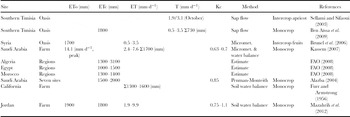
2. A range of techniques (each with different assumptions) has been used, making direct comparisons difficult (Table 1).
3. Water can be extracted from soil depths >2 m.
4. Across West Asia and North Africa calculated/estimated annual ETc totals are (mainly) in the range 1000–2000 mm.
5. In southern Tunisia, T varied from 0.5 (winter) to 3.5 (summer) mm d−1. In the winter, the diurnal variation in T matched the changes in ambient temperature, but in summer, T declined when temperatures exceeded about 32 °C, suggesting some form of stomatal control of transpiration rates.
6. In Syria, ET on a monthly basis ranged from 0.5 (winter) to 3.5 (summer) mm d−1; on a daily basis, ET did not exceed 5 mm d−1. In Saudi Arabia, the corresponding values were about 2–3 mm d−1 and 8–11 mm d−1, depending on location. In Jordan, ET rates were 1.9–2.3 mm d−1 in the winter and 7.6–9.9 mm d−1 in the summer.
7. Experimentally determined values of Kc in Saudi Arabia were inconsistent. In one experiment, Kc = 0.6–0.7, but in a series of experiments Kc averaged 1.18. But when Kc was based on a measured reference crop value for ETo, as opposed to a calculated value, Kc = 0.9. In Jordan, Kc varied with the season: 0.75 in the winter, 1.0 in the spring and 1.10 in the summer.
8. The so-called ‘clothes-line’ effect and the ‘oasis’ effect mean that in some situations Kc can be substantially greater than 1.0 as a result of advection.
9. Interesting observations that require confirmation include the following:
(i) There is a time lag of three days between an irrigation event and an increase in transpiration, but the winter rainfall has an immediate effect.
(ii) At wind speeds >3 m s−1, there is an indication that wind-induced stomatal closure restricts transpiration.
Comparisons of crop water use estimates for date palm (see text for details).

WATER PRODUCTIVITY
In order to evaluate the benefits to be derived from irrigation, some measure of the water productivity is needed. Only two experiments have been reported where an attempt has been made to quantify the benefits in this way. In Aswan, Egypt, the responses of 24-year-old Sakotti palms to four irrigation regimes were compared over two years (1968 and 1969) by Hussein and Hussein (Reference Hussein and Hussein1982). The watering treatments were described as six applications of 180 mm every eight weeks (annual total = 1100 mm); 12 applications of 180 mm at monthly intervals (total 2200 mm); 24 applications of 180 mm at two-week intervals (total 4400 mm); plus a no-irrigation control treatment (no mention is made of any water inputs from flood water or a water table or of the evapotranspiration rates). Averaged over both years, yields of fresh fruit increased from 55 kg tree−1 (control), through 71, 83 and 90 kg tree−1 as the quantity of water applied increased. The total soluble solids and moisture contents of the fruit were also increased with irrigation, but fruit maturity was delayed by up to 15 days. The advice was to apply 12 × 70 mm irrigations a year at four-week intervals. It is not clear on what basis this conclusion was reached. This experiment has limited generic value.
In central Saudi Arabia, Al-Amoud et al. (Reference Al-Amoud, Bacha and Al-Darby2000) compared three levels of water application (50, 100, and 150% times evaporation from a USWB Class A pan) applied at two-week interval or, in the spring and summer months, one-week interval. Three irrigation methods (trickle, bubbler and basin) were also compared within the same experiment (see below), which continued for four years (1991–1994). The soil was a sandy loam. In round figures, the total annual average depths of water applied were 1000, 2000 and 3000 mm to each of the three watering treatments. The average yield across all nine-treatment combinations over the four years was 173 kg tree−1. Trees irrigated with trickle out-yielded those irrigated by the other two methods in some years but not all (overall by about 20%). Yield responses to the three water treatments were inconsistent. The resultant irrigation water productivity values varied between 0.55 kg m−3 (at 150% Epan) and 1.40 kg m−3 (at 50% Epan) (FAO, 2008).
According to the same FAO (2008) report, the highest date palm water productivity is in Egypt with values from 1.3 to 3.3 kg m−3 of water applied. This is significantly greater than all the other countries for reasons, in part, given earlier (soft dates with a water content of 40–50%). By contrast, the range of values for hard date-producing countries in the region is only 0.18–0.37 kg m−3. Expressed in another way, this means between 3 m3 and 5 m3 (or 3 to 5 t) of water is needed to produce 1 kg of fresh fruit!
In Jordan, water productivities over one year declined from 1.25 to 0.64 kg m−3 as the amount of irrigation water applied increased (50, 75, 100 and 125% ETc). The corresponding yields of fresh fruit were 34, 36, 38 and 43 kg tree−1 (Mazahrih et al., Reference Mazahrih, Al-Zu'bi, Ghnaim, Lababdeh, Ghananeem and Ahmadeh2012).
In Saudi Arabia, a typical yield from a commercial farm is 90-kg fresh fruit tree−1, while the annual gross amount of water applied (drip irrigation) rarely exceeds 120 m3 tree−1, and can be as little as 70 m3 tree−1. These represent water productivities of 0.75 and 1.3 kg m−3 (Ahmed Al-Amoud, personal communication February Reference Al-Amoud, Mohammad, Saad and Alabdulkader2012). These are similar to the values obtained in Jordan.
Citing others, Barreveld (Reference Barreveld1993) presented indicative figures for the irrigation requirements and water productivity of date palm in the following practical and instructive way. For example, when water is applied continuously over a year at a rate of 0.5 L palm−1 minute−1, this equates to 250 m3 palm−1 year−1. If one ox (or a man) can lift water from 20-m depth at a rate of 2 m3 h−1, this represents 125-h work per year per tree. For a crop yielding 100 kg tree−1, this equates to about 1.25 h of human effort lifting water to produce 1 kg of fruit (or 2.5 t of water to produce 1 kg of fruit).
Summary: water productivity
1. There is very little published experimental evidence on the water productivity of date palm.
2. A target benchmark figure for hard dates is probably of the order 1.3 kg fresh fruit m−3 irrigation water applied.
SALINITY
Following a review of the literature, Maas and Hoffman (Reference Maas and Hoffman1977) classified the date palm as being ‘salt-tolerant’. They specified the threshold electrical conductivity of the saturated soil extract (ECe), above which fruit yield was reduced, as 4.0 dS m−1. The rate of fruit yield decline if this value was exceeded was estimated to be 3.6% (dS m−1)−1. These two values were based on the results of experiments conducted in California and reported in the 1960s by Furr and Armstrong (Reference Furr and Armstrong1962), Furr and Ream (Reference Furr and Ream1968) and Furr et al. (Reference Furr, Ream and Ballard1966). They are both relative values, dependent on the cultural conditions under which the crop is grown. Despite the limited information base, the same values were later repeated by Maas (Reference Maas, Baligar, Duncan and Yohe1993) in an updated list, and are the ones always cited in papers on salinity (e.g. Ayers and Westcot, Reference Ayers and Westcot1985; Rhoades and Loveday, Reference Rhoades, Loveday, Stewart and Nielsen1990). Based on these two criteria, date palm is classified as the most salt-tolerant fruit crop, and possibly the second most salt-tolerant of all the major crop plants (after barley).
This view has however recently been challenged by the results of a detailed, long-term, lysimeter-based research programme in the Southern Arava region of Israel (29°53′N 53°03′E) reported by Tripler et al. (Reference Tripler, Ben-Gal and Shani2007, Reference Tripler, Shani, Mualem and Ben-Gal2011, Reference Tripler, Shani, Ben-Gal and Mualem2012). This is an arid area (mean annual rainfall of only 25 mm), with summer temperatures reaching 40 °C and the relative humidity of as low as 15%. Over a period of seven years from 1999, the effects of elevated salinity levels in the soil solution on water use, growth and fruit yield of date palms (cv. Medjool), growing in 20 large (initially 1 m3, later increased to 2.5 m3, and then to 10 m3), high-resolution weighing, drainage lysimeters, were monitored. Irrigation water with electrical conductivity (ECi) of 1.8, 4.0, 8.0 and 12 dS m−1 was applied daily. Salinity reduced ETc at all levels, as represented by a series of sigmoid curves. The extent of this reduction increased over time such that, in the final three years of the experiment, ET at the highest salinity level (12 dS m−1) was only about 10% of the maximum for non-stressed trees (ECi = 1.8 dS m−1). Water uptake by the roots was restricted by reduction in osmotic potential due to the presence of salts in the soil water, not to ion toxicity. All aspects of vegetative growth were reduced by salinity, including the rate of production of new leaves, which, in the final years of the experiment, declined from 40 to 20 year−1, and the extension rate of the newest leaves (from 40 to 12 mm d−1). Together these responses to salinity resulted in a reduction in the size of the leaf canopy (Tripler et al., Reference Tripler, Ben-Gal and Shani2007, Reference Tripler, Shani, Mualem and Ben-Gal2011).
Fruit production was also affected. Trees in the low salinity treatments began to produce fruit in 2005, whereas those exposed to high salinity levels did not bear fruit until 2007. Fruit maturity was also delayed by about two weeks. Plotting fruit yield over the final two years against the electrical conductivity of the irrigation water, when responses had stabilised, showed the soil salinity level that reduced yields by 50% to be about 4.7 dS m−1. By comparison, the corresponding value for the data presented by Maas (Reference Maas, Baligar, Duncan and Yohe1993) was 18 dS m−1. The date palm, on the basis of this information, is more sensitive to salinity than previously thought (Tripler et al., Reference Tripler, Shani, Mualem and Ben-Gal2011). An annual crop yield model to predict drainage water salinity levels and leaching fractions has been successfully calibrated and validated (Tripler et al., Reference Tripler, Shani, Ben-Gal and Mualem2012).
In some areas of Saudi Arabia date palms are grown in soils where the ECe reaches 20 dS m−1. The electrical conductivity of the irrigation water in the main aquifers in Saudi Arabia is 2–5 dS m−1 (FAO, 2008). Similarly, salinity is an issue in the irrigated cropped areas surrounding oases in Tunisia (Ben Aïssa et al., Reference Ben Aïssa, Bouksila, Bahri, Bouarfa, Chaumont and Hichri2004). The application of 900 mm of water over a season (April to October) contained, for example, the equivalent of 28 t ha−1 of salt. The salinity of the irrigation water varied with the depth from which the water was abstracted. The results of the study emphasised the need to improve water management by modernising the irrigation methods and by introducing effective drainage.
In the Wargla river basin in Algeria, Bouhoun et al. (Reference Bouhoun, Marlet, Brinis, Saker, Rabier and Côte2011) attempted to distinguish the separate and combined effects of waterlogging and salinity on date palm yields (cv. Deglet Noor) as recorded in 167 field plots located in five irrigation sectors. Saline irrigation water and shallow water tables both increased soil salinity. Actual yields decreased with increase in soil salinity, shallow water tables, and the presence or otherwise of a gypsum-cemented horizon within the soil profile. A significant interaction between water table depth and soil salinity suggested that the crop responded to whichever stress factor was the most severe rather than to a combination of the individual factors. The limiting factors in order of decreasing importance were shallow water table (38% of the field plots), high soil salinity (17%) and the occurrence of a gypsum-cemented horizon (2%). No limiting factors to yield were identified in the remaining field plots (43%). In some sectors, actual yields were far below potential yields, which may have been due to the adverse effect of irrigation water salinity.
In Iran, Tishehzan et al. (Reference Tishehzan, Naseri, Hassanoghli and Meskarbashi2011) used 36 drainage lysimeters to study the effects of water table depth (0.60 and 0.90 m), groundwater salinity (4, 8 and 12 dS m−1) and mulching (with and without date palm leaves) on the growth of young date palms (cv. Berhii). By restricting evaporation from the soil surface, mulching limited the accumulation of salts in the root zone, and reduced the harmful effects of a shallow, saline water table on leaf growth.
In a superficial review of the impact of salinity on date palm, Alhammadi and Kurup (Reference Alhammadi, Kurup, Sharma and Abrol2012) highlighted the need to find ways of screening the many cultivars of date palm (over 1500) for salinity tolerance at different stages of growth. Cultivars do differ in their responses to salt, particularly at the seedling stage. They advocated the use of remote sensing for detecting salinity stress in date palm orchards.
Summary: salinity
1. The date palm is considered to be relatively salt-tolerant with a threshold ECe value of 4.0 dS m−1, but recent evidence from Israel suggests that it is more sensitive than originally thought.
2. Saline irrigation water and shallow water tables both increase soil salinity.
3. The date palm responds to the most severe stress (e.g. a shallow water table) rather than to the influence of a combination of waterlogging and high soil salinity.
4. Mulching limits the accumulation of salts in the root zone, and reduces the harmful effects of a shallow, saline water table on leaf growth.
IRRIGATION SYSTEMS
Originally, the majority of the old date palm orchards (in Saudi Arabia) were irrigated from wells using surface irrigation methods, especially basins. Water was lifted from hand-dug wells, 5–15-m deep, using the swani method in which 1–4 camels or cows provided the power, via a circular wheel, to lift the water in buckets made from animal skin connected by ropes made from date palms. The water was delivered to the palms in ditches. A farm was usually irrigated once a week in the summer and every three weeks in the winter. This is one example of the various irrigation methods used throughout the West Asia and North Africa region and described in some detail in FAO's (2008) country studies.
Flood or surface irrigation is cited as still the most commonly method used, continuing a long tradition. Egypt, for example, still irrigates about 90% of its date palms with surface methods, particularly on the so-called ‘old lands’. Many palms are grown along the borders of farms in Egypt where they are managed as part of the farm cropping system. This may be true in many other countries, particularly where palms are grown in areas with shallow groundwater, such as oases. Sprinkler irrigation is not widely used, although micro-sprinklers play a growing role in some countries, particularly on sandy soils. Drip irrigation is the method that is of the most interest to governments because of its reputation for reducing the irrigation water requirement. The productivity of drip irrigation is however as much a function of how well it is managed as it is of the system itself. Most countries in the West Asia and North Africa region are now experimenting with drip irrigation, which is being supported through government subsidies (FAO, 2008).
In the Coachella Valley, California (2800 ha of palm; 123 palms ha−1) the standard method of irrigation for mature palms is basin with 120–150-mm water applied every 12–14 days during the growing season. Irrigation is reduced about two weeks before harvest. With newly planted orchards, drip irrigation is used for the first five years (Abdul-Baki and Aslan, Reference Abdul-Baki and Aslan2004).
In Saudi Arabia, Al-Amoud (Reference Al-Amoud2008) compared the performance of bubbler irrigationFootnote 1 with trickle in a large-scale farm trial (6000 trees on a farm with >200,000 trees). The bubbler system was designed to deliver water to each tree at 12 L min−1, but the uniformity of distribution of water was only 62%. By comparison, the trickle system, with a design application rate from four drippers of 0.4 L min−1, had a 97% uniformity of distribution. Improvements in the design of the bubbler system were considered possible, but, on the basis of the evidence obtained, it was concluded that a well-designed and managed drip irrigation system was suitable for irrigating large date palms in Saudi Arabia.
In Saudi Arabia, Ahmed et al. (Reference Ahmed, Hashmi and Ghumman2011) compared the performance of sub-surface trickle irrigation systems with pipes of varying wall thickness/flexibility buried at a depth of 0.4 m. With flexible pipes (thin walls, 0.41-mm thickness) leakage occurred and water was wasted. Date palms irrigated through these pipes yielded substantially less, and the water applied was less productive than when water was applied through rigid pipes (thick walls, 1.14-mm thickness) (Ahmed et al., Reference Ahmed, Hashmi, Ghumman and Sheikh2012). The considerable water saving (i.e. water not used for the purpose intended, Perry, Reference Perry2011) from sub-surface drip irrigation, compared with a conventional system, as well as a yield advantage, were confirmed by Al-Amoud (Reference Al-Amoud2010) in a long-term laboratory and field study (2001–2008) again in Saudi Arabia.
In Algeria, localized irrigation (e.g. drip, micro-sprinklers and bubbler systems) was first introduced in the 1980s and between 2000 and 2005. The area of date palms irrigated with these methods increased from 320 ha (0.3%) to 56,000 ha (38%), encouraged by government subsidies. There is a common belief among farmers that drip irrigation does not deliver enough water to the crop. Bubbler irrigation appears to be more acceptable as farmers can see the water being applied.
In oases, most of the water for crops comes from natural ground water and in some coastal areas rising tides push water into date palm plantations. In other places, such as Yemen, various systems of harvesting rainwater either from surface runoff or from underground sources are used. These traditional water resources have been developed over many years into highly sustainable ‘irrigation systems’ (FAO, 2008).
In southern Tunisia, a participatory approach was adopted by Ghazouani et al. (Reference Ghazouani, Marlet, Mekki and Vidal2009) to identify the causes of low date palm productivity on a community-managed oasis. Farmers’ perceptions, and the views of the engineers who had been involved in the implementation of irrigation system modernisation programme, were solicited on why the project had failed to achieve the expected benefits. Farmers were aware of the constraints to production due to waterlogging, and also to the adverse effects of hot irrigation water (60–70 °C; extracted from geothermal wells). Extended intervals between irrigations were cited as the main constraint but this could be resolved by the community agreeing to restrict expansion of the date palm area. Farmers failed to mention salinity and soil degradation as causal factors. It was recommended that, in order to improve the process of modernisation, farmers’ knowledge of the issues should be combined with the expertise of engineers.
This study was followed by a fascinating and detailed evaluation of irrigation performance on the same oasis (Fatnassa) by the same team (Ghazouani et al., Reference Ghazouani, Marlet, Mekki, Harrington and Vidal2012). The date and duration of an amazing 2836 irrigation events over a period of one year were recorded at the farm level on 419 plots. In addition, 163 observation wells were used to characterise the depth and salinity of the shallow groundwater over a two-month period. At the project level, irrigation intervals were twice (36–52 days) those that were expected (19–21 days). This was because farmers took twice as long (17–20 h ha−1) to irrigate a field as planned (10 h ha−1). At the field level, this was due to several factors, including small fields, poor maintenance, night irrigation and lack of farmer commitment to collective rules. The study highlighted issues such as inequity among farmers and the risk to the sustainability of irrigation as the groundwater is depleted.
Summary: irrigation systems
1. Since early times, flood irrigation has been used to irrigate date palm and, in many countries, it is still the most commonly used method.
2. In oases, most of the water for crops comes from natural ground water, and in some coastal areas rising tides push water into date palm plantations.
3. Since the 1980s, localised irrigation (e.g. drip, micro-sprinklers and bubbler systems) has been promoted by governments to date palm farmers as a means (in theory) of saving water.
4. Considerable water savings have been recorded from sub-surface drip irrigation, compared with a conventional system, as well as yield advantages.
5. In order to improve the process of irrigation modernisation, farmers’ knowledge of the issues needs to be combined with the expertise of engineers.
6. A participatory study of irrigation on a community-managed date palm project highlighted as significant issues the inequity among farmers and the risk to the sustainability of irrigation, as the groundwater is depleted.
CONCLUSIONS
In desert oases, the sustainability of date palm and the associated crops can only be ensured if the available water resources are managed well. As a result of the FAO (2008) review, a number of recommendations were made. Many of them are endorsed by this review. Because of the regional and international importance of date palm, the following issues need to continue to be addressed:
1. Factors influencing the water requirements of date palm to be determined.
2. Fundamental studies on plant water relations to enable valid comparisons to be made between sites and cultivars are required.
3. The yield response to deficit irrigation (and to low quality water) to be quantified.
4. Realistic in-depth assessments of the current levels of irrigation water use, the performance of irrigation systems and the way farmers and system managers manage irrigation to be made.
5. New technologies designed to improve water productivity exist, but which are largely unknown among date palm growers, to be promoted.
6. Existing knowledge, good practices and research results from the different countries to be collated in the form of a practical manual on the irrigation of date palm.
Water scarcity in the West Asia and North Africa region is extreme. With rainwater being limited and ground water being depleted, most of the date-producing countries are increasingly dependent on desalinisation of seawater, which is expensive. Only high-value crops suited to the harsh environment, and with high water productivities, can be justified as sustainable. The date palm, being indigenous to this region meets these criteria, but local irrigation practices are often inefficient. Adaptive research at the local level is needed to develop options to improve water productivity (after Oweis, Reference Oweis2004).
Acknowledgements
I am grateful to Professor Ahmed Al-Amoud and Melvyn Kay for their helpful comments on a draft of this paper. An anonymous referee was constructive in his/her criticisms.