





1. Introduction
This article stems from research undertaken as part of the MetaLing Corpus project (October 2023 – February 2026), dedicated to investigating the metalanguage of linguistics in Early Modern English. The goal of the project was the creation of a corpus of texts including language-related discussions from 1500 to 1700, in order to study the development of linguistic terminology and ideas, and to explore epistemic transfers across texts and genres in a period predating the establishment of philology and linguistics as academic disciplines (Andreani & Russo Reference Andreani and Russo2023). Over this period, English underwent substantial changes in its lexicon, phonology, spelling and morphosyntax. Equally significant were changing perceptions of the language itself, as attitudes towards English evolved from Ascham’s characterisation of it as dramatically inadequate: ‘In the Englysh tonge … euery thinge in a maner so meanly, bothe for the matter and handelynge, that no man can do worse’ (Ascham Reference Ascham1545), to increasingly confident assessments of its expressive potential, such as William Lisle’s in his preface to A Saxon Treatise, published in 1623: ‘our language is improued aboue all others now spoken by any nation, and became the fairest, the nimblest, the fullest … yea able to expresse any hard conceit whatsoeuer with great dexterity’ (cit. in Barber Reference Barber2005: 51). Combining corpus-driven and corpus-based methodological approaches, the article presents an exploratory analysis of the MetaLing Corpus aimed at illustrating its analytical possibilities, the types of information it can yield and its potential limitations. Focusing on spelling and discourse variation as complementary sites of linguistic standardisation, norm formation and epistemic authority, the study demonstrates how orthographic choices and discourse patterns can illuminate both the material conditions of language use and the circulation of linguistic knowledge.
2. Data selection and corpus construction
The MetaLing Corpus was developed using Alston’s Bibliography of the English language from the invention of printing to the year 1800 as a key reference work (Alston Reference Alston1974). This multi-volume bibliography encompasses a wide range of genres and language-related phenomena, remaining a foundational resource for research in English language studies and the history of linguistics. Owing to both the project’s time constraints and the limited availability of some volumes of the Bibliography, the selection of sources was intentionally restricted to a manageable set of texts, with a specific linguistic phenomenon chosen as the point of departure. The study initially focused on language variation, drawing on volume IX of Alston’s bibliography, devoted to English dialects, Scottish dialects: Cant and vulgar English. Selecting works published between 1500 and 1700, we compiled an initial list of sources that formed what we termed ‘Subcorpus A: Variation’. During this phase, volumes III and VI were also accessible, providing the basis for the creation of two further comparable subcorpora focusing respectively on miscellaneous works on the English language and on pronunciation (Andreani & Russo Reference Andreani and Russo2026).
A detailed spreadsheet was compiled to record metadata and document the various stages of the work. The information recorded for each source included author name, title, publication date, format, repository location, associated Alston volume and entry number, and provenance identifiers such as OTA (Oxford Text Archive) codes and EEBO (Early English Books Online) references. This spreadsheet laid the groundwork for metadata collection and informed subsequent steps in encoding and publication.Footnote 1 Most digitised texts were sourced from the Oxford Text Archive, which provides materials in various formats, including plain text and TEI-XML. Some texts unavailable in digital form were transcribed using the Transkribus platform, which combines text recognition with machine learning (Kahle et al. Reference Kahle, Colutto, Hackl and Mühlberger2017). While Transkribus assisted initial transcription, the results required extensive human verification; therefore, most sources for which a digital transcription was not available were excluded in this first phase. The resulting corpus was uploaded to Sketch Engine (Kilgarriff et al. Reference Kilgarriff, Rychlý, Smrž and Tugwell2004, Reference Kilgarriff, Baisa, Bušta, Jakubíček, Kovář, Michelfeit, Rychlý and Suchomel2014), accessible through the library system of the University of Milan.
3. Research questions and methodology
As the corpus consists of printed texts, we expected a relatively advanced degree of spelling regularisation, which was indeed observed. Corpus creation nevertheless revealed that what may appear to the philologist as a largely regularised linguistic profile presents in fact significant challenges for the corpus linguist seeking to automate searches (Baron & Rayson Reference Baron, Rayson and Archer2009; Archer et al. Reference Archer, Kytö, Baron and Rayson2015). In addition, because the corpus was compiled according to external criteria, we were interested in assessing the ‘aboutness’ of our texts on the basis of their linguistic features and in exploring the additional discourses and themes that corpus-based analysis might reveal. To this end, we employed word frequency list and keyword analysis as foundational techniques (Sinclair Reference Sinclair1991; Tribble & Jones Reference Tribble and Jones1997; Baron & Rayson, Reference Baron, Rayson and Archer2009). The discussion that follows is organised around two case studies focusing respectively on spelling variation and discourse variation.
4. Spelling variation in the MetaLing Corpus
Spelling inconsistencies within large collections of texts or corpora significantly affect the results of linguistic analysis, an issue that is especially pronounced in Early Modern English texts. The existence of varied spellings has been indicated to impact the reliability of keyword analysis (Baron & Rayson, Reference Baron, Rayson and Archer2009), part-of-speech annotation (Rayson et al. Reference Rayson, Archer, Baron, Culpeper and Smith2007) and semantic analysis (Archer et al. Reference Archer, Rayson, McEnery and Wilson2003). One way scholars have tried to overcome this issue, particularly with Early Modern English texts, is by utilising modernised versions of a text (Culpeper Reference Culpeper2002). However, these are not always available. Another possible technique is to manually standardise spelling variation, which is applicable for small amounts of data, but becomes time-consuming when dealing with large corpora (Schmied Reference Schmied1994; Marquilhas & Hendrickx Reference Marquilhas and Hendrickx2014). While semi-automatic tools have proven valuable for spelling normalisation (Archer et al. Reference Archer, Kytö, Baron and Rayson2015), resource constraints meant that no normalisation was undertaken in our project. The integration of automated and semi-automated normalisation tools in the MetaLing Corpus remains an important area for the future development of the corpus. In its present form, therefore, the corpus retains the original spellings of the source texts without standardisation, allowing for the investigation of emerging orthographic practices, the persistence of variation after the advent of printing, and the choices made by authors and typesetters. Within the scope of this article, we focus on a highly selective set of phenomena identified through wordlist analysis. Our research questions are fundamentally qualitative, seeking to explore the degree to which our corpus reflects linguistic conservatism and innovation, patterns of regularisation and standardisation. Exploration of these aspects is especially significant given that many of our sources can reasonably be assumed to exhibit heightened attentiveness to writing in terms of both form and normative function.
If the printing press is widely regarded as a key extralinguistic factor influencing standardisation, the extent to which grammarians and schoolmasters, as well as printers, influenced standardisation remains an unresolved question (Condorelli Reference Condorelli2023: 274–6). Spelling regularisation arguably offered practical advantages to typesetters by making printing quicker and more efficient; a degree of standardisation was also presumably favoured by the fact that early modern printers formed a tight-knit, localised community of practice (Howard-Hill Reference Howard-Hill2006; Tyrkkö Reference Tyrkkö, Kopaczyk and Jucker2013) and networks of practice (Condorelli & De Wulf Reference Condorelli and De Wulf2023). However, printers could take into account authors’ own spelling idiosyncrasies and preferences, and modern standards were not firmly established until the late seventeenth century (Baron Reference Baron2011: 53–4; Tyrkkö Reference Tyrkkö2020: 78).
4.1. Methodological approach
Wordlist analysis was used to determine the type, range and distribution of the high-frequency vocabulary to inform the selection of terms for analysis. We examined the top 200 words to limit the number of items for closer study, and verified which amongst these presented significant spelling variants. The concordance tool in Sketch Engine was used to retrieve examples of use in context and to filter results. Spelling variants were further verified using a Python script developed for this purpose. Based on a predefined list of target forms, the script processed each corpus file individually, normalising text to lowercase, tokenising it using regular expressions and counting occurrences of each variant. The resulting data were organised by source and year to facilitate the analysis of variation patterns. This procedure provided an efficient and replicable means of tracing lexical variation across the corpus. The full code is available on GitHub for transparency and reproducibility.Footnote 2
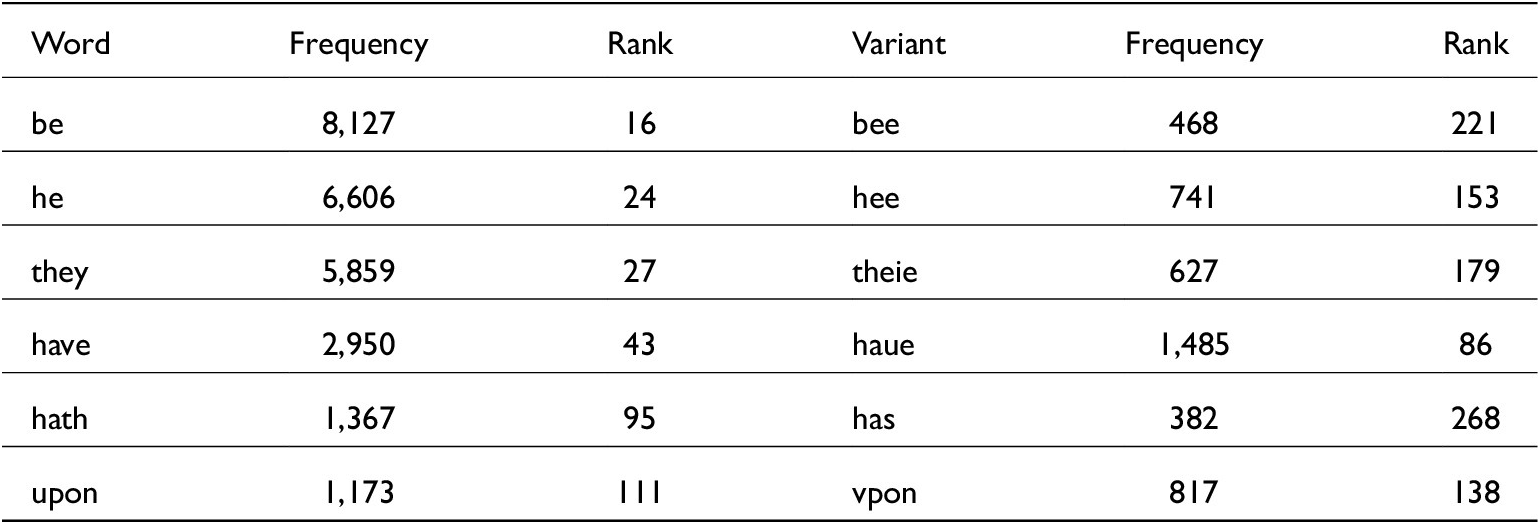
Table 1 provides the list of the top-frequency items displaying significant spelling variation. As may be seen, the top-frequent variants represent <u/v> distinction, the representation of long vowels – a significant source of debate amongst Early Modern English orthographers, grammarians and printers – and the ending of third person singular. In spite of its statistical significance, they/theie was not considered in this article because, on closer inspection, it emerged as an idiosyncratic spelling only used by Richard Mulcaster, whose Elementarie incidentally represents the first consistent attempt to normalise and regulate English spelling (Salmon Reference Salmon and Lass1999: 20). No other orthographic variants of the third-person plural pronoun are attested in the corpus.
Spelling variants for the top-frequency items in the MetaLing Corpus

Table 1. Long description
The table consists of six columns: Word, Frequency, Rank, Variant, Frequency, and Rank.
* Row 1: Word ‘be’ (frequency 8,127, rank 16) compared to variant ‘bee’ (frequency 468, rank 221).
* Row 2: Word ‘he’ (frequency 6,606, rank 24) compared to variant ‘hee’ (frequency 741, rank 153).
* Row 3: Word ‘they’ (frequency 5,859, rank 27) compared to variant ‘theie’ (frequency 627, rank 179).
* Row 4: Word ‘have’ (frequency 2,950, rank 43) compared to variant ‘haue’ (frequency 1,485, rank 86).
* Row 5: Word ‘hath’ (frequency 1,367, rank 95) compared to variant ‘has’ (frequency 382, rank 268).
* Row 6: Word ‘upon’ (frequency 1,173, rank 111) compared to variant ‘vpon’ (frequency 817, rank 138).
4.2. Results and discussion
4.2.1. Representation of long vowels in final and medial position
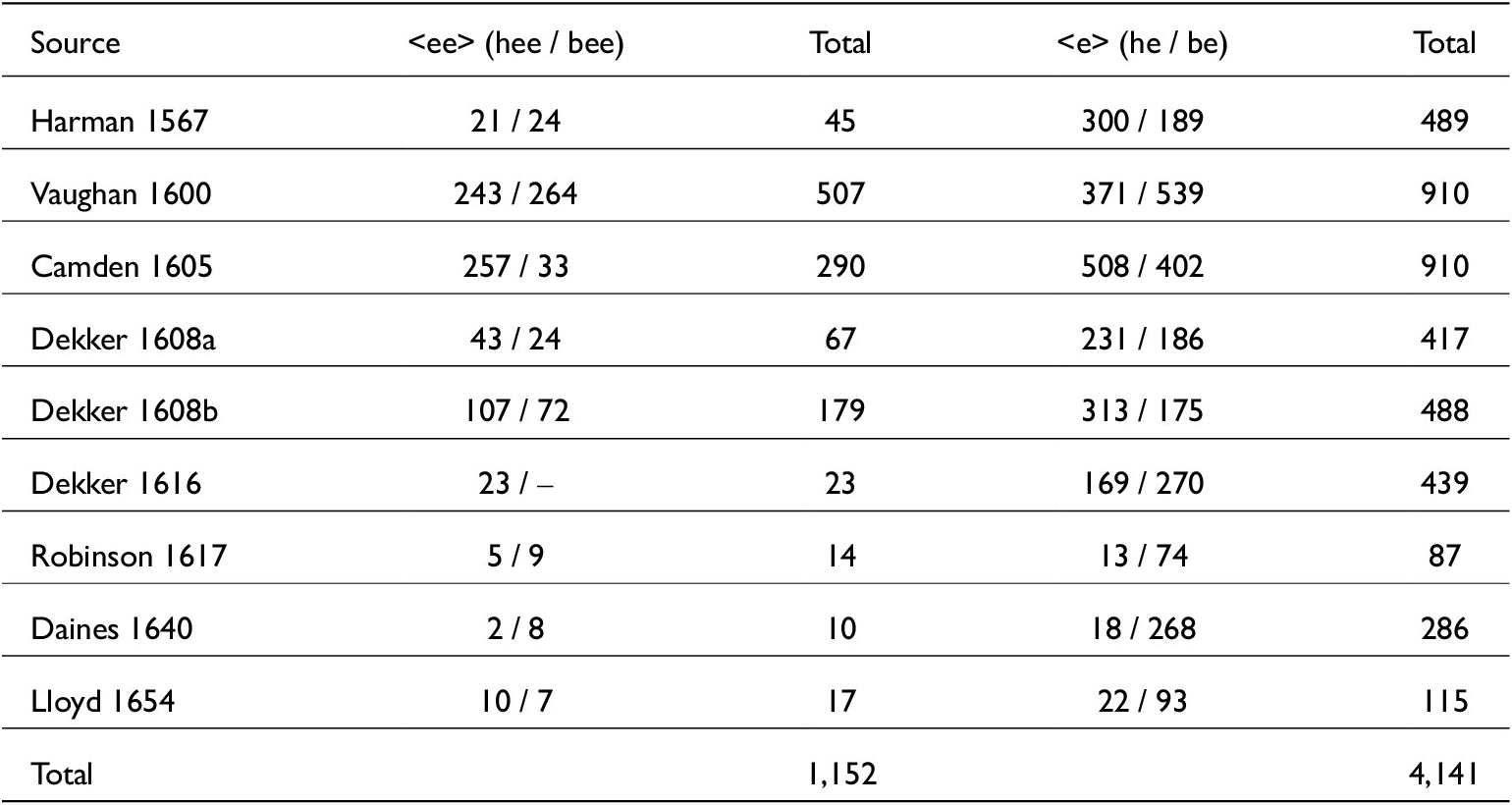
The discussion of results begins with the representation of long vowels. Table 2 presents the distribution of spelling variants focusing on the sources that display alternative variants. The full names and titles of the sources cited in abbreviated form are provided in the Supplementary material Appendix.Footnote 3
Spelling variation for he and be

Table 2. Long description
The table consists of five columns: Source, <ee> (hee / bee), Total, <e> (he / be), and Total.
* Harman 1567: 21 / 24 for <ee> (Total 45); 300 / 189 for <e> (Total 489).
* Vaughan 1600: 243 / 264 for <ee> (Total 507); 371 / 539 for <e> (Total 910).
* Camden 1605: 257 / 33 for <ee> (Total 290); 508 / 402 for <e> (Total 910).
* Dekker 1608a: 43 / 24 for <ee> (Total 67); 231 / 186 for <e> (Total 417).
* Dekker 1608b: 107 / 72 for <ee> (Total 179); 313 / 175 for <e> (Total 488).
* Dekker 1616: 23 / — for <ee> (Total 23); 169 / 270 for <e> (Total 439).
* Robinson 1617: 5 / 9 for <ee> (Total 14); 13 / 74 for <e> (Total 87).
* Daines 1640: 2 / 8 for <ee> (Total 10); 18 / 268 for <e> (Total 286).
* Lloyd 1654: 10 / 7 for <ee> (Total 17); 22 / 93 for <e> (Total 115).
The final row shows aggregate totals: 1,152 for the <ee> variation and 4,141 for the <e> variation.
Overall, the data shows a preference for single-vowel <e> spellings, alongside variation between authors and texts. Spellings in <e> already dominate in printed works by the end of the sixteenth century. This dominance persists across all sources, even though Vaughan and Camden display comparatively higher variation with 507 and 290 occurrences of <ee> spellings which, however, do not overturn the overall preference for <e> spellings.
Dekker texts display both intra-author and inter-textual variation: while <e> spellings outnumber <ee> forms overall, occurrences of the latter indicate that spelling was not entirely stable within a single author’s production. While <e> spellings dominate in all three sources, <ee> variants rise from Dekker 1608a (13.8%) to Dekker 1608b (26.8%), both printed by Edward Allde for different booksellers; they decline in Dekker 1616 (5%), printed by Thomas Snodham. This cluster of texts constitutes a potentially interesting case study for wider scope analysis of printer-mediated variation.
The data shows that by the mid seventeenth century, <ee> spellings are erratic. Remodelled spellings of personal pronouns (such as mee, hee and shee) were proposed by James Howell in 1662 (Salmon Reference Salmon and Lass1999: 46). However, the frequency of <ee> forms in our sources does not suggest that the practice had been anticipated or applied with any consistency.
In light of the significance of this variant in the corpus, we decided to extend the analysis to the representation of long vowels in medial position. Early modern printed texts display two main approaches to represent long vowels: by using final silent <-e> or through duplication. The first attempts at regularising the spelling of long vowels were made in the later sixteenth century (Salmon Reference Salmon and Lass1999: 27, 34), so it is interesting to examine to what extent they are reflected in the MetaLing Corpus. To this end, we compared the spellings of long back and front vowels, all attested in the corpus with competing spellings; again, we relied on wordlist analysis and concordances to identify variant spellings.
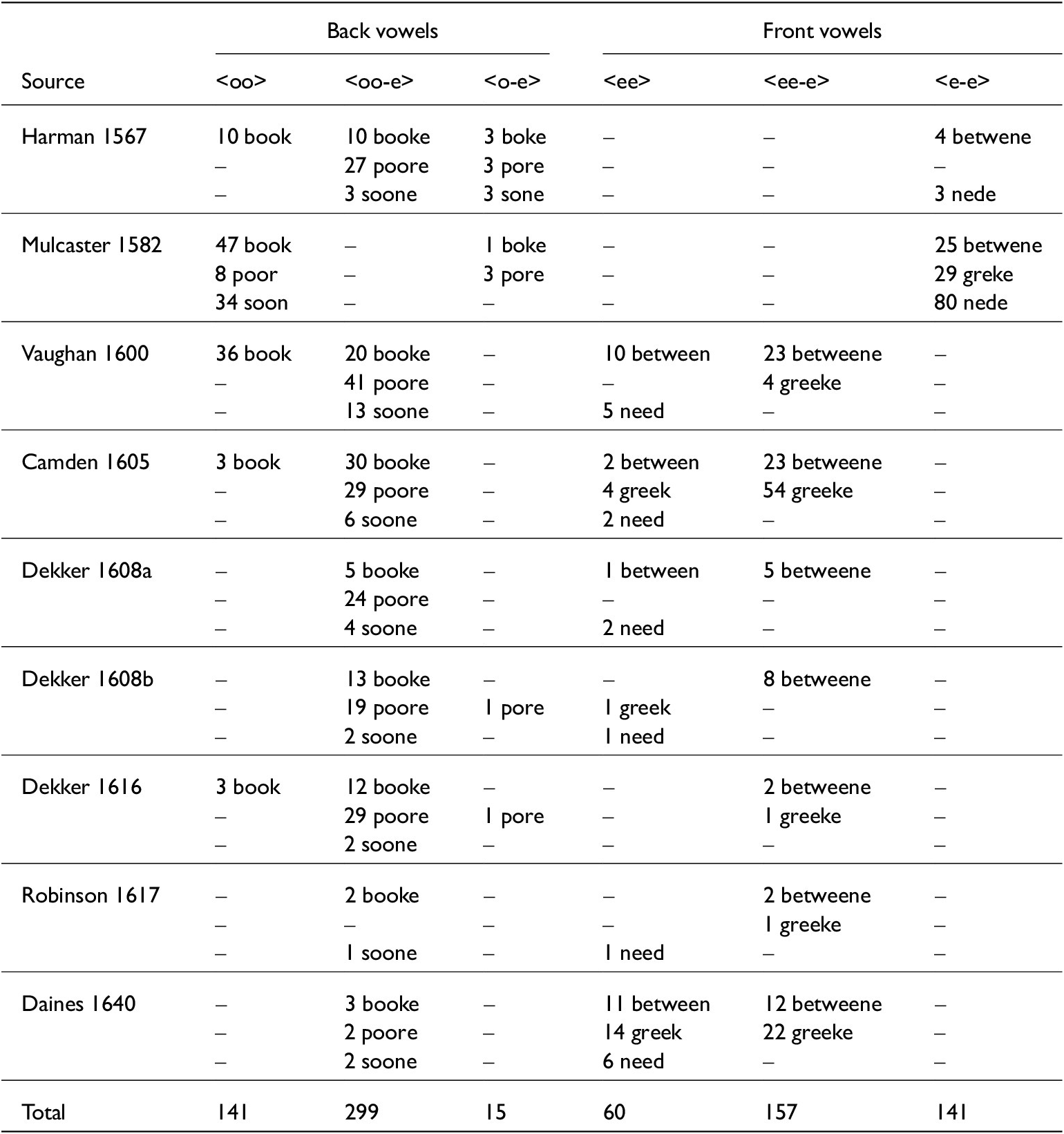
Table 3 documents variation by source. After the mid seventeenth century, the sources display very little variation and a clear shift away from final <-e> spellings towards zero-final forms; for this reason, the data presented in the table focuses on earlier texts. The distribution of variant spellings indicates a marked preference for ‘redundant’ <VV-e> spellings. The distribution of spelling variants also shows different patterns in the representation of back and front vowels: whereas back vowels display relatively decisive shifts towards the one or the other variant spelling, front vowels exhibit variation and coexistence until the mid seventeenth century. For back vowels, duplication is dominant only in Mulcaster, whereas the ‘redundant’ form with duplication and final <-e> is the standard. After 1640 the picture is reversed, and simple duplication is uniformly adopted. The pattern for front vowels is less defined. Early texts select either duplication or final silent <-e> consistently (Harman and Mulcaster), but through the first half of the seventeenth century, variants with duplication and duplication + <-e> are in competition. Up until 1640, they coexist in near-balance; after 1640 the pattern shifts towards standardisation of <ee>. In summary, the distribution of spellings shows that there was no uniform or purely chronological trajectory towards standardisation in the representation of long vowels in medial position.
Spelling variation for final <-e> (selection 1567–1640)

Table 3. Long description
The table is structured with a primary header row dividing data into Back vowels and Front vowels. A secondary header row specifies spelling patterns: less than o o greater than, less than o o dash e greater than, and less than o dash e greater than for back vowels; and less than e e greater than, less than e e dash e greater than, and less than e dash e greater than for front vowels.
Data rows by source:
* Harman 1567: Back vowels show 10 book, 10 booke, 27 poore, 3 soone, 3 boke, 3 pore, 3 sone. Front vowels show 4 betwene and 3 nede.
* Mulcaster 1582: Back vowels show 47 book, 8 poor, 34 soon, 1 boke, 3 pore. Front vowels show 25 betwene, 29 greke, 80 nede.
* Vaughan 1600: Back vowels show 36 book, 20 booke, 41 poore, 13 soone. Front vowels show 10 between, 5 need, 23 betweene, 4 greeke.
* Camden 1605: Back vowels show 3 book, 30 booke, 29 poore, 6 soone. Front vowels show 2 between, 4 greek, 2 need, 23 betweene, 54 greeke.
* Dekker 1608a: Back vowels show 5 booke, 24 poore, 4 soone. Front vowels show 1 between, 2 need, 5 betweene.
* Dekker 1608b: Back vowels show 13 booke, 19 poore, 2 soone, 1 pore. Front vowels show 1 greek, 1 need, 8 betweene.
* Dekker 1616: Back vowels show 3 book, 12 booke, 29 poore, 2 soone, 1 pore. Front vowels show 2 betweene, 1 greeke.
* Robinson 1617: Back vowels show 2 booke, 1 soone. Front vowels show 1 need, 2 betweene, 1 greeke.
* Daines 1640: Back vowels show 3 booke, 2 poore, 2 soone. Front vowels show 11 between, 14 greek, 6 need, 12 betweene, 22 greeke.
The final row provides totals for each spelling pattern:
* Back vowels: less than o o greater than = 141; less than o o dash e greater than = 299; less than o dash e greater than = 15.
* Front vowels: less than e e greater than = 60; less than e e dash e greater than = 157; less than e dash e greater than = 141.
4.2.2. <u/v> distinction
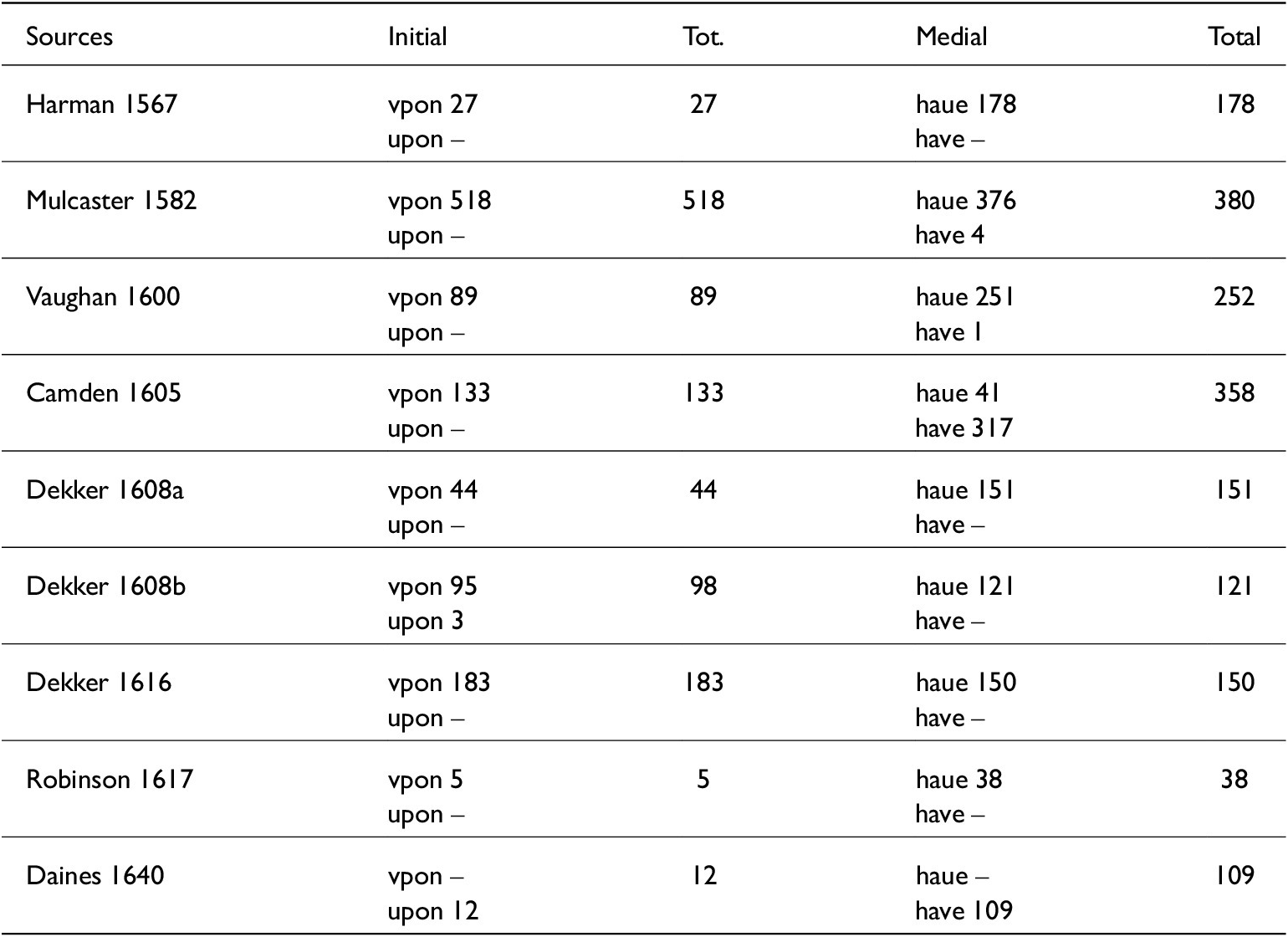
The grapheme <v> was not originally part of the English alphabet, but was introduced in the Middle English period by scribes trained in the French tradition, where it was present alongside its corresponding phoneme. It entered the repertoire of graphemes alongside <u>, already present, but there was no attempt at systematising their distribution; the convention became to use <u> in medial position and <v> in initial position, as continued in the sixteenth and early seventeenth century. Table 4 summarises the distribution of these graphemes in the MetaLing Corpus.
<u/v> distinction (extract)

Table 4. Long description
The table tracks the usage of ‘vpon’ versus ‘upon’ in the initial position and ‘haue’ versus ‘have’ in the medial position across nine historical sources.
* Harman 1567: Initial ‘vpon’ 27, ‘upon’ 0 (Total 27). Medial ‘haue’ 178, ‘have’ 0 (Total 178).
* Mulcaster 1582: Initial ‘vpon’ 518, ‘upon’ 0 (Total 518). Medial ‘haue’ 376, ‘have’ 4 (Total 380).
* Vaughan 1600: Initial ‘vpon’ 89, ‘upon’ 0 (Total 89). Medial ‘haue’ 251, ‘have’ 1 (Total 252).
* Camden 1605: Initial ‘vpon’ 133, ‘upon’ 0 (Total 133). Medial ‘haue’ 41, ‘have’ 317 (Total 358).
* Dekker 1608a: Initial ‘vpon’ 44, ‘upon’ 0 (Total 44). Medial ‘haue’ 151, ‘have’ 0 (Total 151).
* Dekker 1608b: Initial ‘vpon’ 95, ‘upon’ 3 (Total 98). Medial ‘haue’ 121, ‘have’ 0 (Total 121).
* Dekker 1616: Initial ‘vpon’ 183, ‘upon’ 0 (Total 183). Medial ‘haue’ 150, ‘have’ 0 (Total 150).
* Robinson 1617: Initial ‘vpon’ 5, ‘upon’ 0 (Total 5). Medial ‘haue’ 38, ‘have’ 0 (Total 38).
* Daines 1640: Initial ‘vpon’ 0, ‘upon’ 12 (Total 12). Medial ‘haue’ 0, ‘have’ 109 (Total 109).
The data shows a shift from ‘v’ in initial positions and ‘u’ in medial positions toward modern usage by 1640.
The corpus reveals a pattern towards standardisation of <v> in medial position and <u> in initial position, which is completed by 1640, as there are no occurrences of vpon and haue after this date. Overall, medial position spellings display innovation, while initial position remains conservative. In initial position, the only deviation observed in Dekker 1608b confirms that initial <u> is exceptional in the early seventeenth century. A clear shift is observed in Daines, where upon is the only attested variant, reflecting the distinction introduced in the 1630s towards the separation of the functions of <u> as a vowel and <v> as a consonant (Salmon Reference Salmon and Lass1999: 39; Condorelli Reference Condorelli2021: 808–9, 818).
In medial position, the distribution of the graphemes exhibits more variation. Erratic spellings with <v> intrude towards the end of the sixteenth century, and a major shift is visible in Camden, where have outnumbers haue. The innovation is not immediately generalised, however, as Dekker and Robinson revert to haue. Standardisation is again observable starting from Daines. The data shows that medial <v> emerges earlier but spreads unevenly, with periods of coexistence and competition of variant spellings, whereas initial <u> remains virtually unattested until the mid seventeenth century. Scattered later occurrences of vpon in Walker 1655 (3 occurrences), Stubbe 1657 (1 occurrence) and Newton 1677 (1 occurrence) suggest to explore residual variation after the widespread adoption of <u/v> distinction.
4.2.3. Third-person singular verb forms
The final instance of variation concerns third-person present singular verb forms. As is known, the line of development in the early modern period is the replacement of <-th> by <-s> ending. The development is known to have spread from Northumbria; by the end of the fifteenth century it is attested in London and in the early seventeenth century in East Anglia (Holmqvist Reference Holmqvist1922; Kytö Reference Kytö1993; Nevalainen & Raumolin-Brunberg Reference Nevalainen, Raumolin-Brunberg, Dalton-Puffer and Ritt2000; Gries & Hilpert Reference Gries and Hilpert2010). Third-person present singular forms in <-s> are rare until the 1590s, when they begin to display variation with forms in <-th>; around 1700 <-th> is restricted to liturgical, biblical and formal contexts. The patterns of distribution of the two forms seem to be influenced by linguistic factors, such as verb frequency and phonological context, and extralinguistic factors, such as text type (Kytö Reference Kytö1993: 121, 130; Nevalainen & Raumolin-Brunberg Reference Nevalainen and Raumolin-Brunberg2003: 144). Table 5a presents the data for the most frequent verbs in the corpus, separating the high-frequency (HF) verbs have and say and the lexical (Lex) verbs make and know.
Third-person singular verb forms by source

Table 5. Long description
The table contains five columns: Source, Verb class (H F or Lex), <(e)th>, <(e)s>, and Total.
* Harman 1567: H F has 95 eth, 0 es; Lex has 9 eth, 5 es.
* Mulcaster 1582: H F has 163 eth, 0 es; Lex has 27 eth, 9 es.
* Vaughan 1600: H F has 129 eth, 1 es; Lex has 30 eth, 8 es.
* Camden 1605: H F has 127 eth, 2 es; Lex has 17 eth, 3 es.
* Dekker 1608a: H F has 56 eth, 21 es; Lex has 0 eth, 11 es.
* Dekker 1608b: H F has 52 eth, 9 es; Lex has 0 eth, 19 es.
* Dekker 1616: H F has 68 eth, 8 es; Lex has 1 eth, 22 es.
* Robinson 1617: H F has 19 eth, 0 es; Lex has 2 eth, 0 es.
* Daines 1640: H F has 74 eth, 4 es; Lex has 1 eth, 11 es.
* Anon 1644: H F has 7 eth, 0 es; Lex has 0 eth, 3 es.
* Howell 1650: H F has 3 eth, 0 es; Lex has 0 eth, 1 es.
* Lloyd 1654: H F has 4 eth, 0 es; Lex has 1 eth, 0 es.
* Farnworth 1655: H F has 6 eth, 1 es; Lex has 0 eth, 1 es.
* Walker 1655: H F has 63 eth, 8 es; Lex has 0 eth, 5 es.
* Stubbe 1657: H F has 129 eth, 14 es; Lex has 2 eth, 14 es.
* Reyner 1663: H F has 144 eth, 0 es; Lex has 4 eth, 24 es.
* Head 1666: H F has 90 eth, 2 es; Lex has 3 eth, 26 es.
* Ray 1674: H F has 22 eth, 0 es; Lex has 0 eth, 9 es.
* Newton 1677: H F has 92 eth, 9 es; Lex has 0 eth, 21 es.
* Mather 1681: H F has 185 eth, 14 es; Lex has 15 eth, 32 es.
* Anon 1682: H F has 15 eth, 1 es; Lex has 1 eth, 0 es.
* Browne 1683: H F has 6 eth, 0 es; Lex has 0 eth, 0 es.
* Lodwick 1685: H F has 2 eth, 0 es; Lex has 0 eth, 0 es.
* Stuart 1686: H F has 0 eth, 39 es; Lex has 0 eth, 17 es.
* Baker 1699: H F has 0 eth, 296 es; Lex has 0 eth, 16 es.
Totals:
* H F Total: 1,467 eth, 430 es, 1,897 total.
* Lex Total: 195 eth, 265 es, 460 total.
* Grand Total: 1,662 eth, 695 es, 2,357 total.
With 1,662 occurrences, <-(e)th> forms outnumber <-(e)s> forms (695 occurrences). Overall, the data shows a strong persistence of <-(e)th> forms well into the seventeenth century, though lexical verbs show a much earlier and more consistent shift towards <-(e)s> forms. By the last quarter of the seventeenth century forms in <-th> have completely disappeared in high-frequency verbs. As expected, verb frequency conditions the pace of change, and high-frequency items resist innovation longer than less frequent lexical verbs. The verb say displays the greatest spelling variation, reflecting competition amongst multiple forms.
Table 5b shows that variation is both diachronic and author-specific. Whereas <-(e)th> forms are standard in the earliest sources (Harman, Mulcaster, Vaughan and Camden), Dekker’s texts mark the first site of variation. Dekker adopts the innovative ending earlier and more consistently than his contemporaries, although competing variants occur. By contrast, <-(e)th> forms are still dominant for the high-frequency verb have in all Dekker’s texts: 1608a presents 55 hath vs 10 has; in 1608b hath occurs 52 times vs 2 has; in 1616 there are 66 occurrences of hath vs 8 occurrences of has.
Variants of say by source

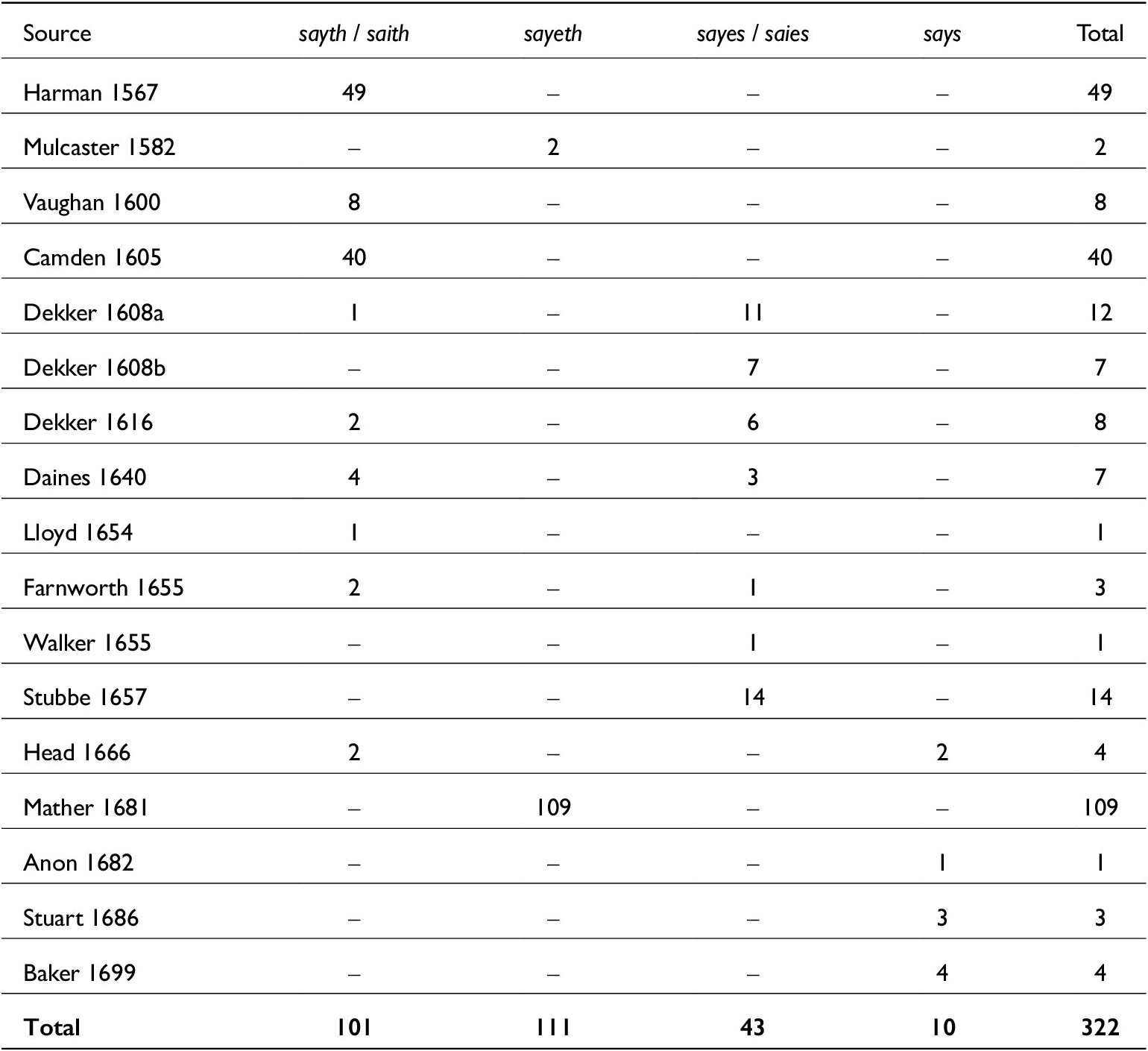
Table 5a. Long description
The table consists of six columns: Source, sayth / saith, sayeth, sayes / saies, says, and Total.
* Harman 1567: 49 sayth / saith, 49 total.
* Mulcaster 1582: 2 sayeth, 2 total.
* Vaughan 1600: 8 sayth / saith, 8 total.
* Camden 1605: 40 sayth / saith, 40 total.
* Dekker 1608a: 1 sayth / saith, 11 sayes / saies, 12 total.
* Dekker 1608b: 7 sayes / saies, 7 total.
* Dekker 1616: 2 sayth / saith, 6 sayes / saies, 8 total.
* Daines 1640: 4 sayth / saith, 3 sayes / saies, 7 total.
* Lloyd 1654: 1 sayth / saith, 1 total.
* Farnworth 1655: 2 sayth / saith, 1 sayes / saies, 3 total.
* Walker 1655: 1 sayes / saies, 1 total.
* Stubbe 1657: 14 sayes / saies, 14 total.
* Head 1666: 2 sayth / saith, 2 says, 4 total.
* Mather 1681: 109 sayeth, 109 total.
* Anon 1682: 1 says, 1 total.
* Stuart 1686: 3 says, 3 total.
* Baker 1699: 4 says, 4 total.
The final row provides the totals for each variant: sayth / saith (101), sayeth (111), sayes / saies (43), and says (10), with a grand total of 322 instances.
In the mid seventeenth century authorial preferences diverge. Daines indicates ongoing competition, Lloyd and Farnworth retain <-(e)th> forms, whereas Walker and Stubbe mark a shift towards <-(e)s> forms. Later authors show increasing standardisation (but note Mather’s preference for sayeth). By the end of the century, the innovative ending has become dominant.
The analysis of the distribution of say variants demonstrates that the transition from <-(e)th> to <-(e)s> was neither linear nor uniform. Individual authors (and printers) exhibit individual preferences and idiosyncratic practices, with some maintaining conservative forms well after the introduction of innovative variants.
The group of variants analysed appears to reflect a stronger influence of printer practice than of grammarians. However, further analysis is required, particularly taking into account printers and the role of typography, and potentially of genre-specific patterns. One limitation of this study is the uneven chronological representation of the corpus, with a gap between the 1620s and the 1640s and a higher concentration of sources between 1600 and 1620. Nevertheless, one clear result is that after 1640 modern spelling standards become widespread, and for the phenomena analysed in this article they largely constitute the norm.
5. Discourse variation in the MetaLing Corpus
The second case study shifts focus from formal variation to discourse variation, combining corpus-driven and corpus-based research to investigate the ‘aboutness’ of our corpus. We begin by applying keyword analysis to help us identify units of outstanding frequency (Egbert & Biber Reference Egbert and Biber2019: 78). However, the analysis remains exploratory, as the current limits of our corpus regarding tokenisation and spelling normalisation prevent us from obtaining statistically robust evidence of domain coverage at this stage. For this reason, the analysis then shifts to a corpus-based approach and is primarily qualitative.
5.1. Keyword analysis
Keyword analysis was performed in Sketch Engine using the built-in keyword extraction function. The historical corpus English Historical Book Collection (EEBO, ECCO, Evans), preloaded in Sketch Engine, was used as a reference corpus because it provides a large and representative diachronic collection of Early Modern English texts, making it suitable for comparison with our dataset. In particular, the subcorpus EEBO-TCP Phase I (1473 – c.1700) was selected because it covers a comparable timespan, while Evans and ECCO focus on the later modern period (from the late seventeenth century onwards). It should be noted that the MetaLing Corpus and the reference subcorpus are processed using different tokenisation procedures, which affect token counts, individual word frequencies and normalised frequencies, and thus lead to keyness scores that may not reliably reflect thematic prominence in our corpus. Additionally, as already pointed out, no normalisation was applied when producing these results. Aware of these limitations, we decided to employ keyword analysis as an exploratory tool to interpret patterns across keyword sets that may indicate thematic relevance.
Informed by Jonathan Culpeper’s approach (Reference Culpeper2009: 36) we tested various possibilities and chose a combination that enabled us to minimise extremely rare word types (Sketch Engine setting 10) and to retrieve a sufficient number of words (1000) with a minimum frequency threshold of 20 occurrences. The resulting keyword list was manually cleaned to remove further irrelevant items, such as contractions (e.g. cō for com) and compounds that were split in the target corpus (e.g. them selues), and to identify spelling variants that could be grouped as different forms of conceptually identical items. Selected keywords were further examined through concordance analysis to interpret their usage in context, and then grouped thematically. Considering the limitations of the analysis, we did not take into account frequencies, and we limited the study to clusters of semantically related keywords that could tentatively point to emerging discourse domains.
The results are presented in table 6. For a more synthetic overview, keywords are grouped according to type (function words are included) or discourse domains. The ranking provided in brackets is based on the keyness metric implemented in Sketch Engine, which reflects differences in relative frequency between the target and reference corpora. As noted, this is not intended to be statistically significant from a linguistic point of view, but is included for the sake of completeness.
Top 50 keywords and potential discourse domains

Table 6. Long description
The table consists of three columns: an index number, Keyword (rank), and Type / Discourse domain.
* Domain 1: Pronouns. Keywords include theie (1), themselue (5), them (8), selue (27), and hee (32).
* Domain 2: Language. Keywords include tung (2)/tongue (210), vowell (6)/vowel (36)/vowels (34), consonant (7), syllable (12)/sillable (202), verb (13), substantive (20), speche (22), pronunciation (26), sound (30), tense (38), adjective (47), and language (50).
* Domain 3: Determiners. Keywords include som[e] (10) and anie (28).
* Domain 4: Linking devices. Keywords include therefor (14) and bycause (16).
* Domain 5: Education. Keywords include elementarie (15), learning (39), and learner (48).
* Domain 6: Heterogeneous. Keywords include natur (18), foren (25), and waie (33).
* Domain 7: Sources/reference. Keywords include Cic (4)/cicero (486), Plaut (21), Ovid (24), Caes (40), and Heaut (43).
* Domain 8: Verbs. Keywords include maie (23) and seme (46).
* Domain 9: Prepositions. Keyword is from (29).
* Domain 10: Time adverbs. Keywords include somtime (35) and alwaie (49).
* Domain 11: Latin words. Keywords include ne (37) and mihi (42).
* Domain 12: Abbreviations. Keywords include c. (11), ep. (19), sc. (45), and Suss. (44).
A number of clusters of semantically related words emerge. The largest, as expected, is related to language (row 2); this can be further divided into more specific semantic fields (e.g. pronunciation, morphology and parts of speech, partly reflecting the specific areas covered by the subcorpora; see Andreani & Russo Reference Andreani and Russo2026) and provides a set of metalinguistic terminology for future research. Another cluster, in row 5, seems to reflect educational discourse, possibly indicating a focus on language learning. Two further potential domains are represented by rows 7 and 12, which point to textuality and intertextuality. It should be noted, however, that some of these keywords, such as ‘Suss.’ and ‘Heut.’ are not distributed across the corpus but are confined to a single text.
5.2. Close-reading
Given the limitations of keyword analysis, we adopted a close-reading approach to the study of discourse variation, combining corpus-driven insights with corpus-informed analysis. For exploratory purposes, we manually selected data from a single text to assess the thematic relevance of educational discourse.
As a reference, Mulcaster’s Elementarie (1582) was chosen to help us identify further words related to the educational settings and practices in the early modern period. Mulcaster’s work is considered one of the foundational works in pedagogic writing in the history of English education and, therefore, represents a prototypical example of pedagogic discourse in our corpus. The aim was to compile a representative set of terms including ‘unpredictable manifestations’ (Kohnen Reference Kohnen, Fitzmaurice and Taavitsainen2007: 141), or, in other words, unexpected or less intuitive words and phrases used to describe learning and teaching practices. To this end, we focused on sections 1.1 to 1.3 (pp. 1–18) of the Elementarie and selected the terms based on the level of confidence with which we could agree on their association with learning and teaching. The sections of the Elementarie were examined separately by the authors through close reading; the two wordlists were then compared to select overlapping terms, resulting in the following items: learn, teach, trial, understanding, performance, comprehend, practice, principles, behaviour, precept and right writing. Considering the inherent subjectivity of term identification, all selected terms were reviewed by a third annotator fluent in English to improve reliability. Given the very small number of items under evaluation, statistical measures of inter-annotator agreement such as Cohen’s Kappa were not considered. Instead, agreement was assessed through direct comparison and consensus. Because these same terms were also used to identify educational discourse in the corpus, the methodology risks circularity. For this reason, in order to partially correct this limit, we complemented the qualitative selection with quantitative measures of frequency and collocational patterns, as discussed in the following section.
5.3. Results and discussions
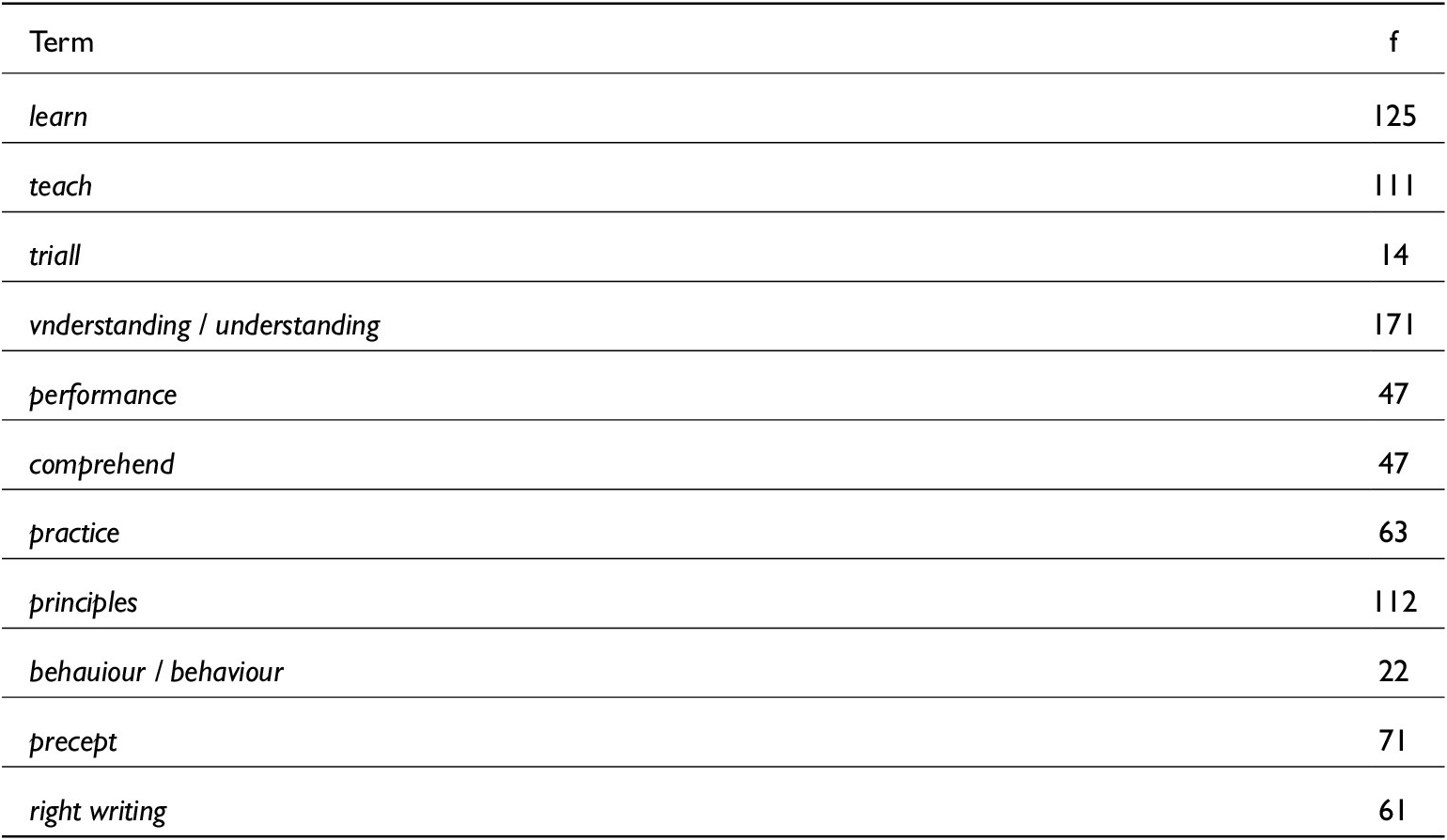
Table 7 presents the number of occurrences of the selected terms in the MetaLing Corpus.
Frequency of educational terminology in the MetaLing Corpus

Table 7. Long description
The table consists of two columns titled Term and f. The data rows are as follows.
* learn: 125
* teach: 111
* triall: 14
* vnderstanding / understanding: 171
* performance: 47
* comprehend: 47
* practice: 63
* principles: 112
* behauiour / behaviour: 22
* precept: 71
* right writing: 61
The concordance of each was examined manually to determine whether the words were really used in an educational context. For instance, the collocational profile of the word precept, analysed using the WordSketch function in Sketch Engine, shows it occurs in contexts marked by educational lexis, such as the verb learn and the nouns practice, method, train and teaching. In most cases, however, the collocational profile was not enough, so occurrences were analysed manually through concordances. As a result, three additional terms were identified as relating to educational discourse, alongside the more obvious cases of learn and teach: performance, principles and precept. Although right writing was also linked to educational discourse, it was excluded from the analysis because it occurs only in Mulcaster’s Elementarie.
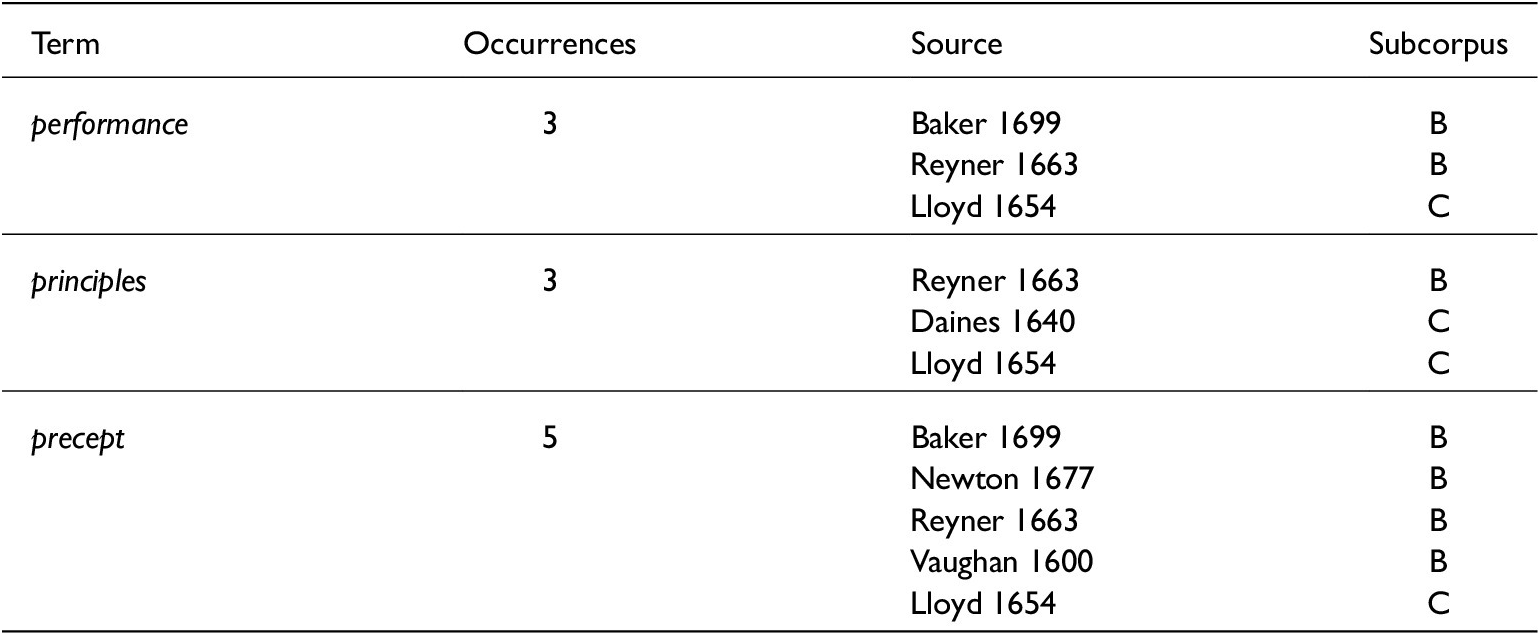
Table 8 summarises the terms selected for analysis, their frequencies in educational contexts following manual classification, and the corresponding subcorpora and source authors. As the table shows, occurrences in educational settings account for only a small proportion of the terms’ overall frequencies. The discussion therefore moves from an examination of individual concordances to the broader textual contexts in which these terms occur.
Frequency of the terms performance, principles and precept

Table 8. Long description
The table consists of four columns: Term, Occurrences, Source, and Subcorpus.
* Row 1: The term performance has 3 occurrences. Sources include Baker 1699, Reyner 1663, and Lloyd 1654. The subcorpora are B, B, and C respectively.
* Row 2: The term principles has 3 occurrences. Sources include Reyner 1663, Daines 1640, and Lloyd 1654. The subcorpora are B, C, and C respectively.
* Row 3: The term precept has 5 occurrences. Sources include Baker 1699, Newton 1677, Reyner 1663, Vaughan 1600, and Lloyd 1654. The subcorpora are B, B, B, B, and C respectively.
5.3.1. Performance in context
The selected concordances are the following:Footnote 6
-
(1) For Learners should endeavour therein exact performance of all circumstances required in the third and fourth, and fifth precedent Rules. (Lloyd 1654)
-
(2) Though better provided of Academical improvements, yet not maintaining their familiarity with their Studies, grow so negligent and loath to bestow any pains upon those performances which their charge exacts from them, that the crudeness of them renders them disgusted with others. (Reyner 1663)
-
(3) The Stores of Learning, by which means by reasoning against Learning, we must at the same time reason for it, and all our Arguments must return upon us; or if the performance were unlearned, it would be to no purpose. (Baker 1699)
In the first concordance, the term refers to the learners and the phrase ‘should endeavour’ emphasises academic discipline, likely referring to completing a task. The term ‘Rule’ seems to indicate the various rules that should be followed by students. The second concordance appears to refer to the student’s academic growth. In addition, the defining relative clause appears to point to tasks or duties expected of students. In the last concordance the phrase ‘Stores of Learning’ suggests the idea of accumulated knowledge or scholarly material within an educational setting. It appears that the author is referring to the philosophical aspect and how even criticism of learning leads to validating it, highlighting the importance of education.
5.3.2. Principles in context
The selected concordances are the following:
-
(4) Which way shall seem most reasonable and likeliest to succeed with most proficiency upon a just comparison of the principles in rules and practise of either methods. (Lloyd 1654)
-
(5) We will immediately come to treat of Letters, as the first Elements or Principles of speech in every Tongue or Language whatsoever. (Daines 1640)
-
(6) For Grammar delivers the first Principles of a Language, shews the Formations, and Significations, Connexions, and Dependencies of words, and how they are put together to frame a discourse, of which no sense can be made without it. (Reyner 1663)
The term principle has the highest frequency in the corpus compared to the other two selected terms, with varying degrees of relevance to an educational or instructional setting. In concordance (4), the lexis suggests an educational context. Although there is not sufficient contextual grounding to clearly identify and justify the pedagogical intention, the phrase ‘principles in rules and practise’ would seem to imply a comparison of methodologies potentially referring to a teaching or learning environment – for this reason, the concordance was selected as potentially significant. In concordance (5), the phrase ‘the first Elements or Principles of speech’ clearly situates the discussion within the domain of linguistics. This example offers a more direct link between principles and language instruction. Moreover, the didactic function of the text here also emerges from the metadiscourse marker ‘we will immediately come to treat of’, which guides the reader through the text by anticipating the goal of the discourse that will follow. The last concordance provides a strong connection between the term principles and formal education. The term refers explicitly to grammar as the foundational framework for understanding language, stating that principles are the underlying rules that govern language structure and usage.
5.3.3. Precept in context
The selected concordances are the following:
-
(7) Schollars that have attayned the true reason of reading rightly will be much perfected therein by reducing received precepts to frequent practise. (Lloyd 1654)
-
(8) Which may be better improved by constant practice, than by any precepts which can be given. (Newton 1677)
-
(9) Ought to choose out a good schoole-master, that will not onely instruct them in learning, but also informe them in the precepts of good maners. (Vaughan 1600)
-
(10) Therefore, though some words comply not with the precepts given by Grammarians. (Reyner 1663)
-
(11) Condition of Speech must be submitted to, and is no objection in plain Laws and easie precepts, that are intelligible enough in any Language, yet in matters of Science. (Baker 1699)
In concordances (7) and (8) teaching methodologies appear to be discussed. As can be seen, these examples show that the authors think that practice and exercise are significant and are to be preferred over rules. In concordance (9), the terms ‘school-master’, ‘instruct’ and ‘learning’ clearly indicate the domain of education and highlight the relevance of the school context in the extract. The text expands the function of precept beyond intellectual instruction; by asserting that a good schoolmaster must gain both learning and ‘the precepts of good manners’, precept is considered in a moral-pedagogical framework, reflecting early modern educational ideals where fostering good character was considered inseparable from education (Lickona Reference Lickona1991; Bushnell Reference Bushnell1996). The role of grammarians in language learning is discussed in concordance (10), which implies an institutional setting or a language classroom, where grammar is being taught or discussed. The last concordance (11) discusses language in various scenarios. The sentence ‘Condition of Speech must be submitted to’ seems to propose that one must accept the nature or limitations of language or speech. The example would seem to reflect on the limitations of language in different types of knowledge.
5.4. Educational terminology in context
In this section, we examine whether the concordances identified are embedded in larger educational sections and consider how these relate to the rationale of the work in which they appear. In doing so, it explores the extent to which corpus-based analysis can illuminate aspects of the corpus ‘aboutness’ that are not immediately apparent from its compilation criteria. The concordances analysed suggest that Lloyd 1654, Reyner 1663 and Baker 1699 are potential sources for investigating pedagogical discourse in the corpus. Significantly, these texts originate from different sections of the corpus: Lloyd 1654 is included in volume VI of Alston’s Bibliography, devoted to works on pronunciation, whereas Reyner and Baker are catalogued in the miscellaneous section of volume III, lacking any explicit association with a particular branch of linguistic knowledge. Educational discourse thus emerges as a domain that cuts across the corpus’s original classification and contributes to a more nuanced understanding of its thematic profile.
5.4.1. The practice of teaching (Lloyd 1654)
Lloyd discusses principles in a section entitled ‘Observations upon the Letters tending to right Syllabizing’, in which he contrasts the conventional syllabising method with his own approach. The section begins by underlying rules of sound–letter relations:
This did move the Author to propound a new Abcedary, with a Preface, declaring the true reasons of Innovation … And for evidencing the truth thereof, hee doth willingly referre himselfe to any impartiall Judgements to determine which way shall seem most reasonable and likeliest to succeed with most proficiency upon a just comparison of the principles in rules and practise of either methods, to wit, of the vulgar way formerly accustomed, and of the new form here propounded, desiring first these premonitions to be remembred. (Lloyd 1654: 22–3)
Lloyd’s practice substitutes ‘the vulgar way formerly accustomed’ with a ‘new form’ that is presented as more systematic and logical. The passage functions as both a beginning to procedural instruction and a rationale for pedagogical reform. Here, the pedagogical intent of the author is clear: Lloyd seeks not only to instruct learners in correct syllabising but also to provide a reasoned framework that allows teachers and students to evaluate methods critically through ‘just comparison of the principles in rules and practise of either methods’ (23). The next passage is from the section ‘Of Schollars communicating knowledg’, which underscores the pedagogical value of applying precepts through active practice, especially in peer-to-peer instruction:
Schollars that have attayned the true reason of reading rightly will be much perfected therein by reducing received precepts to frequent practise, which is done to the best advantage when such do teach their fellowes; for as the more ingenious are thereby more exercised, so the duller sort are more capable of instruction from them, having among themselves an easier method in a proportion neer their own capacity, by a more familiar discourse, fuller of freedome for ingenuity to expresse it selfe…besides that Scholers made super-visors of their fellows, are far more studious and considerate in teaching others, then when they learn themselves. (Lloyd 1654: 30)
Lloyd emphasises that when scholars teach their fellows, both the advanced and the less capable learners benefit; the former refine their knowledge through teaching, while the latter gain instruction in a more accessible and familiar discourse. The passage situates precept at the intersection of theory and practice, demonstrating its role in fostering collaborative and reflective modes of education. This may be compared with concordance (8) in section 5.2.3; the fuller context is as follows:
And thus much concerning Elocution, as for Memory and Pronounciation, which are the other two parts of Rhetorick, I purposely omit them, as being natural Endowments, which may be better improved by constant practice, than by any Precepts which can be given. (Newton 1577: 172)
In this discussion of memory and pronunciation, precept is contrasted with the value of practice. Unlike Lloyd, who acknowledges the usefulness of precepts when applied, Newton appears to believe in practice as superior to perceptive instruction in certain respects, particularly for memory and pronunciation, which he considers natural endowments that can be enhanced through repetition and practice rather than precepts. The pedagogical implication of this text is that not all aspects of learning can be governed by rules; rather, repetition and experience may have greater effectiveness.
In contrast, Lloyd returns to ‘rules’ in the final passage, from a section of his work aptly entitled ‘The rules of Art in writing’. In it, the author lists a series of ‘grounds’ or ‘principles’ which ‘Such as will learn to write with good proficiency’ should observe (Lloyd 1654, p. 40). Our concordance appears in point 12:
12. When Learners are well skilled in the draughts of the smaller letters, it will be expedient, before they enter upon the Capitall, to teach them upon fresh memory how to joyne the same together, […] and when that is performed regularly, to proceed unto the third succeeding president: both which will require much time to gain therein perfection; for Learners should endeavour therein exact performance of all circumstances required in the third and fourth, and fifth precedent Rules. (Lloyd 1654: 46)
This is clearly embedded within a larger educational framework, in which pedagogic content is fundamental. Lloyd’s work is not simply a treatise on pronunciation, but also a pedagogical manual for teachers: The Schoole-Masters Auxiliaries, a ‘guide’ in two volumes, the first devoted to how to teach to read and write English ‘dexterously’, and the second devoted to ‘asserting the LATINE TONGUE in Prose and Verse, to its just Inlargement, Splendor, and Elegancy’ (Lloyd 1654).
5.4.2. Disciplined learning (Reyner 1663)
John Reyner’s A Treatise of the Necessity of Humane Learning for a Gospel Preacher was published from the papers inherited from his father Edward, and represents an earnest justification of the necessity of a classical and academic education for ministers. The occurrences of the terms principles and performance appear in chapter I, which discusses the value of a knowledge of languages for preachers:
Nor are those to be excused, who, though better provided of Academical improvements, yet not maintaining their familiarity with their Studies, grow so negligent and loath to bestow any pains upon those performances which their charge exacts from them, that the crudeness of them renders them disgusted of others, and their conceptions become as jejune and void of any sprightful relish, as if their minds had never received any Artificial seasoning, nor were tinctured with any principles besides those which are ordinarily found among the vulgar throng of men. (Reyner 1663: 31)
This passage is situated within a larger discussion about the responsibilities of learners and the consequences of neglecting academic work. Unlike Lloyd’s prescriptive attitude, Reyner’s emphasis is not on explicit procedural instruction; instead, he emphasises the qualitative results of scholarly effort. He claims that even those having access to academic resources may fail in improving proficiency if they do not actively engage in their studies. This emphasises the potential loss of meaningful learning. In addition, the author highlights that developing scholarly skills hinges upon consistent practice and regular effort. From a pedagogical perspective, this supports the idea that learners’ advancement depends not only on the exposure to materials, but also on the disciplined engagement and the development of intellectual habits, which are central to effective instruction in any field of study. It shows how neglecting scholarly work can hinder learning, which in turn highlights the responsibilities of learners and the importance of instruction in developing capable practitioners. Thus, it can be concluded that the section deals with teaching implications, even if not directly. The next occurrence appears in section IX of chapter I, ‘Of Grammar’:
For Grammar delivers the first Principles of a Language, shews the Formations, and Significations, Connexions, and Dependencies of words, and how they are put together to frame a discourse, of which no sense can be made without it. (Reyner 1663: 36)
According to the author, grammar is considered as the tool through which the foundational principles of language are conveyed. The knowledge of a language is not innate but should be systematically gained through grammar, which elucidates the forms, meanings, relationships and dependencies of words, ultimately enabling a coherent discourse. Unlike Daines, who emphasises letters as the fundamental principles, Reyner highlights the role of grammar as the basis that shapes these elements into a meaningful structure. Training in grammar is presented as indispensable for developing linguistic competence by establishing a bridge between elementary knowledge, such as letters, and functional language use. The discussion is within a section that supports structured learning and the rational acquisition of linguistic skills, aligning with early modern views on the centrality of grammar in education (Hedge Reference Hedge2000; Leblanc Reference Leblanc, Jalobeanu and Wolfe2020). Just like Lloyd’s educational approach, Reyner’s too starts from principles and then moves to practice.
The final occurrence appears in an additional section appended at the end of chapter I, which is entitled ‘Concerning the usefulness of the Arabic’. The language is compared with Hebrew:
The matter would come all to one, and the sense remain inviolate. Therefore, though some words comply not with the Precepts given by Grammarians, which are conformed onely to the examples of the Bible, and not to the whole extent of the Hebrew Tongue, of which since we have no more monuments, we may well be ignorant of much of the ancient Hebraism: yet such words are not presently to be rejected as faults and mistakes. (Reyner 1663: 45)
Here precept is explicitly connected to the grammatical rules. The author ties these rules’ limitations when applied exclusively to biblical Hebrew rather than to languages more broadly. In contrast to Lloyd’s discussion, where precept carries a more didactic or moral connotation, Reyner’s use of the word highlights its role within linguistic description. The pedagogical implication of it is that precepts provide a framework for order and instruction.
5.4.3. Critical pedagogy (Baker 1699)
Thomas Baker’s Reflections upon learning was a successful work that saw numerous editions; it asserted the primacy of revealed knowledge over human reason and countered criticism of the Scriptures. Contrasting with the prescriptive approaches of Reyner and Lloyd, Baker’s writing is predominantly reflective and critically engaged, examining the boundaries of human learning. In the preface to his work he writes:
An attempt of this nature would be utterly impracticable, for either it would be well perform’d, and then it must be done by reasons borrow’d from the Stores of Learning, by which means by reasoning against Learning, we must at the same time reason for it, and all our Arguments must return upon us; or if the performance were unlearned, it would be to no purpose, and might as well be let alone. (Baker 1699: 1)
The passage exemplifies his sophisticated perspective: while he critiques an over reliance on traditional sources of knowledge, he concurrently maintains that engagement with the subject matter necessarily entails interaction with them. The text serves as both a teaching and philosophical guide, preparing the reader to question knowledge rather than just delivering it. Baker presents himself as a guide who points out the flaws and misuses of traditional learning while still recognising its value. Here, teaching isn’t about step-by-step instructions emphasized in Lloyd’s approach, but rather about encouraging critical thinking and reflection on how we learn and how we reason. The teaching purpose in Baker’s text is both subtler and more nuanced, as it highlights the reflective aspect of pedagogy in early modern scholarly practice. This refers to encouraging learners to critically examine their own learning processes, reasoning and assumptions, rather than only following instructions. The other ‘pedagogical’ term used by Baker occurs in the second chapter entitled ‘Of Languages’:
Languages being the Chanels by which most of our Learning is convey’d, it is necessary to the attaining of Knowledge, that these should be kept clear and open; if the Streams in these run muddy, or are corrupted, all the knowledge that is convey’d by them, must be obscure: words at the best are no very certain signs of things, they are liable to ambiguity, and under that ambiguity are often subject to very different meanings; and tho’ this, as far as it is the common condition of Speech must be submitted to, and is no objection in plain Laws and easie Precepts, that are intelligible enough in any Language, yet in matters of Science, it is much otherwise; these are nice things; the strict meaning is to be observ’d in them; nor can we mistake a word without losing the Notion. (Baker 1699: 7)
The author broadens the scope of precept by applying it to the scientific domain, distinguishing between ‘plain Laws and easie Precepts’ – which are comprehensible in everyday language – and the heightened precision necessary in scientific discourse. In this context, ‘precepts’ are to be intended as simplified and accessible instructional tools (such as ‘prescriptions’ or ‘rules’) that would seem to govern moral and behaviours, similarly to laws. The passage is not properly pedagogical but is interesting in that it highlights the epistemological tension between conventional speech and the demands of scientific knowledge, illustrating the inherent limitations of language in conveying meaning unambiguously. The themes are the nature of language itself, and the development of field-specific terminology. In fact, later in his work, Baker expresses reservations about John Wilkins’ philosophical language project, and adopts a rather pessimistic view of the possibility of human mutual understanding: ‘The Divisions of Tongues was inflicted by God as a Curse upon humane Ambition, and may have been continu’d since for the same reason; and as no Remedy has been yet found’ (17–18).
Although these findings are preliminary and should be interpreted with caution, given the limited number of concordance data, they point to both the presence of educational discourse in the corpus and its multifaceted nature. The discourse appears to include not only intellectual instruction but also the elements of moral guidance, reflective thinking and organised pedagogical frameworks. Authors such as Lloyd appear to highlight prescriptive and systematic approaches, focusing on step-by-step methods and procedural rules, while Baker encourages critical reflection and the development of reasoning, by pointing out the importance of practice, repetition and active participation in learning.
6. Concluding remarks
Through two exploratory case studies, this article has assessed the analytical potential of the MetaLing Corpus and the extent to which linguistic evidence can illuminate both orthographic practices and the aboutness of the texts it contains. By focusing on spelling and discourse variation, the study has demonstrated how the corpus can contribute to the study of both orthographic practices and the discursive domains represented within its texts.
The first case study has shown that spelling variation is generally limited in the corpus, confirming trends towards standardisation already identified by previous scholarship. Nevertheless, significant variation is observed in certain forms. The variation observed is individual and uneven, while it also points to author- and printer-specific practices. In fact, the inclusion of multiple works by individual authors makes it possible to explore authors’ choices and the role of typesetters in shaping orthographic choices. This pilot survey provides valuable data for future developments, such as closer analysis of the interaction between authorial preferences and printers’ practices, which might be further illuminated by recent re-evaluations of the role of printers and their historical context (Condorelli Reference Condorelli2021). Another avenue for further research may involve comparative analyses of spelling variation in print and manuscript sources identified by the project.
In the second case study we have focused on the investigation of a potentially emerging discourse field combining corpus-driven insights with corpus-based close-reading approaches. Although the relatively low number of concordances retrieved suggests that the selected terms may not be highly productive in early modern pedagogical contexts, their distribution points to distinct discursive uses across texts. Three sources, in particular, illustrate a spectrum of educational approaches, ranging from prescriptive modes of instruction to more practice-based and experiential forms of learning. The findings suggest that the type of educational discourse represented in the corpus integrates intellectual, moral and reflective dimensions, pointing to a possible interconnection of knowledge acquisition and ethical judgement. More broadly, the analysis suggests the presence of an educational discourse domain alongside language analysis and description that is not immediately apparent from its bibliographic classification. As such, it contributes to a preliminary understanding of the range of discourse domains represented in the corpus and provides a basis for its future semantic and discourse annotation.
As anticipated, one limitation of this research lies in the absence of spelling normalisation in the corpus. While this was balanced by the analytical potential afforded by retaining original forms, orthographic variation has a clear impact on keyword analysis, dispersing frequencies across variant forms. Although some manual correction was undertaken, this inevitably affects the results. In addition, differences in tokenisation further affect frequency counts and limit the reliability of comparisons between the target corpus and the reference corpus. These constraints are not only methodological limitations but also serve to identify priorities for corpus development. In particular, they highlight how variation in spelling and annotation can obscure thematic patterns and reduce the effectiveness of keyword analysis, which, for this reason, has been treated here as an exploratory and heuristic tool, rather than a measure of thematic importance.
In conclusion, the findings highlight both the potential and the current limits of the MetaLing Corpus. The two case studies demonstrate that the corpus can support investigations of orthographic practices, linguistic standardisation and discourse variation, while also revealing aspects of the corpus’s aboutness that are not immediately apparent from its bibliographic classification. At the same time, the study highlights the challenges posed by orthographic variation and text-processing inconsistencies. Addressing these issues through spelling normalisation, improved tokenisation and lemma-based annotation represents a key priority for the corpus’s future development and analytical robustness.
Supplementary material
The supplementary material for this article can be found at http://doi.org/10.1017/S1360674326100859
Acknowledgements
The research leading to these results has received funding from MUR, PRIN2022 project ‘MetaLing Corpus: Creating a corpus of English linguistics metalanguage from the 16th to the 18th century’, ref.: 202233C93X, funded by the European Union under the programme NextGenerationEU, PNRR Missione 4 – Componente 2 – Investimento 1.1 (October 2023 – February 2026). Angela Andreani was responsible for sections 1 to 5.1; Vahid Asadi was responsible for the remaining sections. OpenAI’s ChatGPT (version 5.2) was used to support language revision and the design of table 5. Data selection, analysis and interpretation of the results remain the responsibility of the authors.




 Open access

