INTRODUCTION
Radiation therapy and surgery have been the main methods of management to achieve disease control in head and neck cancers. These modalities have been used either alone or in combination with or without chemotherapy. Conventional radiation therapy is usually delivered at 1·8–2 Gy/day for 5 days a week over 6–7 weeks. However, the disease control and survival of locally advanced head and neck cancers have remained poor with conventional radiation therapy with <30% of patients being cured of their cancers.Reference Vokes, Weichselbaum, Lippman and Hong 1 Moreover, it was seen that accelerated tumour cell repopulation in malignancies of head and neck during radiation therapy treatment could have been an important cause for the lack of good results with conventional irradiation alone.Reference Fowler and Lindstrom 2 , Reference Withers, Taylor and Maciejewski 3 This poor outcome with conventional irradiation has led to the promulgation of studies using altered fractionation regimens to decrease treatment time; use of concurrent chemo-radiation to cause additive tumour cell kill as well as dose escalation by newer techniques such as intensity-modulated radiation therapy (IMRT) or volumetric-modulated arc therapy (VMAT).
Concomitant boost radiation therapy is a type of altered fractionation (accelerated fractionation) regimen, wherein, the total dose, which is about same as conventional radiation therapy, is achieved by adding a second fraction after an interval of at least 6 hours after the first fraction during the second half of the treatment period. This schedule leads to a reduction in treatment duration by 1 week, thereby overcoming accelerated repopulation during radiation treatment. Studies have demonstrated better loco-regional control with concomitant boost radiation therapy in head and neck cancers; but this technique has been associated in the past with significant acute normal tissue toxicities because the radiation was delivered using two-dimensional (2D) techniques.Reference Fu, Pajak and Trotti 4 – Reference Srivastava 6 In recent years, techniques such as IMRT have become the standard treatment technique in head and neck cancers due to better sparing of critical normal structures surrounding the target volume.Reference Eisbruch, Marsh and Martel 7 – Reference Wu, Manning, Schmidt-Ullrich and Mohan 9
Thus, with the advances in technology and sophistication of radiation techniques, it may be possible to reduce the acute normal tissue effects associated with concomitant boost radiation therapy. In this study, the feasibility of delivering concomitant boost radiation therapy by VMAT, a form of IMRT, has been assessed in squamous cell carcinomas of oropharynx, larynx and hypopharynx, and its resultant acute reactions on normal tissue surrounding the target volume.
MATERIALS AND METHODS
A total of 30 patients with previously untreated biopsy proven squamous cell carcinomas of oropharynx, larynx and hypopharynx with stages II–IVA were selected for this study after obtaining consent from the institute ethics committee (No. IEC/SC/2012/5/216). These patients received irradiation by VMAT technique by an accelerated fractionation using a concomitant boost protocol with a dose of 1·8 Gy/fraction (#)/day, 5 days/week to large field along with 1·5 Gy/#/day to a smaller boost field for the last 12 treatment days to a total dose of 68·4 Gy/40#/5.5 weeks. Concurrent chemotherapy with cisplatin 100 mg/m2 IV three weekly was administered to stages III and IVA patients during week 1 and week 4 of radiation therapy where indicated. Computed tomography simulation was undertaken after preparing a thermoplastic mask for immobilisation and contrast-enhanced scan of the target region was taken with a slice thickness of 3 mm. The initial phase clinical target volume (CTV) encompassed the gross tumour volume (GTV) with a 10 mm primary tissue margin for subclinical microscopic disease. It also included lymph node regions of the neck that were at risk which, mostly, included bilateral levels IB–V and retropharyngeal regions. The boost volume CTV comprised of the GTV with a 10 mm margin and any involved lymph node level. An isometric margin of 3–5 mm was given to both initial phase CTV and boost volume CTV to create the planning target volumes (PTV). VMAT plans were generated to cover at least 95% of the PTV with 95% of the prescribed dose respecting normal tissue constraints. The maximum dose was kept <110%.
Statistical analysis
Patient characteristics and acute toxicities have been described using frequency tables with counts and percentages. The significance and relationship between the variables have been determined by applying χ 2 test/Fischer exact test. All statistical analyses have been carried out for two-tailed significance at 5% level of significance with p value <0·05 being considered as significant.
RESULTS
Patient characteristics
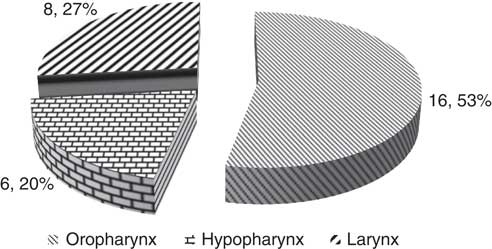
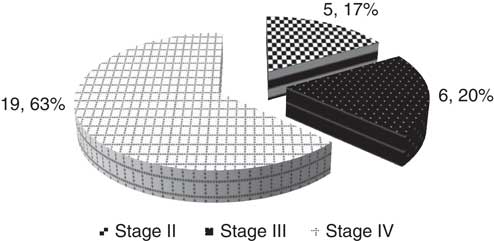
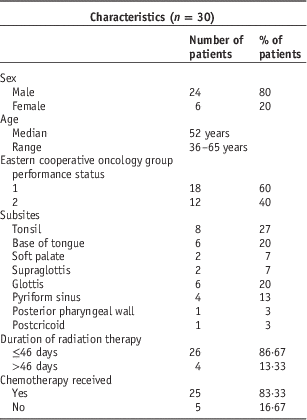
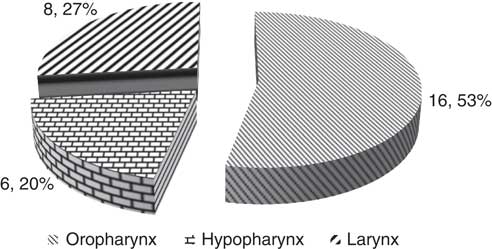
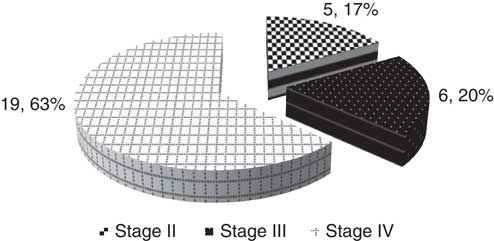
The patient characteristics are shown in Table 1. Out of 30 patients, 24 patients (80%) were males. The median age was 52 years (range 35–65). The site and stage distributions of the tumour are shown in Figures 1 and 2. Oropharyngeal primary was found in 16 patients (53%). Concurrent chemo-radiation was received by 25 patients.
Site wise distribution of cases.
Stage wise distribution of cases.
Patient characteristics

Treatment compliance
All patients completed the scheduled treatment. The median duration of radiation therapy was 44 days (range 40–49). In total, 26 patients completed the radiation therapy in ≤46 days and four patients in 47–49 days. There were no treatment interruptions because of acute toxicities. The treatment breaks were either due to machine breakdown or public holidays.
Status of acute toxicity
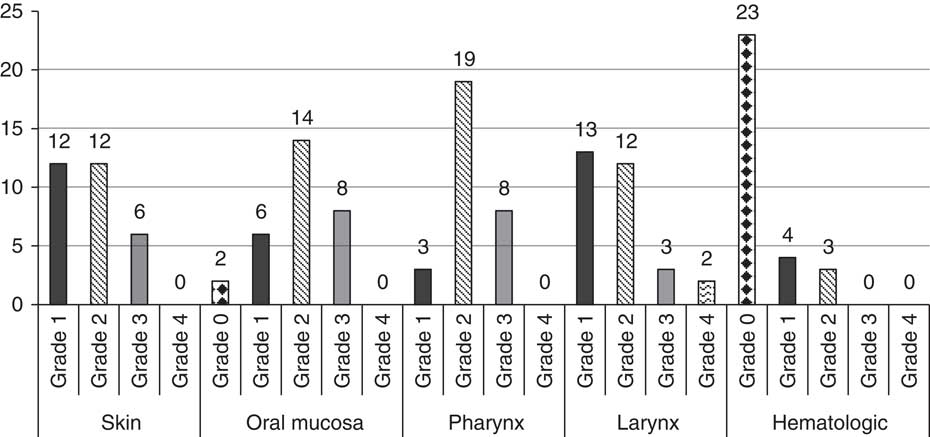
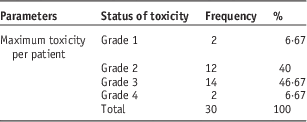
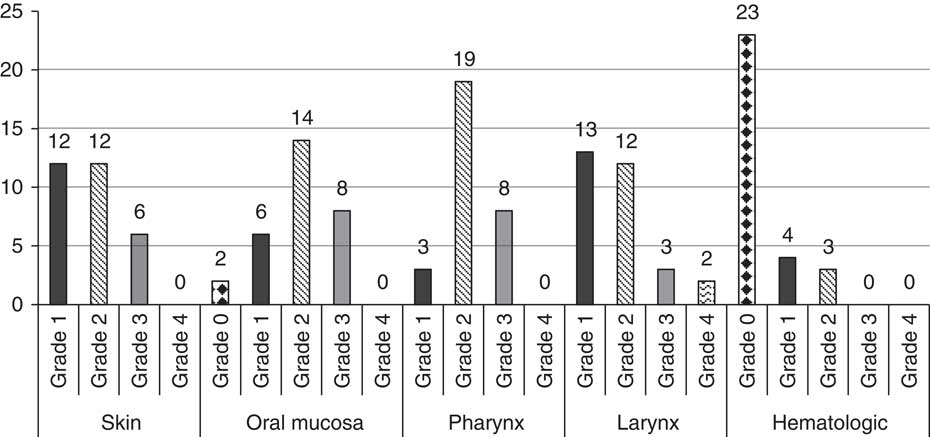
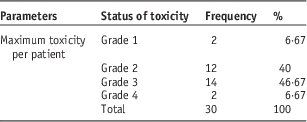
The patients who underwent treatment were assessed for acute toxicity using Radiation Therapy Oncology Group (RTOG) criteria.Reference Cox, Stetz and Pajak 10 The grade of toxicity was documented weekly, and the single maximum grade of acute toxicity for each of the toxicity parameters that the patient developed was documented. The maximum toxicity per patient and the status of acute toxicity of our patients are shown in Table 2 and Figure 3.
Status of acute toxicity.
Maximum toxicity per patient
Skin
All patients developed skin reactions. In total, 24 patients (80%) had grade 1 and grade 2 toxicities. Six patients (20%) had acute grade 3 toxicity. No patients developed grade 4 toxicity. The most common toxicities observed in the skin were hyperpigmentation, dry desquamation and patchy moist desquamation. The six patients who developed grade 3 reaction had confluent moist desquamation and were treated conservatively. These grade 3 skin reactions developed at the end of the treatment.
Oral mucosa
Out of 30 patients, 28 had mucosal toxicity; six (20%) had grade 1; and 14 (46·67%) had grade 2 toxicity. Eight patients (26·67%) had acute grade 3 complication. There was no grade 4 toxicity. The most common toxicity seen in the oral mucosa was patchy mucositis. The eight patients who developed grade 3 toxicity had a confluent mucositis and were treated conservatively.
Pharyngeal toxicity
All patients developed pharyngeal toxicity. Three patients (10%) had acute grade 1 and 19 (63·33%) developed acute grade 2 toxicity. Eight patients (26·67%) had grade 3 toxicity. No patients had grade 4 toxicity. The majority of the patients had moderate dysphagia requiring liquid diet. Of the eight patients with grade 3 toxicity, six had a nasogastric feeding tube during treatment.
Laryngeal toxicity
Out of 30 patients, 13 patients (43·33%) developed acute grade 1 and 12 developed (40%) acute grade 2 toxicity. Acute grade 3 toxicity was observed in three patients (10%) and grade 4 toxicity in two patients (6·66%). Grade 4 complication developed at ~2 months after the start of treatment requiring tracheostomy tube. Patients with grade 2 and grade 3 laryngeal toxicities were managed conservatively with steroids.
Haematological toxicity
Out of 30 patients, seven patients had haematological toxicity. Acute grade 1 toxicity was seen in four patients (13·33%) and grade 2 in three patients (10%). No patients developed acute grade 3 and grade 4 complications. Leucopoenia and neutropenia were the commonly observed haematological toxicities and no patients developed thrombocytopenia.
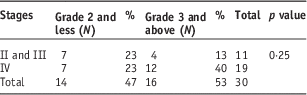
Distribution of toxicity in relation to stage of tumour
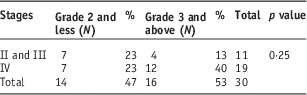
The association between stage of the tumour and toxicity was analysed and tabulated (Table 3). The occurrence of toxicity with respect to the stage of the disease was not statistically significant.
Distribution of toxicity in relation to tumour stage
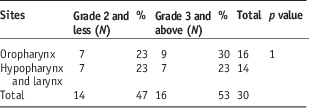
Distribution of toxicity in relation to site of tumour
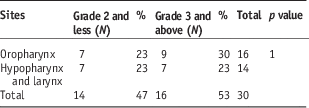
The association between site of the tumour and toxicity was analysed and tabulated (Table 4). The occurrence of toxicity with respect to the site of the disease was not statistically significant.
Distribution of toxicity in relation to the tumour site
DISCUSSION
Concomitant boost radiation therapy is an accelerated fractionation regimen, wherein, the total dose, which is about same as conventional radiation therapy, is achieved by adding a second fraction after an interval of at least 6 hours after the first fraction during the second half of the treatment period. The superiority of concomitant boost radiation therapy over standard fractionation in head and neck cancers had been established by several studies.Reference Fu, Pajak and Trotti 4 – Reference Srivastava 6 In the RTOG 9003 randomised control study by Fu et al.,Reference Fu, Pajak and Trotti 4 four different types of fractionation schedules were used. Patients received either standard fractionation or concomitant boost or hyper-fractionation or split fractionation. In the concomitant boost arm, a total dose of 72 Gy was delivered in 42# over a total duration of 6 weeks, in which the boost field received dose at 1·5 Gy/#/day as a second daily treatment for the last 12 treatment days. It was found that the loco-regional control and disease-free survival were significantly improved in patients who received concomitant boost radiotherapy and hyper-fractionation. Ghoshal et al.Reference Ghoshal, Goda, Mallick, Kehwar and Sharma 5 in their study randomised patients of head and neck malignancies to receive either concomitant boost or conventional fractionation. Patients who were treated with conventional fractionation were delivered a total dose 66 Gy in 33# at 2 Gy/#, whereas the concomitant boost arm patients received a total dose of 67·5 Gy in 40#over a total duration of 5 weeks. The loco-regional control and disease-free survival were improved in patients treated with concomitant boost regimen. Similarly, Srivastava et al.Reference Srivastava 6 also demonstrated that concomitant boost radiation therapy gives much better results in head and neck cancers than conventional radiation alone. This study also revealed that concomitant boost radiation therapy with concurrent chemotherapy produces better outcome than radiation alone. Wolden et al.Reference Wolden, Zelefsky and Kraus 11 showed that the tumour control and survival rates were better in nasopharyngeal carcinoma patients treated with concurrent chemo-radiation using concomitant boost schedule in comparison with patients managed with radiation therapy alone.
Thus, while concomitant boost regimen produced better outcome than standard fractionation, it was associated with an increase in acute toxicities. Fu et al.Reference Fu, Pajak and Trotti 4 treated 296 stages II–IV head and neck cancer patients with concomitant boost radiation therapy and reported acute grade 3 toxicity in 155 patients (58%) and acute grade 4 toxicity in two patients (1%). Ang et al.Reference Ang, Harris and Garden 14 treated 76 patients with concomitant boost with concurrent cisplatin and reported acute deaths in two patients (3%); one patient died of treatment-induced sepsis and the other due to pneumonia with acute respiratory distress syndrome. Therefore, we can see from these studies that acute normal tissue toxicity is the most important limiting factor in concomitant boost radiation therapy. With the advances in conformal radiation therapy (IMRT), acute normal tissue effects can be effectively reduced without compromising on loco-regional control.Reference Eisbruch, Marsh and Martel 7 – Reference Wu, Manning, Schmidt-Ullrich and Mohan 9 In head and neck cancer patients, although IMRT has become an accepted mode of conformal treatment technique, studies have proven that VMAT can produce similar plans as IMRT with the added advantage of shorter delivery time.Reference Otto 12 , Reference Vanetti, Clivio and Nicolini 13 However, although there are studies on advantages of head and neck IMRT, there is a paucity of literature on the clinical utility and advantage of VMAT in head and neck cancers. Moreover, there are few studies on concomitant boost radiation therapy with IMRT, and there is a lack of literature on concomitant boost radiation therapy with VMAT. This was the guiding principle behind designing this present study in which concomitant boost radiation therapy was delivered with VMAT technique which delivers radiation by simultaneously changing the gantry position, multileaf collimator position and dose rate, mainly to reduce acute toxicity.
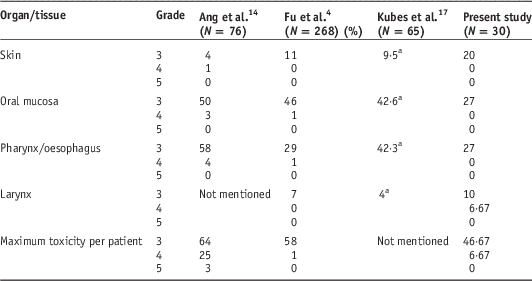
Our study results demonstrated that none of the patients developed grade 5 toxicity (deaths); acute grade 4 toxicity were seen in two patients (6·67%) and grade 3 in 14 patients (46·67%). Ang et al.Reference Ang, Harris and Garden 14 treated 76 patients with concomitant boost with concurrent cisplatin as in our study, but the radiation was delivered by 2D technique and reported acute deaths in two patients (3%); 19 patients (25%) developed acute grade 4 toxicity, and 49 patients (64%) developed acute grade 3 toxicity. Schoenfeld et al.Reference Schoenfeld, Amdur, Morris, Li, Hinerman and Mendenhall 15 in their study treated 85 patients with concomitant boost IMRT (72 Gy/42#/6 weeks) and reported grade 5 toxicity in three patients (3%); and all patients who died during treatment (grade 5 toxicity) had received concurrent chemotherapy. Monroe et al.Reference Monroe, Young, Huff, Ernster, White and Peddada 16 treated 26 patients with concomitant boost IMRT and found no grade 5 toxicity as in our study, but the combined acute grade 3 and grade 4 complications were slightly higher than our study (62 versus 53·34%). Kubes et al.Reference Kubes, Cvek, Vondracek, Pala and Feltl 17 treated 65 patients of stages II–IV head and neck cancers with concomitant boost using conformal or IMRT technique. A total of 10# of 2 Gy (fractions 1–10) plus 15# of 1·8 Gy (fractions 11–25) were delivered to the initial volume and 15# of 1·8 Gy (22·5 Gy), starting from fraction 11 were delivered to the boost volume. The total dose was 69·5 Gy over 5 weeks. Concurrent chemotherapy was contraindicated in the majority of patients or was refused by the patient. In all, 10% of cases had acute grade 3 skin reaction; 42·6% had acute grade 3 mucositis; 42·3% had acute grade 3 pharyngeal toxicity; and 4% developed acute grade 3 laryngeal toxicity. In our study, 20% of patients had grade 3 skin toxicity, 26·67% developed acute grade 3 mucositis and grade 3 pharyngeal toxicity, and 10% had grade 3 laryngeal toxicity. Thus, the acute grade 3 mucosal and pharyngeal toxicities were lower and acute grade 3 skin and laryngeal toxicities were higher in our study. Though direct comparisons cannot be made because of different protocols and techniques, our study results have shown that the overall acute toxicities of concomitant boost radiation therapy by VMAT were relatively less despite patients having received concurrent chemotherapy (25 out of 30 studied patients) when compared with most other studies of concomitant boost radiation therapy by 2D and IMRT techniques. The summary of literature review and comparison of acute toxicities of concomitant boost radiation therapy is presented in Table 5.
Literature review of acute toxicities of concomitant boost radiation therapy
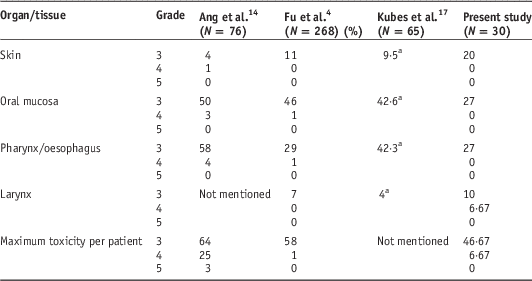
Note:
a Only grade 3 toxicities mentioned in this study.
The most important consequence of acute normal tissue toxicities with concomitant boost radiation therapy by 2D technique is the treatment interruption which may impair the loco-regional control. Allal et al.Reference Allal, Taussky, Mach, Becker, Bieri and Dulguerov 18 managed 296 patients with concomitant boost radiation therapy and demonstrated that 20 patients (7%) had breaks during treatment and in a study by Ghoshal et al.,Reference Ghoshal, Goda, Mallick, Kehwar and Sharma 5 of the 145 patients in the concomitant boost arm, two patients had treatment interruptions due to acute toxicities. In a phase 2 trial on concomitant boost radiation therapy by Kumar et al.,Reference Kumar, Pandey, Lal, Rastogi, Maria Das and Dimri 19 11 out of 95 patients had treatment interruption because of acute toxicity. In our study, all the patients completed the scheduled treatment without treatment interruption related to acute morbiditiy, thus contrasting with other existing literature, but admitting the fact that the sample size was low in our study.
All these findings as well as from other similar studies favour the use of modern conformal techniques in the treatment of head and neck cancers, which improves patients’ compliance to treatment by decreasing the acute toxicities. However, the results have to be further confirmed by large randomised studies.
CONCLUSION
Thus, concomitant boost radiation therapy helps in completing the radiation therapy treatment in a shorter duration of 6 weeks and is expected to counter the phenomenon of accelerated tumour cell repopulation. The use of VMAT helps in reducing the dose to organs at risk thereby allowing completion of treatment with less toxicity. Although patients may have some reactions due to radiation therapy and concurrent chemotherapy, the grade of these reactions encountered due to use of VMAT technique was seen to be low which then enables rapid healing of these reactions in the treated patients. However, this has to be further confirmed by large randomised studies comparing different conformal techniques.
Acknowledgement
The authors would like to acknowledge the help of Dr Shamsudheen, Dr Santhosh and Dr Ankit in carrying out this study.
Financial support
This research was partially funded from an Institute (JIPMER) PG thesis intramural research fund.
Conflicts of Interest
The authors declare that they have no conflicts of interest.