INTRODUCTION
Music perception has been shown to be essential in the understanding of human cognition, providing information for a number of cognitive functions (Zatorre, Reference Zatorre2005), like memory (Snyder, Reference Snyder2000), attention (Janata, Reference Janata2004), complex pattern processing mechanisms (Peretz & Zatorre, Reference Peretz and Zatorre2005), plasticity of the central neural system (Johansson, Reference Johansson2006). One of the early efforts for an information processing model describing music perception is Knoblauch’s, presented already in the nineteenth century (Knoblauch, Reference Knoblauch1890). During the past 2 decades, the study of music perception has known a tremendous interest and growth that have led to cognitive neuropsychological models describing this domain (Koelsch & Siebel, Reference Koelsch and Siebel2005; Peretz, Reference Peretz and Rapp2001). The documentation of musical disorders played a crucial role for the understanding of the cognitive functions that underlying musical perception (Peretz, Champod, & Hyde, Reference Peretz, Champod and Hyde2003). Musical disorders, referred to as acquired amusias, constitute a group of well documented deficits, in the field of neuropsychology (Peretz, Reference Peretz and Rapp2001). Lamy (Reference Lamy1907) in the beginning of the 20th century, first described an aphasic patient who had a musical memory disorder. Lamy’s patient was able to write down in musical notation his national anthem when presented to him auditorily, without, however, having any sense of knowing the tune. Recent studies have documented the functional independence of rhythm and melody aspects of musical perception through evidence from amusic patients (Hyde & Peretz, Reference Hyde and Peretz2004).
Peretz (Reference Peretz and Rapp2001) and Peretz and Coltheart (Reference Peretz and Coltheart2003) have recently presented a cognitive neuropsychological model for music processing, derived from double dissociation studies (Griffith, Rees, Witton, Cross, Shakir, & Green, Reference Griffith, Rees, Witton, Cross, Shakir and Green1997; Liégeois-Chauvel, Peretz, Babaï, Laguitton, & Chauvel, Reference Liégeois-Chauvel, Peretz, Babaï, Laguitton and Chauvel1998; Peretz, Reference Peretz1990; Peretz, Kolinsky, Tramo, Labrecque, Hublet, Demeurisse, & Belleville, Reference Peretz, Kolinsky, Tramo, Labrecque, Hublet, Demeurisse and Belleville1994). In this model, music perception is divided in two different routes, one for melodic and one for temporal processing (see Figure 1). The melodic route is further divided in three modules: one for contour processing (direction of pitch changes within a melody), one for interval processing (pitch distance between two successive notes), and one for tonal encoding (recognition of the particular scale in which the melody is written). The temporal route is divided in the rhythm analysis module (the module responsible for the grouping of events according to temporal proximity, without regard to periodicity) and the meter analysis one (the module responsible for perceiving events that occur at regular intervals in time, in the form of an underlying beat). The modules of the temporal route are thought to be independent unlike the ones of the melodic route. The model also includes a module for musical memory (called “repertoire” or “musical lexicon”) and a module for the emotional analysis of the musical stimulus. In case of damage at any part of the above model, either at a module or at the connection between two modules, an impairment may emerge, which results in a deficit in processing that particular aspect of the musical stimulus.
An adaptation of Peretz’s and Coltheart’s (Reference Peretz and Coltheart2003) model for music perception. The white colored components appear to be specific to music; all others are in gray. Adapted by permission from Macmillan Publishers Ltd: [Nature Neuroscience] (Peretz, I. & Coltheart, M. Modularity of music processing, Vol 6 (7), p 688–691). Copyright (2003).

Recent work (Peretz, Reference Peretz and Rapp2001) has revealed the existence of congenital amusia; a disorder characterized by life-long selective deficits in the perception of music, and pointed a new way of studying the perception of music in otherwise intact people. The requirements of congenital amusia are the musical failures that cannot be explained by obvious sensory or brain anomalies, low intelligence, or lack of environmental stimulation to music (Peretz & Hyde, Reference Peretz and Hyde2003). Later studies revealed that congenital amusia may probably be caused by a deficit in fine grained pitch discrimination (Peretz, Ayotte, Zatorre, Mehler, Ahad, & Penhune, Reference Peretz, Ayotte, Zatorre, Mehler, Ahad and Penhune2002) and does not affect the perception of the temporal aspects of music (Hyde & Peretz, Reference Hyde and Peretz2004; Sloboda, Wise, & Peretz, Reference Sloboda, Wise and Peretz2005), although it affects the ability to synchronize with music, i.e., tapping or dancing (Dalla-Bella & Peretz, Reference Dalla-Bella and Peretz2003). (See Peretz, Reference Peretz2008 for a more recent review of the literature on congenital amusia.)
Peretz and her colleagues (Ayotte, Peretz, Rousseau, Bard, & Bojanowski, Reference Ayotte, Peretz, Rousseau, Bard and Bojanowski2000; Ayotte, Peretz, & Hyde, Reference Ayotte, Peretz and Hyde2002; Cuddy, Balkwill, Peretz, & Holden, Reference Cuddy, Balkwill, Peretz and Holden2005; Liégeois-Chauvel et al., Reference Liégeois-Chauvel, Peretz, Babaï, Laguitton and Chauvel1998; Peretz, Gosselin, Tillmann, Cuddy, Gagnon, & Trimmer, Reference Peretz, Gosselin, Tillmann, Cuddy, Gagnon and Trimmer2008; Peretz, Champod, & Hyde, Reference Peretz, Champod and Hyde2003) presented a standardized neuropsychological battery for the evaluation of musical abilities, derived from all the amusia case studies that have been documented by their team since 1987 (Peretz et al., Reference Peretz, Champod and Hyde2003). This battery is composed of musical tests that evaluate the perceptual and memory skills of the ordinary adult listener and is referred as Montreal Battery of Evaluation of Amusias (MBEA). MBEA is the first standardized battery for the evaluation of musical abilities derived from a cognitive neuropsychological tradition that is consistent with the music processing literature and is already widely used by other teams as well (Patel, Foxton, & Griffiths, Reference Patel, Foxton and Griffiths2005; Schlaug, Reference Schlaug2005; Vignolo, Reference Vignolo2003).
The above neuropsychological evidence have led to the claim for a biological foundation of music perception (Peretz, Reference Peretz and Dupoux2001b, Reference Peretz2006). This biology oriented approach demands, as a precondition, a universality of the music perception system. However, the existing music perception batteries do not take into account cultural issues and differences and therefore cannot be used worldwide to validate their universal claims about musical cognition. Furthermore, the direct comparison of one population’s results with norms obtained from populations with different cultures has been proven inaccurate (Ardila & Moreno, Reference Ardila and Moreno2001; Ferraro, Reference Ferraro2002; Ardila, Reference Ardila2005; Kosmidis, Vlahou, Panagiotake, & Kiosseoglou, Reference Kosmidis, Vlahou, Panagiotaki and Kiosseoglou2004) and, therefore, MBEA’s current normalization data would not provide a precise evaluation for individuals raised in and/or exposed to different musical traditions because music, like language, is a predominantly cultural product.
The Greek population provides a very useful sample to study the validity of cultural aspects of music perception because both the Eastern and Western musical traditions exist simultaneously in Greece. The Greek/ Eastern music is different from the Western music in both temporal and melodic aspects. The meters of Greek music are more complex than the ones of Western music. Fractions like 5/8, 7/8, 9/8, and 12/8 are in use, in a lot of different rhythmic intonations, to produce various rhythms (or dances) [as in all Balkan music (Hannon & Trehub, Reference Hannon and Trehub2005; London, Reference London1995)]. Also, the Greek/Eastern scales (scales commonly used in Greek, Turkish, Arabic, and Yiddish music cultures) use minor, major, and trisemitone intervals (i.e., two subsequent notes that differ by one, two, or three semitones, respectively) in different ways from Western music. More specifically, the Greek/Eastern scales consist of two tetrachords (succession of four notes), both including a trisemitone, in most cases. This trisemitone does not have the functionality of the one found between the VI and VII note in the harmonic and melodic minor scales in Western music. That means that the specific interval does not have to lead in a specific melodic direction (or in the same direction as in the Western music culture); on the contrary it is freely expressed and plays a crucial role in the building of a melody, forming that characteristic Eastern sounding melody (Pennanen, Reference Pennanen1997; Reynolds, Reference Reynolds2008). That is of course the case only if the music is produced in a tempered way (by dividing the octave in 12 equal intervals/semitones), which is the most frequent case today, because the traditional way of playing and/or singing Greek/Eastern music includes interval divisions smaller than a semitone (Ayari & McAdams, Reference Ayari and McAdams2003; Pennanen, Reference Pennanen1997). Possible differences in the pattern of musical perception between the two populations (typical Western and Greek) can provide valuable insights regarding whether and how music perception may be culturally dependent or universal.
Aims
The aim of this study is to address the question whether music perception is culturally dependent and create and validate a battery for the evaluation of musical abilities in cultures that do not use the Western musical tradition exclusively. This endeavour would allow us to measure music perception with standardized tests that take into account cultural variation for music. We hypothesized that the participants sharing the Greek/Eastern music culture would not be sensitive to measures of music perception created for the western populations, that is, the original MBEA, as accurately as the participants used in the original validation of the MBEA. They would be expected to score well below MBEA’s means on the meter and/or melodic scales and thus lower the diagnostic value of the battery. On the contrary, if the results obtained on MBEA and Greek Battery of Evaluation of Amusia (GBEA) do not differ, that would mean that the cultural differences are not large enough to influence individual’s performance on the MBEA.
METHOD
To study music perception in other cultures, we adapted the MBEA into the requirements of Greek/Eastern music traditions, where rhythm and melody scales are different from the ones used in Western music. We then administered both batteries to the same population in Greece and compared the results obtained from them. Furthermore, we validated the new battery in a Greek patient with congenital amusia.
Participants
Thirty native Greek speakers, born and raised in Greece, aged from 20 to 28 (mean age = 21.45; SD = 1.76), participated in the study. Twenty-one of them were university students (undergraduate and graduate), and the other nine participants had a BA degree. Five of the participants had formal music education (of Western music) for a period of 1 to 6 years and four had informal lessons or had learned music by themselves. Of those nine participants, only three continued to play an instrument or sing, with a frequency of less than 3 hours per week. None of them was a professional musician. We administered both GBEA and the original version of MBEA to all subjects. All participants’ data included in this manuscript were obtained in compliance with the Helsinki Declaration.
Materials: The Greek Battery of Evaluation of Amusia (GBEA)
The conceptual structure of the battery was kept identical with MBEA. The MBEA consists of six tests, that is, contour, intervals, scale, rhythm, meter, and musical memory. Each test has 30 target melodies (half of them major and half minor; also half 2/4 and half 3/4) and their corresponding variations for each test (Peretz et al., Reference Peretz, Champod and Hyde2003). We used the 30 original target melodies and their corresponding variations in order to manipulate changes in melody and rhythm. The major scale was replaced with a Greek/ Eastern major-like one (Hijazz) and the minor with a minor-like one (Sabah). Two different meters were also used, that is, 9/8 (“zeibekiko” dance) and 2/4 (“Hasaposerviko” dance). The meter of 2/4 was chosen because it produces a large contrast with the 9/8 and is also used in Western music. The mean duration of the pieces was M = 5.39 s; SD = 1.01 a little longer than MBEA’s melodies (M = 5.1 s). Example of one of the pieces and its manipulations are presented in Figure 2.
Example of one stimulus as used in the six tests of the battery. Asterisk (*) indicates the changed note. The harmonized version serves for the meter test.

As in the original MBEA, three types of variations were used in the melodic tests (scale, contour, and interval). The first one refers to tonal encoding. In Greek/Eastern music tradition, melodies are built around tonal centers following a set of rules that places the general melodic outline. These melodic formulae (Seyir) are dictated by the scale of each piece (Pennanen, Reference Pennanen1997). The alteration of the target note in the musical excerpts used in this study was made by modifying one note so as being out of scale, and also not following the melodic formulae dictated by the scale, and thus sounding out of tune while maintaining the original contour. The second variation refers to contour and the modification was made by changing one note’s pitch direction but maintaining the original key. The third refers to interval, and the modification was made by altering the intervals’ distance, while maintaining the original scale and contour. In the interval change, the alteration was made to the same extent (in terms of semitone distance) in all 15 stimuli. The timing of the deviations from the target was pseudorandomly distributed within each melody.
As for the temporal tests (rhythm and meter), we induced the following manipulations. In the rhythm test, we altered the rhythmic motif by modifying the duration of two notes while maintaining the original number of notes and the original meter. The serial position of the variation varied across the melodies (half of the variations being at the beginning and half at the end) but never involved the first or last note. The other temporal test was the meter test. In this test the same melodies used in the other tests were presented in a harmonized version and chords were added to accentuate the binary or complex structure of the melodies. Half of the melodies (15) were written in “hasaposerviko” dance (2/4) and another half in “zeibekiko” dance (9/8). Participants were supposed to judge if the dance was zeibekiko (9/8) or Hasaposerviko (2/4). There was also a catch melody in each test, in order to make sure that the participants were paying attention. The catch melody consisted of random tones that did not form a melody and was presented in a random order in each subtest.
Finally, the memory recognition test was also organized as in the MBEA. Fifteen of the target melodies of GBEA were presented in their unharmonized version along with 15 new melodies. The new melodies were constructed with the same principle as the target ones, but differed in their exact temporal and pitch pattern. The old and new melodies were randomly presented. Participants had to decide whether each melody was previously presented during the testing procedure or not.
We piloted the new version of the battery on 30 individuals and found that 4 of the 30 musical melodies of the GBEA seemed to be too difficult. For this reason, those stimuli were modified. These changes were applied in the melodic tests only; in the other subtests there was no difference between the first and second edition of the GBEA. The mean intervallic distance between the target and the comparison melody (mean number of semitones separating tests from target melodies) was similar across the three melodic tests, that is, 3.1 for the scale test; 3.2 for the contour test; and 3.5 for the interval test.
Procedure
Participants were asked to judge if each melody was different from the target melody, for 30 melodies in each of the four subtests (contour, intervals, scale, and rhythm). In each subtest there were 30 melodies, 15 of which were altered from the original. The musical pieces were computer-generated and the pitch and rhythmic values were entered manually, as in the MBEA. A piano sound was used for the presentation of the musical excerpts. A laptop was used for the playback (using Windows Media Player), and participants were listening through headphones. Participants gave their answers on a response sheet provided by the experimenter. All six subtests were presented in one session that lasted approximately 1 hour. The order of the tests was counterbalanced across participants (except for the memory test, which was presented always at the end of the session). The two batteries were also presented in a counterbalanced order and the interval between each participant’s two sessions was 1 week.
RESULTS
Comparison of Reliability Scores Between GBEA and MBEA
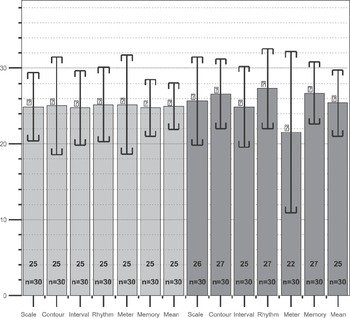
None of the GBEA subtests violated normality as measured by the Kolmogorov–Smirnov and the Shapiro–Wilk’s tests; thus, we set the cutoff point at 2 SDs below the mean for each test. Conversely, all of MBEA’s tests violated normality except for the meter test, because data are skewed toward the higher scores. In the original validation study of the MBEA all of the subtests violated normality for the same reason. Means, SDs, and cutoff points for the Greek subjects in both batteries are shown at Table 1. The means of the Greek population in the GBEA are lower than those at the original version of MBEA as validated by Peretz et al. (Reference Peretz, Champod and Hyde2003), but the cutoff scores still lay above chance. The boxplot of the confidence intervals for both batteries is shown in Figure 3. None of the control participants scored below cutoff in more than one test in any of the batteries.
Confidence intervals for each test. Error bars show Mean +/- 2 SD. The left (light gray) bars are for the Greek Battery of Evaluation of Amusia (GBEA) and the right (dark gray) are for the Montreal Battery of Evaluation of Amusias (MBEA).

Means, SD, and cutoff points for each test

Note
MBEA = Montreal Battery of Evaluation of Amusias; GBEA = Greek Battery of Evaluation of Amusia.
A supplementary analysis was performed to reveal if the Greek sample scored differently in the meters of 9/8 versus 2/4 for GBEA. A t test analysis was chosen for the comparison of the two means and revealed no statistical difference [t(29) = .328; p = .745].
Correlations
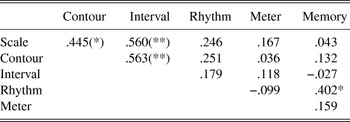
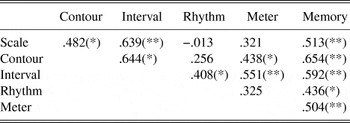
Correlations among GBEA’s six tests showed that the three melodic tests had significant correlations among them; furthermore, the memory test correlated with rhythm test. Results can be seen in Table 2. The correlations among MBEA’s subtests in the Greek sample are similar to those of GBEA (see Table 3).
Pearson correlations among the six tests of the GBEA in the Greek sample

Note
GBEA = Greek Battery of Evaluation of Amusia. **Correlation is significant at the .01 level (two-tailed). *Correlation is significant at the .05 level (two-tailed).
Pearson correlations among the six tests of the MBEA in the Greek sample

Note
MBEA = Montreal Battery of Evaluation of Amusia. **Correlation is significant at the .01 level (two-tailed). *Correlation is significant at the .05 level (two-tailed).
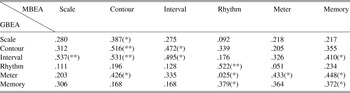
When we compared each test of the GBEA with the same test in MBEA, we found that they correlated significantly with each other except of the scale test (see Table 4).
Pearson correlations of the homologous subtests of each battery

Note
**Correlation is significant at the .01 level (two-tailed). *Correlation is significant at the .05 level (two-tailed).
Fluctuation of the Participants Score Across Each Battery’s Subtests
A repeated-measures analysis of variance (ANOVA) was used to examine the Greek sample’s scores on GBEA to those of MBEA for each subtest. The repeated measures ANOVA had two within-subjects factors: one with two levels (GBEA and MBEA), and one with six levels (each subtest). The repeated-measures ANOVA revealed an interaction between the two factors [F(3.374, 97.839) = 15.515; p = .000]. Two supplementary ANOVAs (one for each battery) were used in order to explain the interaction and revealed that the participants performed at the same level in all GBEA tests [F(3.606, 104.58) = .212; p = .957]. The above observation suggests a stability of the participants’ performance across the battery’s subtests. On the contrary, the Greek participants’ performance on MBEA subscales was more variable [F(2.634, 76.398) = 20.831; p = .000]. Pairwise comparisons showed that, in the MBEA’s subscale of meter, the Greek sample scored significantly lower than any other subtest of the battery (Figure 3). Also, in the MBEA interval test, the participants scored significantly lower. Bonferroni correction was used for the pairwise comparison.
Results of a Congenitally Amusic Participant
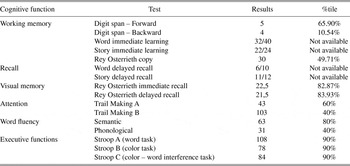
The MBEA as well as the GBEA have been formulated to assess deficits in music perception. Moreover, the MBEA has been particularly useful in successfully assessing deficits in congenital amusias (Peretz & Hyde, Reference Peretz and Hyde2003). If the GBEA was a sensitive tool for amusia assessment, we would expect that the battery would successfully differentiate amusic individuals from the normal population. Here we present the case of B.Z. a congenitally amusic individual as assessed by the GBEA. B.Z. is a right-handed woman aged 63, with higher education (MD and PhD in Medical Sciences) who did not report any other neurological symptoms or head injuries but reported that she always had problems in dancing and remembering the music of songs and/or tunes. B.Z.’s audiometric test results were as follows: a) Left ear (250 Hz = 25 db, 500 Hz = 25 db, 1000 Hz = 35 db, 2000 Hz = 50 db, 4000 Hz = 60 db, and 6000 Hz = 80 db); b) Right ear (250 Hz = 35 db, 500 Hz = 30 db, 1000 Hz = 30 db, 2000 Hz = 45 db, 4000 Hz = 50 db, 6000 Hz = 110 db, and 8000 Hz = 75 db). The elevated threshold in 6000 Hz in the right ear was not expected to affect the amusia evaluation procedure because her hearing was normal in both ears until 4000 Hz, which is already higher than the highest note of the battery. B.Z. was also tested for other neurocognitive abilities (i.e., working memory, recall, visual memory, attention, executive functions, word fluency). B.Z.’s results on the neuropsychological tests are listed on Table 5 showing that she has no other deficit.
B.Z. results on the neuropsychological tests

We compared B.Z.’s performance with the performance of control participants on GBEA. B.Z. scored 2 SDs below the mean, that is, below the cutoff points, in both the melodic and the meter subtests of the GBEA, and on the cutoff point in the memory subtest. On the contrary, results of B.Z. in MBEA are not clear. In the melodic subtests, she scored below the cutoff point in one subtest (contour), right on the cutoff point in another (interval), and above the cutoff point in the scale subtest. In the temporal subtests, she scored above the cutoff point (i.e., normal) in both the meter and the rhythm tests. She also scored below the cutoff point in the memory subtest. The statistical significance of the above mentioned results is also confirmed by the Crawford and Garthwaite (Reference Crawford and Garthwaite2002) modified t tests. B.Z.’s results are shown in Table 6 compared with the norms obtained from the Greek population for both batteries.
B.Z. results compared with the normative data

Note
MBEA = Montreal Battery of Evaluation of Amusias; GBEA = Greek Battery of Evaluation of Amusia. *Significantly different from the population using Crawford & Garthwaite (Reference Crawford and Garthwaite2002) modified t test.
Given the fact that BZ complained she was always off-tune and could not find the rhythm to dance, it is surprising that she could score that high in a meter and rhythm test (as she did for these tests in MBEA). However, her scores in the meter and rhythm tests of GBEA are in accordance to her impairment.
DISCUSSION
The goal of this study was to stress the issue of cultural concerns for music perception and provide a way to quantify and measure it. We developed a Greek/Eastern version of the MBEA, the GBEA that could be used for cultures that share the Middle-Eastern tradition, and we compared the performance of a Greek population sample in both batteries. We further validated its sensitivity through a case of congenital amusia.
A point we would like to comment on is that the means and the cutoff scores for each test of GBEA are lower than those reported for MBEA (Peretz et al., Reference Peretz, Champod and Hyde2003). However, they do lie above chance. The scores in the GBEA did not violate normality; they were not skewed toward the higher scores but rather gathered near the center. This reinforces the ability of the battery to distinguish between normal and abnormal performance. On the contrary, the scores of the Greek sample in the MBEA violated normality and were significantly lower than in the original validation study in the Canadian (Western) sample (Peretz et al., Reference Peretz, Champod and Hyde2003). This finding suggests that the Greek population is not as good as the Western population on the MBEA. As for the GBEA, the confidence intervals are higher than chance level (15/30) and the normality of the scores reinforces the diagnostic value of the battery. The fact that, in the meter test of MBEA, the confidence interval is lower than the chance level but the homologous test in GBEA is significantly higher than that indicates that the Greek population does not have good representation of the two meters used in the original MBEA battery (waltz and march). Therefore, this particular subtest could not constitute a reliable test for evaluating the Greek population.
ANOVA results indicated that participants had significant stability on the way they scored on GBEA’s subscales, suggesting that each test of the battery has the same degree of difficulty and thus has equal diagnostic value. Quite the reverse image is indicated by the results of the Greek population on MBEA, which suggests that two of the tests (meter and interval perception tests) are more difficult than the others, for the specific population. Therefore, the diagnostic value of MBEA’s meter and interval subtests for the Greek population is limited (e.g., in the meter test the cutoff score was much lower (11/30) than chance level).
Two alternatives may explain the differences in the results obtained from the Greek population in GBEA and MBEA. According to the first hypothesis, GBEA’s subtests of contour, rhythm, and musical memory may simply be more difficult than MBEA’s homologous tests (i.e., the difference of the performance in the two batteries is due to the stimuli). However, the differences are small (two cutoff points) that this would not be significant, and therefore, it would not explain the problematic performance in the meter test of MBEA for the Greek sample. According to the second hypothesis, the Greek population, although exposed to both cultures (Western and Greek/Eastern), still has a better representation of the Greek/Eastern musical idiom which is more prevailing in the culture and is more prominent in the different musical meters used in this part of the world. In this case, the difference is ascribed to the population (see Pennanen, Reference Pennanen1997, for a more thorough discussion for the differences between musical idioms).
The cultural effect on the meter perception confirms the hypothesis that the perception of meter regularity is not just a psychoacoustic parameter, but rather a higher cognitive function which can be influenced by cultural differences probably due to the influence of the repertoire module (musical lexicon). Brattico (2001) showed that an event-related potential (ERP), called Mismatch Negativity (MMN), was significantly larger in the condition of listening to culturally familiar intervals than in the condition of listening to unfamiliar intervals signifying that the brain is more sensitive to the familiar culture. Moreover, tapping the foot in time to a piece of music is found to be susceptible to cultural differentiation (Cross, Reference Cross, Peretz and Zatorre2003). Similarly, North America adults had difficulty producing complex metrical patterns based on two different 7/8 meters common in Balkan music, especially in the absence of exogenous signals (Snyder, Hannon, Large, & Christiansen, Reference Snyder, Hannon, Large and Christiansen2006). Cultural influence on meter and rhythm perception and production seems to be at play in the performance of the Greek sample in the original MBEA, because the meters of waltz and march are not common in the traditional Greek music but meters such as zeibekiko and hasaposerviko are, and this discrepancy can lead to a diminished, or less accurate, cognitive representation of the unfamiliar meters.
The results of the first amusic individual tested are only indicative, because we do not have age matched controls, but still shed more light in to the cultural differences of the two populations. B.Z.’s results on the two batteries indicate that she has deficits in music perception and that these deficits are more evident when she is evaluated with the GBEA. The fact that B.Z.’s deficits are more evident when she is evaluated with the GBEA as well as the significantly poorer performance of the Greek sample on MBEA compared to their own performance on GBEA point out that the Greek/Eastern populations may not have a good representation of the Western musical culture and, therefore, produced lower means and larger SDs in the normative data of MBEA, lowering the cutoff scores of each test and thus lowering the diagnostic value of the battery.
B.Z.’s performance in the meter test is worth further commenting. In this test, B.Z. scored well below the cutoff score in the GBEA but not in the MBEA. This could be attributed to the complexity of the meter zeibekiko (9/8) used in the GBEA. In the Greek sample’s normative data, results did not differentiate between the two meters used in the GBEA; on the contrary, B.Z. had a tendency to favor the simple meter of hasaposerviko (2/4) and to ignore the complex meter of zeibekiko (9/8). She recognized correctly 9 out of 15 hasaposerviko tunes [percentile = 9.948%, which is not statistically different from the control group, according to Crawford and Garthwaite (Reference Crawford and Garthwaite2002) modified t tests t(29) = ˗−1.314; p = .198], but only 6 of 15 zeibekiko tunes [percentile = 0.342%; t(29) = ˗−2.912; p = .006]. This is the first time that a congenital impairment in meter perception has been reported, emphasizing the value of studying cultural specific issues of music perception.
As already noted, Peretz’s (Reference Peretz and Rapp2001) model of music perception separates the music perception system in two routes. The melodic route (containing the modules of contour, interval, and tonal encoding) is homogenous while the temporal route seems to be separated into the two different modules: rhythm and meter. In our study, the correlation analyses of the six tests for both batteries revealed that the temporal tests of rhythm and meter did not correlate with each other while the melodic tests correlated significantly among them. This finding is in agreement with the model according to which the battery is build and supports the idea that rhythm and meter are processed by different modules, that belong, however, to the same route (Peretz, Reference Peretz and Rapp2001). Additionally, the fact that the three melodic tests correlate among them confirms that the melodic route takes into account the information extracted from contour, interval and scale. Overall, the above results confirm the model’s predictions and show that the cognitive organization of music perception is similar in the Greek/Eastern and Western cultures.
Conclusions
The present validation of the GBEA showed that the battery reliably evaluates different aspects of music perception in populations of different musical tradition, that is, Greek/Eastern, while the original MBEA may not be as appropriate for this population especially with regard to meter perception. However, additional studies are needed to replicate these initial but encouraging results and determine which cultural aspects may affect music perception. This battery could provide new and interesting data about the musical ability of non-Western populations living in the Balkans and the east Mediterranean and become a useful tool in order to evaluate cultural aspects of musical perception. Our results show that, besides cultural issues concerning musical perception of melodic and temporal aspects of the different musical genres, the cognitive organization of music perception as described before in Peretz (Reference Peretz and Rapp2001) and Peretz and Coltheart (Reference Peretz and Coltheart2003) is similar in the Greek/Eastern and Western cultures.
ACKNOWLEDGMENTS
There are no sources of financial support, and no conflicts exist.