Highlights
-
Understanding farmers’ preferences and willingness to pay (WTP) for varietal traits is critical for demand-driven varietal development.
-
We investigate preferences and WTP for traits of groundnut varieties for 1299 groundnut farmers using choice experiments in Tanzania.
-
Farmers have strong preferences for groundnut varieties that are high-yielding, tolerant to environmental stresses, early-maturing, red-colored, and fetching high grain prices.
-
Farmers are willing to pay the highest premium for high-yielding attribute, closely followed by the tolerance trait.
-
A latent class analysis identifies four distinct classes of farmers, with notable distinction between preferences of consumption-oriented and market-oriented farmer classes.
Introduction
Improved crop varieties hold great potential for improving agricultural productivity and welfare of smallholder farmers in the developing world (Kostandini et al., Reference Kostandini, Mills and Mykerezi2011; Maredia et al., Reference Maredia, Byerlee and Pee2000). However, despite demonstrated productivity gains, adoption rates of improved varieties of many crops remain disappointingly low (Miriti et al., Reference Miriti, Regassa, Ojiewo and Melesse2023). The literature has put forward several complementary explanations, including missing markets for risk and credit (Karlan et al., Reference Karlan, Osei, Osei-Akoto and Udry2014; Regassa et al., Reference Regassa, Degnet and Melesse2023), limited information and social networks (Shikuku and Melesse, Reference Shikuku and Melesse2020), and behavioral constraints (Duflo et al., Reference Duflo, Kremer and Robinson2011). An alternative explanation could be that improved varieties do not possess traits that farmers value most. For example, Lunduka et al. (Reference Lunduka, Fisher and Snapp2012) reported that farmers’ interests in a diversity of traits explained adoption plateaus for modern varieties in Malawi.
The adoption of improved varieties essentially depends on farmers’ demand and willingness to pay (WTP) for the varieties. Commonly, participatory variety selection approaches are employed in crop breeding during variety development, testing, and release (Magaisa et al., Reference Magaisa, Manjeru, Kamutando and Moyo2022). However, there is a continued debate about whether current breeding priorities are adequately considering farmer preferences and needs (Lunduka et al., Reference Lunduka, Fisher and Snapp2012; Valle et al. Reference Valle, Arnaud, Marimo and van Etten2022) and whether improved varieties are adapted to heterogeneous farmers’ preferences (Miriti et al., Reference Miriti, Regassa, Ojiewo and Melesse2023). Further, improving a typical trait would involve potential trade-offs with other traits that could compromise expected adoption and impact of a variety (Enid et al., Reference Enid, Enoch and Rosemary2015). However, participatory approaches do not allow quantifying the strength and heterogeneity of farmers’ preferences and WTP for traits.
In this study, we use a choice experiments (CE) approach to evaluate farmers’ preferences for traits of groundnut varieties, estimate WTP for each trait, and explore the heterogeneity in preferences in Tanzania. Groundnut (Arachis hypogaea L.) is an important crop to smallholder farmers in Tanzania as a source of income and high-quality protein for food and fodder and contributes to soil fertility improvement (Akpo et al., Reference Akpo, Muricho, Lukurugu, Opie, Ojiewo and Varshney2020; Daudi et al., Reference Daudi, Shimelis, Laing, Okori and Mponda2018). Over the years, more than 17 relevant improved varieties of groundnut have been developed and released by international and national agricultural research systems in Tanzania (Mwalongo et al., Reference Mwalongo, Akpo, Lukurugu, Muricho, Vernooy, Minja, Ojiewo, Njuguna, Otieno and Varshney2020). While the development of these varieties is laudable, they have not been adopted at scale (Akpo et al., Reference Akpo, Muricho, Lukurugu, Opie, Ojiewo and Varshney2020; Daudi et al., Reference Daudi, Shimelis, Laing, Okori and Mponda2018). Most of these cultivars are developed based on conventional breeding approaches, primarily focusing on yield and disease-resistance traits. While important, agronomic traits alone may not be enough predictors of demand for improved varieties (Macours, Reference Macours2019).
In response, there is growing interest in understanding pathways linking the development of technologies with their widespread and sustained adoption (Noriega et al., Reference Noriega, Halewood, Galluzzi, Vernooy, Bertacchini, Gauchan and Welch2013). A specific focus has been on better understanding of farmers’ preferences and integration of these preferences into breeding programs. As clients of breeding, groundnut farmers are both producers and consumers of the crop. This has two implications for breeding systems. First, it highlights the need for breeding programs to address traits that appeal to both producers and consumers. Second, it calls for dual market policies that strike a balance between favorable seed prices and attractive grain market prices, which necessitates understanding trade-offs that farmers are willing to make between seed and grain prices.
Our analysis draws upon detailed CE and survey data collected from a relatively large sample of Tanzanian groundnut farmers. The CE involves six key attributes of groundnut: yield, tolerance to environmental stresses (disease, pest, and drought), maturity period, grain price, seed color, and seed price. The analytical strategy combines a mixed logit model and latent class analysis (LCA). Our results reveal that all selected attributes are significant determinants of varietal choice but are valued by farmers in varying degrees. Farmers place the highest value on high-yielding trait, closely followed by tolerance to environmental stresses. However, we observe considerable heterogeneity in farmers’ preferences across attributes. Exploiting this heterogeneity, a latent class model identified four segments of farmers. These results have important implications for demand-driven variety development, breeding priority setting, and targeted dissemination of improved groundnut varieties. Notably, they can inform breeding programs to develop market-oriented product profiles, and seed systems efforts to design targeted marketing strategies to disseminate new varieties.
The rest of the paper is organized as follows: “Production and Importance of Groundnut in Tanzania” presents the production and economic importance of groundnut in Tanzania. “Material and Methods” describes the study sample, data, and design of the CE. “Results and Discussion” reports the results, while “Conclusions and Policy Implications” concludes.
Production and Importance of Groundnut in Tanzania
Groundnut (Arachis hypogaea L.) is an economically important crop for smallholder farmers in Tanzania. With the total annual production of about 690 000 tons over an area of approximately one million hectares and more than one million participating smallholder farmers, groundnut is ranked the second most important oil seed/nuts in Tanzania after common beans (FAOSTAT, 2020). The major groundnut-growing regions in Tanzania are Dodoma, Tabora, Shinyanga, Singida, Mtwara, and Mwanza where production is dominated by subsistence farmers in rainfed systems (Daudi et al., Reference Daudi, Shimelis, Laing, Okori and Mponda2018).
Groundnut plays a critical role in poverty reduction, improving smallholders’ nutrition and health, and increasing the sustainability of farming systems. It is a nutritious legume that is a rich source of quality vegetable oils (48–50%), protein (26–28%), minerals, dietary fibers, and vitamins (Pasupuleti et al., Reference Pasupuleti, Nigam, Pandey, Nagesh and Varshney2013). Groundnut has the capacity to fix nitrogen and grow in low fertility environments, recycle nutrients from deep in the subsoil, and is used in intercropping and rotation (Akpo et al., Reference Akpo, Muricho, Lukurugu, Opie, Ojiewo and Varshney2020). Thus, groundnut contributes to optimizing rural livelihood resilience.
Despite its economic importance, productivity of groundnut in Tanzania remains low. The unshelled yield is about 0.69 tons/ha compared with the global average of about 1.8 tons/ha (FAOSTAT, 2020). The low yields have partly been attributed to various abiotic and biotic stresses, including groundnut rosette disease, rust, and early- and late-leaf spot (Daudi et al., Reference Daudi, Shimelis, Laing, Okori and Mponda2018). Increased use of improved groundnut cultivars and production technologies is essential for overcoming these stressors and boosting crop yields (Akpo et al., Reference Akpo, Muricho, Lukurugu, Opie, Ojiewo and Varshney2020). Taken together, over 17 relevant improved groundnut varieties have been released in Tanzania to date (Mwalongo et al., Reference Mwalongo, Akpo, Lukurugu, Muricho, Vernooy, Minja, Ojiewo, Njuguna, Otieno and Varshney2020). Relevant varieties are those that are released for commercial purposes with proper seed multiplication and maintenance mechanisms (Weissmann et al., Reference Weissmann, Yadav, Seth, Udaya Bhaskar and Dadlani2023).
Despite these achievements in breeding, adoption of improved groundnut varieties is limited, and local varieties remain the main source of seeds for farmers (Akpo et al., Reference Akpo, Muricho, Lukurugu, Opie, Ojiewo and Varshney2020). Understanding farmers’ preferences for new varieties and their traits is key for demand-driven breeding that ensures the adoption of the new technologies at scale. Preferences for traits could also evolve over time, shaped by occurrence of plant diseases and frequent climate change. Previous studies have employed cost and profitability models and qualitative approaches to assess preferences for breeding attributes (Akpo et al., Reference Akpo, Muricho, Lukurugu, Opie, Ojiewo and Varshney2020; Daudi et al., Reference Daudi, Shimelis, Laing, Okori and Mponda2018). However, these assessments do not provide quantitative information on the relative importance of the attributes and the heterogeneity in trait preferences. This paper uses a discrete CE that allows evaluation of farmers’ preferences for attributes and trade-offs between various desired breeding attributes. It uses latent class analysis to exploit the heterogeneity in preferences and map groundnut farmers into classes.
Material and Methods
Data and descriptive statistics
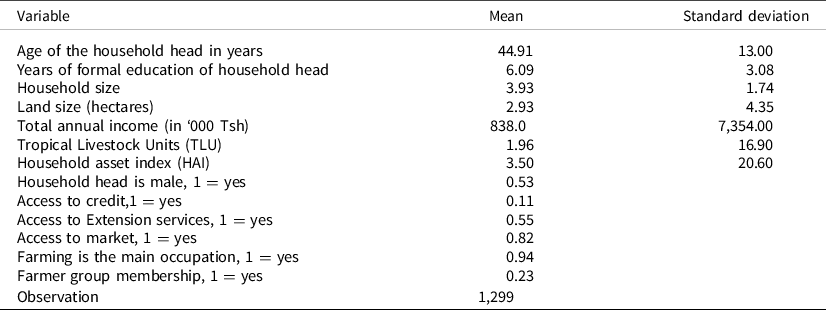
Data for this study were collected from groundnut farmers selected using a multistage sampling design in Tanzania. First, six main groundnut-growing regions in Tanzania were purposively selected. These regions included Dodoma, Mtwara, Shinyanga, Singida, Songwe, and Tabora. Second, eight districts were selected from these six regions, depending on geographical size and groundnut production potential of the regions. The districts were Bukombe, Bahi, Kahama, Kaliua, Mbozi, Mkalama, Mpwapwa, and Nanyumbu. Third, 20 villages were randomly selected, two villages from each district. The final stage involved random selection of representative households using proportionate-to-size method from village sampling frames. This resulted in a sample of 1299 groundnut farmers. Data were collected in December 2019 through face-to-face interviews using tablets and administered by well-trained local enumerators. The questionnaire was pretested, and necessary adjustments were made to the framing of the questions for the actual data collection. Table 1 contains main characteristics of the sample households.
Socioeconomic characteristics of sample households

Source: Household survey (2019) in Tanzania.
The majority (53%) of the households were headed by men with about four family members. The average respondent was about 45 years old, with six years of formal education. Households pursued a mixed crop-livestock production, with 94% depending on farming as the main source of livelihood working on about three hectares of land and a livestock herd of about two tropical livestock units (TLU). Footnote 1 The average annual household income was Tanzanian Shillings (Tsh) 837, 970 (about USA$365). About 82%, 55%, and 11% had reported access to market, extension, and credit services, respectively, in the last 12 months prior to the survey. Less than one-third reported membership in at least one form of farmer group.
Choice experiment design and analytical framework
Discrete choice experiment design
Recent applications of CE reveal the versatility of the method in various development domains. The approach has been used, for instance, in assessing consumer preferences for food products and quality and safety attributes (Jada et al., Reference Jada, Melesse and van den Berg2022; Pambo et al., Reference Pambo, Otieno and Okello2017), preferences for animal welfare attributes (Otieno and Ogutu, Reference Otieno and Ogutu2020), designing of policies (Latacz-Lohmann and Breustedt, Reference Latacz-Lohmann and Breustedt2019; Regassa et.al, Reference Regassa, Abate and Kubik2021), and modeling farmers’ preferences and WTP for crop attributes (Enid et al., Reference Enid, Enoch and Rosemary2015; Miriti et al., Reference Miriti, Regassa, Ojiewo and Melesse2023).
In this study, the CE approach is motivated by several reasons. First, there are no well-functioning seed markets for groundnut varieties in Tanzania, and reliable data on seed sales remain very scarce. Second, even when markets for varieties do exist, it would be difficult to identify effects of each trait on farmers’ choices based on market data. For instance, grain and seed prices may not be exogenously determined. While their values are likely to change over time and space, they are also likely to be correlated with the most (if not all) of the attributes included in the CE. That is why it is difficult to isolate the contribution of the attributes in the setting of revealed preference data due to the potential correlation of these attributes with other attributes. However, CEs effectively deal with two major drawbacks of using revealed preference data; namely, the invariance of attribute levels in revealed preferences and multicollinearity among attributes of varieties being valued. Choice experiments take the likelihood of consideration of each attribute over the many repeated choices and by design permit the analyst to disentangle the contribution of each of the attributes to overall utility (Hensher and Greene, Reference Hensher and Greene2003; Train, Reference Train2009). Third, choice experiment analyses capture the nuances of decision-making that can provide insights into trade-offs between different traits.
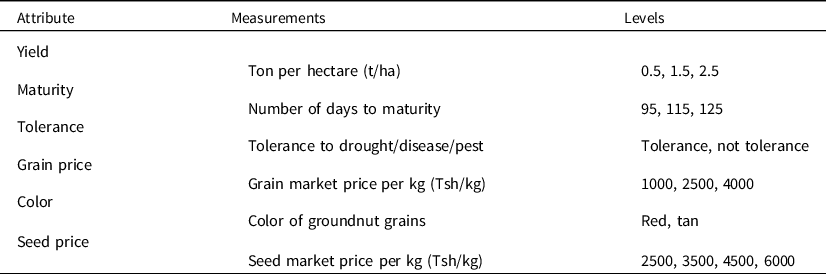
Using the Lancaster’s (Reference Lancaster1966) framework, we consider groundnut varieties as bundles of attributes. Considering the number of measurable, plausible, and actionable attributes, we identified six relevant groundnut attributes that constitute main interests of farmers’ groundnut variety choices. These attributes are yield, maturity, grain price, color, tolerance to environmental stresses (drought, disease, and pest), and seed price (Table 2). The choice of these attributes was guided by an extensive literature review, validated through consultation with breeders and scientists and focus group discussions with farmers. Finally, a pre-test was conducted to check whether the attributes were relevant and whether levels for each attribute were plausible and understandable for farmers.
Groundnut seed attributes used in the choice experiment

Source: Constructed by authors.
Yield, maturity, and tolerance are agronomic attributes. Yield levels were determined by the minimum, average, and maximum yield based on data from experimental stations and farmer surveys. Likewise, attributes of maturity were defined by minimum, average, and maximum maturity days. Tolerance, defined broadly as the ability to withstand environmental stresses, including drought, diseases, and pests, had two levels – tolerance and not tolerance. Admittedly, defined this way, tolerance attribute is too broad, and differentiating across tolerance to drought, diseases, and pests might have resulted in more specific and relevant insights. However, this would have, at the same time, complicated the choice experiment design significantly and hence the cognitive burden to respondents (see below). Commonly for experiments involving less educated subjects, such as ours, having fewer attributes is recommended to ensure effective trade-offs in choices and minimize the cognitive burden of respondents (Kuhfeld, Reference Kuhfeld2010). Furthermore, since these challenges are often interdependent (e.g. diseases/pests happen during high/low rainfall), farmers have problem of differentiating desirable varieties in relation to a specific shock in isolation. Therefore, bundling together the three challenges helps respondents to interpret the attributes relative to the main and the frequent challenges they encounter. Furthermore, the result from the pre-test suggested that the attribute is well understood.
Color is an important trait that is used as a proxy for preference for consumption and value in the market. Color was defined as the color of the grain, with two known groundnut colors in Tanzania: red and tan. Lastly, groundnut seed and grain prices were included to capture producer demand for seed and consumer demand for grain, as well as to facilitate estimation of trade-offs for traits. Levels of these attributes were derived from data in local markets for grain and improved seed. The inclusion of the grain price may merit further discussion. First, grain price may be endogenous with respect to other attributes considered in our choices, but this is addressed by the design of the choice experiment. Second, it is clearly not defined in advance but may also depend on a number of factors that change over time. Conceptually, it is expected that farmers would consider the market demand for their produce when they decide on the adoption of improved varieties and choice of their seeds. We included current grain price as attribute based on the argument that it is a cursor to the general grain market condition.
Designs of discrete CEs require striking a proper balance between the ability to estimate desired effects and the practicality and cognitive complexity of the choice task. The choice of six attributes is recommended to ensure effective trade-offs in choices and minimize cognitive burden of respondents (Kuhfeld, Reference Kuhfeld2010). A full factorial design based on the attributes and their corresponding levels gives 432 (=33 × 22 × 4) choices. However, working with all choices is not practically feasible. Instead, the D–optimal fractional factorial design was used to generate choice sets that allow estimation of all main effects. The design offers an efficient combination of orthogonality, level balance, and minimum overlap, and reduces predicted parameter standard errors (Kuhfeld, Reference Kuhfeld2010). This process generated 36 choice sets using random selection without replacement. Further, the 36 choice sets were randomly divided into six blocks using statistical analysis system macros. Thus, each respondent made six choices, with each choice set consisting of two groundnut variety alternatives (variety alternatives 1 and 2) and an opt-out option (alternative 3). The main goal of the opt-out option is that respondents are not forced to choose an unsatisfactory option, which reflects real market practices. Alternatively, the opt-out option represents current groundnut varieties grown by farmers, i.e., the status quo. Respondents were provided with a description of the task, an explanation of attributes and their levels, and an outline of how to make a choice. The tasks were presented to farmers on laminated cards. Table A1 in the supplementary material provides detailed instructions, definitions of attributes, and a sample choice set. In total, 23 382 choice sets were produced from 1,299 households.
The CE part of the survey started with an explanation of the importance of farmers’ participation in developing seed technologies. This step is critical to reduce information asymmetry among respondents, thereby improving response rate and quality of response. Participation was completely voluntary, and respondents offered their consent to participate. Respondents were told that they could opt out of the survey at any time with no penalty. Respondents were informed that groundnut variety alternatives presented to them differed only in the six attributes under consideration and that all other unstated attributes are the same for the two alternatives in a choice set. They were also provided with the so-called ‘consequential clause’ that their responses would be used by policymakers, breeders, and seed companies to develop and produce new groundnut varieties. This helps to attenuate the concern with hypothetical bias that may influence choices given the strong credence attributes of seeds. Using such an introductory statement helps to frame respondents’ minds to translate the hypothetical scenarios into real-life decisions (Cummings and Taylor, Reference Cummings and Taylor1999).
Analytical framework
The random utility theory (RUT) provides a good basis for analyzing individuals’ choice behavior. It is consistent with Lancastrian demand theory that individuals view the goods and services they purchase as a bundle of attributes. Individuals derive utility from these attributes rather than from the good or service as a whole (Lancaster, Reference Lancaster1966). A key assumption is that attributes are well-known and measurable, based on which preference models can be estimated. This possibility rests on the random utility maximization hypothesis that individuals act rationally and make choices to maximize their utility.
Groundnut farmers made a series of choices from the available two alternative varieties, or neither, based on their preferences for the attributes of the varieties. Assuming a linear indirect functional form, the utility that a farmer n obtains from alternative groundnut seed j in choice situation
 ${\rm{\;}}t$
, labeled
 ${U_{njt}}$
, is expressed as a function of a systematic component
 ${V_{njt}}$
, and a random component,
 ${\varepsilon _{njt}}$
:
 $${U_{njt}} = {V_{njt}} + {\varepsilon _{njt}}$$
The stochastic component captures unobserved variations in tastes as well as errors in farmer’s perceptions and optimization. It could also come from latent individual characteristics and measurement errors. We estimate a probabilistic utility function, as individuals’ true utility function cannot be observed. Assuming that a farmer can choose between two alternatives of groundnut seed, i and j, based on the desired bundle of breeding attributes, then the probability that alternative i is chosen is given by:
 $${P_i} = Prob\left( {{U_i} \gt {U_j}} \right) = Prob\left( {{V_i} + {\varepsilon _i} \gt {V_j} + {\varepsilon _j}} \right) = Prob\left( {{V_i} - {\varepsilon _i} \gt {V_j} - {\varepsilon _j}} \right);\;{\forall _i} \ne j\;\;$$
From Equation (2), it can be inferred that the difference in observed utility increases with higher probability of choosing an alternative.
For a more decisive application of RUT, we borrow a leaf from assumptions of neoclassical theory that farmers have complete, stable, and consistent preferences and that their indifference curve is continuous. The continuity axiom eliminates the possibility of lexicographic orderings, like dominant preferences, and ensures the concept of trade-off, i.e., marginal rate of substitution. Discrete choice models, particularly conditional logit and random parameter logit (RPL) (mixed logit), are used to model choice behavior because of their consistency with the RUT (McFadden and Train, Reference McFadden and Train2000). We use the mixed logit model because, unlike the conditional logit, the mixed logit relaxes the independence of irrelevant alternatives (IIA) assumption by allowing heterogeneity of preferences for observed attributes.
The systemic or measurable component of farmers’ utility is a function of observable attributes of the groundnut seed (
 $X)$
. Thus, we first model a mixed logit by specifying the utility derived by individual n from alternative j in a choice situation
 ${\rm{\;}}t$
as:
 $${U_{njt}} = {\beta _n}{X_{njt}} + {\varepsilon _{njt}}$$
where
 ${X_{nj}}$
are the attributes that relate to the alternative and the decision-maker,
 ${\beta _n}$
is a vector of coefficients representing the individual’s tastes and preferences, and
 ${\varepsilon _{nj}}$
is an independently identically distributed (iid) random term. From Equation (3), the probability that individual n chooses alternative j in choice scenario t is specified as:
 $${L_{njt}}\left( {{\beta _n}} \right) = {{{\rm{exp}}\;\left( {{\beta _n}{X_{njt}}} \right)} \over {\sum\nolimits_{j \in C} {{\rm{exp}}} \left( {{\beta _n}{X_{njt}}} \right)}}\;$$
In cases where individual choice preferences
 ${\beta _n}$
do not vary in repeated choice tasks but remain heterogeneous for all respondents, the probability is specified as:
 $${G_n}\left( {{\beta _n}} \right) = \mathop \prod \nolimits_t {L_{njt}}\left( {{\beta _n}} \right)\;$$
The unconditional probability for the sequence of choices made by individual n is expressed as:
 $${P_n}\left( \theta \right) = \int {G_n}\left( {{\beta _n}} \right)f\left( {{\beta _n}\theta } \right)d{\beta _n}$$
The coefficients vary among decision-makers in the population with density
 $f\left( {{\beta _n}\theta } \right)$
. This density is a function of parameter θ that represents the mean and covariance of the βs in the population. The RPL seeks to specify the function
 $f\left( {{\beta _n}\theta } \right)$
and estimate the parameter
 $\theta $
through a maximum log-likelihood based on simulation of the choice probability. The log-likelihood function is specified as:
 $$LL\left( \theta \right) = \mathop \sum \limits_n Ln{P_n}\left( \theta \right)$$
First, we draw a value of β from
 $f\left( {{\beta _n}\theta } \right)$
and label it β
r with the superscript r = 1 referring to the first draw. Secondly, the logit formula, L
nj
(β
n
r
) is calculated with the draw obtained from step one. Steps 1 and 2 are repeated several times before averaging the results. The average is the simulated probability given by:
 $${\hat P_{nj}} = {1 \over R}\sum\limits_{r = 1}^R {{L_{nj}}} \left( {\beta _n^r} \right)$$
where R is the number of draws and is an unbiased estimator of
 ${\hat P_{nj}}$
by construction. The value of
 ${\hat P_{nj}}$
is twice differentiable in the parameter
 $\theta $
and variable x, which facilitates the numerical search for the maximum likelihood function and the calculation of elasticities. Then, the simulated probabilities are inserted into the log-likelihood function to give a simulated log-likelihood (SLL) function as:
 $$SLL = \mathop \sum \limits_{n = 1}^N \mathop \sum \limits_{j = 1}^J {d_{nj}}{\hat P_{nj}}\;$$
where
 ${d_{nj}} = 1$
if a respondent chooses j and zero otherwise. Thus, the maximum simulated likelihood estimator is the value of
 $\theta $
that maximizes SLL. This procedure maintains independence over decision-makers of simulated probabilities that enter SLL. Further, following Train and Weeks (Reference Train, Weeks, Scarpa and Alberini2005), we estimated the WTP in WTP space by reparametrizing the mixed logit model so that the coefficients estimated directly represent trade-offs or marginal utilities for the various attributes that individuals are willing to make. The WTP in WTP space produces more robust WTP estimates than the traditional approach where WTP is estimated as a simple ratio of the non-price attributes to the price attribute. The WTP in WTP space also allows to distinguish variations in preferences versus scale heterogeneity.
Once individual preferences are modeled, we conduct aLCA to identify distinct farmer groups that are homogenous within a group and heterogeneous across groups with underlying preferences and characteristics. The results of such analysis inform tailored policy recommendations that target different farmer classes. The LCA analysis is also based on the RUT, but
 $f\left( \beta \right)$
is discrete, taking S distinct values based on sociodemographic variables (Greene and Hensher, Reference Greene and Hensher2003). The probability that farmer
 $n$
selects alternative j in choice scenario t is given as:
 $${P_{njt}} = {{\exp \;(X_{njt}'{\beta _s})} \over {\sum\nolimits_k {\exp } (X_{knjt}'{\beta _s})}}{P_{ns}};\,\,S = 1,2,.. \ldots, K$$
where
 ${\beta _S}$
is the specific parameter vector for class
 $S$
, and
 ${P_{ns}}$
is the probability that farmer
 $n\;\;$
is grouped under class
 $S$
, which could be specified as:
 $${P_{ns}} = \mathop { {{\exp (\gamma_s' \;{Z_n})} \over {\sum\nolimits_{s=1}^s {{\exp (\gamma_s' \;{Z_n})}}}} }\;$$
where
 ${\rm{\gamma }}_s'$
denotes class-specific vector of estimated parameters, and
 ${Z_n}$
represents individual sociodemographic characteristics. For the sake of model identification, estimated parameters of the last class S are usually normalized to zero and results from the other classes are compared relative to this class (Boxall and Adamowicz, Reference Boxall and Adamowicz2002). Substituting Equation (11) into Equation (10) results:
 $${P_{njt}} = \mathop \sum \nolimits_{s = 1}^S \left[ {\left( {{\exp (\gamma_s' \;{Z_n})} \over {\sum\nolimits_{s=1}^s {{\exp (\gamma_s' \;{Z_n})}}}} \right)} \right]$$
This enables us to simultaneously estimate both the attribute preference parameter
 ${\beta _s}$
and socioeconomic characteristics parameter
 ${\gamma _s}$
for every latent class (Boxall and Adamowicz, Reference Boxall and Adamowicz2002). We estimate the model using the maximum likelihood technique. Since we hypothesize that farmers’ preferences for groundnut seed are guided by specific attributes, we can think of this as demand for groundnut seed varieties subject to these desired attributes. As a result, farmers derive utility/disutility based on these preferred attributes, which allows evaluation of WTP for specific attributes.
Results and Discussion
Preferences for groundnut attributes
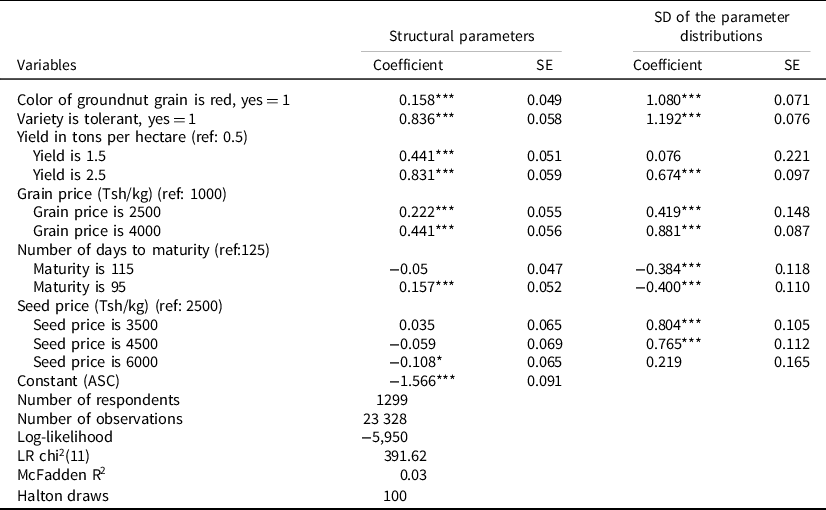
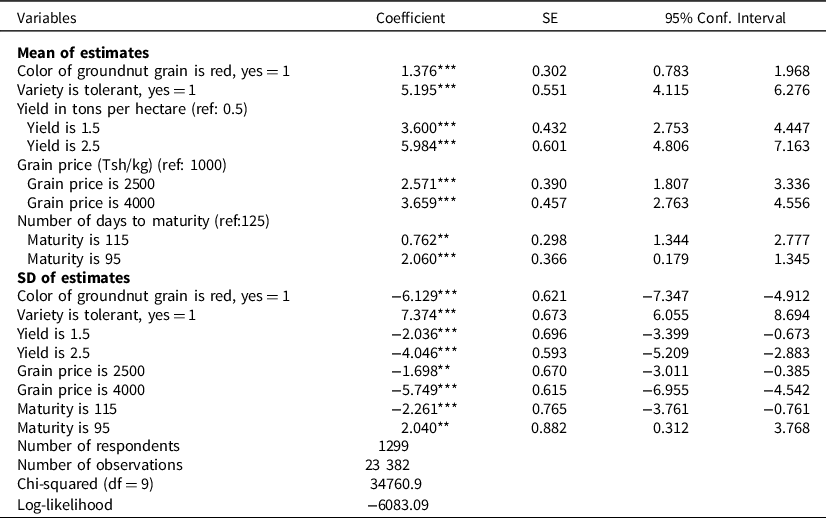
We estimate a mixed logit model, where all choice parameters are specified as random and assumed to be normally distributed to allow for positive and negative preferences for each attribute. The results are presented in Table 3. Our results show that all the six included attributes significantly explain farmers’ varietal choices but in varying degrees. High-yielding and tolerant varieties are strongly preferred by farmers. The reference yield level of 0.5 tons/ha is closely comparable to the current yield level (about 0.69 tons/ha) for groundnuts in Tanzania. Our estimates indicate that an increase in the yield level to either 1.5 tons/ha or 2.5 tons/ha is strongly preferred (p < 0.001). While the choices of 1.5 and 2.5 tons/ha are hypothetically considered in the choice experiments, these yield levels are attainable targets given that the current global average yield level is about 1.8 tons/ha (FAOSTAT, 2020). Farmers also have strong preference for tolerant groundnut varieties (p < 0.001). The preference for tolerance varieties is consistent with risk-coping strategy of smallholder farmers in developing countries. While farmers are interested in yield, they also consider tolerance of such varieties to local conditions, notably pests and diseases, to reduce crop failures (Marenya et al., Reference Marenya, Wanyama, Alemu and Woyengo2021; Wale and Chianu, Reference Wale and Chianu2015).
Maximum simulated likelihood estimates of the mixed logit model

*** and * represent statistical significance at 1% and 10% level, respectively. SE = standard errors; SD = standard deviations indicating preference heterogeneity in mean; ASC = alternative-specific constant.
Our results indicate that farmers prefer groundnut seed varieties with the 95 days to maturity much more than the reference category of 125 days to maturity (p < 0.001). The preference for early-maturing varieties reflects farmers’ desire to lower the cost of production related to input usage, overcome unpredictable weather patterns, and have multiple crop cycles in a season per crop field. Early-maturing varieties also help poor households to bridge lean season consumption shocks. The coefficient of red color attribute is positive and significant. This indicates the positive marginal utility associated with red groundnut, which is appealing to market (Mwalongo et al., Reference Mwalongo, Akpo, Lukurugu, Muricho, Vernooy, Minja, Ojiewo, Njuguna, Otieno and Varshney2020). Using a participatory rural appraisal approach, Daudi et al. (Reference Daudi, Shimelis, Laing, Okori and Mponda2018) reported that yield, tolerance to environmental stresses, early maturity, and red color were groundnut attributes preferred by Tanzanian farmers. While the coefficients of grain prices are positive, the coefficients of seed prices are negative (Table 3). Seed price is one of the components of costs of crop production. Seed prices generally account for a considerable share of the total cost of production for smallholder farmers in developing countries (Food and Agriculture Organization, 2016). Thus, the significant and negative preference for high seed price indicates farmers’ disutility with high production costs. On the other hand, together with the strong preference for high-yield varieties, the strong preference for high-market value (high grain prices) is consistent with income-maximizing behavior of farmers (Oyinbo et al., Reference Oyinbo, Chamberlin, Vanlauwe, Vranken, Kamara, Craufurd and Maertens2019).
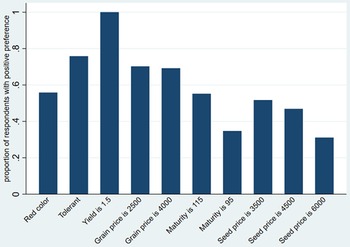
The parameter corresponding to the alternative-specific constant is defined as a binary variable that takes a value of zero if either alternatives variety 1 or 2 was chosen and 1 if the respondent chooses the ‘opt-out’ option; hence, it represents the status quo. It is negative and significant, indicating that farmers prefer the choice of varieties to current groundnut varieties and their respective attributes. This means that farmers have a strong demand for improvements in current groundnut varieties. To further reinforce this, we produced Figure 1 which indicates the proportion of groundnut farmers that had a positive preference for included attributes. Footnote 2 Generally, groundnut farmers value improvements in all groundnut attributes, though in varying degrees. All farmers prefer improvement of the yield level to 1.5 tons/ha. Given the current yield of about 0.69 tons/ha in Tanzania and the global average of about 1.8 tons/ha (FAOSTAT, 2020), farmers perhaps consider 1.5 tons/ha as the realistic target for yield improvement. More than half of the farmers prefer improvement in tolerance to environmental stresses of the existing varieties. Overall, improvements in the color of current varieties (to red), grain prices, and early maturity are valued positively by groundnut farmers.
Proportion of respondents with positive preference for attributes.

Finally, the last two columns of Table 3 contain information on standard deviations associated with mean preference parameter estimates and their standard errors calculated over 100 Halton draws. Except for yield (1.5) and seed price (6000), standard deviation coefficients are statistically significant, indicating considerable preference heterogeneity among farmers for attributes. In “Latent class analyses”, we use an LCA to explore the heterogeneity in trait preferences to identify distinct classes of farmers.
Willingness to pay for groundnut attributes
Table 4 provides the WTP estimated using the WTP space for groundnut attributes. Technically, the WTP estimates represent the value farmers attach to different attributes and measure implicit prices of possible trade-offs across traits. It is important to note that the interpretation of the WTP for attributes is not interpreted separately. In fact, the interpretation of the WTP for attributes is conditional on three implicit consideration: a) the reference value of each attribute; b) the decision to choose a specific attribute is not a standalone in choices of farmers, but bundled with other attributes (but the variations in the repeated choices allow to specifically estimate the WTP for a specific attribute); and c) this valuation is also, at least in the choice experiment setting, independent of unstated attributes of groundnuts. In our design, the issue in (c) is addressed in two ways. First, farmers are informed that groundnut variety alternatives presented to them differed only in the six attributes under consideration and that all other unstated attributes are the same for the two alternatives in a choice set. Second, our analysis uses the mixed logit that relaxes the IIA assumption by allowing heterogeneity of preferences for observed attributes.
Willingness-to-pay (WTP) estimates for groundnut attributes, ’000 Tsh

*** and ** represent statistical significance at 1% and 5% levels, respectively. SE = standard errors; SD = standard deviations.
Consistent with preferences, farmers are generally willing to pay a positive premium for improved variety attributes. Groundnut farmers are willing to pay the highest premium for high-yield potential. They are willing to pay up to Tsh 5,984 (about USA$2.6) for variety that yields 2.5 tons per hectare, while the average WTP for a variety that yields 1.5 tons per hectare is Tsh 3,600 compared with the reference variety that yields in 0.5 tons per hectare. These findings are consistent with other studies in a similar setting (e.g. Marenya et al., Reference Marenya, Wanyama, Alemu and Woyengo2021) and support farmers’ high demand for high-yield groundnut varieties.
Tolerance is the second most important trait for farmers, with WTP of up to Tsh 5,195 for tolerant groundnut varieties compared with non-tolerant ones. Tolerance is expected to be important in Tanzania since crops are susceptible to recurring adverse climatic and agronomic conditions, like drought, disease, and pests (Arndt et al., Reference Arndt, Farmer, Strzepek and Thurlow2012). Particularly, strong challenges are posed by groundnut diseases due to various abiotic and biotic stresses, including groundnut rosette disease, rust, and early- and late-leaf spots (Daudi et al., Reference Daudi, Shimelis, Laing, Okori and Mponda2018). Tolerant crop varieties not only give high yields but also lower production costs for farmers (Okori et al., Reference Okori, Chirwa, Chisale, Jumbo, Makumba, Makumbi, Matumba, Mosha, Munthali, Nadigatla, Ngowi, Njeru, Ochieng, Setimela, Swai and Tarekegne2022). Studies have indicated that the use of tolerant crop varieties reduces the probability of crop failure and the production cost that farmers could have incurred for purchasing herbicides and chemicals to control pests and diseases (Zhao et al., Reference Zhao, Marek, Liu, Harrison and Xue2022).
Farmers are willing to pay the third highest premium to groundnut varieties that would fetch high grain market price. Compared to a seed variety that could be sold for Tsh 1000 per kilogram, farmers are willing to pay Tsh 3,659 for a variety that could be sold for Tsh 4,000 per kilogram. Similarly, the average farmer’s WTP for a variety that could raise Tsh 2,500 per kilogram in the market is Tsh 2,571. This shows that farmers were willing to pay from Tsh 1.2 to Tsh 1.7 for every additional Shilling that a groundnut grain generates from the market. Interestingly, this indicates that farmers were willing to pay 20–70% more money than the immediate revenue from grain prices. This premium may be interpreted as the present value of all the future earnings from the preferred variety across subsequent production cycles. This is consistent with the observation that market opportunity and demand are important drivers of agricultural technology adoption (Singbo et al., Reference Singbo, Badolo, Lokossou and Affognon2021). However, as emphasized, this valuation for varieties that can be sold for a specific price probably should not be treated in separation from other attributes, such as yield and tolerance to environmental stress. While farmers value varieties that attract high prices for their grain produce, this valuation is normally considered in the context of bundling several important attributes of improved groundnut varieties.
Similarly, farmers are willing to pay premiums for early-maturing varieties. Specifically, they are willing to pay Tsh 2,060 and Tsh 762 for groundnut varieties that take 95 days and 115 days to mature, respectively, compared to varieties that would take 125 days to mature. Finally, groundnut farmers are willing to pay, on average, Tsh 1,376 for varieties that are red in color compared to tan-colored varieties. Farmers’ willingness to pay premiums for early-maturing crops and market-desirable grain colors are also reported in other studies (Miriti et al., Reference Miriti, Regassa, Ojiewo and Melesse2023; Wale and Chianu, Reference Wale and Chianu2015).
Latent class analyses
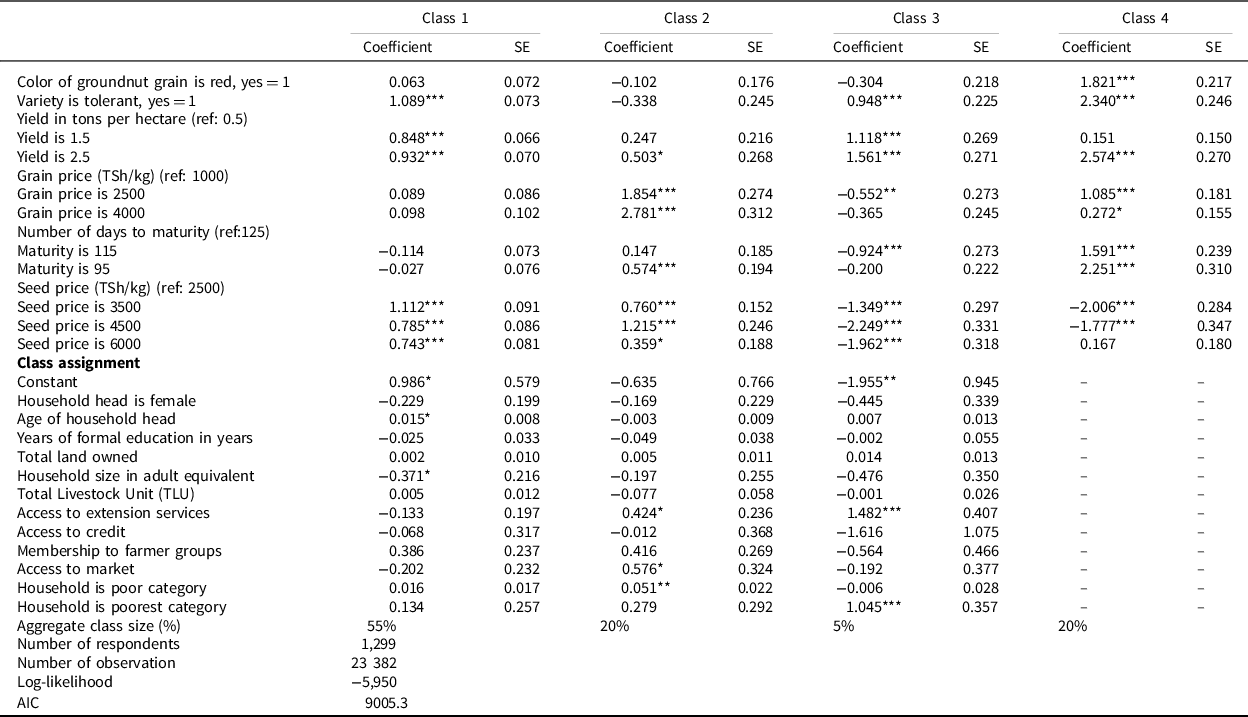
The first procedure in LCA involves model selection, i.e., determining the number of optimal classes based on a model that minimizes the information criteria (AIC, BIC) (Scarpa and Thiene, Reference Scarpa and Thiene2005). We selected a model with four classes based on model fit statistics (the lowest values of AIC = 9005.33 and BIC = 8922.33), reasonable class sizes (
 $\ge$
5%), and logical interpretation of the classes. Table 5 contains the estimated results for a 4-class model, showing the preference structure and relative importance of the attributes within each class. The LCA reveals preferences are heterogeneous, based on which classes with distinct preference structures are possible. Indeed, parameter coefficients for the different latent classes are significantly different.
Regression results of the LCA with four classes

***, ** and * represent statistical significance at 1%, 5% and 10% levels, respectively. SE = standard errors; LCA = latent class analysis.
We carefully consider patterns of preferences to specific attributes to name and label the different classes. Specifically, clear patterns are observed in market-related attributes, such as color and grain price. Farmers in classes 1 and 3 are less interested in grain prices, and farmers in class 2 and class 4 have much stronger preferences for grain prices. Class 4 farmers are also particularly more sensitive to the color of groundnut grain. Another important differentiating sociodemographic variable is ‘access to market’. Compared to class 4 farmers, the parameter estimate is positive and significant only for class 2 farmers. For farmers in classes 1 and 3, the estimates are negative but not significant. Following this, farmers in classes 1 and 3 are broadly classified as ‘consumption-oriented’ groundnut growers, while those in classes 2 and 4 are considered as ‘market-oriented’ groundnut growers.
Farmers in classes 1 and 3 have a predicted class share of 55% and 5%, respectively. Choices of farmers in these classes are not driven by grain prices and are indifferent to groundnut seed color. The negative significance of medium-maturity (relative to long-maturity) for both classes is consistent with the use of crops as a saving mechanism. Additionally, class 3 farmers have strong negative preferences for both grain prices and seed prices. This suggests that class 3 farmers tend to be pure subsistence groundnut producers, where their own consumption is a main driver for growing groundnut. On the other hand, farmers in classes 2 and 4 constitute class share of 20% each. They have relatively stronger preferences for market-related traits, such as grain prices and red-colored groundnut varieties, and can broadly be labeled as market-oriented small-scale farmers. Between the two groups, class 4 farmers seem small-scale semi-commercial farmers, as they respond less to grain prices but more to seed prices and tolerance. Farmers in class 2 may largely be considered small-scale commercial-oriented farmers. Overall, the distinction between consumption- and market-oriented groups of farmers is more evident when we consider market-related attributes. Otherwise, while both consumption- and market-oriented growers do care about yield and tolerance, market-oriented growers (particularly those in class 4) showed more stronger preference for yield and tolerance than farmers in classes 1 and 3.
Furthermore, we have included various socioeconomic variables in the latent class model to explain the probability of class membership (Table 5), with class 4 as a reference category. Footnote 3 Class 1 farmers – net consumers – differ from class 4 farmers – market-oriented farmers – in terms of household size and age of the household head. Class 2 farmers are more likely to have better access to extension services and membership to farmer groups but are poorer than farmers in class 4. Class 3 farmers are more likely to be headed by males and have better access to extension services but are poorer compared to class 4 farmers. In general, class 4 farmers are wealthier than other classes. Lastly, the constant is significant for classes 1 and 3, showing difference in the reserve utility associated with the opt-out choice between these two classes and the reference class 4.
In order to further characterize classes of farmers, we report statistical differences comparing across profiles of farmers in all four classes (Table A3 in the Supplementary material). Statistical differences across profiles of farmers support class descriptions presented in terms of elicited preferences. Classes 1 and 3 constitute farmers who are typically headed by male and older members. They tend to own more livestock and constitute larger share of households at the bottom 20% of the wealth distribution. However, there are notable differences between farmers in classes 1 and 3. Compared to class 1 farmers, class 3 farmers have lower access to market and credit and are predominantly crop producers (larger farm size) but less reliant on livestock. But they have better access to extension services, which is consistent with the extension services in Africa that focus on food security. Class 3 farmers are also poorer, have larger family sizes, and are predominantly male-headed. On the other hand, farmers in class 1 are headed by older and male farmers with high levels of farmer group membership and access to credit. They have lower average landholding and the highest TLU across the four classes, showing that farmers in this class are more engaged in livestock production than other classes.
Classes 2 and 4 are more market-oriented and constitute relatively larger share of female-headed households, which is consistent with the view that groundnut is women’s crop (Daudi et al., Reference Daudi, Shimelis, Laing, Okori and Mponda2018). Class 4 farmers are marginally more male-headed and wealthier, with larger family sizes and better levels of education. Alternatively, farmers in class 2 are dominated by households of female and younger heads than class 4 farmers. They have the least TLU and larger land ownership, suggesting a focus on crop production instead of livestock production.
Overall, our results provide important implications for policy and breeding programs. Specifically, LCA reveals substantial heterogeneity in preferences among farmers, which is masked by the aggregate analysis. A clear distinction is between preferences of consumption-oriented and market-oriented classes. However, preferences of the market-oriented farmers appear to be dominant. For example, farmers prefer red-colored groundnuts because of their market appeal in the whole sample analysis. The implication is that part of the sampled farmers preferred attributes of groundnut different from the traits preferred by the overall sample. Breeding programs should be aware that not all farmers would welcome a change in a specific attribute of a variety, implying the need for targeting. Thus, breeding programs need to weigh the potential market size before scarce resources are committed to improving an attribute.
Further, our findings have implications for constraints of adoption of improved varieties by specific groups of farmers. Generally, various sociodemographic and institutional factors, such as tenure status, land size, wealth, and education, are important determinants of adoption of agricultural technologies in developing countries (Feder et al., Reference Feder, Just and Zilberman1985). However, our results suggest that there are significant heterogeneities in importance of these factors across different classes of farmers. For instance, smallholder farmers’ market access (and participation) is an important driver of adoption of agricultural technologies in low-income countries (Singbo et al., Reference Singbo, Badolo, Lokossou and Affognon2021). The idea is that variations in access to markets give rise to spatial biases, which hinder access to information on the new technologies and their potential in the market. But the findings of this paper show that market access is likely to be an important determinant of technology choice only for market-oriented groundnut growers.
Consumption-oriented farmers are typically headed by male and older household heads, tend to own more livestock, and constitute larger share of households at the bottom 20% of the wealth distribution. These farmers possess typical characteristics of self-subsistence small-scale farmers whose focus is primarily on farming for survival but often incapable of generating enough food for the family (Giller et al., Reference Giller, Delaune, Silva, van Wijk, Hammond, Descheemaeker, van de Ven, Schut, Taulya, Chikowo and Andersson2021). As is common in Africa, these farmers are likely to be targeted for improving food security outcomes by development efforts, such as extension services and credit services, which is supported by our data. Subsistence production systems are dominated by staple crop production, and cash inflows do not arrive when inputs are needed to be purchased due to high seasonality of economic activities (Christiaensen, Reference Christiaensen2017). As a result, these households face binding liquidity constraints to finance improved varieties (Regassa et al., Reference Regassa, Degnet and Melesse2023). On the other hand, market-oriented groundnut farmers may have relatively better capacity to adopt improved varieties. Consistently, the present study indicates that these farmers are wealthier with larger family sizes and better levels of education. Farmers with higher levels of education are more likely to easily access, analyze, and understand information about new varieties, which enable them to adopt these technologies (Feder et al., Reference Feder, Just and Zilberman1985).
Conclusions and Policy Implications
Understanding farmers’ preferences for varietal traits is critical for demand-driven varietal development and designing strategies that accelerate uptake by farmers. However, the complexity of farmers’ varietal choices makes the analysis of benefits or risks of changes in attributes from revealed preference data challenging. In this study, we use discrete choice experiments to evaluate Tanzanian farmers’ preferences for traits of groundnut varieties. Using a mixed logit and latent class models, we estimate implicit prices that farmers attach to each groundnut attribute, quantify potential trade-offs between attributes, and explore underlying heterogeneities in preferences for different traits. Such insights are useful for staple crops, as smallholder farmers’ production and consumption preferences are likely to be non-separable.
Our results reveal that farmers have strong preferences for groundnut varieties that are high-yielding, tolerant to environmental stresses, early-maturing, red in color, and fetching high grain market prices. Farmers’ willingness to pay is consistent with their preferences. Farmers place the highest value on the high-yielding attribute, closely followed by the tolerance trait. While farmers consider yield in varietal choices, they also consider the suitability of these varieties to local environments. The lowest WTP is attached to groundnut varieties that would take long to mature. These findings reveal that farmers are willing to pay premiums in terms of higher seed prices for groundnut varieties with appealing attributes. Overall, while research has considerably succeeded in developing relatively high-yielding and stress-tolerant groundnut varieties in Tanzania, there is still demand for more improvement in these traits, as demonstrated by high WTP estimates. Further, preferences for groundnut traits are heterogeneous across sampled farmers. The latent class analysis produces four different classes of farmers with distinct preference structures compared to the sample mean. A clear distinction is between preferences of consumption-oriented and market-oriented farmers. This is an interesting result that would not have been revealed by the mean preference structure of the whole sample.
Our results have important implications for demand-driven variety development, breeding priority setting, and targeted dissemination of improved varieties in Tanzania. First, our results can be useful for breeders to identify farmer-preferred traits. Importantly, breeding programs need to be mindful of the importance of non-agronomic traits, like grain market price and color, in the development of breeding product profiles. Capturing consumer-preferred traits could help increase demand for new varieties and speed up varietal adoption and replacement. Second, breeding programs need to consider the heterogeneity in farmers’ preferences for groundnut attributes. Our latent class analysis results suggest that farmers can be distinguished into four classes, which is useful information for market segmentation and trait prioritization. In other words, breeding programs need to be aware that not all farmers would welcome a change in an attribute of a variety. Specifically, breeding programs need to assess whether varieties with specific bundle of attributes correspond to sufficiently large demand to justify research investments and account for heterogeneity in preferences.
Third, the results highlight that trait-based promotion and marketing of varieties may offer an effective strategy to promote adoption of improved varieties. For instance, providing information on the performance of most valued attributes at the point of sale can be more convincing for farmers in adopting a variety. However, the challenge is that farmers can observe the quality and performance of a seed only after it is purchased and used in the field. To further complicate matters, the performance of a seed is likely to depend on many factors that are unrelated to the variety itself (e.g., rainfall patterns). For example, the improved performance of a new drought-tolerant variety will only be noticed by farmers during years of poor rainfall. This challenge is likely to be compounded by other aspects of the technology adoption process. Adopting agricultural technologies involves uncertainty and trade-offs for smallholder farmers. Also, information on the costs and benefits of adopting technologies in agriculture is often imperfect. As such, decisions to adopt improved varieties are made in a climate of uncertainty with a large element of ‘trial and error’ in their application, and the speed and extent of adoption vary considerably among farmers (Lambrecht et al., Reference Lambrecht, Vanlauwe, Merckx and Maertens2014). Fourth, our results can be useful for policymakers about potential economic benefits and costs related to varietal development to make informed decisions regarding resource allocation. Breeders and development partners should understand possible trade-offs in farmers’ preferences for seed attributes and prioritize investments in breeding programs that improve more valued traits, as they are likely to gain widespread adoption among smallholder farmers.
Finally, two caveats may warrant further qualification in the consideration of the implications of our results. First, we define the ‘tolerance’ attribute broadly as the ability to withstand environmental stresses, including drought, diseases, and pests. Our aim in bundling the three aspects of tolerance was to strike a proper balance between the ability to estimate desired effects and the practicality and cognitive complexity of the choice tasks in the design of the experiment. However, distinguishing the tolerance of a variety across these three conditions may better inform policy. Second, the data for our study were collected in 2019 and thus might involve some degree of time lag in farmers’ preferences for and valuation of attributes. This concern may be relevant to the willingness-to-pay estimates, as farmers’ valuation of attributes might be affected by other factors and priorities changing over time and space. However, the concern is less likely to be significant for farmers’ preferences for attributes of groundnut varieties for different reasons. First, factors, such as climate change and environmental stresses, have only become more pronounced. As a result, breeding for climate change adaptation is currently high on the development research agenda. Second, the marginal values of the WTP for groundnut attributes are considerably substantial, which may not be met in such a short time, as new varietal development is often based on incremental improvement of a trait or two. This is especially true, as groundnut is cultivated by a large number of farmers in Tanzania, where a substantial proportion of them positively value improvements in all considered groundnut attributes compared to current groundnut varieties (see Figure 1).
Generally, this concern speaks to a well-known challenge to plant breeding that cultivars are developed on a time lag because of the costly and time-consuming traditional breeding programs based on innovations through in planta and field-based experiments (Kusmec et al., Reference Kusmec, Zheng, Archontoulis, Ganapathysubramanian, Hu, Wang, Yu and Schnable2021). This originates from the fact that technology development must address new issues and priorities that change over time and space. In response, recent breeding efforts aiming at improving plant breeding processes emphasize the need for efficient and complementary approaches for accelerated breeding and rapid varietal replacement (Cooper et al., Reference Cooper, Messina, Podlich, Totir, Baumgarten, Hausmann, Wright and Graham2014). These new approaches are expected to help develop better-performing, farmer-preferred crop varieties and to decrease the average age of varieties in farmers’ fields, providing real-time adaptation to evolving production systems, markets, and climate change.
Supplementary material
The supplementary material for this article can be found at https://doi.org/10.1017/S0014479723000169
Acknowledgements
We thank Gerald A. Lukurugu and Devotha Mchau for their excellent assistance in data collection. We are also grateful for the time and willingness of the groundnut farmers who participated in the experiment. We thank the editor and the anonymous reviewers for their comments and suggestions on the manuscript. All errors are the sole responsibility of the authors
Financial support
The authors gratefully acknowledge financial support from the Bill and Melinda Gates Foundation through the Accelerated Varietal Improvement and Seed Systems in Africa.
Competing interests
The authors declare none.