Introduction
The concept of self and identity is well documented in a wide variety of academic contexts and ‘has been one of the unifying themes of social sciences for the last twenty years’ (Jenkins, Reference JENKINS2008, p. 28). Much identity work is influenced by the social constructionist paradigm and the writings of Mead (Reference MEAD1934) where identity is seen as a construction created through interactions between the self and the society we live. In a review of identity studies, Cerulo (Reference CERULO1997) notes that many works now refocus attention away from the individual, towards group agency and collective definitions. This observation supports the theory of role identity salience, where the self is viewed as a construction of roles, defined in part by social structure and in part by the individual (Tajfel, Reference TAJFEL1978). Critical to this perspective is the assumption that some roles or allegiances are more salient than others and will therefore have more influence over self-definition (Callero, Reference CALLERO1985). Music ‘plays a fundamental role in the development, negotiation and maintenance of our personal identities’ (MacDonald et al., Reference MACDONALD, HARGREAVES and MIELL2002). It is therefore likely, that for a professional musician, an occupational identity is likely to have a high degree of salience when determining a self-concept.
Work, according to Fouad and Bynner (Reference FOUAD and BYNNER2008) gives an assurance that when a particular identity is established it can remain in the same form for as long as the individual chooses. However, this statement does not take into account the current shift in the concept of employment and career development. As companies respond to economic change and globalisation, traditional long-term contracts and job security ‘where dedicated workers could aspire to a job for life’ (Savickas et al., Reference SAVICKAS, NOTA, ROSSIER, DAUWALDER, DUARTE, GUICHARD, SORESI, ESBROECK and VAN VIANEN2009, p. 3) have declined in favour of short-term contracts and more flexible working patterns. The implication for workers in the 21st century is that they need to ‘embrace flexibility rather than stability, maintain employability and create their own opportunities’ (Savickas et al., Reference SAVICKAS, NOTA, ROSSIER, DAUWALDER, DUARTE, GUICHARD, SORESI, ESBROECK and VAN VIANEN2009, p. 4). What Savickas describes here is the protean career model first introduced by Hall (Reference HALL1976) which he says is ‘shaped more by the individual than by the organisation’ (Hall, Reference HALL1976, p. 201).
It is the protean model that Bennett (Reference BENNETT2009) feels best describes a musician's career trajectory. Although not always desirable, musicians have become accustomed to carving out a freelance career which is largely self-managed. Indeed, Daykin (Reference DAYKIN2005) notes that the responses of musicians as ‘flexible creative workers’ may have relevance for the study of new forms of employment in western societies. However, there are still a considerable number of musicians who enjoy the security of full-time employment in orchestras and opera companies. The study came about because in 2004, one national opera company made a complete chorus of 36 singers redundant. Redundancies also occurred in two London-based opera companies several years previously. In light of the current economic situation, redundancy is now a real concern for all musicians on full-time contracts. The participants of this study had been employed by their respective companies for between 10 and 20 years. Identity formation for these singers is likely to be influenced by working within a stable musical environment. The data presented in this paper are part of a larger, more complex study on the effects of redundancy for opera choristers (for further reading, see Oakland Reference OAKLAND2010, Reference OAKLAND, MACDONALD and FLOWERS2012). This current paper explores the construction of an ‘opera singer identity’ and its fragmentation as a result of job loss.
Identity and the voice
Musical identity is a vibrant topic for exploration throughout a lifespan (MacDonald et al., Reference MACDONALD, HARGREAVES and MIELL2002; Hays & Minchiello, Reference HAYS and MINICHIELLO2005; North & Hargreaves, Reference NORTH and HARGREAVES2008). However, relatively little has been documented that makes specific reference to identity and the voice, particularly in the context of a professional singing career. Hargreaves et al. (Reference HARGREAVES, MIELL, MACDONALD, MacDonald, Hargreaves and Miell2002) state that it is the way in which humans view themselves in relation to culturally defined roles such as violinist, singer, pianist, that are central to our concept of identities in music. This is confirmed by Bennett (Reference BENNETT2007) who found that most performance-based musicians define themselves according to their instrumental speciality. Any understanding of what constitutes a ‘sense of self’ for a singer must also take into account the embodiment of the vocal instrument. As Welch (Reference WELCH, Miell, MacDonald and Hargreaves2005, p. 245) points out, the voice is ‘an essential aspect of our human identity: of who we are, how we feel, how we communicate and how other people experience us’. A singer communicates entirely through their own body and unlike an external musical instrument the voice grows with the body and dies with the body.
Physical attributes play a critical role in determining individual vocal characteristics. For example, vocal colour (the unique quality of a singer's voice) is dependent upon several non-controllable factors such as bone structure, size of vocal chords, gender and age (Welch, Reference WELCH, Miell, MacDonald and Hargreaves2005). Physical appearance also plays a large part in a singer's identity. Kokotsati et al. (Reference KOKOTSAKI, DAVIDSON and COIMBRA2001) investigated the experiences of singing assessment for 42 students of singing. The participants were particularly concerned with body image during assessment procedures. Emphasis on ‘body work’ is a particular issue for contemporary opera singers who are required to have ‘film star’ looks and execute feats of athleticism while still producing a beautiful vocal tone. In addition, an opera singer's ‘sense of self’ is not only bound up in the embodied voice, but also in the theatrical environment where they live and work. Davidson (Reference DAVIDSON, Miell, MacDonald and Hargreaves2005) suggests that a singer is constantly creating a tension between the ‘character’ on stage and the ‘real person’ on stage. She acknowledges the demands that acting can have on a singer's perception of themselves and their performing identity and that there should be further investigation in this area (Davidson, Reference DAVIDSON, MacDonald, Hargreaves and Miell2002), but as yet there is a scarcity of work available.
Work and a musical identity
Several studies are now beginning to emerge that explore the careers of professional musicians, such as the diversity of skills required by the contemporary musician (Mills, Reference MILLS2006; Bennett, Reference BENNETT2007, Reference BENNETT2008, Reference BENNETT2009); the connection between music education and a musician's ability to earn a living (Coulson, Reference COULSON2010); factors contributing to stress in the lives of professional orchestral musicians (Brodsky, Reference BRODSKY2006; Dobson, Reference DOBSON2011); and career development for professional opera singers (Sandgren, Reference SANDGREN2005). According to Bennett (Reference BENNETT2007), the majority of musicians spend more time teaching than performing and many supplement their income with low paid, unskilled or non-music related jobs. Similar findings were made by Mills (Reference MILLS2006) in the ‘Working in Music Project’ undertaken at the Royal College of Music in London between 2001 and 2007. A total of 908 alumni were interviewed and findings showed that 93.5% were still active in music, 82% of whom made their living entirely from music, and only 7% worked entirely outside of music. Although a large percentage of alumni stated that they made their living from music Mills points out that this work encompasses many different industry roles such as teaching and administrative work.
These trends resonate with a report sponsored by Youth Music (Rogers Reference ROGERS2002) which suggested at the time that significant areas within education, training and employment had yet to address the changing realities of being a musician and that the definition of being a musician should be refined in light of these changes. Mills (Reference MILLS2004) defines being a musician in terms of a ‘professional identity’ which describes what musicians do, and a ‘subjective identity’ which describes what musicians believe themselves to be, irrespective of professional validation. The work of Bennett and Mills infers that the subjective identity is highly influential in ‘self-labelling’ as a musician. Mills (Reference MILLS2004) gives the example of ‘performer teachers’ who see themselves more as musicians than teachers, even though the majority of their employment comes from teaching. (For further work on the performer/teacher identity see Connelly et al., Reference CONNELLY and CLANDININ1999; Beijaard et al., Reference BEIJAARD, MEIJER and VERLOOP2004; Tryantafyllaki, Reference TRIANTAFYLLAKI2010). Full-time opera choristers are primarily engaged in the business of performing opera. Therefore, in the context of this study, it is likely that the professional identity of ‘opera singer’ is also congruent with what the singers ‘feel they are’. A freelance chorister may rely more on the subjective identity for self-definition, thereby reducing the reliance on paid work for identity validation.
Career transition
Transition is a natural part of human development and a model by Schlossberg (Reference SCHLOSSBERG1981) attempts to explain the reasons why individuals differ in their ability to adapt to change. Her model identifies three areas that influence adaption to transition: (1) perception of the particular transition; (2) characteristics of pre-transition and post-transition environments; (3) characteristics of the individual. She states that it is not the transition itself that is important but how that transition fits with an individual's situation at the time. Career transition is a widely researched topic in sport psychology and a number of studies have used the model of Schlossberg to understand athletic career transition (Baillie & Danish, Reference BAILLIE and DANISH1992; Sinclair & Orlick, Reference SINCLAIR and ORLICK1993; Parker, Reference PARKER1994). Depending on individual perception of change, it is possible to view transitions as positive life events, or what Moustakes (Reference MOUSTAKES1990, p. 99) calls ‘Symbolic Growth Experiences’, because ‘they create shifts in an individual's attitude to their sense of identity and the selfhood from which one grows’. Subsequently, a number of studies report positive elements from athletic retirement (Sinclair & Orlick, Reference SINCLAIR and ORLICK1993; Perrna et al., Reference PERRNA, AHLGREN and ZAICHKOWSKY1999). In contrast, if transitions are perceived as negative events, ill health and depression can be experienced (Fryer & Fagan, Reference FRYER and FAGAN2003; Waters, Reference WATERS2007).
During the course of their musical involvement, musicians may experience a number of transitions in a variety of different circumstances, such as becoming a music student (Burland & Pitts, Reference BURLAND and PITTS2007) and the transition from music student to professional musician (Burland & Davidson, Reference BURLAND, DAVIDSON and Davidson2004; Creech et al., Reference CREECH, PAPAGEORGI, DUFFY, MORTON, HADDON, POTTER, DE BEZENAC, WHYTON, HIMONIDES and WELCH2008). More specifically, a study by Monks (Reference MONKS2003) investigated the role played by singing during adolescent transition. She found that the participants correlated vocal development with personal development and were more concerned with this relationship than public acknowledgement for their talent. Her findings highlight the amount of influence that the vocal instrument can have on self-awareness during a life transition. Job loss is a major life transition which until now has been a neglected area in music psychology research, possibly because, unlike the professions of sport and dance, being a musician was thought to be a career which could span a lifetime (see Manturzewska, Reference MANTURZEWSKA1990). Research which specifically examines career transition in the music profession may provide valuable information to help singers and other musicians cope with a changing work environment.
Research methods and analysis
Interpretative phenomenological analysis
In accordance with the model of Schlossberg (Reference SCHLOSSBERG1981) this article views transition as an individually orientated process. Interpretative phenomenological analysis (IPA) is concerned with the way individuals make sense of major life experiences. It aims to produce an in-depth account, which encompasses the complexities and contradictions of a particular experience for a particular person. Unlike nomothetic methods which make large-scale claims about human behaviour, it was felt that IPA could offer a richer account of the experience and meaning of redundancy for the participants (for an in-depth discussion of IPA methodology see Smith et al., Reference SMITH, FLOWERS and LARKIN2009). An account of an experience is constructed initially by both researcher and participant during the interview process. Subsequent analysis and interpretation of the written data are likely to be influenced by this relationship. At the time of the investigation, the first author was a professional opera chorister and during the research process a reflexive diary was kept to monitor any pre-conceptions and influences this position might have had on the data collection and subsequent analysis.
Participants
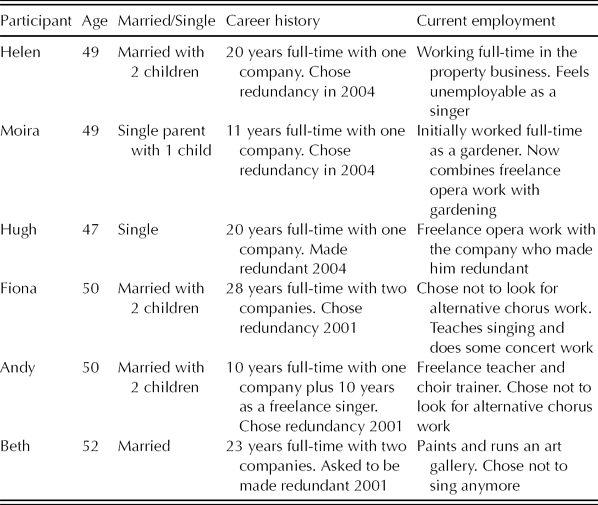
The six participants had all been made redundant from UK opera houses in the previous 10 years (see Table 1). In all cases, redundancy was the result of economic re-structuring of the company they worked for. Participants were recruited through professional contacts of the first author, although no participant was personally known to the author. The singers were initially approached by letter outlining the nature and the purpose of the investigation. During the recruitment process it became clear that for many potential participants the impact of job loss was still very intense. Consequently, a number of singers felt unable to take part in the study due to illness or relationship problems. Criteria for participation were that the singers should have a minimum of 10 years consecutive employment with one company and no longer be in full-time musical employment.
Participant information

Data collection and analysis
Data were collected using face-to-face interviews in the homes of each respective participant. Each interview was preceded by an informal chat intended to develop trust between researcher and participant and create a relaxed atmosphere. The interview schedule was broadly semi-structured in order for each individual to have the freedom to explore potentially sensitive issues at their own pace as well as to lessen any pre-conceptions on the part of the interviewer. Each interview began with the same question: ‘What does singing mean to you?’
Interpretative phenomenological analysis follows a series of stages which systematically identify themes and patterns, first across individual transcripts and then the whole dataset. The process is both rigorous and iterative. Each transcript is analysed in three distinct ways: firstly, for exploratory codes which examine on a line-by-line basis the particular micro-aspects of content, description and language; secondly, for emerging (sub-ordinate) themes, to formulate a sense of what the key themes are within the transcript; thirdly, the relationships between the sub-ordinate themes are examined in terms of how they fit together, or coalesce, into larger, overarching themes (super-ordinate themes). Following the detailed analysis of one transcript, the process is repeated with every transcript carefully considering each case in its own right, in addition to exploring shared commonalities across the transcripts (i.e. what is recurrent). The latter are then transformed into a narrative account which combines textual evidence with researcher interpretation. This paper addresses one recurrent super-ordinate theme, ‘All About Me’. The results section explores three recurrent sub-ordinate themes. These themes encapsulate three main elements of identity formation that were seen to be most influential for the participants when making sense of occupational change, namely, their relationship with singing, the stage, and the job. Interpretation of the data is cautious and the account presented here is intended to be credible but not the only credible interpretation.
Results
Music, singing and ‘me’
This theme explores the impact that redundancy has on the musical elements of identity formation for the participants. At the time of the interviews, differences emerged between the participants who still viewed themselves and their voice as an inseparable unit after being made redundant and those who took a more objective view of their voice. This comment by Moira shows a feeling of total unity with her voice:
You can't separate your voice from who you are. I don't believe you can talk about your singing as a separate thing, it's not like a violin or a pianist, it's you, it's human. (Moira)
Moira's comments highlight the concept of vocal embodiment. She sees her voice as a living entity unable to be separated from Moira the person and in her mind, this sets her apart from instrumentalists. For Moira and Beth, the physical sensations of singing seem to be an essential experience in order to maintain this sense of self:
I need an avenue that I can give energy into, it's part of who I am, it's like a fix, there's nothing like it, it's like sex. (Moira)
When singing works well there's nothing like it, the magical feeling you get, the shiver, it's almost like a drug. (Beth)
Comparisons with sex and drugs imply a fundamental need for the addictive ‘high’ that singing can induce. Neither singer was working professionally at the time of the interview but this does not seem to change their perceptions of the physical act of singing. In contrast, Helen seems unable to relate to her voice in any capacity other than with feelings of loss:
I haven't sung for two years, so singing is still in me, it's within my being but I'm not physically expressing it. Singing was a way of earning a living, and now it's not. (Helen)
Helen's comments refer not only to her loss of work but to the fact that she has not physically sung for two years. Redundancy highlights her reliance on professional work to validate her vocal identity. Although Helen is unable to sing she acknowledges that her voice is still within her. This extracts shows how voice and self are sometimes indistinguishable, whereby a negative life event is also reflected negatively in the voice.
Fiona used to connect her vocal identity with paid work but she now speaks in a different way about the meaning of singing and separates it from her identity:
Singing means energy, expression, not identity now, it was identity for years, it isn't identity now. (Fiona)
Fiona seems to de-value the identity she had as a working singer. Although this may be a coping strategy to deal with the loss of her professional identity, she now appears to have rediscovered the energy ‘fix’ talked about by Beth and Fiona. It is possible that this fundamental aspect of singing may have retreated into the background as a result of many years of routine professional work. After redundancy, Fiona chose to move back to her home town because she felt it would be better for her family. Her current feelings for singing may be a consequence of a more balanced home environment where singing is now only part of her life.
The two male participants both focus on their relationship with music rather than the voice as a means of identification:
Singing isn't the be all and end all for me, I've always been a general musician, it was a way of making a living, satisfying my musical desires, so it wasn't that I was mad keen on opera, I was mad keen on music. (Andy)
This extract shows how Andy sees the voice as a tool to access other areas of musical experience. He prioritises the title of musician over singer which may reflect the current inability of professional work to validate his identity as a singer. Hugh expresses similar feelings for singing when he says ‘I suppose it's never been the be all and end all, I've always had other interests as well’, but the following extract shows the extent of his passion for the music:
. . . you know, the whole colour of music, it kind of nourishes the soul in a way that sitting in an office could never do. (Hugh)
Hugh places music on a par with basic physical needs such as sustenance. Singing in a professional capacity is a way to access this sustenance. Hugh's comments could be likened to those of Beth and Moira who needed the ‘fix’ they got from singing. The drug for Hugh is music rather than singing, but like Andy, this priority may reflect the effect of redundancy on his confidence as a singer.
The extracts presented in this section show that despite redundancy, Moira, Fiona and Beth still experience themselves directly through their voices in a positive manner. Hugh and Andy express a more detached relationship with their voices after redundancy. Instead they turn to music to seek a continuity of self. Only Helen seems to struggle to maintain any coherent sense of a vocal self. These observations suggest that while the relationship between self and voice is highly influential in maintaining an identity, it can also be vulnerable in the event of occupational change.
Me and the stage
The nature of operatic work creates another dimension to ‘self-forming’ due to the addition of the stage and acting requirements. When the participants were no longer able to work on the stage, the delicate balance between stage and real-life was also disrupted. The following, somewhat clichèd comment, shows that Beth has not lost her performing instincts when dealing with loss of work:
The show must go on, my show must go on. (Beth)
She later stated that she had to ‘learn to be an ex-opera singer’ as if learning a new role. There was a feeling throughout the interview that Beth was performing a role and it could be that she uses her ‘stage self’ to protect herself from the distress of redundancy and reinforce her performer's identity.
Using performance as a way of establishing continuity through change is expanded upon in the following extract from Moira:
I'm not a shy little wallflower when I'm away from the stage. Being a singer is attention seeking. I don't want to sit back and let someone else take centre stage. (Moira)
Moira makes no difference between the performing self and the real-life self. She seems to focus more on her need to be the centre of attention than her loss of professional singing work. When she was made redundant Moira enlisted on a gardening course where she was able to find a new stage to provide her with the attention she desired:
I went in as an opera singer and I think I was accepted in the first week and when the principal of the college found out that I had been an opera singer, he brought the local newspaper in and I have a photo of myself – the singing gardener or something like that. (Moira)
Moira still describes herself as an opera singer, even though she is about to enter a non-musical world. The acceptance she refers to appears to be for herself, as a theatrical performer in the wider community, rather than fitting in as a potential gardener. Moira's view of the stage as an integral part of the self is in direct contrast to Andy who appears uncomfortable in his associations with the stage:
. . . some people have that stage persona, they have the stage with them when they go off stage, that they're completely wrapped up in the whole theatre thing and you get other people that do a good job, come off stage and they're just normal blokes at the end of the day. (Andy)
Andy differentiates between colleagues who treat their work as a job and those, perhaps like Moira, who carry the stage with them constantly. He talks about his colleagues being ‘wrapped up’ in the theatre which could suggest that he sees theatrical life as a means to protect the self from real-life. Andy now takes an objective view of his former work, which may be indicative of his withdrawal from the profession.
Helen's description of performance is that of a changing concept of self:
You can be someone else not just the person you are. When you work on a stage you go through life being so many different people and it's challenging to be your own character and work out your own personality. I don't feel comfortable with this person who doesn't do what I do. (Helen)
Helen seems to use the stage to experiment with different selves, but when she ceased to be part of the operatic world she experienced a self with which she was unfamiliar. She talks about herself in the third person as if she is observing a physical body which is functioning in daily life, but one with which she is unable to engage psychologically. Self and body have become separated through the experiences of job loss. The voice, which for Beth and Moira provides a sense of continuity of self during change, is unable to provide Helen with any form of stability.
Working within a theatrical environment can complicate identity formation because the self can be manipulated in many ways, either by the working environment, by personal needs such as a desire for recognition, or a need to escape real life. Performance acts as an agent for Moira and Beth to focus attention on themselves outside the operatic community and for Andy to place distance between himself and his past life. For Helen, loss of performance equates with loss of self.
Me and the job
This theme evaluates the extent to which the singers form an identity through the meaning of work and the status of ‘being an opera singer’. Beth, Fiona and Moira give great value to the title of ‘opera singer’:
I was Beth the opera singer, how I was from say the age of 17, 18. (Beth)
I definitely rode on the fact that I was an opera singer, nothing to do with singing but the name of the job and the level of the job. (Fiona)
I don't want to say I used to be an opera singer. (Moira)
All three extracts highlight the status and self-esteem attached to the title of ‘opera singer’. Beth adopted the title at student level, irrespective of paid employment. Fiona highlights the importance of professional status when she appears to place the job title above her singing abilities. In contrast, the following extract shows how Andy attempts to retain self-esteem when he disassociates himself from the singing profession:
I kind of always classed myself as a classical musician never as an opera singer. I suppose at some time I must have said I'm a singer but I don't think I ever said I was an opera singer ‘cos I've been a musician longer than just a singer. (Andy)
Andy makes clear distinctions between the titles of singer, opera singer and musician. Whereas other participants enjoyed being evaluated by other people's perception of the job this was not the social status sought by Andy. He infers that he is more than ‘just’ a singer which may be a way to compensate for any loss of self-esteem he may have felt through redundancy. Because Andy feels his identity as a musician is more established than his identity as a singer, this may lend stability to the self in crisis.
Loss of full-time work does not necessarily mean loss of career. Theoretically, it was possible for all the participants to look for alternative employment as singers with other companies. However, Helen and Moira were constrained by family commitments and the geographical distance involved in finding alternative singing employment. Helen, Moira and Hugh were offered the chance of freelance employment with the same company but extracts from Helen and Hugh point out the need to take a different approach to this sort of work:
Towards the end when I made the decision to go early I was officially part time and it was awful, it felt like you were nothing on the stage. You were automatically looked on differently, even by colleagues. I was then classed as a part-time chorister and that was the start of the loss of status if you like, it was the beginning of realising that I wasn't going to be the same person. (Helen)
Helen opted for early redundancy one year before the final notices were issued because she felt she was able to regain some control over the situation. However, it meant that she spent her final year working the same hours as her colleagues, but without full-time status. The extract above shows the fragility of artistic identity and its dependence on external validation, particularly from colleagues. Because of her change in work status Helen felt in a different class from colleagues with whom she had worked as an equal for more than 20 years. Hugh also experienced loss of status but coped in a different manner:
As a freelancer you can often be stuck at the back of the stage as just being an extra body, and now I just stand back and let the full-timers get to the front of the stage if they want. As a full-time chorister I think I cared more about the work than I do as an extra chorister. (Hugh)
A commonality between Hugh and Helen is that they both experienced a psychological lack of presence on stage when they were no longer on a permanent contract. Although they were functioning physically on the stage in the way they always had, there was no sense of belonging. Unlike Helen, Hugh could accept the different status by decreasing his loyalty to the job and looking at it purely as a means of earning a living. Singing then becomes a tool of the job rather than a personal contribution to a collective performance.
When Fiona began a new life in a rural community she was reticent to define herself as an opera singer:
When I first came here I didn't want anyone to know I was an opera singer because I thought people would think it was a bit strange, the other side of that is I, well you know, you're at a party and someone says what do you do? Oh I'm an opera singer, and that's it, that's all the conversation from then on and I think, well actually I'm more than just an opera singer. (Fiona)
Even though Fiona is reluctant to acknowledge her operatic past she still talks about ‘my job’ in the present tense which shows the strength of the association. There are contradictions in the way that she does not want to be seen as strange and yet she likes the attention that her former work brings. Fiona now feels that the opera singer label has restricted her throughout her working life and like Andy she talks of being more than just an opera singer but unlike Andy, has yet to fully relinquish the professional title.
For the participants, the role of work in defining the self appears to be influenced by the perceptions of others and this may be symptomatic of a profession where artists are constantly under evaluation by the general public as well as their colleagues. This theme in particular has shown how any renegotiation of identity is also a renegotiation of the self in the community as well the music sector. From the data presented in this theme only Andy has adopted a new professional title. Other singers seem to be in various stages of seeking to redefine themselves but are still reluctant to let go of the perceived social status attached to their job. A longitudinal study may have been able to shed more light on the actual process of the re-negotiation of a professional identity.
To summarise, it appears that for these singers, identity formation was not only influenced by the relationship between self and voice but also by external factors, such as paid work and the perceived status of the job title. The data have shown that although adapting to professional change is an individual process, the singers were in different stages of seeking ways to establish continuity of self by re-evaluating the meaning of singing and professional work.
Discussion
This paper has explored the construction and concept of an ‘opera singer identity’ and the implications that an enforced change to working conditions has for this identity. Data analysis from the six participants has shown that the experience of ‘being an opera singer’ consists of engagement with singing, the stage, music and the operatic profession. Levels of engagement with these elements varied between the participants which in turn influenced their experiences of career disruption. Interpretative phenomenological analysis is concerned with the meaning of individual experience and according to Baumeister (Reference BAUMEISTER1986) it is experience that is the essence of identity formation. He suggests that experience is not necessarily a momentary event, but events that are spread over a period of time and linked together with unity of meaning. In this way the self also takes on a unity across time and a continuity of identity is established. Baumeister also notes that continuity is most under threat when involvement with established experiences changes abruptly. The participants had expected to be opera singers in full-time employment for as long as they chose. When this was not the case, an identity formation that was based around the requirements of the job was disrupted and the singers were forced to re-negotiate an identity in the wider community.
Looking for continuity has been shown to be a key factor in coping with change (Stryker & Burke, Reference STRYKER and BURKE2000; Wise & Millward, Reference WISE and MILLWARD2005). Despite singing being only one aspect of an opera singer's identity, in accordance with the findings of Monks (Reference MONKS2003), the voice appears to be a major resource for the participants to establish an internal coherent sense of self and make sense of the disruption to their lives. All the female singers felt that the physical and psychological stimulation they experienced through singing was an essential part of who they were. For example, although Fiona lost the meaning of singing through the demands of work, redundancy enabled her to rediscover the core elements of singing which helped bring stability to an unstable situation. In a different way, the close proximity of voice and self is highlighted by Helen's inability to sing, whereby loss of the professional self is reflected in a loss of vocal self. However, both male participants claimed that singing had never been the ‘be all and end all’. Their current evaluation of singing may give them more resources to cope with job loss. However, the size of the research sample does not allow wider assumptions to be made and further work is needed to clarify the influence of gender on transition.
If identity formation within music is a socially constructed concept, related to the way society defines or labels musical roles (Hargreaves et al., Reference HARGREAVES, MIELL, MACDONALD, MacDonald, Hargreaves and Miell2002), it is also necessary to understand the meaning and expectations that arise out of association with these culturally defined roles.
The term ‘dance artist’ has been adopted to help dancers cope with the realities of making a living in the contemporary profession (see Bennett, Reference BENNETT2009). Giving a broader definition to the meaning of being a dancer means that professional success need not be judged on performance alone. The term ‘dancer’ then becomes a subjective identity which can form the basis for the development of additional skills in order to sustain a professional career and be better prepared for career transition. Research into sport career transition has shown that greater levels of emotional distress are found in athletes who derive their identity solely from the athletic role (Brewer et al., Reference BREWER, VAN RAALTE and LINDER1993; Alfermann et al., Reference ALFERMANN, STAMBULOVA and ZEMAITYTE2004). While this has positive advantages for athletic performance (Werthner & Orlick, Reference WERTHNER and ORLICK1996) it becomes problematic when an athlete disengages from sport (Miller & Kerr, Reference MILLER and KERR2002). It is possible that encouraging singers to define themselves in broader terms such as a ‘vocal artist’ could help maintain a sense of continuity through professional change, rather like the way Andy now defines himself as a musician. However, the value and status given to the ‘opera singer’ title by the female singers suggests that the social and cultural perceptions of this title may be difficult to change in the short term.
This paper promotes the ‘opera singer identity’ as a professional identity which may become a salient identity during a working life because of the amount of time spent doing the work. However, the findings of this study also show that this identity is underpinned by several sub-identities. Loss of the salient professional identity may have heightened the awareness of the singers to these other, more subjective, identities which they either minimise or prioritise in order to re-negotiate the self in a different social setting. Because the voice will always be a biological part of a person it can be therefore seen as a stable point of reference from which to monitor change. In the event of career disruption not every singer gave the act of singing equal salience, but in different ways, all the participants used the voice as a resource to make sense of a changing self.
Conclusions
There is currently much debate about the role of conservatoires in preparing young musicians for the profession. Bennett (Reference BENNETT2009) documents her concern about the lack of understanding that performing arts graduates have of the profession and that unfortunately, the role models used by these graduates are generally only the most successful performing artists. Although some UK conservatoires are introducing many of the skill acquisitions recommended by Rogers (Reference ROGERS2002), this also presents a dilemma for the music profession. Developing sub-skills and sub-identities may be useful in coping with the unpredictability of a musical career, but artistic excellence requires focus and commitment to a particular role. Therefore, does widening the curricula of a music performer's education ultimately compromise the overall artistic standard of musical performance?
There are undoubtedly changes happening in the singing profession where the focus is less on the voice and more on areas such as musicianship, dance and acting abilities. Age is also becoming an issue due in part to the use of technologies such as video and cinema screening and public expectations of visual glamour. Conservatoires could develop even greater connections with the professional world in order to give students a more honest view of their future career. For example, successful singers could be invited to talk about the realities of their work. The mentoring scheme could be expanded whereby students are attached to an opera company for a certain length of time and shadowed by a professional chorister.
However, developing a flexible singing identity at student level does not help singers already in the profession who may face career transition in the future, either voluntarily or involuntarily. The singers in this study were offered no help or advice from managements. In contrast, the professions of sport and dance have well-established systems in place to help individuals adapt and grow through transition. Professional development is supported using specially trained psychologists. Opera singers have many aspects in common with athletes and dancers because of the focus on the body. If more inter-disciplinary collaboration could be initiated, which resulted in the training of applied music psychologists, singers and their employers could also benefit from this wealth of knowledge.
Jane Oakland gained an MA in Psychology for Musicians from the University of Sheffield. Her PhD with Glasgow Caledonian University investigated the implications of redundancy for a musical identity for professional opera choristers. She is also an experienced professional opera singer. Current research interests are the careers of professional musicians.
Raymond MacDonald is a Professor in the Department of Music at Edinburgh University. Previously he was Professor of Music Psychology and Improvisation at Glasgow Caledonian University. He has published over 70 papers and co-edited four texts, Musical Identities (2002), Musical Communication (2005), Music Health and Wellbeing (2012) and Musical Imaginations (2012). Between 2006 and 2012 he was editor of the journal Psychology of Music and he is currently Associate Editor for The International Journal of Music Education, Musicae Scientae, Jazz Research Journal, Journal of Music Therapy and Research Studies in Music Education.
Paul Flowers is a chartered Health Psychologist and an Academician of the Academy of Social Science. He is an inter-disciplinary applied researcher with particular interests in identities, sexualities, sexual health, interpretative phenomenological analysis and mixed methods research. Broadly speaking he is concerned with focusing upon the contribution of the social sciences to applied research.