Aposematic colouration is widespread among invertebrate species that present chemical defences (Ruxton et al. Reference RUXTON, SHERRATT and SPEED2004). Millipedes commonly feature chemical defence glands along the length of the body (Shear Reference SHEAR2015). Among 16 orders of living millipede, 11 secrete topical irritants, repellents and antifeedant fluids (Shear Reference SHEAR2015, Sierwald & Bond Reference SIERWALD and BOND2007). Allomones, including quinazolinone alkaloids, benzoquinones and hydroquinones have been found in the fluids secreted by millipedes (Shear Reference SHEAR2015). Millipede species that release noxious secretions present several aposematic colouration patterns, and are usually black, or white, with alternating bands or spots in yellow, red, orange and blue (Shear Reference SHEAR2015). For instance, the order Polydesmida encompasses many aposematic species that usually secrete fluids with cyanogenic compounds (Shear Reference SHEAR2015, Sierwald & Bond Reference SIERWALD and BOND2007). In addition, the evolution of aposematic mimicry rings among millipede species support the idea that their warning colouration can effectively increase survival (Marek & Bond Reference MAREK and BOND2009).
Experiments with captive birds and mammals indicate that visually oriented predators can learn to avoid millipedes after experiencing their repugnant liquids (Eisner et al. Reference EISNER, ALSOP, HICKS, MEINWALD, Born, Eichler, Farah, Herken and Welch1978). However, the role of millipede warning colouration in predator avoidance remains poorly explored, especially under field conditions. Brodie & Moore (Reference BRODIE and MOORE1995) addressed the hypothesis that if visually oriented predators avoid attacking millipedes with red-ringed colouration patterns, then coral snakes could be mimicking those aposematic millipedes. They conducted an experiment in a tropical forest in Costa Rica, comparing predation attempts among millipede plasticine replicas simulating warning colouration of millipedes, replicas presenting the coral snake ringed colour pattern and brown control replicas. The authors conclude that red-ringed aposematic millipedes are not good models for snakes to mimic, because millipede replicas were attacked more often by visually oriented predators than coral snake and control replicas. Conversely, Marek et al. (Reference MAREK, PAPAJ, YEAGER, MOLINA and MOORE2011) observed from a field experiment that non-bioluminescent millipedes and replicas had more attack marks by predators than the bioluminescent specimens. Thus, the authors concluded that warning colouration found in some millipedes can be linked to avoidance by nocturnal mammalian predators in temperate forests. However, hitherto studies evaluating the adaptive significance of millipede aposematism and secretion of repugnant fluids are still missing for most species inhabiting tropical ecosystems.
In this study, we evaluated the hypothesis that avian predators represent an important selective pressure favouring the evolution of aposematic colouration in millipedes that present chemical defences. Here, we report the results of a field experiment utilizing artificial replicas of millipedes constructed with plasticine and placed in the natural habitat of an aposematic millipede species. We used a factorial experimental design to test functions of aposematic colouration and secretion of repugnant liquid in predator avoidance. To do so, we assessed the attack patterns to aposematic and non-aposematic replicas applied with repugnant fluid extracted from living millipedes and two control treatments. More specifically, we predicted that marks of attack by visually oriented predators, namely birds, should be frequent on millipede replicas. Furthermore, we predicted that avian predators should attack less the aposematic replicas and those applied with repugnant fluid than non-aposematic and repugnant fluid-free replicas.
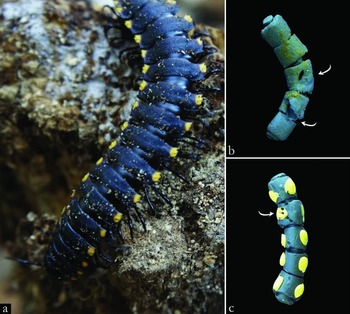
We selected the millipede Odontopeltis aleijadinho Pena-Barbosa, Sierwald & Brescovit, Reference PENA-BARBOSA, SIERWALD and BRESCOVIT2013 (Polydesmida: Chelodesmidae) as the model organism for our experiment, because it presents a typical aposematic pattern. This species can reach 8 cm long and 1.5 cm wide, and its body and legs are dark coloured with the apex of the paranota with bright yellow spots (Figure 1a). According to Marek & Bond (Reference MAREK and BOND2009) species of this order have no eyes and their colouration patterns are not related to sexual selection, but to defence against predators. We carried out this study in Rio Doce State Park (Parque Estadual do Rio Doce – PERD) Minas Gerais state, Brazil (19°40′S, 42°33′W). This site is the species’ type locality (Pena-Barbosa et al. Reference PENA-BARBOSA, SIERWALD and BRESCOVIT2013), allowing us to assume a close connection between O. aleijadinho colour pattern and the selective pressure exerted by predators in its natural habitat. PERD spans an area of nearly 36000 ha, comprising the largest continuous Atlantic Forest remnant in Minas Gerais State and one most important reserve for biodiversity protection in south-eastern Brazil. The study site is around 600 m asl and the vegetation mosaic comprises natural lakes within primary and secondary forests (Campos et al. Reference CAMPOS, VASCONCELOS, RIBEIRO, NEVES and SOARES2006).
The aposematic colouration pattern of Odontopeltis aleijadinho (Polydesmida: Chelodesmidae) in Rio Doce State Park, south-eastern Brazil: the living specimen (a), a non-aposematic replica with V-shaped imprints attributed to avian predators (b), and an aposematic replica with teeth imprints attributed to mammals (c). The arrows indicate the attack marks. Credits for Figure 1a to Chaim Lasmar.

To conduct the experiment, in October 2014 we constructed millipede replicas (6 cm long × 1.5 cm in diameter) with non-toxic plasticine (Acrilex©). This approach have been effectively utilized in field experiments to evaluate predation attempts because plasticine malleability allows inferring the identity of potential predators (Brodie Reference BRODIE1993). We used two treatments to evaluate the aposematic colour pattern as one factor affecting the attack to millipede replicas. We made 150 replicas simulating size and the aposematic pattern of O. aleijadinho, dark grey colouration with the edge of paranota with bright yellow plasticine spots, and 150 all dark grey replicas as non-aposematic controls. We collected two specimens of O. aleijadinho to extract their repulsive fluids. We kept the individuals alive in glass vials and induced them to release their repulsive fluid by poking their bodies with a stick and by shaking the glass vials vigorously. Subsequently, those individuals were fixed in 10 ml of absolute methanol for 24 h. The solution containing repulsive fluids from these two individuals was withdrawn and transferred to glass vials with plastic lids sealed in Teflon. We applied three treatments to evaluate the presence of O. aleijadinho repugnant fluids as a factor affecting the attack to aposematic and non-aposematic replicas: (1) controls with no fluid; (2) controls with methanol only, for controlling the effect of methanol application; and (3) replicas with methanol solution with repugnant fluid extracted from O. aleijadinho. We used a soft paintbrush to apply entire replicas with repugnant fluids diluted on the methanol just after setting them in the field. Absolute methanol is commonly utilized to conserve repulsive fluids of millipedes for chemical analyses (Shear Reference SHEAR2015, Shear et al. Reference SHEAR, MCPHERSON, JONES, LORIA and ZIGLER2010), and we assumed that due to the high volatility of methanol, the replicas should be coated with the millipede repugnant fluid only a few minutes after application.
We placed millipede replicas in 10 experimental stations, or blocks, within forest sites located at least 100 m apart. We set five replica groups arranged 10 m apart in a circular area within each station. Each group comprised six replicas 1 m apart, three aposematic and three non-aposematic for each fluid treatment in a factorial design. Therefore, we placed five millipede replicas per station for each treatment combination, totalling 30 replicas per station and a total of 50 replicas for each one of the six treatment combinations. We placed each millipede replica on the forest floor on top of the leaf-litter, which was attached to the ground by a wooden stick labelled for each treatment. The replicas remained pliable, allowing the detection of predator attack marks and we checked them individually to ensure that its surface was free of marks. We removed the replicas from the stations after 48 h of exposure in the field, following the same procedures of Brodie & Moore (Reference BRODIE and MOORE1995). We carefully took millipede replicas to the laboratory to evaluate the attack marks made by potential predators under a stereoscope.
Our sample unit for analyses was the percentage of the five replicas of a given treatment with attack marks attributed to avian predators within each station, totalling 10 samples of predator attack for each one of the six treatment combinations. We performed a randomized block factorial ANOVA to evaluate the effects of aposematic colouration and presence of repugnant fluid on the percentage of replicas attacked per station. In the model, we considered the stations as a random blocking factor, replica colour pattern and fluid application as fixed factors. We used angular transformation for statistical analyses according to Zar (Reference ZAR1996), with α = 0.05.
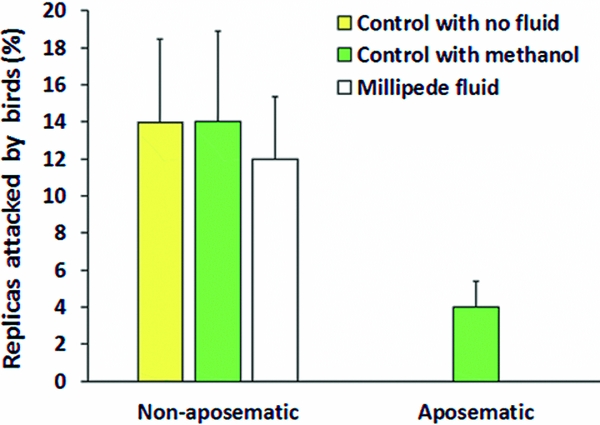
Among the 300 millipede replicas placed on the forest floor, 149 (~50%) showed signs of attack and five had unrecognizable marks and three disappeared (2%), thus it was not possible to determine the identity of potential predators. In 118 (79%) of the attacked replicas, we found marks consistent with morphology of invertebrate mouthparts, replicas pinched or with tiny perforations. In 24 (16%) replicas, we found V or U-shaped marks consistent with imprints left by beaks (Figure 1b), and in seven (5%) replicas we found teeth marks attributed to mammal predators (Figure 1c). We found a highly significant effect of colouration pattern on the percentage of replicas attacked by avian predators (F = 24.9, P < 0.0001, Figure 2), but no effect of repugnant fluid presence (F = 0.65, P = 0.53) or interaction with colouration pattern (F = 0.44, P = 0.64). The average percentage of replicas attacked was nearly 10-fold higher on those non-aposematic control replicas (13.3% ± 3.3%, mean ± SE) than on aposematic replicas (1.3% ± 0.9%).
Percentage of millipede replicas attacked by avian predators in Atlantic Forest site, south-eastern Brazil. Bar values represent mean (± SE) percentage of replicas attacked by avian predators.
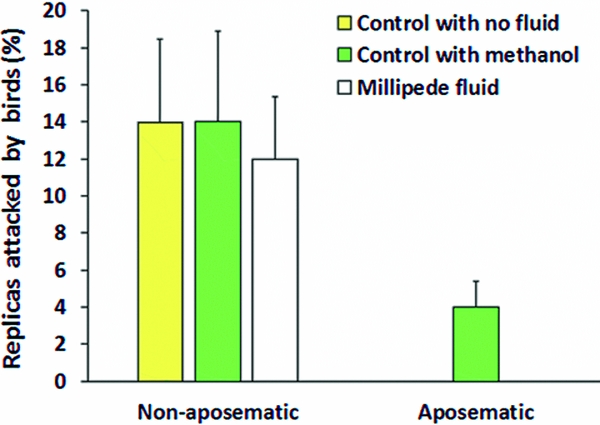
We demonstrated for the first time that aposematic millipedes can be avoided by visually oriented predators in a tropical forest ecosystem. The warning colouration pattern of O. aleijadinho significantly reduced the proportion of millipede replicas attacked by birds that forage on the forest floor. In fact, this result is also indicative that fluids secreted by this species truly work as repellants, otherwise these predators should not avoid attacking aposematic millipedes. Our results support Marek & Bond's (Reference MAREK and BOND2009) suggestion that evolution of aposematic colouration in chemically defended millipedes may be closely linked to the selective pressure exerted by visually oriented predators. In addition, our study also supports the idea that birds are able to recognize and avoid aposematic prey (Exnerová et al. Reference EXNEROVÁ, STYS, FUCÍKOVÁ, VESELÁ, SVÁDOVÁ, PROKOPOVÁ, JAROSÍK, FUCHS and LANDOVÁ2007, Skelhorn & Rowe Reference SKELHORN and ROWE2006). The percentage of replicas attacked by avian predators were relatively low, but it is important to note that nearly 14% of the non-aposematic replicas suffered attacks within just 48 h in the field. Therefore, considering broader time scales the effects of selective pressure exerted by avian predators on the millipede population could be substantial.
In our experiment, most attacks on millipede replicas were attributed to arthropods. This pattern was previously reported in other studies evaluating predation on invertebrate plasticine replicas in tropical forests (Fáveri et al. Reference FÁVERI, VASCONCELOS and DIRZO2008, Loiselle & Farji-Brener Reference LOISELLE and FARJI-BRENER2002). Although arthropods such as ants, beetles and bugs are known predators of millipedes (Eisner et al. Reference EISNER, EISNER and DEYRUP1996, Enghoff et al. Reference ENGHOFF, MANNO, TCHIBOZO, LIST, SCHWARZINGER, SCHOEFBERGER, SCHWARZINGER and PAOLETTI2014, Sierwald & Bond Reference SIERWALD and BOND2007), conclusions regarding predation by arthropods upon model replicas are limited because some arthropods that use chemoreception to detect prey may not have recognized our models. In the case of attacks by these predators, the role of aposematic colouration in predator avoidance could be restricted. Nevertheless, the combination of defensive behaviour with secretion of repugnant fluids could play a major role in millipede protection against arthropods. The effects of the secretion of repugnant fluids by O. aleijadinho and its warning colouration on the avoidance behaviour of its potential invertebrate predators need further investigation.
The presence of repugnant fluid did not affect the percentage of replicas attacked by avian predators. However, the efficiency of repugnant fluids of millipedes against predators is well-studied (Eisner et al. Reference EISNER, EISNER and DEYRUP1996, Enghoff et al. Reference ENGHOFF, MANNO, TCHIBOZO, LIST, SCHWARZINGER, SCHOEFBERGER, SCHWARZINGER and PAOLETTI2014, Shear Reference SHEAR2015). Therefore, we believe that this result could be an artefact of our experimental procedures. For instance, we extracted the repugnant fluids from only two O. aleijadinho individuals and used the millipede fluid and methanol solution to coat 100 replicas. Thus, the amount of repugnant fluid applied on replicas could be too low to promote effective predator avoidance. Besides, these fluids could have optimal effects on predator repellence immediately after secretion by millipedes, with allomone chemical structure decaying and losing its repellent effects a few minutes after secretion. Due to the inherent pitfalls, we prefer to assume that our experiment was not successful in evaluating the effects of repugnant fluids secreted by O. aleijadinho on predator avoidance. The chemical composition of allomones supposedly present in repugnant fluids secreted by O. aleijadinho needs proper description in future studies, as well as tests of their repellent effects on different types of predator, including arthropods, birds and mammals.
We conclude that the aposematic colouration pattern involving yellow spots symmetrically distributed along the millipede body seems to function as a warning signal to some visually oriented predators. This colouration pattern is also present in some mimicking millipedes (Marek & Bond Reference MAREK and BOND2009), suggesting their effectiveness as defence adaptations. Our data support the hypothesis that the warning colouration pattern of O. aleijadinho must mediate avian predator avoidance in its forest habitat.
ACKNOWLEDGEMENTS
We are grateful to the Rio Doce State Park Staff for all the logistical support, to G. Demétrio, B. Brett and R. Cuissi for the field assistance and to Rodrigo Ferreira for discussing the experimental design, and Natalia Alkmin for helping with the millipede replicas. We conducted this study during the ecology field course fully supported by Programa de Pós-Graduação em Ecologia Aplicada at Universidade Federal de Lavras, coordinated by N.H.A. Curi and T.J. Guerra. T.J.G. received a post-doctoral scholarship from CAPES and L.F.M.I. was supported by a scholarship from CAPES.