


Democracy is about including those who are potentially affected by collective decisions in making those decisions. It follows that contemporary democratic theory is mostly concerned with institutions and practices through which the voices of citizens find a place in collective decision making. And it also follows that contemporary democratic theory should focus on the means for voice-based inclusions: distributions of rights, including rights to vote, speak, and associate; individuals’ standing as citizens and their capacities of citizenship; and the practices, organizations, and institutions that translate voice into collective decisions. For these reasons, contemporary democratic theory is modeled primarily on membership combined with empowered voice.
An alternative to voice is exit. As conceived in Hirschman's (Reference Hirschman1970) classic work Exit, Voice, and Loyalty, given the opportunity, dissatisfied members may choose to exit a collectivity rather than to seek reform or response by voicing their dissatisfaction. If voice is associated with democracy, exit is associated with markets: Individuals choose organizations that best serve their needs and exit those that fail them. They vote with their feet.
The trade-offs and interactions between voice and exit have been extensively and brilliantly examined by Hirschman and a wave of literature generated by his work (Dowding and John Reference Dowding and John2008; Dowding et al. Reference Dowding, John, Mergoupis and Van Vugt2000; Hirschman Reference Hirschman1970, Reference Hirschman1974, Reference Hirschman1978). Hirschman's goal in Exit, Voice, and Loyalty was to introduce the concept of voice to economists, habituated to conceiving exit as the only mechanism through which firms are held accountable by their customers. Voice, Hirschman argued, is essential to renewing organizations because it conveys information from the most quality-conscious and active members/customers to organizational leaders, enabling the kinds of responsiveness necessary for organizations to recuperate from mistakes and to hold at bay the more destructive option of exit.
If Hirschman sought to introduce the concept of voice into economics, my aim here is to reintroduce the concept of exit into democratic theory. I use the term “reintroduce” because the concept has played a major, though undertheorized, role in the institutions and practices of democracy. Exit mechanisms have always been recognized as essential to electoral democracy, as citizens leave one party and join another. Rights of exit are logically implied by all democratic theories with roots in liberal contract theory (Green Reference Green1998; Kukathas Reference Kukathas2003). Theorists who see a civil society composed of voluntary associations as a key element of democratic government assume that “voluntariness” brings with it rights as well as capacities for exit from associations (Rosenblum Reference Rosenblum1998; M.E. Warren Reference Warren2001). More recently, theorists of multiculturalism and feminism have advocated rights of exit from groups as a hedge against the coercive capabilities of ethnic and religious groups within liberal-democratic societies (Benhabib Reference Benhabib2002, 131–32; Deveaux Reference Deveaux2006, 47–53; Kukathas Reference Kukathas2003; Okin Reference Okin2002; Philips Reference Philips2007, chap. 6).
But with a few important exceptions (Gastil Reference Gastil2000, chap. 2; Shapiro Reference Shapiro2003, 43–64; Sørensen Reference Sørensen1997), exit has not been theorized as a generic feature of democratic theory and practice. Tellingly, “exit” is not to be found in the indexes of works of contemporary democratic theory. When the concept does make an appearance, it is often viewed as an undesirable alternative to democracy understood as common choice, one that atomizes collectivities and damages collective loyalties, erodes collective choice and undermines provision of common goods, encourages excessive individualism, drains collectivities of their best and brightest, and substitutes silence for voice (see, e.g., Barry Reference Barry1974; Elster Reference Elster, Bohman and Rehg1997, 33–34; Healy Reference Healy2007; Held Reference Held2006, 94–98, 235; Newman Reference Newman2007; Olson Reference Olson2006, 48–52, 92).
I argue here that exit-based empowerments—individual rights and capacities for exit—are as central to the design and integrity of democracy as the distributions of votes and voice long considered its key structural features. My theoretical aim is to conceptualize exit-based empowerments as generic features of democratic institutions. My normative aim is to identify the contributions of exit-based empowerments to democratic goods. The primary scope of my analysis is the strong, liberal-democratic constitutional states that have effective monopoly powers over public goods provision, and have some capacity to design and reform institutions in ways that increase their responsiveness to citizens. Many of my examples of exit-based empowerments are drawn from these contexts, including, for example, competitive party systems and civil societies composed of voluntary associations, within which exit-based empowerments are central. Although the primary context of my analysis is that of strong liberal-democratic states, because I conceptualize exit-based empowerment as a generic feature of democracy, it will also have some applications in weak state contexts, as well as within non-democratic regimes and contexts. But I shall comment upon these contexts only in passing.
The argument unfolds in six sections. In the first, I note that exit-based mechanisms are poorly theorized within democratic theory, largely because they are equated with market mechanisms. Democratic theorists have instead implicitly adopted a “voice–monopoly” model characterized by limited exit and focused on voice-based institutions and practices. Although the costs of exit are often emphasized in democratic theory, the costs of the voice–monopoly model to basic democratic norms are not. In the second section, I identify and justify two norms that are increasingly common in contemporary democratic theory: nondomination and the all-affected principle. I consider the challenges of instantiating these norms under several contemporary circumstances of politics, which include challenges of size, scale, high resource thresholds for collective action, and the migration of loci of decision-making across borders and into nondemocratic organizations. Within the domain of each challenge, I argue, the voice–monopoly model masks damage to democratic norms. In the third section, I begin the task of recovering the democratic possibilities of exit as an alternative by noting that the mechanism is, almost always, constructed into political systems, either by being enabled through rights and protections, or by being institutionalized by designing competition into states, as in the case of competitive party systems. Exit is, typically, connected to democratic goods in two ways: as a means of providing individuals with empowerments with low thresholds of effective use, and as ways of inducing responsiveness from organizations. Two further potentially democratic effects follow: Exit can often induce representatives or other elites to engage deliberatively those who can exit, and exit induces elites to cultivate reputations for trustworthiness. Each of these goods counts as a fundamental contribution to the basic norms of democracy. In section four, I suggest that these democratic potentials of exit have been masked because its political functions have not been well conceptualized. In particular, exit and voice do not trade off, because they refer to two different features of democracy: empowerment of individuals, and communication of values and preferences. Hirschman's exit–voice dichotomy confused the dimensions of empowerment and communication. So the alternative to rights-based inclusion is exit, whereas the alternative to voice is what I shall call “signal,” which is the communicative feature of exit. In the final section, I show how this conceptualization of exit—particularly, the concepts of enabled and institutionalized exit, and the distinction between exit as empowerment and exit as communication—pays off in institutional analysis. I use these distinctions to map the ways exit might be, should be, and often are designed into democratic institutions. Understanding exit-based empowerment, I conclude, will enhance our capacity to imagine institutions that deepen democracy under the contemporary circumstances of politics.
EXIT AND THE VOICE–MONOPOLY MODEL OF DEMOCRACY
The democratic potentials of exit-based mechanisms have gone largely untheorized. The key reason is that democratic theorists have adopted, usually implicitly, what I shall call here a “voice–monopoly” model of democracy. Exit, in this model, is a market mechanism based on individual choice. Democracy, in contrast, is about collective choice, enabled and empowered by strong, constitutional states. Exit, in this view, has little place in such contexts, not least because it would undermine collective decision and action. Rawls’ theory of a liberal-democratic society, for example, assumes a collectivity that members enter by birth and exit only through death (Rawls Reference Rawls1993, 41).Footnote 1
The one explicit justification of the voice–monopoly model is found outside of democratic theory proper, in A. O. Hirschman's (Reference Hirschman1970) brilliant Exit, Voice, and Loyalty. Hirschman introduced the exit–voice dichotomy to explain how organizations repair and regenerate themselves in response to the dissatisfaction of their members. Voice and exit are two ways members can pressure organizations to change: They can speak out or they can leave. Voice presupposes that an organization is structured in such a way that it can respond to its members. Exit assumes that members have the opportunity and capacity to choose goods from competing organizations. In organizations that are responsive, voice and exit are complementary: The availability of exit induces organizations to provide members with voice, precisely so they can reduce the likelihood that members will leave with their dollars, their votes, their good will, or their capacity to contribute to the organization (Hirschman Reference Hirschman1970, 36). Loyalty, the third term in Hirschman's model, is a resource organizations can cultivate to counter exit and stabilize a core of their most committed and “quality sensitive” members, which in turn helps to ensure their long-term capacity to regenerate, reform, and thrive.
In the absence of loyalty and the presence of choices for members, however, exit and voice may trade off: Dissatisfied members will prefer exit to voice. In Hirschman's (Reference Hirschman1970) model, exit has a low threshold of difficulty relative to voice. It has the advantage of being “impersonal—any face-to-face confrontation between customer and firm with its imponderable and unpredictable elements is avoided and success and failure of the organization are communicated to it by a set of statistics.” By contrast, voice is “a far more ‘messy’ concept because it can be graduated, all the way from faint grumbling to violent protest; it implies articulation of one's critical opinions rather than a private, ‘secret’ vote in the anonymity of a supermarket; and finally, it is direct rather than roundabout. Voice is political action par excellence” (15–16).
The messiness of voice can be a barrier to its use, so that voice-based political action—the essential feature of democracy—is relatively disadvantaged whenever exit is available, at least when loyalty is not factored into the model. When individuals choose exit, they have control over the consequences of their acts, and they bear the costs and reap the rewards. When they exercise voice, however, they are subject to inherent qualities of politics: the “slow boring of hard boards”—as Max Weber ([1919] Reference Weber, Gerth and Mills1946, 128), so nicely put it; the inherent unpredictability of collective actions—in Hannah Arendt's (Reference Arendt1958, chap. 5, section 34) terms; the risks of speaking up; the possibility of large investments with little or no payback; and the psychological burdens of overt conflict. Thus, Hirschman writes,
while exit requires nothing but a clear-cut either–or decision, voice is essentially an art constantly evolving in new directions. This situation makes for an important bias in favor of exit when both options are present: Customer-members will ordinarily base their decision on the past experience with the cost and effectiveness of voice even though the possible discovery of lower cost and greater effectiveness is of the very essence of voice. The presence of the exit alternative can therefore tend to atrophy the development of the art of voice. (43)
Without members who are willing to take on the burdens of voice, organizations, including democratic states, are unlikely to be able to rejuvenate, reform, and perform. For these reasons, Hirschman (Reference Hirschman1970) suggests, a “no-exit” situation is sometimes preferable, assuming “(1) exit is ineffective as a recuperation mechanism, but does succeed in draining from the firm or organization its more quality-conscious, alert, and potentially activist customers or members; and (2) if voice could be made into an effective mechanism once these customers or members are securely locked in” (55).
Hirschman's reasoning provides the structural logic that maps onto the normative logic of contemporary democratic theory: Democracy is, in the first instance, about empowering the voices of citizens. But Hirschman's analysis also reveals a feature of democracy—or, rather, thinking about democracy—that is less remarked: The democratic case for voice usually assumes monopoly organizations. It does so normatively—voice is most important within the context of monopolistic organizations. And it does so structurally—monopoly induces voice by restricting exit.
In these two respects, Hirschman's analysis tracks the fact that modern democracy was born of a specific kind of monopoly—that of states. In its eighteenth- and nineteenth-century origins, the democratic project focused on increasing inclusions within states that had effectively consolidated power by controlling territory, developing administrative capacities, and regularizing sovereignty through constitutional means (Poggi Reference Poggi1990, chaps. 1–2). The justifications for voice are closely related to these elements of monopoly in two ways. First, when a collectivity controls key features of livelihood, such as security, and solves collective action problems through coercion, then individuals subject to that coercion should have a say in how it is deployed. Second, the greater the costs of exit to individuals, the greater the need for voice. Though liberal-democratic states do not legally restrict exit from their territories, they recognize that exit is costly: It is disruptive of family, social support networks, careers, language, and culture, and can mean giving up the protections and welfare entitlements of citizenship. These monopoly-like effects are well recognized and justified by the existence of voice mechanisms—that is, democratic processes that legitimate the monopoly-like properties of the state. Thus it is appropriate that democratic theory has focused on equalities of political resources, secured by positive political rights (voting, speech, association) and related welfare rights (education and income security), as well as on the mechanisms such as electoral systems, judicial systems, public sphere discourse, and civil society activism through which citizens’ voice is translated into influence over law and policy (see, e.g., Habermas Reference Habermas and Rehg1996, chap. 8).
The depth of attachment to monopoly within democratic theory stems from the fact that it is structurally necessary for the provision of common goods. As Hirschman's analysis suggests, democracies are sensitive to problems of collective action: Defectors from collectivities undermine democracy by undermining the possibility of common choice (Barry Reference Barry1974). Union organizing is the archetypal case: The worker who breaks with the solidarity of the bargaining unit also undermines the capacity of the union to serve its members. More generally, as Olson (Reference Olson1971) famously detailed, when individuals are left to weigh the costs and benefits of collective action, larger groups tend to return fewer benefits, causing individuals to exit the collectivity, which in turn undermines the provision of public goods. As Hobbes understood, monopoly removes the threats to common security and provision posed by defection. Similarly, democratic theorists—particularly those focused on the important relationship between solidarity and collective choice—view exit opportunities as harmful, indeed, so much so that, as Hirschman (Reference Hirschman1970) observes more generally, exit is often branded criminal or treasonous (17).
Similarly, democratic theorists typically understand opportunities for exit from public and publicly provided goods as undesirable, as they drain collectivities of their resources, degrading public provision (Barry Reference Barry1974; Healy Reference Healy2007; Newman Reference Newman2007; Olson Reference Olson2006, 48–52, 92). Hirschman (Reference Hirschman1970) identifies a particularly “noxious combination” of exit and voice that transforms public services into expensive, low-performing public entities (44–46). The presence of some amount of exit—from government rail transport to private trucking in Nigeria, or from public to private schools, and from high tax to low tax municipalities in the United States—drains organizations or jurisdictions of their “quality conscious” members, who are, typically, those who have the resources that enable them to exit. In this way, organizations—rail in Nigeria, and some public schools and municipalities in the United States—develop into what Hirschman calls “lazy monopolies”—expensive, inefficient, unresponsive, and poorly performing entities that have a lock on those without the resources to exit. The “lazy monopoly” phenomenon probably extends to pressures for democratization as well. Nineteenth-century Britain sought colonies to relieve internal pressures on internal labor markets, which elites feared could result in disorder. Their strategies also reduced pressures for democratic reform. Many authoritarian states—China, for example—encourage their most vocal dissidents to exit, thus reducing internal pressure for voice.
Following this logic, democratic theorists implicitly tie the very possibility of democracy to monopoly, whereas the concept of exit is left as an undertheorized residual loosely identified with market organization, and collective choice is modeled as an alternative to markets (see, e.g., Ackerman and Fishkin Reference Ackermann and Fishkin2002; Barber Reference Barber1984; Bowles and Gintis Reference Bowles and Gintis1987, chap. 5; Elster Reference Elster, Bohman and Rehg1997, 33–34; Held Reference Held2006, 94–98, 235; Macpherson Reference Macpherson1977; Olson Reference Olson2006, 48–52, 92; cf. Shapiro Reference Shapiro2003, 56). In this way, the concept of exit is identified with features of markets that undermine collective choice: Exit means that investors with mobile capital shop for the cheapest places to do business—places with weak labor and environmental standards, for example. Exit enables the wealthy to free ride on societies that are well ordered because they have strong public services and security (Hirschman Reference Hirschman1978, 96; Lindblom Reference Lindblom2001, chap. 17). Competition among local governments in federal systems, especially for capital, tends to corrode central state capacities to provide public goods (Cai and Treisman Reference Cai and Treisman2004). Libertarians and public choice theorists buy into the same dichotomy from the other side, preferring markets to government—the latter necessarily dangerous and almost always oppressive owing to its monopoly character. Democracy is dangerous on this view just because it builds on the monopoly powers of the state, which are no less onerous because political elites wield their powers on behalf of a majority or plurality (Buchanan Reference Buchanan1975; Hayek Reference Hayek1944). This same dichotomy was replayed in the resurgence of “neoliberalism” in the 1980s—the British-originated concept that identifies the privatization of government services with more market, less government—and, thus by implication, a shrinking of the domain of democracy in favor of the market. In these ways, the meanings of exit in most democratic theories have been tied to “private” zones of choice, particularly markets, protected but not controlled by the state, and hence beyond the proper domain of democracy.
It also follows from this model that when voice is effective and monopoly extensive, the bare fact of monopoly is, on average, good for democracy: Violence monopolized can also be tamed, turned into capacities for collective provision of common goods, and legitimated through various kinds of democratic devices (Warren Reference Warren, Dryzek, Honig and Phillips2006). Voice is not only normatively required by monopoly-based democracy, but also enabled: Dissatisfied citizens will pressure for change, and democratic institutions should both empower and channel this dissatisfaction. Under these circumstances, democracy is not only inclusive, but also directive: Through public opinion formation and electoral representation, peoples’ interests, preferences, and values are formed into voice and translated into policies.
For these kinds of reasons, most contemporary democratic theorists view exit as a threat to democracy, with the result that they have taken on, sometimes explicitly but more often implicitly, a theoretical commitment in favor of tight monopoly organization combined with voice—or what I am calling the voice–monopoly model of democracy.Footnote 2
COSTS OF THE VOICE–MONOPOLY MODEL
Although the costs of exit are often noted in contemporary democratic theory, the costs of the voice–monopoly model for democratic goods are rarely tallied. The costs are best appreciated by surveying the fit between the contemporary circumstances of politics and the voice–monopoly model in light of the basic norms of democracy: that is, the norms by which we should assess institutions and practices to be more or less democratic.
Contemporary democratic theorists are increasingly converging on two complementary norms. The first of these is nondomination. The norm that individuals should not be subject to domination has a long history traceable to early modern republican thought, but has recently been reemphasized by a number of thinkers who seek to relate the concept of democracy more directly to the good of self-determination (Bohman Reference Bohman2007, chap. 1; Pettit Reference Pettit1999, chap. 3; Richardson Reference Richardson2003, 28–36; Young Reference Young2000, chap. 1). Although there are relatively sophisticated accounts of domination as a form of power, for present purposes the intuitive meaning is sufficient: Individuals should not be subject to relations of power that deny them capacities and opportunities to self-determine. Stated positively, individuals should have empowerments—political, economic, and social—sufficient for them to avoid relations of domination and to exercise individual autonomy (see also Habermas Reference Habermas and Rehg1996, 84–87; Held Reference Held2006, chap. 10)
The second norm is the all-affected principle: Because many of the relationships that enable self-determination are collective in nature, self-determination requires that those potentially affected by collective decisions have the opportunity to influence those decisions (Goodin Reference Goodin2007; Habermas Reference Habermas and Rehg1996, 107, 365; Young Reference Young2000, 23). The all-affected principle is a principle of proportional inclusion: Individuals have a normative claim to influence collective decisions just to the extent that they are affected by collective decisions. Nondomination is a necessary but not sufficient condition for instantiating the all-affected principle insofar as it focuses normative attention on conditions of individual autonomy. The all-affected principle is more demanding and positive: Individuals should have effective opportunities to influence collective decisions that potentially affect them, including the voice to communicate their values, interests, and preferences and deliberate their relationship to collective decisions. The nature and scope of this norm remain under debate, not least because it is quite demanding in a world in which the effects of collective decisions on individuals are complex, extensive, and intertemporal (Goodin Reference Goodin2007; Näsström 2010; Young Reference Young2000, 23). For my purposes here, however, it is sufficient to note that the principle taps a long-standing normative intuition first expressed in the Code of Justinian from the sixth century: “What touches all ought to be considered and approved by all” (Cod. 5.59.5.2: quod omnes tangit, omnibus tractari et approbari debet). The updated version of the intuition is that, whatever else democracy might require, it is fundamentally about self-governance through collective decisions and actions.
Importantly, these principles abstract from institutions and practices, so that “democracy” is defined normatively rather than identified with specific institutions and practices such as competitive elections, majority rule, political rights and liberties, representative government, or deliberation. By abstracting democratic norms, we can ask how each kind of institution or practice advances (or damages) these norms.
The voice–monopoly model of democracy is one model for organizing these two norms into society. The norm of nondomination is closely linked to two long-standing and widely appreciated features of democratic institutions. On one hand, the familiar catalogs of rights protect against political sources of domination: rights such as those of speech, conscience, protections and self-incrimination, due process, and so on. On the other hand, many of these rights combine with others to produce positive powers, or choices. These include rights to vote, petition, and associate, as well as welfare rights aimed at material vulnerabilities. The voice–monopoly model of democracy theorizes these protections and enablements as working within the monopoly powers of the state. The protections function as limitations of state powers. But the model also assumes, importantly, that state powers can be directed to underwriting several dimensions of citizenship. Thus political citizenship is enabled by electoral systems and representative institutions. Legal citizenship is enabled by judicial institutions that provide standing, protection, and due process. And social citizenship is enabled by a variety of welfare entitlements as well as some regulation of economic powers. These enablements presume (rightly) states with monopoly powers of regulation, taxation, and redistribution. With respect to the all-affected principle, the voice–monopoly model of democracy assumes that the primary domain of collective affectedness is circumscribed by the state. Thus, the locus of collective self-governance is the state, and the primary means of self-governance are the rights, standings, and representative structures that empower voice within state or statelike entities.
The voice–monopoly model of democracy is not “wrong”: It instantiates these norms of democracy in ways that respond to important and legitimate problems of collective action—problems that remain with us. But the voice–monopoly model is increasingly insufficient. As I suggest below, it is insensitive to some long-standing problems of democracy, as well as being outgrown by new problems, in such a way that is not only costly to democratic norms, but also makes it difficult to conceptualize one key mechanism for instantiating democratic norms: exit-based empowerment. I detail the problems below and then theorize exit-based empowerment in the remainder of the article.
There are at least five problems areas, two of which are well recognized, and three of which are increasingly part of the contemporary landscape of politics. The first three problems generate normative deficits primarily with respect to the all-affected principle, whereas the remaining two problems generate normative deficits primarily with respect to nondomination.
Effects of Size and Scale on Voice
The most widely recognized problem is that of size and scale. On one hand, the effectiveness of collective actions often depends upon scaling collective units to the magnitude of problems, rather than to the chances that individuals will have effective voice. On the other hand, as political units and jurisdictions integrate, the effective voice of each individual is diluted to the point to the point of insignificance. This problem is long-standing and generic (Dahl and Tufte Reference Dahl and Tufte1973; Przeworski Reference Przeworski2010, chap. 5). But it is magnified by contemporary circumstances of politics, in which effective jurisdictions are often regional or global. As scale and size increase, so too do the thresholds for effective voice. The effects are not equally distributed: Those with greater political resources—education, organization, attentiveness, and time—are more likely to surpass these thresholds than those without, a pattern extensively documented in the literature on participation (e.g., Verba, Schlozman, and Brady Reference Verba, Schlozman and Brady1995, chaps. 6–7). The effects of size and scale on voice undermine the all-affected principle.
High Thresholds for Influence over Collective Actions
The second problem is also generic, though its implications for democracy are perhaps less well recognized. It is in the nature of democratic political decision-making that, if successful, it rests on a broad basis of assent. For individuals (or the groups that represent them) to have influence within political units of any significant size requires long-term commitments of resources and attention. As Davies (Reference Davies2007) notes, even the best voice-based procedures require organization and attentiveness that will disproportionately favor insiders, well-organized interests, and professionals who have mastered organizational cultures. These kinds of barriers are very difficult to engineer out of institutions. As in the case of size, this feature of democratic decision-making in itself favors citizens and groups with political resources. Insofar as collectivities are subject to these effects, the results will count as “democratic” only if active, well-organized groups have interests that are representative of those who are inactive or poorly organized. But we know that, on average, active citizens are unlike passive citizens in socioeconomic status, a consistent predictor of political activity (Schlozman, Verba, and Brady Reference Schlozman, Verba and Brady2010, 490–93; Verba, Schlozman, and Brady Reference Verba, Schlozman and Brady1995, chaps. 6–7). Within a voice–monopoly model, the alternative to voice for those with few resources is not exit, but silence, even when standard voice mechanisms are in place, producing a normative deficit with respect to the all-affected principle.
Migration of Decisions into Administrative Agencies
Another challenge follows from a trend common to the developed democracies: Much policymaking is shifting into the executive agencies of government (Bobbio Reference Bobbio and Griffin1987, 37–38; Richardson Reference Richardson2003, chap. 16; Warren Reference Warren2009). A large part of the reason is the increasing complexity of government with the rise of welfare states in the post-WWII era: Legislatures can at best function in ways that are broadly directive, leaving much policy to be determined by administrative entities that have capacity and expertise, but are not structured for empowered voice. Standard theories of representative democracy, built on the assumptions of the voice–monopoly model, hold that administrative agencies should take direction from the formally democratic branches of government. Voice outside of formally democratic channels corrupts democratic control over collective actions. Administrative agencies should thus operate as no-voice, no-exit entities, precisely to ensure their democratic integrity and legitimacy. If, however, the elected branches of government in fact farm out much political work to administrative agencies—as they have done for decades owing largely to the technical and political complexity of the modern functions of government—then accountability to those affected fails, leaving only monopoly. Universal health care in the Canadian provinces is a case in point. Democratic accountability is, presumably, provided via elected governments. But because elections are information-poor and function primarily as retrospective judgments about the performance of entire governments, they provide only the loosest of linkages between citizens (who are both payers and patients) and the provincial ministries of health, within which key structural decisions are consolidated. Most policy decisions that affect the quality and efficiency of health care are devolved to semiautonomous agencies that have no formal provision for public voice at all. Effective voice within these systems is left to well-organized groups—typically professional associations and unions—that gain their voice by virtue of their veto powers over service delivery. From a democratic perspective, their members represent only a small subset of those affected by the health care system. The primary means citizens have for voice is through media attention to clear system failures, and through the courts. Both are clumsy, cumbersome, and resource-intensive means of exacting responsiveness from public systems.Footnote 3 In such cases, the “voice” provided through electoral democracy simply fails to respond to those who are affected. From a theoretical perspective, an ironic result is that the voice–monopoly model functions to justify monopoly without voice.
It is important to democratic prospects that executive agencies increasingly employ consultative and participatory governance practices (Cain, Dalton, and Scarrow Reference Cain, Dalton and Scarrow2003; Warren Reference Warren2009). These practices often count as important conduits for voice, although, to date, they are typically advisory rather then empowered, relatively local, and usually limited to closely specified areas of policy. Were these developments to spread, particularly in combination with empowerments (including exit-based) of those affected, they would count as important enhancements of democracy (Warren Reference Warren, Cain, Dalton and Scarrow2003, Reference Warren2009).
Diffusion of the Locations of Decision
Even assuming that voice mechanisms were effective and inclusive, yet another trend threatens the basic norms of democracy in ways to which the voice–monopoly model is increasingly inadequate. Within the developed democracies, state monopolies over collective capacities are less extensive than they were half a century ago. States compete and cooperate with transnational economic and security regimes, international organizations, and other nongovernmental organizations. They must anticipate market structures and reactions, even as they plan for and respond to market externalities. An important consequence of these developments is that policies and policymaking are increasingly decentered and decentralized, whereas the locations of collective responsibility and accountability are more diffuse (Beck Reference Beck1996; Offe Reference Offe1996, chap. 1; Sørensen Reference Sørensen1997). The impacts of collective decisions on those affected are often remote and impossibly complex. Two kinds of damage to democratic norms follow. The first is to voice, with implications for the all-affected principle. Voice-based mechanisms that function through voting and related forms of representation in liberal-democratic states have less impact on those collective decisions that affect people's lives than just a few decades ago. As Bohman (Reference Bohman2007) has convincingly argued, it is hard to imagine that statelike entities might be scaled up to match these chains of “affectedness” such that they could function as loci of democratic control (24–25). The monopoly–voice model is increasingly irrelevant to these developments.
There is more to be said about this circumstance from the perspective of nondomination. Here it is important to be more precise about the kind of problems and opportunities posed by exit. The voice- monopoly model is quite appropriate to identifying problems of collective action across jurisdictions, just as it does within jurisdictions. Thus, when powerful economic actors exit from states, they often seek to exploit common resources while externalizing the costs. “Exit” in such cases amounts to free riding on common goods (Cai and Treisman Reference Cai and Treisman2004; Ostrom Reference Ostrom1990, chap. 1). When common goods are degraded or fail to be provided by markets—as in environmental degradation or public health—there are few options but to scale up political regimes to encompass common goods, ideally simulating a voice–monopoly model of decision.Footnote 4 Yet these justifiable inclusions in common protection and provision are but one kind of interdependency. As chains of “affectedness” expand, so too do “nonvoluntary inclusions”—that is, inclusion within collectivities that follow from decisions with effects that reach far beyond the parties to the decision, of the kind represented by trade regimes or local control of resources by a multinational corporation (Bohman Reference Bohman2007, 25). Interdependencies can produce monopoly-like effects not because the goods cannot be exited in principle (as with commons and other public goods), but rather because individuals lack the capacity to exit owing to their vulnerabilities—poverty, lack of education, or cultures that limit choice. In such cases, lack of choice—de facto monopoly—maps onto domination: a condition in which individuals are included as subordinates within collectivities within which they have neither voice nor the possibility of exit. In such cases, the voice–monopoly model fails to model these vulnerabilities, and thus obscures the possibility that individual opportunities for exit might limit their vulnerabilities to extensive patterns of “nonvoluntary inclusions,” particularly those that flow across borders. Under these conditions, the cost of the voice–monopoly model is to the norm of nondomination.
Tradeoffs between Inclusion and Freedom
The final trend of relevance here is cultural, and relates to the demand side for exit-based empowerment. As the developed democracies become more “postmodern,” citizens increasingly value life choices (Inglehart and Welzel Reference Inglehart and Welzel2005). Postmodern individuals are more likely to value exit in principle—it is implied by choice—even if they do not use it. Forms of participation such as voting that do not elicit clear responses from political elites are less attractive to postmodern individuals than those that are targeted toward problems and more likely “to make a difference”—the kinds of participation offered by organizations such as voluntary associations and advocacy groups (Dalton Reference Dalton2007). However necessary, standard voice–monopoly forms of democracy may be at an increasing cultural disadvantage—victims of their very success in protecting, developing, pluralizing, and energizing the societies of which they are a part (Van Deth Reference Van Deth2000). Most telling, perhaps, is that the voice–monopoly model sides, uncomfortably, against choice, with its implied freedoms, close connection to self-determination, and hedges against domination. Within the history of political thought, this tradeoff has often appeared as an apparent threat that democracy (collective choice) represents to liberty (individual choice).
RETHINKING EXIT: ENABLED AND INSTITUTIONALIZED EXIT
Democratic theory is not without resources to respond to the deficits of the voice–monopoly model. One of these resources, I am arguing, can be found in rethinking the democratic potentials of exit. It is because much contemporary democratic theory has slipped with little notice into the voice–monopoly model that such rethinking has not occurred. The reason for the slippage, I suggested above, is that the voice–monopoly model gets its traction primarily from problems of collective action, combined with its normative emphasis on voice, and (often implicitly) the attractions of a solidaristic conception of citizenship. The concept of exit is left as a residual category associated with the market. So when this residual concept drifts back into the political realm, the implications (on this implicit logic) are negative: Exit is a strategy associated with those who are excessively individualistic, who fail to recognize common dependencies, and who free ride on the common contributions of others.
These features of exit are, of course, empirically possible and even common. This article is neither an unqualified argument against the voice-monopoly model nor is it an unqualified argument for exit. What I am arguing is that, as a democratic theory, the voice–monopoly model fails to identify the conditions under which exit might function as a key mechanism for connecting democratic norms to contemporary circumstances of politics, disarming a key democratic device where it is needed the most.
That the voice–monopoly model undertheorizes exit is evident in the range of positive and negative normative valances that attach to its common meanings. Exit may mean shirking collective responsibilities. But it might also mean breaking a relationship of domination, as in quitting a bad marriage, a poor job, or a domineering ethnic or identity group. Exit might mean leaving an underperforming service provider, such as a clinic or school, in favor of another. Exit could mean leaving a political party by voting for the opposition. Or it might mean, simply, quitting, as does a drop-out who is not engaged by a neighborhood school. Exit might carry penalties for the organization that is exited, as when a voter sends his or her vote to one candidate rather than another. In such cases, exit generates attentiveness from the organization. But exit might also indicate lack of choice, as when citizens become discouraged with their limited choices for representatives, and choose not to vote at all. Or exit may, sometimes, simply indicate apathy, as when a social relationship or membership falls into disuse.
Examples such as these suggest that there is nothing inherently democratic (or undemocratic) about exit in itself. That is because we know little about what exit might signify or accomplish without knowing the social relationships it entails. For exit to count as an empowerment rather than silence, neglect, or shirking, an individual must (a) have the capacity to replace one kind of membership with another that is voluntarily chosen. To count as a democratic empowerment, (b) that capacity must be linked to consequences for the entity subject to exit in such a way that the entity has the incentive to respond to the individual's choice. From a normative perspective, conditions that meet (a), the capacity to choose, support nondomination, whereas conditions that meet both (a) and (b), linking choice to organizational responsiveness, support the all-affected principle.
The forms of exit that meet these conditions are, typically, constructed in one way or another by social and political institutions. Here I distinguish two forms:
• Enabled exit is primarily about the ways and means though which individuals are empowered to make choices throughout a range of social, economic, and political relationships, including rights and protections, and welfare supports.
• Institutionalized exit is primarily about organizing the monopoly powers of the state in such a way that individual decisions to enter or exit an organization, such as a political party within a competitive party system, serve to evoke responsiveness from that organization.
Enabled Exit
Because exit has deep, structural relationships with basic democratic goods, it should come as no surprise that exit-based concepts have a central presence in democratic theory and practice—although the concepts are rarely framed in these terms. Enabled exit is basic and extensive, capturing the situations in which states, statelike entities, or transnational organizations structure social and economic relations by underwriting individual choice. Enabled exit depends upon the dual strategy of limiting political domination (by means, for example, of negative liberties) and supporting social and economic choice (by limiting domination within social and economic relationships). It describes situations in which individuals can choose to leave (for example) an employer, an association or organization, a domestic relationship, or other relationships of social or economic dependency. Enabled exit typically depends upon the selective deployment of state or statelike powers to protect, develop, and underwrite the powers of individuals to make choices. Clearly, competitive economic markets are instances of enabled exit. Not only must competing providers of similar goods exist, but also individuals must have the capacity to avail themselves of alternative providers, which in turn depends upon political construction.Footnote 5 Economic markets depend upon common and binding contract law, a credible currency, certain kinds of enforced transparency, regulations barring monopolies, and other features of the environment that enable buyers to exit relations with particular sellers and vice versa. Of course, even with these constructed elements, individual capacity for exit from sellers depends upon the distribution of effective demand (wealth and income), whereas exit from labor contracts is contingent upon the availability of alternative employment. Capacities for exit may be enhanced, as do welfare policies that provide baseline capacities for individuals to exit abusive employers—the importance of which can be seen in cases where such baselines do not exist, such as is the case for most migrant agricultural labor in the United States, particularly undocumented laborers who are unable to avail themselves of the protections and benefits of citizenship.
The political conditions for market-based exit have been extensively theorized. The key point here is that when we see exit as an individual capacity that is enabled though political construction, we can also see that economic markets are not exhaustive of enabled exit (Dowding and John Reference Dowding and John2008). Contemporary democratic theory notwithstanding, enabled exit has never been simply a market concept. Thus, for example, today's liberal-democratic states have enabled exit from household domination by reforming marriage and property laws so that women have the legal and economic power to leave a marriage (Hobson Reference Hobson1990). Basic welfare supports are also important to exit, not simply from economic domination, but also from forms of social domination, including domination that can occur through families and groups.
Liberal-democratic states also enable exit by guaranteeing freedom of association, which helps to reduce domination within communities. It is for this reason that democratic theorists sometimes argue that civil society associations need not practice procedural democracy as long as they are voluntary—that is, members are free to vote with their feet through exit (Benhabib Reference Benhabib2002, 19–20, 131–32; Goodin Reference Goodin2003; M.E. Warren Reference Warren2001, 96–97). According to Paul Hirst, the “negative right to leave an association at one's choice, and the legal defence of that right by the public power, is more important than any positive interventions by the public power to ensure that the association is democratic” (Hirst Reference Hirst1993, 51).
Enabled exit has figured as well into recent debates within the political theory of multiculturalism. Purely liberal approaches to multicultural questions—particularly to the question of the extent to which liberal societies should tolerate domination of individuals, especially women, within cultural identity groups—often assume that formal rights of exit from groups ensure individual autonomy (Kukathas Reference Kukathas2003). Critics point out, correctly, that formal rights of exit do not reliably translate into effective powers of exit. Failure to understand the difference between rights and effective empowerments can blind liberals to domination within groups (Deveaux Reference Deveaux2006, 47–53; Okin Reference Okin2002; Phillips Reference Philips2007, 133–57). Nor, critics note, do liberals fully appreciate that some kinds of goods cannot be exited without their destruction, such as the goods of religion and community. Deveaux and Phillips both argue that practices within groups should be open to deliberation, so those subject to group oppression have the effective opportunity to transform group relationships. “The right to exit does not provide enough protection to people living in oppressive conditions, but it also does not offer enough of a solution to those with a strong normative commitment to their cultural or religious group. Voice matters as well as exit” (Phillips Reference Philips2007, 157). We should note, however, that critics of exit are not arguing against the exit-based empowerment, but against the ideological effects of formal rights of exit in masking contexts within which effective empowerments are weak (Benhabib Reference Benhabib2002, 131–32). So the structural complement to voice empowerment, even by this logic, is the effective power of exit, which must be enabled through education and job skills training, rights of property ownership, legal rights to divorce, and other conditions of choice.
As these examples suggest, the basic normative contribution of enabled exit is to nondomination. To have a choice is to have the power to exit relationships of domination. As Kukathas (Reference Kukathas2003) puts it using slightly different language, the “right of exit is, in fact, nothing more or less than the right to repudiate authority. It arises out of what might be called the ‘no-right’ of any authority to coerce people into becoming or remaining members of a community or association” (97).
As these examples also suggest, enabled exit assumes liberal-democratic, constitutional states with high capacities for protecting and enabling their citizens. Considered purely as an empowerment strategy justified by the norm of nondomination, however, enabled exit can reach across borders. In some of the most pressing cases, basic security serves to underwrite individual life choices. International institutions such as the International Criminal Court that seek to extend basic human rights by focusing on the most egregious cases of abuse are, in a very fundamental ways, working to enable exit from violence. In weak-state environments more generally, exit from relationships of domination can be enabled at an individual level through the distribution of economic and educational opportunities by development-oriented interveners, in ways that reduce individuals’ dependence on underperforming, corrupt, or oppressive organizations and institutions.
Although the contributions of enabled exit to nondomination are primary and direct, its indirect contributions to the all-affected principle are no less important to democracy. Enabled exit helps to transform the media of social organization from relationships of domination to those of assent. Early modern liberalism placed a protodemocratic value on exit by viewing consent of the governed as a necessary to justify state power (Green Reference Green1998). In Locke, the legitimacy of civil government derives from consent among equals, imagined as a contract. This kind of justification remains fundamental to democratic theory today (see, e.g., Benhabib Reference Benhabib2002, 47; Habermas Reference Habermas and Rehg1996, 496; Hirst Reference Hirst1993, chap. 3; Rawls Reference Rawls1993, xvii). But although democratic theorists have focused primarily on consent as voice, the concept logically implies the capacity to withhold consent, and thus exit from the contractual relationship. The availability of exit transforms the relationship itself. Indeed, it is precisely this shift in media of social organization that underwrites contemporary theories of deliberative democracy: Agreements are only legitimate, and only have motivating force, to the degree that participants have the opportunity to withhold their agreement—to exit, as it were, a discursive appeal. Indeed, the authenticity of any agreement presupposes that parties to the agreement could exit, but choose not to do so.
Institutionalized Exit
The second kind of constructed exit I am calling institutionalized exit. Exit in this case is designed into institutions, such that individuals can chose (or exit) providers of services, voice, or representation. Institutionalized exit covers a narrower domain than enabled exit, but presupposes it. We can think of enabled exit as generic, referring to individual empowerments to choose. Institutionalized exit refers to situations in which exit is designed into an institution in such a way that individual-level enablements are empowered with respect to that institution. Thus, when exit is enabled in a society, enablements should work across domains that are protected but not organized by the state—markets and civil society. Institutionalized exit presupposes enabled exit, but is most important in domains where monopolies are natural, necessary, or to be desired—particularly, in the domains of states or statelike monopolies that are justified by common goods provision. In such domains, exit is not an alternative to the monopoly powers of states, but rather a mechanism that helps to organize these powers so they are consistent with democratic goods—as do, for example, competitive party electoral systems.
Once we view exit as constructed in these two ways, four further kinds of democratic goods come into view, each a contribution to the democratic norm of the all-affected principle. The first of these goods is widely recognized, and is already well theorized in Hirschman (Reference Hirschman1970): Exit can incentivize responsiveness of decision-makers to those they claim to serve or represent. This good is the structural complement to empowerment: To the extent that individual exit choices carry costs to organizations—say, fewer votes, members, or dollars—organizational decision-makers have incentives to respond to those their decisions affect. Properly linked to organizational costs—that is, properly institutionalized—exit induces proactive responsiveness. Where such linkages exist, decision-makers are more likely to respond to citizens, and more likely to value voice and deliberation within their organizations to forestall the possibility of exit (Gastil Reference Gastil2000; Hirschman Reference Hirschman1970, 5, 36; Mintrom Reference Mintrom2003; Olson Reference Olson2006, 57; Sørensen Reference Sørensen1997).
The linkage between this kind of institutionalization of exit and the good of democratic responsiveness is, of course, central to the theory and design of elections and electoral competition. The logic of institutionalized exit is highly developed here (Gastil, Reference Gastil2000, chap. 2; Hirschman Reference Hirschman1970, chap. 6; Schumpeter Reference Schumpeter, Joseph1942, chap. 22; Shapiro Reference Shapiro2003, 44–64): Voters can hold officials and parties accountable for representation and performance only to the extent that elections are competitive. Votes function as empowerments just to the extent that voters can exit one candidate or party in favor of another. Exit and democracy are linked because the possibility of exit is a condition for using votes to signal and enforce representative relationships. This is also why noncompetitive elections such as plebiscites, or districts with no effective party competition, are usually thought to be nondemocratic: voters have no alternatives to which to exit. Thus, it is quite proper that many of the issues surrounding electoral system design and electoral rules have to do with questions of competition. The question as to whether voters have effective choices is, in part, about whether voters have a chance to discipline or remove their representatives from office—that is, exit one representative relationship in favor of another (Przeworski, Stokes, and Manin Reference Przeworski, Stokes and Manin1999). If the vote is to function as an empowerment (and not just, say, an expression of approval or disapproval, as it would in effectively single-party elections and plebiscites), the option for exit must be real and effective (Burnham Reference Burnham1970, 133). It is for this reason that many democratic theorists see the two-party system as oligopolistic (Macpherson Reference Macpherson1977), and prefer multiparty systems that, effectively, multiply the opportunities for exit, and thus the incentives for parties to respond to constituents (e.g., Disch Reference Disch2002; Lijphart Reference Lijphart1999). Indeed, some of the most interesting proposals for electoral system reform aim to increase voters’ powers of exit by dramatically expanding their voting options (Guinier Reference Guinier1994; see also Pogge Reference Pogge2002).Footnote 6
Although the concept of institutionalized exit is most thoroughly recognized in competitive elections, the logic is generic. Paul Hirst (Reference Hirst1993), for example, extended this logic of exit to a fully developed theory of democracy in which associations perform most collective actions and the possibility of exit from associations serves as the primary guarantor of democratic responsiveness and accountability. But short of an association-based democracy, once we identify the generic logic of institutionalized exit, we can see that it might be organized into administrative agencies charged with delivering public services. Institutionalized exit can help to address the problem, detailed above, that electoral representation mostly fails to empower those who are affected by the agencies charged with delivering public services, producing the de facto circumstances of monopoly without voice. One well-developed example is the public school choice system (in contrast to voucher systems). In this model, systems of supply and distributions of demand are delinked (Dowding and Dunleavy Reference Dowding, Dunleavy, Edgell, Hetherington and Warde1996), so that students have equal entitlements to education, but their entitlements are mobile among schools within a public system. In this way, the system can equalize individual capacities for demand while enabling choice among schools—the two necessary conditions of empowering exit for individuals in a way compatible with the all-affected principle. A consequence of this constructed exit capacity is that school officials have positive inducements to respond to students (and their parent “representatives”). One study suggests that schools within choice systems respond by increasing their internal democracy, as a democratic theory of exit would predict (Mintrom Reference Mintrom2003). This study is backed by experiences with public universities in the United States, which collectively make up a relatively competitive market consisting of governmental entities serving a demand that is (depending upon the state) more or less heavily subsidized. Although there are many factors in play, it is probably the case that the exit-based system produces better, more responsive institutions than its public counterparts in Europe, which are much more likely to be administered as local monopolies serving captive student populations. In other areas, however, European governments have established exit-based service delivery. Denmark, for example, has instituted competitive, exit-based services in child and elder care, resulting in higher-quality care and greater citizen satisfaction (Sørensen Reference Sørensen1997). Much the same system is used with the successful and relatively efficient U.S. Food Stamp program: The capacity to demand is distributed to those who qualify, and suppliers compete to address the demand. In India, there are now proposals for a similar system, aimed at addressing the problem that “70 percent of a roughly $12 billion budget” for food distribution “is wasted, stolen or absorbed by bureaucratic and transportation costs” (Yardley Reference Yardley2010). Vouchers or cash given directly to the poor, according to the proposals, would not only dramatically increase the absolute amount of food aid to the poor, but also contribute to nondomination by severing dependencies between poor individuals and (often corrupt) local government authorities.
Although elite responsiveness is a relatively well-recognized contribution of exit-based empowerment to democratic goods, a second has gone almost unnoticed: Exit typically has a lower threshold of effective empowerment than voice. As suggested above, because voice is inherently resource-intensive, voice options favor those with greater political resources. In contrast, although certain forms of exit are resource-intensive (e.g., capital flight), others are not (e.g., joining or leaving a voluntary association, changing public schools, voting for a nonincumbent party or candidate, taking food stamps to another store, or refusing to buy an environmentally destructive product). When exit options are available, they can be exercised by individuals, often within a time horizon that makes a difference for the ways in which organizations affect their members. When constructed as an empowerment, exit can be distributed to and used by those with fewer resources. Simply put, exit suffers from fewer inherent inequalities than voice. That said, powers of exit—choices for individuals—can neither be assumed, nor deduced from formal rights of exit, nor inferred from the rhetoric of choice, which is often not matched by individual-level opportunities and capabilities (Okin Reference Okin2002; Phillips Reference Philips2007, 133–57). If these conditions of choice are poorly distributed, they too must be constructed if exit is to function as a democratic empowerment.
A third democratic good, to which I have already alluded, follows closely on the first two: When individuals are empowered to exit, decision-makers have incentives not just for responsiveness, but also for deliberative responsiveness. This good is perhaps surprising, because within the voice–monopoly mode of democracy exit is identified with silence—a private withdrawal that contrasts with voice. It is quite right that the act of exit in itself is low-information. But exit avoidance requires much information: Decision makers must ask, formulate, frame, and respond in order to avoid the silent signal that exit generates. The incentives produced by exit underwrite deliberative motivations, not silence. Importantly, because exit opportunities are likely to induce proactive responsiveness, they also lower the effective threshold for communication: Attentive decision makers are more likely to seek out those they represent and serve, and to ask for their input in order to forestall exit.
This democratic effect is foreshadowed in some strains of political thought. Locke argued in A Letter Concerning Toleration ([1689] Reference Locke and Wootton1993) in favor of free and voluntary entrance into and exit from churches, the effect of which would be to set religious organizations into competition with one another. With the end of conversion by the sword, churches would become accountable to their followers for the content of their theological offerings. Lacking the powers of the state, Locke believed they would revert to the powers of argument. In Book V of the Wealth of Nations, Adam Smith ([1776] Reference Smith and Cannan1994, 743–45) explicitly detailed a similar logic regarding religious competition. Tocqueville ([1848] Reference Tocqueville and Lawrence1969, vol. I, chap. 11) argued in favor of freedom of the press by noting that the accountability to the truth provided by competition among news sources was superior to any that censorship might achieve, on the assumption that opinion is subject to the discipline of exit. In On Liberty, John Stuart Mill ([1859] Reference Mill and Himmelfarb1982, chap. 2) argued for liberty of thought and speech on the basis of similar logic. Deliberative democrats likewise understand that there is a close correlation between the force of speech and the freedom of deliberators to exit arguments they do not find credible. Arguments can only be “won” only when agreement is voluntary. More generally, the presence of effective exit is the structural condition that authenticates “voice”: It is individuals’ capacity to stop talking, to exit deliberation, that ensures that the deliberation that does occur is among free individuals—“free” in the sense that they could, without threat to life or livelihood, exit the conversation.
There is a final, less well-theorized dimension of the democratic goods effected by institutionalized exit. In a democracy, warranted trust in authorities is an alternative to voice (Mansbridge Reference Mansbridge2009; Warren Reference Warren and Warren1999). From an economic perspective, trust is cheap and efficient. If decision makers are not being constantly monitored and second-guessed, they can often serve their constituents and members with more creativity, flexibility, and intelligence. So elites should have an interest in guarding trustworthiness as a valuable resource, just as constituents or members have an interest in the trustworthiness of elites (Habermas Reference Habermas and Rehg1996, 363; Thompson Reference Thompson2000, 92–93). The logic of trusted brands works in politics as in economic markets: Ideally, elites guard their reputations with the same attentiveness to citizens that name-brand firms lavish on the customers who trust their products. Exit options should provide incentives for elites to secure the trust of those they serve and represent, producing, at some ideal limit, “markets in integrity” (Philp Reference Philp2001, 374).
In sum, properly constructed, exit-based empowerment should underwrite democracy through several individual-level and structural effects. From the perspective of the individual, each such choice is an empowerment. From the perspective of society and institutions, collectivities find themselves in competition for the allegiance, loyalties, and energies of members, such that none can exercise powers of domination over the individuals they affect. Exit is constructed “democratically” when individuals have effective choices among the collectivities that affect their lives, and the presence of choices induces these collectivities to respond to those they affect. In weak state and transnational contexts, exit may be enabled—thus contributing to nondomination—but will be difficult to institutionalize without strong state capacities. In strong-state contexts, exit-based empowerment is not an alternative to state monopoly powers, but rather a way of constructing, constraining, and deploying them, either by enabling or institutionalizing exit so that it contributes to nondomination and the all-affected principle.
TWO ELEMENTS OF DEMOCRACY: EMPOWERMENT AND COMMUNICATION
Given the centrality of exit-based empowerment to democracy, why has it not played a key role in democratic theory, particularly in theories that focus on institutionalizing democracy within strong state contexts—that is, contexts in which states have effective (territorial) monopolies of coercive power? Why have recognitions been ad hoc rather than included among the generic mechanisms of democratic empowerment?
A key theoretical reason is that most democratic theories conflate two discrete problems of democratic organization in ways that obscure the potentially democratic functions of exit: (1) how power is distributed, and (2) how communications enter into collective decision-making. Exit, I have been arguing, is primarily about empowerments. But because contemporary democratic theory centers on voice—a modality of communication—it views exit not as an empowerment, but as silence. But this kind of judgment conflates distributions of power with communication, and leads to a mistaken polarization of exit-based and voice-based institutions, as if they trade off on the same register. They do not.
Ironically, it was a theorist of the thinnest version of democracy we have—Schumpeter—who understood this distinction, which he deployed to refocus “democracy” away from judgment and decision-making, and toward power. He develops the distinction in the course of introducing his famous (or infamous) definition of democracy:
It will be remembered that our chief troubles about the classical theory centered in the proposition that “the people” hold a definite and rational opinion about every individual question and that they give effect to this opinion—in a democracy—by choosing “representatives” who will see to it that the opinion is carried out. Thus the selection of the representatives is made secondary to the primary purpose of the democratic arrangement, which is to vest the power of deciding issues in the electorate. Suppose we reverse the roles of these two elements and make the deciding of issues by the electorate secondary to the election of the men who are to do the deciding. To put it differently, we now take the view that the role of the people is to produce a government, or else an intermediate body, which in turn will produce a national executive or government. And we define: The democratic method is that institutional arrangement for arriving at political decisions in which individuals acquire the power to decide by means of a competitive struggle for the people's vote. (Schumpeter Reference Schumpeter, Joseph1942, 269)
This passage is usually noted within democratic theory for its view of the people as passive selectors of elites who make decisions (Held Reference Held2006, chap. 5). This (valid) critique notwithstanding, Schumpeter here suggests two important innovations.
First, he notes that democracy has two “elements”—one empowering the electorate and the other making collective decisions. Whether or not Schumpeter is accurate in his characterization of “classical” democratic theory (he was not: see Macpherson Reference Macpherson1977, 85; Pateman Reference Pateman1975, 3–5), he was right in charactering that theory as a theory of decision, conceived in terms of a directive voice of the people. Schumpeter argues that democracy should instead ensure that power resides with the people. He thus distinguishes empowered inclusion from decision, and thus mechanisms of empowerment from the substance of political judgment. (Schumpeter understood democracy as a theory of power, not judgment—though this point is not essential to the analysis here.)
Second, as Ian Shapiro (Reference Shapiro2003, 55) insightfully notes, Schumpeter identifies competition as the primary means of empowerment. “The underlying logic of his argument,” writes Shapiro, “is disarmingly simple. It reduces to a double claim: (1) That structured competition for power is preferable both to Hobbesian anarchy and to the power monopoly that Hobbes saw as the logical response to it, and (2) that the choices among anarchy, monopoly, and competition are the only meaningful possibilities.” Schumpeter's distinction highlights the fact that political systems are “democratic” only insofar as they are based on democratically distributed mechanisms of empowerment of the kinds that generates competition among political elites for followers who hold these empowerments. We do not need to follow Schumpeter in concluding that decision making is a matter only for elites. We simply need to note that empowerment and decision making are two distinct elements in a theory of democracy. Thus, a (democratic) theory of the distribution of power should focus on the means through which those affected by collective decisions gain standing to have influence over those decisions, effected through distributions of political, civil, and social rights, as well as distributions of substantive enablements, such as education. The theory of collective decision making should be about the ways and means though which participants form and communicate their preferences, and transform their preferences into collective decisions—through bargaining and deliberation, for example. One “element” has to do with how people get into a political conversation; the other with what happens in the conversation.
Once we make this distinction, we can see that exit, with its implied system requiring elites to compete for the power to decide, is primarily a means of empowerment of individuals, not a means of collective communication and judgment. For its part, voice now appears not primarily as means of empowerment, but rather as a feature of the communication necessary to collective decision making. We thus have two dimensions, empowerment and communication, in which democratic institutions can vary. Exit is mostly (but not only) about empowerment, and voice is mostly about communication. Thus the conceptual opposite of exit is monopoly, not voice. The conceptual opposite of voice is what I shall term signal, not silence. I specify these dimensions of exit more closely in the remainder of this section, and then put them to work to map the democratic configurations of exit in the final section.
If, as I have been claiming, the primary contribution of exit to democracy has to do with empowerment, then we can identify the contribution more exactly by relating exit to a basic account of power. We already have some tools: I argued earlier that exit contributes to nondomination when it is constructed in ways that enable individuals to break a relationship with some provider of representation, services, or other goods. So a baseline meaning of exit is the capacity to break a social relationship: to leave a service provider, to fail to buy a good, to quit an association, to refuse to be counted as a constituent of a political party or advocacy group, to leave a marriage, or to leave a conversation. Breaking a relationship implies a choice; and a choice implies the possibility that the individual can reestablish a relationship that will serve to provide alternative goods: another source of income, a more responsive representative, higher-quality services, a better marriage, a more relevant conversation, and so on. Thus, exit is empowered just to the extent that there are alternative providers of goods, so that no provider holds a monopoly over goods in a way that might become the basis for an unjustifiable dependency (see, e.g., Alston and Ferrie Reference Alston and Ferrie1993; Domar Reference Domar1970).
We can redescribe such relationships of choice in terms of power, and thus specify more closely the idea that exit might function as an “empowerment.” Every power relationship is an asymmetrical relationship of choice structured by control over resources: A has power over B, just insofar as A controls a resource wanted or needed by B, and B must do A's bidding to gain access to that resource. In every power relationship, choice plays a key role: B's actions are, typically, valuable to A just to the extent that B wills the performance. Thus, even in a slave relationship, A's threats are effective just to the extent that B does A's bidding. A slave who simply refuses, even to the point of death, has effectively broken the relationship of domination, though at the cost of replacing it with a relationship of pure violence.
Within this simple model of power, exit functions to change asymmetrical relationships of power (with slavery a limiting kind) into symmetrical relationships of choice. A's power over B is diminished just to the extent that A's monopoly over resources B needs or wants is dissipated, which means that B can choose to exit a relationship with A, in favor of relationships with C, D, E, etc., who represent alternative providers of resources B needs or wants. As B's choices expand, A's asymmetrical power over B may be transformed into a relationship of choice. Note that this formulation does not count as an argument against the monopoly powers of the state as such: Monopoly is often justified and necessary for providing common goods. But it is an argument for designing exit-based empowerments into such institutions (think competitive party systems) as suggested earlier.
This simple model of power makes it easy to identify the conditions under which exit can function as a kind of empowerment that supports democratic goods. Exit is empowerment just to the extent that B can replace a relationship with A with alternative relationships. If A is not a monopoly supplier for goods B needs or wants, A cannot use control over these goods as a power relationship, nor can B merely suffer neglect owing to the lack of alternatives. It is also easy to identify the work that constructions of exit, discussed earlier, accomplish: Rights, protections, status, development of alternative suppliers (political parties, schools, health clinics, etc.) alter relationships of power at the individual level, away from asymmetrical relations of dependence or neglect and toward symmetrical relations of choice.
Framed in these terms, it is likewise easy to identify the contributions of exit to basic democratic norms. With respect to the good of nondomination, the primary meaning of exit-based empowerment here references individual choices, the effective existence of which blunts potential relationships of domination, and contributes to self-determination. Exit reduces vulnerability by increasing choice, and the possibility of exit helps to certify that relationships of mutual dependency—which are constitutive of social life as such—are not those of domination or neglect.
The work accomplished by exit with respect to the all-affected principle is also clear. In the limiting case of monopoly-based domination, the resource holder dictates the terms of dependency. In contrast, if exit is constructed in such a way that it induces a collectivity (or its elites, representatives, or decision-makers) to respond to its members, exit-based empowerment expands self-determination into collectivities, supporting the all-affected principle.
Now consider exit from the perspective of communication. If, as I have been arguing, exit contributes to democracy primarily through empowerment, then we should not be measuring exit on the register of voice, as do democratic theorists when they view exit as a silent act of private choice in contrast to the public act of voice. Exit carries communicative content just because every act, including an act of exit, leaves communicative traces. Or, stated otherwise, the capacity to exit is a form of power; but it is also a form of communication that indicates satisfaction or dissatisfaction, as Hirschman (Reference Hirschman1970, chap. 9) recognized.
Although communication can assume a wide variety of forms, here I identify voice-based communications with acts with linguistic content (expressions, assertions, arguments, etc.) or acts that can translate into linguistic content (protests, demonstrations, etc.), while using the term signal to identify the nonlinguistic communications that are consequences of exit from organizations or other kinds of social or political relationships. Although the act of exit may combine with voice, the act in itself constitutes a mode of communication—a signal—even when not combined with voice. Signals register in prices, membership numbers, and followings counted in votes.
No doubt these features of exit-based signal explain why exit is so often viewed as the (silent) opposite of voice. It is true that, in contrast to voice, exit fails to convey propositional content—and, indeed, does not (immediately) register in the medium of language. Strictly speaking, exit-based signals are residuals of acts of choosing. Whereas joining is positive and specific—a choice made to enter in this relationship rather than unspecified others—exit primarily signals dissatisfaction without the additional information that positive acts of choice convey through their specificity. But these features of exit should not lead us to overlook its residual (but potentially effective) communicative content. Contemporary philosophy of language emphasizes that in saying something we are also always doing something—typically, establishing a social relationship with an interlocutor, setting expectations for others and self, or committing oneself to the implications of what one says (Brandom Reference Brandom2000). The reverse is also true: In doing something, we are often saying something. But what is “said” through the act of exit is underspecified with respect to meaning unless (a) exit is matched with a positive choice, though which acting signals a specific intent (economists view such choices as communicative insofar as they “reveal preferences” (Tiebout Reference Tiebout1956, 410–17)), or (b) exit is matched with a content designed to specify the communicative content—focus groups, questionnaires, anonymous complaint boxes, exit interviews, and other mechanisms that seek to transform the implicit communicative content of a signal into explicit propositional content. For this reason, entities that are subject to exit—losing candidates and parties, failing businesses, languishing associations, undersubscribed service providers, jilted lovers—can respond only if they supplement signals with voice of the kinds that conveys specific, propositional content. Indeed, this was Hirschman's (Reference Hirschman1970) key recommendation: Healthy, innovative, responsive organizations anticipate exit by providing for voice (chaps. 3, 9).
These considerations further specify a key feature of exit relevant to democracy and mentioned above: its lower threshold for use relative to voice. If exit is constructed into a system or institution such that it can be exercised for relatively low cost, it also follows that communication through signal will have low effective thresholds of use relative to voice. Two potentially democratic implications follow: First, a lower threshold of use means that exit-based signals are less endowment-sensitive—and thus, in principle, may be available to individuals even when they lack the resources for voice. Second, to the extent that exit is low-cost, dissatisfaction may be signaled long before it is expressed, enabling organizations to respond to dissatisfactions and seek to cultivate voice as a proactive response. Because the communicative content of exit is not symmetrical with positive choices—to join, to buy, to enter a conversation, and so on—if it is institutionalized, it shifts the communicative burden to the entities that suffer loss. Both features of exit as signal underwrite the all-affected principle.
MAPPING THE DEMOCRATIC POSSIBILITIES OF EXIT
My analysis so far has been conceptual, aimed at developing the concept of exit in order to identify its place within democratic theory, namely, as an empowerment with a residual communicative content. One part of the analysis has been normative: I have been concerned with identifying the democratic norms—nondomination and the all-affected principle—that exit-based empowerments might advance. Another part has aimed at bridging normative effects and institutional design. As I have suggested, democratic institutions carry off two important feats: They empower people who are affected by collective decisions, and they communicate the preferences, values, and ideas that figure into decisions. I have been concerned with clarifying the circumstances under which exit might empower and communicate in ways that advance democratic goods. For these kinds of effects to follow, I have argued, exit must be constructed, either by being enabled or by being institutionalized. Although I have provided some examples, we can now put these distinctions to work more systematically to locate the places in which exit-based empowerments might be designed into the political systems of strong, constitutional states.Footnote 7
If we treat these elements of democracy as dimensions on which the design of institutions can vary, we can map the domain of institutional design, as indicated in Table 1. In the vertical dimension, representing forms of empowerment, we can distinguish three kinds of design, two of which are exit-based: enabled exit and institutionalized exit. Collective inclusion identifies positive empowerments to direct organizations with low exit (monopolies): typically actionable rights of organization and expression.
Mapping Exit-based Empowerments within Democratic Systems

I stylize the (horizontal) dimension of communication as varying from signal to voice and deliberation. Signals, as suggested above, are the nonlinguistic communicative consequences of individual decisions to join or leave organizations or other kinds of social or political relationships, indicated, for example, in votes, prices, membership numbers, and the like. The category labeled voice and deliberation includes communications with specifiable content, often (although not necessarily) in linguistic form. Although for other purposes we might make finer-grained distinctions, the key point here is to highlight the communicative residuals of exit.
Combining these dimensions in Table 1 represents the key theoretical argument spatially: Voice and exit are far from exhaustive of the possible workings of democracy (cells 2, 3, and 4, shaded in dark gray). Notwithstanding the brilliance of Hirschman's analysis, the exit–voice dichotomy (cells 1 and 5, shaded in light gray) hides as much as it reveals about the workings of democracy: It maps too easily back onto the distinction between exit-based markets (cell: 1 enabled exit–signal) and inclusion-based politics (cell 5: monopoly–voice), thus obscuring the roles of exit-based empowerments, actual and potential, within democratic systems. The broad point of the table is that it identifies democratic possibilities beyond the voice–monopoly model, which—as the example of electoral democracy suggests—was never adequate in any case. Three of these possibilities—represented by cells 2, 3, and 4—bear closer examination. (The empty cell represents an impossible combination: Where there is monopoly and no exit, there can be no residual communicative signal.)
Enabled Exit and Voice
The combination of enabled exit and voice (Table 1, cell 2) is best exemplified by the domain of voluntary associations that populate civil society—that is, organizations that build on the expression of common purposes and attract members just because the organizations serve these purposes. This domain has been well recognized and theorized over the last two decades (Goodin Reference Goodin2003; Hirst Reference Hirst1993 Putnam Reference Putnam, Leonardi and Nonetti1994; Rosenblum Reference Rosenblum1998; M.E. Warren Reference Warren2001). The most basic normative contribution of this combination is to nondomination. Enabled exit depends upon state powers to construct and protect exit opportunities. In weak and clientelist state contexts, exit from relationships of domination is typically more difficult—in the former case, because states fail to protect, and in the latter case, because clientelist organizations function as low-exit relationships of dependency between citizens and states.
Where exit is successfully enabled, however, it is transformative of the domain of associations in ways that underwrite the all-affected principle. Enabled exit should, on average, lower the threshold of organizational responsiveness in civil society, adding to the mix of empowerments available to individuals (M.E. Warren Reference Warren2001, chap. 7; M.R. Warren Reference Warren2001). In addition, in civil societies that are populated with a variety of associations, the simple act of joining is a way to choose a “voice representative” who will express precisely the position an individual desires, just because that individual can choose to join precisely with the position he or she wishes to express (Montanaro Reference Montanaro2008). These kinds of exit-enabled voice mechanisms are not, of course, sufficient to a democratic system of decision-making, because this very precision weighs against the kind of broad, programmatic platforms necessary for governing. But they can contribute to inclusions—and thus to the all-affected principle—by providing low-cost ways for individuals to insert their voices into public debate and contestation. Movement into and out of advocacy groups will, all other things being equal, produce public spheres composed of organizations taking positions on behalf of like-minded followers. Amnesty International, Greenpeace, the National Right to Life Committee, and the tens of thousands of other such groups provide, as it were, the organizational infrastructure of public sphere advocacy, debate, and deliberation. Whatever the merits of any particular group or mix of groups (there is an increasing prevalence of fake grassroots organizations in the United States, for example), where there is a variety of organizations, the mechanisms of entrance and exit provide the means for individuals to project their voices into public discourse.
Considered from the perspective of democratic political systems, a key challenge for contemporary democracies is to find ways of connecting institutions that should function as monopolies (e.g., those providing public goods) to those forms of organization that are sensitized to voice by exit-based empowerments. This kind of strategy is central to the increasingly common “two-track” approaches to democracy that emphasize the complementarities of civil society and constitutional states (Benhabib Reference Benhabib2002; Cohen and Arato Reference Cohen and Arato1992; Edwards Reference Edwards2009; Habermas Reference Habermas and Rehg1996; M. E. Warren Reference Warren2001). In a well-functioning democracy, the connective tissue between these two tracks is in part supplied by organizations that combine exit and voice.
Institutionalized Exit and Signal
A second domain revealed by Table 1 is the combination of institutionalized exit and signal (cell 3). As suggested previously, this combination describes the competitive electoral systems at the core of representative democracy. But the logic is more general: Similar mechanisms work in public school choice systems, public university systems, and public health care systems. In all such cases, individuals have institutionalized powers of exit: from representative relationships, contractual relationships, and specific public service providers. Unlike enabled exit, which depends primarily upon distributions of liberties (such as freedom of association) and capacities (such as education), institutionalized exit designs exit-based empowerment into a system by combining multiple “suppliers” (parties, schools, clinics, etc.) with an (equal) distribution of the capacity to demand responsiveness: equal votes, equal rights to a public education, or equal access to health care. In all such cases, the monopoly powers of states serve both to distribute individualized capacities to choose among organizations and to ensure that there are a variety of organizations from which to choose. For their part, the success of organizations in a system of institutionalized exit will be tied to the entrance and exit decisions of individuals, measured in votes, or by tying an organization's income to services chosen by individuals and delivered.
To appreciate the democratic niche of the institutionalized exit–signal combination, recall that it is primarily a way of constructing legitimate monopoly powers of the state. Such monopolies, as suggested above, enable collectivities to solve collective action problems with respect to public goods, as well as to pursue common goals. As I argued, under contemporary circumstances states or statelike monopolies can also undermine the democratic norms of nondomination and the all-affected principle.. But if state monopolies have institutionalized exit constructed into them—that is, exit-based empowerments—individual uses of these empowerments generate signals with communicative impact. As also suggested, to conceptualize this function, democratic theorists will need to expand their conception of communication from its natural domain of voice and deliberation to include signal. Prices are not the only form of signal: The democratic forms are votes, memberships, and related indications of entrance and exit. Choice leads, and signal follows as a consequence of choice. Thus, for example, the vote is a distributed empowerment to enter or exit a representative relationship. What is empowered is a choice (in sufficiently competitive systems) registered on a ballot. The communicative content is residual, typically read onto electoral outcomes as a consequence of voters entering and exiting relationships with representatives or political parties. Voters do not “speak” (a conceit of the winners and pundits). But neither are they silent. They “signal,” and it is up to those who would seek to stem future exit to anticipate the communicative content of the signal, through polls, focus groups, and the like. When exit is institutionalized, signal can become the informational basis for directive distributions—not just distributions of powers to officials or parties, but also distributions of resources to institutions according to the numbers of individuals who choose their services. In this way, signal carries not only information, but also positive incentives for organizations to attract members and to establish voice-based communication, just because the signal is a residual of empowerment. In this spirit, Philippe Schmitter (Reference Schmitter2000) has proposed that vouchers for associational membership and representation be distributed to citizens of the European Union, a scheme that would not only enable new, highly attentive forms of representation, but also overcome the resource biases of enabled exit.
Relative to enabled exit, however, institutionalized exit can reduce the information provided by signals, simply because institutionalization will tend to constrain the number of “suppliers” from which individuals choose. Without additional communicative devices such as focus groups, institutionalized exit can fail to “reveal preferences” (in economists’ language), just because such revelations require both that preferences be enabled as effective demand, and that the variety of goods be sufficient to reveal the content of preferences. Whereas a civil society may have a wide variety of associations resulting in a wide variety of choices, a system of institutionalized exit will have, typically, a limited number of political parties, public clinics, or public schools. If choices of organizations become too constrained (as they arguably are in the U.S. two-party system, even without uncompetitive districts), then signals carry less information, and choices carry less empowerment. When choices are highly constrained, individuals may exit the system into relative silence. Thus, when systems of institutionalized exit work—when they produce exit-based empowerment—they do so because they provide a range of choice sufficient to cover the interests of those affected by the collectivity in question.
Institutionalized Exit and Voice
The final combination (Table 1, cell 4) follows straightforwardly from the institutionalized exit–signal combination: The existence of exit requires organizations to cultivate voice, not only to stem exit, but also—and equally importantly for democratic systems—to engage in advocacy in order to attract members. The logic of retaining loyal members, particularly the “quality-conscious” who are particularly valuable in organizational renewal and leadership, was well developed by Hirschman (Reference Hirschman1970), and needs no additional development here. What Hirschman did not develop was the broader effects of systems of institutionalized exit: When organizations are advocating for members, both potential and actual, they bring into existence public spheres—that is, systems of advocacy, argument, persuasion, and deliberation—that would not exist except for the competitive need for organizations to continually make their cases to their audiences. This point is an old one, traceable to Kant ([1786] Reference Kant and Reiss1991, 247) and Mill ([1859] Reference Mill and Himmelfarb1982; see also Habermas Reference Habermas and Rehg1996). What we need to notice here, however, is that the robust public spheres that characterize the developed democracies depend, structurally, upon systems of enabled and institutionalized exit, imperfect though they are.
CONCLUSION
The voice–monopoly model remains important in those areas of collective decision and action that must be binding upon all affected. Yet that model ought not to exhaust democratic mechanisms. The voice–monopoly model is not “wrong”—but it is overgeneralized, usually implicitly, within democratic theory. It is also descriptively inadequate to the practices of democracies. Most importantly, the voice–monopoly model fails to accommodate changing circumstances of politics, including high thresholds for individual influence on collective decisions, and the migration and diffusion of decisions into locations not sensitive to standard democratic mechanisms. Under these circumstances, the voice–monopoly model is least sensitive to empowering those with the fewest political resources, failing democratic norms for precisely those for whom these norms are most important.
In contrast, exit-based empowerment is deeply embedded in democratic societies, institutions, and practices, and—properly recognized—might be improved together with other democratic mechanisms. Well-constructed exit should serve as an easy, low-cost, and actionable form of empowerment. The problem, which I have aimed at formulating here, is to identify the features of exit that are generically democratic, so that it might become one of the basic elements of democratic institutional design. When it is integrated into other democratic devices, exit-based empowerment should generate and widely distribute usable powers for those who need them most, evoke responsiveness from elites, induce voice, discipline monopoly, and underwrite vibrant and pluralistic societies.
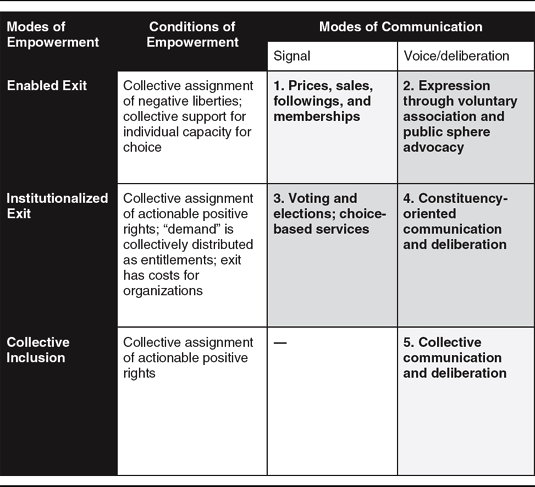



Comments
No Comments have been published for this article.