Morality is a central aspect of social life and is fundamental to maintaining and regulating interactions in large groups and societies. For over a half century, moral developmental investigations have stemmed from socialization and cognitive developmental constructionist perspectives (Jambon & Smetana, Reference Jambon, Smetana and Wright2015). More recently, empirical research influenced by evolutionary theory has focused on the early emergence of implicit social evaluations and preferences toward care and cooperation. These seemingly hardwired tendencies and intuitions emerge very early in ontogeny, and as a result are assumed to be the outcomes of selection pressures due to their adaptive value in promoting group living.
Mature morality incorporates multiple dimensions, including knowledge, values, reputation, and relevant behaviors. It involves both unconscious and deliberate processes such as harm aversion, empathic concern, social emotions (e.g., guilt, remorse, and shame), theory of mind, executive functioning, and abstract reasoning. Human moral decisions are governed by both statistical expectations (based on observed frequencies) about what others will do and normative beliefs about what others should do. These vary across different cultures and historical contexts, forming a continuum from social conventions to moral norms typically concerning harm to others (Tomasello & Vaish, Reference Tomasello and Vaish2013).
In contrast to this wide variation in normative beliefs, there is broad consensus that physically harming others and violating considerations of fairness are central to the moral domain (Gray, Young, & Watz, Reference Gray, Young and Watz2012; Hauser, Reference Hauser2006). Prototypical examples of moral rules include those prohibiting killing or injuring other people, stealing their properties, or breaking promises. Violations of moral rules typically involve a victim who has been physically or psychologically harmed, whose rights have been violated, or who has suffered an injustice. As such, most moral transgressions involve a causal relation between the inflicting agent, her/his intentions and actions, and the resulting suffering for the victim. Across cultures, countries, and religions, people draw a distinction between moral and conventional violations in that moral transgressions are judged to be more serious and less authority dependent (if at all) and conventional transgressions are arbitrary, situation dependent, and have a less prescriptive force (Smetana, Reference Smetana, Killen and Smetana2006). This distinction emerges early in development, even as young as 3.5 years old.
In this paper, we argue that perception and reaction to interpersonal harm provides a window into one rudimentary, yet critical, element of morality. Noticing interpersonal harm alongside the development of empathic concern, theory of mind, and socialization can lead to an understanding that harmful actions cause suffering and an appreciation that complex moral rules and norms depend on contexts within cultures. In this article, we provide a comprehensive mechanistic account of third-party harm aversion and demonstrate how it critically contributes to moral cognition and behavior by integrating recent empirical evidence from developmental social neuroscience, developmental psychology, and psychopathology, as well as clinical neuroscience. While evidence for the role of sensitivity to interpersonal harm in moral cognition appears convincing, we conclude by suggesting future research directions that are necessary to fully characterize whether this information and its underlying neural computations are domain specific, or rather should be seen as a general reaction to negative emotion akin to the negativity bias.
Experiencing and Perceiving Others’ Pain as a Foundational Element
Most scholars agree that harm aversion is a critical input in moral evaluation (Gray et al., Reference Gray, Young and Watz2012). The general prohibition against harming others is fundamental to peaceful human coexistence in large societies, so much so that the indiscriminate use of force against other humans is not permissible in any communities (Turiel, Reference Turiel2002). We propose that at the most elementary level, this sensitivity to interpersonal harm piggybacks on evolutionary ancient physiological pathways involved in nociception and pain processing.
Defense against harm is a vital requirement for continued existence. Even single-cell organisms can detect and respond to harmful stimuli. Across species, threat detection involves the processing of innate and learned threats by the nervous system through specialized defense circuits (Blanchard & Blanchard, Reference Blanchard and Blanchard1989). Nociception, which is the detection of a noxious tissue-damaging stimulus and sometimes is accompanied by a reflex response such as withdrawal, is evident in a number of different phyla including birds and mammals. Neonates do feel some form of unpleasant sensation or pain-related stress from noxious stimuli, similar to that which is felt in infants and adults, even though there are no known biological pain markers and only behavioral and stress-related physiological correlates (Marchant, Reference Marchant2014). These early reactions to risky stimuli, and avoidance of potential dangers to the self, provide a base from which infants begin to interpret hazards and distress in others. To perceive and possibly resonate with signals of distress from others, infants need multisensory neurons that can be triggered by the mere sight or sound of others’ distress. Whether multisensory integration exists at birth or gradually develops through experience remains a topic of debate. Neurophysiological data with animal models and event-related potential (ERP) studies with children suggest that the optimal capacity to integrate multisensory information reaches its maturity late in childhood and is strongly dependent on early experience (Dionne-Dostie, Paquette, Lassonde, & Gallagher, Reference Dionne-Dostie, Paquette, Lassonde and Gallagher2015).
Humans appear sensitive to signals of distress early in development. Neonates possess a neural mechanism for vocal affective discrimination, as demonstrated by a mismatch electroencephalographic response over the right hemisphere in response to emotionally laden syllables, particularly fearful and happy ones, within the first few days of life (Cheng, Lee, Chen, Wang, & Decety, Reference Cheng, Lee, Chen, Wang and Decety2012). This affective discrimination is selectively driven by voice processing rather than low-level acoustical features. The cerebral specialization for human voice and emotion processing emerges over the right hemisphere during the first days of life. In infants aged 3–7 month olds, sad vocalizations are associated with a selective increase of hemodynamic activity in brain regions involved in processing affective stimuli, such as the orbitofrontal cortex and insula (Blasi et al., Reference Blasi, Mercure, Lloyd-Fox, Thomson, Brammer, Sauter and Murphy2011). While this negativity bias is clearly observed in the first days of life in the vocal modality (Cheng, Lee, et al., Reference Cheng, Lee, Chen, Wang and Decety2012), it emerges later for facial expressions. Only in the first year of life do infants begin to pay more attention to negative emotions. For instance, 7-month-olds looked longer at fearful than happy faces (e.g., de Haan, Belsky, Reid, Volein, & Johnson, Reference de Haan, Belsky, Reid, Volein and Johnson2004), and exhibit greater amplitudes in a negative component over the frontal and central electrodes around 700 ms labeled negative central (Nc) in response to fearful rather than to happy faces. The Nc is usually interpreted to reflect infants’ allocation of attention. Behavioral and physiological responses of infants to the distress of others can be observed as early as 8 to 16 months (Roth-Hanania, Davidov, & Zahn-Waxler, Reference Roth-Hanania, Davidov and Zahn-Waxler2011), without confusion between self and other.Footnote 1
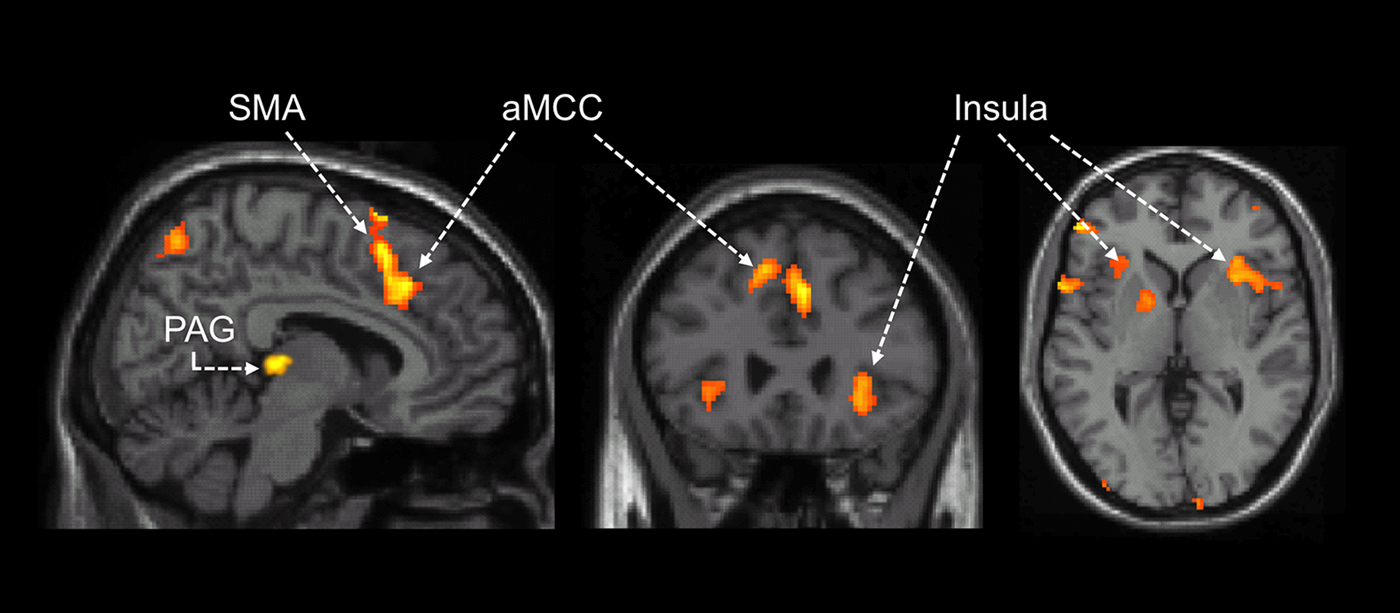
This sensitivity to the distress of others continues to evolve with age. Across early and middle childhood (3–9 years), an early automatic component (N200), reflecting attention to emotionally salient stimuli, and a late-positive potential (LPP) measured with electroencephalography (EEG), indexing cognitive reappraisal or more complex processing of emotional stimuli, are detected when perceiving the pain of others (Cheng, Chen, & Decety, Reference Cheng, Chen and Decety2014). The neuroanatomical localization of these ERP responses can be inferred from functional neuroimaging studies (functional magnetic resonance imaging [MRI]) conducted with older children and adults (e.g., Cheng, Yang, Lin, Lee, & Decety, Reference Cheng, Yang, Lin, Lee and Decety2008; Hohmeister et al., Reference Hohmeister, Kroll, Wollgarten-Hadamek, Zohsel, Demirakca, Flor and Hermann2010; Jackson, Rainville, & Decety, Reference Jackson, Rainville and Decety2006) that converge on sources in the anterior midcingulate cortex. This region, through its reciprocal connections with limbic and paralimbic structures (amygdala, nucleus accumbens, orbitofrontal cortex, periaqueductal gray, and autonomic brainstem motor nuclei), plays a central role in nociceptive processing, specifically in the motivational-affective dimension of pain, which is associated with the preparation of behavioral responses to aversive events (Figure 1).
(Color online) Regions involved in perceiving cues of distress and pain. Functional neuroimaging studies with children (Decety & Michalska, Reference Decety and Michalska2010; Decety et al., Reference Decety, Michalska and Akitsuki2008) and adults (Jackson et al., Reference Jackson, Rainville and Decety2006; Lamm et al., Reference Lamm, Decety and Singer2011) have consistently demonstrated that the perception of others in pain or emotional distress elicits neural response in a network of brain areas that partly overlap with regions involved in somatic pain processing and nociception, which includes the anterior midcingulate cortex, the supplementary motor area, the anterior insula, the periaqueductal gray, and sometimes the amygdala (not shown). Of particular importance is the anterior midcingulate cortex, a region that implements a domain-general process that is integral to negative affect, pain, and cognitive control, and contains pain responsive neurons that are activated by both the anticipation of pain and the instrumental escape from pain. These multimodal neural responses are related to bottom-up processes involved in saliency detection, arousal and/or attentional capture, and the selection of appropriate defensive reactions (Decety, Reference Decety2011; Legrain, Iannetti, Plaghki, & Mouraux, Reference Legrain, Iannetti, Plaghki and Mouraux2011).

These early emerging responses to distress of another supports the view that natural selection has tailored the brain to be sensitive and responsive to the affective states. Sensitivity toward others is necessary to promote group living and social learning (Decety, Ben-Ami Bartal, Uzefovsky, & Knafo-Noam, Reference Decety, Ben-Ami Bartal, Uzefovsky and Knafo-Noam2016). The most basic ability to detect signals of distress and feel concern for another has co-opted primitive homeostatic processes involved in reward and pain systems in order to facilitate various social attachment processes (Decety, Norman, Berntson, & Cacioppo, Reference Decety, Norman, Berntson and Cacioppo2012). These abilities pave the way for more complex socioemotional behaviors to emerge. Encephalization of pain evaluation transitions from being purely a physical phenomenon, in which the body and brain reacts to physical nociceptive stimuli, to a psychophysiological phenomenon, in which the loss of social contact produces psychological pain (Tucker, Luu, & Derryberry, Reference Tucker, Luu and Derryberry2005). However, this does not mean there is a direct path between the behavioral and aversive neural responses to the pain of another and moral judgment. These responses appear necessary but alone are not sufficient conditions for adultlike moral judgment, and therefore, do not directly cause moral judgment.
Neurological Dysfunctions That Impair Moral Development
One source of evidence regarding the critical role of sensitivity to interpersonal harm in the development of moral cognition comes from atypical socioemotional processing due to neurological lesion or dysfunction in brain anatomical connectivity. Damage to specific brain regions and neural circuits often yields downstream deficits in moral development within the context of normal psychological functioning. In particular, early lesions of the ventromedial prefrontal cortex (vmPFC) impair the development of moral knowledge and judgment (Eslinger, Flaherty-Craig, & Benton, Reference Eslinger, Flaherty-Craig and Benton2004). There is a large body of electrophysiological evidence as well as functional MRI data indicating that the vmPFC represents information about the personal and subjective value of stimuli or actions (i.e., economic utility or motivational value) to inform decision making even in the absence of choice (Levy & Glimcher, Reference Levy, Glimcher, Brosch and Sander2016). The connectivity of the vmPFC with various regions (e.g., striatum, amygdala, and temporoparietal junction) allows for a core function, possibly across economic, social, and affective domains, in the value encoding of real and hypothetical objects and behavior (Xia, Stolle, Gidengil, & Fellows, Reference Xia, Stolle, Gidengil and Fellows2015). Lesions of the vmPFC acquired before 16 months of age manifest in severe antisocial behavior, insensitivity to future consequences of decisions, and repeated failure to respond to behavioral interventions later in development. One such study examined the impact of early-onset (before 5 years) versus late-onset lesions to the vmPFC on moral judgment (Taber-Thomas et al., Reference Taber-Thomas, Asp, Koenigs, Sutterer, Anderson and Tranel2014). Patients with developmental-onset lesions endorsed significantly more self-serving judgments that broke moral rules or inflicted harm to others, suggesting that the vmPFC cortex is a critical neural substrate for the acquisition and maturation of moral competency necessary for considering the welfare of others and moving beyond self-interest (Decety & Cowell, Reference Decety and Cowell2014).
Dysfunction in the pathway that connects the amygdala (a region that guides and prioritizes the relevance of stimuli for the goals and motivations of the perceiver) to the vmPFC compromises or alters the development of moral judgment and care-base morality, and increases the risks of disregard for the well-being and the rights of others (Blair, Reference Blair2007). Breakdown in this pathway may also account for atypical responses to moral transgressions and to the distress of others, which can be evident as early as childhood. For example, children with callous–unemotional traits (lack of guilt, absence of empathy, and callous use of others) show similar behavioral characteristics to adults with psychopathy, such as a lack of fearfulness and empathy (Barry et al., Reference Barry, Frick, DeShazo, McCoy, Ellis and Loney2000). Moreover, they exhibit reduced electrodermal responses to distress cues and threatening stimuli relative to controls (Blair, Reference Blair1995). Callous–unemotional traits are relatively stable across childhood and adolescence and are associated with a particularly severe, aggressive, and stable pattern of antisocial behavior (Frick & White, Reference Frick and White2008) and are generally inversely related to affective empathy (Pasalich, Dadds, & Hawes, Reference Pasalich, Dadds and Hawes2014).
Neuroimaging studies have consistently shown abnormal anatomical and functional MRI connectivity in children, adolescent, and adult populations exhibiting conduct disorder and psychopathy, characterized by atypical moral cognition and antisocial behaviors. Such dysfunctions consistently illustrate the necessary functional communication between the amygdala and the ventromedial prefrontal cortex (Motzkin, Newman, Kiehl, & Koenigs, Reference Motzkin, Newman, Kiehl and Koenigs2011; Passamonti et al., Reference Passamonti, Fairchild, Fornito, Goodyer, Nimmo-Smith, Hagan and Calder2012; Wolf et al., Reference Wolf, Pujara, Motzkin, Newman, Kiehl, Decety and Koenigs2015). In individuals with psychopathy, a reduced response in the vmPFC has been documented to the emotional and physical distress of others, as well as reduction or absence of activation when processing moral judgment tasks (Decety, Chen, Harenski, & Kiehl, Reference Decety, Chen, Harenski and Kiehl2013; Decety, Lewis, & Cowell, Reference Decety, Lewis and Cowell2015; Harenski, Harenski, Shane, & Kiehl, Reference Harenski, Harenski, Shane and Kiehl2010; Yoder et al., Reference Yoder, Lahey and Decety2016).
The uncinate fasciculus is one anatomical pathway that serves as a critical link between structures that are implicated in several components of moral cognition, particularly between the orbitofrontal cortex/vmPFC, anterior insula, temporal pole, and amygdala. This long-range association pathway connects the anterior temporal lobe with the amygdala and orbitofrontal cortex. It is one of the last white matter tracts to reach its maturational peak with a developmental time course extending throughout adolescence and into young adulthood (Olson, Von Der Heide, Alm, & Vyas, Reference Olson, Von Der Heide, Alm and Vyas2015). In neurological patients, uncinate fasciculus stroke damage on the right side is associated with deficits in affective perspective taking (Oishi et al., Reference Oishi, Faria, Hsu, Tippett, Mori and Hillis2015), thus demonstrating that acute lesions can cause impaired empathy. Studies that examined antisocial traits in children and adolescents have consistently reported alterations in the uncinate fasciculus (Olson et al., Reference Olson, Von Der Heide, Alm and Vyas2015). For instance, significantly reduced fractional anisotropy was detected in the uncinate fasciculus of psychopaths compared with age- and IQ-matched controls. Further, antisocial behavior was correlated with individual differences in anatomical organization in this pathway (Craig et al., Reference Craig, Catani, Deeley, Latham, Daly, Kanaan and Murphy2009).
In addition, other studies have found that juvenile psychopaths with high callous–unemotional traits exhibit atypical temporal neural dynamics (measured with EEG/ERP) of pain empathy processing in the early stages of affective arousal when compared to age-matched controls. In the study by Cheng, Hung, and Decety (Reference Cheng, Hung and Decety2012), this abnormality was exemplified by a lack of the early ERP response (120 ms), thought to reflect an automatic aversive reaction to negative stimuli (other people suffering), and was coupled with relative insensitivity to actual pain in these adolescents, as measured with the pressure pain threshold. Nevertheless, the capacity of these participants to understand mental states was not impaired. Functional MRI studies conducted with children and adolescents with disruptive psychopathic traits have shown that these participants had reduced activity when perceiving the suffering of others within regions typically implicated in affective responses to others’ pain, including the anterior cingulate cortex, insula, and amygdala (Lockwood et al., Reference Lockwood, Sebastian, McCrory, Hyde, Gu, De Brito and Viding2013; Marsh et al., Reference Marsh, Finger, Fowler, Adalio, Jurkowitz, Schechter and Blair2013; but see Michalska, Feffiro, & Decety, Reference Michalska, Zeffiro and Decety2016). Abnormal functional connectivity between the amygdala, vmPFC, insula, and anterior cingulate has also been reported in children with higher callousness when they are exposed to signals of distress from others (Yoder, Lahey, & Decety, Reference Yoder, Lahey and Decety2016).
Overall, neural and subjective responses to perceived distress from third-party interpersonal harm both seem to require the anatomical integrity of the pathways connecting the amygdala, insula, and vmPFC. Dysfunction in these pathways has major consequences for the development of morality, highlighting the importance of sensitivity to interpersonal harm in moral development.
Early Social Evaluation and the Role of Interpersonal Harm Sensitivity
Infants are also sensitive to the valence of third-party social interactions and display a preference for prosocial agents over antisocial or neutral ones. When evaluating wooden characters helping or hindering another, 3-month-olds expressed a negativity bias by gazing significantly longer at the more-positive character, suggesting an aversion for antisocial behavior (Hamlin, Wynn, & Bloom, Reference Hamlin, Wynn and Bloom2010). Likewise, preverbal infants (6- and 10-month-olds) show an aversion to antisocial acts and prefer (e.g., reaching for/increased looking time toward) prosocial characters over antisocial characters. Infants appear to implicitly evaluate moral action and are concerned with how people act toward one another, at least enough for it to influence their social choices.
In addition to evaluating third-party social interactions on the basis of behavior, infants also take into account the social context in which actions occur (Hamlin, Reference Hamlin2014). When shown events depicting fair and unfair distributions of goods (such as milk or cookies), 15-month-old infants looked longer at the unfair situation. This suggests that even infants expect equality and are surprised by violations of distributive justice (e.g., Schmidt & Sommerville, Reference Schmidt and Sommerville2011; Sloane, Baillargeon, & Premack, Reference Sloane, Baillargeon and Premack2012). Preverbal infants as young as 10 months old manifest sympathetic responses to victims of antisocial behavior, represented only by moving geometrical objects. Infants who witnessed third-party interactions depicting pro- and antisocial behaviors exhibited a preference for the victim and avoidance of the aggressor. They seemed to understand the consequences of the interpersonal behaviors (Kanakogi, Okumura, Inoue, Kitazaki, & Itakura, Reference Kanakogi, Okumura, Inoue, Kitazaki and Itakura2013). Moreover, 10-month-old infants anticipate that a recipient of pro- and antisocial behavior (e.g., helping vs. hindering another from achieving her goal) should approach the agent who performed the prosocial action rather than the agent who performed the antisocial action, and are surprised if the recipient approaches the antisocial agent (Fawcett & Liszkowski, Reference Fawcett and Liszkowski2012; Lee, Yun, Kim, & Song, Reference Lee, Yun, Kim and Song2015). Beyond actions, infants appear concerned with the situational context and the mental states of the agents in third-party interactions.
This body of work has come under scrutiny in recent years because some studies have failed to replicate the early social preference for prosocial agents (e.g., Salvadori et al., Reference Salvadori, Blazsekova, Volein, Karap, Tatone, Mascaro and Csibra2015) or have provided a different, potentially leaner, interpretation (Scarf, Imuta, Colombo, & Hayne, Reference Scarf, Imuta, Colombo and Hayne2012). However, a recent literature review of 16 studies examining third-party social evaluation indicated that two-thirds of the published work clearly show a preference for prosocial agents and an avoidance of antisocial agents, expressed through looking times and reaching behavior, across different experimental paradigms (Holvoet, Scola, Arciszewski, & Picard, Reference Holvoet, Scola, Arciszewski and Picard2016).
Given infants’ limited verbal ability, theory of mind, and executive functioning, these third-party moral evaluations are thought to rely on intuitive processes that constitute the foundations for an innate moral core shaped by natural selection to facilitate social affiliation and collaboration (Hamlin, Reference Hamlin, Decety and Wheatley2015). Recent developmental neuroscience research largely confirms these behavioral findings. This work has also begun to identify specific neural computations underpinning early sociomoral evaluations and their relation to moral preferences, as well as considering parental dispositions.
In one such study, infants aged 12–24 months (Cowell & Decety, Reference Cowell and Decety2015a), watched cartoon characters engaging in prosocial and antisocial actions while EEG, time-locked ERP, and gaze fixation were recorded. After viewing the animations, physical versions of the characters were presented to assess reaching preference. Overall, infants and toddlers expressed preferential looking toward the prosocial over antisocial characters, supporting prior research on early social evaluation (Holvoet et al., Reference Holvoet, Scola, Arciszewski and Picard2016). Relative alpha asymmetry was greater for the perception of hindering than helping, implying the engagement of domain-general mechanisms of withdrawal/avoidance when confronted with aversive stimuli and the reduction of withdrawal when viewing positive stimuli, rather than the recruitment of a specific “moral module.” Relatively automatic differences (Nc = 300–500 ms) after observing these characters interacting were also detected. Those children with greater negativity (in Nc) associated with the perception of prosocial versus antisocial characters also tended to reach for the prosocial character. They marked consistency in social evaluations across multiple paradigms and a translation of implicit evaluation (ERP) to actual behavioral preferences. Greater negativity for prosocial actors was also predicted by higher parental sensitivity to injustice for others. These findings highlight the complexity of early social evaluations and the added value of a neuroscience approach. While infants exhibited a group-level difference in the neural processing of others’ interpersonal behaviors, the extent of their discrimination was already modulated by the views and dispositions of their parents, rendering the contention that social evaluations are the sole product of core knowledge questionable.
Another neurodevelopmental study examined implicit moral evaluations of antisocial and prosocial behaviors in children (3–5 years), and whether early automatic or later cognitive controlled (LPP) processes were predictive of children's own generosity (Cowell & Decety, Reference Cowell and Decety2015b). Differences were found in both automatic and later controlled ERPs when children viewed these scenarios. Only cognitively controlled processes predicted actual prosocial behavior (i.e., the number of stickers given to another anonymous child). These findings further emphasize that seemingly basic third-party perceptions of harming and helping require both automatic, intuitive/affective and cognitively controlled processes, and that exhibiting prosocial behavior entails additional cognitive reappraisal.
Neurodevelopmental investigations of early social evaluation indicate that infants do differentiate between prosocial and antisocial others. These differentiations may translate to behaviors as early as toddlerhood, and certainly by early childhood. However, this differentiation seems relatively basic in nature as it is based on approach/withdrawal tendencies and attentional resource allocation to relevant stimuli. Moreover, the potential modulation of these neurophysiological responses is already dependent upon some aspects of the sociocultural environment and socialization (Cowell & Decety, Reference Cowell and Decety2015a). Such computations, especially perception of interpersonal harm, play a central role in generating patterned moral responses, especially when they will become associated with social inputs from learning practices within a given culture. Accordingly, transgressions involving harm, justice, and rights evoke a similar negative affect, alerting the individual to the moral saliency of a situation or acting as an antecedent to moral judgment.
In these developmental and neurodevelopmental studies, the infant, toddler, or child is always an external observer, witnessing interactions between two or more actors/agents (puppets, characters, or geometric shapes). These uninvolved observational reactions are required for any inference of “judging” right and wrong, yet they, alone, are not adequate (Dahl, Reference Dahl2014). Any argument that young children are engaging in moral judgment is most persuasive when these third-party observations and preferences are applied and translated to one's own actions. A necessary condition for moral judgment is that children must be able to negatively evaluate their own actions in some circumstances. There is currently no evidence that infants are evaluating their own transgressions negatively around or before the first birthday. Signs of negative reactions following one's own transgressions are usually not seen until around the second birthday or later (Barrett, Zahn-Waxler, & Cole, Reference Barrett, Zahn-Waxler and Cole1993).
Infants, toddlers, and preschoolers harm others at higher rates than older children and adults. Data from large birth cohort studies suggest that most children substantially increase the frequency of physical aggression from 9 to 48 months followed by a steady decline until preadolescence (Tremblay, Reference Tremblay2006). An observational study that filmed social interactions among children in daycare documented that one in four interactions in 24-month-olds was an act of physical aggression and not just simple frustration (Restoin et al., Reference Restoin, Montagner, Rodriguez, Girardot, Laurent, Kontar, Talpain, Tremblay, Provost and Strayer1985). Two-year-olds have the capacity for empathic concern in reaction to seeing someone in distress, but this does not immediately transfer to their own moral behavior. Frequency reductions in acts of aggression from preschool through high school likely illustrate the crucial effects of brain and cognitive maturation in dynamic interaction with learning and socialization (Tremblay, Reference Tremblay2000). Another important lesson from these longitudinal studies is that children do not need to observe models of physical aggression to initiate the use of physical aggression, contrary to traditional belief.
Behavioral and neuroscience studies both demonstrate that several building blocks of morality are present early in development. In particular, an aversion to interpersonal harm and approach/preference toward prosocial characters is shown at an early age. These early social inclinations may help infants learn who can provide protection, affiliation, or cooperation in their social world (Hamlin, Reference Hamlin, Decety and Wheatley2015) so that they can also survive and thrive in a social group. A historic body of work from social-domain theorists has shown that children as early as preschool age judge actions against others involving harm more harshly than they judge actions without interpersonal harm. By later childhood and preadolescence, it is precisely the differentiation recognition of interpersonal harm that may signal the difference between a moral and conventional transgression (see Killen & Smetana, Reference Killen, Smetana and Lamb2015, for an extensive review of this literature). These basic elements develop across childhood and become increasingly interconnected with other capacities known to influence moral judgment, such as perspective taking and empathic concern (e.g., Killen & Smetana, Reference Killen, Smetana and Lamb2015). This gradual maturation is in constant interaction with inputs from rearing practices and social learning (Brownell, Reference Brownell2016).
Empathic Concern and Its Role in Morality
Perceiving other conspecifics being harmed triggers more than mere negative arousal. It can elicit empathic concern, as well as emotions such as anger and sadness for the victim, particularly when the harm is inflicted intentionally and is unjustifiable. Empathic concern is critical in moral cognition (Decety & Cowell, Reference Decety and Cowell2014).
Developmental studies have found clear behavioral expressions of empathic concern in infants around 10 months of age, and these expressions continue to increase gradually into the second year of life (Roth-Hanania et al., Reference Roth-Hanania, Davidov and Zahn-Waxler2011). Empathic concern does not necessarily require complex cognitive capacities such as theory or mind or a conscious awareness of one's feelings and others’ feelings. Rather, empathetic concern relies on a basic ability to discriminate between self-generated and external stimulation (Davidov, Zahn-Waxler, Roth-Hanania, & Knafo, Reference Davidov, Zahn-Waxler, Roth-Hanania and Knafo2013).Footnote 2 As stated previously, that 2-year-olds have the capacity for empathic concern for someone in distress does not necessarily translate into compensatory moral behavior. These children may not view the harming of others as wrong. For instance, nearly 80% of infants between 11 and 24 months engage in spontaneous acts of violence/force (Dahl & Freda, Reference Dahl, Freda, Sommerville and Decety2016). However, by the age of 3, children do understand that it is wrong to break moral rules and show increased responsiveness to emotional distress evoked by moral transgressions involving issues of harm and fairness as compared to social transgressions involving traditions and customs (Smetana, Reference Smetana, Killen and Smetana2006). This demonstrates the maturation of the early foundations of morality through socialization, including parenting, peer relationships, cultural practices, and values (Kartner, Keller, & Chaudary, Reference Kartner, Keller and Chaudary2010).
A recent developmental neuroscience study examined the electrophysiological responses (EEG and ERPs) associated with affective perspective taking and empathic concern when preschool-aged children were shown visual stimuli depicting somatic pain. The children were asked to evaluate how much pain the person in each presented image was suffering and how sorry they felt for him/her (Decety, Meidenbauer, & Cowell, Reference Decety, Meidenbauer and Cowellin press). In addition, children also played the widely used behavioral economics Dictator game to assess prosocial behavior (Benenson, Pascoe, & Radmore, Reference Benenson, Pascoe and Radmore2007; Cowell, Lee, et al., Reference Cowell, Lee, Malcolm-Smith, Yagmurlu, Zhou and Decety2016). Parent dispositional empathy was also collected. Consistent with a body of studies using similar stimuli in both children and adults, larger early (~200 ms) ERPs were found in response to perceiving painful versus neutral stimuli. In the late LPP window (~600 ms), a significant interaction of empathy condition and stimulus type was driven by a greater difference between painful and neutral images in the empathic concern condition. Across early development, children exhibited enhanced N2 to pain when engaging in empathic concern. Greater pain-elicited N2 responses in the cognitive empathy condition also related to parent dispositional empathy. Children's own prosocial behavior, as measured by generosity in the Dictator game, was predicted by larger early LPP responses during cognitive empathy and greater differentiation in late LPP responses to empathic concern versus affective perspective taking.
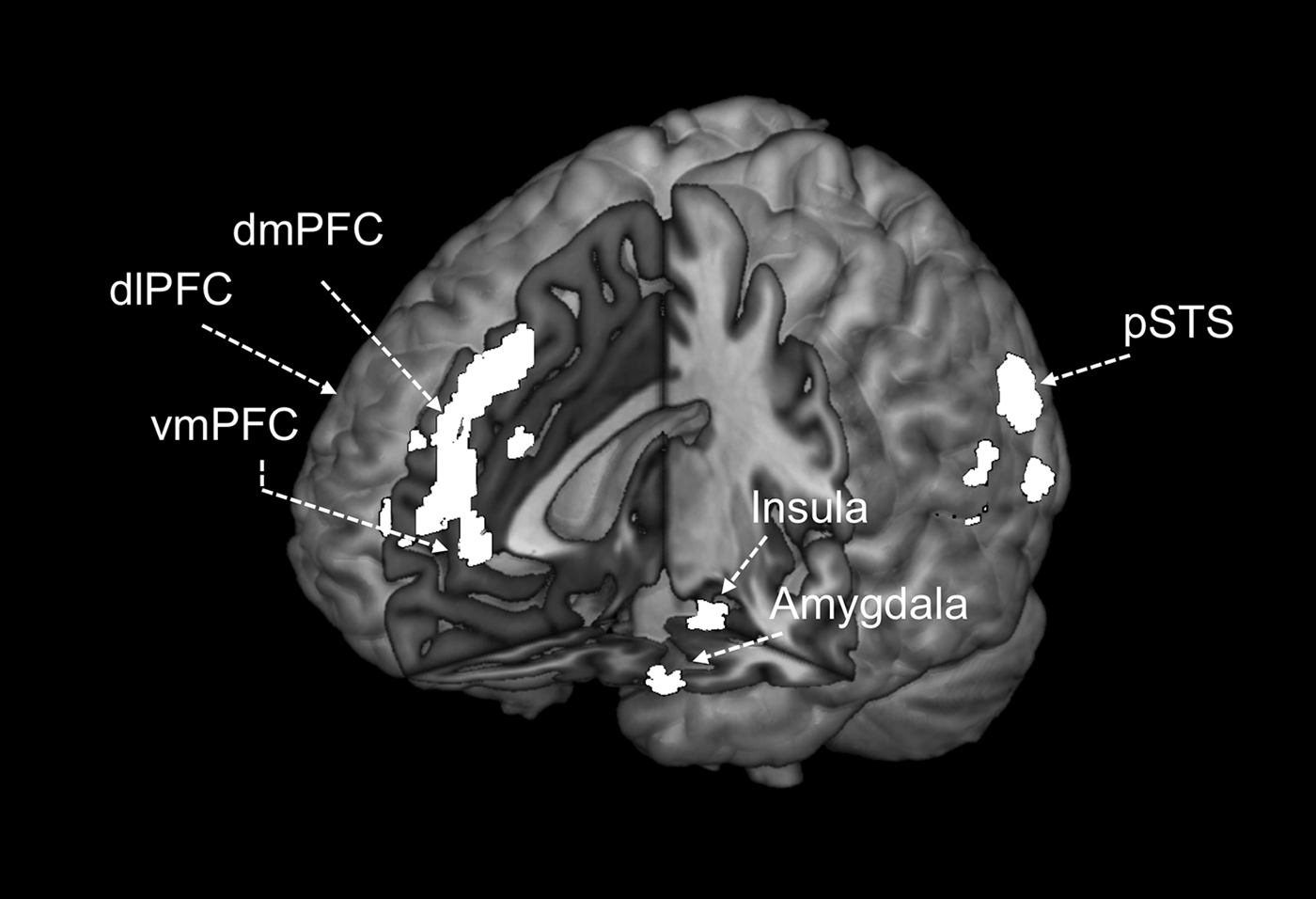
Another study used high-density EEG in a community sample to examine the spatiotemporal neurodynamic responses when viewing people in physical distress under two subjective contexts: one evoking affective sharing; the other, empathic concern (Decety et al., Reference Decety, Lewis and Cowell2015). The results indicate that early automatic (175–275 ms) and later controlled responses (LPP = 400–1,000 ms) were differentially modulated by engagement in affective sharing or empathic concern. Of vital importance, the late ERP component was significantly impacted by dispositional empathy and psychopathy, but the early component was not. Source localization analysis from another study, using the same stimuli, indicated that the peak for LPP was driven by frontal regions corresponding to the vmPFC and dorsolateral prefrontal cortex (see Figure 2).
Neural regions underpinning moral cognition. Converging evidence from social neuroscience and neurology indicate that brain regions associated with moral cognition and judgment are widely distributed and share computational resources with circuits controlling other capacities such as emotional saliency, mental state understanding, valuation of rewards, and decision making. These regions include and the posterior temporal cortex, amygdala, insula, ventromedial prefrontal cortex (vmPFC), dorsolateral PFC, dorsomedial PFC (dmPFC), and striatum (not shown). Both empathic concern and moral decision making require involvement of the vmPFC, a region that bridges conceptual and affective processes, necessary to guide moral behavior and decision making (Decety & Cowell, Reference Decety and Cowell2014). Human neuroimaging and primate electrophysiology studies show that the vmPFC tracks the personal subjective value of a wide range of stimuli during active decision and even in the absence of choice (Delgado et al., Reference Delgado, Beer, Fellows, Huettel, Platt, Quirk and Schiller2016). Recent meta-analyses suggest a distinction between the roles of the vmPFC and dmPFC in sociomoral judgments, such that the vmPFC is thought to compute the degree to which an object is relevant, valued, or important to the self, whereas the dmPFC is involved in evaluating social information about relevant goals, social norms, and contextual factors in order to make a judgment or decision (Denny, Kober, Wager, & Ochsner, Reference Denny, Kober, Wager and Ochsner2012). Early damage to the vmPFC leads to impaired moral judgments and social decision making, a lack of concern for others, and failure to learn from repeated mistakes, despite normal intellect and explicit knowledge of the consequences of one's behaviors and decisions.

The involvement of the vmPFC in expressions of empathic concern is far from trivial. This neural response does not reflect a mere negativity bias or an aversive response to interpersonal harm. First, functional neuroimaging studies examining emotional sharing usually do not report activation of that region when watching negative emotions and pain (Lamm, Decety, & Singer, Reference Lamm, Decety and Singer2011) except when children and adult participants are engaged in feeling or caring for a conspecific (Decety, Michalska, & Akitsuki Reference Decety, Michalska and Akitsuki2008; Decety, Michalska, & Kinzler, Reference Decety, Michalska and Kinzler2012; Decety & Porges, Reference Decety and Porges2011; FeldmanHall, Dalgleish, Evans, & Mobbs, Reference FeldmanHall, Dalgleish, Evans and Mobbs2015; Swain et al., Reference Swain, Konrath, Brown, Finegood, Akce, Dayton and Ho2012). Second, a lack of empathic concern, a robust behavioral phenotype of psychopathy, is associated with an absence of neurohemodynamic response in the vmPFC and atypical functional and anatomical connectivity with the amygdala (Decety, Skelly, & Kiehl, Reference Decety, Skelly and Kiehl2013). In one study, forensic psychopaths were scanned while viewing stimuli depicting bodily injuries and adopting an imagine-self and an imagine-other perspective (Decety, Chen, et al., Reference Decety, Chen, Harenski and Kiehl2013). During the imagine-self perspective, participants with high psychopathy showed a typical response within the network involved in empathy for pain, including the anterior insula, anterior midcingulate cortex, supplementary motor area, somatosensory cortex, and amygdala. Conversely, during the imagine-other perspective, psychopaths exhibited an atypical pattern of brain activation and effective connectivity seeded in the anterior insula and amygdala with the vmPFC. The response in the amygdala and insula was inversely correlated with the Factor 1 (interpersonal/affective) from the Psychopathic Check List Revised (Hare, Reference Hare2003) during the imagine-other perspective.
Developmental neuroscience work with children and adolescents supports a gradual maturation and integration across distinct neural computations in service of moral evaluation. In one cross-sectional study, preschool through adult participants (4–27 years) observed intentional and accidental harm to others while neurophysiological measures were collected, including functional MRI, eye tracking, and pupillometry (Decety, Michalska, et al., Reference Decety, Michalska and Kinzler2012). Across development, several neural areas involved in the integration of affective, mental state understanding, and cognitive processes, including the vmPFC, increased in activation and their functional connectivity to the amygdala and posterior superior temporal sulcus (pSTS). These findings reflect the continued neural growth underlying the integration of more complex contextual cues with aversion to interpersonal harm, empathic concern, and mental state understanding to arrive at more mature moral cognition.
Neurodevelopmental Changes in Third-Party Evaluation of Interpersonal Harm
The evaluation of harmful actions goes beyond sensitivity to interpersonal pain and empathic concern for the welfare of the victim. This evaluation is an input that will be integrated along with causal responsibility, intention to cause harm, and consequences of the action. Moral evaluation of the perpetrator has several decisive outcomes such as judgment on the wrongness of the action and deserved punishment. A significant cue in determining whether an action was malicious or not (Malle & Guglielmo, Reference Malle, Guglielmo, Langdon and Mackenzie2012) is intentionality, but its usefulness in judging the wrongness of an action may be age dependent (Zelazo, Helwig, & Lau, Reference Zelazo, Helwig and Lau1996). Intentionality also affects recommendations for punishment, which often require a complex integration between the analysis of mental states of the perpetrator and the consequences of his/her actions.
Neuroscientific data are critical to determine whether affective reactions to interpersonal harm (and then later moral violations in general) are activated before moral computations, during moral computations, or as antecedents to moral computations. This clarification is at the heart of moral theory. In order to sharpen theoretical discussion and empirical inquiry, it is necessary to characterize the functional architecture involved in mediating intuitive and deliberate moral evaluation, as well as the timing within this network (Huebner, Dwyer, & Hauser, Reference Huebner, Dwyer and Hauser2008). In one initial investigation of this time course, young adult participants were presented with visual stimuli of two characters interacting. High-density ERPs combined with source localization analyses revealed that differences due to the perception of visual stimuli depicting interpersonal intentional harm compared with interpersonal accidental harm are first detected in the right pSTS/temporoparietal junction (TPJ), a region that plays a key role in reasoning about the content of mental states of others, as fast as 62 ms poststimulus. Later, responses were found in the amygdala (122 ms) and vmPFC (182 ms; Decety & Cacioppo, Reference Decety and Cacioppo2012). In a follow-up study, direct electrophysiological recordings in neurological patients, using the same stimuli, demonstrated that intentional harm induces early activity in the amygdala (<200 ms) that, in turn, predicts intention attribution of the perpetrator (Hesse et al., Reference Hesse, Mikulan, Decety, Sigman, del Carmen Garcia, Silva and Ibanez2016). These electrophysiological data contribute to theoretical clarity with regard to the timing of the neural computations involved in moral cognition.
Research has also examined how the neural circuits supporting moral evaluations may change with age. A neurodevelopmental study using a large sample of preschool to adult participants (4–37 years) employed functional MRI and eye tracking, while displaying visual scenarios depicting intentional or accidental harm to others (Decety, Michalska, et al., Reference Decety, Michalska and Kinzler2012). After scanning, participants were presented with the same scenarios that they saw in the scanner and were asked to evaluate whether the actions performed in the video clips were intentional or accidental. They were also asked to respond to a set of questions probing moral judgment (wrongness and punishment), empathic concern for the victim, personal distress, and understanding of the perpetrator's mental state. Perceived intentional harm to people (as opposed to accidental harm) was associated with increased activation in brain regions sensitive to the perception, prediction, and interpretation of others’ mental states such as the right pSTS/TPJ in all participants (Pelphrey & Carter, Reference Pelphrey and Carter2008). Increased activation was also present in regions processing the affective consequences of these actions (amygdala and insula), subjective valuation, and decision making (vmPFC). The more participants reported being personally distressed when watching harmful actions, the higher the activity in the amygdala. Age was negatively correlated with empathic sadness for the victim of harm in the video clips, with the youngest participants exhibiting the greatest personal sadness. The degree of sadness each participant felt was predictive of the neural response in the insula, thalamus, and subgenual prefrontal cortex. The response in the amygdala followed a curvilinear function, such that the hemodynamic signal was highest at the youngest ages, decreased rapidly through childhood and early adolescence, and reached an asymptote in late adolescence through adulthood. This developmental change in amygdala recruitment, coupled with its relation to subjective ratings of empathic distress, supports the role of this region in the typical development of empathic understanding (Decety & Michalska, Reference Decety and Michalska2010). Conversely, the neurohemodynamic signal in older participants increased in the mPFC and vmPFC, regions that are associated with metacognitive representations, valuation, and moral decision making.
Patterns of functional connectivity (i.e., temporal correlations between spatially remote neurophysiological events) during the perception of intentional harm relative to accidental harm showed complementary evidence for an increased developmental integration between the prefrontal cortex and the amygdala. Older participants showed significant coactivation in these regions during the perception of intentional harm relative to accidental harm, whereas the youngest participants only exhibited a significant covariation between the vmPFC and periaqueductal gray in the brainstem. Furthermore, adult participants showed the strongest connectivity between the vmPFC and pSTS/TPJ while viewing morally laden actions suggestive of developmental changes in functional integration within the mentalizing system (theory of mind).
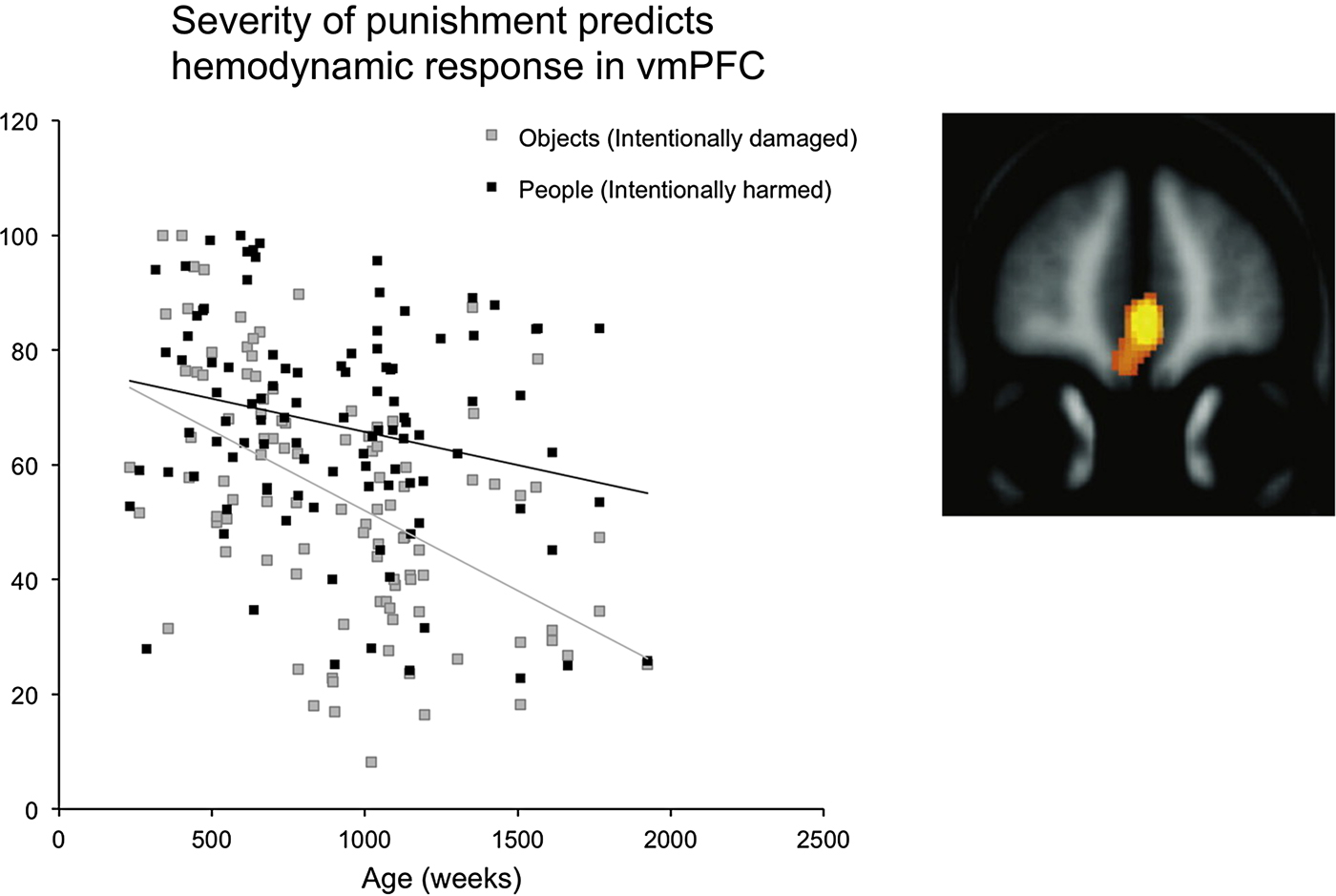
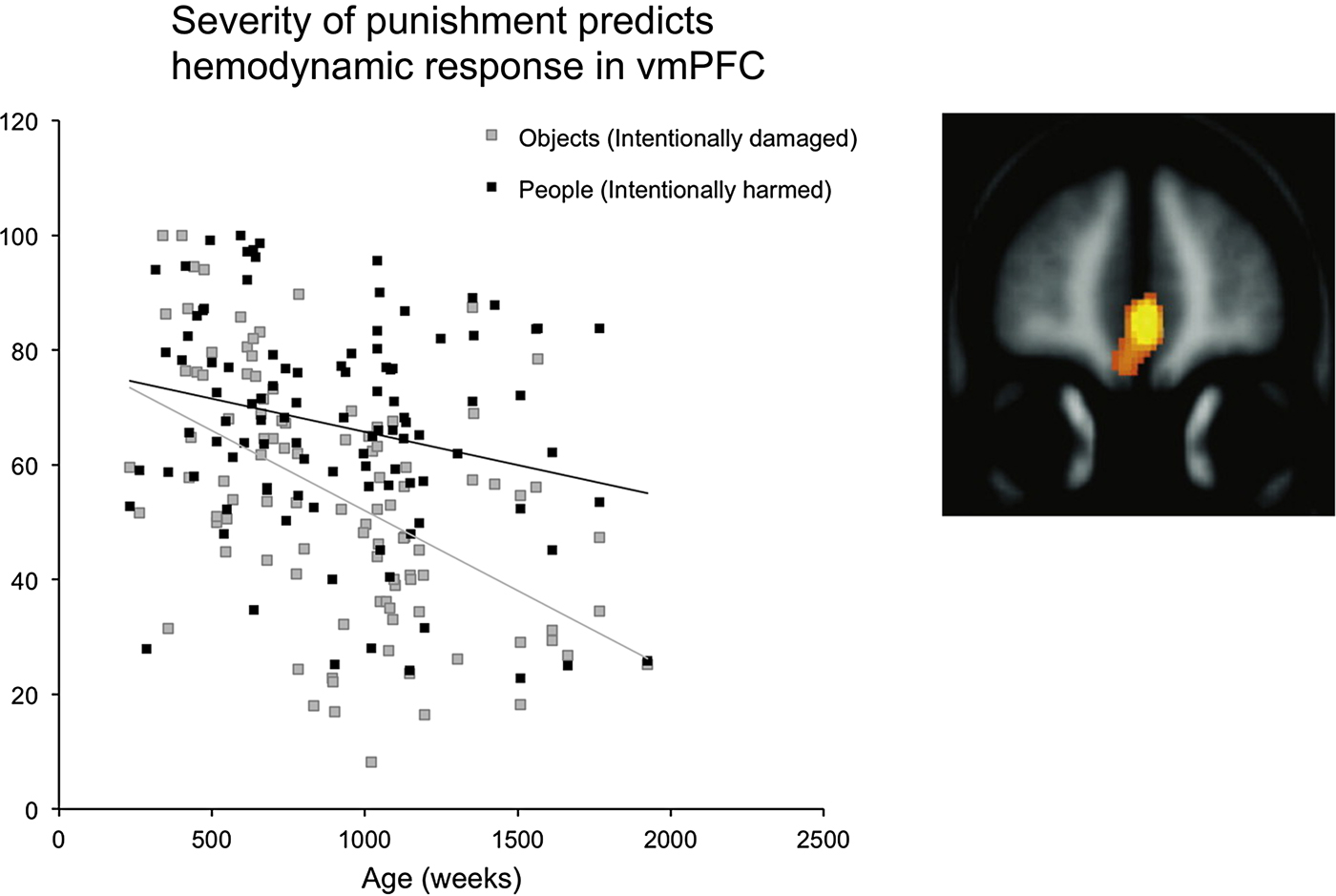
By using visual stimuli depicting interpersonal harm, several neurodevelopmental changes can be detected in neural regions that are implicated in emotional saliency (amygdala and insula). A gradual reduction in activation with age may be interpreted as increasing metabolic efficiency. Conversely, activity in regions of the medial and vmPFC, which are reciprocally connected with the amygdala, and are involved in valuation and decision making, increased with age as they became functionally coupled. This pattern of developmental change was also reflected in the moral evaluations, which require the capacity to integrate a representation of the mental states and intentions of others together with the consequences of their actions (Leslie, Knobe, & Cohen, 2006). Third-party judgments of wrongness did not change across age, as all participants rated intentional harm as more wrong than accidental harm. However, when asked about the malevolence of the agent, subjective evaluations indicated a more discerning appraisal with age. Young children considered all agents malicious, regardless of intention and targets (i.e., people and objects), but older participants perceived the perpetrator as clearly less mean when carrying out an accidental action, and even more so when the target was an object. As age increased, participants also punished an agent who damaged an object less severely than an agent who harmed a person (Figure 3). Though even young children attend to both intentionality and target in guiding their own empathic responses and judgment of wrongness, there is an increased discrimination of intentionality and target in determining moral culpability with age. This trend is consistent with developmental shifts in moral judgment that suggest an early focus on outcomes of actions and a later integration of both intent and consequences.
(Color online) How much would you punish an agent? Across development (4–37 years of age), participants will punish people more for an intentionally versus an accidentally harmful action. They will punish people more if they harm a person than if they damage an object, regardless of the intention of the action (p < .01). The graph shows age-related change in ratings of deserved punishment. With age, participants’ severity of punishment decreases significantly more for intentional damage done to objects than intentional harm done to people. With age, an increased discrimination of intentionality and outcome in determining moral culpability, and the severity of punishment predicts activity in the ventromedial prefrontal cortex (Decety, Michalska, et al., Reference Decety, Michalska and Kinzler2012).
Taken together, findings from these neurodevelopmental investigations of the perception and evaluation of third-party intentional harm, using both electrophysiology and functional imaging, highlight the importance of the dynamic integration of several interconnected neural networks implicated in processing distress cues, intentionality of the agent, consequences for the victim, valuation, and social decision making. In infancy, the valence of the observed action is readily coded, as reflected by early ERP responses distinguishing antisocial from prosocial interpersonal behaviors. However, when viewing visual scenarios later in development, intentionality of the agent seems to be processed first, which is then followed by an affective reaction, valuation, and reasoning. Across ontogeny, these task-level control networks show significant developmental change in functional connectivity, particularly between the amygdala, vmPFC, and pSTS. While neural network modules emerge very early in life (Fair et al., Reference Fair, Cohen, Dosenbach, Church, Miezin, Barch and Schlaggar2008), these functional modules are refined during toddlerhood, childhood, and adolescence, and become more distinct, characterized by changes in connectivity both within information processing modules and between modules. Such development allows for functional specialization, reducing interference among systems and facilitating cognitive performance to support adaptive behavior (Fornito, Harrison, Zalesky, & Simons, Reference Fornito, Harrison, Zalesky and Simons2012).
Conclusions
Evidence from the neural processing of social stimuli has been used to support the view that human infants are born equipped for the social world and ready to interact with other individuals of our species (Csibra & Gergely, Reference Csibra and Gergely2011). This applies not only to the sensitivity to human voices, perception of human faces, and attachment to a caregiver, but also to third-party social evaluation. While there is no consensus for a conceptual framework that explains why infants are able to evaluate other social agents so early in ontogeny, we propose that sensitivity to interpersonal harm plays a fundamental role in conjunction with basic approach versus avoidance motivations. This largely accounts for infants’ spontaneous cognitive evaluations and preferences for prosocial agents and negative evaluations for antisocial agents. Such basic computations are essential, regardless of any rich or lean interpretations of the emergence of a moral sense. Whether infants are endowed with an innate moral core or gradually develop morality through experience and socialization, these specific innate functions serve to guide or elicit the necessary learning for constructing the rest of the sociomoral competency.
The perception of interpersonal harm is a common core of most theories of morality. It constitutes a launching pad for examining the underlying neurobiological and psychological processes necessary for the development of moral cognition and behavior from infancy to childhood and beyond. These early building blocks of moral cognition are not supported by a single region or structure. Rather, they involve a multiplicity of connected and interwoven systems that subsume domain-general processes and basic motivations. Still, lesions to certain parts of the brain and to specific pathways can dramatically alter moral decision making and behavior, especially if they occur early in development. This developmental neuroscience perspective supports neuroconstructivist theories, which are viewed as a middle ground between core knowledge (nativist) systems and nonspecific learning devices (Karmiloff-Smith, Reference Karmiloff-Smith2012). This perspective advocates for the building of complex moral judgment from basic aversion to interpersonal harm, which is then combined with empathic concern, theory of mind, executive functioning, and metacognitive abilities, all embedded with social practices, cultural values, and normative evaluations.
Finally, while the evidence for the role of the sensitivity to interpersonal harm in moral cognition appears convincing, further research is necessary to fully characterize whether this information and its underlying neural computations are domain specific (specialized for a circumscribed class of stimuli), process specific (specialized for a particular type of computation), or rather should be seen as a general reaction to negative emotion akin to the negativity bias. This is a crucial consideration for anyone interested in clinical relevance and normative/nonnormative variation. It is particularly important to trace impairments in sociomoral functioning to deficits in specific stages of emotional information processing (e.g., perception, cognition, and regulation). Because similar behavior (i.e., longer looking to victims of harm) at two different ages might be due to distinct neurocognitive processes, behavioral observations alone are not sufficiently explanatory. This necessitates using neuroimaging methods such as ERPs, functional MRI, or functional near infrared spectroscopy, which provide insight into the ongoing neural processes (their spatial distribution and temporal dispersion) while the infant, child, or adolescent is attending to a stimulus, in conjunction with observing the behavioral outcomes of these processes. Moreover, there is evidence that constructive family interactions and warm and supportive parenting affect young children's morality and prosocial tendencies positively (Dunn, Reference Dunn, Killen and Smetana2014), and recent burgeoning evidence of parental transmission values of justice and fairness that can be observed in infant, children, and adolescent neural responses to morally laden scenarios (Cowell & Decety, Reference Cowell and Decety2015a; Decety et al., Reference Decety, Meidenbauer and Cowellin press). Future neurodevelopmental studies will need to consider how context and socialization factor in the early development of morality.