INTRODUCTION
Radiocarbon (14C) is one of the cosmogenic nuclides, which is formed during collisions between thermal neutrons and the nuclei of nitrogen in the nuclear reaction 14N(n, p)14C. The 14C that is formed in the atmosphere is oxidized in a two-step reaction process that produces 14CO2; through photosynthesis, and this carbon is incorporated into plant tissue. The global average production rate is of the order of 2 atoms·cm–2·s–1 (Castagnoli and Lal Reference Castagnoli and Lal1980) and it strongly depends on the intensity of the cosmic ray flux (Usoskin and Kovaltsov Reference Usoskin and Kovaltsov2012). The changes in the latter arise due to the variability of the solar magnetic field intensity, the interplanetary magnetic field, and the Earth’s magnetic field, all of which modulate the flux of cosmic rays. The production rate of 14C may increase due to extra-terrestrial high-energy events, such as solar proton events (SPEs), supernova explosions (SNe), or gamma-ray bursts (GRBs), which increase the intensity of the cosmic rays that reach the upper atmosphere.
Evidence of a rapid increase in the radiocarbon concentration of tree rings for the year 775 CE was initially presented by Miyake et al. in 2012 (henceforth called M12). Recorded from samples of the annual tree rings of Japanese cedar (Cryptomeria japonica), between 774 CE and 775 CE, the increase was determined to be around 12‰, which has been subsequently confirmed by several other authors (Jull et al. Reference Jull, Panyushkina, Lange, Kukarskih, Myglan, Clark, Salzer, Burr and Leavitt2014; Güttler et al. Reference Güttler, Beer, Bleicher, Boswijk, Hogg, Palmer, Vockenhuber, Wacker and Wunder2013; Rakowski et al. Reference Rakowski, Krąpiec, Huels, Pawlyta, Dreves and Meadows2015; Büntgen et al. Reference Wacker, Galván, Arnold, Arseneault, Baillie, Beer, Bernabei, Bleicher and Boswijk2018) via dendrochronologically dated annual tree rings in different places around the world. No significant differences have been recorded for the observed magnitude of this event at various locations, which indicates its global characteristics. Results reported by Jull et al. (Reference Jull, Panyushkina, Lange, Kukarskih, Myglan, Clark, Salzer, Burr and Leavitt2014), from samples taken in Siberia (Northern Hemisphere, NH), indicate that the increase began as early as 774 CE and then continued into 776 CE, which suggests that this was not caused by a single global event but probably a series of such events. In the Southern Hemisphere (SH), in samples from a kauri tree (Agathis australis) in New Zealand, the maximum 14C concentration was observed half a year later (Güttler et al. Reference Güttler, Beer, Bleicher, Boswijk, Hogg, Palmer, Vockenhuber, Wacker and Wunder2013), probably due to the SH offset (Rodgers et al. Reference Rodgers, Mikaloff-Fletcher, Bianchi, Beaulieu, Galbraith, Gnanadesikan, Hogg, Iudicone, Lintner, Naegler and Reimer2011).
Miyake et al. (Reference Miyake, Nagaya, Masuda and Nakamura2012) made an initial attempt to explain the causes of the M12 event. This involved using a four-box carbon cycle model, which produced the estimated production rate of 6·108 atoms·cm–2·s–1 that suggests a giant SEPs or SNe may have caused this global event. Since no evidence for SNe exists for this time frame, this possibility can be ignored. The production value was later recalculated by Usoskin et al. (2013) with use of a five-box carbon cycle model; their obtained result is around 4 times smaller than that calculated by Miyake et al. (Reference Miyake, Nagaya, Masuda and Nakamura2012), i.e., 1.3 ± 0.2·108 atoms·cm–2·s–1. In comparison, a production rate of approximately 0.9 ± 0.2·108 atoms·cm–2·s–1 was estimated for the event that occurred in 993/994 CE (Miyake et al. Reference Miyake, Masuda and Nakamura2013), which is lower than the case of M12. Mekhaldi et al. (Reference Mekhaldi, Muscheler, Adolphi, Aldahan, Beer, McConnell, Possnert, Sigl, Svensson, Synal, Welten and Woodruff2015) reported a comparable rapid increase in the concentration of 10Be and 36Cl in ice cores from Antarctica and Greenland for the years around 775 CE and 994 CE. GRBs with a typical energy spectra and fluxes could produce significant amounts of 14C and 36Cl. However, the rate of 10Be production would not be significantly affected (Pavlov et al. Reference Pavlov, Blinov, Konstantinov, Ostryakov, Vasilyev, Vdovina and Volkov2013; Mekhaldi et al. Reference Mekhaldi, Muscheler, Adolphi, Aldahan, Beer, McConnell, Possnert, Sigl, Svensson, Synal, Welten and Woodruff2015). We can thus conclude that a large SEP, or a series of SEPs, is likely to be the cause of the discussed Miyake events.
Since then, other events similar to the M12 have been confirmed for different time periods. A comparable increase of 11.3‰ was recorded between 993 and 994 CE in samples from the Hinoki cypress (Chamaecyparis obtusa) (Miyake et al. Reference Miyake, Masuda and Nakamura2013, Reference Miyake, Masuda, Hakozaki, Nakamura, Tokanai, Kato, Kimura and Mitsutani2014), which have been confirmed by other authors (Jull et al. Reference Jull, Panyushkina, Lange, Kukarskih, Myglan, Clark, Salzer, Burr and Leavitt2014; Güttler et al. Reference Güttler, Beer, Bleicher, Boswijk, Hogg, Palmer, Vockenhuber, Wacker and Wunder2013; Rakowski et al. Reference Rakowski, Krąpiec, Huels, Pawlyta, Dreves and Meadows2015, Reference Rakowski, Krąpiec, Huels, Pawlyta and Boudin2018; Fogtman-Schultz et al. Reference Fogtmann-Schulz, Ostbo, Nielsen, Olsen, Karoff and Knudsen2017; Büntgen et al. Reference Wacker, Galván, Arnold, Arseneault, Baillie, Beer, Bernabei, Bleicher and Boswijk2018). Another Miyake event was recorded for around 660 BC, which was later confirmed by Park et al. (Reference Park, Southon, Fahrni, Creasman and Mewaldt2017) and Rakowski et al. (Reference Rakowski, Krąpiec, Huels, Pawlyta, Hamann and Wiktorowski2019). In addition, a rapid increase in the radiocarbon concentration, between 814–815 BC (Jull et al. Reference Jull, Panyushkina, Miyake, Masuda, Nakamura, Mitsutani, Lange, Cruz, Baisan, Janovics, Varga and Molnar2018), has been reported; however, the magnitudes of the corresponding events were significantly lower in comparison to the M12. So far, the oldest observed rapid increase in the radiocarbon concentration occurred in mid-Holocene in around 5480 BC (Miyake et al. Reference Miyake, Jull, Panyushkina, Wacker, Salzer, Baisan, Lange, Cruz, Masuda and Nakamura2017). However, without any information on the changes in the production rate of 10Be and 36Cl, it is difficult to say if these are also Miyake events.
Since the M12 event was global, it has made it possible to use accurate radiocarbon dating with a one-year set of annual tree rings. Wacker et al. (Reference Wacker, Guttler, Goll, Hurni, Synal and Walti2014) first showed that such an event can be used as an age marker for the precise dating of artefacts. The authors used the abrupt increase in concentration of the radiocarbon for the years 774/775 CE to precisely date the year of the cutting of timber for use in the historical Holy Cross chapel of the convent St. John the Baptist in Val Münstair, Switzerland. A similar method was used to date the Baitoushan Volcano eruption in China (Hakozaki et al. Reference Hakozaki, Miyake, Nakamura, Kimura, Masuda and Okuno2018), and to obtain the absolute dendrochronological scale for pine trees from NW Poland (Krąpiec et al. Reference Krąpiec, Rakowski, Pawlyta, Wiktorowski and Bolka2020) on otherwise floating chronologies.
In this work, we extend our previous results (Rakowski et al. Reference Rakowski, Krąpiec, Huels, Pawlyta and Boudin2018) by including the measurements of the radiocarbon concentrations in the sub-annual rings. The piece of oak wood (Quercus sp.) used in our study belongs to the ring-porous angiosperms species, which has clearly developed both earlywood (EW) and latewood (LW). The EW consists of large vessels, which are formed in the spring just before the appearance of leaves. For their generation, the plant mainly uses stored reserves from the previous growing season. LW, on the other hand, is formed with the photosynthesized substances created during the growing season, i.e., the year of tree-ring formation. This enables a more accurate (a half-yearly) determination of the timing of the 14C concentration change. The goal of this study is to use the information on the carbon isotopic composition in sub-annual tree rings to estimate the beginning of the Miyake event.
SAMPLES AND METHODS
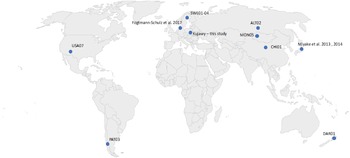
A sample of a subfossil oak wood (designated KU 13), taken from the Vistula alluvium during the construction of a sewage treatment plant in Kujawy near Kraków (50.0522 N, 20.1035 E, see Figure 1) was used in this study. The sample spans the years 908–1051 CE, and its absolute dating is dendrochronologically based on the South Polish oak standard POLSKA2 (Krąpiec Reference Krąpiec2001). The rings from this sample were dated to 981–1000 CE and they were previously successfully used to identify the Miyake event around 993–994 CE (Rakowski et al. Reference Rakowski, Krąpiec, Huels, Pawlyta and Boudin2018).
Sample location sites: Kujawy village (50.0522 N, 20.1035 E) near Kraków, SE Poland (this study), CHI01, MON05, ALT02, SWE01, SWE02, SWE03, SWE04, USA07, PAT03, DAR01 from Büntgen et al. (Reference Wacker, Galván, Arnold, Arseneault, Baillie, Beer, Bernabei, Bleicher and Boswijk2018), Japanese Hinoki cypress (Chamaecyparis obtusa) from Miyake et al. (Reference Miyake, Masuda and Nakamura2013, Reference Miyake, Masuda, Hakozaki, Nakamura, Tokanai, Kato, Kimura and Mitsutani2014), and Danish oak from Fogtmann-Schulz et al. (Reference Fogtmann-Schulz, Ostbo, Nielsen, Olsen, Karoff and Knudsen2017).

For the scope of this study, the annual increments for the period 990–997 CE, which are characterized by its adequate thickness and highly developed characteristics, were sliced and then separated into LW and EW. For 993 and 994 CE, the LW was additionally split into two parts. From each of the 18 samples, the most stable portion of the wood, in the form of α-cellulose, was designated for study (Santos et. al. Reference Santos, Bird, Pillans, Fifield, Alloway, Chappell, Hausladen and Arneth2001, Nemec et al. Reference Nemec, Wacker, Hajdas and Gaggeler2010). The extraction of the α-cellulose from the samples was performed according to the method described in work by Michczyńska et al. (Reference Michczyńska, Krąpiec, Michczyński, Pawlyta, Goslar, Nawrocka, Piotrowska, Szychowska-Krąpiec, Waliszewska and Zborowska2018: BABA + bleaching (with NaClO2 and HCl) + strong base NaOH). The obtained α-cellulose was then dried overnight at a temperature of 70°C. The extracted α-cellulose (with weight 4 mg) from each sample was combined with cupric oxide and silver wool, then sealed in a quartz tube, and evacuated with a rotary oil pump. The flame-sealed tubes were then placed into an electric furnace for 4 hr at 900ºC. The carbon dioxide produced from the samples was released under vacuum, cryogenically purified, and then collected. Next, the samples were graphitized via a reaction with H2 at 600ºC in the presence of an Fe catalyst (Nadeau et al. Reference Nadeau, Grootes, Schleicher, Hasselberg, Rieck and Bitterling1998; Krąpiec et al. Reference Krąpiec, Rakowski, Huels, Wiktorowski and Hamann2018).
The resulting mixture of graphite and Fe powder was pressed into a target holder for the AMS 14C measurements. All the prepared targets were measured at the Center for Applied Isotope Studies at the University of Georgia, USA (labcode UGAMS; Cherkinsky et al. Reference Cherkinsky, Culp, Dvoracek and Noakes2010). The 14C contents are reported as Δ14C in per mil (‰) deviations from the standard sample, with 0.7459 activity for the NBS oxalic acid (SRM-4990C). The age correction, the isotopic composition correction (δ13C, measured by the AMS system), and the Δ14C values were calculated using formulas previously presented in the literature (Stuiver and Polach Reference Stuiver and Polach1977). For the IRMS δ¹3C determinations, the same cellulose extracted from the tree-rings were used. A weight of 100–120 µg for each cellulose sample was packed into a tin capsule. The isotopic analyses were made in duplicates, in which each half dozen sample of the two different reference materials were analyzed. The EuroVector EA3000 elemental analyzer was used for the combustion of the sample and the purification of the gases. Gas resulting from the combustion was carried via high purity helium gas. CO2 gas was purified in the elemental analyzer and then chromatographically separated from the other combustion gases in a packed GC column. The elemental analyzer was interfaced via an open split to IsoPrimeTM (Elementar UK Ltd.) isotope ratio mass spectrometer. A multi-point calibration procedure was used during the δ¹³C calculations (Coplen et al Reference Coplen, Brand, Gehre, Gröning, Meijer, Toman and Verkouteren2006). IAEA-CH3 cellulose, IAEA-600 caffeine, and IAEA-CH6 sucrose international standards (International Atomic Energy Agency) were used for the δ¹³C normalization. The δ¹³C results are expressed in ‰ using the VPDB scale (Coplen et al Reference Coplen, Brand, Gehre, Gröning, Meijer, Toman and Verkouteren2006).
RESULTS AND DISCUSSION
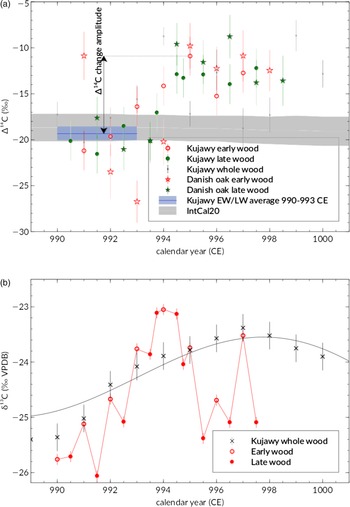
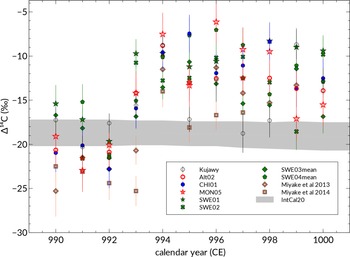
The measured results (pMC, Δ14C, δ13C), with the corresponding uncertainties, are presented in Table 1. Figures 2(a) and 2(b) shows the Δ14C and δ13C values for the sub-annual (EW and LW) tree rings for the period 990–997 CE. Since the LW is produced in the summer, their results are displaced by half a year. Additionally, the LW rings from the years 993 and 994 CE have been split into two parts and they are shifted by +0.5 and +0.75 years, respectively. Results from Rakowski et al. (Reference Rakowski, Krąpiec, Huels, Pawlyta and Boudin2018), displayed in Figures 2 and 3, represent the Δ14C and δ13C values for the whole annual tree rings (EW and LW); these were compared with the results from Miyake et al. (Reference Miyake, Masuda and Nakamura2013, Reference Miyake, Masuda, Hakozaki, Nakamura, Tokanai, Kato, Kimura and Mitsutani2014), and Büntgen et al. (Reference Wacker, Galván, Arnold, Arseneault, Baillie, Beer, Bernabei, Bleicher and Boswijk2018) (CHI01, MON05, ALT02, SWE01, SWE02, SWE03mean, SWE04mean). The data from Rakowski et al. (Reference Rakowski, Krąpiec, Huels, Pawlyta and Boudin2018) and Büntgen et al. (Reference Wacker, Galván, Arnold, Arseneault, Baillie, Beer, Bernabei, Bleicher and Boswijk2018) show a comparable pattern. In both set of records, a more gradual increase from 991–992 CE to 993 CE of about 4.7 ± 1.9‰ is seen, followed by a 6.8 ± 1.8‰ increase between 993–994 CE (Rakowski et al. Reference Rakowski, Krąpiec, Huels, Pawlyta and Boudin2018). This provides a total increase in the Δ14C values of approximately 11.5 ± 1.6‰ within the 991–994 CE time period. However, the samples from the Hinoki cypress (Chamaecyparis obtusa) show a rapid increase in the Δ14C value within one year (993–994 CE) of around 9.1 ± 2.6‰ (Miyake et al. Reference Miyake, Masuda and Nakamura2013) and 11.3 ± 2.5‰ (Miyake et al. Reference Miyake, Masuda, Hakozaki, Nakamura, Tokanai, Kato, Kimura and Mitsutani2014). We observe that there is no offset (–1.1 ± 1.0‰) between the data presented by Rakowski et al. (Reference Rakowski, Krąpiec, Huels, Pawlyta and Boudin2018) and Miyake et al. (Reference Miyake, Masuda and Nakamura2013). However, a significant systematical negative offset of –4.4 ± 1.0‰ occurs between the data presented by Rakowski et al. (Reference Rakowski, Krąpiec, Huels, Pawlyta and Boudin2018) and Miyake et al. (Reference Miyake, Masuda, Hakozaki, Nakamura, Tokanai, Kato, Kimura and Mitsutani2014).
Values for the pMC, Δ14C, δ13C of the EW and LW from Kujawy. The LW samples for 993 and 994 CE have been divided into two sub-samples. In further calculations, an average value based on both parts has been used. The uncertainty in the δ13C measurements is greater than 0.10‰.

Graphs showing the (a) Δ14C values (in ‰) for the Kujawy whole wood (Rakowski et al. Reference Rakowski, Krąpiec, Huels, Pawlyta and Boudin2018), EW, and LW, alongside the EW and LW values for the Danish oak (Fogtmann-Schulz et al. Reference Fogtmann-Schulz, Ostbo, Nielsen, Olsen, Karoff and Knudsen2017) and IntCal20 (Reimer et al. Reference Reimer, Austin, Bard, Bayliss, Blackwell, Ramsey, Butzin, Cheng, Edwards, Friedrich, Grootes, Guilderson, Hajdas, Heaton, Hogg, Hughen, Kromer, Manning, Muscheler, Palmer, Pearson, van der Plicht, Reimer, Richards, Scott, Southon, Turney, Wacker, Adolphi, Büntgen, Capano, Fahrni, Fogtmann-Schulz, Friedrich, Köhler, Kudsk, Miyake, Olsen, Reinig, Sakamoto, Sookdeo and Talamo2020) and (b) δ13C values (in ‰ VPDB) for the EW and LW from Kujawy.

Graph depicting the Δ14C values (in ‰) for the Kujawy whole wood (Rakowski et al. Reference Rakowski, Krąpiec, Huels, Pawlyta and Boudin2018), the data from Büntgen et al. Reference Wacker, Galván, Arnold, Arseneault, Baillie, Beer, Bernabei, Bleicher and Boswijk2018 (CHI01, MON05, ALT02, SWE01, SWE02, SWE03mean, SWE04mean), and the data from Miyake et al. (Reference Miyake, Masuda and Nakamura2013, Reference Miyake, Masuda, Hakozaki, Nakamura, Tokanai, Kato, Kimura and Mitsutani2014) and IntCal20 (Reimer et al. Reference Reimer, Austin, Bard, Bayliss, Blackwell, Ramsey, Butzin, Cheng, Edwards, Friedrich, Grootes, Guilderson, Hajdas, Heaton, Hogg, Hughen, Kromer, Manning, Muscheler, Palmer, Pearson, van der Plicht, Reimer, Richards, Scott, Southon, Turney, Wacker, Adolphi, Büntgen, Capano, Fahrni, Fogtmann-Schulz, Friedrich, Köhler, Kudsk, Miyake, Olsen, Reinig, Sakamoto, Sookdeo and Talamo2020).

The sub-annual data from the Kujawy EW and LW rings show a gradual increase in the Δ14C values between 991–995 CE, which are similar to those observed by Rakowski et al. (Reference Rakowski, Krąpiec, Huels, Pawlyta and Boudin2018). An increase of 10.3 ± 2.6‰ in the Δ14C for the EW data, and 8.6 ± 2.6‰ in the LW data has been observed for this period. The increase of 5.5 ± 2.9‰ in the Δ14C is seen in the LW data, between 993–994 CE, and is also visible in the EW data with a magnitude of 3.1 ± 2.9‰ for one year later between 994–995 CE. This is because, to a significant extent, the EW is formed from the material accumulated in the previous year and a much lesser amount of it derives from the material created by photosynthesis in the year of growth (Speer Reference Speer2010). Olsson and Possnert (Reference Olsson and Possnert1992) observed that there is no delay between the radiocarbon concentration in the atmospheric sample in comparison with its concentration in the EW and LW during the maximum bomb effect (1962–1963). However, in our data, the radiocarbon concentrations in the EW and LW from the previous year are similar. A reduced chi-squared test is applied to the LW and EW data from consecutive years, which shows that there were no statistically significant differences between those values for the whole period, and also for the pairs 993LW/994EW CE and 994LW/995EW CE. The total amplitude of the excursion, which is calculated for the Kujawy site as the difference between the average of EW/LW Δ14C values for the period of 990–993 CE and the maximum of Δ14C observed in the EW of 995 CE, is equal to 8.4 ± 1.5‰ (Figure 2a).
The sub-annual δ¹³C data from the EW and LW rings originating from Kujawy show a pattern similar to the whole wood data that was previously published. The variability of the sub-annual δ¹³C data is much higher than for the whole wood samples. From the graph of Figure 2(b), it can be seen that sum of the harmonic functions fitted (Rakowski et al Reference Rakowski, Krąpiec, Huels, Pawlyta and Boudin2018) to the whole year data may also describe the sub-annual δ¹³C. Comparison of the early and late wood δ¹³C data (Figure 2(b)) shows that, in most cases, the LW δ¹³C is significantly lower than the EW δ¹³C. For the 990 CE ring, there is no significant variation between LW/EW δ¹³C. This is different from the previously described pattern is the 993 CE ring, for which the δ¹³C value of the second part of the late wood is significantly higher that the δ¹³C of both the first part of the late wood and the early wood.
In Figure 2(a), the Δ14C results determined by Fogtman-Schultz et al. (Reference Fogtmann-Schulz, Ostbo, Nielsen, Olsen, Karoff and Knudsen2017) are presented alongside the results from Kujawy (the EW, LW and whole ring). This data shows the radiocarbon concentration between 990–998 CE in the EW and LW rings of the oak tree from Mojbøl in Southern Jutland, Denmark. Here, a sharp increase of 10.5 ± 3.4‰ in the Δ14C has been observed in the LW between 993–994 CE, and almost the same increase in magnitude of 10.2 ± 3.5‰ in the EW between 994–995 CE. This is consistent with the values presented by Miyake et al. (Reference Miyake, Masuda and Nakamura2013, Reference Miyake, Masuda, Hakozaki, Nakamura, Tokanai, Kato, Kimura and Mitsutani2014). The systematical negative offset of –2.1 ± 1.0‰ for the LW and the Hinoki tree data and –5.1 ± 1.1‰ for the Danish oak and the Hinoki tree have also been reported (Fogtmann-Schulz et al. Reference Fogtmann-Schulz, Ostbo, Nielsen, Olsen, Karoff and Knudsen2017). The magnitude of the Δ14C increase in the LW (for 993–994 CE) and the EW (994–995 CE) from Kujawy seems to be smaller. However, there are no statistically significant differences between the corresponding values from the Danish oak (less than 1.5σ), which is due to the large uncertainty of these measurements. The EW and LW radiocarbon concentration data from the Danish oak were used to estimate the most probable period during which the phenomena occurred (most likely a SEP or a series of SEPs), which caused the abrupt increase in the atmospheric radiocarbon concentration. It was determined that the most probable time period for the occurrence of this global phenomena is between late autumn of 993 CE and early summer of 994 CE, but most likely between April–June 994 CE (Fogtmann-Schulz et al. Reference Fogtmann-Schulz, Ostbo, Nielsen, Olsen, Karoff and Knudsen2017). The latter is based on the fact that no increase is seen in the radiocarbon concentration in the EW from that year.
Sets of data that show the changes in radiocarbon concentration in the tree rings from sites around NH (CHI01, MON05, ALT02, SWE01, SWE02, SWE03, SWE04, USA07) and SH (PAT03 and DAR01) for the period 990–1000 CE were used to determine the production rate of 14C atoms and the timing of this phenomena (Büntgen et al. Reference Wacker, Galván, Arnold, Arseneault, Baillie, Beer, Bernabei, Bleicher and Boswijk2018). Using a box model, the authors estimated that, during the Miyake event in 993 CE, an additional 5.3 ± 0.5⋅1026 radiocarbon atoms have been produced, which is around 1.8 ± 0.2 times the natural annual production of this isotope. The most probable period for this to occur was estimated to be within the boreal spring (April ± 2 months) of 993 CE, which is one year earlier than estimated by Fogtmann-Schulz et al. Reference Fogtmann-Schulz, Ostbo, Nielsen, Olsen, Karoff and Knudsen2017. Our results, based on the sub-annual δ¹³C data patterns, suggest that some stress to the tree occurred in the summer 993 CE. Based on this observation, the event may of arisen in the summer/late summer (September –2/+1 month) of 993 CE. An earlier occurrence of this phenomena is suggested by Büntgen et al. (Reference Wacker, Galván, Arnold, Arseneault, Baillie, Beer, Bernabei, Bleicher and Boswijk2018), which would explain the gradual increase in the radiocarbon concentration in the annual tree rings that is seen in the samples from Kujawy, and for all sets of data from NH (CHI01, MON05, ALT02, SWE01, SWE02, SWE03, SWE04, USA07) and SH (PAT03 and DAR01) from Büntgen et al. (Reference Wacker, Galván, Arnold, Arseneault, Baillie, Beer, Bernabei, Bleicher and Boswijk2018).
CONCLUSIONS
A new high-resolution set of radiocarbon data from the sub-annual oak tree rings of Kujawy, southern Poland, is presented in this paper. This radiocarbon concentration dataset from the EW and LW rings covers the Miyake event in 993/994 CE. This new data record shows a gradual increase in Δ14C of 10.3 ± 2.6‰ in the EW data, and 8.6 ± 2.6‰ in the LW within the years 991–995 CE, which are similar (and in agreement) to previously reported observations (Rakowski et al. Reference Rakowski, Krąpiec, Huels, Pawlyta and Boudin2018). In comparison, the radiocarbon data collected for 990–1000 CE in both the northern and southern hemispheres, as presented by Büntgen et al. (Reference Wacker, Galván, Arnold, Arseneault, Baillie, Beer, Bernabei, Bleicher and Boswijk2018), provide comparable data patterns with a gradual increase that begins before 994 CE. The most probably time period for a major event, which caused a significant change in the radiocarbon concentration of the tree rings, is most likely in the spring season (September –2/+1 months) of 993 CE.
ACKNOWLEDGMENT
This work was supported by the National Science Centre, Poland, grant UMO-2017/25/B/ST10/02329.