In December 1992 Iraqi state television put on a day-long program devoted to the opening of a new drainage canal at Yusufiyya, south of Baghdad. President Saddam Husayn himself presided over the ceremonies, swimming in the canal and performing ritual ablutions at the water's edge. Military personnel, the crew of the grounded Iraqi national airline, and gray-suited engineers paraded in uniform. The ceremony climaxed with the unveiling of a thirty-foot statue of the president, his hand outstretched to the water.Footnote 1 The canal connected to a 550-kilometer long network of dikes and sluices running from Baghdad to the Euphrates and southward to the Persian Gulf. The “Third River” promised to rejuvenate Iraqi agriculture, a plan harkening to Mesopotamia's heritage as a hydraulic civilization. Meanwhile, farther downstream, signs of severe ecological distress began to appear in the vast expanse of wetlands at the confluence of the Tigris and Euphrates rivers. The Hammar, Amara, and Hawizeh marshes collectively formed the largest wetland in southwest Asia and were the home of the Marsh Arabs (Maʿdan), whose unique subculture was based on fishing, rearing water buffalo, and cultivating reeds. After crushing the popular uprising of March 1991 that swept through southern Iraq, Saddam launched a systematic campaign to burn the marsh villages and remove the population. The new hydrological infrastructure effectively diverted water from the marshes and facilitated the military penetration of the area.
The destruction of the marshes and their inhabitants figures prominently as both ecocide and genocide in any bill of particulars against Saddam and the Baʿth.Footnote 2 It is even mentioned in the preamble of Iraq's 2005 constitution among the former regime's crimes against the Iraqi people.Footnote 3 This paper shows how the sectarianism of the Baʿth regime interacted with its visions of socioeconomic development and sense of insecurity to generate an extremely violent response to the marshes' obstreperous physical and human geography. The destruction of the marshes represented not just a reversion to primitive ethno-sectarian supremacism, but a catastrophe induced by an authoritarian, modernizing state committed to re-engineering human ecology.
The idea of control through engineering has deep roots in Iraq.Footnote 4 Since antiquity rulers have sought to bend the Tigris and Euphrates rivers to their will, channeling the waters with dams and dikes and expanding the zone of settled agricultural production. But the reach of supposed hydraulic despots tended to exceed their grasp. During long intervals when hydrological infrastructure fell into disrepair, the water would flow unencumbered, washing-out precious cropland and feeding the marshes.Footnote 5 It was not until the 19th and early 20th centuries that states acquired new means to regulate nature and affect societal designs. Imperial rulers in Iraq, like their counterparts in Egypt and elsewhere, used hydrology, agronomy, epidemiology, economics, and a host of other technologies to alter human ecology.Footnote 6 Diverting water from the marshes through irrigation and moving peoples from rural hinterlands to the modern agricultural sector was a cornerstone of Iraq's development strategies. This technopolitics used ostensibly scientific, rational, and universal technological means for distinctly political ends. Like many similar examples of technopolitics, the bid to transform the marshes had dire and unforeseen human and environmental consequences.Footnote 7
Coming to power in 1968, Saddam and the Baʿth built off this technopolitical foundation. More than their predecessors, the Baʿth evinced a commitment to what James C. Scott calls high modernist ideology, a “muscle-bound” confidence in “scientific and technical progress, the expansion of production, the satisfaction of human needs, [and] the mastery of nature (including human nature).”Footnote 8 High modernism is an extreme mode of technopolitics based on an exacting blueprint for perfecting human ecology. These designs for societal transformation become especially dangerous in the hands of authoritarian regimes. The worst catastrophes tend to occur during crises, when a combination of insecurity and hubris compels rulers to put their full coercive weight behind plans to reshape people and nature.Footnote 9 For the Baʿth, the escalation began during the Iran–Iraq War. Concerned about infiltration and insurgency, the regime used techniques that had emerged in the development domain to divert water and forcibly resettle populations from the marshes. These measures were linked practically and discursively to the wider initiative of modernization. The perceived Shiʿi betrayal of March 1991 further radicalized this agenda, as the regime set out to “solve” the problems of development and security simultaneously through wholesale destruction and population removal.
First and foremost, then, this paper seeks to contribute to an understanding of Iraq in the Baʿth era. The opening of the Saddam Hussein (SH) archive at the Conflict Record Research Center of the National Defense University and the Arab Baʿth Socialist Party (ABSP) in Iraq archive at the Hoover Institution of Stanford University allows for an unprecedented perspective on the regime's inner workings.Footnote 10 Much of the historiography surrounding the marshes centers on the question of sectarianism. The assault on marshes is often seen as part of the broader repression of Iraqi Shiʿa following the 1991 uprising.Footnote 11 Yet the regime's internal documents reveal a more complex picture than the caricature of Saddam as merely a Sunni chauvinist. In fact, explicit reference to sect was largely taboo within regime circles.Footnote 12 The Baʿth regime framed its policies as progressive, rational, and scientific reforms that transcended the anachronism of sect. Still, sectarianism inflected this outwardly apolitical high modernism. Paranoia about Shiʿi disloyalty and the need to protect Saddam's narrow powerbase was a consistent subtext in policy discussion. As Dina Khoury argues, the regime's sectarian outlook became more pronounced in response to the crisis of 1991.Footnote 13 Yet, except for the genocide in Kurdistan, Iraqi government documents have not been used to explore specific acts of Baʿth repression.Footnote 14 Seeing the marshes through the state's own documents shows how high modernist technopolitics articulated and enabled sectarian politics.
The paper also adds to a comparative discussion of the drivers of ecological and social change in the Middle East. Projects such as the drainage of the Hula wetlands in Israel, the al-Ahsa Irrigation and Development Project in Saudi Arabia, and, most famously, the construction of the Aswan High Dam in Egypt, embody technopolitical methods of changing society by manipulating ecology.Footnote 15 These projects were all deemed critical steps toward national development. They helped make way for the assertion of state authority over previously undeveloped spaces and peoples. Yet they also induced significant societal dislocation and ecological damage.Footnote 16
Drawing from theories in political geography and critical security studies, this paper highlights the continuities between development-induced ecological disruption, population displacement, and the violence of counterinsurgent warfare. Nancy Lee Peluso, Michael Watts, and Peter Vandergeest stress that development and counterinsurgency share many of the same technopolitical parameters. Both are components of the state's habitus of imposing legibility and governmentality upon people and places.Footnote 17 Political instability and insurgency are frequently depicted as symptoms of underdevelopment. David Kilcullen, a doyen of contemporary counterinsurgency theory, describes his tasks as “armed social work; an attempt to redress basic social and political problems while being shot at.”Footnote 18 Ameliorating these problems through targeted improvement projects—water pumps, roads, farm implements, schools, and so forth—can help assuage or preempt popular discontent and peel civilians away from the cause of rebellion. Many of the Baʿth's stratagems in the marshes rested on precisely this premise.
Yet the line between ecology-altering development and counterinsurgency is often fuzzy. As Mark Duffield explains, “development is ultimately impossible without stability and, at the same time, security is not sustainable without development.”Footnote 19 Such circularity can intensify rather than mitigate violence. Take the United States' war in the jungles and swamplands of Vietnam, often depicted as a prototypical case of ecocide.Footnote 20 Defoliants were meant to eliminate the biomass that provided supplies and cover to guerrillas. Degrading the jungle, though, was conjoined with efforts to re-engineer the erratic Mekong hydrology and relocate peasants to strategic hamlets where they could access state-of-the-art agricultural technologies. Displacement and destruction, then, were seen as twin paths toward a modern Vietnam.Footnote 21
This article tracks a similar trajectory of violence in the Mesopotamian marshes. The first section describes Ottoman and British efforts to transform the Iraqi marshes from a wilderness into a productive, legible, and—most importantly—governable space from the 19th to the mid-20th century. The second section examines the Baʿth party's welding of development and counterinsurgency techniques into a distinctly authoritarian high modernist technopolitics during the Iran–Iraq War. The third section focuses on the final destruction of the marshes in the early 1990s and the efforts to revive the marshes following the removal of the Baʿth in 2003. The article concludes by showing how plans to put development in the service of counterinsurgency can lead to disaster.
MODERNIZATION, DEVELOPMENT, AND THE ENCLOSURE OF THE MARSHES
The Mesopotamian marshes have long stood out as an indomitable ecology immune to state control. The marshes provided a refuge from taxation, conscription, slavery, and other forms of subjugation. A litany of medieval uprisings, as well as more banal banditry, emanated from the marshlands.Footnote 22 The connection between ecology and resistance to state control was clear to the 14th-century traveler Ibn Batuta, who reported encountering a “water logged jungle of reeds, inhabited by nomad Arabs.” These Shiʿi “brigands” waylaid Ibn Batuta's fellow travelers, “fortif[ied] themselves with this jungle and are able to defend themselves in it against all attacks.”Footnote 23 Beside banditry, hunting, fishing, and buffalo herding offered the marsh-dwellers an alternative to the servitude of sedentary agriculture. It was easy to evade state authority by disappearing or dispersing within the marshes.Footnote 24 Moreover, like many peripatetic groups, the Maʿdan maintained a symbiotic relationship with adjoining settled society. Medieval Basra, for instance, hosted a market devoted to reeds and other marsh flora.Footnote 25
By the mid-19th century, though, new forms of technological and political powers began to encircle and enclose upon the marshes. In the 1830s, the Ottomans authorized British surveys of the waters north of Basra, leading to the establishment of regular steamer transit on the rivers. But the marsh region remained in perpetual flux. Streams and channels shifted unpredictably and the population itself seemed in constant motion. The Ottomans established the first gendarmerie posts at the marsh outskirts in the 1860s and repeatedly tried to deport unruly tribes from the water's edge. Still, tribes such as the Albu Muhammad remained armed and defiant, periodically cutting telegraph wires, raiding ships, and destroying dikes.Footnote 26 At the same time, the marsh-dwellers found ways to take advantage of new economic opportunities. Much of the steamer cargo was ghi made from the milk of the Maʿdan's buffalo. A brisk trade in marsh reeds continued and Maʿdan canoes offered passage when steamers stalled or ran aground.Footnote 27
Hydrology was integral to the Ottoman land reform efforts of the late 1800s. If the tribesmen were to be turned into free-holding peasants cultivating cash crops, as the government sought, the state needed to make the rivers reliable for irrigation and navigation.Footnote 28 In 1908, Sir William Willcocks, a veteran of the Indian water authority and overseer of the first Aswan Dam project, was commissioned by the Ottomans to chart the Tigris and Euphrates and develop a comprehensive hydrological plan for the region. Willcocks called for the restoration of the ancient transverse canals and the reclamation of floodlands. He was convinced that irrigation could return Mesopotamia to its ancient splendor. Still, he ruled out draining the marshes, saying that it would “be disastrous . . . [to] convert 800,000 hectares of swamps, worth something, even today, into desert.”Footnote 29
As mandatory power (1920–32) and then neoimperial patron, the British intensified the commitment to rule Iraq through technology. Though Willcocks' plan became the touchstone to British hydrological planning, his insights about the marshes were lost on subsequent planners. A 1922 article in the influential Quarterly Review reproduced Willcocks' maps, but bemoaned the waste of precious water and land to “unregulated riparian cultivation.”Footnote 30 In the 1950s, F. F. Haigh, a British engineer consulting for the technocratic Iraqi Development Board, recommended diverting water from the marshes in order to improve agricultural irrigation and recover more arable land. Over the next two decades various international firms were retained to implement different components of the plan.Footnote 31
Aircrafts stood alongside hydrology as key technopolitical tools. The British used aerial bombardment extensively to suppress the 1920 tribal uprising in the mid-Euphrates. “Air policing” by the Royal Air Force was deemed a humane and efficacious alternative to direct confrontation. Aerial cartography supplemented the Ottoman-era maps and provided almost real-time surveillance of southern Iraq's fluid population and topography.Footnote 32 As the mandate progressed, one of the most important tasks of air policing was to prevent tampering with dams and other hydrological infrastructure.Footnote 33 The marsh villages were frequent targets of RAF bombing in the 1920s and 1930s.Footnote 34
Technopolitics was not just about coercion, though, but was geared toward the wider goal of social and economic modernization, especially of the rural hinterlands.Footnote 35 This impetus necessarily brought new forms of penetration of the marsh terrain through public health and hygiene initiatives. Chibaysh (al-Jibayish), a once restive village on the marsh edges east of al-Nasiriyya, had a government-run dispensary and school by the 1930s and post and veterinary offices by the 1950s.Footnote 36 Beginning in 1955, with support from the World Health Organization and other international agencies, Iraqi officials launched a multiyear campaign to eradicate the malaria-bearing Anopheles mosquitoes. Some 4.5 million people, about three quarters of the country's total population, had their villages and towns treated with DDT and other pesticides. Similarly, chemical pesticides and pool drainage were used to combat snail-born bilharzias, another traditional marsh scourge.Footnote 37
But while engineers dreamed of resurrecting Babylon, Iraq—especially the marsh regions—acquired what the Iraqi jurist Salah al-Din ʿAbd al-Latif Nahi dubbed the “feudalism of Hammurabi.”Footnote 38 Ottoman land reform efforts had tried, albeit ineffectually, to weaken the tribal paramounts and empower the peasantry. The British, in contrast, actively sought to partner with and elevate the shaykhs as bulwarks of social stability. Large swaths of formerly communal land became the shaykhs' private holdings. Lesser tribesmen were locked into debt peonage.Footnote 39 The collaboration between the government and the shaykhs, as Robert Fernea describes, centered on irrigation. Government engineers controlled the larger canals and sluices and were responsible for the delivery of water to whole communities. The shaykhs controlled the smaller capillaries and so often effectively determined how individuals and households accessed irrigation.Footnote 40
Land holdings were especially unequal in the marsh regions of Amara and Kut, spurring tens of thousands to flee for exurban slums.Footnote 41 By the 1920s Baghdad and the southern cities had “a floating population of Maʿdan Arabs who bring dairy produce, fowls, or sheep to the town markets.”Footnote 42 Those who remained in the marshes were generally regarded as bumpkins, or worse. As a native guide told the Orientalist Wilfred Thesiger, the Maʿdan were thieves who live “in the marshes like their buffalo and are scared of the government.”Footnote 43
There were some who pointed out the failures of Iraq's emergent technopolitics, particularly regarding the rural south. Doreen Warriner decried how development planning in Iraq
has concentrated on the control of the environment. It has been carried out by consulting engineers . . . The engineer's approach is two dimensional, a blue-print in land and water, which money can turn into dams and dikes and drains. Except in so far as they provide laborers, the people of Iraq do not enter into it.Footnote 44
Lord Arthur Salter wrote what amounted to a minority dissent to the Haigh Report, in which he mocked the idea of managing Iraq's hydrology through “a central control room” and recommended reorienting the economy to indigenous products such as marsh reeds.Footnote 45 Within the political arena, the banned Iraqi Communist Party gave voice to the alienation of southern Shiʿa, who had been most gravely affected by these techno-political machinations.Footnote 46 After the July 1958 revolution successive new regimes offered their own plans for land redistribution.Footnote 47 Still, the technopolitical edifice that had matured since the colonial era proved to have unforeseen and dangerous potential to erode even further the foundations of human ecology within the marsh region.
FROM DEVELOPMENT TO COUNTERINSURGENCY
If earlier development planning could be described as too focused on harnessing nature to consider the Iraqi people, the Baʿth plans upon coming to power in 1968 were to construct new Iraqi men and women.Footnote 48 Applying technologies to conquer nature was a means to enact this goal. Through the 1970s the regime tried to remold the relationship between people and their environment. To replace buffalo milk, a dietary staple and a major component of the southern economy, Iraq imported turnkey industrial dairies from Europe. The project faltered, however, when the Frisian cows proved to have no immunity to indigenous diseases.Footnote 49 Whereas earlier efforts to expand education had largely stopped at the marsh water's edge, the Baʿth dispatched “floating schools” to the most remote hinterlands. In 1978, the regime launched a mandatory ten hours per week adult literacy program. Nonparticipation was punishable with imprisonment.Footnote 50
Soviet advisors took the lead in large-scale irrigation and hydroelectric projects.Footnote 51 With the collapse of the Kurdish revolt in 1975, the erection of new hydrological infrastructure inundated many isolated hamlets, further facilitating the government's effort to resettle Kurds in modern development towns.Footnote 52 At roughly the same time, Turkey and Syria built dams on their portions of the Tigris and Euphrates. In 1968, the river flows were estimated at 68×109 cubic meters, and the Amara and Hammar marshes collectively spanned an estimated 7,970 square kilometers. After the construction of dams at Keban, Turkey (1975), at Tabqa, Syria (1975), and at Haditha, Iraq (1984), the flow diminished by over forty percent and the marshes shrank by over a third.Footnote 53 Nitrates and pesticides accumulated downstream, altering the marsh ecology and providing opportunities for new invasive fish species such as the common carp (Cyrpinus carpio), brought to Iraq for purposes of aquaculture, and the Asian catfish (Heteropneustes fossilis), introduced to combat bilharzias.Footnote 54 By 1979, the water at al-Nasiriyya was already undrinkable, even with a new water treatment plant, and some twenty to thirty percent of Iraq's cultivated land had to be abandoned due to creeping salinization.Footnote 55
The Iranian Revolution and Iraq's subsequent war with Iran caused a dramatic shift in regime orientation from development to security. The revolutionary turmoil in Iran posed both dangers and opportunities for Iraq. On the one hand, Ayatollah Khomeini appealed to Iraqi Shiʿa to topple the secularist Sunni-dominated Baʿth regime. On the other hand, the Baʿth saw a chance to force Iranian concessions on the Shatt al-ʿArab and even to press Iraq's claims to Khuzestan. Saddam Husayn depicted Iraq as the bulwark of Arab nationalism, progressivism, and modernity against Iranian theocracy.Footnote 56
In the context of war, the marshes were no longer just a provincial backwater, but a dangerous frontier. Saddam ordered the invasion of Iran in September 1980 confident in a speedy victory, but Iraqi forces bogged down in the mud around Abadan and Khorramshahr. Water itself became a weapon. Less than a month into the war Saddam considered bombing Iranian dams to induce flooding in Tehran.Footnote 57 Reciprocally, the Iraqis feared that Iranian troops or their Kurdish allies would strike their upstream dams at Dukan and Darbandikhan.Footnote 58 As Iran stemmed Iraqi advances and counter-attacked, the Iraqis sought to augment the marshes as a natural defense by flooding additional canals (such as Fish Lake near Basra) and setting mines and electrical wires to prevent infiltration.Footnote 59 Experts from the irrigation ministry provided hydrological analysis of alimentary sources and drainage points of the marshes. These technical assessments were incorporated into instructions to field commanders to protect the dams and monitor water levels.Footnote 60
By 1983, in the euphemistically labeled “Operation Peace,” Iraq established a cordon sanitaire around the marshes and began deporting the population. ʿAli Hasan ʿAbd al-Majid, Saddam's cousin and close advisor, oversaw the coordination between the Baʿth party's southern branch, the party militia, the military, and the police. In a span of a few days over 500 people were arrested and 189 killed. At al-Majid's command, public executions were held in Maysan before an audience of party and government officials. The operation marked a turning point in new efforts at interagency cooperation and drew directly from lessons learned during the counterinsurgency campaign in Kurdistan in the 1970s.Footnote 61
As violence intensified, the policies in the marshes remained anchored in development. The expressed goal of the program was not just to relocate the Maʿdan villages, but to replace their traditional fishing and animal husbandry with modern agricultural techniques. In 1984, at the president's directive, various ministries submitted recommendations for how to deal with Basra, Maysan, and Dhi Qar provinces, the center of the marsh problem. Predictably, the Health Ministry submitted a list of locations for new clinics, the Oil Ministry recommended new filling stations, and the Interior Ministry proposed new police barracks closer to the troublesome waters. The Local Affairs Ministry sketched the most elaborate program, including connecting villages to the electrical grid, building schools, bridges, and irrigation projects in the marsh areas, and opening up local marketplaces. Perhaps most importantly, it recommended surveying and then leveling land to make room for paved roads, which would help encourage the roaming marsh-dwellers finally to become sedentary.Footnote 62
The regime derived much of its understanding of the marshes from data collected by local party officials who had spent the previous decade tasked with facilitating economic development. A Baʿth party official in Maysan provided a series of reports detailing the marshes' physical and human geography, the location and demographics of villages, whether they had electricity, as well as the points of passage between Iranian and Iraqi territory. Maintaining the Baʿth's long-standing taboo against discussing sect, the report made a crucial distinction regarding the Maʿdan. Unlike the rest of southern Iraq, “where a great number of people of Iranian origin were able to live and reside,” the Maʿdan exemplified the “purity” of Arab ethnicity and were affiliated with Arabic-speaking tribes. According to this study, the conservative Maʿdan culture was inhospitable to communism, which had become massively popular elsewhere in the south. Similarly, the Maʿdan were “simple and superficial” in religious practices, making them unreceptive to Iran. Still, tribalism retarded political consciousness by overriding national allegiances among the Maʿdan. Ultimately, geography and ecology were the determining factors in the fate of the marshes. Since it was easy to “disappear” and “live on what is available from agriculture and fishing,” the marshes themselves had to be depopulated and isolated.Footnote 63
In the midst of battle, though, the marshes no longer evoked an authentic Iraqi heritage, but a brutal and desolate landscape. Iraqi veterans described gruesome images of dismembered body parts floating in the marsh waters. Morale eroded and desertions became commonplace.Footnote 64 Alongside Iranian troops, Iranian-backed al-Daʿwa and al-Majlis al-Aʿla li-l-Thawra al-Islamiyya fi al-ʿIraq (Supreme Council for Islamic Revolution in Iraq; SCIRI) forces infiltrated with the goal of inciting revolt against Saddam.Footnote 65 Led by ʿAbd al-Karim al-Muhammadawi (Abu Hatem), a scion of the Albu Muhammad tribe, some of the marsh tribes themselves joined the resistance.Footnote 66
The wetlands topography mooted Iraq's advantages in modern military technology, wreaking havoc on radar and mechanized transport. Chemical munitions rounds failed to explode in the muddy soil.Footnote 67 In February 1984, Iranian forces crossed the forty-kilometer wide Hawizeh marsh using small rubber boats and Styrofoam pontoons to launch a surprise attack on the oil installation at Majnoon Island.Footnote 68 Iraqi intelligence noted how Iranian engineers used portable dams and sluices to ease their passage through the marshes, a tactic the Iraqis tried to imitate.Footnote 69 This hydrological manipulation further intertwined security and development measures; siphoning off the water both strengthened defensive perimeters and exposed more area for oil exploration. Access to oil became a significant consideration in whether individual marsh communities were left intact.Footnote 70
Drawing on the accrued anthropological, cartographic, and hydrological data, through the mid-1980s the government launched increasingly fierce operations against saboteurs and deserters, involving assassinations, bombings, burning villages, and poisoning water. The marshes were put under “economic siege” and villages relocated “on dry land where they are easy to control.” Helicopters monitored traffic; boats were surveyed and registered; hunting and fishing were prohibited, the sale of fish banned, and food rations revoked.Footnote 71 At the same time, an outbreak of cattle plague (rinderpest) struck the marshes, compounding the food crisis. Introduced by buffalos imported through Kuwait, the epizootic claimed 17,000 heads. By war's end nearly a quarter of Iraq's buffalo were lost to the disease or to the direct impact of the fighting.Footnote 72
The Iraqi army gradually learned new techniques to penetrate the marshes, often taking cues from their Iranian adversaries. In the April 1988 offensive to retake the al-Faw (Fao) peninsula, Iraqi troops rolled out large mats and poured gravel into the marsh waters to allow their armored vehicles to maneuver.Footnote 73 Iraq's June offensive on Majnoon Island began with an artillery barrage of both conventional and chemical ordinances, and troops set up pontoon bridges and earthen causeways to help the flow of reinforcements from the rear.Footnote 74
The end of the war in August 1988 gave Iraqi officials opportunity to appraise and renew their efforts in the marshes. Al-Faw was reconstructed as a symbol of national “victory” and an emblem of modernist aspiration. The new city center featured a 170-meter wide “Festival Square” rimmed by massive columns, a military museum, a cinema, and a theater.Footnote 75 Iraqi military intelligence estimated that cumulatively the Iraqi and Iranian hydrological manipulation of the waterways had reduced the Hawizeh Marsh to about 1,500 square kilometers. In late 1987, Iraqi military planners considered continuing the desiccation of the marshes in order to solidify the southern defensive perimeter. The results, they reckoned, would be a further loss of 500 square kilometers. The planning continued even after the ceasefire with Iran. At the directive of the president's office, the military consulted with the civilian ministries charged with economic and social development. The Oil Ministry favored the move, as drying the marshes would allow easier access to the Majnoon oil field. The Agriculture Ministry, though, warned that the marshes played a critical role in regulating the floods of the southern areas and their elimination would undermine Iraq's food security. The hydrological plan was tabled, at least temporarily.Footnote 76
Nevertheless, efforts to “purge” (taṭhīr) deserters and saboteurs in the marshes continued and even intensified through 1989. The situation in the marshes seemed to be worsening. The insurgency continued and more and more weapons leaked from the security services into rebel hands. The Third, Fourth, and Seventh Corps, as well the police, the party militia, and officials from the governorates and the party structure, military intelligence, general intelligence, and military aviation coordinated to tighten the economic encirclement of the marshes, as well as to undertake military operations deep within the marshes. Thousands of homes and hundreds of canoes were destroyed. At the same time, however, the Baʿth continued to conceive of their effort as part and parcel of a development plan. To bring a “new” and “better” life to the marsh inhabitants, the latter had to be convinced to give up their antiquated tribalism and dependence on the marshes for sustenance and security.Footnote 77
REVOLUTION AND THE DESTRUCTION OF THE MARSHES
While the techniques for draining the marshes were crucially shaped by the crucible of the Iran-Iraq war, it took the disaster of the 1990–91 Gulf War and the ensuing March 1991 uprising to put them to full use. The simultaneous rebellion in the Kurdish north and the Shiʿi south profoundly challenged the regime and helped catalyze the final cataclysm. Iranian-backed SCIRI militiamen infiltrated through the marshes, with at least some Maʿdan tribes joining the uprising. The most intense violence occurred along the Iranian border, in villages and towns still scarred by the fighting of the 1980s. However, the southern uprising never reached critical mass. The United States stood aside as government troops re-took the southern cities in less than ten days.Footnote 78 By the end of March the marshes were among the last refuges left.
Saddam Husayn turned his attention to marshes as the cities still smoldered. Internal documents reveal that on 29 March 1991 he issued directive 1909, calling for plans to drain the wetlands.Footnote 79 In public, the president blamed the violence on traitors “carrying counterfeit Iraqi identification cards,” and criminals who
burnt the property of the people. They looted the headquarters of the government . . . includ[ing] schools, hospitals, and private residences. They raped women, and they went further to burn on purpose the civil registry, the real estate ownership ledgers, and the marriage and heirs ledgers in the government offices.Footnote 80
In private, he attributed the southern uprising to those “brainwashed” by religion. “It is not all the people of Maysan, the city of Amara, who wanted the rebellion the way it happened,” he said, “but a large number of the people of Maysan wanted the mutiny to happen as it did.”Footnote 81 This soliloquy typified the convoluted logic of authoritarian high modernism confronting resistance. On the one hand, since the population was assumed to welcome the chance to become modern and productive, disobedience must be attributed to outsiders. On the other hand, the Shiʿa were always suspected of harboring doubts or ill-will toward the regime, thereby justifying repression. In April 1991 government-run newspapers articulated this sense of betrayal in editorials pillorying the Shiʿa in general and the Maʿdan in particular as primitive, debased, and un-Iraqi.Footnote 82
International attention reinforced this sectarian framing. Iranian media hyperbolically claimed that hundreds of thousands of Iraqi Shiʿa had fled to the marshes and warned that Saddam was preparing for ethnic cleansing. Prompted by international outcry, a United Nations special envoy visited the town of Hammar in July, where he was shown a Potemkin village of well-fed residents adulating the president. Once the delegation left, Iraq shut down all UN operations in the marshes.Footnote 83 Plans for the final liquidation of the marshes were put into place under the noses of US and British warplanes as they continued to patrol Iraqi airspace.
While the regime adopted its most outwardly sectarian posture in the wake of the 1991 crisis, explicit sectarian animus remained muted in the internal deliberations on the marshes. Iraqi intelligence surveys in 1992 identified over fifty villages in the provinces of Basra, Dhi Qar, and Maysan where more than 7,000 “traitors,” “saboteurs,” and “criminals” were suspected of hiding out, an estimate that almost certainly conflated guerrillas with common lawbreakers. In a district in the Dhi Qar province, for instance, fifty “saboteurs” affiliated with al-Daʿwa were reported to possess seventeen motorized boats in addition to rafts, from which they mounted shoulder-fired surface to air missiles. A dozen “saboteurs . . . led by the criminal nicknamed Abu Musa” operated in the Suq al-Shuyukh train station and owned eight small rafts.Footnote 84
In the spring of 1992, the government launched a new and comprehensive program to transform the marshes. In April, food relief agencies were expelled, intensifying the economic siege of the marshes.Footnote 85 The National Assembly approved a plan to relocate the Maʿdan along the Basra-Qurna highway. The goal, claimed Speaker of Parliament Saʿdi Mahdi Salih, was to take the Maʿdan “from deep inside [the marshes] . . . to the fringes, [where] we can reach them and provide amenities” such as electricity, schools, and running water. Still, the marsh-dwellers “will not be given a choice to move or stay.” Today, he said, the Maʿdan “live in the same houses with their animals” and are afflicted by bilharzias. Salih ominously likened this resettlement program to the one the government had implemented in Kurdistan. He decried Western hypocrisy, noting that “America wiped the Red Indians off the face of the earth and nobody raised an eyebrow.”Footnote 86 Again, this pronouncement emphasized a developmental impulse in dealing with the marsh-dwellers.
Concomitantly, the military implemented new measures that linked security and development ever more closely. Reprising the technical and geographical information accumulated over the previous decades, a report by the military's operations and planning department dispensed with the notion that the Maʿdan were noble savages, but stopped far short of the media's anti-Shiʿi rhetoric. Marsh society, it said, was divided into three levels of civilization: first were the urban “employees, traders, workers, and free-lancers” who had contact with the media and, consequently, were settled and civilized. Second were farmers, workers, and fishermen of the villages, who are “less cultured and less settled.” The third group was comprised of those who lived within the marshes themselves. The report claimed that they
build their floating houses from canes and include a social group with a nature of its own, culturally distinct, and with a tendency to rebel, carry weapons, and break the law due to the harsh nature of the area. They live a secluded life with conservative traditions and behaviors.
The marshes had been “a haven and shelter for thieves and outlaws” throughout Iraq's history. War made the problem acute. The rebels enjoy “self-sufficiency of what the marsh provides with fish and birds” and “can depend on residents of the areas for supplies” because of “tribal relations and fear.”
The marshes “represent a national treasure,” the report concluded, but “the favorable way to eliminate the sabotage is draining the area of the marshes and transforming it into arable lands.” Once drained, the government could introduce “a new pattern of life based on production and direct trade with the government” by leasing land, launching industrial dairies and marketing centers, and operating veterinary clinics in the area.Footnote 87 At the same time, the government renewed its effort to co-opt tribal leaders in the marshes, issuing fishing licenses in return for pledges of loyalty and even arming the tribal chiefs to help combat infiltration.Footnote 88
Through the spring and summer, functionaries in the military and party branches discussed launching a campaign in the marshes that would be “similar to the al-Anfal operations” in the north. Al-Majid, who had coordinated Kurdish genocide, returned again to the marshes.Footnote 89 On 11 July 1992, troops forcibly evacuated villages during the holy month of Ramadan. Water flow was diverted, and the reed huts burned.Footnote 90 In August, al-Majid oversaw the deportation of 2,500 people from Chibaysh to camps in the north, where they were eventually executed. Witnesses recounted barrages of artillery shells emitting a white gas that killed animals and wilted plants, suggestive of a mixture of nerve agents and defoliant, as well as seeing soldiers dump chemicals into the marsh water itself.Footnote 91
Further upstream, thousands of workers labored through the summer to build the “Third River,” often using machinery confiscated or abandoned by international firms. Iraqi officials claimed that this network of sluices and dams would siphon away salinized wastewater before it could seep into the soil. The basic contours of the plan had originated in the 1950s and many of its components were already underway before the war.Footnote 92 Since international sanctions forbade Iraq from importing the fertilizers and pesticides needed for more intensive use of existing lands, horizontal expansion of arable land was imperative for Iraq's food security.Footnote 93 The ceremonial opening at Yusufiyya in December 1992 underscored the state's abiding technocratic prowess and commitment to development.
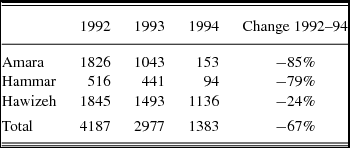
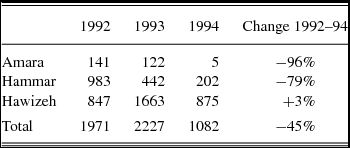
The marsh water levels declined precipitously. Iraqi officials blamed their upstream neighbors, particularly Turkey, for holding back the flow. Indeed, in January 1990, Turkey had impounded the Euphrates river flow in order to fill the reservoir of the Atatürk Dam at Karababa.Footnote 94 Still, the impact of the Turkish diversions on the marshes were secondary compared to those Iraq itself imposed.Footnote 95 Satellite images revealed a stunning loss of vegetation and water, particularly in the Amara and Hammar marshes. Straddling the Iranian border, the Hawizeh Marsh was the only one left intact (see Tables 1 and 2). Later studies concluded that of the roughly 9,000 square kilometers covered by marshes in 1973, about 85 percent was gone by 2000.Footnote 96 Iraq's land reclamation did not go as planned, though. Instead of burgeoning fields of rice and grain, the uncovered land was so riddled with salt and silicone that it glistened like broken glass and yielded a meager crop at best. The ecological impact of the marshes' destruction was felt immediately on the marsh biota.Footnote 97 Another cattle plague outbreak in 1994 further degraded whatever self-sufficiency the Maʿdan might have had left.Footnote 98
Change in vegetation coverage, 1992–94 (km2)
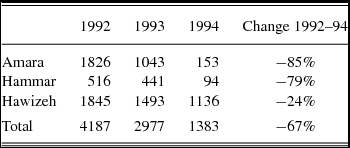
Source: D. C. Munro and H. Touron, “The Estimation of Marshland Degradation in Southern Iraq Using Multitemporal Landstat TM images,” International Journal of Remote Sensing 18 (1997): 1597–1606.
Change in water coverage, 1992–94 (km2)
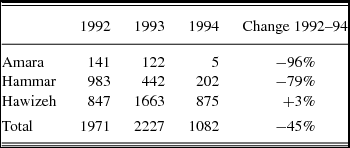
Source: D. C. Munro and H. Touron, “The Estimation of Marshland Degradation in Southern Iraq Using Multitemporal Landstat TM images,” International Journal of Remote Sensing 18 (1997): 1597–1606.
The insurgency receded with the water and reeds. The denuded landscape proved much easier to enter by tank or helicopter. Since regular troops were prone to cavorting with local civilians, the elite Republican Guard patrolled the area.Footnote 99 Marsh-dwellers fled along with tens of thousands of other Iraqis. Iran resettled an estimated 40,000 former marsh-dwellers in refugee camps around Dezful or elsewhere, but many simply squatted on the Iranian side of the marshes.Footnote 100
Even before American troops reached Baghdad in 2003, former marsh-dwellers destroyed dams and dikes and haphazardly inundated the sunken lake beds.Footnote 101 Abu Hatem's forces seized control of Amara in advance of the coalition troops, claiming the city to be the only one in Iraq to have liberated itself without the need for the occupying powers.Footnote 102 Eager to claim credit for restoring the Mesopotamian Eden and to win the allegiance of the Maʿdan militias, the United States appointed Abu Hatem to the interim Governing Council.Footnote 103 American military engineers and newly formed Iraqi nongovernmental organizations collaborated in trying to revive the wetlands.Footnote 104
Nevertheless, the marshlands were patchy and disjointed and the wildlife still stunted by pollution and pesticide. Drought in 2008 and 2009 made the ecology of the marshes even more tenuous.Footnote 105 The marshes remain essentially artificial lakes, their water levels and quality contingent on usage in Iran, Turkey, Syria, and Iraq itself. Socially and politically, the Maʿdan evinced a similar ambivalence. The urban-based Islamist parties defeated Abu Hatem's ticket in the provincial elections of 2005 and the parliamentary elections of 2006. With the British evacuation from Amara, Muqtada Sadr's Mahdi Army militias routed Abu Hatem's forces. Many of Muqtada's followers bore surnames indicative of Maʿdan origins. Once deemed the “Prince of the Marshes” in Western media, Abu Hatem was reduced to pleading with the departing occupation authorities to preserve at least his local seat of power.Footnote 106 After spending years in shantytowns, refugee camps, and urban slums, many former marsh-dwellers were not willing to resume their old way of life.Footnote 107 Of an estimated 200,000 people displaced from the marshes, only a few tens of thousands came back to their lives in the waters.Footnote 108 The reflooded swamps lacked the basic landmarks that had allowed the Maʿdan to navigate them. Even those who wanted to return had no way of knowing where they were in the “new” marshes. The Maʿdan—and the marshes themselves—were at long last “civilized.”
CONCLUSION
The destruction of the Mesopotamian marshes earned Saddam Husayn international opprobrium after 1991, but the devastation had actually been enacted gradually, over the course of decades. Ancient rulers had tried—and usually failed—to tame the marsh waters and the residents therein. Modern states, however, could accomplish what these ancient despots could not. Ottoman and British imperial rule bequeathed the techno-political approach to the nascent Iraqi state. The impetus to make wild places legible, to domesticate landscapes and make them suitable for human habitation, was cloaked in scientific rationalism.Footnote 109 These projects steadily degraded the marsh ecology and undermined the Maʿdan lifestyle.
The Baʿth pushed this destruction to a new level. In the midst of the Iran–Iraq War, the marsh's physical and human terrain was an outright danger and had to be neutralized. The already violent techniques that had emerged as part of development planning were put into the service of doubly brutal counterinsurgency measures. As Khoury argues, concerns about internal security made the regime intensely aware of sectarian and regional cleavages.Footnote 110 This does not mean, however, that the regime was driven by the calculus of sectarian domination alone. Rather, sectarianism was refracted and articulated through a multivalent technopolitics. Internment of the marsh inhabitants and desiccation of the wetland ecology served multiple purposes—improving Iraqi defenses, facilitating commercial agriculture and oil exploration, and helping to transform the Maʿdan from primitives into modern citizens.
The March 1991 uprising provided the final push toward obliteration. The uprising may have brought the regime to see security threats in explicitly sectarian terms, at least to some extent. But by late 1992 and 1993, when the marsh destruction measures were being fully implemented, the rebellion was capable of little more than hit-and-run operations and posed little real danger to the regime.Footnote 111 What was at stake was not sectarian domination or regime security per se, but the larger ambition to refashion Iraq according to the Baʿth's high modernist plan. Seen through the eyes of the Iraqi state, the Shiʿa in general and the Maʿdan in particular were obstacles to the goals of modernization and ungrateful recipients of the Baʿth's beneficence. Like the Kazakh herdsmen who were denied their livestock and pasturage by a Soviet regime intent on hastening an agrarian revolution,Footnote 112 the Maʿdan were forced to adopt a new—and to the state, superior—way of life, just as the marsh waters were rechanneled to more productive purposes. Their redemption came only through their elimination.
The fate of the marshes also informs a general understanding of high modernist technopolitics and the ways development planning and counterinsurgency affect the relationship between people and nature. It is no coincidence that the implacable wildernesses and underutilized wastelands—marshes, mountains, and jungles—that states target for development are also the places that shelter indocile and “lawless” populations.Footnote 113 The Mesopotamian marshes were not the first to be subjected to this kind of militarized development. As discussed above, many of the techniques of altering terrain and controlling populations witnessed in the marshes in the 1980s and 1990s were first deployed in Kurdistan in the 1970s and 1980s. Moreover, Iraq was not alone in taking this militarized approach to development. In the Dersim region of eastern Anatolia, the Turkish government has deliberately burned forests, eradicated herds, and closed pastures as part of its effort to modernize and assimilate restive Kurds. The Southeastern Anatolia Project and its string of large hydroelectric dams permanently transformed the topography and ecology of Kurdistan and eliminated the stateless zones where insurgents operate.Footnote 114 Israel uses a host of terrain and hydrology-altering techniques to block infiltration from the West Bank and Gaza while at the same time facilitating the integration of Palestinian labor and land into the globalized Israeli economy.Footnote 115
Few countries launch development projects intent on devastation, just as few initiate counterinsurgency campaigns with the goal of annihilation. Viewed through techno-political frames, new roads, electricity, modern agriculture, and animal husbandry appear as peaceful and beneficial ways to win over unruly peoples of the hinterlands. Yet this perspective elides both the structural violence of development and the overlap between techniques of development and counterinsurgent pacification. Especially for deeply authoritarian regimes such as the Baʿth, resistance tends to be met with more intensive coercion. In the midst of security crises, development and counterinsurgent practices become tightly coupled. In order to change wilderness into well-ordered, well-governed, and productive space, vegetative cover must be destroyed. Civilians are impounded in concentrated areas, making food and shelter contingent on cooperation with the state.Footnote 116 Once these policies are in place, notions of racial or sectarian supremacy are but the last steps toward ecocide and genocide, the outright elimination of both environmental and human hindrance to high modernist perfection.