Introduction
The Department of Health National Dementia Strategy has identified several priority actions, including promotion of understanding of dementia and its risk factors, timely diagnosis and intervention, access to specialist services, person-centred disclosure of diagnoses, provision of detailed information about supports and entitlements and the creation of national guidance on use of medications in dementia, in particular psychotropics (Department of Health 2014). Other key principles included the training of healthcare staff to communicate with people who have dementia, tailoring communication materials to maximise ease of understanding and the provision of support for people with dementia to retain their skills as far as possible.
It is not clear the role specialist memory clinics are expected to play in delivering on these aims or how that role will be funded and resourced. There are 17 memory clinics across the Republic of Ireland, 13 of which are public services. Most are run by Old Age Psychiatry and/or Medicine for the Elderly teams, two by Intellectual Disability services. Most are based on hospital sites but have limited access to dedicated sessions from allied health professionals (Cahill et al. Reference Cahill, Pierce and Moore2014). There are no national standards or quality structures to guide the constitution or activity of memory clinics, which are largely delivered on an ad hoc basis. Most of these clinics evolved organically from the appointment of a clinician who happened to have an interest in cognitive impairment. Few are specifically funded as memory clinics. In many services the memory clinic piggybacks on the resources available for general clinics and the performance indicators from memory clinic activity are not collected or acknowledged by those who hold the purse strings.
Given the disparity in the make-up, resources and demands of the country’s various memory clinics, it is difficult to imagine how a universal set of quality standards could be fairly agreed upon unless the Dementia Strategy is translated into dedicated funding streams and staffing allocations. In the meantime how do clinicians know if they are doing a good job? National fora such as the annual Memory Clinic Conferences are helpful but a structure to usefully measure performance might be more so. In June 2009, the College Centre for Quality Improvement (CCQI) of the Royal College of Psychiatrists (RCPsych), after widespread consultation and piloting, launched the Memory Clinics National Accreditation Program (MSNAP) ‘to encourage high-quality memory services’, highlighting achievement and areas for improvement and using ‘accreditation as a motivator to initiate change’. Currently 108 British memory clinics are participating and 87 are accredited. Although there is an affiliate member clinic in Northern Ireland, there are no accredited services on the island of Ireland (Clary et al. Reference Clary2015). The accreditation process takes at least 6 months and has three main stages (MSNAP Accreditation Process, 2015). First, the participating clinic receives a pack of self-assessment materials, consisting of a chart review, management checklist and questionnaires for staff, referrers, patients and carers. Over a period of 3 months, the clinic can use these data to make any necessary changes before the visit of the review team. One to two months after the self-review, a team of four peer reviewers arrive for a day to validate the self-review data and discuss any issues which arose in the process. The team will usually comprise two health professionals from another MSNAP member clinic, a service user/carer and a member of the MSNAP project team. An Accreditation Committee with members from various professional bodies and service user groups review the information gathered and give a verdict of accreditation, deferral of accreditation (to give time for remedial action) or no accreditation. The standards set are of three types:
Type 1: failure to meet these standards would result in a significant threat to patient safety, rights or dignity and/or would breach the law.
Type 2: standards that an accredited service would be expected to meet.
Type 3: standards that an excellent service should meet or standards that are not the direct responsibility of the service.
A clinic must meet all Type 1 standards, 80% of Type 2 and 60% of Type 3 standards to be accredited (Hodge et al. Reference Hodge2016).
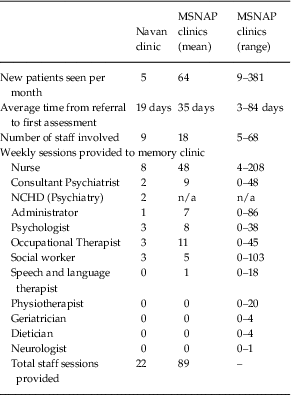
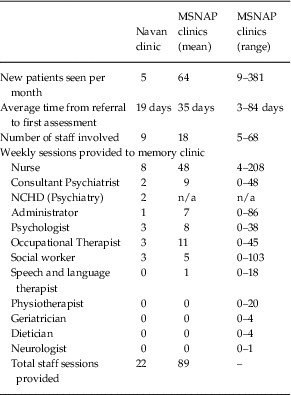
MSNAP have also developed a set of key Quality Indicators which are not factors in the accreditation decision but are published nationally to allow teams to compare their performance to other memory clinics across the United Kingdom. MSNAP membership is a significant investment of money and time but the benefits of engaging with the process include expert development support, the support of a network of peers and a clear structure for clinical governance which incorporates consultation with all the main stakeholders in a memory service. At the cognitive clinic at An Ré Órga in Navan, a semi-rural Old Age Psychiatry service, we decided to adapt the self-review phase of the MSNAP accreditation process as an audit cycle, partly for our own clinical governance and partly to test ourselves against this robust benchmark. The clinic operates 1 day per week, with a complement of eight staff (including administrative support) and sessional input from an outside clinical neuropsychologist. Our workload and organisational structure, compared to the average MSNAP member service, is described in Table 1.
Contextual data, comparing Navan Cognitive Clinic to Memory Service National Accreditation Program (MSNAP) member clinics, based on MSNAP Fourth National report 2015–16
Methods
Organisation
Memory clinic staff from all levels and disciplines were involved with the audit and carried out the work in addition to clinical duties. The Clinical Nurse Manager and Senior Registrar were responsible for administration of the audit. The working time spend on the audit was estimated at about 25 h in total, including review meetings. This does not include time spent on the initial development of the audit materials nor the design and implementation of new processes as part of the audit cycle.
Setting the standard
Our intent was to use MSNAP as our standard of care for comparison and to replicate their self-review process as closely as possible. Only MSNAP members have access to the self-review materials provided by the CCQI. We carefully reviewed all published MSNAP materials including their revised standards (Hodge et al. Reference Hodge, Hailey and Orrell2014), their national reports (Clary et al. Reference Clary2015; Hodge & Hailey, 2015) and their guidance advice for members. From the published data, we created our own pack of self-audit materials. These included chart review checklists, organisational checklists, questionnaires for patents and carers, and questionnaires for referrers. Given our small complement of staff we did not pursue the staff questionnaires at this time.
Measuring current practice
We completed a retrospective chart review encompassing 6 months of new referrals to the service. A selection of charts was randomly allocated to each member of the multidisciplinary team for review using a standardised checklist. Any problem accessing or interpreting required information was reviewed by a senior clinician. Key aspects assessed, as emphasised in the MSNAP guidance and our own National Dementia Strategy were: waiting times, time to diagnosis, information about available benefits and supports, and in-house access to follow-on supports. We reviewed the function and accessibility of the clinic environment, and performed a check on the availability of written policies on aspects of assessment and follow-on care, such as acceptance of referrals, informed consent, data protection and prescription of memory enhancers and psychotropics.
Comparison of results to standards set
We carried out a simple comparison between our standards and those exemplified by UK clinics undergoing their first MSNAP cycle, as published in the most recent MSNAP report (Clary et al. Reference Clary2015). This was largely qualitative and no formal statistical analysis was applied.
Intervention
Having reflected on some of the main issues revealed by the retrospective audit, we singled out areas in which we could expect to improve over a short time. These included the following: (i) development of a memory clinic diagnostic handbook using current international standards, as a safeguard against diagnostic drift in the consensus diagnosis meeting; (ii) routine provision to every service user of a typed summary in accessible language detailing the assessment findings, an explanation of the diagnosis, details of the management plan including medications, follow-up and tailored advice regarding modifiable risk factors, driving, legal issues and contact details for the clinic and other support services; (iii) addition of a regular cognitive rehabilitation group to suite of follow-up supports; (iv) addition of a specific enquiry regarding patients’ and carers’ interest in participating in research; (v) seeking service user and carer feedback as part of our routine process.
Re-audit
A prospective audit examined newly referred cases for a 6-month period according to the same checklist as the original audit. In addition we introduced an anonymous patient questionnaire and carer questionnaire.
Results
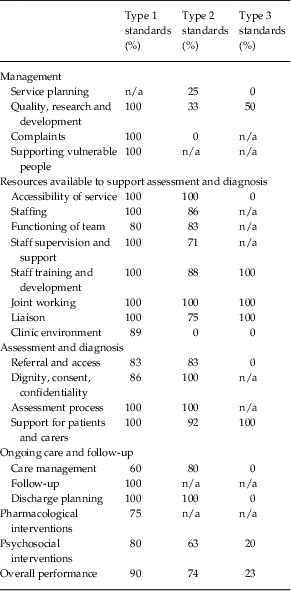
Overall performance against the various MSNAP standards was estimated by comparison with published MSNAP data on the performance of their member clinics. We performed strongly against 90% of Type 1 standards, 74% of Type 2 standards and 23% of Type 3 standards. It must be noted that the actual standards applied by MSNAP were unavailable to us and our self-review, benchmarking approach does not accurately reflect the stringency of an external accreditation process, which would combine both self-review and peer/expert review. A breakdown of performance in the various clinical and administrative domains is available in Table 2.
Attainment of Memory Service National Accreditation Program (MSNAP) standards in Navan Cognitive Clinic, as estimated by comparison with average performance of UK clinics according to MSNAP Fourth National Report 2015–16

n/a, no such standard applied in this domain.
Organisational structure
We assess approximately five new patients per month, fewer than any MSNAP member. Our staff contributes ~22 sessions/week to the service, compared with an average of 89 sessions in UK clinics. Despite the disparity in resources, most of the Types 1 and 2 organisational standards were met including, a designated clinical lead, clearly defined team roles, weekly clinical meetings and regular administrative meetings. Patients did not have a designated care co-ordinator (Type 2 standard), instead this tended to fall informally to the team member most heavily involved with the patient’s care. As part of the general Old Age Psychiatry service, all staff were appropriately trained with structures and budget in place for staff appraisal, continuous professional development and individual supervision.
Accessibility and environment
We discovered some important areas for improvement in this domain. In 65% of UK services, attendees could access free transport to and from their clinic, whether public transport or provided by the clinic. We could not meet this Type 3 standard, though patients in the immediate catchment had access to a subsidised bus service. The clinic environment was generally comfortable and appropriate, with secure storage for records but lacked disabled parking on site and a clear signage both towards the clinic location and within the building (Type 2 standards). We failed to reach the Type 1 standard of soundproof assessment rooms. Home assessment was available where necessary and there was access to translators and adapted assessment tools where needed.
Liaison
One of the areas needing most work was the clinic’s relationships with outside services particularly General Practitioners (GPs) in order to support identification and timely referral of patients. There was a standard referral form but no publicly available policy regarding referral and required investigations. There was no clinic website but information posters were distributed to local GPs and appropriate public places. There was a culture of informal support for GPs who would regularly phone to discuss cases and the staff provided significant outreach to local homecare and nursing home services (Type 2 standard) but no formal training courses.
Dignity, consent, capacity and confidentiality
From service user surveys introduced in the re-audit, 100% of patients and carers reported that they were treated with dignity and respect. Staff documented in 74% of cases in the initial audit and 89% on re-audit, that they had ensured the patients and carers understood the process, were free of coercion and understood their rights. They also documented if the patient wished to know their diagnosis and with whom they permitted the assessment outcome to be shared. A significant omission was a written protocol on informed consent and data sharing (Type 1 standard).
Assessment and communication of diagnosis
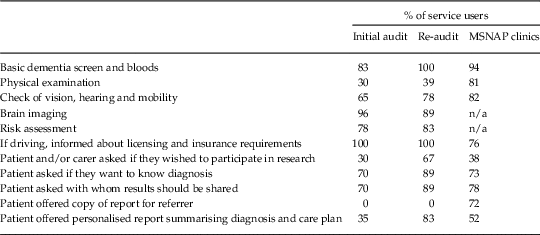
The service performed well overall in terms of the assessment and feedback process (see Table 3 for a summary). Relatively poor areas included completion of physical examination (30–39%) and assessment of vision, hearing and mobility (65–78%). Both of these measures (Type 1 standards) improved between audit and re-audit but still fell behind MSNAP averages. The introduction of the standard diagnostic handbook improved the figures slightly for documentation that diagnoses were made according to best international standards, from 83% on initial to 89% on re-audit. The average time from initial referral to referrer receiving a report increased from 54 days on initial audit to 88 days on re-audit. This was due to the longer wait for results following introduction of magnetic resonance imaging (MRI) brain scanning to the protocol –17% of patients had received an MRI scan on initial audit compared with 67% on re-audit. Due to a focused intervention around feedback, 89% of patients and carers included in the re-audit were offered a personal report detailing diagnosis, follow-up and carer information, compared with a baseline of 35% and an MSNAP average of 52%. All patients and carers survey rated the feedback session and the written materials provided as ‘very helpful’. One patient commented in her feedback that ‘It lifted my spirits having things explained to me’. In both of our audit phases 100% of drivers were given advice and information on the legal requirements in relation to their diagnosis (Type 1 standard). A written protocol regarding driving was available for staff.
Comparison of assessment and feedback processes between Navan Cognitive Clinic and average Memory Service National Accreditation Program (MSNAP) members undergoing their first audit cycle, as published in MSNAP Fourth National Report 2015–16
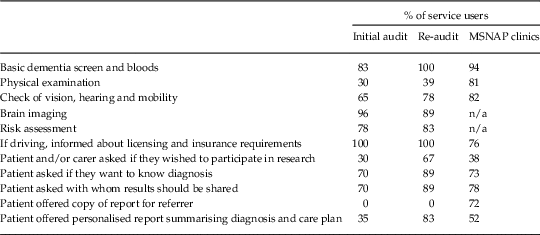
n/a, data not published.
Follow-on care
All patients had a management plan recorded in the main notes at the consensus diagnosis meeting but the charts did not contain a separate care plan document (Type 1 standard). About half were given information about voluntary organisations such as the Alzheimer’s society. Discussion of modifiable risk factors was documented in 72–83%. Advice on other psychosocial issues was variable, due to variation in diagnosis and level of need at time of diagnosis. A formal approach to prescribing in the service was lacking. There was no written policy in place regarding use of anti-dementia medications. Anti-psychotics were prescribed in 17% of patients on audit and 6% on re-audit. No named individual was responsible for review of antipsychotic use in the service and there was no audit system in place. Antipsychotic use was routinely audited in 74% of MSNAP clinics and this was recently upgraded from a Type 3 to a Type 1 standard. In total, 57% of our patients were offered some type of cognitive rehabilitation intervention and on re-audit 61% were specifically offered group Cognitive Stimulation Therapy (CST) in which 17% participated. This is now a Type 1 standard, with most MSNAP clinics offering it on a long-term basis for maintenance.
Key quality indicators
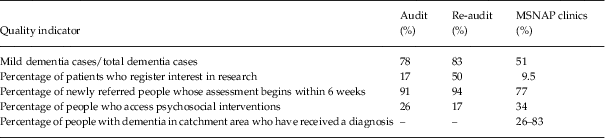
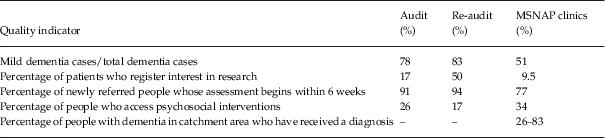
The MSNAP indicators of quality are listed in Table 4 and are compared below with the results published in the most recent MSNAP report (Clary et al. Reference Clary2015).
1. The number of people diagnosed with mild dementia as a percentage of all those diagnosed with dementia was 78–83%, against an MSNAP member average of 51%. This reflects performance on the key goal of timely access to diagnosis.
2. The percentage of patients who registered their interest in participating in research was 17% on initial audit and 50% on re-audit. This is compared to an average figure of 9.5% in the United Kingdom.
3. The percentage of new people with memory problems/dementia whose initial assessment process began within 6 weeks of referral was 91–94%. Our average time to first contact with the patient was 7–11 days and time to initial assessment was 20 days.
4. The percentage of patients who accessed psychosocial interventions was 26% on initial audit and 17% on re-audit. The MSNAP average was 34%.
5. The Dementia Prevalence Calculator is a constantly updated tool which enables UK GPs and memory clinics to benchmark their performance by demonstrating what proportion of those statistically predicted to have dementia in the catchment area have actually been formally diagnosed. There is no equivalent instrument in Ireland at this time.
Key quality indicators
Discussion
Overall, the review was a useful exercise in highlighting areas where the clinic was performing well and providing clear direction for change. Performance in relation to access, clinical assessment, communication with service users and approach to issues around dignity and consent was comparable to the UK benchmark. The clinic has a good skill base, with contributions from well-trained staff across several clinical specialities and access to high-quality neuropsychological assessment and those investigations recommended by MSNAP. Some of the issues relating to the built environment and patient transport are beyond our control but the vast majority of weaknesses in the service are remediable. Our path ahead includes a focus on education and intervention around modifiable risk factors and clear communication of their importance to primary care. Importantly, we must commit to the creation of clear written policies around service goals, referrals, consent, prescribing and data protection, but in a small country it may be more practical and appropriate to develop country-wide policies through the National Dementia Office. This is a piece of work where a peer support network such as the MSNAP community would be invaluable.
The MSNAP standards were created for the UK health service, partly in response to the National Audit Office report highlighting low rates of diagnosis and longer waits for diagnosis than their European counterparts (Bourn, Reference Bourn2007). Irish research confirms we face similar and worse issues here since the service as a whole is less well developed (Cahill et al. Reference Cahill, Shea and Pierce2012). It is easy to dismiss the MSNAP model as irrelevant or unattainable in an Irish context but it is clear that British memory clinics face similarly dramatic variations in staffing, resources and organisational frameworks. Many smaller services have no access to administrative support, allied health professionals or psychology input. Their throughput of new patients each month varies from 9 to 381 but these teams are still aiming for a consistent quality of care, particularly at the level of Type 1 and Type 2 standards (Clary et al. Reference Clary2015). It is precisely for this reason that the MSNAP standards were established to ‘focus on function, rather than any particular model of service delivery’ (Hodge et al. Reference Hodge, Hailey and Orrell2014).
The ad hoc nature of memory services remains an obstacle to progress. Our own audit revealed a lack of structured joint service-planning or review involving local or national stakeholders and this is probably true of many clinics. Clinicians in the current system have expressed concern that the application of a national quality standard may result in the closure of small regional clinics (Cahill et al. Reference Cahill, Pierce and Moore2014) but this is not a reason to operate without standards. The various challenges in developing a national dementia registry have been discussed elsewhere (Hopper et al. Reference Hopper2008) but specialist memory clinics should be leading the way with nationally agreed referral procedures, organisational structures facilitating timely access and agreed minimum standards guaranteeing accurate diagnosis and appropriate interventions. Administrative separation of memory clinics from old age medical and psychiatric services would allow equitable access for people of all ages and facilitate a rehabilitative and supportive approach rather than a purely diagnostic service. In the current model, if patients do not have complex medical or psychiatric needs appropriate to the background specialism of the clinic, they are discharged to primary care and, where available, the support of voluntary organisations. Given the availability of local level dementia prevalence estimates (Pierce & Cahill, Reference Pierce and Cahill2014), it should be possible to formalise the distribution and resourcing of specialist memory clinics by catchment area. At its simplest, this would involve setting up multispecialty full-time clinics in the major cities. Given the complexity of the assessments and the unique suite of psychosocial interventions required, these sites would be the ideal locations for sessions dedicated to young-onset dementia and dementia superimposed on intellectual disability. Beyond this, small, part-time regional clinics could offer an easily accessible local service, with the option to refer on cases requiring more specialised investigations or supports. The circle would be completed with the development of more formalised outreach to primary care.
Were MSNAP membership to be extended internationally, it would not be appropriate to impose their quality control template indiscriminately in regions where information technology infrastructure and the organisation of health services are not directly comparable with the United Kingdom. There is, however, plenty to learn from this model and where resources are scarce it is wasteful to spend them re-inventing the wheel. In the context of a relatively small pool of expertise and the absence of a national consensus on standards, there is a strong argument for at least a subset of clinics engaging with this robust quality assurance process as a learning and development exercise.
Acknowledgements
This audit could not have been completed without the support and hard work of all staff members at the Navan Cognitive Clinic.
Financial Support
This research received no specific grant from any funding agency, commercial or not-for-profit sectors.
Conflicts of Interest
All authors declare that there are conflicts of interest.
Ethical Standards
The authors assert that all procedures contributing to this work comply with the ethical standards of the relevant national and institutional committee on human experimentation with the Helsinki Declaration of 1975, as revised in 2008. The authors assert that ethical approval of this audit was not required by their local Ethics Committee.