INTRODUCTION
Trypanosoma evansi (T. evansi) is the causative agent of trypanosomosis, a widely spread disease, affecting many wild and domestic animals species including camels (Luckins and Dwinger, Reference Luckins, Dwinger, Maudlin, Holmes and Miles2004). The disease causes high economic losses in camel industry due to high morbidity, mortality, low milk and meat production, poor carcass quality and reduced reproductive performance (Pacholek et al. Reference Pacholek, Gamatie, Franck and Tibayrenc2000; Njiru et al. Reference Njiru, Brett, Ole-Mapeny, Githiori and Ndung'u2002). The disease occurs in acute and chronic forms, however, chronic form is more prevalent and manifested by anaemia, emaciation, lacrimation, lymphadenitis and sometimes abortions (Gutierrez et al. Reference Gutierrez, Corbera, Juste, Doreste and Morales2005). Anaemia resulting from trypanosomosis is primarily haemolytic and has been attributed to either dyshematopoiesis or erythrophagocytosis (Anosa, Reference Anosa1988). Anaemia followed by secondary hypoxia has been suggested to induce cardiac damage (Fartashvand et al. Reference Fartashvand, Nadalian, Sakha and Safi2013).
Cardiac troponin I (cTnI), is a regulatory protein controlling calcium-mediated interaction between actin and myosin and is considered a highly sensitive and precise biomarker for diagnosis of myocardial damage in humans (Reagan et al. Reference Reagan, York, Berridge, Schultze, Walker and Pettit2013) and animals (Wells and Sleeper, Reference Wells and Sleeper2008; Fonfara et al. Reference Fonfara, Loureiro, Swift, James, Cripps and Dukes-McEwan2010). The values of serum cTnI increase in response to cardiac injury as a consequence of enzyme leakage from cardiac cells (O'Brien et al. Reference O'Brien, Smith, Knechtel, Marchak, Pruimboom-Brees, Brees, Spratt, Archer, Butler, Potter, Provost, Richard, Snyder and Reagan2006). Several studies reported an increase in the level of cTnI in response to leishmaniosis (Silvestrini et al. Reference Silvestrini, Piviani, Alberola, Rodríguez-Cortés, Planellas, Roura, O'Brien and Pastor2012), and babesiosis (Lobetti et al. Reference Lobetti, Kirberger, Keller, Kettner and Dvir2012) in dogs, bovine theileriosis (Fartashvand et al. Reference Fartashvand, Nadalian, Sakha and Safi2013) and in camels with tick infection (Tharwat and Al-Sobayil, Reference Tharwat and Al-Sobayil2014). Moreover, the level of cTnI has been also used as a marker of cardiac injury during camel transportation (Tharwat et al. Reference Tharwat, Al-Sobayil and Buczinski2013). Another biomarker of cardiac injury is creatine kinase (CK) enzyme which exists as isoenzymes in three combinations: MM, MB and BB. The CK isoenzymes is distributed in many tissues including skeletal muscles, but there is more of CK-MB fraction in the heart, therefore CK-MB is considered relatively specific for myocardial injury when skeletal muscle damage is absent (McLean and Huang, Reference McLean and Huang2012).
In dromedary camels, many cardiac problems cannot be diagnosed except after necropsy, therefore there is a need for introducing non-invasive diagnostic methods for such problems.
Recently, camel trypanosomosis has been linked with a state of oxidative stress process, with significant increase of serum malondialdehyde (MDA), reduction in super oxide dismutase (SOD) and no change in catalase (Saleh et al. Reference Saleh, Al-Salahy and Sanousi2009). The values of MDA in blood and tissues are commonly used as biomarkers of lipid peroxidation (Yousef et al. Reference Yousef, Saad and El-Shennawy2009). The SOD is an antioxidant enzyme which protects the tissue against oxidative stress by reducing superoxide anion to hydrogen peroxide, which is then converted to water by catalase and glutathione peroxidase (Rahman et al. Reference Rahman, Biswas and Kode2006). Oxidative stress has been also reported to play an important role in both myocardial injury and repair (Ansley and Wang, Reference Ansley and Wang2013).
The objectives of the present study were: to evaluate the serum concentration of cTnI, CK-MB in camels infected with T. evansi infection as a marker of possible myocardial injury, to investigate diagnostic and prognostic accuracy of cTnI and CK-MB in infected camels, and to monitor the relationship between cTnI, blood picture, oxidative stress markers, CK-MB and CK in infected camels.
MATERIALS AND METHODS
Study animals
A total of 94 camels (52 male [mean age = 6·1 year] and 42 female [mean age = 5·6 year]) admitted to Veterinary Teaching Hospital, King Faisal University, Saudi Arabia during the period from September 2012 to December 2013 were included in the present study. Camels were divided into two groups based on clinical, haematological and parasitological examination. The first group consisted of 20 clinically healthy camels (12 male and 8 female) that were admitted to the Teaching Hospital for a routine examination before breeding season. Based on the laboratory results, the selected camels were tested negative for presence of other parasites. The second group consisted of 74 camels (40 male and 34 female) with clinical picture of trypanosomosis. All camels were thoroughly examined and clinical signs were carefully recorded.
The infection in camels was confirmed by the presence of the parasite in blood using wet-blood film and also micro-Haematocrit technique (OIE Manual, 2012). Positive camels were also examined by stained blood smears (Diff-Quick®). Moreover, latex agglutination test (LAT) was applied on all examined camels according to the method described by (Olaho-Mukani et al. Reference Olaho-Mukani, Nyang'ao and Ouma1996). The infected camels were consequently treated with trypanocidal preparations (Cymelarsan®, Merial). Forty three of 74 camels with trypanosomosis were successfully treated. Blood samples were collected from the jugular vein of both groups into plain and heparin vacutainers. Whole blood was used for the determination of haemoglobin content (Hb), total erythrocytic count (TEC), packed cell volume (PCV), red blood cell indices, total and differential leucocytic counts. Sera were harvested and stored at −20 °C until assayed for cTnI, CK-MB, CK, MDA and SOD. Fecal samples were also collected from all selected camels and were analysed using standard sedimentation-flotation technique according to the methods described by Coles (Reference Coles1980).
Haematological and biochemical analysis
Complete blood picture was determined using electronic cell counter (VetScan HM5 Hematology system).Cardiac troponin I was analysed in serum samples using a point-of-care analyser (VetScan i-STAT® 1, Abaxis, CA, USA) according to the manufacturer's instructions. All results are expressed as nanograms per milliliter (ng mL−1) with an intra- and inter-assay coefficient of variance of 5·0 and 5·7%, respectively. The analysis of CK-MB was carried out using the Roche Diagnostics Cobas 6000 c501, electrochemiluminescent assay (Roche, Indianapolis, Indiana, USA). CK was analysed using VetScan VS2 chemistery analyser (Abaxis, California, USA).The SOD activity was assessed in the RBC haemolysate according to the method described by Misra and Fridovich (Reference Misra and Fridovich1972).
For MDA, lipid peroxidation in RBC haemolysate and serum was estimated as thiobarbituric acid reactive substances (TBARS) according to Placer et al. (Reference Placer, Cushman and Johnson1966). Lipid peroxidation in the RBC haemolysate was expressed as nmol of erythrocytic malondialdehyde (eMDA) per g Hb. Lipid peroxidation in serum was expressed as nmol of serum malondialdehyde (sMDA) per g serum protein (Shimadzu AA-6800 atomic absorption spectrophotometer, Koyoto, Japan).
Statistical analysis
Because of the small size of the control group and non-normally distributed markers in camels with T. evansi, differences in blood biomarkers between camels with treatment success or failure were compared using non-parametric analysis (Wilcoxon Mann–Whitney) at P value <0·05. Selection of cut-off points that optimize sensitivity (Se) and specificity (Sp) for each of cTnI and CK-MB was determined using receiver operating characteristics (ROC) analyses. The ROC curves were constructed by plotting sensitivity vs 1-specificity (false-positive rate) for all possible cut-off points for cTnI and CK-MB. The area under the curve (AUC) indicates the overall accuracy of the tested parameter. The difference in the AUC for the cTnI and CK-MB was compared using non parametric method which account for correlation resulting from using the same samples for both tests (DeLong et al. Reference DeLong, DeLong and Clarke-Pearson1988). All analyses were done using Stata version 13 (Stata Corp, College Station TX, USA).
Ethics statement
All the animal procedures were performed according to the guidelines of the Animal Ethics Committee of College of Veterinary Medicine and Animal Resources, King Faisal University, Saudi Arabia.
RESULTS
All of the diseased camels showed progressive anaemia, pale mucous membrane, emaciation, marked depression or lethargy ‘upward hanged head, called locally Heyam’, recurrent fever, dullness, enlargement of lymph nodes and lacrimation. Atrophy of the thigh muscles was observed in (42/74), corneal opacity (21/74), diarrhoea (28/74), oedema of the dependent parts (48/74), loss of condition and some cases showed nervous signs (22/74) such as trembling, and unusual aggressiveness. Pointed shape feces and bitter odour of urine were also typical for the infected camels.
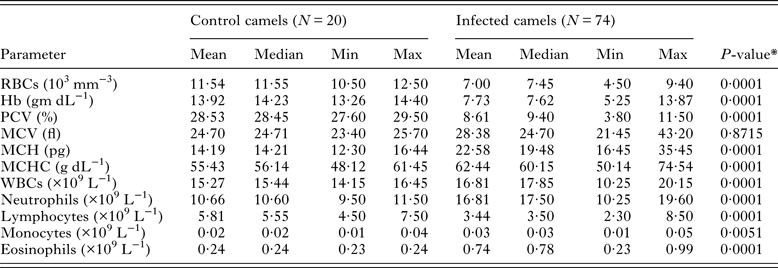
Data summarized in Table 1 indicates a significant (P < 0·05) reduction in the values of TEC, Hb content and PCV% with significant elevation (P < 0·05) in mean corpuscular haemoglobin (MCH), mean corpuscular haemoglobin concentration (MCHC), total leucocytic count (TLC), neutrophils, lymphocytes, monocytes and eosinophils counts in infected camels compared to control.
Descriptive results of haematological parameters in control and T. evansi infected camels and their statistical significance

MCV, mean corpuscular volume; MCH, mean corpuscular haemoglobin; MCHC, mean corpuscular haemoglobin concentration.
* P-value resulting from non-parametric Wilcoxon Mann–Whitney test.
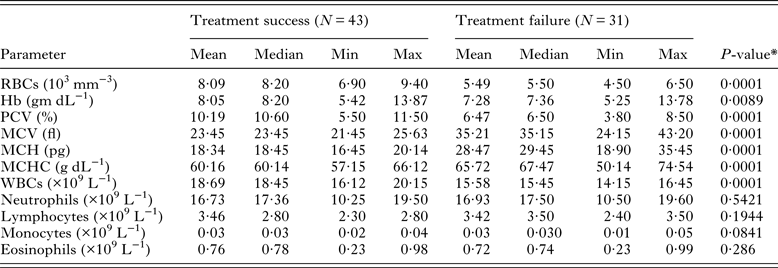
Table 2 shows variations in haematological parameters between successfully treated camels and those with treatment failure. The response to treatment was significantly (P < 0·01) associated with RBCs count, Hb content, PCV%, mean corpuscular volume (MCV), MCH, MCHC and TLC count.
Descriptive statistics of haematological parameters in T. evansi infected camels with treatment success and failure
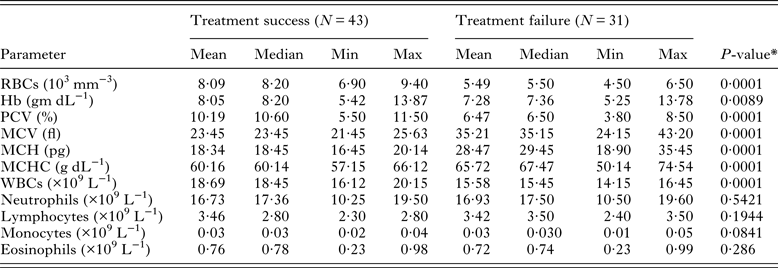
MCV, mean corpuscular volume; MCH, mean corpuscular haemoglobin; MCHC, mean corpuscular haemoglobin concentration.
* P-value resulting from non-parametric Wilcoxon Mann–Whitney test.
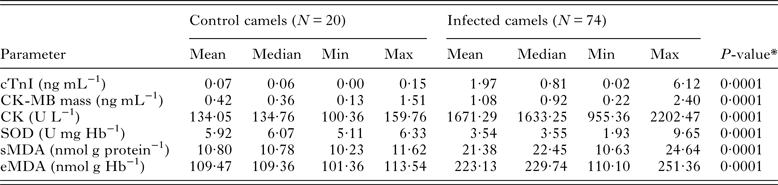
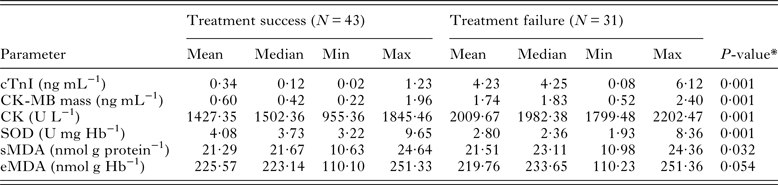
Table 3 shows that infected camels had significantly (P < 0·0001) higher values of cTnI, CK-MB, CK, sMDA and eMDA than healthy controls. In contrast, a lower level of SOD was observed in infected camels compared to control ones. Data presented in Table 4 describes the variables depending on treatment success or failure. The response to treatment was significantly (P < 0·05) associated with cTnI, CK-MB, CK, sMDA, eMDA and SOD levels.
Descriptive statistics of the level of cardiac and oxidative stress biomarkers in control and T. evansi infected camels

cTnI, cardiac troponin I; CK-MB mass, creatine kinase myocardial band; CK, creatine kinase; eMDA, erythrocytic malondialdehyde; sMDA, serum malondialdehyde; SOD, super oxide dismutase.
* P-value resulting from non-parametric Wilcoxon Mann–Whitney test.
Descriptive statistics of the level of cardiac and oxidative stress biomarkers in T. evansi infected camels with treatment success and failure

cTnI, cardiac troponin I; CK-MB mass, creatine kinase myocardial band; CK, creatine kinase; eMDA, erythrocytic malondialdehyde; sMDA, serum malondialdehyde; SOD, super oxide dismutase.
* P-value resulting from non-parametric Wilcoxon Mann–Whitney test.
Spearman's correlation (r) analysis showed high negative (r ≥−0·82, P < 0·001) correlation between treatment response and each of cTnI and CK, whereas RBC, Hb and TLC were highly and positively (r ≥ 0·85, P < 0·001) correlated with treatment response. Additionally, cTnI was positively correlated with each of CK-MB (r = 0·70), serum CK (r = 0·81) and sMDA (r = 0·30). On the other hand, the values of cTnI were inversely correlated with the values of RBC (r = −0·75), Hb (r = −0·72), TLC (r = −0·44) and SOD (r = −0·58).
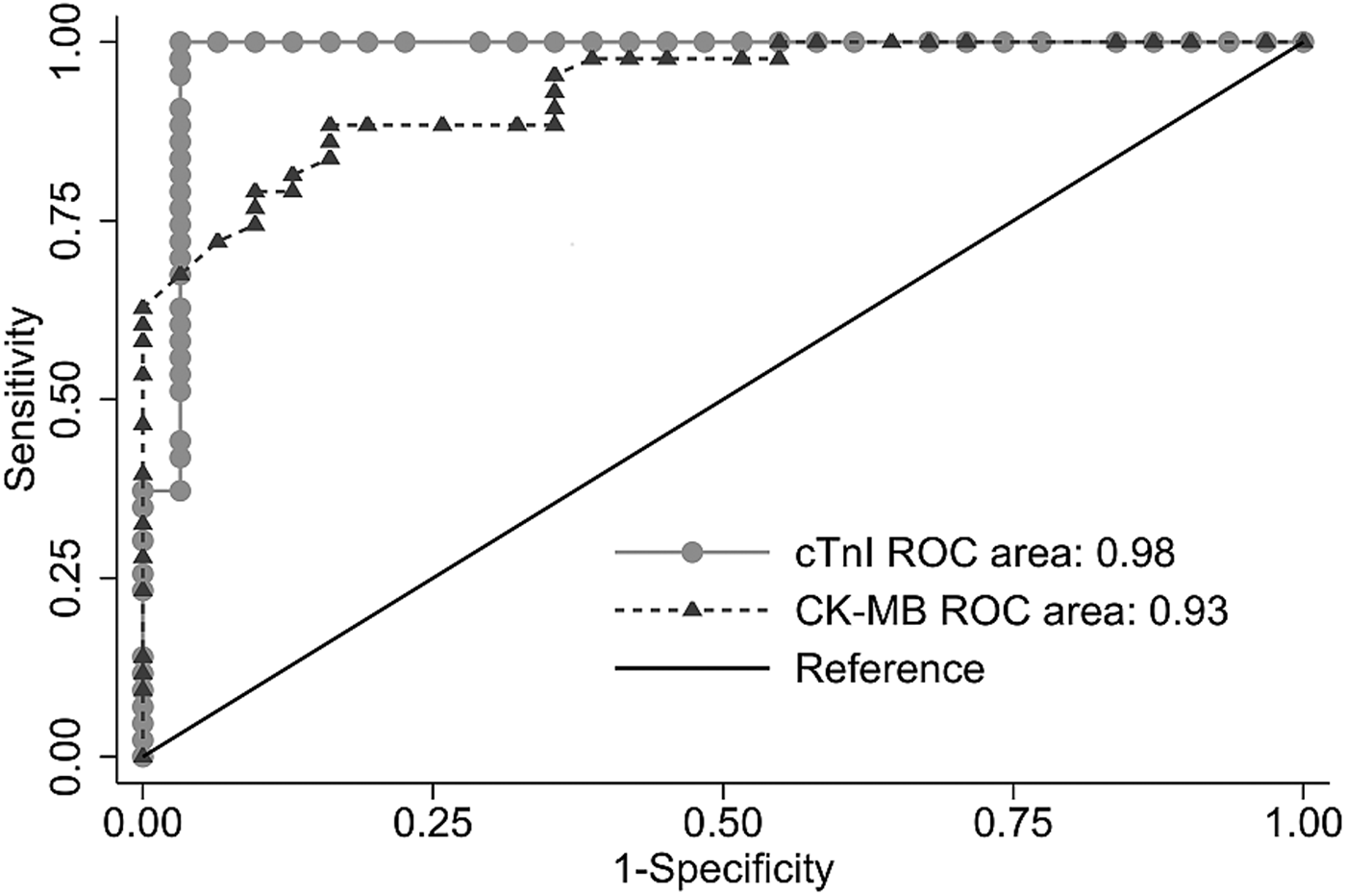
From Table 5 and Fig. 1, both cTnI and CK-MB showed high accuracy in predicting treatment response, at the selected threshold (AUC = 0·98 and 0·93, respectively). However, cTnI showed better sensitivity (Se = 96·8% vs 83·9%) and specificity (Sp = 100% vs 88·5%) than CK-MB. Comparison of the AUC indicated no significant difference between AUC for cTnI and AUC for CK-MB (P = 0·153).
Receiver operating characteristic plot: comparison of the AUC for cTnI and CK-MB mass.

Threshold and test characteristics of selected cardiac biomarkers for prognosis of treatment success and failure in T. evansi infected camels

cTnI, cardiac troponin I; CK-MB, creatine kinase myocardial band; AUC, area under the curve.
DISCUSSION
To the best of authors’ knowledge, this is the first study to address the diagnostic and prognostic accuracy of cTnI and CK-MB in cases of T. evansi infection in camels. The mean serum cTnI of the control camels in this study was similar to that recently reported in healthy camels (Tharwat et al. Reference Tharwat, Al-Sobayil and Buczinski2013). In the current investigation, higher values of cTnI in camels with T. evansi infection may indicate a possible myocardial injury. In the successfully treated camels, the cTnI was significantly lower than camels with treatment failure.
The cTnI is considered the ‘gold-standard’ biomarker with a great sensitivity and specificity in diagnosis of cardiac disorders (O'Brien et al. Reference O'Brien, Smith, Knechtel, Marchak, Pruimboom-Brees, Brees, Spratt, Archer, Butler, Potter, Provost, Richard, Snyder and Reagan2006; Wells and Sleeper, Reference Wells and Sleeper2008). Such specificity of cTnI could be related to its tissue specificity, low basal blood concentration, prompt release and detection in the blood. The serum levels of cTn has been shown to be correlated well with histopathological changes in the myocardium, cardiac pathophysiology; degree of heart damage; clinical picture and disease outcome (O'Brien et al. Reference O'Brien, Smith, Knechtel, Marchak, Pruimboom-Brees, Brees, Spratt, Archer, Butler, Potter, Provost, Richard, Snyder and Reagan2006; Wells and Sleeper, Reference Wells and Sleeper2008; Fonfara et al. Reference Fonfara, Loureiro, Swift, James, Cripps and Dukes-McEwan2010). The precise mechanism of cardiac injury in camels with T. evansi infection is uncertain. However, elevated serum cTnI concentration in camels with T. evansi infection may be attributed to the occurrence of anaemia, which was evident in the current investigation, as indicated by the lowered RBC count, haemoglobin concentration and haematocrit percent as well as the high negative correlation between cTnI and each of RBC count and Hb content. The obtained results support previous hypothesis that anaemia, followed by hypoxia may lead to cardiac damage (Fartashvand et al. Reference Fartashvand, Nadalian, Sakha and Safi2013). The same authors also found that anaemic cattle with theileriosis had higher cTnI level than healthy cattle.
In the present study, cTnI concentration was <1·23 ng mL−1 in successfully treated camels. On the other hand, 30 out of 31 camels with treatment failure had a serum cTnI concentration >3·54 ng mL−1. Therefore, it can be suggested that the increased serum concentration of cTnI over 3.54 ng mL−1 at initial examination was a bad prognostic indicator in camels with T. evansi infection. The cTnI showed a great Se and Sp in predicting treatment failure (Se 96·8%, Sp 100% and AUC = 0·98). Wang et al. (Reference Wang, Lam, Wang, Chan, Lui, Zhang and Sanderson2009) conducted a study on the prognostic accuracy of cTnI in patients with non-primary cardiac disorders and concluded a positive predictive ability for cTnI on the disease outcome. A significant elevation in the values of CK-MB was also observed in T. evansi infected camels. The elevated levels of CK-MB could be attributed to skeletal muscle injury caused by T. evansi and possibly myocardial injury. Furthermore, the CK-MB showed a relatively good Se and Sp in predicting treatment outcome (Se 83·9%, Sp 88·5%). The higher sensitivity and specificity of cTnI compared to CK-MB may be due to the presence of high concentration of troponin in heart cells. In addition, most of depleted cTnI resulting from cardiac injury released in the blood. On the other side, CK-MB is not specific for cardiac injury as a small amount is found in skeletal muscles.
Other possible mechanism of cardiac injury is the state of oxidative stress in infected camels with T. evansi. Oxidative stress increases in cases with chronic heart failure and have been linked with myocardial disorders. An obvious mechanism through which myocardial oxidative stress might hinder cardiac activities is through oxidative injury to cellular proteins and membranes (Ansley and Wang, Reference Ansley and Wang2013).
In the present study, oxidative stress was evident as indicated by higher level of lipid peroxidation biomarker (MDA) and stimulation of antioxidants enzymes to counteract the active free radicals in T. evansi infected camels. Earlier studies demonstrated higher level of MDA in mice infected with Trypanosoma brucei (Igbokwe et al. Reference Igbokwe, Esievo, Saror and Obagaiye1994) and in camel infected with T. evansi (Saleh et al. Reference Saleh, Al-Salahy and Sanousi2009). Superoxide dismutase (SOD) is one of the main enzymes incorporated in defence mechanism against reactive oxygen species (ROS). The present study reported lower level of SOD in T. evansi infected camel compared to the control. The lower SOD level might be related to its depletion as free radical scavengers during the oxidative process in chronic T. evansi infection in camels (Saleh et al. Reference Saleh, Al-Salahy and Sanousi2009). Parallel to the present study, 60% reduction of SOD values in blood of chronically infected patients with Trypanosoma cruzi was mentioned (Wen et al. Reference Wen, Vyatkina and Garg2004). In addition, chronic T. evansi in dromedary camels caused obvious decrease in reserve of the antioxidant levels (Saleh et al. Reference Saleh, Al-Salahy and Sanousi2009). In the contrary, Omer et al. (Reference Omer, Mousa and Al-Wabel2007) reported no change in SOD values in rats with acute T. evansi infection.
It was reported that ROS might be implicated in several effects relevant to the pathophysiological mechanisms of chronic heart failure. The superoxide anion is a powerful inactivator of the signalling molecule nitric oxide (NO); the resulting decline in NO bioavailability subsidizes to vascular endothelial dysfunction and the loss of other physiological properties related to inflammation and blood flow. Moreover, the reaction between superoxide and NO creates peroxynitrite, which is itself a strong ROS. Additionally, ROS can moderate the activity of diverse intracellular signalling pathways and molecules with the prospective to trigger specific acute and chronic effects (Grieve and Shah, Reference Grieve and Shah2003). The superoxide radical could be challenged with SOD (which significantly decreased in the present study) to convert it into hydrogen peroxides. From another point of view, it was also detected that markers of lipid peroxidation are significantly increased in cases of irreversible myocardial injury (Ansley and Wang, Reference Ansley and Wang2013).
From the present study, it could be concluded that, elevated serum concentration of cTnI and CK-MB in camels with T. evansi infection shed the light on the possible existence of myocardial injury in infected camel. The selected cardiac biomarkers (cTnI and CK-MB) could be used as diagnostic and prognostic biomarkers in camels with trypanosomosis. Antioxidant therapy may assist in the treatment of T. evansi infection in camels.
ACKNOWLEDGEMENTS
The authors thank camel owners for their cooperation during sampling procedures.
FINANCIAL SUPPORT
This research was supported by the Deanship of Scientific Research (Project No. 130031), King Faisal University, Saudi Arabia.