Background
In the field of music education, considerable investigation of musical activity preferences, assessments of music instruction and gender differences have been undertaken in many countries. Among these results it is important to pay attention to the influence of different cultural and educational contexts. The present research has been conducted in the framework of the formal musical educational system in Finland and included participants ranging in age from kindergarten to university.
Since the 1860s, music in the Finnish school system has belonged to the national curriculum in primary, secondary and comprehensive school. The quantity of music instruction has changed periodically; lately it has generally diminished. In class teacher training, music has also had an important role. During participants' school years in Grades 1 to 6 have been generally included one or two hours of compulsory music study per week, in grade 7, only one hour per week. Thereafter music has been an optional subject. In upper secondary school it was an alternative with art, presenting a problem for students who wanted to study both subjects (Ruismäki & Ruokonen, Reference RUISMÄKI, RUOKONEN, Juvonen and Anttila2006: 31–76; Partanen, Reference PARTANEN2007).
In class teacher training (Tereska, Reference TERESKA2003: 5–6) the professional goal of compulsory basic music studies was to enable the participants to teach music in Grades 1 to 6. Thereafter music teachers took over the instruction. In the class teacher training programme, the music courses were as follows:
– Singing, voice conducting and solfège.
– Piano playing, with the main goal being to accompany school songs.
– Recorder playing, with the main goal being to teach children notation
– Theory, history and music listening skills
– Music teaching methodology, including group instrument instruction (e.g. guitar, kantele, drums, Orff instruments).
Research review
The following review is grouped along the research questions of the present study.
Assessments according to different age groups
Bowles (Reference BOWLES1998) clarified the preferences of the sectors of music teaching from kindergarten up to the fifth grade in Minnesota and Texas. Students were asked if they wanted to participate in 13 traditional music classroom activities. The results suggested that the kindergartners responded to nearly all the musical activities most positively, while the responses from fifth graders were most negative. Bowles observed that his findings supported earlier research results (see references therein, in particular Broquist, 1961; Haladyna & Thomas, 1979; Nolin, 1973; Vander Ark, Nolin & Newman, 1980), who found that positive attitudes towards music weaken, as the class level rises. In New Zealand Buckton (Reference BUCKTON1998) found that children's negativity towards music increases from Grades 4 to 8.
In Finland Uusikylä and Kansanen (Reference UUSIKYLÄ and KANSANEN1988: 42) also observed that the popularity of subjects in general fell as students moved to higher grades (1 to 6). Indeed, the phenomenon is characteristic of pupils in industrialised countries. Likewise in research into Finnish educational goals, pupils' conscientiousness in schoolwork was found to decrease up to the ninth grade, after which it gradually rose again (Sauvala et al., Reference SAUVALA, KARI and ROBINSON1979: 114; Kari & Sauvala, Reference KARI and SAUVALA1980: 30).
In Puurula's study (Reference PUURULA1992: 86–7) made of university pedagogy students (N = 244), music was not appreciated at their school age. Its instruction was judged to be theoretical and insufficient. However, if music belonged to the students' daily professional work or interests, their attitudes towards it became more positive. Lundin and Sandberg (Reference LUNDIN and SANDBERG2001) suggested that musical childhood memories of Swedish nursery school teachers were shaded with increasing negativity with age, but in their daily work music was experienced as positive and useful. In Sundin's study (Reference SUNDIN1989), students and professionals in the field of education (N = 187) generally had considerably more positive memories from nursery school as compared to the experiences of the later school years.
In the UK, Pitts (Reference PITTS2002) investigated the changing perceptions of music students during their transition from secondary school to university through their understandings of what it means to be a musician. She revealed clear differences between the expectations and experiences at secondary school and those of university students.
Gender differences
The underachieving male student is a well-known phenomenon. Along with Wright's research (Reference WRIGHT2001) in a South Wales secondary school, there was a correlation between gender and achievement in music education with boys showing significant strengths in the areas of performing and composing and girls in appraising. Turton and Durrant (Reference TURTON and DURRANT2002) revealed some gender differences through their study of adults' singing experiences beginning with their years in secondary school: girls enjoyed singing more than boys. Those girls who did not enjoy singing cited dislike of the musical styles selected as their first reason, but for boys the style was not important. Girls' and boys' enjoyment of class music lessons was different during Grades 4–9 (ages 8–14). At secondary school girls' levels of participation in music lessons decreased more dramatically than boys' (Lamont et al., Reference LAMONT, HARGREAVES, MARSHALL and TARRANT2003).
The most pleasant and unpleasant music activities
In Bowles' research (Reference BOWLES1998) students from kindergarten to Grade 5 chose among six musical classroom activities to identify their favourite. The activities were ranked in the following order: playing instruments, movement/dance, singing, listening to music, composing and talking about music. Temmerman (Reference TEMMERMAN2000) pointed out that the musical activity preferences of preschool children were the following: moving, playing, singing and listening to music. At primary school in England pupils liked singing, but at secondary school they were less willing to sing alone in front of the class or to sing songs that were not to their musical tastes. Music theory and history were viewed negatively (Lamont et al., Reference LAMONT, HARGREAVES, MARSHALL and TARRANT2003). At a secondary school in Hong Kong the most popular avenues to music were music appreciation and singing. The theory and history of music were the most undesirable (Ho, Reference HO2001). According to Buckton (Reference BUCKTON1998) the most popular musical activities changed through Grade levels 4 to 8, from playing to passive listening to music. Turton and Durrant (Reference TURTON and DURRANT2002) reported that in singing, the selection of songs was central. The main reason pupils gave for not enjoying school singing was that they did not like the musical styles of the song.
The experiences of kindergarten student teachers' (N = 258) school days were quite positive. Usually, the most positive experiences were those of singing in school choir concerts (a kind of formal music education). Music theory was mentioned as being frustrating, and students experienced nervousness when they had to sing alone in singing tests. (Ruismäki, Reference RUISMÄKI1996: 397–407). In Puurula's (Reference PUURULA1992: 100) research, too having to study music theory and perform singing tests alone in front of the class were the activities most widely criticised.
Sundin (Reference SUNDIN1989) studied early music memories as part of the socialising process. In the positive experiences of pupils and in student samples (N = 74), the social nature of music was emphasised, such as playing together and group performances. Positive memories were mentioned only by those pupils who succeeded in music. The feeling of shame created by a teacher's criticism if a student did not sing well enough or went out of tune was a key factor in negative experiences. Sundin mentioned that many pupils stopped singing completely as a consequence of such criticism (Sundin, Reference SUNDIN1989). Singing is the most vulnerable activity. As Monks (Reference MONKS2003) states, the connection of singing to the self-concept is so fundamental that it is often overlooked or taken for granted. Sundin (Reference SUNDIN1989) mentioned that negative feedback lowered pupils' self-esteem.
Teacher
The teacher was the main reason given by pupils for not enjoying school singing, but it was not so meaningful a reason for enjoying school singing. The characteristic rated most highly for a music teacher was enthusiasm and the ones rated the lowest were looking old and wearing old-fashioned clothes (Turton & Durrant, Reference TURTON and DURRANT2002).
In Pitts' study (Reference PITTS2004) of adult learners in COMA (Contemporary Music-making for Amateurs), a summer school in the UK, the first educational theme that emerged was the interaction between tutors and participants. Pitts noted that generally teachers are expected to meet the needs of all their students, but they are given only limited opportunity to discover what these needs are.
During teacher training, piano teachers were generally popular and often became close to pupils. ‘The two-way chats with the piano teacher’ were remembered fondly and they were characterised by a warm and open atmosphere (Anttila, Reference ANTTILA2000: 147).
Most undergraduate musicians in England were not considering a career in secondary school class teaching, giving as reasons such things as pupil disinterest and misbehaviour and their own disappointing experiences in school music lessons. They also felt that schoolteachers' general teaching skills were more important than their subject-specific musical skills (Purves et al., Reference PURVES, MARSHALL, HARGREAVES and WELCH2005). The situation in Finland is much the same in secondary schools (Ruismäki, Reference RUISMÄKI1991: 280). In Finnish lower-level comprehensive schools, the problem is that many class teachers do not want to teach music because of insufficient musical skills (Räisänen, Reference RÄISÄNEN1996: 64); about a third of pre-service elementary teachers do not want to teach music to their own class in their future career (Tereska, Reference TERESKA2003: 189).
This research emerged from a concrete problematic situation in class teacher training when some student teachers did not want to practise music teaching, yet some others were enjoying it. This paper examines possible answers to this phenomenon through the following questions.
Research questions
(1) How is music learning assessed at different phases of life from early childhood to adulthood?
(2) Do gender differences account for differences in these assessments?
(3) What are the most pleasant and unpleasant experiences of participants' music education?
Participants
The research population consisted of students from all teacher training institutions in Finland, with the goal being to obtain to research results that were as representative as possible. All participants (N = 590) were in their second academic year and aged between 20 and 25 years. The participants represented a broad geographical base. (Tereska, Reference TERESKA2003: 95–7)
Method
In this research information for a profile study was obtained with cross study methods. The retrospective questionnaire extracts were directed towards participants' kindergarten and school age experiences, and real-time questions were directed towards their teacher training experiences. Through quantitative questions participants were asked to assess how positive or negative was the music instruction they had received, while through qualitative questions they were asked to give reasons for their satisfaction or dissatisfaction.
A general impression was gleaned from the music learning experiences in the five different life phases on the Likert scale (5 = extremely positive, 4 = positive, 3 = partly positive and partly negative, 2 = negative, 1 = extremely negative). The numbers of the answers in the different age groups were the following: at the kindergarten level N = 382 (100 male, 282 female); lower-level comprehensive school N = 590 (223 male, 367 female); upper-level comprehensive school N = 590 (221 male, 363 female); upper secondary school N = 299 (98 male, 201 female); and teacher training institute N = 590 (222 male, 365 female). The participants were also asked if they liked their music teachers in primary school (7–12 years) and in upper-level comprehensive school (13–15 years). The significance of the differences between boys and girls was measured with a two-way t-test.
The qualitative information was received through semi-structured questions such as ‘What was most agreeable in the music lessons?’ and ‘What did you not like at all?’. Each participant listed from one to three positive and negative experiences. In the early childhood phase only memories were requested. The material was classified using content analyses according to information in the answers.
Results
The overall assessments of music learning experiences from kindergarten to university
The pre-service elementary teachers' general impressions of the music learning experiences were assessed numerically in five different life phases as follows:

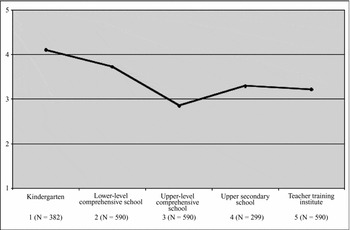
The assessment process on the positive–negative dimension is represented graphically in 1. The most representative results are obtained from stages II, III and V about which all the participants answered. The general impressions from music learning experiences at first become more negative, declining from early childhood through the first school years and the upper level of comprehensive school. Positive attitudes increase again in upper secondary school and during teacher training.
The overall assessment of music learning experiences from early childhood to university

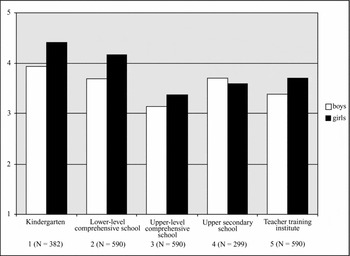
Gender differences in music learning from kindergarten to university
In Figure 2, gender differences in the assessments of music teaching are described graphically along the means. It can be seen that the girls' assessments are generally higher than the boys'. Only at the upper secondary school stage is this trend reversed.
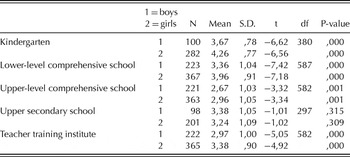
Differences between male and female participants' assessments of received music instruction

In Table 1 gender differences are shown as statistical indicators: numbers of males (1) and females (2), means, standard deviations, t-values, degrees of freedom, and p-values. Along the t-test gender differences are statistically significant (p < .001) except at upper secondary school level.
Differences between male and female assessments of music instruction as statistical indicators

The most pleasant and unpleasant music learning experiences at different ages Kindergarten (4–6 years)
In Finland pre-school programmes had yet not been instituted during the participants' childhood. Thus, the music learning experiences of early childhood were from musical activities in Sunday school, daycare centres, kindergartens or music kindergartens.
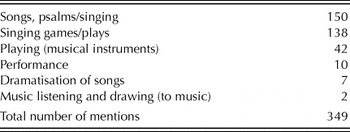
Only 69% of the participants (N = 386) answered a semi-structured question on memories of early music lessons. They mentioned one to three content areas, activities and sometimes something of the atmosphere. The areas shown in Table 2 reflect the popularity of the contents and activities of early childhood music education at the beginning of the 1970s.
Memories of music lessons in early childhood (N = 386)

The majority of individual memories emphasised the satisfaction and enjoyment of childhood music lessons and the joy of singing. They showed the children's sensitivity of feeling and share insights into the contents of the songs.
Music learning experiences from lower-level comprehensive school (7–12 years)
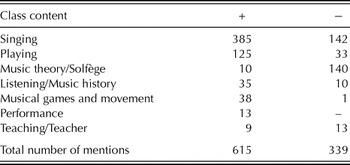
Pleasant memories were reported by 89% of the participants and unpleasant ones by 58%. The same content classes appeared among both the most pleasant and the most unpleasant experiences. Thus, nearly all the musical activities had their supporters and their opponents. The answers are collected in plus and minus columns in Table 3.
The most pleasant and the most unpleasant music learning experiences in lower-level comprehensive school (N = 590)

Singing
The positive answers emphasised the social aspects of singing, particularly ‘singing together’. The power of singing and the use of strong voices pleased young pupils. Polyphonic songs, canons and choir activity were also favourably mentioned. Performances had usually taken place in choirs or other kinds of singing groups and had remained without exception in the participants' minds as positive experiences. However, there had been too much ‘practicing of words’ without singing. With solo singing, many negative memories were connected. Usually, it was a test situation and often performed in front of the class.
Playing
In the memories reported, playing the recorder was the most common and often it was also experienced negatively. Playing with other kinds of instruments and band experiments were experienced as the most agreeable. A few participants did not like ‘too slow or compulsory playing’.
Music theory
The participants had experienced solfège and music theory as difficult and completely negative. Only a few mentioned there was ‘not enough theory’ or regretted ‘the fact that notes were not learned’.
Listening and music history
Listening to music was placed among the agreeable experiences. From learning about the history of music someone remembered ‘the composer biographies narrated by the teacher’ as most favourable, even though most of them dreaded composer information and historical dates.
Movement and games
Movement and games were among the activities most liked in music lessons.
Teacher
Music teachers were generally quite well liked, as shown by an opinion assessment M = 3.80 (s = 1.03) and expressed, for example, in sentences such as: ‘the teacher was really nice’; ‘I admired the teacher's piano playing skills’; or ‘the teacher praised me saying you sing well’. However, negative memories surfaced among the verbal answers. For example, the strictness of some teachers was mentioned as were unprofessional attitudes towards pupils.
Music learning experiences from upper-level comprehensive school (13–15 years)
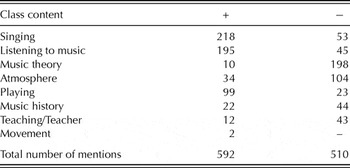
The music instruction received at the upper level of comprehensive school was assessed distinctly more critically than that in the previous stages.
On the upper level of comprehensive school the content items presented differed slightly from the preceding phase. The most pleasant experiences were reported by 88% of the respondents and the most unpleasant ones by 84%.
Singing
The most pleasant experiences were still related to singing, but their relative share had diminished. The selection of the repertoire was central in the memories. Polyphonic song and choir were liked, as was voice control. The solo song tests were still mentioned as the most undesirable. ‘Childish’ or ‘old-fashioned songs and psalms’ were also felt to be unpleasant. Still, a favourable attitude towards music was shown in such negative answers as ‘not enough singing’ and ‘not enough lessons’.
Playing
Playing together, ‘orchestra’ or ‘band playing and accompanying singing’ were experienced as the most pleasant. The pupils enjoyed successful skill practice. In recorder playing, ‘too quick progress and too large groups’ were experienced negatively.
Music listening
Listening to music was regarded as pleasant. Becoming acquainted with the different music styles was experienced positively, yet on the other hand, nearly all the traditional musical styles were considered to be undesirable.
Music theory and solfège
Most of the participants experienced music theory as being negative and considered it ‘unnecessary’ or at least found its basics boring. The study of solfège was mentioned as the most difficult of all theory subjects.
Atmosphere
The positive memories of the lessons' atmosphere emphasised ‘freedom’ and ‘a relaxed feeling’. On the other hand, there were many references to disturbances. During music lessons commotion, noise, general uproar, the boys' racket or even teasing the teacher were regarded as the most undesirable. In such a situation participants commented, ‘I learned nothing, even though I wanted to’ or spoke of ‘frustration’ or complained ‘nothing was produced or required’. One reason for these kinds of situations was ‘the pupils' negative attitudes’ and ‘asocial pupils’. One participant stated: ‘On the upper level personal problems made the whole studying more difficult; in upper secondary school it was more comfortable’.
Teacher
At this stage teachers were generally liked distinctly less than at the lower level of the comprehensive school (M = 3.29, s = 1.14). The verbal answers emphasised much more negativity: ‘he did not make the pupils interested in anything’ or ‘she did not take the trouble to teach thoroughly’. Only a few mentioned that the music teacher was ‘humane’, ‘skilful’ or ‘reasonable and expert’.
Music learning experiences from upper secondary school (16–19 years)
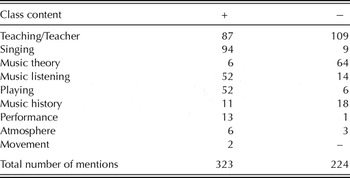
In Finnish upper secondary schools music was an optional subject, and therefore, those who participated in it were fewer than in the previous stages (299). Their assessment of the music teaching was distinctly higher than in the previous phases (M = 3.28, s = 1.07). The positive mentions were presented by 88% and negative ones by 73% of the participants (Table 5).
The classes of memories deviated from the previous school stages in their content and frequency. Still, the big difference was further characteristic of the experiences of music lessons, from ultimate satisfaction where ‘all is found to be the most positive’ to utter frustration, in which ‘all the music lessons’ were seen as the most negative.
The teacher
The abundance of particularly negative experiences with teachers was surprising. Critical responses were the following: ‘no goals’, ‘lessons unsystematic’, ‘laissez faire attitude’, ‘the teacher changed every year’. The pupils experienced the contents of the lessons as ‘frustrating’, ‘superficial’ and ‘repetitious’.
Singing
Of the music teaching activities the most positive and enjoyable experiences at the upper secondary school stage were also connected to singing. The development of skills and ‘singing ensembles’, choir or the more demanding ‘chamber choir’ were experienced as positive. The choir activity included the performances, which made the work goal-oriented. At this stage some pupils also became interested in solo singing.
Music theory
Music theory was still described as dry, and the rapid pull of the teaching made it even more difficult. Yet, there were also students who experienced music theory as being positive. They emphasised adapting the theory to their practice by utilising the notes of their own singing, playing, and composing tasks.
Music history
In music history the emphasis on merely delivering information, such as biographical facts and work lists of great composers was negatively experienced. As a positive alternative, the history of pop music was proposed. Live musical performances such as ‘school concerts’ and ‘visits to the opera’ were mentioned as popular ways of learning.
Playing instruments
The experiences related to playing were almost completely positive. Some participants considered ‘the personal instruction of playing’, ‘piano playing’ or ‘piano lessons’ the most valuable. These were found in the music-oriented upper secondary school. Learning accompaniment skills was already such an achievement. ‘Instrumental bands’, ‘ensembles’ and ‘orchestra’ were the most popular activities.
Music learning experiences in the teacher training institute (20–25 years)
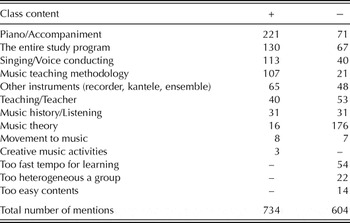
The basic music studies in teacher training were different from all previous stages. The study aims were professional competencies, and the new areas in the contents were methodology and personal instruction in piano playing. The majority of those studied were satisfied with the contents of their studies (Table 6).
Playing instruments
Piano studies were mentioned most and the opportunity to receive personal instruction was also appreciated. The learning of a wholly new skill in the midst of a broad and demanding educational programme might at first appear to be a distinctly utopian goal, in which case it is easy to understand one student's final comment: ‘I learned to play the piano in spite of everything’. Experiencing progress and internal motivation could also change earlier negative attitudes to positive ones as one student stated: ‘My parents acquired a piano for me in the autumn of the second year. After that my playing skills progressed considerably’. The following pessimistic student did not believe that owning an instrument helped: ‘I have complained my whole life that I did not have a piano as a child. Now I have it, but I am too old and busy to learn to play it well’.
While piano playing studies were enjoyed by a majority of the participants, the basic examinations required in university study appeared among the most undesirable experiences also in connection with playing and singing.
Music teaching methodology
Signs of growth to be a music teacher could be seen in such references as ‘increase in courage’ and ‘one is encouraged to teach oneself’, references which were connected to methodological training. Quite often those who had had modest beginnings regarded the results of two years of toil as the most rewarding, as revealed in the following statements: ‘because the bottom was weak, results were seen’ or ‘increasing knowledge and skills’. More ‘practical hints’, ‘applications of the approaches which are used at school’ and more practice teaching were desired. Many students reported that the music studies in teacher training did not sufficiently prepare them for future practical work among children.
In teacher training basic music studies were assessed a little above the middle level (M = 3.22, s = .96) as a whole. The average expresses both the moderate quality of the studies and a quite critical attitude to the music teaching received. This is quite natural for those who study only the teaching profession.
Discussion
Research question 1: How is music learning assessed at different phases of life from early childhood to adulthood?
This study suggests that these assessments are most positive in the kindergarten phase. The negativity towards music learning is increased until puberty and upper comprehensive school. A change to positiveness was found in the upper-secondary school and teacher training. Earlier research also examined the changing assessment process, but during shorter periods of life; yet these studies also contribute to the results of this study. From kindergarten and school years, Bowles (Reference BOWLES1998), Buckton (Reference BUCKTON1998), Sundin (Reference SUNDIN1989) and Uusikylä and Kansanen (Reference UUSIKYLÄ and KANSANEN1988: 42) observed an increasing negativity along with rising class level. Diminishing negativity after the ninth class was found by Sauvala et al. (Reference SAUVALA, KARI and ROBINSON1979: 114) and Kari and Sauvala (Reference KARI and SAUVALA1980: 30). Puurula (Reference PUURULA1992: 86–7) and Lundin and Sandberg (Reference LUNDIN and SANDBERG2001) compared childhood and adulthood retrospectively and observed positive attitudes in the latter phase. Pitts (Reference PITTS2002) reported the difference between school and university students.
The increasing negativity until puberty was explained by the motivation researchers Deci and Ryan (Reference DECI and RYAN2000) as a gradual change of intrinsic motivation to an extrinsic one, evolving with the age of the child. Aho (Reference AHO1987: 99–100) stated that the self-concept of lower-level comprehensive school pupils weakened steeply up to about the fifth grade, and schools were not offering pupils enough rewarding experiences of success. Furthermore, young people experience a migration process at this stage from the familiar lower level comprehensive school to the upper level, in which they must adapt to new teachers, new classmates and new environmental conditions. Music practice is especially sensitive to changes of this kind. The teaching at the upper-level comprehensive school is the most difficult and challenging area in the teachers' work (Purves et al., Reference PURVES, MARSHALL, HARGREAVES and WELCH2005). Young beginning teachers should be trained and instructed in these potential challenges. For example, in Finland many young teachers moved to other fields after having experienced the worst of problems while teaching in their first working year (Ruismäki, Reference RUISMÄKI1991: 280).
According to this research, the change to positive direction happens during upper secondary school. Supposedly, participants' developing musical skills, music hobbies as well as pleasure and rewarding experiences of listening to their favourite music contribute to this change.
Research question 2: Do gender differences appear in these assessments?
The results of the study suggest that gender differences do appear. Boys appeared to be underachievers in music education as earlier research has suggested (Wright, Reference WRIGHT2001). One unexpected difference for the benefit of boys was found in upper secondary school where music was an optional subject with art. It can thus be assumed that music was chosen only by those boys who had the most positive and enthusiastic attitudes towards music, and in this case they were so positive and enthusiastic that they even surpassed the girls'.
Research question 3: What are the most pleasant and the most unpleasant experiences of participants' music education?
The classification of experiences has been made according to the answers of the participants, not according to the methodological content areas of music pedagogy. So the class contents in Tables 3–6 are rather different and express the human development process of students.
The most pleasant and the most unpleasant learning experiences in music lessons in upper-level comprehensive school (N = 590)

Music learning experiences from upper secondary school (N = 299)

The most pleasant and the most unpleasant music learning experiences during teacher training (N = 590)

In this study, the most pleasant music experiences from Kindergarten to upper secondary school involved singing. In Bowles' (Reference BOWLES1998) research it was playing in the lower-level comprehensive schools that emerged as the children's most popular activity. One possible reason for the central position of singing in Finland is that there were not appropriate equipment needed in music education during participants' school years. Singing together in choirs and ensembles was a very popular activity. The most negative experience was often a singing test alone in front of the class as earlier research has also shown (Lamont et al., Reference LAMONT, HARGREAVES, MARSHALL and TARRANT2003; Sundin, Reference SUNDIN1989; Ruismäki, Reference RUISMÄKI1996: 404; Puurula, Reference PUURULA1992: 100). Also negative was a selection of songs whose styles were disliked by a participant. (Lamont et al., Reference LAMONT, HARGREAVES, MARSHALL and TARRANT2003; Turton & Durrant, Reference TURTON and DURRANT2002).
Bands and orchestras were experienced as the most pleasant ensembles as also shown in Sundin's (Reference SUNDIN1989) research on playing together. Very often, however, playing meant only playing recorder with the whole class, and memories of that were negatively assessed. In teacher training the most appreciated and enjoyable activity was piano playing and its individual instruction. The only negative feature connected with it were tests at the academic level. In Anttila's study (Reference ANTTILA2000: 101) 80% of students found that tests inspired them to practise more, although 43% of them felt the piano playing were undesirable.
In this study, listening to music became more pleasant as the students' age increased as Bucton (Reference BUCKTON1998) and Ho (Reference HO2001) have also suggested. Listening often belongs to music history, which was a difficult subject for many participants. The memories of music history in upper-level comprehensive and upper secondary school were among the most unpleasant ones. Could a different teaching method make history more interesting? Should it be possible nowadays to combine computer capabilities with music history and thereby teach different musical styles as well as great works?
By far the most unpleasant class activity was music theory as stated earlier (Lamont et al., Reference LAMONT, HARGREAVES, MARSHALL and TARRANT2003; Ho, Reference HO2001; Ruismäki, Reference RUISMÄKI1996: 406; Puurula, Reference PUURULA1992: 100). Obviously, the teaching of music theory has progressed too abstractly and the connection between theory and practise has not been established. Students have had too much theory without any context. At its best music theory should be taught only to the extent that it is needed for the students' own singing or playing – sometimes not at all.
The numerical evaluations of music teachers were quite normal (over three) in lower and upper comprehensive school, but the written references to them during upper secondary school and teacher training were very critical. In upper secondary school this could arise from the disappointment of those who had chosen the option of music and then been subjected to ineffective teaching. In teacher training this was perhaps explained by the students having just finished their second academic year when their main attention had been directed towards the profession of teaching.
Many participants remembered the atmosphere of music lessons in the upper comprehensive school as very unpleasant because their classmates disturbed the learning environment. According to Aho's studies (Reference AHO1984: 90–1), pupils with weak self-concepts were the ones to create disturbances in the lessons. In connection with the situations of this study one can conclude that the weakness and negativity of the musical self-concept of adolescents brings about these negative phenomena.
In teacher training a heterogeneous initial level among the students is apparently the most serious problem. Participants with weak musical skills experienced the learning as very difficult. However, in a positive direction it is possible to develop even the weakest students' individual singing readiness with a skilful tutor (Numminen, Reference NUMMINEN2005: 4–5; Rautavaara, Reference RAUTAVAARA1996: 410, 417–21). This is perhaps not possible in an intensive study program, but it could be accomplished in extra curricula courses, such as the English COMA summer school reported on by Pitts (Reference PITTS2004).
Concluding remarks
The material of the current research extends over different age groups from childhood to adulthood and at the same time reveals different developmental phases in an individual's music education. A drawback of the retrospective data used from school years is the inaccuracy of the memories recalled. Nevertheless, the results are consistent with earlier real-time studies from shorter periods of life. On the other hand one advantage is that the development of attitudes can be seen from childhood to adulthood in the same individuals.
In future research it would be interesting to examine music education in upper secondary schools in Finland and examine what voluntary courses students choose after the compulsory one and investigate how the selection contributes to teacher training. With the aid of some case studies, the kinds of phenomena behind the most positive and the most negative individual's musical life stories could be explained as the core of the problem investigated using qualitative methods. In teacher training it would be very important to know what kinds of events in an individual's life nurture the most negative or the most positive attitudes towards music.