Introduction
Agriculturists and forest managers are equally worried about the range expansion and host shift of insect pests. This may be a part of the dynamic evolutionary process (Bernays and Chapman, Reference Bernays and Chapman1994; Janz et al., Reference Janz, Nylin and Wahlberg2006), but has accelerated in the context of global climatic change (Williams and Liebhold, Reference Williams and Liebhold1995; Van Bael et al., Reference Van Bael, Aiello, Valderrama, Medianero, Samaniego and Wright2004). A herbivorous insect requires behavioural adaptation for a successful expansion of its range to new habitats (Henniges-Janssen et al., Reference Henniges-Janssen, Schöfl, Reineke, Heckel and Groot2011). This includes its adaptability for mating, ovipositing and foraging in the new habitat or host plant. An understanding of the habitat utilization of insect pests for their basic requirements for survival would help to develop control measures in agricultural systems (Floater and Zalucki, Reference Floater and Zalucki2000; Azerefegne and Solbreck, Reference Azerefegne and Solbreck2010).
To understand the factors that govern insect outbreaks, the processes operating at regional and local scales must be understood (Heisswolf et al., Reference Heisswolf, Käär, Klemola and Ruohomäki2010). Variability in weather conditions and pesticide use are the two potential environmental factors that govern the pest population dynamics in agricultural lands (Danthanarayana and Kathiravetpillai, Reference Danthanarayana and Kathiravetpillai1969). Delayed response of specialist natural enemies such as parasitoids and microbes to the expanded range of pests, enables them to quickly establish in agricultural and forest systems (Berryman, Reference Berryman1988). During this initial period, generalist predators are known to play a crucial role in reducing the severity of pest outbreaks (Klemola et al., Reference Klemola, Tanhuanpää, Korpimäki and Ruohomäki2002; Heisswolf et al., Reference Heisswolf, Käär, Klemola and Ruohomäki2010; Sinu et al., Reference Sinu, Antony and Mallick2011).
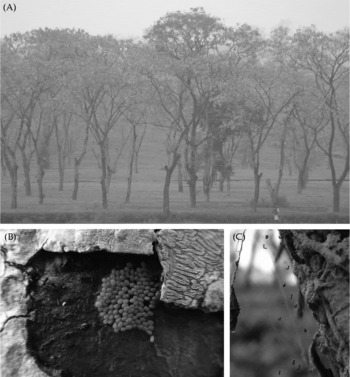
Tea is grown on about 400,000 ha in the entire Northeastern (NE) India. In Dooars (North Bengal) alone, a total of 14.2 million kg of tea is produced annually (15% of the total national production) from 69,703 ha plantations (Tea Board of India, personal communication). Unlike many other parts of the world, tea in NE India is cultivated under the shade of several woody trees, especially leguminous ones (Barua, Reference Barua1994) (Fig. 1A). Several geometrid species are major defoliator pests of tea in South Asia, particularly in NE India (Bigger, Reference Bigger2009). Until 2006, Buzura suppressaria Guen. (Geometridae: Lepidoptera) was the only geometrid pest of tea in NE India (Das, Reference Das1965). In 2006, Hyposidra talaca (Walk.) ‘invaded’ about 60,000 ha of tea plantations in the sub-Himalayan plains of North Bengal. By 2008, the problem of H. talaca became severe. Globally, H. talaca is a pest of cocoa, Theobroma cacao L. (Sterculiaceae), cinchona, Cinchona spp. L. (Rubiaceae) and mangosteen, Garcinia mangostana L. (Clusiaceae) in Australasian region and that of dipterocarpacean forests of Southeast Asia (Dun, Reference Dun1967; Kennedy, Reference Kennedy1996; Intachat et al., Reference Intachat, Holloway and Staines2001; Singh and Singh, Reference Singh and Singh2004). In NE India, it is known as a pest of sal (Shorea robusta Roth., Dipterocarpaceae) forests (Sen-Sharma and Thakur, Reference Sen-Sharma, Thakur, Jha and Sen-Sharma2008). The present study examines: (1) under what climatic conditions the expansion of H. talaca to tea plantations happened, and (2) the biological characteristics that helped it to build up and spread in the plantations in a short span of time.
A, a typical tea plantation of the Dooars of Northeastern India; B, a single egg-clutch of Hyposidra talaca concealed under the scales of a shade tree; C, neonate caterpillars of H. talaca drop from the shade tree trunk to tea plants in the lower strata.

Materials and methods
Study area
The studies were carried out in the Dooars (26o44′–26o54′N; 88o55′–89o28′E) area of North Bengal in NE India. Dooars forests are dominated by sal, which is a coppicing tree species (Uma Shankar et al., Reference Uma Shankar, Lama and Bawa1998). Forest fragmentation, slash-and-burn agriculture, land clearing for tea plantations and developmental activities associated with the ‘taungya’ system of forestry (planting certain timber-yielding species) helped some coppicing species such as sal and Cinchona spp., which are the preferred host plants of H. talaca, to dominate the forests of the region (Uma Shankar et al., Reference Uma Shankar, Lama and Bawa1998). The experimental studies were carried out in a tea plantation of central Dooars (26o53.934′N, 88o54.475′E; 222 masl). Weather data were recorded in the North Bengal Regional R&D Centre at Nagrakata. Mean winter temperature and rainfall were calculated for the period November to January. The study took place between 05.30 and 07.30 h in the summer of 2010.
Study species
In Dooars tea plantations, H. talaca has seven generations in a year. Egg laying occurs under the scales of barks of almost all shade tree species (P.A. Sinu, unpublished data) (Fig. 1B). Immediately after hatching, the neonate caterpillars drop on a silken thread of salivary secretion (Fig. 1C) to access tea plants below the shade trees. The caterpillars are often carried by the wind to larger areas, accelerating the spread of the pest (P.A. Sinu, unpublished data). Very few natural enemies are reported for H. talaca's different life stages. In cocoa plantations of Papua New Guinea, Winthemia diversa Malloch and a Calozenillia sp. (Diptera: Tachinidae) are known larval parasitoids (Dun, Reference Dun1967). Egg or pupal parasitoids have not been reported for H. talaca. In NE Indian tea plantations, a nucleopolyhedrovirus and the mixed-species foraging flock of four bird species prey on H. talaca caterpillars (Antony et al., Reference Antony, Sinu and Das2011; Sinu, Reference Sinu2011; Sinu et al., Reference Sinu, Antony and Mallick2011).
In the study area, sal is a wild host-plant of H. talaca caterpillars (Sen-Sharma and Thakur, Reference Sen-Sharma, Thakur, Jha and Sen-Sharma2008). The deforestation and recent land-use changes in the adjoining cinchona plantations might have prompted the range expansion of the pest to tea.
Experimental methodology
To study egg parasitization, a total of 12,352 eggs of 62 different egg clutches from seven severely infested tea plantations were collected and reared in the laboratory. The about-to-hatch egg clutches, which can be identified by the associated colour change from bluish-green to yellow, were collected for the study. To study the role of bark-specialist predatory birds on H. talaca eggs on shade tree plants, 51 egg clutches on 47 shade trees were additionally monitored.
The response of the caterpillars to different predator-like stimuli was studied experimentally and naturally. Late-instar larvae (3rd–5th), which are vulnerable to predation, were used in these studies. Potential predators of the caterpillars in tea plantations were eumenid and vespid wasps, predatory ants and insectivorous birds (P.A. Sinu, personal observation). As the leaf-plucking and insecticide-spraying operations constantly disturb tea plants, which could affect the foraging behaviour of the caterpillars, the effect of mechanical vibrations was also studied. In all, three major predator-like stimuli were tested: (1) the buzzing sound of a predatory wasp, (2) tactile effect of the common predatory ant Tetraponera rufonigra (Jerdon) (Hymenoptera: Formicidae) on the caterpillar, and (3) substrate vibration. A buzzing wasp, taken in a wide-mouth plastic tube covered by a muslin cloth, was held near different caterpillars to record their response (N = 210). The caterpillar-inhabited primary branches of 100 tea plants were manually vibrated to record the response of the caterpillars to mechanical vibration. Response to predatory ants was studied by releasing a single T. rufonigra adult to 100 different 3rd instar caterpillars on the tea leaves.
To study the response of the caterpillars to insectivorous birds, we observed them in bird-active and bird-free zones of a tea plantation. After 15 min of bird activity, the position and posture of the caterpillars were recorded in 35 randomly selected tea plants in bird-active and bird-free zones, simultaneously.
The height at which the caterpillar originally positioned itself on tea plants was recorded beforehand. Since the height of the experimental plants varied (0.40–1.10 m), the drop length of a caterpillar was calculated relative to the original height of the plant. Studies were made on 1-year-old pruned tea plants as pruning enhances accessibility and visibility for recording observations. The Mann–Whitney U test was used to compare the difference in the response of caterpillars in bird-active and bird-free tea plants. Kruskal–Wallis Rank ANOVA test was used to compare the relative drop lengths of the caterpillars in different experiments. Mean ( ± 1 SEM) values are given throughout the paper.
Results
Possible reasons of range expansion of H. talaca to tea plantations
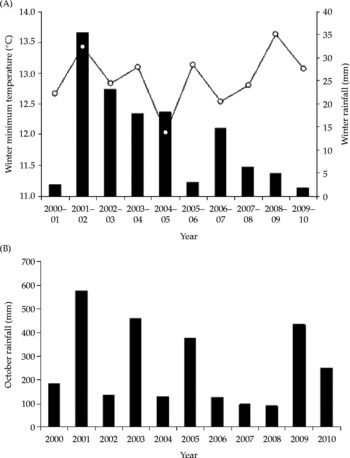
Over the last 10 years, the entire Dooars has been experiencing extreme fluctuations in rainfall and winter temperatures (Fig. 2A). Winter temperature during this period increased by a mean 0.7°C compared with the previous 30-year average. Winter rainfall has decreased consistently since 2000. October rainfall, which indicates the end of the southwest monsoon and influences the length of the succeeding dry period, varied considerably during the pest outbreak period of H. talaca (Fig. 2B). The droughts of 2006, 2007 and 2008 coincided with H. talaca range expansion to tea plantations. Since more than 80% of tea plantations in Dooars are contiguous, the spread of H. talaca has been accelerated.
A, fluctuations in winter (November–January) minimum temperature (line diagram: primary Y-axis) and rainfall (bar diagram: secondary Y-axis); B, fluctuation in October rainfall during the 2000–2010 period in the tea-growing belt of the Dooars area in Northeastern India.

Anti-predatory tactics of H. talaca
No egg parasitoids emerged from the field-collected H. talaca eggs. Yet, eggs in the plantations were susceptible to the attack of three woodpecker species (Dendrocopus canicapillus (Blyth), Dinopium benghalense Linn. and Chrysocolaptes lucidus Scopoli) that frequently visited the shade trees in the plantation in search of prey. The birds also foraged from the lower trunk of the shade trees, where egg deposits are high. We found that 23.6% (N = 51) of the egg clutches were completely damaged by the birds.
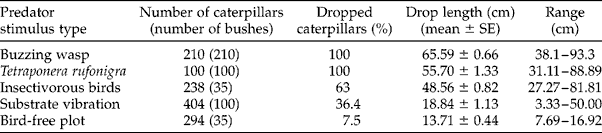
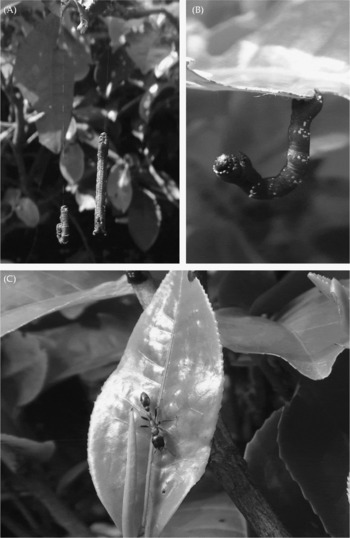
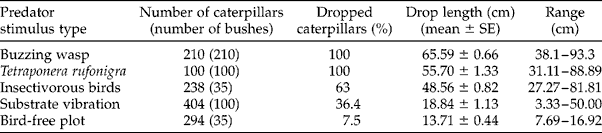
The caterpillars responded differently to various predator-like stimuli (Table 1): 100% caterpillars (N = 210) dropped on a salivary thread to the lower level in response to the buzzing noise of a predatory wasp (Fig. 3A). To manual substrate vibration, 36.4% (N = 404) of the caterpillars dropped and the remaining 63.6% (N = 404) assumed a deimatic ‘U’ or ‘S’ position in the foliage (Fig. 3B). To a tactile stimulus of T. rufonigra, 100% (N = 100) of the caterpillars dropped. In bird-active tea plants, 63% (N = 238) of the caterpillars dropped, and the remaining 37% assumed a deimatic posture in the foliage. In bird-free tea plants, only 7.5% (N = 294) of the caterpillars dropped (Mann–Whitney U test, U = 9.5, Z = 7.08, P = 0.0000).
Responses of Hyposidra talaca caterpillars to different potential predator-like stimuli in tea plantations of the Dooars, Northeastern India
A, caterpillars of Hyposidra talaca dropping, influenced by a predatory wasp; B, a caterpillar assumes a deimatic posture on a tea leaf; C, a Tetraponera rufonigra predatory ant on a tea leaf.

The mean relative drop lengths of the caterpillars varied significantly between different predator-like stimuli (Kruskal–Wallis Rank ANOVA test, H(3, 607) = 395.37, P = 0.0000) (Table 1). The length was 65.59 cm (range 38.1–93.3, N = 210), 55.7 cm (range 31.11–88.89; N = 100), 48.56 cm (range 27.27–81.81; N = 150) and 18.84 cm (range 3.33–50; N = 147), respectively, for the stimulus of a buzzing wasp, ant, bird and substrate-vibration. In bird-free tea plants, the mean relative drop length of the caterpillar was only 13.71 cm (range 7.69–16.92).
Discussion
Our results suggest that the range expansion of H. talaca to tea plantations in NE India is associated with the prolonged drought and inconsistent rainfall in the Dooars. This outbreak resembles reports from other tropical regions (Intachat et al., Reference Intachat, Holloway and Staines2001; Itioka and Yamauti, Reference Itioka and Yamauti2004; Van Bael et al., Reference Van Bael, Aiello, Valderrama, Medianero, Samaniego and Wright2004; Menéndez et al., Reference Menéndez, González-Megías, Lewis, González-Megías, Shaw and Thomas2008). Most of the drought-related pest outbreaks in the tropics are reported from the Neotropics, where the influence of the El Niño oscillation event is common. Data from outbreaks of insect pests in Old World tropical regions are too few to make any generalization (see Itioka and Yamauti, Reference Itioka and Yamauti2004). Notably, the outbreak of H. talaca happened in an intensive monoculture system of a sub-tropical region and it shares, to some extent, some features of an outbreak in the temperate regions. It persisted for several generations and years, apparently with an obvious population build-up, less diversity of natural enemies and delayed response of density-dependent regulating agents (Berryman, Reference Berryman1988; Menéndez et al., Reference Menéndez, González-Megías, Lewis, González-Megías, Shaw and Thomas2008).
We found that H. talaca caterpillars, like other pests, are behaviourally adapted to escape from potential predators (Floater and Zalucki, Reference Floater and Zalucki2000; Sinu et al., Reference Sinu, Nasser and Dharmarajan2007; Azerefegne and Solbreck, Reference Azerefegne and Solbreck2010). The concealed eggs and pupae under the barks of shade trees and inside the soil, respectively, frequently escaped from predators (Raymond et al., Reference Raymond, Vanbergen, Watt, Hartley, Cory and Hails2002; Tanhuanpää et al., Reference Tanhuanpää, Ruohomäki and Kaitaniemi2003).
Geometrid larvae under natural conditions either drop or remain cryptic to their environment under the influence of predators (Evans, Reference Evans1986; Witz, Reference Witz1990). In tea plantations, H. talaca caterpillars dropped to potential predator-like stimuli (predatory wasps, ants and birds) and remained motionless to non-potential predator-like stimulus (mechanical vibration). The drop lengths of the caterpillars indirectly explain the importance of a predator. Predatory wasps, therefore, are the most important insect predator of H. talaca caterpillars. Predatory ants like T. rufonigra, although known to influence the herbivory of geometrid caterpillars (Ito and Higashi, Reference Ito and Higashi1991), had little impact on the pest due to the dropping behaviour of H. talaca caterpillars. The primary response of the caterpillars to substrate vibration was assuming a static posture in the foliage, indicating that vibration threat was perceived to be less dangerous than predation threat.
In our study, we failed to detect any egg parasitism, but bark-specialist predatory birds such as woodpeckers damage to a limited extent the concealed eggs of H. talaca.
Conclusion
The range expansion of H. talaca to tea plantations happened in the context of climate change. However, the obvious build-up of pest populations was due to the behavioural adaptation of different life stages of the pest to overcome the effect of generalist predators and probably due to the delayed response of their specialized natural enemies. After 2 years of the outbreak in tea plantations, we observed increased predation by birds (Sinu, Reference Sinu2011) and evidence of increased levels of a viral disease in the caterpillars (Antony et al., Reference Antony, Sinu and Das2011; Sinu et al., Reference Sinu, Antony and Mallick2011).
Acknowledgements
We thank Sean M. Kent (Northeastern University, USA) and Professor K.R. Shivanna (ATREE–Bangalore) for critical reading of the paper. Funding for the research from the Tea Board of India is gratefully acknowledged. We thank Dr S.K. Pathak (The CAO (WB)) for necessary help in carrying out the research. Cooperation from Bogotpore Tea Plantation is gratefully acknowledged.