Familial Mediterranean fever is a genetic disorder manifested by recurrent attacks of peritonitis, pleuritis, and arthritis, and characterised by clinical, histological, and laboratory evidence for localised and systemic inflammation. Colchicine treatment usually prevents the attacks and the associated inflammation. Inflammation may play an important role in the initiation and progression of atherosclerosis and ischaemic cardiac disease. Cardiac repolarisation abnormalities may be seen because of cardiac involvement in Familial Mediterranean fever. Dispersion of repolarisation represents the degree of repolarisation heterogeneity in the heart and it has been reported that increased dispersion shows increased susceptibility to complex ventricular tachyarrhythmias and sudden deaths.Reference Kuo, Munokata, Reddy and Surawicz 1 – Reference Higham and Campbell 3 QT dispersion is defined as the difference between the maximum QT interval and minimum QT interval measurements on standard 12-lead electrocardiography. It has recently been found that QT dispersion and corrected QT dispersion intervals, which are variables of dispersion of repolarisation, were significantly longer in patients with Familial Mediterranean fever compared with healthy controls.Reference Akcay, Acar and Sayarlioglu 4 It has also been suggested that QT dispersion might be a useful marker of cardiovascular morbidity and mortality due to complex ventricular arrhythmias in rheumatoid arthritis.Reference Akcay, Acar and Sayarlioglu 4 The factors related to disease and sustained inflammation leading to endothelial dysfunction and subclinical atherosclerosis may cause inhomogeneity of ventricular repolarisation in autoimmune rheumatic diseases such as rheumatoid arthritis, ankylosing spondylitis, and systemic lupus erythematosus.Reference Cindas, Kutsal, Tokgözoglu and Karanfil 5 – Reference Yavuz, Atalar and Karadag 7 Owing to the fact that children with Familial Mediterranean fever are characterised by increased inflammatory activity, there may be an increased QT dispersion in these patients. To our knowledge, QT dispersion and corrected QT dispersion have not been studied in children with Familial Mediterranean fever. Therefore, we aimed to evaluate QT dispersion and corrected QT dispersion in children with Familial Mediterranean fever, as well as their relationship with echocardiographic parameters.
Materials and methods
The study was carried out on 69 patients – 36 boys and 33 girls – recruited from the Pediatric Rheumatology Department, Faculty of Medicine, İstanbul University. All the patients fulfilled the Tel-Hashomer criteria;Reference Livneh, Langevitz and Zemer 8 the patients were in the age group of 5–16 years (mean 10.79 plus or minus 2.85 years). We chose 71 healthy volunteers, matched for sex and age, as the control group. All the healthy subjects were interviewed about their health status. Patients and controls with a history of arterial hypertension, left ventricle wall motion abnormality, left ventricle ejection fraction less than 50%, primary cardiomyopathy, children with congenital or rheumatic cardiac disease, diabetes mellitus, valvular cardiac diseases, amyloidosis, and electrolyte imbalance were excluded from the study. In addition, children with history of any clinical evidence of cardiac manifestations, arrhythmia, or ischaemic cardiac diseases were excluded. All the patients were in sinus rhythm and none of them were taking medications such as antiarrhythmics, tricyclic antidepressants, antihistamines, and antipsychotics. A total of 71 healthy age- and sex-matched children – 37 boys and 34 girls – aged from 5 to 16 years (mean 9.92 plus or minus 2.78 years) were enrolled in the study and served as the control group. Erythrocyte sedimentation rate (millimetre per hour) was determined by the Westergren method. Height and weight were directly measured using a standardised protocol. Informed consent was obtained from the parents of each participant before the study. The study protocol was approved by the ethics committee of Faculty of Medicine, İstanbul University.
Echocardiographic examination
All subjects underwent a detailed echocardiography, which included an M-mode, two-dimensional, colour, and Doppler – continuous and pulse wave – examination. Images were obtained on a Siemens Acuson CV70 with a 4–2 megahertz transducer. The patients were requested to rest for 5 minutes before the measurements and breathe slowly during the procedure. Recordings were made with subjects in the supine or left lateral positions. M-mode tracings were obtained at the level of tips of mitral leaflets in parasternal long-axis position, and measurements of left ventricular end-systolic dimension and left ventricular end-diastolic dimension were performed according to the recommendations of the American Society of Echocardiography.Reference Sahn, Demaria, Kisslo and Weyman 9 Ventricular septal and posterior wall thickness at end-diastole, and left atrial dimension were measured from parasternal long-axis window in M-mode echocardiography. Left ventricular ejection fraction and fractional shortening were obtained using Teichholtz in M-mode echocardiography.Reference Devereux, Alonso and Lutas 10 Left ventricle diastolic function was assessed by measuring the mitral flow velocity recorded in the apical four-chamber view. The pulse Doppler sample volume was placed in the left ventricular inflow tract at the level of mitral leaflet tips and three consecutive measurements were averaged. The various variables of diastolic function that were measured included: peak early (E; metre per second) and peak atrial filling velocity (A; metre per second), ratio of E to A (E/A), E deceleration time (metre per second), and isovolumic relaxation time (metre per second). The isovolumic relaxation time is ideally measured from the start of the aortic valve closure signal to the start of the mitral valve opening signal.Reference Myreng and Smiseth 11 This last parameter was measured with the probe at the apical five-chamber position, with the sample volume placed between the aorta and mitral valve where the recordings of both valves were taken simultaneously.
Electrocardiography
The 12-lead electrocardiography was recorded at a paper speed of 25 millimetres per hour and gain of 10 millimetres per microVolt (Cardiofax V, Nihon Kohden Corporation, Tokyo, Japan) in the supine position, with the patient breathing freely but not allowed to speak during the electrocardiographic recording. Electrodes were placed in anatomical positions according to routine procedure. Electrocardiography strips were recorded for 10 seconds with a standard device. Electrocardiographies of inadequate quality were repeated. To avoid diurnal variations, we generally took the electrocardiography recordings of all Familial Mediterranean fever patients and control subjects at the same time interval (10–12 hours). QT intervals were measured manually from the point where the Q wave started and the T wave returned to the isoelectric line. To decrease the error measurements, QT intervals were measured manually with calipers and magnifying glass. Subjects with U waves on their electrocardiographies were excluded from the study. All the measurements were repeated three times and average values were accepted for each of the electrocardiographic parameters. Only recordings with more than eight analysable leads were included. All of the measurements were performed by two experienced investigators unaware of the subject's clinical status. Maximum QT was determined as the lead with the longest QT interval. Minimum QT was determined as the lead with the shortest QT interval. QT dispersion was defined as the difference between the longest and shortest QT intervals; rate correction was performed using the Bazett formula:Reference Bazett 12 corrected QT dispersion equals QT dispersion/square root (RR interval) in milliseconds. This traditional correction procedure is intended to obviate the dependence of QT interval on heart rate. The blinded intra- and inter-observer variability of QT measurements were less than 5%. Patients were followed up for 1 year.
Statistical analyses
The SPSS statistical software package (version 11.0) was used to perform all statistical calculations. Continuous variables were expressed as mean plus or minus standard deviation and categorical variables as percentages. Findings were compared between the groups using the Student t-test. Relationships between variables were analysed using correlation analysis, that is, the Pearson correlation coefficient for normally distributed variables and the Spearman correlation coefficient for non-normally distributed variables. A p-value less than 0.05 was considered statistically significant.
Results
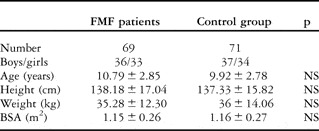
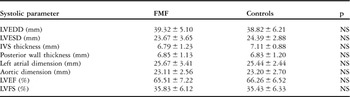
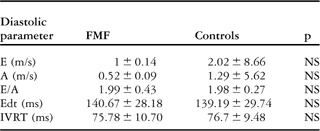
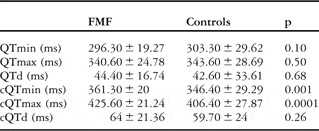
The demographic characteristics of the study population are summarised in Table 1. There was no significant difference between the two groups with regard to gender, age, and body surface area. Table 2 represented the clinical and laboratory characteristics of the patients with Familial Mediterranean fever. However, erythrocyte sedimentation rate (millimetre per hour) was significantly higher in the patients with Familial Mediterranean fever compared with controls. The mean erythrocyte sedimentation rate (millimetre per hour) at the end of 1 hour was 21.16 plus or minus 11.41 millimetres per hour in the patients with Familial Mediterranean fever. The mean disease duration was 4.65 plus or minus 3.19 years. All patients were free from cardiovascular symptoms. Table 3 showed the cardiovascular parameters in patients with Familial Mediterranean fever and controls. There were no significant differences in heart rates and systolic–diastolic blood pressures between the groups. In addition, left ventricle end-diastolic dimension, left ventricle end-systolic dimension, left atrium dimension, aortic dimension, and left ventricle ejection fraction – shortening fraction were similar between the Familial Mediterranean fever patient group and control groups (Table 4). Among diastolic measurements, almost all parameters showed insignificant differences between the patient and the control group. All diastolic parameters of the groups are summarised in Table 5. The calculated QT dispersion and corrected QT dispersion parameters for the two groups are shown in Table 6. All parameters were from the normal distribution. Minimum corrected QT and maximum corrected QT showed significant differences between the patient and the control group. Minimum corrected QT and maximum corrected QT was significantly higher in patients versus controls. However, between groups, there was no statistically significant difference in QT dispersion and corrected QT dispersion. In addition, there was no difference in minimum QT and maximum QT durations between the study and the control groups. In addition, there was no significant correlation between erythrocyte sedimentation rate (millimetre per hour) and QT dispersion, corrected QT dispersion (r = −0.097, p = 0.433; r = −0.067, p = 0.585, respectively). During 1 year of follow-up, no case of ventricular arrhythmia was documented in either group.
Demographic data of the study population (mean plus or minus standard deviation).

BSA = body surface area; FMF = Familial Mediterranean fever; NS = non-significant
Clinical and laboratory data of FMF patients (mean plus or minus standard deviation).

ESR = erythrocyte sedimentation rate; FMF = Familial Mediterranean fever
Cardiovascular parameters in FMF patients and controls (mean plus or minus standard deviation).

FMF = Familial Mediterranean fever; NS = non-significant
Systolic parameters measured by M-mode echocardiography (mean plus or minus standard deviation).

FMF = Familial Mediterranean fever; IVS = interventricular septum; LVEDD = left ventricular end-diastolic diameter; LVEF = left ventricular ejection fraction; LVESD = left ventricular end-systolic diameter; LVFS = left ventricular fractional shortening; NS = non-significant
Diastolic parameters measured by Doppler echocardiography (mean plus or minus standard deviation).

A = peak late diastolic flow velocity; E = peak early diastolic flow velocity; Edt = early diastolic flow deceleration time; FMF = Familial Mediterranean fever; IVRT = isovolumic relaxation time; NS = non-significant
Electrocardiographic measurements of the FMF patients and controls (mean plus or minus standard deviation).

cQTd = corrected QT dispersion; cQTmax = corrected maximum QT; cQTmin = corrected minimum QT; FMF = Familial Mediterranean fever; QTd = QT dispersion; QTmax = maximum QT; QTmin = minimum QT
Discussion
This study showed that systolic–diastolic function of left ventricle, QT dispersion, and corrected QT dispersion were similar between the children with Familial Mediterranean fever and control groups (Tables 1 and 2).
Familial Mediterranean fever is a disease characterised by recurrent and sustained increased inflammatory activity.Reference Bilginer, Ozaltın and Basaran 13 Several rheumatic diseases, such as lupus and rheumatoid arthritis, are associated with left and right ventricular diastolic dysfunction, which is believed to contribute to cardiovascular complications and early death.Reference Wislowska, Jaszczyk, Kochmanski, Sypula and Sztechman 14 Indeed, diastolic dysfunction can lead to premature mortality even in non-rheumatic patients, regardless of other comorbidities.Reference Achong, Wahi and Marwick 15 Impairment of ventricular diastolic functions has been reported in patients with Familial Mediterranean fever without clinical evidence of cardiac disease.Reference Bilginer, Ozaltın and Basaran 13 , Reference Sarı, Arican and Can 16 – Reference Akdogan, Calguneri and Yavuz 18 Unfortunately, there are a limited number of studies investigating the cardiovascular involvement in children with Familial Mediterranean fever. In detailed echocardiographic examinations that were conducted in our study, systolic and diastolic ventricular functions were not different between patients with Familial Mediterranean fever and control groups.
However, to our knowledge, the presence of QT dispersion in children with Familial Mediterranean fever has not yet been investigated. We hypothesised that QT dispersion may not only be affected in adult patients with Familial Mediterranean fever, but also may be affected in children with Familial Mediterranean fever. In this study, QT dispersion was evaluated in Familial Mediterranean fever patients free of cardiac symptoms and was compared with that in healthy control subjects.
Abnormally high QT dispersion has been reported to pose an arrhythmogenicity risk. In this study, QT dispersion and corrected QT dispersion was not found to be higher in children with Familial Mediterranean fever than in healthy control subjects. Our findings disagree with Akcay et al'sReference Akcay, Acar and Sayarlioglu 4 recent study comparing electrocardiography parameters of Familial Mediterranean fever patients and controls. They reported that the Familial Mediterranean fever group had a significantly higher QT dispersion (36 plus or minus 11.4 versus 20 plus or minus 11.2 milliseconds, p < 0.0001) and higher corrected QT dispersion (40.4 plus or minus 13.5 versus 21.9 plus or minus 12.4 milliseconds) relative to the controls.Reference Akcay, Acar and Sayarlioglu 4 The authors have given reason to it by accusing subclinical atherosclerosis and inflammatory features of Familial Mediterranean fever. In our study, inflammatory marker – erythrocyte sedimentation rate – was significantly higher in Familial Mediterranean fever patients than in control subjects. But there was no significant correlation between erythrocyte sedimentation rate (millimetre per hour) and QT dispersion, corrected QT dispersion (r = −0.097, p = 0.433; r = −0.067, p = 0.585, respectively). The reason for this incompatibility may be explained by the patients being in an attack-free period and mean disease period being short. Nussinovitch et alReference Nussinovitch, Livneh and Katz 19 in their study of adult patients with Familial Mediterranean fever have achieved similar results to the results of our study. They reported that all parameters were from the normal distribution. There was no statistically significant difference between groups in QT and QT dispersion parameters (QT dispersion: 48 plus or minus 12.5 versus 46.7 plus or minus 9.7 milliseconds and corrected QT dispersion: 51.4 plus or minus 12.0 versus 49.7 plus or minus 10.5 milliseconds). The results are supported by the earlier reports of a similar risk for ischaemic cardiac disease in Familial Mediterranean fever patients and the general populationReference Langevitz, Livneh and Neumann 20 and the lack of any documented lethal arrhythmias during follow-up.
In our study, the QT measurement was performed using the manual method. Nussinovitch et alReference Nussinovitch, Livneh and Katz 19 measured QT dispersion with operator-independent automated commercial software, whereas Akcay et al,Reference Akcay, Acar and Sayarlioglu 4 like us, used the manual method. However, it has not been established whether computerised measurements of QT interval are more accurate than manual measurements.Reference Murray, Mclaughlin and Campbell 21
In our study, we observed only asymptomatic patients with respect to cardiac involvement. The mean age of our study population was considerably younger than that in most other studies. Therefore, the mean disease duration is short. Our study patients were under regular colchicine treatment. Colchicine may be considered by some as a cardioprotective agent.Reference Gasparyan and Ugurlucan 22 – Reference Nussinovitch, Livneh and Katz 24 We found that on electrocardiographic studies, children with Familial Mediterranean fever who were continuously treated with colchicine and did not develop amyloidosis had a similar QT dispersion and corrected QT dispersion as healthy controls. Our results are supported by the lack of an increased risk for ventricular arrhythmia and sudden death in children with Familial Mediterranean fever in the medical literature. Both the Nussinovitch et alReference Nussinovitch, Livneh and Katz 19 study and the previous study by Akcay et alReference Akcay, Acar and Sayarlioglu 4 included a fewer number of patients. The number of patients in our study was greater than these two studies.
However, it has been reported that there was no difference in rhythm disorders between rheumatoid arthritis patients and controls, who were observed with 24-hour Holter monitoring.Reference Kumar, Rasheed, Gallo, Al-Hales and Duran 25 Perhaps, further studies are necessary to investigate the frequency of ventricular arrhythmias by rhythm Holter in children with Familial Mediterranean fever.
We found that diastolic dysfunction was not associated with QT dispersion. The results of this study suggested that larger-scale, prospective, longitudinal studies are needed to assess the effect of electrocardiographic studies and inflammatory activity on the risk of malignant ventricular arrhythmia and sudden cardiac death in this special patient population. The evaluation of electrocardiographic findings would have been more accurate if it was performed during both exacerbations and attack-free periods for assuming that QT dispersion and corrected QT dispersion are affected in children with Familial Mediterranean fever. Long-term follow-up is required before definitive conclusions can be made. In this study, we used manually measured QT dispersion. In the future, the dispersion of repolarisation may be assessed invasively using endocardial or epicardial mapping, or non-invasively by multi-lead body surface mapping.