Psychosocial adjustment is an important dimension of the long-term outcomes of children who undergo cardiac surgery in infancy. Although most of these children achieve good psychosocial outcomes,Reference DeMaso1 studies of adult survivors with congenitally malformed hearts suggest increased psychiatric morbidity, including major depressive disorder and panic disorder,Reference Horner, Liberthson and Jellinek2 obsessive-compulsive symptoms, interpersonal difficulties, depression, paranoid ideation, and psychosis.Reference Brandhagen, Feldt and Williams3
Studies using parent-completed questionnaires indicate that school-aged children with congenitally malformed hearts have significantly more behavioural problems than do their peers, with the greatest differences typically apparent in the rates of “internalizing” problems such as social withdrawal, anxiety, depression, and somatic complaints.Reference Wright and Nolan4–Reference Miatton, De Wolf, Francois, Thiery and Vingerhoets11 Teachers, however, do not always rate as significantly different the behaviours of the children with congenitally malformed hearts when compared to their peers.Reference Wright and Nolan4, Reference Oates, Turnbull and Simpson5 A possible explanation is that children behave differently at home and at school, although in one study, the differences between the ratings made by parents and teachers were much greater among the cardiac patients than among their controls.Reference Wright and Nolan4 It is also possible that the ratings made by the parents reflect factors other than the behaviour of their child, such as guilt, over-protectiveness, stress, and anxiety.Reference Kong, Tay and Yip12, Reference Uzark and Jones13 Indeed, the severity of illness, or physical limitations, tend to be less strongly predictive of the emotional adjustment of the child than are maternal perceptions, characteristics of the relationship between mother and child, the impact of the illness of the child on family processes, and the extent of the available social networking.Reference Bjornstad, Spurklund and Lindberg6, Reference DeMaso, Campis and Wypij14–Reference McCusker, Doherty and Molloy16
A variety of other factors are also associated with the risk of psychological dysfunction in children with congenitally malformed hearts. The type of cardiac lesion is itself important, as children with cyanotic lesions appear to be at somewhat greater risk of psychosocial problems than are children with acyanotic lesions.Reference Spurkland, Bjornstad and Lindberg17 Aspects of the surgical interventions undertaken to repair the malformations are also important. In a study involving parental ratings of the behaviour of children aged from 10 to 15 years, the risk factors for behavioural problems included a greater number of cardiac operations, use of deep hypothermic circulatory arrest at less than 22 degrees Celsius during cardiac surgery, low systemic saturations of oxygen, and older age at repair.Reference Utens, Verhulst and Duivenvoorden18 Impairments of the central nervous system and deficits in intelligence are also strong risk factors for psychological dysfunction in children with cyanotic lesions.Reference Utens, Verhulst and Meijboom19, Reference DeMaso, Beardslee and Silbert20 The interpretation of many studies in this area is complicated, however, by the inclusion of patients with multiple cardiac lesions, high rates of postoperative disability, small sizes of samples, and variability across studies in operative factors known to influence neurodevelopmental outcomes, such as the method used to support vital organs, along with strategies for managing the haematocrit and pH.
In this study, we present data on the behaviour of children with a single lesion, namely transposition defined on the basis of concordant atrioventricular and discordant ventriculo-arterial connections or alignments, who underwent the arterial-switch operation in a randomized trial, the Boston Circulatory Arrest Trial, which compared the neurodevelopmental sequels of the two primary methods providing support for the vital organs, namely deep hypothermia with predominantly total circulatory arrest, and deep hypothermia with predominantly low-flow cardiopulmonary bypass. In contrast to many other cohorts, particularly those who underwent palliative surgeries only,Reference Bjornstad, Spurklund and Lindberg6, Reference Casey, Sykes and Craig15 the postoperative physical health of these children was excellent, with none reported to have significant limitations in their activities.Reference Dunbar-Masterson, Wypij and Bellinger21 To date, in assessments conducted at the ages of 1, 4, and 8 years, the developmental and neurologic outcomes of the group treated with low-flow have generally been better than those undergoing circulatory arrest,Reference Newburger, Jonas and Wernovsky22–Reference Bellinger, Wypij and duPlessis25 particularly in the areas of motor function and speech production. To determine whether the frequency of behavioural disorders was also increased in those undergoing circulatory arrest, we obtained ratings from the parents when the children were 4 years old, and from both the parent and teachers when the children were 8 years old.
Methods
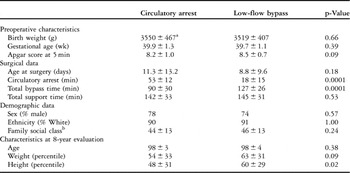
Patients were enrolled in a prospective randomized single-center trial between April, 1988, and February, 1992. Eligibility included a diagnosis of transposition with intact ventricular septum or ventricular septal defect, scheduled repair by 3 months of age, and coronary arterial anatomy considered suitable for the arterial switch operation. Babies were excluded if their weight at birth was less than 2.5 kilograms, they had a recognizable syndrome of congenital anomalies, an associated extra-cardiac anomaly of greater than minor severity, previous cardiac surgery, or associated cardiovascular anomalies requiring reconstruction of the aortic arch or additional open surgical procedures. Children were randomized to receive the arterial switch operation using deep hypothermia and predominantly total circulatory arrest, or predominantly continuous low-flow bypass as the method for supporting the vital organs. No arterial filter was employed in the bypass circuit, all patients were haemodiluted to levels of 20%, and the alpha stat strategy was employed to control pH. Detailed information about operative management employed at the time of this study is available in previous publications.Reference Newburger, Jonas and Wernovsky22, Reference Wernovsky, Wypij and Jonas26, Reference Newburger and Wypij27 Characteristics of the children and their families, stratified by their mode of surgical treatment, are presented in Table 1. Most families fell into the middle range of the socioeconomic spectrum, although the full range of the spectrum was represented in the sample.
Characteristics of infants with transposition (concordant atrioventricular and discordant ventriculo-arterial connections) according to the mode of surgical treatment.

aMean ± SD.
bHollingshead Four-Factor Index of Social Class (raw score).
The arterial switch operation was performed in 171 infants, 95% of those enrolled. Of these, 165 were alive at eight years of age. Of the patients, 5 (3%) lived outside of the United States of America, and were not considered eligible. Of the remaining 160 patients, 155 (97%) participated. No patients were lost to follow-up. This study was approved by the Children’s Hospital Boston Institutional Review Board and conducted in accordance with institutional guidelines. Parents of all children provided informed consent.
Parent and teacher ratings of behaviour when the children were aged 8
Parents completed two rating scales pertaining to behaviour, the Child Behavior Checklist,Reference Achenbach28 and the Connors’ Parent Rating Scale.Reference Connors29 Generally the mother completed the forms, although sometimes it was the father, and sometimes the parents together. This information was not taken into account in the analyses. The Child Behavior Checklist has two parts. The section relating to competence yields scores on the quality of functioning with respect to activities, such as sports, hobbies, organizations, chores, social adaptation such as relationships with siblings, friends, and parents, and school. Higher scores indicate increased competence. Scores of less than 34 on the Competence scales were considered to be in range of clinical concern. A score is also calculated for total competence, with scores less than 41 considered to be in the range of clinical concern. The section relating to behaviour yields scores on three summary scales, namely Internalizing Behaviors, Externalizing Behaviors, and Total Problem Behaviors, and 9 syndrome scales, specifically Withdrawn, Somatic Complaints, Anxious/Depressed, Social Problems, Thought Problems, Attention Problems, Delinquent Behaviors, and Aggression. Higher scores indicate more problems. Total scores of 60 or greater on the summary scales, and of 67 or greater on the syndrome scales, are considered to be in the range of clinical concern. The Connors’ Parent Rating Scale yields scores on eight scales, namely Conduct Disorder, Anxious-Shy, Restless-Disorganized, Learning Problem, Psychosomatic, Obsessive-Compulsive, Antisocial, Hyperactive-Immature.
Teachers completed the Teacher’s Report Form,Reference Achenbach30 and the Connors’ Teacher Rating Scale.Reference Connors29 The Adaptive section of the Teacher’s Report Form yields T-scores for Academic Performance, Working Hard, Behaving Appropriately, Happy, Social, as well as a Total Adaptive Score. The Behavior section yields the same set of summary and syndrome T-scores as the Child Behavior Checklist, and the same cut-off values are used to identify scores of clinical concern. The Teacher’s Report Form Manual, however, does not identify cut-offs for the Adaptive scales. The Connors’ Teacher Rating Scale yields scores on scales for Hyperactivity, Conduct Problem, Emotional Indulgent, Anxious-Passive, Asocial, Daydream-Attention Problem.
The following data was abstracted from the study databases:
Operative course and post-operative state
Using forms developed for the clinical trial, data was recorded on the mode of treatment, that is total circulatory arrest versus low-flow bypass, the duration of total circulatory arrest, time on cardiopulmonary bypass, the state of the ventricular septum, length of stay in the intensive care unit, length of hospitalization, occurrence of a clinical seizure in the first postoperative week, and occurrence of ictal activity during the first 48 post-operative hours, as captured by continuous video electroencephalographic monitoring.Reference Helmers, Wypij and Constantinou31
Behavior at the age of 4
Behaviour was assessed at this age by having parents complete the same version of the Child Behavior Checklist used to assess behavior at the age of 8.
Neurodevelopmental state
At the ages of 4 and 8 years, children were evaluated, in a blinded manner, by a paediatric neurologist, a developmental psychologist, and a speech pathologist.Reference Bellinger, Wypij and Kuban24, Reference Bellinger, Wypij and duPlessis25 As endpoints from these evaluations suitable to serve as indicators of the state of the central nervous system, we chose presence of a definite or possible neurological abnormality at the ages of 4 and 8, and Full-Scale scores for intelligence quotient from the Wechsler Preschool and Primary Scale of Intelligence-RevisedReference Wechsler32 at the age of 4, and the Wechsler Intelligence Scale for Children-Third EditionReference Wechsler33 at the age of 8.
Family Characteristics
When children were 4 and 8 years old, parents completed the Parenting Stress Index,Reference Abidin34 which assesses parental perception of the parent-child system, the Social Readjustment Rating Scale,Reference Holmes and Rahe35 which assesses stressful life events, and the Family Adaptability and Cohesion Evaluation Scales,Reference Olson and Portner36 which assesses family communication and decision-making style.
Statistical methods
We evaluated the following hypotheses:
• According to the reports of the parents, but not the teachers, the behaviour of children with surgically corrected transposition at the age of 8 is worse than the behaviour of the general population of children.
• On the basis of the reports of parents and teachers, the behaviour at the age of 8 of those treated with circulatory arrest is worse than the behaviour of those treated with low-flow.
• Longer duration of stay in the intensive care unit, and longer post-operative hospitalization, are risk factors for behavioural problems reported by parents and teachers.
• Behavioural problems are more frequent among children with signs of impairment of the central nervous system. We examined 4 such indicators: post-operative seizures detected clinically in the first post-operative week, seizures detected by continuous video electroencephalographic measurements in the first 48 post-operative hours, abnormalities on neurological examination at the ages of 4 and 8, and a Full-Scale score for intelligence quotient less than or equal to 85 at the ages of 4 and 8.
• The likelihood that behaviour of the child is rated as more problematic by the parent at the age of 8 than 4 is greater among children judged by the teacher to be experiencing academic problems in school at the age of 8.
• The likelihood that a child has behavioural problems at the age of 8 varies depending on parental and familial characteristics, such as stress, depression, or cohesion, as measured when the child was 4 years old.
We tested the first hypothesis using t-tests to compare the ratings given by the parents and teachers for the children with surgically corrected transposition to normative values published in the Child Behavior Checklist and Teacher’s Report Form manuals. The second hypothesis was evaluated using regression analyses, adjusting for sex and family social class, to compare the ratings assigned by parents and teachers to children in the groups treated with circulatory arrest and low-flow bypass. The third, fourth, and sixth hypotheses were evaluated using regression analyses, adjusting for sex and family social class, to determine whether length of intensive care unit stay and length of hospitalization, for the third hypothesis, impairment of the central nervous system for the fourth, or parental and family characteristics at the age of 4 for the sixth hypothesis, were significant predictors of the ratings of behaviour when the children were aged 8. The fifth hypothesis was evaluated using regression analysis, adjusting for sex and family social class, to determine whether, by parental report, the behaviour of children not making adequate academic progress, with a T-score less than 41 on the Total adaptive scale of the Teacher’s Report Form at the age of 8, was less optimal than the behaviour of children judged to be making adequate progress.
Results
First hypothesis: According to the reports of the parents, but not the teachers, the behaviour of children with surgically corrected transposition at the age of 8 is worse than the behaviour of the general population of children
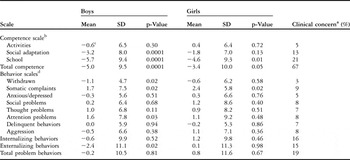
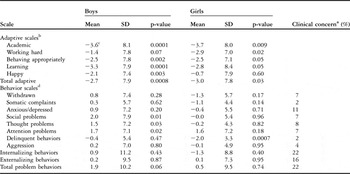
This hypothesis was partially confirmed, in that both parents and teachers identified many areas of psychosocial vulnerability in the surgically treated children (Tables 2 and 3). The consistency between the ratings of the teachers and parents was greatest on the Competence scales of the Child Behavior Checklist (parent-rated), and the Adaptive scales of the Teacher’s Report Form (teacher-rated). Parents rated boys as worse on all Competence scales except Activities, and girls as worse on School and Total Competence. Teachers rated boys as worse on all Adaptive scales except Working Hard, and girls as worse on all scales except Happy. On the Behavior scales of the Child Behavior Checklist, boys were rated as worse than the general population of boys on Somatic Complaints, Attention Problems, but better on Withdrawn and Externalizing Behaviors. Girls were rated as worse on Somatic Complaints only. Teachers rated boys as significantly worse on Social Problems, Thought Problems, and Attention problems. Girls were not rated by teachers as worse than the general population of girls on any Behavior scale. They were, however, rated better on Delinquent Behaviors. More significant differences were found for boys than for girls. This likely reflects, to some extent, the fact that three-quarters of the sample were male, which provided greater statistical power of tests involving this subgroup.
T Scores on Child Behavior Checklist compared to published norms, stratified by sex.

aBoys and girls combined.
bA higher score is better.
cDifference between the mean T scores of children with transposition (concordant atrioventricular and discordant ventriculo-arterial connections) and published sex-specific mean.
dA lower score is better.
T Scores on Teacher’s Report Form compared to published norms, stratified by sex.

aBoys and girls combined. The manual does not provide cut-off values for identifying scores of clinical concern on the Adaptive Scales.
bA higher score is better.
cDifference between the mean T scores of children with transposition (concordant atrioventricular and discordant ventriculo-arterial connections) and published sex-specific mean.
dA lower scores is better.
The frequencies of scores exceeding the borderline/clinical cut-off scores provided in the Child Behavior Checklist and the Teacher’s Report Form manuals were elevated on most scales of both instruments (Tables 2 and 3). For the summary scales of the Child Behavior Checklist, the frequencies were: Total Competence 67%, Total Problem Behaviors 19%, Internalizing Behaviors 16%, and Externalizing Behaviors 15%. On the Teacher’s Report Form, the frequencies of scores in the range of clinical concern were: Total Problem Behaviors 22%, Internalizing Behaviors 22%, and Externalizing Behaviors 16%.
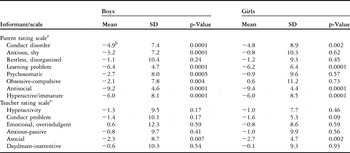
On the Connors’ Parent Rating Scale, parents rated their children as significantly better than the standardization sample on all scales except Restless/Disorganized. On the Connors’ Teacher Rating Scale, teachers rated the children as significantly better than the standardization sample only on the Asocial scale (Table 4).
T Scores on the Parent and Teachers’ Connors’ Ratings Scales compared to published norms, stratified by sex.

aA lower score is better.
bDifference between the mean T scores of children with transposition (concordant atrioventricular and discordant ventriculo-arterial connections) and published sex-specific mean.
Second hypothesis: On the basis of the reports of parents and teachers, the behaviour at the age of 8 of those treated with circulatory arrest is worse than the behaviour of those treated with low-flow
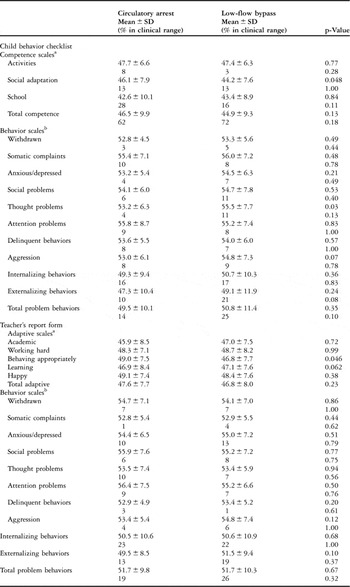
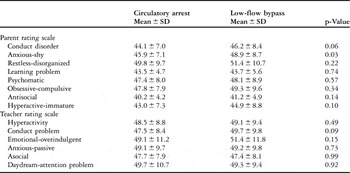
This hypothesis was not confirmed. Relatively few significant differences were found on either the Child Behavior Checklist/Teacher’s Report Form (Table 5) or on the Connors’ Parent/Teacher Rating Scales (Table 6) relating to the mode of treatment. Moreover, while the direction of the differences noted was consistent, it was contrary to the hypothesis. The behavior of those receiving low-flow was rated as worse than the behavior of the group undergoing circulatory arrest, with significant differences between the groups more frequent in the ratings of the parents than the teachers. No significant differences were found in the frequencies of scores in the range of clinical concern on the Child Behavior Checklist or the Teacher’s Report Form.
Scores on Child Behavior Checklist and Teacher’s Report Forms, according to mode of treatment.

aA higher score is better.
bA lower score is better.
T Scores on Connors’ Parent and Teacher Rating Scales, according to mode of treatment.

Third hypothesis: Longer duration of stay in the intensive care unit, and longer post-operative hospitalization, are risk factors for behavioural problems reported by parents and teachers
This hypothesis was partially confirmed. Neither length of stay in the intensive care unit, nor length of postoperative hospitalization, as the measured value or categorized by quartile, was significantly associated with scores on any scale of the Child Behavior Checklist. Both longer stay in the intensive care unit and longer hospitalization, as the measured value but not categorized by quartile, were significantly associated with worse scores on the Restless-Disorganized and Hyperactive-Immature scales of the Connors’ Parent Rating Scale. According to the ratings of the teachers, longer stay in the intensive care unit, the measured value, was significantly associated with Asocial score on the Connors’ Teacher Rating Scale, but not with the score on any Teacher’s Report Form scale. Length of hospitalization, in quartiles, was significantly associated with the scores for Internalizing Behaviors, Somatic Complaints, Social Problems, and Delinquent Behavior as reported by the teachers.
Fourth hypothesis: Behavioural problems are more frequent among children with signs of impairment of the central nervous system
This hypothesis was confirmed. The occurrence of postoperative clinical seizures was significantly associated with Social Problems and Attention Problems on the Child Behavior Checklist. The occurrence of seizures detected using continuous video electroencephalographic monitoring was significantly associated with School and Social Problems on the Child Behavior Checklist, and with Academic Performance on the Teacher’s Report Form. Intelligence quotient, measured at 4 and 8 years of age, was significantly associated with almost all of the Adaptive and Behavior ratings assigned by teachers on the Teacher’s Report Form and the Connors’ Teacher Rating Scale. This was not true to the same extent in the ratings of the parents, although associations were evident for 3 of the 4 scales for Competence, and the Social Problems, and Attention Problems of the Child Behavior Checklist, as well as the Restless-Disorganized, and Learning Problem scores on the Connors’ Parent Rating Scale. In terms of parental ratings, an abnormal neurological examination at the age of 4 was significantly associated only with the School scale on the Child Behavior Checklist, and an abnormal examination at the age of 8 was not significantly associated with any scores. In contrast, an abnormal neurological examination at either age was significantly associated with many of the ratings of the teachers. On the Teacher’s Report Form, these were Academic Performance, Working Hard, Learning, Happy, Total Adaptive, Internalizing Behaviors, Total Problem Behaviors, Withdrawn, Social Problems, and Attention Problems. On the Connors’ Teacher Rating Scale, these were Hyperactivity, Anxious-Passive, and Daydream/Attention Problem.
Fifth hypothesis: The likelihood that behaviour of the child is rated as more problematic by the parent at the age of 8 than 4 is greater among children judged by the teacher to be experiencing academic problems in school at the age of 8
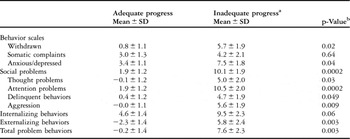
This hypothesis was confirmed. Among children judged to be making adequate progress, the change in mean scores on the Behavior scales of the Child Behavior Checklist ranged from −2.3 to 4.6 points (Table 7). In contrast, the change in mean scores among children making inadequate progress were all positive, meaning movement towards less optimal behavior, and ranged from 4.2 to 10.5 points. The differences between the groups in change scores were significant for all but two scales. The scales on which scores increased the most were Social Problems and Attention Problems. For both, the change corresponded to an increase of approximately one standard deviation.
Change in T Score on Child Behavior Checklist between ages 4 and 8, according to teacher-rated academic progress.

a“Inadequate progress” defined as a Total Adaptive T score in the lowest quartile (<41).
bp-value for t-test comparing the mean change scores for children making “adequate” and “inadequate” academic progress.
Sixth hypothesis: The likelihood that a child has behavioural problems at the age of 8 varies depending on parental and familial characteristics, such as stress, depression, or cohesion, as measured when the child was 4 years old
This hypothesis was generally confirmed. Parental ratings on all scales of the Parenting Stress Index at age 4 were significantly associated with the ratings assigned to the child on at least one and, in most cases, several Child Behavior Checklist Behavior scales at age 8. Only Social Problems was not significantly associated with scores on any of the Parenting Stress Index scales. A similar pattern was evident for ratings of child behaviour on the Connors’ Parent Rating Scale. Only the Learning scale was not significantly associated with the score on at least one scale. At neither 4 nor 8 years was the Balance score on the Family Adaptability and Cohesion Evaluation Scales significantly associated with any parental behavioural rating.
The pattern of widespread associations between self-reported parenting and life stress by the parents, and the ratings they assigned to the behaviour of their children, suggests that either these ratings reveal more about the parents than they do about the behaviour of the children, or they suggest a possible causal mechanism for the behaviour. To some extent, these competing hypotheses can be evaluated by determining whether the ratings of the teachers for behaviour at age 8 are also significantly associated with Parenting Stress Index and Social Readjustment Rating Scale scores at age 4. Some associations, in fact, were found between parental characteristics at age 4 and ratings of the teachers at age 8, although they were considerably fewer in number than were found between parental characteristics and parental ratings. The ratings of the teachers on the Anxious/Passive scale of the Connors’ Teacher Rating Scale were associated with the Depression, Restriction of Role, and Spouse scales of the Parenting Stress Index, as well as family stress at age 4, and balance score at age 4, on the Family Adaptability and Cohesion Evaluation Scales. Similarly, the Balance score at age 4 was significantly associated with all of the Adaptive Competence scores on the Teacher’s Report Form at age 8, except for Behaving Appropriately and Happy.
Discussion
We found that most children who undergo reparative surgery for a congenitally malformed heart achieve good psychosocial adjustment. Our cohort did differ from the general population, however, in the realm of adaptive functioning. By parental report, at 8 years of age, 1 in 4 of the children was functioning in the borderline/clinical range on an index that integrated activities, social relationships, and school performance. Ratings given by the teachers for the children were consistent in this regard. In contrast to some previous studies,Reference Oates, Turnbull and Simpson5, Reference Spurkland, Bjornstad and Lindberg17 elevated scores on “internalizing” and “externalizing” behaviours were equally common on both the Child Behavior Checklist completed by parents, at 16% and 15%, respectively, and Teacher’s Report Form completed by teachers, at 22% and 16%, respectively. These percentages are similar to the figures of 23% (Internalizing) and 20% (Externalizing) reported by Ellerbeck et al.Reference Ellerbeck, Smith and Holden8 for Child Behavior Checklist ratings of children with transposition who had also undergone the arterial switch operation. Both parents and teachers identified attention as a challenge for the children. As in other studies,Reference Spijkerboer, Utens, Bogers, Verhulst and Helbing9, Reference DeMaso, Beardslee and Silbert20 we found that children providing evidence of impairment of their central nervous systems, for example those suffering ictal activity in the early post-operative period, those with lower intelligence quotients, and those with abnormal neurological findings at 4 or 8 years of age, were rated, particularly by teachers, as having greater behavioural problems. Moreover, children who were currently experiencing difficulties at school at the age of 8 showed a greater shift toward more disordered behaviour between the ages of 4 and 8 than did children who were not currently experiencing difficulties at school. As has been reported previously,Reference DeMaso, Campis and Wypij14, Reference Spurkland, Bjornstad and Lindberg17 we noted many associations between the ratings of the behaviour of the children and scores on instruments that measure family characteristics, including the Parenting Stress Index and a life events inventory. Such characteristics tended to be associated more strongly with parental ratings of behaviour than with those provided by the teachers, suggesting that the parental perceptions of their children might have been coloured by family dynamics, or that the behaviour of the child might have affected family characteristics. Our findings that the ratings by the teachers of some behaviours at the age of 8 were associated with parental responses to questionnaires at the age of 4 is consistent with a causal association between early family dynamics and later behaviour of the child. We cannot exclude, however, the possibility that behaviour of the child prior to the age of 4 was already affecting family dynamics.
Previous studies of the changes in Child Behavior Checklist and Teacher’s Report Form scores over time, as well as studies of their predictive validity, enable us to evaluate the long-term implications of the psychosocial vulnerabilities we found in our cohort. In a 14-year follow-up of a random sample of the general population of 4 to 16 year olds, two-fifths of children who were considered to be deviant upon initial assessment were still considered to be deviant according to their scores on the Young Adult Behavior Checklist.Reference Hofstra, Van der Ende and Verhulst37 The form in which deviance is expressed is highly stable.Reference Mattison and Spitznagel38 For outcomes such as referral to mental health services, referral to special education services, and contacts with police, the ratings of the teachers are consistently more predictive than are parental ratings.Reference Verhulst, Koot and Van der Ende39 The Child Behavior Checklist and Teacher’s Report Form scales that are generally most predictive of later adjustment difficulties are Attention Problems, Delinquent Behavior, and Aggression (Child Behavior Checklist) and Somatic Complaints, Social Problems, and Delinquent Behavior (Teacher’s Report Form).Reference Hofstra, Van der Ende and Verhulst37, Reference Verhulst, Koot and Van der Ende39, Reference Stanger, Achenbach and McConaughy40
Children assigned to low-flow bypass were assigned worse ratings on the externalizing behaviors sections on the Child Behavior Checklist and Teacher’s Report Form than were children assigned to circulatory arrest. This is consistent with our finding of greater problems with attention and impulse control in this group on a continuous performance test at age 8.Reference Bellinger, Wypij and duPlessis25 The aetiology of this difference in attention and activity is unclear, but the presence of this finding may partially account for the general absence of differences between the groups in academic success at the age of 8 years.Reference Bellinger, Wypij and duPlessis25 Children undergoing circulatory arrest had worse motor and speech performance, but better attention and behaviour, which may partially offset each other and result in similar academic performance in the two groups.
There are several limitations to our study. First, no measures are available of family function prior to the surgical intervention, which occurred in all cases within 3 months of birth of the child and, for most, within two weeks. Because our first contact with these families was during the relatively short interval between diagnosis and surgery, we did not consider that data collected during such an extremely stressful time would be reliable. Second, self-report data by the children was not collected, only estimates by adults of the well-being of the children. Few self-report instruments are available for children as young as 8, reflecting the assumption that self-reports of behaviour and internal states are likely to be unreliable at this age. Third, our study did not include a formal control group. Although this did not affect the validity of our comparisons of the modes of treatment, it is relevant to our inferences regarding the behavioural health of the patients as a group. At the beginning of this clinical trial, approximately one-quarter of all arterial switch operations in the United States were being performed in our centre, and patients travelled to us from all over the country. The most appropriate control group seemed to be the national standardization samples of the tests administered, since these samples are large, and representative of the national population from which our patients were drawn. Fourth, although we evaluated general hypotheses, we did not have specific hypotheses about the likely nature of any behavioural differences we might find. In light of this exploratory nature of the analyses, we conducted many statistical tests, and did not adjust for multiple comparisons. Some of the differences we found might be due to chance. Fifth, there have been many changes in the conduct of bypass since our population underwent surgery, including improved hardware designed specifically for infants and neonates, a decrease in priming volume, development of low prime arterial filters that are now used routinely, as well as changes in strategies for control of the haematocrit and pH. Thus the relevance of our findings to the long-term outcomes of contemporary neonates undergoing surgery for transposition is unknown. Our findings are relevant, however, to the large population of contemporary children and adolescents who underwent surgery as neonates to correct a congenitally malformed heart. Finally, detailed assessments were not made of the parental psychiatric history or current functioning, which could have affected how they completed questionnaires about the behaviour of their child.
In summary, we found that children who underwent early surgery to correct transposition between 1988 and 1992 had an increased prevalence of behavioural problems at the age of 8, as assessed by the reports of both parents and teachers. Few differences, however, were found between those assigned to circulatory arrest as opposed to low-flow bypass. Despite some inconsistencies between the ratings of the parents and the teachers, postoperative clinical and electroencephalographic seizures, abnormalities on neurological examination, and low intelligence quotient predicted worse scores on Competence and Adaptive scales, and on social skills and attention. Parental ratings suggested that the behaviour of children with academic problems at the age of 8 years identified by their teachers became worse between the ages of 4 and 8, while the behaviour of children making adequate academic progress remained largely the same. The increased risk of behavioural problems among children with congenitally malformed hearts suggests that primary providers and specialists who care for these patients should be alert for signs of developing difficulties, so that appropriate and timely interventions can be implemented.