Even though the great majority of the biomass and diversity of mammals in tropical forests inhabit the canopy (Eisenberg & Thorington Reference EISENBERG and THORINGTON1973), most knowledge of this group is based on forest-floor samples (Lowman & Moffett Reference LOWMAN and MOFFETT1993). Studies that include trapping efforts in the canopy are becoming increasingly common (Grelle Reference GRELLE2003, Lambert et al. Reference LAMBERT, MALCOLM and ZIMMERMAN2005, Malcolm Reference MALCOLM and Lowman1995, Patton et al. Reference PATTON, DA SILVA and MALCOLM2000, Vieira & Monteiro-Filho Reference VIEIRA and MONTEIRO-FILHO2003, Voss et al. Reference VOSS, LUNDE and SIMMONS2001), but aspects on the ecology of arboreal small mammals still remain poorly understood. Many species of non-flying mammals co-occur in the canopy and, thus, are expected to use niche dimensions differently to permit coexistence (Cameron et al. Reference CAMERON, KINCAID and CARNES1979). Despite the difficulties of access to and in understanding the three-dimensional use of the arboreal strata by the different species (Emmons Reference EMMONS and Lowman1995), some studies have demonstrated that the differential use of the habitat (Cunha & Vieira Reference CUNHA and VIEIRA2002, Gentile & Fernandez Reference GENTILE and FERNANDEZ1999), of food items (Cáceres et al. Reference CÁCERES, GHIZONI-JÚNIOR and GRAIPEL2002, Santori et al. Reference SANTORI, ASTUA DEMORAES and CERQUEIRA1995) or both (Leite et al. Reference LEITE, COSTA and STALLINGS1996, Mauffrey & Catzeflis Reference MAUFFREY and CATZEFLIS2003), include strategies involved in the division of resources.
Few studies in Brazil have shown the importance of the activity period on the division of the niche (Graipel et al. Reference GRAIPEL, MILLER and GLOCK2003). However, the time of activity may be one of the most relevant strategies for the coexistence of species (Schoener Reference SCHOENER1974). Knowledge of circadian activities of small mammals is normally granted by means of simple classifications, such as those of diurnal and nocturnal activity patterns (Olmos Reference OLMOS1991). The objectives of this study were (1) to describe the period of activity of the white-eared opossum (Didelphis albiventris), the long-furred woolly mouse opossum (Micoureus paraguayanus), and the lesser Wilfred's mouse (Juliomys pictipes), which occupied the arboreal strata of the Atlantic Forest; (2) to analyse the strategies in the partitioning of resources among D. albiventris and M. paraguayanus; and (3) to discuss the innovative use of camera-traps directed to suspended platforms in studies about the activity of arboreal and scansorial species.
The study was carried out in the Serra do Tabuleiro State Park (STSP) in the State of Santa Catarina, in southern Brazil (27°40′S, 48°49′W). The predominant climate of the region is mesothermal humid, with annual temperature average of 19 °C. The mean annual rainfall is 1600 mm, the wettest month being February (270 mm), and the driest, June (68 mm). The camera-traps and platforms were installed in two physiognomically distinct areas of the Atlantic Forest, one in dense ombrophilous forest and the other in coastal sand-plain forest (Klein Reference KLEIN1981). The ombrophilous forest was located in the municipality of Santo Amaro da Imperatriz, northern region of the STSP, at 200 m asl. Its vegetation was in an advanced stage of regeneration (logging stopped 60 y ago), with its canopy at 20 m. The coastal sand-plain forest was located in the municipality of Palhoça, on the eastern sector of the STSP. This coastal forest is characterized by a canopy that varies around 5 m, with Psidium, Arecastrum, Cauna, Diodia as predominant tree genera, and a dense shrub understorey composed mainly of species of Cordia, Clusia, Miconia and Tibouchina. During the study period, local sunrise was from 06h15 to 07h00 and local sunset from 17h30 to 18h30.
Eight suspended platforms were built and used from March to June 2005: three in the dense ombrophilous forest and five in the coastal sand-plain forest. The platforms were 200–1000 m apart from each other, to reduce the probability of recording the same individual at two platforms. The platform comprised a rectangular wooden platform of 35 × 25 × 2 cm and supported by two 30-cm-long poles that were nailed to the trunk between 3–6 m from the ground. Two camera-traps (Tigrinus®) in the coastal sand-plain forest and one in the dense ombrophilous forest were used. The camera-traps were switched to different platforms weekly, to minimize conditioning of the animals to the attractiveness of the bait and to increase the probability of another individual being photographed. As such, each station was only re-sampled at 11–21-d intervals. The camera-trap was fixed to an adjacent tree (about 1 m away from the platform) and fastened with a tie-down rubber strap to the trunk. It was then directed to the wooden platform. The camera-trap was positioned 20 cm above the platform and adjusted with a branch, as necessary. Each trap was programmed to work 24 h per day and to take shots at minimum intervals of 30 min each. The camera was programmed to record date and time of each photograph.
Banana slices with peanut butter were set on top of the platforms as bait and replaced weekly. Since the bait was totally consumed in between the third and fourth day of the week throughout the whole experiment, only the first four days were thus considered as the effective weekly effort.
Additional data on D. albiventris, from a study conducted from March to June 2006, which monitored 14 trapping stations with camera-traps on the coastal sand-plain forest floor, were used. Identification of species was based on the photographic records and on the knowledge of species, gained in previous capture-mark-recapture studies of small mammals on the floor and canopy of both areas.
Photographs of the same species on each capturing station with a minimal time-lapse of 1 h were considered independent records, and the number of records made every hour of the day was regarded as an index of activity (Gómez et al. Reference GÓMEZ, WALLACE, AYALA and TEJADA2005). The period of activity was only analysed for those species with more than 26 independent records. For the analysis of the circadian activity patterns, circular statistics of the ORIANA 2.0 program was adopted. To compare the activity pattern of D. albiventris and M. paraguayanus in the canopy, or to compare the activity pattern of D. albiventris on the floor to that of the canopy, the Watson's test was used (Zar Reference ZAR1996). Watson's test is a non-parametric test that verified differences on the distribution of two data groups measured in a circular scale, such as circadian activity. A robust alternative approach could use the camera station as the replicate unit, to avoid pseudoreplication from individuals. This approach was not used because of the small sample size. However, our unpublished results with live-traps indicated that 10–25 individuals of M. paraguayanus and 10–20 individuals of D. albiventris could be photographed in the coastal sand-plain forest.
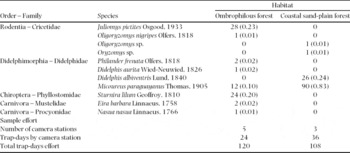
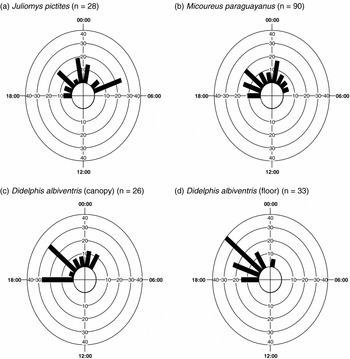
We recorded eight species in the dense ombrophilous forest and four species in the coastal sand-plain forest (Table 1). Furthermore, in an effort of 480 traps-days on the coastal sand-plain forest floor, only D. albiventris were recorded (33 records). All recordings, except that of N. nasua (16h59), were made from 18h00 to 06h00. Micoureus paraguayanus, D. albiventris and J. pictipes presented a strict nocturnal unimodal circadian activity pattern (Figure 1). Juliomys pictipes presented constant nocturnal activity (Figure 1a), whereas M. paraguayanus and D. albiventris had their peak activity after sunset (18h00), with gradual slowdown through the night (Figure 1b, c). There were no significant differences between the activity patterns of M. paraguayanus and D. albiventris (U = 0.032, P = 0.57) in the canopy, nor between the activities of D. albiventris in the canopy and on the floor (U = 0.043, P = 0.32) (Figure 1c, d).
Number of species captures, trapping efficiency in captures per trap-day (in parentheses) and sample effort by habitat.

Activity pattern of small mammals in the canopy of the dense ombrophilous forest (a) and in the canopy (b, c) and floor (d) of the coastal sand-plain forest. The bars indicate the proportion of recordings (%) made each hour of the day. n = the number of independent records.

The main differences in the richness and species composition between the two studied areas are likely due to the differences in the complexity and heterogeneity of the habitat. The ombrophilous forest is a mature rain forest, presenting high richness of small mammals and some medium carnivores. In contrast, the coastal forest presents a less complex and heterogeneous habitat, not supporting a high richness of small mammals or medium carnivores (Vieira & Monteiro-Filho Reference VIEIRA and MONTEIRO-FILHO2003).
Micoureus paraguayanus and J. pictipes have arboreal habits and D. albiventris is considered scansorial (Fonseca et al. Reference FONSECA, HERRMANN, LEITE, MITTERMEIER, RYLANDS and PATTON1996). Didelphis albiventris has nocturnal-crepuscular habits (Rossi et al. Reference ROSSI, BIANCONI, PEDRO, Reis, Peracchi, Pedro and Lima2006), and studies with D. marsupialis in captivity (McManus Reference MCMANUS1971) and with D. aurita (Cáceres & Monteiro-Filho Reference CÁCERES and MONTEIRO-FILHO2001) corroborate that most activity occurs in the early hours of the night. Micoureus paraguayanus is considered nocturnal (Emmons Reference EMMONS1997), and J. pictipes presented nocturnal activity in the STSP. Activity pattern of small mammals are shaped by intrinsic (endogenous or evolutionary trait) or extrinsic factors (temperature, photoperiod, prey availability or predation risk) (Aschoff Reference ASCHOFF1966, Daan Reference DAAN and Aschoff1981). In this case, we believe the general nocturnal activity have been related to the evolutionary trait of arboreal small mammals (Aschoff Reference ASCHOFF1966, van Schaik & Griffiths Reference VAN SCHAIK and GRIFFITHS1996). However, the unimodal pattern observed in the three studied species could be likely stimulated by photoperiod. Indeed, in the case of the insectivorous marsupials studied, the concentrated activity after dusk could be related both to diminished predation risk and to synchronize activity with the activity of insect prey.
Micoureus paraguayanus and D. albiventris presented a similar arboreal habit and activity pattern in the coastal sand-plain forest. Micoureus paraguayanus (Cáceres et al. Reference CÁCERES, GHIZONI-JÚNIOR and GRAIPEL2002, Leite et al. Reference LEITE, COSTA and STALLINGS1996) and D. albiventris (Rossi et al. Reference ROSSI, BIANCONI, PEDRO, Reis, Peracchi, Pedro and Lima2006) have an opportunistic insectivorous-omnivorous diet and both species search for nesting sites and shelters in the canopy (Delciellos et al. Reference DELCIELLOS, LORETTO and VIEIRA2006, Moraes-Júnior & Chiarello Reference MORAES-JÚNIOR and CHIARELLO2005). Despite similarity in the activity patterns of both marsupials in the arboreal strata of the STSP, D. albiventris was also recorded on the floor, whereas we never recorded M. paraguayanus in this stratum. However, some authors have reported M. paraguayanus as occurring on the floor, mostly in the driest months, when there is less availability of fruits in the canopy (Cáceres et al. Reference CÁCERES, GHIZONI-JÚNIOR and GRAIPEL2002). In the Amazonia Forest, M. demererae was captured mainly in the understorey and canopy, while D. marsupialis was captured equally on the floor, understorey and canopy (Lambert et al. Reference LAMBERT, MALCOLM and ZIMMERMAN2005). Similar results were found by Grelle (Reference GRELLE2003) and Vieira & Monteiro-Filho (Reference VIEIRA and MONTEIRO-FILHO2003) that captured D. aurita mainly on the floor and M. paraguayanus was sampled mainly at 2–12 m height in the Atlantic Rain Forest.
A differentiated pattern of strata use has been also shown with syntopic rodents in Amazonia (Mauffrey & Catzeflis Reference MAUFFREY and CATZEFLIS2003) and with similar-sized marsupials and rodents in the Atlantic Rain Forest (Vieira & Monteiro-Filho Reference VIEIRA and MONTEIRO-FILHO2003). Other studies suggested that the body mass of South American marsupials is a limiting factor in allowing arboreal movements (Cunha & Vieira Reference CUNHA and VIEIRA2002, Delciellos & Vieira Reference DELCIELLOS and VIEIRA2006). Therefore species of arboreal small mammals, such as Micoureus spp. and Juliomys spp., have lower body mass than scansorial species, such as Didelphis spp. (Fonseca et al. Reference FONSECA, HERRMANN, LEITE, MITTERMEIER, RYLANDS and PATTON1996). Differences in the spatial use of the strata, reported in the present study, and in the size of the consumed items, normally associated with the difference in body size of D. albiventris (500–2750 g) and M. paraguayanus (58–132 g) (Rossi et al. Reference ROSSI, BIANCONI, PEDRO, Reis, Peracchi, Pedro and Lima2006), seem to be one of the most important strategies in the resource partitioning between these marsupials (Vieira Reference VIEIRA, Cáceres and Monteiro–Filho2006, Vieira & Monteiro-Filho Reference VIEIRA and MONTEIRO-FILHO2003).
The majority of studies with camera-traps have dealt with the activity period of ground-dwelling animals (Gómez et al. Reference GÓMEZ, WALLACE, AYALA and TEJADA2005) or with population estimation of species with natural markings (e.g. felines) (Karanth & Nichols Reference KARANTH and NICHOLS1998). However, few studies used camera-traps in the arboreal strata. Otani (Reference OTANI2001) installed camera-traps in the canopy to measure fig consumption by primates, while Hirakawa (Reference HIRAKAWA2005) tested the use of an artificial attraction for bats. Studies of the activity of small mammals are normally carried out with live-traps. This methodology, when directed at the study of activity patterns, demands constant checking of the traps, which can alter the activities of animals (Bruseo & Barry Reference BRUSEO and BARRY1995). When trap-checks are not made, a mathematical correction is proposed in order to correct the gradual reduction of capturability throughout the day (Graipel et al. Reference GRAIPEL, MILLER and GLOCK2003). After each capture, there is a decrease in capture probability, due to the reduction of available traps and of individuals to be captured. Studies with biased activity data, without repeated trap checks, may confound the interpretation of activity and the capture rates through time, without any form of correction (Bruseo & Barry Reference BRUSEO and BARRY1995).
With the use of camera-traps, checks and corrections are not necessary, manipulation of the animal is avoided, species are not selected by live-trap size, monitoring is performed throughout the time of the study and many species and individuals can be recorded by the same trap during a sampling period. On the other hand, for the majority of small mammals, species identification may be difficult if not preceded by a study involving animal capture. Furthermore, neither body and age variation nor sex or reproductive conditions can be recorded. Additionally, the bait might induce a potential bias, as it increases the feeding time on the platform. In this case, a sampling design that included many platforms, short continuous sampling period in each platform and long intervals between sampling period in each platform, should decrease this bias effect. Finally, results presented here suggest that the use of this innovative technique with platforms at several heights may be a feasible way to understand the temporal and spatial use of arboreal strata by the different species.
ACKNOWLEDGEMENTS
We thank F. Bruggerman and T. T. Moreira for logistic support and cooperation in the field, P. G. Crawshaw Jr. and C. A. Zucco for commentaries on this manuscript.