1. INTRODUCTION
This paper arises out of research comparing wayfinding in environmental space with information-seeking in paper documents and on-screen. A key component in the research approach is the formulation of a taxonomy that sorts behaviours into categories that are equally applicable to environmental space, paper documents and on screen. Despite being applicable to all three of these contexts, here the taxonomy is discussed only in relation to environmental space. As the taxonomy is applicable to all three contexts, this paper makes reference to research from all three contexts; and because the research is intended to also inform information design practice, it references practice literature from that discipline.
The taxonomy and user studies discussed in this paper form a significant portion of the author's doctoral research. Space constraints here substantially limit descriptions and explanations: greater contextualisation and explanation can be found the author's doctoral thesis (Barker, Reference Barker2018).
Before proceeding, it is necessary to define some key terms.
1.1. What is meant by ‘wayfinding’?
For the purposes here, ‘wayfinding’ is defined as the continuous, recursive series of choices made when an individual purposefully seeks and progresses towards a defined objective. The process is taken to be constructive, dynamic, responsive and interactive. This definition is indebted to those in Gomez et al. (Reference Gomez, Rousset and Baciu2009), Conroy (Reference Conroy2001), Brown (Reference Brown2003), Allen (Reference Allen and Golledge1999), Golledge (Reference Golledge and Golledge1999), Miller and Lewis (Reference Miller and Lewis1999), Carlson (Reference Carlson1997), Pressley and Afflerbach (Reference Pressley and Afflerbach1995) and Passini (Reference Passini1984). Readers may be more familiar with the term ‘navigation’: broadly, navigation and wayfinding are interchangeable; but some authors (such as Golledge, Reference Golledge and Golledge1999: P. 6–8) explicitly define navigation as different to wayfinding. In this paper, wayfinding is used to mark the ways in which the concerns of this paper differ from those that may be encompassed by navigation. Wayfinding here is largely comparable with navigation in that both are purposeful and have an objective, but it differs from navigation in three critical aspects. First, this taxonomy addresses occasions when the individual is traversing an environment or aiming for an objective with which they are unfamiliar. This unfamiliarity is key in this paper as it is central to the concerns of the information designer who designs wayfinding systems (such systems are typically designed to mitigate the user's unfamiliarity with the environment). Navigation does not necessarily focus on this issue. Second, processes of self-monitoring are not addressed: these include monitoring environment, orientation, location and the effectiveness of a course of action. For the purposes here, this monitoring is assumed: an activity that is separate from but entwined with wayfinding (and customarily included within definitions of navigation). Third, wayfinding is examined here within the setting of everyday life. In contrast, navigation is often considered within the context of professional activity, and while that may be part of an individual's everyday life, the focus here is not on practice or conduct within a particular profession.
1.2. What is meant by ‘behaviour’?
The term behaviour is used here in much the sense that it is used in ‘behavioural sciences’. Behaviour is split into three dimensions by Carliner (Reference Carliner, Albers and Mazur2003. P. 45): physical, intellectual (cognitive) and emotional (affective). The taxonomy discussed here is concerned principally with the first of these three: with observable physical actions in a person–environment interaction. Putting more detail into this, the person in this interaction is characterised as an individual human with a physical body that includes a mind, and with a configuration of sensory modalities (such as sight, hearing, touch, balance and smell) and a more or less idiosyncratic set of habits, preferences, and experiences; this individual is wayfinding for some particular purpose. The environment, or the space within which their actions occur, is characterised as having particular material, technical, sensory and ergonomic affordances. This framing of wayfinding behaviour is inspired by the conception of reading as a human–technology interaction in Mangen (Reference Mangen, Black, Luna, Lund and Walker2017. P. 278).
It is possible to examine behaviour at a variety of scales. Four scales of behaviour were proposed by Marchionini (Reference Marchionini1995. P. 72–74), although formulated for information seeking in electronic environments, these readily serve our purposes here. From largest to smallest, Marchionini's scales of behaviour are:
• Patterns (groups of strategies or tactics which a person applies to a particular category of problem)
• Strategies (the approach a person takes to a particular problem, ‘sets of tactics’)
• Tactics (‘discrete intellectual choices’)
• Moves (discrete actions such as clicking a mouse or walking to a shelf)
These have fuzzy boundaries, but provide a useful means for thinking about scales of behaviour. Research examining wayfinding behaviour spans this entire range of scales but is predominantly larger-scale, while this paper examines behaviour at the smaller ‘tactic’ scale.
1.3. What is meant by ‘environmental space’?
In terms of ‘environmental space’, the focus of this paper is environments in which man's intervention is apparent, although such an intervention can be as little as a signpost or a track in what might otherwise be regarded as a wilderness.
2. WAYFINDING BEHAVIOUR RESEARCH
Spatial behaviour is extensively studied across many disciplines. Much of that research is concerned with learning an environment or executing tasks within a known environment: these do not contribute directly to understanding wayfinding behaviour in unfamiliar environments. Studies that do consider wayfinding in unfamiliar environments take a variety of approaches, one of which is the formulation of a taxonomy of wayfinding behaviours, and there are numerous such taxonomies. Many of these are limited in their contribution here due to issues of scale and scope: the scale of behaviours is often larger than that employed here; and the scope is wider, narrower, or simply not the same as that defined here. This applies to the taxonomies by Webber et al. (Reference Webber, Burnett and Morley2012), Morville and Callender (Reference Morville and Callender2010. P. 52–51), Afflerbach and Cho (Reference Afflerbach, Cho, Israel and Duffy2009), Gibson (Reference Gibson2009), Ferrara (Reference Ferrara2008), Smitshuijzen (Reference Smitshuijzen2007), Juvina and Van Oostendorp (Reference Juvina and Van Oostendorp2006), Spencer (Reference Spencer2006), Kallai et al. (Reference Kallai, Makany, Karadi and Jacobs2005), Guinee et al. (Reference Guinee, Eagleton and Hall2003), Kato and Takeuchi (Reference Kato and Takeuchi2003), Roy and Chi (Reference Roy and Chi2003), Choo et al. (Reference Choo, Detlor and Turnbull2000), Adler et al. (Reference Adler, Gujar, Harrison, O'Hara and Sellen1998), Schriver (Reference Schriver1997. P. 290–291), Pressley and Afflerbach (Reference Pressley and Afflerbach1995), Pejtersen (Reference Pejtersen1984) and Pugh (Reference Pugh, Kolers, Wrolstad and Bouma1979).
Five taxonomies match the scope here: those of Cromley and Azevedo (Reference Cromley and Azevedo2008. P. 298–299), Kalbach (Reference Kalbach2007. P. 54–82), Mollerup (Reference Mollerup2005), Weisman (Reference Weisman, Regnier and Pynoos1987) and Passini (Reference Passini1981). Of these, the first two are from web design practice literature, the third and fourth are from wayfinding design practice literature and the fifth is from wayfinding research. All have fed into the taxonomy reported here through examination of their categories and definitions. In most cases, individual categories in their taxonomies map onto categories in this taxonomy, although none of these taxonomies cover all of the categories herein. Space limitations constrain detailed comparison of these taxonomies and the one presented here. Mollerup (Reference Mollerup2005) provides the most conspicuous influence and is the most obviously comparable with this taxonomy. Most of his categories of behaviour have a 1:1 relationship with the categories in this work, but the taxonomy reported here differs in its structured and systematic approach to differentiating categories of behaviour. The categories created by Passini (Reference Passini1981) are an exception: his categories are formulated on a basis that is quite different to that used here, which is not to say that either is right or wrong. This can be taken as a demonstration of the observation made by Bruner et al. (Reference Bruner, Goodnow and Austin1956. P. 7, 232) that category making does not reveal truth, but invents possible ways of grouping discriminably different things as if equivalent.
3. DEVELOPING THE TAXONOMY
The process of developing the taxonomy is too lengthy to describe in detail here, other than to note that it developed incrementally through many iterations, during which definitions were refined and behaviour categories added and modified. This was informed by three distinct parallel trains of thought. The first of these, as described above, was driven by a survey of comparable taxonomies and other relevant literature.
The second train of thought was driven by three user research studies examining wayfinding in everyday life. These were conducted consecutively during the development of the taxonomy. All three studies are exploratory, rather than testing an a priori hypothesis, and take place within everyday life settings. They each informed the taxonomy in two ways: first, during their design, by prompting thought experiments about how the taxonomy relates to the behaviours that the studies observe, and secondly, once the studies had taken place, by providing a body of data to analyse via the taxonomy, thereby testing its utility.
The third train of thought contributing to the development of the taxonomy drove the process by giving it visible form. A thorough and systematic approach to making the visual explanation served to identify weaknesses and inconsistencies in the thinking that underpins it.
4. THE TAXONOMY
4.1. Four questions to drive the taxonomy
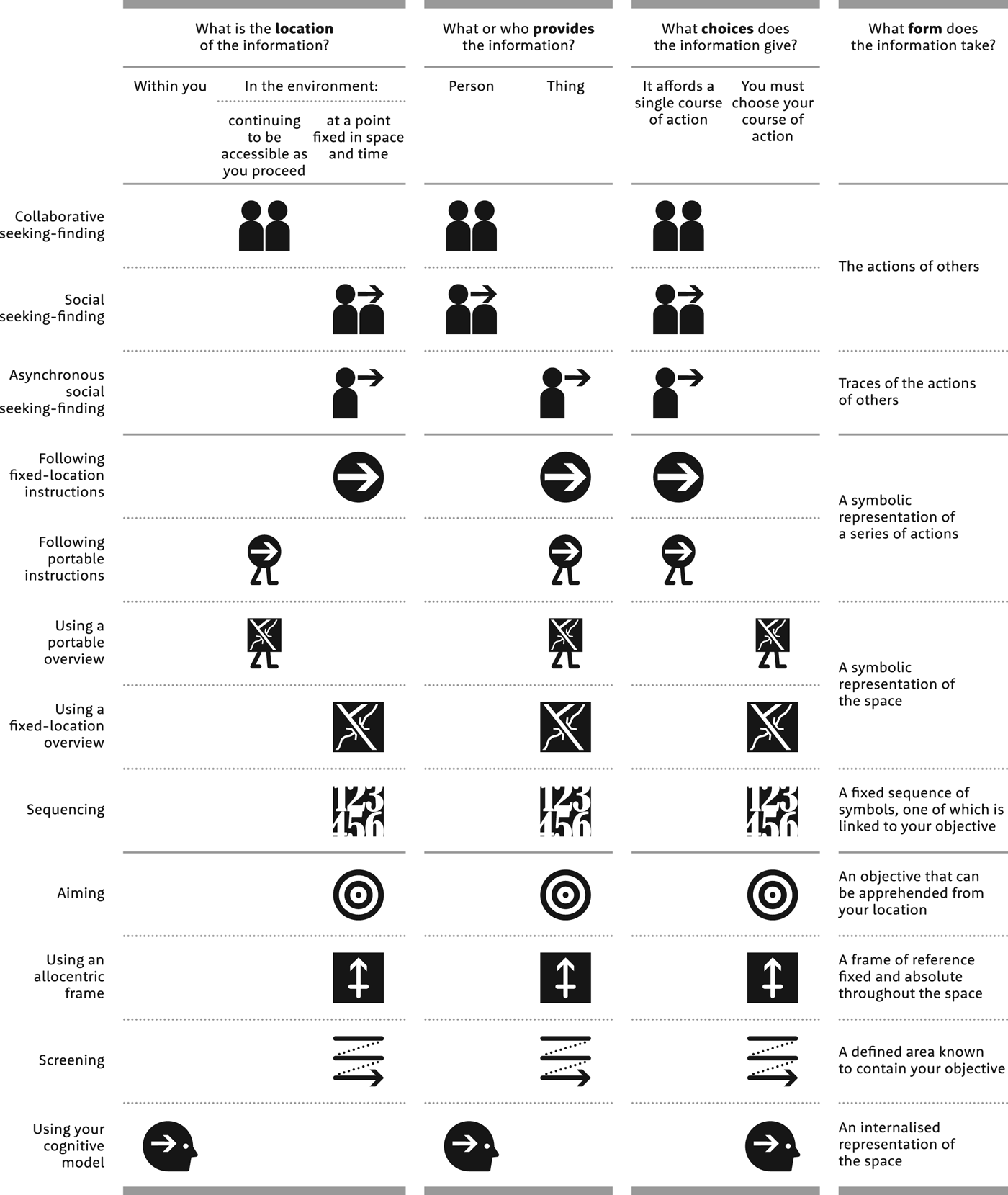
The categories of behaviour in this taxonomy are differentiated by characteristics of the information that they use. These differences are articulated through four questions about that information. Available information as a (possibly critical) behaviour-influencing factor in wayfinding, and behaviour more generally, is widely identified (for example, Norman, Reference Norman2013; Gibson, Reference Gibson2009; Mallot and Basten, Reference Mallot and Basten2009; Li, Reference Li2006; Montello and Sas, Reference Montello, Sas and Karwowski2006; RSSB, 2006; Mollerup, Reference Mollerup2005. P. 43; Casakin et al., Reference Casakin, Barkowsky, Klippel, Freksa, Freksa, Habel, Brauer and Wender2000; Miller and Lewis, Reference Miller and Lewis1999; Passini, Reference Passini1996. P. 322–326; Freksa, Reference Freksa, Gero and Tversky1999. P. 23; Goodman, Reference Goodman1993; Downs and Stea, Reference Downs and Stea1977. P. 67): ‘This leads one to view the information as being the important variable in determining wayfinding solutions’ (Passini, Reference Passini1981. P. 27). The four questions are:
• What is the location of the information?
– Within you
– In the environment: continuing to be accessible as you proceed
– In the environment: at a point fixed in space and time
• What or who provides the information?
– A person
– A thing
• What choices does the information give?
– It affords a single course of action
– You must choose your course of action
• What form does the information take?
– The actions of others
– Traces of the actions of others
– A symbolic representation of a series of actions
– A symbolic representation of the space
– A fixed sequence of symbols one of which is linked to your objective
– An objective that can be apprehended from your location
– A frame of reference fixed and absolute throughout the space
– A defined area known to contain the objective
– An internalised representation of the space
Figure 1 gives an overview of the taxonomy, showing how the twelve categories of behaviour relate to each other through the four questions.
Overview of the taxonomy showing the questions and their relationships to the categories of behaviour.

5. THE TWELVE CATEGORIES OF BEHAVIOUR, IN THREE GROUPS
The categories of behaviour in the taxonomy are sorted into three groups: social, semantic and spatial. These groupings derive from Dourish and Chalmers (Reference Dourish and Chalmers1994) and, although formulated for information seeking on screen, are readily adapted to other contexts. Dourish and Chalmers seek to define ‘social navigation’, and in the process do the same for behaviours that are not social: they characterise these as either ‘spatial’ or ‘semantic’. Social navigation happens when ‘movement from one item to another is provoked as an artefact of the activity of another or a group of others’ (Dourish and Chalmers, Reference Dourish and Chalmers1994. P. 1). All three behaviour groups are defined below. These distinctions between social, semantic and spatial characteristics of information sources are comparable to those made in a number of other studies. Semantic and spatial distinctions are made in Van Oostendorp and Juvina (Reference Van Oostendorp and Juvina2007), Juvina and van Oostendorp (2006), Waterworth (Reference Waterworth, Munro, Höök and Benyon1999. P. 136), Carlson (Reference Carlson1997. P. 246, citing Gauvain (Reference Gauvain1993), and Lave (Reference Lave1988)) and Bartram (Reference Bartram1980. P. 103, citing Welford (Reference Welford1968)). In addition, social, semantic, and spatial distinctions are made in Mallot and Basten (Reference Mallot and Basten2009) and Dogu and Erkip (Reference Dogu and Erkip2000, P. 736).
The social, semantic and spatial groups do not define categories of behaviour absolutely or exclusively. Each category of behaviour in the taxonomy has social, semantic and spatial characteristics, but the strength of each characteristic varies between categories. Each category of behaviour is placed in a group according to which characteristic is predominant in the information that drives the behaviour.
5.1. Social behaviours
Social behaviours rely on information derived from the actions of others. These actions may be witnessed directly or observed through the traces they leave. Arguably all information used in wayfinding activities is a consequence of the actions of others – how else did that map or direction sign come into existence other than through being the result of someone's actions? The key points with social behaviours are: first, whether the person providing the information is present at the time the information is received. If this is the case then the ‘socialness’ of the seeking-finding is established, and secondly, the question of agency: if the creator of the information is a non-expert or generates it in a way that is not planned – if it is accidental, ad hoc, amateur – then it is likely to count as social.
5.1.1. Collaborative seeking-finding
In this category of behaviour, the information is provided by a person who proceeds with you and with whom you interact in real time. The information takes the form of the actions of that person (including speech) and presents a single course of action. This category includes activities such as not only going out with friends but also following a tour guide.
5.1.2. Social seeking-finding
The information is provided by someone who you witness, in real time, at a point fixed in space and time. The information takes the form of the actions of that person (including speech) and presents a single course of action. This category of behaviour includes such things as asking a stranger for directions.
5.1.3 Asynchronous social seeking-finding
The carrier of the information is a thing rather than a person; the information takes the form of traces left by the actions of one or more persons and these traces are at a point fixed in space and time within the environment. The information presents a single course of action. This category of behaviour includes such things as following a foot-worn track across a common.
5.2. Semantic behaviours
Semantic behaviours are symbol-driven: they rely on using information that represents things, their conceptual organisation and their interrelation. This representation typically uses symbol systems (such as words, numbers or pictograms). These behaviours use symbols in three ways: representing a series of actions, representing the affordances of a space or in a fixed and known ordinal sequence with the objective associated with one symbol in that sequence. In the case of a symbolic representation of a space such as a map, one might wonder which takes priority: the space or the symbol system, raising the question of whether it is a spatial or semantic behaviour. Given that most symbol systems are inherently spatial (Fathulla, Reference Fathulla2008; Tversky, Reference Tversky, Freksa, Habel, Brauer and Wender2000), it can be hard to separate the two categories, but any behaviour that depends on symbolic representations is most likely to be in this group.
5.2.1. Following fixed-location instructions
The carrier of the information is a thing; the information takes the form of symbols representing a series of actions and it is at a point fixed in space and time within the environment. The information presents a single course of action. This category includes such things as following a direction sign, or announcements on public transport.
5.2.2. Following portable instructions
The carrier of the information is a thing; the information takes the form of symbols representing a series of actions and it continues to be accessible to you as you proceed on your way. The information presents a single course of action. This category includes such things as following spoken instructions on a satnav, or following the route marked on a paper map that you carry with you or following a line marked on the floor that guides you to your destination.
5.2.3. Using a portable overview
The carrier of the information is a thing; the information takes the form of symbols representing the affordances of the space within which you are wayfinding and it continues to be accessible to you as you proceed on your way. The information affords multiple possible courses of action and you must choose which to take. This category includes such things as using a map on your phone (with no route marked on it).
5.2.4. Using a fixed-location overview
The carrier of the information is a thing; the information takes the form of symbols representing the affordances of the space within which you are wayfinding and it is at a point fixed in space and time within the environment. The information affords multiple possible courses of action and you must choose which to take. This category includes such behaviours as using a you-are-here map attached to a wall to plan your route.
5.2.5. Sequencing
The carrier of the information is a thing; the information takes the form of a fixed, widely understood, ordinal sequence of symbols one of which is linked to your objective and it is at a point fixed in space and time within the environment. The information affords multiple possible courses of action and you must choose which to take. This category includes such things as using house numbers or room numbers to find the one you seek.
5.3. Spatial behaviours
Spatial behaviours rely on information integral to the physical manifestation of the space they take place in, and access to which is distributed throughout the space. This includes such things as landmarks and points of the compass.
5.3.1. Aiming
The carrier of the information is a thing; it takes the form of a marker that is distinct from its surroundings, and that can be apprehended from your location and used as an objective. This marker is at a point fixed in space within the environment. The information affords multiple possible courses of action and you must choose which to take. This category typically involves heading for a landmark such as the Eiffel Tower.
There are two subcategories to aiming. With direct aiming, the perceptible object is your objective. With indirect aiming, you know that the perceptible object is proximal to your objective (which cannot be apprehended from your location).
5.3.2. Using an allocentric frame
The carrier of the information is a thing; it takes the form of a frame of reference that is fixed and absolute throughout the space in which you are wayfinding (it is fixed in space within the environment). The information affords multiple possible courses of action and you must choose which to take. This category includes such behaviours as using the points of the compass (perhaps by checking the position of the sun in the sky), or looking for the stairs or lift because you know your destination is on the top floor of the building you are in.
5.3.3. Screening
The carrier of the information is a thing; it takes the form of a defined area believed to contain your objective (the defined area is fixed in space within the environment): you search this defined area according to a system. The information affords multiple possible courses of action and you must choose which to take.
There are three subcategories of screening: targeting, satisficing and optimising. With targeting screening, the search ends when the pre-defined objective is found, even if the defined area has not been completely searched. With satisficing screening, the search ends when a ‘good enough’ solution is found. With optimising screening, the search is comprehensive, and it ends when the defined area has been entirely searched; only then is the best solution selected from among those available.
This category includes such behaviours as checking the street name signs for the turnings off of the road that you are walking along until you find the street name that you require (targeting screening).
5.3.4. Using your cognitive model
The carrier of the information is you yourself: the information is within you and takes the form of an internal representation based on knowledge gained from previous actions within the world: a model of how the world is, and how it can be predicted to operate. The information affords multiple possible courses of action and you must choose which to take.
There are three subcategories of using your cognitive model: direct, indirect and theoretical. When you are using your direct cognitive model, your information comes from direct experience of the space. When you are using your indirect cognitive model, your information has been acquired without direct experience of the space – for instance, from a picture, map or description of the space. When you are using your theoretical cognitive model, your information derives from experience of other spaces of the same type.
This category includes such behaviours as knowing the route to a building because (i) you previously visited the building next door to it (using your direct cognitive model) or (ii) you studied a map before you set out (using your indirect cognitive model), or (iii) it is a ferry terminal so it must be at the harbour (using your theoretical cognitive model).
Throughout the rest of this paper, behaviour names are underscored, to help identify the terminology.
6. USING THE TAXONOMY IN A DIARY-KEEPING STUDY OF WAYFINDING BEHAVIOUR
The study discussed here is the third and final user study conducted during the development of the taxonomy described above. It is included here, to give background to the sort of user research that informed the taxonomy, and also to demonstrate using the taxonomy to investigate wayfinding behaviour in everyday life.
In this study, 12 participants, selected to give a broad range of age, ethnicity, educational level and family circumstances, each kept a diary of wayfinding behaviour in their everyday lives over the course of a month. Each time they travelled to a destination with which they were unfamiliar, they made a report of their behaviour using a questionnaire containing open and closed questions to identify the tactics they employed to find their way. This is part of a larger study that asked the same participants also to make similar records of the information-seeking they undertook on-screen and in paper documents. The author asserts that all procedures contributing to this work comply with the ethical standards of the relevant national and institutional committees on human experimentation and with the Helsinki Declaration of 1975, as revised in 2008.
The data from this study is too extensive to present here in full: the discussion below is a summary of some findings. In overview, what emerges is considerable diversity of behaviour: across the 12 participants no two show comparable patterns of behaviour in their reports.
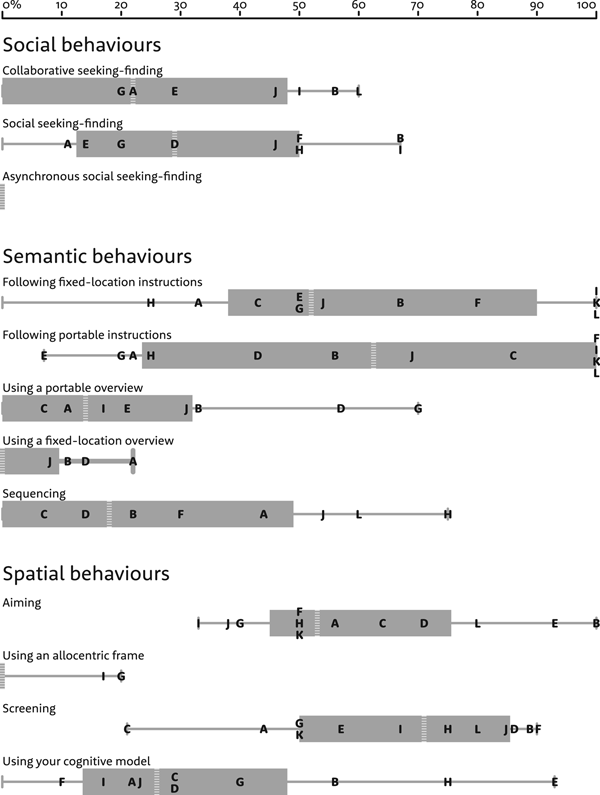
Figure 2 shows the proportion of each participant's reports that include each of the categories of behaviour (one journey by one participant = one report). Each of the participants is identified by a letter A–L, and these letters are positioned along percentage scales to show, for instance, that participant E included collaborative seeking-finding in 29% of her reports and social seeking-finding in 14% of them, and as with all other participants reported no asynchronous social seeking-finding. Box and whisker plots are superimposed to give overview to the distribution of individual participants in terms of the proportion of each participant's reports that include each of the categories of behaviour. The length of many of these plots demonstrates the considerable variation between participants in terms of the percentage of each participant's reports that include that category of behaviour.
Box and whisker plots showing the distribution of individual participants (identified by letters A–L) in terms of the proportions of their reports that include each of the categories of behaviour. One journey = one report. Where a participant did not report a behaviour (0%) they are not shown in this chart in order to avoid congestion at the left-hand edge of the chart, although they are included in the calculations. Participant C is not included in the data for social behaviours because of issues with her reporting of them.

Examining the relative proportions of each participant's reports that include each behaviour makes the point that different individuals show different patterns of reported behaviour. For instance, participants I, K and L included following fixed-location instructions and following portable instructions in all of their reports – a greater proportion than any other participants – but this is not the case for any other category of behaviour, nor are these three participants grouped together for any other category of behaviour.
Participants submitted variable quantities of reports, depending on how often in the course of the month their everyday life took them somewhere unfamiliar (range: 2–14 reports per participant, mean: 9). Reports also varied in the number of categories of behaviour they included (range: 1–8 behaviours per report, mean: 3·825). Much research into spatial behaviour examines single behaviours or isolates individual behaviours within a task. The study reported here suggests that in everyday life, people typically employ multiple behaviours during a single wayfinding task. This finding is likely to be (at least in part) a consequence of (i) examining behaviours at a scale smaller than is the case in much research into spatial behaviour, and (ii) the complexity of tasks in everyday life in comparison with those used in more controlled research settings (see Albers, Reference Albers2004; Albers and Mazur, Reference Albers and Mazur2003). This study suggests that executing single wayfinding tasks typically requires multiple information sources (and hence multiple categories of behaviour).
In addition to showing inter-individual variation, Figure 2 also shows that some categories of behaviour are more heavily reported than others.
6.1. Little-reported behaviours
The two behaviours that are included in the smallest proportions of reports are asynchronous social seeking-finding and using an allocentric frame. The former was not reported by any participant. This is not to say that it does not happen: it is included, for instance, in the taxonomy by Mollerup (Reference Mollerup2005. P. 67) as part of ‘social navigation’, which suggests that he is confident that it does happen. Also, data from another study conducted during the development of this taxonomy includes one report of this behaviour among 44 questionnaires, but gives no qualitative detail. The diary-keeping study discussed here includes examples of this behaviour from navigating in paper documents and on-screen.
Although not reported in this study, asynchronous social seeking-finding in wayfinding has been facilitated in recent years by mobile digital technology. This takes the form of people making location-specific content that is uploaded to websites to help themselves and others, at a later date, to find places and routes in environmental space (Huang and Gartner, Reference Huang and Gartner2009, Bilandzic et al., Reference Bilandzic, Foth and de Luca2008). This has been used to help, for instance, tourists choose itineraries (Cotfas, Reference Cotfas2011), pedestrians find routes (Andrade and Fatah gen. Schieck, 2015; Huang and Gartner, Reference Huang and Gartner2010), and to help people with disabilities to plan accessible routes (Prandi et al., Reference Prandi, Salomoni, Roccetti, Nisi and Nunes2016; Karimi et al., Reference Karimi, Dias, Pearlman and Zimmerman2014; Rice et al., Reference Rice, Curtin, Paez, Seitz and Qin2013). Surveys of crowdsourcing for wayfinding purposes can be found in Hirtle and Raubal (Reference Hirtle, Raubal, Raubal, Mark and Frank2013) and Hirtle (Reference Hirtle2011). For a general overview of using crowdsourcing for collection of geographic data see Lauriault and Mooney (Reference Lauriault and Mooney2014).
The other little-reported behaviour in this study was using an allocentric frame: it was reported by two participants (G and I). That both users of cardinal directions are male fulfils stereotypes (see Anacta and Schwering, Reference Anacta and Schwering2010). When asked about this behaviour in their exit interviews, several participants (male and female) observed that they had been sceptical that they used this behaviour at the start of the study, but on reflecting were surprised to recall instances when they had used it, but clearly few arose in the course of the study.
6.2 Heavily-reported behaviours
At the other end of the scale, the four most heavily-reported behaviours were those with medians above 50%: following fixed-location instructions, following portable instructions, aiming and screening. These are the only behaviours that at least half of the participants included in more than half of their reports.
Despite following fixed-location instructions being included in all of the reports from participants I, K and L, it was not included in any of the reports of participant D; the remaining participants were distributed between these extremes. The three participants who included this behaviour in all of their reports also included following portable instructions in all of their reports (in this they are joined by participant F). Despite this, and despite having similar distributions across the whole range, there was no similarity between these two behaviours in terms of how much they were reported by other individual participants. It is perhaps unsurprising that these behaviours were reported so heavily given that the former includes using direction signs and the latter includes using devices such as a satnav or wayfinding directions on a mobile phone.
In comparison with the two behaviours above, the other two heavily reported behaviours – aiming and screening – both span smaller ranges (between the participants who included the behaviour in the smallest and greatest proportions of reports). That said, they each spanned over 60 percentage points, so there is still considerable inter-individual variation in the proportion of reports including these behaviours.
The order of participants is different in each bar in Figure 2: there is no conspicuous pattern shared between behaviours. Because this study was carried out within everyday life, with none of the control of a laboratory setting, behaviour-influencing factors are legion. They are likely to include such things as differences of task or goal, and differences in the affordances of each particular environment; but it is probable that part of this variation is the result of individuals having different preferences or aptitudes in the choices of wayfinding behaviours that they make.
6.3. Case study: Fergus
Fergus was one of the participants in the diary-keeping study; he is discussed here to give further insight into the utility of the taxonomy as a tool for investigating wayfinding behaviour in everyday life. Fergus in particular has been selected because of his reliance on social behaviours. This is of interest to wayfinding designers because their practice literature rarely gives more than fleeting attention to this group of behaviours. This literature often pithily recommends the leveraging of social behaviours within wayfinding systems, such as ‘People ask for directions first. Design a program that helps people give directions.’ (Berger, Reference Berger2005. P. 97; see also ACRP, 2011. P. 109–110; NDA and DoAHG, 2011. P. 56; Calori, Reference Calori2007. P. 6; Smitshuijzen, Reference Smitshuijzen2007. P. 13; RSSB, 2006. P. 62; Berger Reference Berger2005. P. 97, 111, 159; Carpman and Grant, Reference Carpman, Grant, Bechtel and Churchman2002. P. 433; Kelly, Reference Kelly2001. P. 39; Arthur and Passini, Reference Arthur and Passini1992. P. 57, 210–211), but includes little insight into how to achieve this, while at the same time typically providing extensive guidance on the design of direction signs (following fixed-location instructions).
At the time of research Fergus was 28 years old, cohabiting and with children; he is educated to degree level and working in the construction industry. His approach to seeking-finding can be characterised as both fearless and social: he will start with not much more than a rough plan, trusting to opportunism and the willingness of other people to interact with him; and even when he does have a plan, he still chooses to interact with others.
In Figure 2, Fergus is participant ‘I’, his behaviour can be seen here in the context of other participants. This shows him as including social behaviours in greater proportions of his reports than most of the other participants. He also included using instructions – whether fixed-location or portable – in all of his reports, but he uses other semantic behaviours very little or not at all. In terms of spatial behaviours, despite being one of only two participants to report using an allocentric frame, he generally includes other spatial behaviours in smaller proportions of reports than many other participants. In particular, he included aiming in a smaller proportion of his reports than any other participant.
Additional information about Fergus' social behaviours comes from his briefing and exit interviews. In his briefing interview, Fergus described an instance of seeking-finding in environmental space. He was going to meet friends in a pub in a part of London he had never visited before, and he did no overt route planning before setting out. Fergus started his journey by going to his local Tube station and asked the staff for the best route to his destination. On reaching the Tube station that they directed him to, he ‘went to a taxi office and asked them for directions’. He went on to say ‘I got lost once or twice and I had to ask a couple of people – I asked one person and I could tell he wasn't a hundred per cent sure what he was saying – so I asked somebody else – and they said “no it's that way” and I asked a couple more and they pointed me in the right direction’. This strategy of asking multiple people for directions to find a consensus is intriguing, but perhaps labour-intensive.
In his exit interview Fergus said ‘I notice a lot of the time, even when I have a route for somewhere – maybe it's just for peace of mind – “Am I going the right way? Can you give me directions?” – And if I don't trust somebody I'll ask somebody else – Even if I've got the route on Citymapper I'll still ask someone’. Even when he had a plan, he still chose to interact with strangers.
This study also collected data about planning ahead: Fergus made plans before 62% of the journeys he reported, and this was less than any other participant. Some participants planned ahead before all of the wayfinding that they reported. It is likely that Fergus' larger-scale wayfinding behaviour patterns sometimes used social behaviours in place of planning.
Across the entire group of participants in this study, social seeking-finding (which largely comprises asking strangers for directions) emerged as having a relationship with both gender and collaborative seeking-finding. Of the 13 reports that included both collaborative seeking-finding and social seeking-finding, the gender split is roughly equal: six were by women and seven were by men. However, of the 17 reports of social seeking-finding occurring without collaborative seeking-finding, only five were by women and 12 were by men. This suggests that men may be predisposed more than women to ask directions of strangers when they are out alone.
7. CONCLUSIONS
The taxonomy presented here affords a means for relatively fine-grained examination of wayfinding behaviour. It is intended principally as a tool for studying the behaviours used in everyday life when wayfinding to an unfamiliar destination or across unfamiliar terrain. It can also afford similar examinations of information-seeking in paper documents and on-screen; it can afford comparisons between behaviours across all three contexts; and it can be used as a tool to structure and inform designer's thinking about the design of wayfinding systems, prompting them to think of alternatives to putting up a bunch of signs – but none of these other possibilities are discussed in this paper.
This taxonomy is distinct from other taxonomies in the systematic way in which it differentiates its categories, its comprehensiveness, its focus on differentiating behaviours based on information use; and the opportunity it affords to compare wayfinding behaviour with information seeking behaviours in paper documents and on screen.
A brief overview of a study into wayfinding behaviour is included here to demonstrate the sorts of insights the taxonomy can afford. The principal finding from the brief overview given is the diversity of individual wayfinding behaviour. Different individuals report different patterns of behaviour, with no conspicuous overall pattern emerging other than that some behaviours are used more than others in the broadest of senses. Some of this difference is likely to be due to other factors such as differences in task and differences in the affordances of particular environments, but it is likely that at least part of the difference arises from differences in preferences or aptitudes of individuals. Returning to the significance of the taxonomy for wayfinding designers, a key point made by the diversity of behaviour shown in the user study is that when designers are planning a wayfinding system they should not assume that everyone using the space will behave in the same way, even if their objectives are similar.