What are the relational dimensions of politics? Does the way that people and organizations are connected to each other matter? Are our opinions affected by the people with whom we talk? Are legislators affected by lobbyists? Is the capacity of social movements to mobilize affected by the structure of societal networks? Powerful evidence in the literature answers each of these questions in the affirmative. However, compared to other paradigmatic foci, political science has invested tiny amounts of capacity in the study of the relevance of networks to political phenomena. Far more attention has been paid to the psychology of how people process information individually as opposed to collectively, and to the role that institutions play in structuring politics as opposed to the relational undergirdings of politics. A review of the flagship journals in political science reveals a dearth of articles on networks. Few, if any, doctoral programs include courses for which the primary focus is network-related ideas, and even the notion of a relational dependence in data is rarely mentioned in discussions of the assumptions embedded in the statistical methods that dominate political science.
This gap is arguably the result of the boundaries among social science disciplines that emerged in the 1950s, when social network ideas found their home largely in sociology and anthropology while political science leaned toward statistical methods that assumed away interdependence among observations. Ironically, there is now a wave of interest in networks in political science that has originated partly in sociology and partly in that most distant of disciplines from political science, physics. The objective of this article is to provide an intellectual history of the study of social networks and political networks in particular, as well as the current trajectory of such work.
A SHORT INTELLECTUAL HISTORY OF THE STUDY OF NETWORKS
The foci of the network paradigm are the causes and consequences of the connections among a system's elements. The genesis of the modern study of social networks is usually dated to the work of Moreno (Reference Moreno1934) and the emergence of sociometry in the 1930s.Footnote 1 The 1940s and 1950s witnessed an explosion of research on social networks, some of which is still required reading in many disciplines. Much of this work was conducted in the fields of sociology and social psychology but contained significant political themes, including a range of studies on social influence (Alwin, Cohen, and Newcomb Reference Alwin, Cohen and Newcomb1992; Festinger, Schachter, and Back Reference Festinger, Schachter and Back1963; Festinger Reference Festinger1954), the Columbia studies on public opinion (Lazarsfeld, Berelson, and Gaudet Reference Lazarsfeld, Berelson and Gaudet1968), Bavelas's work on small group networks (Reference Bavelas1950), and the Robber's Cave experiment (Sherif et al. Reference Sherif, Harvey, Hood, Sherif and White1961). By the 1960s, the study of networks had largely been consolidated into sociology and anthropology and, to some extent, communication. The one major exception during this period was Milgram's (Reference Milgram1967) work on small worlds, discussed further in the following sections. Important work during this time was conducted by Harrison White (White, Boorman, and Breiger Reference White, Boorman and Breiger1976; Boorman and White Reference Boorman and White1976), Linton Freeman (Freeman Reference Freeman1979), and Everett Rogers (Rogers Reference Rogers1995); these scholars formulated some of the foundational concepts of the field and mentored the generation of scholars who followed—most notably, Mark Granovetter, whose 1973 article “The Strength of Weak Ties” is the most-cited paper on social networks in the social sciences (Granovetter Reference Granovetter1973).
From the 1970s to the 1990s, the study of networks was fairly stable, with a consolidation in focus around the statistical characterization of the structure of networks, with a steady niche presence in sociology, anthropology, communications, and related fields (e.g., organizational behavior). The 1990s witnessed an explosion of research on networks that has ricocheted across the academy. Two veins of research, which developed largely independently of one another, were associated with this explosion. In the social sciences, there was an emergence of interest in the concept of social capital, in part fueled by the political scientist Robert Putnam (Putnam Reference Putnam2001; Putnam, Leonardi, and Nanetti Reference Putnam, Leonardi and Nanetti1993). The exact characterization of the relationship between social network ideas and social capital is ambiguous. Putnam's work is macro-level and emphasizes associational affiliations more than interpersonal ties, whereas other work on social capital is far more micro-level and asserts the core importance of the interpersonal dimension (e.g., Lin Reference Lin, Lin, Cook and Burt2001).
The second vein of academic research focused on the small world problem and emerged from physics, marked by the publication of Watts and Strogatz's (Reference Watts and Strogatz1998) small world paper and Barabasi and Albert's (Reference Barabasi and Albert1999) article on scale-free networks. Interestingly, a political scientist, Ithiel de Sola Pool, co-authored an important antecedent paper on the small world problem that circulated for years as an unpublished manuscript before being published in the first issue of Social Networks (Pool and Kochen Reference Pool and Kochen1978). An enormous literature on small world–related research emerged almost overnight in physics, as well as in computer science, biology, and ecology, among other fields.
It is almost certainly not a coincidence that this interest emerged in synchrony with the widespread adoption across the world of a transparently network-based medium, the Internet. Some of this network research caught popular attention, serving as part of the motivation for Malcolm Gladwell's Tipping Point (Reference Gladwell2002) and other popular books from the principals of the field, including Watts (Reference Watts2004; Reference Watts2003), Strogatz (Reference Strogatz2003), Barabasi (Reference Barabasi2003), and Christakis and Fowler (Reference Christakis and Fowler2009).
An exhaustive list of the themes explored in these literatures is well beyond the scope of this article, which attempts to summarize a few of the major threads of this research, categorized into (1) the effects of networks, and (2) the origins and structure of networks.
THE EFFECTS OF NETWORKS
The reason to study networks rests on the assertion that they are somehow consequential: being in a good position within the network increases one's odds of success; being near someone with the flu increases one's odds of becoming sick, and so on. A majority of the literature that studies the effects of networks can be categorized as focusing on the circulatory, regulatory, or control effects of networks.
Arguably, the biggest single category of network research rests on the conceptualization of networks as a structure through which things circulate. The vast literature on the diffusion of innovation (Rogers Reference Rogers1995), for example, examines the relational determinants of innovation adoption. Epidemiology examines how various contact patterns affect the spread of pathogens (Morris and Kretzschmar Reference Morris and Kretzschmar1997). The literature on social influence (Festinger, Schachter, and Back Reference Festinger, Schachter and Back1963; Marsden and Friedkin Reference Marsden, Friedkin, Wasserman and Galaskiewicz1994; Christakis and Fowler Reference Christakis and Fowler2007) asserts that convergence in attitudes and behaviors flows through ties. Much of the power of small world research comes from the idea that even in a world where most ties are local, a small number of ties connecting distant actors' experiences vastly accelerates diffusion. Furthermore, much of the positional analysis conducted on networks (see the following paragraphs) relies on the circulatory metaphor—for example, the concept that “central” people are more likely to obtain information first.
A second large segment of the network literature focuses on how network structure regulates individual behavior. Much of the social capital literature, following on the concept of “network closure,” argues that closed networks—in which friends of friends tend to know each other—reduces opportunistic behavior. That is, a transaction between A and B has implications for a transaction between A and C. The idea of the network as a regulator of markets has formed the basis for the whole subfield of economic sociology (Granovetter Reference Granovetter1985). Of particular importance are the constructs of structural embeddedness (whether the people with whom one has ties know one another) and relational embeddedness—whether one has multiple types of relationships with the people one knows (Uzzi Reference Uzzi1999).
A third stream of literature that is particularly relevant to the study of politics examines how position in the network affects control. Exchange theory (Emerson Reference Emerson1976) offers one paradigm that explores this concept. In one notable article, Padgett and Ansell (Reference Padgett and Ansell1993) offer a compelling examination of the rise of the Medici in medieval Florence by arguing that the position of the Medici in the marriage and exchange networks of Florence enabled effective control of their coalition.
Particular theories within the network field weave these three streams of study together. Most prominently, Burt's (Reference Burt1995) structural hole argument relies partly on the proposition that individuals who are tied to other structurally diverse individuals are exposed to more information than those who are not (the circulatory element), and partly on the assertion that being connected to individuals who are not connected enables greater control (e.g., resulting in greater rents through arbitrage).
THE ORIGINS AND STRUCTURE OF NETWORKS
Perhaps one of the most robust findings in all of the social sciences is that of homophily: the idea that individuals who are similar to one another are more likely to form ties (see McPherson, Smith-Lovin, and Cook Reference McPherson, Smith-Lovin and Cook2001). Such a pattern stems from many causes. In some cases, homophily may reflect a simple preference to be with others similar to oneself; in other cases, that revealed preference may reflect an instrumental need to be with similar others (e.g., because they are more likely to have useful information), and in yet other cases, homophily may simply be the result of a powerful opportunity structure (e.g., only wealthy people live in expensive neighborhoods, and one's neighborhood largely determines the people to whom one talks). Certainly, the relevance of homophily to political discussion networks was demonstrated in the early Columbia studies and has continued to be the focus of research (Huckfeldt and Sprague Reference Huckfeldt and Sprague1995; Mutz Reference Mutz2004; however, Lazer et al. Reference Lazer, Rubineau, Chetkovich, Katz and Neblo2010a find little evidence of preference for similar others in the context of political discussion partners). Schelling (Reference Schelling1978) explores the emergent properties of the preference for homophily, finding that mild preferences to be with similar others tend to be amplified. Physical proximity is a particularly powerful predictor of tie formation on both the large and small scales (Butts Reference Butts, Breiger, Carley and Pattison2003; Allen Reference Allen1970).
THREADS OF NETWORKS IN POLITICAL SCIENCE
There is an obvious match between politics and social network ideas. At an anecdotal level, it is impossible to deny that friendship matters in the authoritative distribution of resources—whether regarding the banal politics of a university department or the more consequential politics of the U.S. Congress. It is therefore unsurprising that from the early days of the study of networks, political phenomena were major research foci. At least one early study of legislative friendships that involved the collection of sociometric data was conducted at roughly the same time as Moreno's work on sociometry (Routt Reference Routt1938). However, political science has been fairly unfriendly territory for social network research until recent years. Arguably, this stems from the fact that the dominant methodological paradigm in political science since the 1950s has centered on public opinion research, with the assumption that observations in a sample are distributed independently of one another. Scientific sampling methods are not necessarily at odds with the network approach—see the discussion of egocentric network data in the following paragraphs—because the assumption that the observations in a sample are independent of one another does not rule out the possibility that those observations are dependent on other unseen observations. However, the implicit theory embedded in most statistical methods used in political science is intrinsically asocial. These statistical methods are also inconsistent with whole network methods, which have long dominated social network analysis. It is not surprising, therefore, that to the extent that political science has studied social influence, it has used egocentric data.Footnote 2
Several active strands of network-based research have been explored in political science. The most robust has addressed public opinion, following the classic Columbia studies. Research on “breakage effects” (Berelson, Lazarsfeld, and McPhee Reference Berelson, Lazarsfeld and McPhee1954; Putnam Reference Putnam1966) in political science followed in the 1950s, and in the last generation, work by Huckfeldt and colleagues (e.g., Huckfeldt and Sprague Reference Huckfeldt and Sprague1995) has been particularly notable, as well as Mutz's research (Reference Mutz2006) on cross-cutting ties. There has also been a thin but steady stream of research on networks in Congress, starting with Routt (Reference Routt1938), as noted previously, and progressing to the work of Patterson and collaborators starting in the 1950s (Patterson Reference Patterson1959; Caldeira, Clark, and Patterson Reference Caldeira, Clark and Patterson1993). More recently, there has been significant attention paid to the network dimension of cosponsorship data—for example, who tends to cosponsor with whom (Fowler Reference Fowler2006).
Research has also addressed political organization and the degree to which connections within the political system matter. To a certain extent, this subject has primarily been the focus of political sociology (Heinz Reference Heinz1993; Laumann and Knoke Reference Laumann and Knoke1987; Padgett and Ansell Reference Padgett and Ansell1993), but it has lately received increased attention from political science as well (Carpenter, Esterling, and Lazer Reference Carpenter, Esterling and Lazer2004; Heaney Reference Heaney2006).
International relations has the ironic distinction of being the subfield of political science that includes “relations” in its name and yet, historically, has rarely used the analytic tools of network methods. In fact, many of the canonical datasets in international relations are network-based by nature—for example, nodes are nation states and the edges some relational variable, such as trade, treaties, or measures of conflict. The democratic peace literature offers perhaps the most compelling (if often unacknowledged) example of the importance of a relational level of analysis, finding, for instance, that the probability of war between two countries is powerfully correlated with a dyadic variable—that is, democratic–nondemocratic dyads are particularly likely to engage in war with each other (Maoz and Russett Reference Maoz and Russett1993). The international relations literature, however, did not historically use statistical methods developed from the study of social networks that capture dependencies endemic in network data (e.g., surely, the Germany–U.K., U.S.–U.K., U.S.–Germany dyads are not independent of each other). In the last decade, this state of affairs has changed substantially (see Maoz Reference Maozforthcoming; Hafner-Burton, Kahler, and Montgomery Reference Hafner-Burton, Kahler and Montgomery2009; O'Loughlin et al. Reference O'Loughlin, Ward, Lofdahl, Cohen, Brown, Reilly, Gleditsch and Shin1998; Lazer Reference Lazer1999).
METHODOLOGICAL ISSUES: CONCEPTS AND VOCABULARY
The core building blocks of a network are nodes and edges. Nodes are typically actors and edges typically represent relationships among actors. Edges may be undirected (A and B are connected) or directed (A sends B a tie), unvalued (a tie exists or does not exist) or valued (a variety of values are possible). Physical proximity between two people is necessarily undirected; advice-giving is directed; whether a country has an embassy in another country is unvalued; the volume of trade between two countries is valued.
Most research within the social network field involves study of “whole network” data. Whole network data involve relational information on some closed set of actors. Egocentric data involve analysis of the local network of otherwise unconnected individuals, typically by asking a focal individual (the “ego”) about his or her discussion partners (the “alters”). Each type of data has particular limitations. Egocentric data, as noted previously, allow the application of scientific sampling to large populations for whom it is impractical to collect whole network data (e.g., the population of the United States). The General Social Survey (GSS), for example, regularly includes an egocentric battery of questions, allowing inferences to be drawn about particular network-related population parameters, such as the extent to which friendship is within or across racial groups (Marsden Reference Marsden1987). However, egocentric methods do not allow inferences about other types of network parameters, such as the maximum degree of separation between any two nodes in the network (the “diameter”), which whole network data allow.
Any relational information may be construed as “network” data, including self-report data on relationships, transaction data, archival data, and observational data. Historically, the bulk of research on social networks has relied on self-report data, which, in turn, has focused the development of analytic tools on single snapshots of small networks. (Collection of self-report data multiple times or on large-scale networks is often not practical or is prohibitively expensive.) Self-report relational data, like other self-report data, are also subject to substantial reliability issues, as a vigorous literature pointed out in the 1980s (Freeman, Romney, and Freeman Reference Freeman, Romney and Freeman1987; Bernard et al. Reference Bernard, Killworth, Kronenfeld and Sailer1984; Eagle, Pentland, and Lazer Reference Eagle, Pentland and Lazer2009). The reliance on self-report data has begun to decrease over the last decade with the increased availability of large-scale archival data (Lazer et al. Reference Lazer2009).
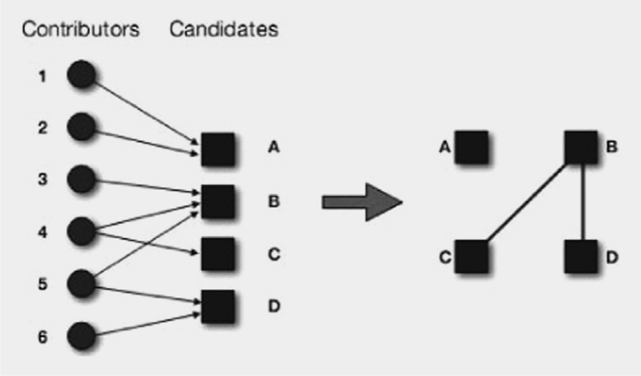
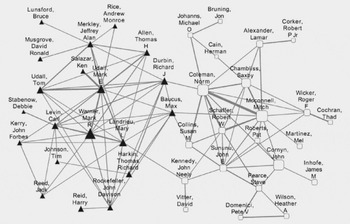
Whole network data can be one-mode or two-mode in nature. One-mode data involve ties among one set of agents, and two-mode data involve ties between two different sets of agents. For example, direct ties among nations, such as trade, would be classified as one-mode. Ties from nations to international organizations would be considered two-mode. Two-mode data might be converted to one-mode by examining the number of common ties that one set of agents have to the other set).Footnote 3 Thus, countries A and B might belong to five of the same international organizations, or two international organizations might share three members. Or, as in figures 1a and 1b, one might view senators as being connected by shared contributors, for which the resulting graph reveals both some unsurprising structural features (the strong partisan divide; the strong tie between the Udall cousins) and some notable features (the especially strong tie between McConnell and Coleman).
Unipartite Projection of Bipartite Contribution Data

Unipartite Projection of 2008 Co-Contribution Network of Senate Candidates' Campaign Committees
Note: Cut-off is at $50,000 for both nodes and links; thickness of edges and size of nodes corresponds to amount of co-contribution. Republicans are represented by squares and Democrats by triangles. Adapted from Onnela and Lazer (Reference Onnela and Lazer2009).

Network analysis might focus on any of a number of levels of analysis. At the positional level, one might examine the position of the node within the overall network. Centrality has received the most attention of all positional variables in the network literature, and a wide array of measurements has been developed to assess it (Freeman Reference Freeman1979). At the dyadic level, one would look at the determinants and consequences of a tie between pairs of actors. Are actors who are similar to one another more likely to have a tie? Are they more likely to converge in terms of behavior? The triadic level—how does the probability of a tie between A and B combined with a tie between B and C affect the probability of a tie between A and C?—has also received significant attention (Holland and Leinhardt Reference Holland and Leinhardt1970). Exponential random graph modeling is a statistical approach that has been developed to detect a variety of local structural regularities in whole network data at the dyadic, triadic, and higher levels. Beyond that, there have been various efforts over the years to detect cohesive subgroups (Freeman Reference Freeman, Breiger, Carley and Pattison2003), with particular attention in recent years to the development of scalable algorithms for “community detection” (see Porter, Onnela, and Mucha Reference Porter, Onnela and Mucha2009). Finally, researchers have also recently addressed the systemic level, especially building on both Watts and Strogatz's (Reference Watts and Strogatz1998) small world work, in which the measure of interest is the typical degree of separation between any two actors in the system, and the Barabasi and Albert (Reference Barabasi and Albert1999) work on degree distribution.
TRENDS AND FUTURE ISSUES
In recent years, the study of networks has devoted increased attention to the development of methods for making robust statements regarding the causal effects of networks. As is typical in the social sciences, observational data in networks offer particular challenges for interpretation. For example, the similarity between two people who have a relationship may be the result of social influence, homophily, or some other process that pushes similar individuals together. A number of strategies have emerged to address causation. Laboratory experiments have a long tradition of the study of social networks (Kearns, Suri, and Montfort Reference Kearns, Suri and Montfort2006; Bavelas Reference Bavelas1950), although the simulation of psychologically meaningful relationships in the laboratory setting is an intrinsic limitation. Field experiments have the potential to be particularly powerful, although there are only a few examples as applied to networks, such as the work of Nickerson (Reference Nickerson2008) and Lazer et al. (Reference Lazer, Sokhey, Neblo and Esterling2010b) in political science, and that of Mobius, Szeidl, and Center (Reference Mobius, Szeidl and Center2007) in economics. The importance of location in determining ties has also been used as an instrument for measuring network ties (Festinger, Schachter, and Back Reference Festinger, Schachter and Back1963; Sacerdote Reference Sacerdote2001). The applicability of any experimental or quasi-experimental research, of course, varies dramatically by subfield in political science; field experiments are highly applicable to the study of political opinion and behavior and irrelevant in the study of international relations.
Longitudinal data are also powerful in discerning causal direction, for which the observation of temporal precedence may allow an inference of causal order (Snijders Reference Snijders, Carrington, Scott and Wasserman2005; Christakis and Fowler Reference Christakis and Fowler2007). The power of that logical leap, however, depends on the additional assumption that there is not some unobserved process that affects both position in the network and outcome over time. For example, if skill causes network position at time t and success at time t + 1, an inference that network position yielded success based on temporal precedence would be spurious.
The reliance on exogenous processes to push information through networks is another method that has been used to assist in causal inference. Both the Columbia studies and more recent work in the same tradition rely on the assumption that elections cause increased communication regarding politics (Huckfeldt and Sprague Reference Huckfeldt and Sprague1995). However, a potential problem with such an interpretation is that other messages (e.g., media use, targeted messages from the campaign) may be correlated with network structure.
Increased attention has also been paid to network dynamics (Carley Reference Carley, Breiger, Carley and Pattison2003). Many relationships are intrinsically episodic. “Network dynamics” can reflect either a change in the probability of those episodes occurring over time or the specific temporal sequence of those episodes. Thus, the question “with whom do you talk about politics?” captures an overall tendency to talk about politics, but the actual discussions about politics with someone occur at particular points in time. While more attention has been focused on the first notion of network dynamics, the second idea has important implications for core constructs in the study of social networks, such as centrality (Moody Reference Moody2002).
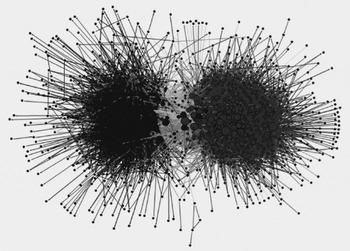
Closely related to the increased attention on network dynamics has been the increased availability of massive, passive datasets about human behavior (Lazer et al. Reference Lazer2009). For example, Onnela et al. (Reference Onnela, Saramäki, Hyvönen, Szabó, Lazer, Kaski, Kertész and Barabási2007) analyzed mobile phone call logs for millions of individuals over months of observations, and the Internet offers a plethora of network data (see figure 2).
Structure of the Political Blogosphere in 2004
Note: The charcoal nodes indicate liberal leaning blogs, and dark grey nodes conservative blogs. Light grey lines reflect a link between liberal and conservative nodes. The size of the node reflects how many other blogs link to it. Adapted from Adamic and Glance (Reference Adamic and Glance2005).

These types of data clearly offer potentially extraordinary insights into the dynamics of relationships on a societal scale. They also offer significant challenges to the social sciences, from privacy and human subjects issues to bread-and-butter methodological concerns. (As a social science construct, what does a phone call between two people mean? What statistical methods scale to datasets with millions of nodes and trillions of dyads?)
BACK TO THE FUTURE
Politics is a relational phenomenon. Political action is built not just on the coincidence of interest and the foundation of institutions, but also on a superstructure of favors owed, friendships, and enmities. Even the construction of interest is surely joint, the result of a common calculation of communal and personal interest. The power of institutions is drawn, in part, from how they shape relational patterns. It is therefore not surprising that politics and political science have been present in the study of social networks from the field's genesis. What is more surprising is the relative neglect of networks in political science over the last 50 years.
Consider a core construct of political science: power. Sometimes conceived of in political science as the attribute of an actor, power is intrinsically relational: it flows from the capacity to affect other actors. Such capacity is typically dyadically differentiated: Argentina is far more consequential to Brazil than Bhutan, and the chair of the agricultural committee is far more important to a member of Congress from Iowa than a member of Congress from Manhattan. Once one conceives of influence as dyadically differentiated, it is necessary to think of power in network terms. To understand one individual's power, it is necessary to understand not just his or her capacity to directly affect the world, but also the pull he or she exerts on other individuals. As E. E. Schattschneider (Reference Schattschneider1960) observes, “If a fight starts, watch the crowd.” Surely, the individual in a fight who has more friends in the crowd has a powerful advantage.
As befits the subject, an integration of network ideas requires many points of contact with the discipline. This necessity partly reflects the widely divergent theoretical and empirical foci of political science. Theorizing about the nation state is quite different from theorizing about an individual voter. Social network theories do offer some frameworks that cross levels quite well—thus, diffusion within networks has been examined both among nations (Simmons and Elkins Reference Simmons and Elkins2004) and voters (Fowler Reference Fowler and Zuckerman2005). However, the micro-level processes in these two cases differ radically, and the discussion of diffusion and networks needs to be embedded within the particular subfield. Political networks courses would be valuable additions to the curricula at leading doctoral programs, but the integration of network ideas into the introduction of particular subfields is equally essential.
The methodology of the study of networks, however, transcends particular subfields. Decades of political science doctoral students have been done a disservice by the uncritical, undiscussed assumption that observations are independent and identically distributed (I.i.d.). I.i.d. is a useful statistical assumption but a poor theory about human behavior, and every statistics class about human behavior should provide clear examples of when that assumption obscures more than it illuminates.
The current surge of interest in networks across the academy has certainly had a short-term impact on the discipline, as measured, for example, by the increased number of papers focused on networks at the APSA annual meeting. There is the potential for this surge of interest to have a lasting effect on political science because of the intrinsic relevance of network ideas to the discipline. Whether it does depends on the extent to which these ideas and methods become institutionalized within the discipline. Currently, the trends of the last few years seem promising. The years between 2008 and 2010 witnessed the first three Political Networks conferences, the first two at Harvard University and the third at Duke (a fourth will take place at the University of Michigan), and as of 2009, a Political Networks section has been established in the APSA (and subsequently in regional political science associations). Ultimately, the test will be whether these conference papers are published and where and whether network ideas become a mainstay of training in political science doctoral programs.
Finally, as the study of networks has sprawled across academia, it has evolved, because new domains offer novel ways that networks matter. Network ideas have been used to understand ecology, economics, cancer, and the spread of disease, among many other phenomena. Political science is perhaps less distant than other fields from the deep roots that network analysis has within sociology, psychology, and anthropology, but it does offer distinctive phenomena and data. For example, the subfield of international relations has developed one of the most remarkable arrays of relational data in existence, with information on such topics as conflict, treaties, and trade. However, extant statistical methods developed within social network analysis are generally poorly suited data that are valued (i.e., more values than 0 or 1), episodic, and highly dynamic. Data on campaign contributions, such as those collected by the Federal Elections Commission, offer an intrinsically relational, large-scale, longitudinal perspective on U.S. politics. But existing social network theories and methods have limited relevance to massive, longitudinal, continuous-time, geographically linked data. In short, for network approaches to be relevant to political science, they will need to be expanded and transformed by political scientists.