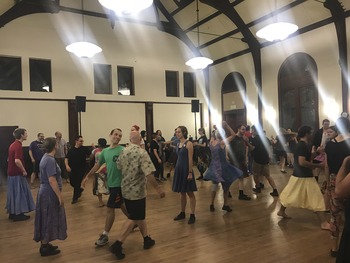
At Oakland’s Circle Left contra dance, I notice my hands fumbling as I take “hands four” with my partner and our neighbour couple to form one of many foursomes in a long line of contra dancers. My partner and I place our hands facing palm up expecting to find a hand to hold facing palm down. In “traditional” contra, it is the person in the “lady” role who places their hand palm down on the hand of the person in the “gent” role. But this time it is I, a cisgendered male,Footnote 1 who am in the wrong, since we decided before the dance that I am dancing the “raven” part, traditionally the “lady,” and my partner is dancing the “lark,” traditionally the “gent.” I correct myself and place my hand upon theirs. When I adopt the “raven” role, thirty-three years of contra dancing, that is, thirty-three years of gendered behaviour that have contributed to how I have learned to be male, are slightly difficult, but, as it turns out, not too difficult to unlearn. As we advance down and back up the hall, I make other, less minute mistakes, some that have to do with the new role expectations and some that are just part of a customary failure at executing dance moves perfectly. Like “traditional” contra dance, Circle Left (Figure 1) is a communitarian, participatory activity, and forgiveness is quickly given with a smile.
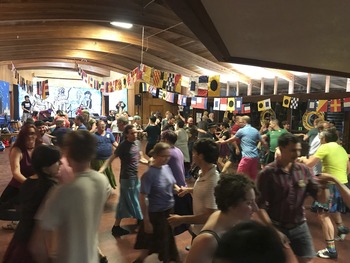
Circle Left (photo: Andrew Snyder, 2018).

This was my first time at Oakland’s Circle Left, a gender-neutral contra dance that has been going strong since 2012 in the San Francisco Bay Area with upwards of a hundred people in regular attendance. Now a regular at the dance, I am happy to dance either role or to switch roles throughout a dance. It is well known that through dance we learn gendered behaviour patterns, but through this experience I have understood that dance can also be a practice through which we can unlearn them.
Circle Left is a monthly contra dance with a lineage in queer versions of contra but one open to all and frequented by many straight dancers. Contra dance is an American coupled line dance related to square dance that is often described as the “unruly American offspring” of the more stately English country dance. Dancers sometimes riff on the word “contra” in the sense of “opposition” to underline the tradition’s history of deviance. In this sense, the replacement of “ladies and gents” with degendered role names is just one evolution in a long history of a changing, dynamic form. While contra is traditionally a gendered dance of interacting male–female couples in “sets” of double-file lines, what Circle Left calls “gender-neutral” contra removes the reading of gender as any guide of how to dance with others.Footnote 2 By promoting a “dance with who’s coming at you” system based on position rather than gender presentation or expression, Circle Left provides a space to dancers of all genders to dance with everyone else, rather than with half the room. Beyond a penchant for bad academic puns, I use the term “contraculture” not only to describe this particular subcultural manifestation of contra dance; I also portray how countercultural dance communities like Circle Left have aimed to make critical and effective changes in the broader contra dance world.
This article explores Circle Left as a window into the contemporary movement to degender contra dance. Circle Left is one of the first contra dances to adopt “larks and ravens” terminology and was instrumental in popularising the terms beyond queer communities as an alternative to “ladies and gents” in the broader national dance community. Though Circle Left has sought to disseminate sustainable and lasting terms, in a sign of the quickly changing territory, the role name of “raven” switched to “robin” during the production of this article due to critique from the Tlingit indigenous community in the Pacific Northwest for whom “raven” is a binary identity in their kinship system. I will henceforth refer primarily to the “larks and robins” system as the current preference of Circle Left at the time of publication but also refer to “raven” as the term in use when this research was conducted and also because some dances outside the Bay Area are still using “raven.” As role names, “ravens” and “robins” are functionally equivalent as replacements for the “lady” role.
The parent organisation of Circle Left is San Francisco Bay Queer Contra Dance (SFBQCD), which also runs Queer Contra Dance Camp, a “queernormative” weekend of contra dancing in the Santa Cruz Mountains. While Circle Left is part, therefore, of a queer lineage and community of contra dance that originally developed gender-neutral contra, the dance is less focused on being exclusively “queer” than on being gender-neutral and attracting youth, from teens to dancers in their 30s, whom the organisers view as interested in degendered dance regardless of sexual orientation. In this way, Circle Left, based in an urban area that has long been at the forefront for queer rights, stands as a bridge from queer communities to a larger public. Previously “mainstream” dances around the country have since adopted “larks and ravens/robins” role names, new dances have formed based on Circle Left’s model, most recently in Los Angeles and Denver, and dance communities around the country are facing demands to change.Footnote 3 A look at a closed Facebook group (“Gender Free Contra”), devoted to discussion of how to introduce “larks and ravens/robins” to pre-existing dances around the United States, reveals that non-queer identified contra communities are shifting to “larks and ravens/robins” at an exponential rate, a movement that some feel to be an irreversible wave. Indeed, it seems conceivable that “larks and robins” could even replace “ladies and gents” in the coming years. Perhaps, newcomers will someday believe “larks and robins” to be little more than a folksy nomenclature of a folksy dance, unaware of its recent emergence. Or perhaps “larks and robins” will be only a passing phase in a changing form.
By thinking about queer movements and the mainstream in relationship to one another, I reflect in this article on an observation made by a Circle Left participant about gender-neutral dance: “it’s obvious why queer people need it. It’s not obvious why straight and cis people need it.” This article explores why gender-neutral dance might be of need beyond queer communities.
I argue that gender-neutral dance has become relevant beyond queer-identified communities for four reasons. First, the generally liberal mainstream contra dance community has long been concerned with inclusion and creating a safe, participatory environment for dancers (Turino Reference Turino2008). Mainstream dancers have found adopting the terms to be helpful in including marginalised gender identities and sexualities. Second, mainstream communities have long negotiated gender imparity forcing dancers to “queer themselves” by being “called” as the incorrect gender (a form of misgendering), and the “larks and robins” system has been seen to “solve” the problems of gender imparity. Third, the “larks and robins” system brings a critical stance to the problems of a historically heteronormative courtship dance, including inegalitarian gender-based roles and issues with consent in such an intimate activity as dance.
Finally, and I think most interestingly, the widespread shifts in millennials’ and younger generations’ understanding of gender as a performance rather than inhering in the body has led young dancers—queer, straight, and some uninterested in labels—to develop gender-neutral dance. The rise of gender-neutral dance indicates a post-binary understanding of gender and sexuality beyond rigid dichotomies between female and male, gay and straight. By promoting these alternatives, organisers aim to maintain the dance as a sustainable form for the future. Moreover, I suggest that the degendering of contra dance is representative of a generational shift in understanding queerness as broader than a “separatist” subculture of marginalised sexual and gender identities. As national, and indeed worldwide, debates have moved forward on marriage equality and transgender rights, communities are working at integrating diverse gendered identities and sexualities. This article shows, however, that inclusion cannot just happen at the margins but may force the mainstream itself to change and embrace the innovations of the “contraculture.”
Far from a “cutting-edge” popular music scene, gender-neutral contra is a revision of a dance that most Americans might assume would be preservationist and preoccupied with heritage and a conservative tendency to ossify “traditional” practices (Bendix, Eggert, and Pesselman Reference Bendix, Eggert and Pesselman2012). As will be explained below, however, contemporary contra dance is a revival form (Bithell and Hill Reference Bithell and Hill2016) primarily practised by urban liberals for recreation, community building, and affinity, rather than a fixed heritage form understood as being passed down through the generations of practitioners’ families. In conversation with UC Santa Cruz ethnomusicologist Tanya Merchant (pers. comm., 13 April 2019), I have come to view contra dance communities as not primarily preoccupied with the heritage of this traditional form but rather with its sustainability, as understood by Jeff Todd Titon (Reference Titon2009) as well as Huib Schippers and Catherine Grant (Reference Schippers and Grant2016). Taking an ecological approach to sustainability, Schippers argues that culture bearers must attend to “underlying values and attitudes (constructs) steering musical directions. These include…explicit and implicit approaches to cultural diversity resulting from travel, migration, or media, as well as obstacles such as prejudice, racism, stigma, restrictive religious attitudes, and issues of appropriation” (Schippers Reference Schippers, Schippers and Grant2016:14). In embracing a terminological shift in language, the movement to degender contra dance aims to performatively create fundamental changes in the form, which adherents believe will help the dance live into the future.
Advocates of degendered dance reject what I call “cis-dance,” a heteronormative and patriarchal system whereby gender identity is assumed to be a natural expression of sexual difference and dictates dance roles, which even in contra dance manifest unequal power. The term “cisgender,” originally articulated in contrast to transgender, calls attention to the constructedness of the normalised relationship between heteronormative gender identity and assigned birth sex. I use “cis-dance” to point to the normalised extension of cisgendered logic from assigned birth sex to gender identity to dance role. In cis-dance, the presumed default is that an assigned female body will present as, or perform the gendered identity of, a woman and dance the “lady,” while the assigned male body will present as a man and dance the “gent.” Though the term “cisgender” has been critiqued for its binary opposition to transgender and its limitations for intersex and non-binary identifying people, I use “cis-dance” not implying that its opposite would be “trans-dance,” but rather what Circle Left calls “gender-neutral” dance. While my informants use all these terms in diverse ways, within the context of heteronormativity, I consider any departure from cis-dance to be a “queering” of the dance.
Indeed, dancers view “queer” broadly as an umbrella term for any non-heteronormative sexuality or gender identity. Circle Left organiser Laura Gorrin asserts that “queer is a way of redefining gender and sexuality without the binary and with more political connotation…it’s possible for anyone to have a queer understanding of gender.”Footnote 4 In this way, “queer” offers critiques of gender that, organisers believe, should be applicable to everyone. Circle Left is an enactment of queer theory that is, much like Annamarie Jagose’s consideration, experimental, indeterminate, and with an unwritten future (Reference Jagose1996:3).
This research is based on a year of fieldwork with lots of dancing at Circle Left’s monthly dance and attendance at the community’s annual Queer Contra Dance Camp in Santa Cruz in 2019. I also formally interviewed two of the organisers of Circle Left, Laura Gorrin and Margaret Pigman, and Alan Kline, president of SFBQCD, and I have had numerous informal conversations with dancers. I come to this project as a person who identifies as bi-sexual but who is a cisgender male with a bi-sexual, cisgender wife. Though a nominally straight couple, our own attempts at couple dance have been fraught by her stringent refusals to exclusively dance a subservient “lady” role, showing the shortcomings of cis-dance for many straight couples.
I also come to this research as a lifelong contra dancer. My father was a contra caller, who would teach dance progressions and call dancers through them. He and my mother helped found the contra dance in Santa Fe, New Mexico, still going strong. As a dance caller, he constantly negotiated problems raised by cis-dance, such as frequent gender imbalance and problems with consent. Though I had taken a departure from contra dancing since college and during my PhD research in ethnomusicology on Brazilian brass bands, my father’s death by cancer in 2017 re-sparked my curiosity in the contra tradition. During his illness, I also witnessed how the contra dance community formed a powerful communal resource in the final year of his life. It was a community that had long provided support for him to embrace what Thomas Turino (Reference Turino2008) calls an alternative way of being American. As I began frequenting Circle Left in Oakland soon after, I have seen how this gender-neutral manifestation of the dance, rooted in politically oppositional movements for queer liberation, also forms a strong community of support, a new way to be “contra” in a longer history of dance rebelliousness.
Folk Dance Enactments of Third Wave Feminism and Queer Theory
Circle Left subverts a variety of expectations of what a queered folk dance might be, or even how it could exist. Beyond the presumption that a traditional dance would be inherently conservative, one might also assume a “queer contra dance” might be a space primarily for the free expression of marginalised sexual orientations—for lesbian, gay, and bi-sexual dancers looking to meet and dance with the gender to which they are attracted. The emergence of Circle Left out of a more explicitly gay and lesbian contra dance scene, however, bespeaks changing generational priorities that are reflected in shifts from second to third wave feminism and from gay and lesbian studies to queer studies.
The “larks and robins” system could be understood as an enactment of Judith Butler’s intervention that gender is not the inevitable result of sex, a concept foundational to the third wave. Decoupled from the category of sex, gender is an “identity tenuously constituted in time—an identity, instituted through a stylised repetition of acts” (Reference Butler1988:519). Gender is what Foucault would call “biopolitical” (Reference Foucault and Davidson2008), a discursive formation that rules over the body. Butler argues that feminist discourse had previously assumed a universal subject of “women,” and “men” in opposition, one that left feminism open to “charges of gross misrepresentation” of other marginalised identities (Reference Butler1990:8). That is, Butler argues that second wave feminists had understood women as an oppressed, monolithic category, essentially different from men by gender and sex, which were invariably linked together.Footnote 5
For Circle Left organisers, these distinct understandings of gender represent generational divides in the contra dance community. SFBQCD president Alan Kline notes that contra’s push back against the terms “lead and follow” in the 1970s was based on a “second wave feminist argument. What was feminist then was using ‘gents and ladies’ and not ‘leads and follows,’”Footnote 6 as dancers rejected the notion that “lady” follows. It was not primarily the differences between genders that were contested—indeed, they were often celebrated—but rather the inequalities between them. By contrast, Circle Left views gendered dance as a repetitive performance of confining, gendering acts that are part of constituting “the illusion of an abiding gendered self” (Butler Reference Butler1988:519). Circle Left intervenes on cis-contra dance as a kind of “gender trouble” (Butler Reference Butler1990) of the naturalised categories of man and woman that presumably dance the gendered roles of “gent and lady.”
Considering that in most couple dance, the “gent” leads and the “lady” follows, clearly most partnered cis-dance is a performance of patriarchy. Theoretically, however, cis-dance might not necessitate male domination but rather only distinct gendered roles. Some of the older generation do see contra as a dance of equal “ladies and gents.” Cis-contra does have a large share of gender-neutral moves (“circle,” “star,” “lines forward and back”), as well as gendered moves that might not seem unequal (the “ladies’ chain”). The choreography of the dance redistributes considerable power from the lead role to the caller, rather than male-led improvisational cues used in cis-closed partner dances (waltz, swing, salsa, etc.). Patriarchal power is, however, expressed in the ballroom position swing, the courtesy turn led by the gent, and the flourishes such as “ladies”’ twirls that are prompted, and often forced (or “cranked”), by “gents.” Contra is not immune to patriarchy, and it too is a world in which, through repetitions of acts, we learn gendered inequalities. It is no accident that the decline of patriarchal coupled cis-dance in favour of individual dance from the 1960s to the present accompanied a feminist movement that rejected male power over women’s bodies. Circle Left seeks to sustain partnered dance by creatively doing its part to smash the patriarchy.
In the over three-decade history of queer contra dance communities, the word “queer” has been increasingly embraced, replacing “gay and lesbian,” a shift that also occurred in academia in the 1990s when queer studies overtook gay and lesbian studies. Like third wave feminism, queer theory critiqued notions of “stable sexes, genders and sexualities” in favour of “post-structuralist figuring of identity as a constellation of multiple and unstable positions” (Jagose Reference Jagose1996:3). Queer theory accused gay and lesbian studies’ binarism of neglecting other marginalised sexualities, such as bisexuality, asexuality, and pansexuality, as well as gender and sexual identities, including intersex, non-binary, gender-fluid, and trans identity. A queer theory would be one defined by indeterminacy and on “mismatches between sex, gender and desire” (Reference Jagose1996:3). Moreover, the use of the term “queer,” a reclaimed slur, resonates with a legacy of activism beyond the embrace of a subcultural identity.Footnote 7
Circle Left and Queer Contra Camp have advanced a notion of queerness as an umbrella term, or “coalitional sensibility” (Croft Reference Croft2017:2), one that, as SFBQCD president Alan Kline reflects, “involves any gender or sexuality that is outside of heteronormative. If you do not identify as cis-male or cis-female or are not heterosexual, you are queer.” This definition grew from critiques of the limitations of folk dance groups that defined themselves as gay and lesbian, which had been aging out and were not viewed as in line with understandings of queerness among youth. For Circle Left organisers, however, the innovations advanced by queer communities would be of interest to younger dancers who might not necessarily define themselves as queer.
This article joins small but growing literatures on queer dance and performance (Savigliano Reference Savigliano1997 and Reference Savigliano2010; Buckland Reference Buckland2002; Croft Reference Croft2017; Liska Reference Liska2017; Alexander Reference Alexander2018), “traditional culture” and queer identities (Johnson Reference Johnson2013; Hubbs Reference Hubbs2014; Richardson Reference Richardson2018), and ethnochoreology of contra dance and related forms in North America (Dart Reference Dart1992; Tyler Reference Tyler1992; Hast Reference Hast1993 and Reference Hast1994; Jordan-Smith Reference Jordan-Smith2001; Quigley Reference Quigley2001; Jamison Reference Jamison2003 and Reference Jamison2015; Horton and Jordan-Smith Reference Horton and Jordan-Smith2004; Turino Reference Turino2008; Gifford Reference Gifford2010; Kaminsky Reference Kaminsky2011; La Chapelle Reference La Chapelle, Zuckerman, Kun and Ansell2011; Alexander Reference Alexander2014; Sparling Reference Sparling2018). With a broad array of case studies from around the world in the collection Queer Dance, editor Clare Croft remarks that “It is worth noting that not all queer dance floors exist in the darkness of a club” (Reference Croft2017:4). Just as Circle Left provides a queer critique to the mainstream, Croft argues that “Dancing queerly challenges dance communities of all kinds to overcome unimaginative categorisations that conceptualise gender difference as an essentialised, physical difference” (ibid.:6). Moving beyond the focus on discourse and the written text, Croft views queer in dance “as invested in the body, queer as a critique of normativity, and queer as an embrace of heterogeneity” (ibid.:8) and asks how dance might “manifest a theory of queerness” (ibid.:10).
While these diverse case studies have broadened the conversation about what constitutes queer dance, I contest that Circle Left brings something else to the table. There is perhaps something unique about contra dance itself as an intervention of queer theory, asking us to move beyond the tendency to focus on queer dance communities in isolation, or as separate, from the broader dance worlds in which they exist. Alan Kline asks, “Is there something about contra that is allowing [the degendering of dance] to happen? In swing dance, there is queer swing and straight swing, but I’m not seeing a movement of ‘let’s make the dance welcoming to everybody’ swing.” Perhaps it is the particular formation of contra dance, an inclusive social dance in which participants have no choice but to meet each other where they are at in the dance line that has allowed the queer critique to grow so quickly into the mainstream, as more and more dances go “larks and robins.”
Origins of Cis-Contra Dance
Providing a longer account of queer dance in his history of the queer contra dance in Boston, the dance’s founder, Chris Ricciotti, writes about drag balls, “like most gay institutions, gay drag balls did not emerge sui generis in the gay world, but were sub cultural adaptations of the institutions and social practices of the dominant culture” (Reference Ricciotti2011:12). Likewise, delving deeper into the history of contra and its negotiations of gender helps us understand Circle Left’s interventions.
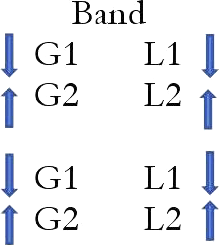
Dorothea Hast takes a historical and ethnographic account of contra dance, explaining the “divergent cultural [and] political agendas” (Reference Hast1994:3) that emerged over time, a “historically discontinuous process” of recycling the genre “according to the needs of each generation” (ibid.:30). The formations of coupled set, or “social,” dances used in contra—including lines, rounds, squares, and others—all ultimately derive from English country dance. What came to be known as “country dancing” grew popular in English elite society in the sixteenth century. Peter Manuel notes that country dancing has long been viewed as egalitarian and accessible: “As with revivalist American country and contra dancing today, the traditional country dance offered the pleasure of social dancing to those who were not necessarily skilled or trained as dancers” (Reference Manuel2009:5). In contrast to boisterous contra, English country dance, which is also danced by some contra dancers today, is now a dance associated with elegance and restraint. The dominant formation of English country line dances, with women and men facing their partners on different sides of a line, segregated by gender, is called “proper,” which was also the dominant formation of contra dance until the mid-twentieth century. “Active” couples, or “ones,” may do more moves than their corresponding “inactive” couples, or “twos,” who watch the active couples “present” moves until arriving at the end of a line and changing to the other position (Figure 2).
Couples going down and up a line with arrows representing movement of couples away from and towards the band respectively, with “lady” (L) and “gent” (G) in proper formation.

In contrast to the relatively unpretentious and interactive English country dances, French social dances had been rigidly hierarchical. When the French encountered English country dance, they saw it as “contre,” or counter, because the couples faced each other along the line sets rather than towards the “Presence,” or the important personage presiding over the dance. Both “country” and “contre” have been proposed as the origin of the American term “contra.” The French adopted English country dances and developed the form of the square dance (quadrille). The most popular dance form in the Atlantic World by 1800, versions of English and French social dances spread through Europe and the Americas during colonisation, leading to new variants, including contra dance in New England, céilí in Ireland, contradanza in Cuba, kwadril in St. Lucia (Guilbault Reference Guilbault1985), quadrilha in Brazil, chacarera in Argentina, and many other variants (Manuel Reference Manuel2009). These forms provided spaces for disciplining gendered bodies but could also be considered dangerous sites of physical contact between the sexes.
Contra dance in eighteenth-century North America, especially in New England, was a popular pastime, spread by itinerant dance masters. Philip Jamison mentions that people participated in part to assert class distinction, which influenced the choice of role terms:
In America, as in Europe, attendance at a dancing school distinguished the middle and upper classes from the unrefined common folk, and partly as a way to deflect criticism from the church, dancing masters also taught lessons in etiquette and proper manners. As a consequence, the dancers, who in Playford’s time [in seventeenth-century England] had been referred to as “women” and “men,” became known as “ladies” and “gents.”
(Reference Jamison2015:30)The quadrille, henceforth the “square,” came to the United States from France in the early nineteenth century. This new form began to displace the line formations of contra dance in popularity, though contra remained popular in New England into the twentieth century. In the nineteenth century, the figure of the caller emerged in southern Appalachian square dancing, a black innovation that led to a more improvisatory structure than that of the dances taught by dancing masters and memorised by dancers (Jamison Reference Jamison2003). The musical accompaniment of fiddlers, many of whom were black, became popular, and they adapted Anglo-Celtic jigs and reels as well as minstrel tunes. The ascendance in the mid-nineteenth century of “closed” ballroom couple dances in which couples did not interact with other couples—such as the waltz, polka, and schottische—led to the decline of couple dancing in sets throughout the Atlantic World. By the beginning of the twentieth century, both contra and square dancing seemed to belong to a bygone era.
American Set Dancing Revivals in the Twentieth Century
American contra and square dancing, formations that continue to overlap in many dance communities, went through two major revivals in the twentieth century with polar opposite political intents: a nationalist revival in the early twentieth century (Quigley Reference Quigley2001; Gifford Reference Gifford2010; La Chapelle Reference La Chapelle, Zuckerman, Kun and Ansell2011; Brucher Reference Brucher2016) and a leftist revival in the 1970s (Dart Reference Dart1992; Hast Reference Hast1993 and Reference Hast1994; Turino Reference Turino2008; Alexander Reference Alexander2014). Henry Ford, a racist who regarded 1920s popular music as black and Jewish, promoted a national square dance revival, seeking to enshrine square dance as the official national dance.Footnote 8 While he did not succeed, twenty-eight states did adopt the dance as the official state dance, the reason many Americans learn square and contra dancing in school today. This revival led to the institutionalisation of the Modern Western Square Dance tradition, perhaps the most prominent image of set dancing for most Americans: “boys and girls” in matching, gendered clothing dancing to recorded music.
I have found very little crossover between contemporary contra communities and Modern Western Square Dance, though the similarities between the forms do produce mutual interest.Footnote 9 New England contra dance had lived on, however, maintained by the enthusiasm of particular people, such as Ralph Page from New Hampshire, who popularised the tradition in Boston in the 1940s. Page, mostly uninfluenced by the Modern Square Dance Movement, did not adopt its Western look, and he maintained an adherence to live music, still mostly a requirement at contra dances today (Dart Reference Dart1992). Modern contra dance owes its origins, in contrast to the reactionary Fordist revival, to the leftist folk revival in the Northeast. The folkrevival is known as a primarily urban movement with roots as far back as the 1930s that drew on American and Anglo-Celtic vernacular forms as populist and oppositional repertoires. The movement was first associated with what Thomas Turino (Reference Turino2008) calls “presentational” singers, such as Woody Guthrie, Pete Seeger, and Joan Baez.
Turino suggests that contra dance was attractive to countercultural adherents of the 1960s folk revival who sought to move beyond the presentational “star system.” Their interest was “a response to a need for participatory music making and dance [as] emblems that would tie individuals to the idea of community and to what was deeply and alternatively American” (Reference Turino2008:159). The explosion of interest in the 1960s in the Northeast, especially in Boston, was propelled by young, countercultural dancers, who were primarily white, middle-class, and college-educated—the demographic that continues to dominate contra scenes today. The tradition spread to urban centres and college towns throughout the United States in the 1970s. Contra dance today is a translocal, national community with local dancers connected by popular dance camps and a network of travelling musicians and callers.
This more liberal revival promoted contra as an accessible, inclusive, and non-competitive tradition. Post-revival participants dance in casual clothing with none of the matching costumes of Western Square Dance. Laurel Horton and Paul Jordan-Smith note that modern contra dance represents a complication of the “folk costume” model promoted by the field of folklore, “an outmoded term that refers to a narrow range of ethnic, sectarian, and occupational clothing traditions” and overlooks “some kinds of clothing choices because they seem merely to reflect ‘everyday dress’” (Reference Horton and Jordan-Smith2004:414). Dancing for fun, comfort, and recreation rather than heritage, contra dancers sport colourful, casual clothing, with a particular fondness for skirts to twirl. Indeed it is common in the most mainstream of contra communities to see men dancing in skirts, usually not as an expression of cross-dressing or trans identity, but rather as a mark of an experienced male dancer who likes to twirl. As a very young contra dancer, I learned late in childhood that men wearing skirts was not, in fact, “normal” and that the skirt is a garment gendered as female.Footnote 10
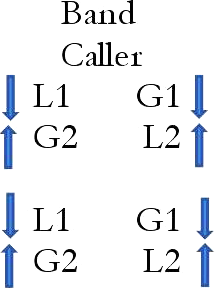
Indeed, considerations of contra dance since the folk revival focus on its values of equality between the genders and the blurring of many gendered lines. Mary Dart (Reference Dart1992) argues that this development was influenced by the second wave feminist movement and women’s rejection of subordinate roles. Unlike the calling of Modern Western Square Dance, which is often addressed to the men as the primary dance agents (for instance, “swing your gal,”) post-revival contra callers, who were increasingly non-male, began to call to both genders. Rather than sticking with a single partner, most contra dancers find new partners for each dance, and it is common for women to take as much initiative as men in finding a partner. Dart emphasises the evolving value of equal participation as a primary reason that the choreography of the dance changed substantially in the twentieth century. Since the revival, the “proper” form that divided male and female lines has almost completely disappeared in favour of the “improper” formation that mixes the genders by positioning couples facing each other down and up the hall, with the “gent” on the left and the “lady” on the right (Figure 3). While earlier contra dances had maintained distinct roles for active couples going down the hall, performing moves while inactive couples watch and applaud the active couple’s presentation, post-revival contra dance has reduced and nearly eliminated the distinction between active and inactive. Callers now prefer the terms “ones” and “twos” and overwhelmingly favour dances in which all couples are always active.
Couples going down and up the line with “lady” (L) and “gent” (G) in improper formation.

Despite these changes in gender relations towards a more participatory and egalitarian form, it was not a goal of post-revival contra to deconstruct the very foundation of cis-dance. Laura Gorrin maintains that this system was enforced by second wave feminism, which was invested in the “essential” differences between the genders. Some of these dance communities rejected the terms “ladies and gents” because of the terms’ classist, aristocratic tone in favour of the terms “men and women.” For Gorrin, these terms felt worse than “ladies and gents,” which were more clearly roles, whereas “men and women are identities.”
Post-revival contra communities have rarely been able to simply be at ease with the enforcement of cis-dance roles. Many communities have more attendance by women than men, less rarely the other way around. Perfect parity between the genders is a rarity, and dance weekends traditionally enforced quota systems that blocked out many women from registering, though such practices are now on the decline. Lack of gender parity at regular dances has led to some women dancing with one another and, less commonly, men dancing with one another. Even in cis-dance contexts, this practice is widely tolerated in the spirit of inclusivity, though some insist that it is confusing. Many have employed visual systems to identify the “lady and gent,” including providing gendered clothing such as ties.
Women and men switching roles, however, can produce looks of consternation and accusations of unnecessarily trying to confuse the dancers. Given the homophobic culture in which men especially are raised, some men simply do not want to swing other men, less of an issue for woman dancing with each other. Alan Kline relates, “I stopped going to gendered dances because I would ask a guy to dance and the looks I’d get, or I’ve come to guys in line and they’ll step out of line until I pass them. They will not swing me.”Footnote 11 Post-revival dance weekends did, however, provide liminal and carnivalesque opportunities for experienced dancers to dance gender-neutral or switch roles, showing that Circle Left would draw on many pre-existing, if marginal, practices rather than completely reinventing the dance. But besides the many limitations of cis-dance, what about the people who simply did not want to be confined to dancing with the opposite gender, who felt that the terms misgendered them, or who were otherwise alienated from this system?
Queer Contra and the Emergence of Gender-Neutral Dance
Boston caller Chris Ricciotti is owed credit for popularising and codifying gender-neutral contra. In his history of “gender-free” contra dance (Reference Ricciotti2011), Ricciotti, a gay man, describes falling in love with traditional dances but initially believing that this interest could not converge with his life as a gay man, as gay male social life was largely confined to bars and largely disassociated from “traditional” culture. In a 2016 promotional video about the queer dance he founded, Ricciotti reflects, “Early on in my coming out process, I had one thought: what about the idea of gay people contra dancing and square dancing. Wow, wouldn’t that be amazing. Then I thought, ‘nah, that’ll never happen.’ Little did I know….”Footnote 12 Ricciotti founded his first gay and lesbian contra dance in 1987, calling “ladies and gents” but allowing dancers to dance either role. Soon complaints emerged from dancers who did not want to be identified as either a “lady” or a “gent.” In 1989, he tore up bed sheets to make bands of sheets for dancers in the previously “gent” role to wear. He created a system of “bands,” those who wore the bands and standing in for the former “gent,” and those who went “bare,” standing in for the former “lady”—the “bands and the bares.” Gender-neutral contra dance was born.
Ricciotti quickly intuited that this system might be of use to others, offering a workshop he describes as controversial but popular at the New England Folk Festival in 1990. As new gender-neutral, queer-identified communities were founded throughout New England, he consolidated these dances into the Northeast Gay and Lesbian Country Dancers (NEGAL, initially SEGAL), and he founded the first annual gender-neutral dance camp in 1989. In 1992, Bobbi Keppel, a bi-sexual activist, pointed out the limitations of “gay and lesbian” to encompass other marginalised sexualities, prompting Ricciotti to change the name to the Lavender Country and Folk Dancers (LCFD). In the video, Ricciotti expresses a more ecumenical vision: “If you’re gay, if you’re straight, if you’re lesbian, if you’re bi, if you’re trans, queer, questioning, intersex, asexual, whatever, you are welcome in our community.” The concept of queer contra spread to other American cities, including New York City, Atlanta, the Twin Cities, Seattle, and in 2004 to San Francisco.
That year, LCFD dancers who had moved to San Francisco founded a monthly dance known as “Queer Contra” in the “bands and bares” mold of Ricciotti. Primarily frequented by older gays and lesbians, Laura Gorrin describes it as a “great community space” that had little crossover with what they call “straight contra,” or the larger Bay Area dance communities. In 2008, Queer Contra founded the annual Queer Contra Camp weekend dance camp in the Santa Cruz Mountains, which grew into an event with its own identity run by SFBQCD and continues to grow each year. Queer Contra entertained the idea of creating gender-segregated alternating dances for gays and lesbians, showing the continuing importance of second wave, binary-based notions of queerness and gender identity. Margaret Pigman notes, “I think it’s a good indication of the difference between Queer Contra and Circle Left. It’s completely inconceivable to us that you would want to separate the women and the men; besides which, what do you with all the non-binary folks?” Queer Contra also faced persistent challenges in fostering a high level of contra dancing because the dance primarily advertised to gays and lesbians, including on dating sites, rather than to the larger experienced contra dance community. Queer Contra would officially end in 2014 partly in response to the enthusiasm for Circle Left, which, according to Laura Gorrin, would present “a model of queer dancing that was more in line with the desires and beliefs of a larger population.”
Circle Left and the Degendering of Mainstream Contra Dance
Much about Circle Left seems like an average contra dance until one notices that the dance expresses no gendered logic. Like many contra dances, a short lesson for new dancers at 7:30 pm precedes an hour and a half of ten-minute or so contra dances and one waltz before a break for socialising. At 9:45 pm, the contra dances start back up, closing with another waltz by 11:00 pm, at which point some go to a nearby café to socialise. Aside from the “larks and robins” terminology, the dances themselves are largely called as they would be anywhere else. With a direct style distinct from the sing-songy Modern Western Square Dance calling, contra callers teach one progression of the dance, invite the live musicians to start off a tune set,Footnote 13 and call the dance progression repeatedly until it seems that the dance is memorised, coming in only to resolve confusion and otherwise letting dancers enjoy the music. In all these respects, Circle Left is a contra dance much like any other.
Laura Gorrin and Margaret Pigman, who founded Circle Left with Mike Sokolovsky and run the dance with Yoyo Zhou, recount that Circle Left started in 2012 without much intentionality. Laura Gorrin was an integral part of both Queer Contra and the larger Bay Area contra dance scene, part of a younger group of dancers in the local dance scene. Circle Left began with two primary goals: that it be gender-neutral, though it would be open to all beyond the queer community, and that it be oriented towards the younger twenties and thirties crowd, though all ages would be welcome. Anyone under the age of thirty, regardless of student status, pays less to enter the dance. The name “Circle Left,” one of the most basic moves in contra dance, was meant to evoke a leftist revision of this community dance.
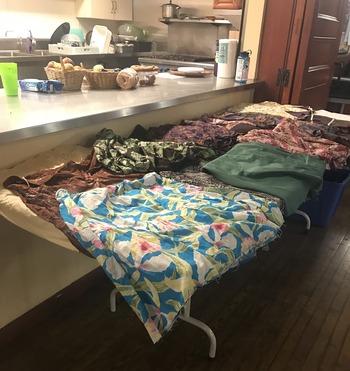
The organisers brought certain elements from other dances, such as the “skirt table,” from which any one can borrow a skirt to dance in, which has been an element since the beginning of the dance (Figure 4
Skirt table at Circle Left (photo: Andrew Snyder, 2018).

Circle Left 2018 flyer (courtesy of Laura Gorrin).

). Gorrin recounts that there was a dancer who would throw “‘real men wear skirts dances.’ They would have a collection of skirts that they brought to Hayward and would hold dances where men were specifically encouraged to wear skirts. When we started Circle Left we inherited that bag of skirts…. One of the things that we’ve always had is the skirt table where we encourage people to try skirts if they want to.” Margaret Pigman’s “intention is to help people feel more welcome because they might not know the way that people dress, which lets people dress more like other people without having to come back to do it or invest in a skirt.”
The skirt table is an example of an element that a newcomer might assume to be a queer innovation on a folk dance. Instead, it is an amplification of a pre-existing element in post-revival contra dance. Yet the subversive notion that “real men wear skirts” certainly does not align with Circle Left’s understanding of gender as a performance distinct from sex. Laura Gorrin notes how in contra dance the skirt loses its gender association: “I actually don’t wear skirts ever, period, except at contra, and the reason I feel comfortable wearing skirts at contra is because it isn’t gendered in ways that it is in the rest of the world. It means ‘I like twirling’ more than ‘I am female.’”
While many dance communities that the organisers call “straight dances” have since adopted “larks and robins” terminology, Circle Left is distinct as a dance that started gender-neutral from the beginning, initially using “bands and bares” in the Ricciotti lineage. The organisers were, however, dissatisfied with the dominant “bands and bares” models, which had multiple problems. “Bands” could easily be mixed up with the band playing music. As both one-syllable words beginning with “B,” they could be misheard on the dance floor. The visual signifier made switching roles within a single dance difficult, a practice common at Circle Left. Some people would simply not wear the bands despite dancing the “band” role, making the lack of uniformity confusing. Most ironically, the homonym “bear” is a gay subculture term for a larger gay man. Ultimately, the notion that a visual signifier was necessary to understand dance role was a gender-neutral adaptation of cis-contra dance’s conflation of a binary-based presentation system with dance role that organisers would come to view as unnecessary.
Alternative options based on a “dance with who’s coming at you” position system had been filtering through the contra community, with a broad agreement that the role names should have different numbers of syllables and sound significantly different, such as one possibility of “jets and rubies,” which seemed to Alan Kline “ridiculously gendered. We have the dark stoic stone and then we have the pretty one.” A caller from Los Angeles, Frannie Marr, had mentioned to Circle Left organisers that she and Seattle caller Susan Michaels had developed “larks and ravens/robins” in the context of a family dance, in which children do not necessarily want to dance in heteronormative dance roles (with serious concerns about cooties). While both “robin” and “raven” were presented as possibilities, Circle Left organisers initially settled on “raven” because of potential confusion with a dance move called “mad robin” before recently learning of the issues with “raven” mentioned above and changing to “robin.” “Larks” and “ravens/robins” had different numbers of syllables, sounded different, were thematically related, and, cleverly, could be remembered as dance positions by the first letters of each word (“L” and “R” for “left” and “right”). Like the “gent” position, the “lark” stands on the left, and like the “lady” position, the “raven/robin” stands on the right. Importantly for understanding the growing usage of these terms beyond queer communities, they did not originate in queer communities and were not inherently associated with queerness as “bands and bares” had been.
The organisers mentioned this system to Erik Hoffman, the organiser of the Berkeley contra dance. Berkeley’s dance is not a queer-identified dance, but Erik had wanted the dance to be more inclusive and had been negotiating queer dancers and others who enjoyed switching and subverting cis-dance. While some might expect the rejection of “ladies and gents” and the cis-dance system to be confusing, the pre-existing practices of switching and same-gender dancing amid widespread lack of gender parity in contra communities could make the “ladies and gents” system actually more confusing. Laura Gorrin relates having heard one person remark, “oh thank goodness they’re not using ‘ladies and gents.’ It was so confusing to expect a man and there appears a woman. There were enough people swapping that it was actively confusing.” Despite being a straight dance compared to Circle Left, Berkeley adopted the terms as the first dance to do so two weeks before Circle Left in 2014. They were eventually adopted by Boston’s LCFD and other dances that had grown tired of “bands and bares” before spreading at an exponential rate to increasingly more straight dances around the country. Now in the Bay Area, the terms are used by all East Bay contra dances, including Circle Left, Berkeley, and Hayward, while San Francisco and Palo Alto have maintained “ladies and gents” so far but have gradually introduced “larks and robins” (Figure 5).
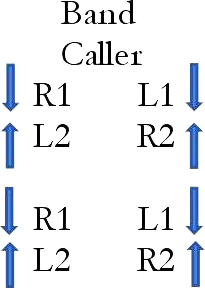
At Circle Left, when the caller asks the dancers to line up for a contra dance, they find a partner, join a line, and start joining “hands four” with a neighbour couple. Unlike at a cis-contra dance, however, the “gent” does not simply go to the left and the “lady” to the right. Every dance begins with some version of the question: “do you have a role preference?” sometimes asked visually by dancers’ flipping their hands up and down with a quizzical look, signifying the two distinct roles. Dancers negotiate who will be the “lark,” who will be the “robin,” and whether the couple will “switch,” referring to the practice of changing roles within a single dance that requires a good bit of skill and attention. In practice, dancing the “lark” is not markedly different from dancing the “gent,” meaning that one will initiate flourishes for the “robin,” placing the right hand on the small of the “robin’s” back during ballroom position swings, and receiving the “robin” for a courtesy turn or twirl during the “robins’ chain.”Footnote 14 Likewise, being a “robin” is not unlike being a “lady,” as a “follow” role with more opportunities for flourishes. The degendering of the roles has, however, equalised some moves that had been restricted to a single gender, such as the growing fondness for “larks’ chains.” While the roles remain somewhat distinct and relatively unequal, the terms and inequality between the roles are, however, completely degendered. Any person can choose any role (Figure 6).
Couples going down and up a line with “larks” (L) and “robins” (R) in improper formation.

Interestingly, while participants use the “essence” language of “do you want to be a ‘lark’ or ‘raven/robin,’” equally common is turning the terms into action words: “do you want to ‘lark’ or ‘raven/robin.’” “Larking” and “ravening/robining,” as gerunds, underline the performative dimension of the role. These are actions that in no way imply an identity. Alan Kline insists,
“Lark and raven” don’t define me. I am not a “lark.” I am not a “raven.” I am dancing a role, and that has to be renegotiated every time I dance with someone. It’s not my identity. When I danced as a “lady,” I wasn’t a lady. [The transformation into verbs] is a good argument for why “lark and raven” is important. People don’t ask, “are you manning?,” “are you genting?,” or “are you ladying?”
When I “raven/robin,” dancing the opposite role to which I have been socialised, I notice intently how my body bears the physical trace of gendered dance behaviour. I observe that my dance cues are not needed or necessarily welcome, I have to learn how to be swung and recline into ballroom position, and I have to assert my own agency for when I do and do not want to be twirled.
In a degendered space such as Circle Left, there are no universally held reasons for a given person to want to “lark” or “raven.” Because “lark and robin” are distinct roles, callers ask new dancers to try both in the lesson to understand the different demands associated with each. Some dancers develop particular affinities with the roles that may or may not have to do with gender. Alan Kline, a cisgender gay man, prefers “ravening” in part because it is subversive:
My rule is I will not go to a dance and only “lark” or lead, but I also just like twirling. I don’t want to dance with just women and I want to dance with men. I’ve noticed I am half a beat ahead of everyone else and it’s a defense mechanism of “I am a ‘raven’ and you’re gonna tell me I’m in the wrong place,” so my hand is in for the star so you can’t ask me what I’m doing because I’m already doing it right.
Other dancers bring gendered experience from other previous dance experiences, which gives them a predilection for the role historically related to their gender identity, and limited competence with the dance leads many to stick with a single role, at least initially. Some female and trans dancers make a point of “larking,” while for others, this is less important, or important in some circumstances and less in others. The diverse subject positions and reasons for choosing one role over another are irreducible to one another.
More and more dancers are interacting with this system as it spreads through the country by way of dance weekends, travelling callers, interested organisers, and internet forums, and as it becomes the official language of many dances. Unlike at Circle Left, however, where “lark and robin” are largely de-coupled from gender, at straight dances that have adopted the terms, “lark and robin” roles can be quickly regendered. A default can emerge that men “lark” and women “robin” unless dancers explicitly renegotiate roles. On one occasion at the Berkeley dance, I asked the role preference of a female-presenting partner, who replied, “‘raven’—that’s the ‘lady,’ right?” Alan Kline reflects that “people are socialised in certain ways. Changing the names isn’t going to change people’s preferences, which is built on socialisation. Who are we to say you have to dance half of the dances as this and half as this? At Circle Left, it feels like a choice, whereas at other dances it feels like an assumption.” While cis-dance remains a default in mainstream, or “straight,” dances that have adopted the terms, I have seen that degendering the language does create an opening to subvert the heteronormative system and a broader acceptance of change.
Dancing by position means, of course, that one must be more acutely attuned to being in the correct position at the correct time and interacting with others by their place in the set, whereas in cis-contra, a confused, out-of-place person may simply be shoved into place depending on gendered appearance. At Circle Left, confusion is quickly resolved by asking a dancer their role. All dance with more than one person involves what Benjamin Brinner calls “distributed competence,” or collective competence that is dependent upon the skilled interaction of multiple agents (Reference Brinner1995). Both the “cis-dance” and the “bands and bares” systems are distinct from “larks and robins” by their reliance on visual signifiers as elements of distributed competence. In this sense, the “larks and robins” position system requires dancers, on the whole, to attain a higher level of competence for the overall success of the dance. Likewise, widespread experience of both roles can make a dancer more attuned to the needs of their dance partners. In this sense, the “lark and robins” system can make dancers more skilled.
A high level of individual competence is required in order to retain sufficient distributed competence among all dancers to successfully switch roles throughout a dance, which some couples negotiate before or during the dance. Particular moments that are easy for switching include arriving at the end of the line—when the couple would have to “cross over” in improper formation in order to retain their respective roles—and swings—when a couple can shift who “leads” the ballroom position on the fly and thus end the swing in a new position. Switching means that participants immediately need to understand their new position in the set and do moves, such as the “robins’ chain,” that are role specific that they might not have learned during the practice walk through. Though I consider myself an experienced dancer, I find that switching can be mentally exhausting, occasionally forgetting whether I am “larking” or “robining.” I have asked other dancers on the floor when I have been unsure “what role are you dancing?” to exasperated but friendly replies of “I don’t even know anymore!”
Dancers play with gender expression in a variety of creative ways, using the skirt table and their own wardrobe to express themselves as they please. Some have adapted a practice common in contra communities of using name buttons by adding their pronouns to them. Like the choosing of a dance role, this reflects a broader movement beyond queer spaces of choosing and introducing third-person pronouns, either gendered (“she,” “his,” “her,” etc.) or neutral (such as “they,” “their” for a single person) with many other creative solutions. Part of a larger movement of particular need for trans people to have access to gender-neutral bathrooms that entered the national political conversation during the Obama administration, Circle Left papers over all the gendered restrooms of Oakland’s Unitarian Church to create gender-neutral restrooms, with advisory notes inside informing dancers about transgender etiquette. Laura Gorrin describes how the organisers of Queer Contra Camp have moved towards creating a gender-inclusive environment at camp: “We had a ‘I require non-gendered housing’ box on the form, and we’ve had ‘I require gendered housing’ for the last couple years. Next year, I believe it’s just gonna be ‘any other housing needs write them here.’”
Callers have the most responsibility to enforce the “larks and robins” system. Margaret Pigman, who books the dance, makes sure that all callers are able to use the terms with tolerance for mistakes, an adaptation that is easier for some than others. Callers are not allowed to “gender people from the mic both in terms of talking about groups of people and specific dancers.” Circle Left also requires its callers to use an alternate name for a move traditionally known as the “gypsy,” a move that originally comes from English country dance and one that Circle Left participants sometimes refer to as the “G-word.” Renamed “right-shoulder round,” this is one of the more flirtatious moves in which two dancers circle each other, passing right shoulders and locking eyes. With a performative imagination carried by the racially derogatory term for Roma, dancers sometimes interpret the call with movements that might seem “orientalist.” While having little to do with gender, dancers argue that queer people are more likely to recognise discrimination towards others (Fryer Reference Fryer2015). An understanding of the intersectionality of oppressions and willingness to transform the tradition reflect what Clare Croft describes as a key element of queer dance that “queerness must always work to challenge white privilege” (Reference Croft2017:3). This concern is also reflected in the dancers’ recent willingness to change “raven” to “robin” upon learning of the importance of “raven” as a binary identity in the Tlingit indigenous community.
While the organisers would be happy to see all contra dance degendered, a more urgent transformation for Margaret Pigman is fortifying consent culture in the dance: “one thing that is often associated with gendered dance that I want to tackle first is creep comments, particularly toward young women.” This comment is in stark contrast to Mary Dart’s evaluation of contra as “a safe place to meet members of the opposite sex, and to touch them, without feeling any obligation to pursue the relationship further” (Reference Dart1992:147), as well as Barbara O’Connor’s description of “safe sets” for women set dancing in Ireland (Reference O’Connor and Thomas1997) compared to more sexualised dance cultures. Paul Jordan-Smith (Reference Jordan-Smith2001), by contrast, has documented the “sleaze factor” at contra dances, writing that women are often “sleazed” (in the passive mood) by men who use their power of lead role to enact non-consensual touching and closeness, especially during swings.
At the 2019 Queer Contra Camp, Alan Kline began a consent workshop by asking “when do you not dance with who’s coming at you?,” turning the mantra for positional dancing on its head. At Circle Left and Queer Contra Camp, unlike many contra dances where dancers are encouraged to never say no to an invitation to dance unless they are sitting out, callers make a point of telling dancers that they can reject an invitation. Laura Gorrin relates a story of a young, straight, female dancer who went to Queer Contra Camp and “was ecstatic to have the place where she was not dealing with creepy guys and where people talked about consent.” Margaret Pigman explains that this dancer “in the past had the desire to tie her shirt to have a bare midriff, but for the first time ever she thought no one would make weird comments, so she was able to express herself the way she wanted to.” Building a culture of consent is a key element of Circle Left that is of interest to younger people regardless of sexuality, especially since the ascendance of Trump and the #MeToo movement. As Alan Kline notes, “There are people who don’t feel safe even if they’re straight in gendered communities.” He argues that “larks and robins,” which allows even straight women the opportunity not to dance with men, along with explicit and direct countering of “sleaze” behaviour, helps deconstruct patriarchal dance behaviour.Footnote 15
From Queer Utopia to the World
Queer Contra Camp dance weekend, held outside of Santa Cruz, California, has provided an annual space to experiment more in depth with new practices and ideas (Figure 7). Drawing on a much longer tradition of dance weekend camps, Queer Contra Camp offers many activities beyond contra, including calling workshops, other dance genres, and folk singing. In contrast to other camps, however, Queer Contra Camp includes discussions and workshops where dancers debate the culture and politics of the dance. When I attended in 2019, the camp began with a roundtable discussion of how to build a queernormative space in which queer action, expression, and thought become the default over the weekend, an ideal distinct from simply filling a space with queer people. While acknowledging queernormativity as an as-yet unattained ideal and potentially an oxymoron, given Croft’s definition of queerness as anti-normative (2017), for dancers, the idea involves many important practices, including not assuming pronouns or dance role preferences, expecting the unexpected, and practising consent. Alan Kline argues that “Part of being a queernormative space is talking about consent” because of the emphasis on individual self-determination and bodily autonomy.
Queer Contra Camp (photo: Andrew Snyder, 12 April 2019).

Though the camp was founded by the older organisers of the now-defunct Queer Contra monthly dance, its demographics have shifted markedly towards being “younger and queerer.” Kline’s extensive data collection of participants at Queer Contra confirm empirically that as the camp has shifted from an older audience in 2010 (47% over 50 and 38% 40–49) to a younger audience in 2019 (30–39 at 51% and 20–29 at 32%), the numbers of dancers identifying in 2010 as male (56%), female (40%), and other (4%) shifted dramatically by 2019 with genderqueer/non-binary (29%) and transgender (14%) becoming increasingly prominent (multiple answers were possible). Dancers have also shifted dramatically since 2010 from identifying as gay (51%), lesbian (20%), queer (18%), bi-sexual/pansexual (11%), and heterosexual (9%) to identifying in 2019 as queer (57%), bi-sexual/pansexual (40%), heterosexual (19%), gay (18%), lesbian (6%), asexual (13%), and questioning (13%). With this age and generation shift over the past decade, therefore, one sees a marked change in identification beyond gender and sexuality binaries towards a much larger diversity of identifications of dancers dancing with each other regardless of gender identity or sexuality.
While Queer Contra Camp aims to explicitly create a queernormative space, though what is understood as queer has changed over the years, Circle Left’s queer status is far more ambiguous by design. By drawing from both the queer and straight communities and marketing to youth, the organisers have created a popular dance full of young people regardless of whether they are queer-identified “under the theory,” as Alan Kline argues, “that gender-free attracts young people, which I feel is 100% a draw for youth on the West Coast.” Laura Gorrin argues that, because Circle Left “was more accessible to straight and young people who already contra danced, it was more sustainable at retaining and improving the skill levels of participants.” I ask if organisers were worried about “straight gentrification,” the possibility that an event important to queer people might be overrun by progressive straight people. “Oh god yes!” Kline responds. He and the Circle Left organisers at one point had a long debate about whether Circle Left, with the attendance of possibly 50% straight people, was, in fact, queer. They decided that Circle Left was indeed queer based on, as Gorrin explains, the dance’s definition of “‘queer’ as a way of thinking about gender and sexuality as non-binary, rather than exclusively as a reflection of the particular genders and sexualities of the participants.” Alan Kline notes that “Queer is broadening. For teenagers and people in their early 20s, there used to be a presentational queerness that has been lost. Queer has been assimilated by straight society. The people who come, I don’t think I can pretend to know their sexualities, and I don’t need to know.”
Inspired by dances like Circle Left and Queer Contra Camp, a new dance camp was founded in Oregon in 2018 called Next Generation Dance Camp, run by and for young people but open to all. Using “larks and ravens,” all the dancers danced with each other and negotiated their roles for each dance, but Kline notes that there was nothing otherwise queer about it. Bringing the innovations of spaces like Circle Left and Queer Contra Camp, which he describes as a “queer paradise in the wilderness,”
Next Gen is saying how can we take this utopic place and make it the world? That’s the next step. “Larks and ravens” is being pushed at dances all around the country. But explicitly, we are not arguing you should be “larks and ravens” because all spaces should be queer. We are arguing that “larks and ravens” makes you more accepting and by being more accepting you get benefits. I think Circle Left is the test case for that…It’s good for queer audiences in a way that goes into possible assimilation, but we need to be able to be in a world where we can coexist…I think of the dance world as part of the larger world: how can we make our dance get it right so that we can see that there is a way that the world can get it right?
Kline’s point about coexistence shows that the “larks and ravens/robins” system is being pushed explicitly in order to help dance communities around the country integrate diverse gender identities and sexual orientations. He argues that countercultural social dance provides a performative link to creating a distinct world beyond it, a world in which one’s life might not be defined, or interpellated, by the gender binary. If one were to draw a line of influence from queernormative contra dance to the world, it might look like (Figure 8):
Line of influence of Queernormative Contra Dance to the world.

Don’t Fear the Future
In “Gender is a Construct Do-si-do,” a YouTube video made by Funny or Die (2016),Footnote 16 muppet-like characters line up for a dance called to the floor by an older male muppet caller who is slowly advancing on gender issues. He calls in a rhymed sing-song style more associated with Modern Western Square Dancing than contra:
Steven, a younger muppet in a cowboy hat with a nose ring, looks approvingly at the caller in appreciation. The caller continues:
Steven comes over to whisper to the caller that using “girls” for adults is sexist and patriarchal. The caller apologises to the dancers, explaining he needed a word that rhymed with “whirls.” He goes on calling, “Find your mister or your miss, give them a bow then blow them a kiss.” Steven, horrified, walks over to the caller again, more exasperated. The caller nods and goes back to calling:
At this point, the dancers collapse into chaos, petrified by Steven’s critiques. The caller concludes, dejected: “You can do whatever you want, there’s no wrong move apparently. I’m a remnant of an antiquated age. Thanks Steven, we’re all having a lot of fun tonight because of you.”
While it is unclear whether the video’s makers condemn either Steven, who seems to have destroyed a wholesome activity, or the caller, who just doesn’t get it, one could certainly read the video as reactionary. A look at the video’s YouTube comments show that most viewers interpreted it as portraying political incorrectness gone awry. Regardless, Steven’s critiques are not dissimilar from those of the Circle Left organisers. Callers should be clear about the distinction between gender and sex, they should not belittle dancers, they should promote consent culture, and they should not use offensive terms.
But far from dissolving into an amorphous, chaotic blob, Circle Left is fun, and organised fun at that. Gender-neutral contra can increase the competence of all dancers rather than destroy the dance. Over in the real world, the broader movement among mainstream dances to adopt innovations developed in queer spaces shows that the Funny or Die caller may indeed be a remnant of a dying age, but the fun tradition he loves is not dying with him. As Alan Kline observes, gender-neutral contra “is part of a lineage of contra changing to fit the people who want to do it.” This lineage comprises a history of innovations from the early days of English country dance through the evolution of contra and square dance in the United States, the Fordist revival, the leftist folk revival, and into the future.
I conclude simply, therefore, with the suggestion that we need not necessarily fear that changes will destroy a tradition. Rather, it may be that ossification is a much graver threat, as older communities “age out” and fail to attract youth to replace them, a worry for many contra organisers. Recent surveys have reported that as many as 57% of people between the ages of 13 and 26 in the United States and the United Kingdom do not view themselves as fitting into the traditional definition of heterosexuality (McNamara Reference McNamara2017). Given this momentous generational shift, I have argued that “larks and robins” have spread their wings beyond queer spaces into the mainstream dance communities in order to keep the dance itself sustainable. More and more mainstream communities are adopting the terms due to a liberal ethic of inclusion, a desire to resolve gender imparity in many communities, and an interest in addressing consent issues in a historically heteronormative and patriarchal courtship dance. The adoption reflects a broader contemporary popularisation of post-binary understandings of gender and sexuality and a push to integrate queer and straight dance worlds that had previously existed as separate spheres of sociality. I have shown that with inclusion and integration, however, must come change in mainstream institutions, practices, and language.
On a visit in September 2018 to my hometown of Santa Fe, New Mexico, I went to the contra dance that my parents helped found in the early 1980s, now an older scene with few younger dancers. With my experiences of Circle Left, I cast a new eye on the gendered organisation of the room. There were more women than men, and women dancing together would pick up a tie from the rack that had been placed at the bottom of the hall in order to distinguish the “gent” from the “lady.” The caller remembered me from my early years and we chatted during the break. I told him about Circle Left and the “larks and ravens” terminology. Halfway through the last dance of the night, he announced a welcome to me, “one of the earliest members of the community,” and said, “Andrew told me about a new thing in the Bay Area—so it must be cool—where they have stopped using ‘ladies and gents’ but instead use ‘lark’ for the dancer on the left and ‘raven’ for the dancer on the right. I thought we could give it a try.” He started calling the moves with the new terms. The dancers stumbled a bit at first, always with a smile, but they quickly adapted.