Introduction
The majority of people with dementia are cared for at home (de Vugt et al., Reference de Vugt2006). However, when home care becomes inadequate, institutional care is necessary. Traditionally, institutional care for older people with dementia has been arranged according to the medical model (Finnema et al., Reference Finnema, Droes, Ribbe and van Tilburg2000). In this model, emphasis is given to the treatment of the underlying pathology that causes the disease (Taft et al., Reference Taft, Fazio, Seman and Stansell1997). However, the medical model provides little guidance in the care of dementia patients since there is no cure for dementia yet. Nowadays, the medical approach has become outmoded and a shift towards a psychosocial model of care has been developed (Finnema et al., Reference Finnema, Droes, Ribbe and van Tilburg2000). In this approach, the care is person-centered and aimed at the well-being of the individual. The therapeutic milieu is arranged to support the remaining strengths of older people with dementia.
Together with interest in this new care approach, it is increasingly recognized that the design of the physical environment has an important influence on dementia care (Day et al., Reference Day, Carreon and Stump2000). Some studies have suggested that a small, homelike environment is beneficial for older people with dementia (Calkins, Reference Calkins2001; Day et al., Reference Day, Carreon and Stump2000; Judd et al., Reference Judd, Marshall and Phippen1998; Sloane et al., Reference Sloane, Mitchell, Preisser, Phillips, Commander and Burker1998). As a result of these developments, new therapeutic environments have been created for older people with dementia, emphasizing normalization of daily life: the environment is small and homelike and the care is person-centered with respect for residents' needs and choices. In the literature, these environments are sometimes referred to as a “housing model” (Marshall and Archibald, Reference Marshall and Archibald1998) or “home model” (Briller and Calkins, Reference Briller and Calkins2000) as opposed to the “hotel”, “resort” or “medical” models of care. In Sweden, almost 20% (14,000) of people with dementia residing in institutional care lived in group living facilities in 2000 (Wimo and Morthenson Ekelöf, Reference Wimo and Ekelöf2004). Estimates indicate that in the Netherlands around 25% of the long-term nursing home care in 2010 will be realized in these small-scale, homelike facilities (te Boekhorst et al., Reference te Boekhorst, Depla, De Lange, Pot and Eefsting2007).
Currently, a common and desirable policy principle in many countries is to delay residency in an institution by enabling older people with dementia to remain at home for as long as possible (Moise et al., Reference Moise, Schwarzinger and Um2004). Furthermore, when institutional care is required, this should be as home-like as possible. In addition, present health care ethics emphasizes respect for residents' autonomy (Hertogh et al., Reference Hertogh, The, Miesen and Eefsting2004). Small-scale, homelike care concepts for older people with dementia are in line with these policy and moral principles. Although their underlying core philosophy is similar, there seems to be a large cross-national variation in characteristics of such care settings with little insight into the requirements of the physical and social environment. A systematic international overview of small-scale homelike concepts for older people with dementia is lacking. Marshall (Reference Marshall1993) has reported several small-scale domestic style facilities. Since then, various new developments have been reported in this rapidly changing field of care. Moreover, Warren et al. (Reference Warren, Janzen and McKim2002) describe some residential-style facilities but they focus on the impact of the environment on residents, not on characteristics. Insight into these characteristics is essential to improve our understanding of the concept, planning and implementation of small-scale homelike facilities in dementia care.
The aim of this study is to present an international overview of small-scale and homelike facilities for older people with dementia. It seeks to compare and describe them in terms of five main characteristics: the physical setting, number of residents, residents' characteristics, domestic characteristics and care philosophy. Overall similarities and differences among and within the concepts are emphasized. An overview of concepts and their characteristics provides tools for scientists as well as clinicians to improve dementia care settings. This is relevant to the ongoing debate on enhancing domesticity in dementia care and for future planning of care settings.
Methods
Search procedure
To identify the possible concepts, different search strategies were performed systematically. First, various electronic databases were searched for references, including Medline, PsycINFO, Cumulative Index to Nursing and Allied Health Literature (CINAHL) and PubMed. English, German and Dutch publications from 1970 until May 2008 were included in the review. Search terms included dementia, group living, group home, collective living, group dwelling, small units, special care unit, special care facility, homelike environment. Because of the large amount of publications found in PubMed, the key word “nursing home” was added to limit the results of the search in this database. Articles were screened for relevance based on title and abstract. Furthermore, reference lists were explored to identify additional relevant studies. Finally a “gray” literature search was performed using the internet. All types of publications were included in the search procedure, i.e. articles, books, chapters, reports, non-empirical studies and commentaries.
Selection criteria
Publications needed to fulfill three criteria to be eligible for this review. First, they had to describe projects specifically designed for older people with dementia. Second, publications needed to describe projects which were small scale, i.e. a maximum of 15 residents living together in one group or unit (Zeisel et al., Reference Zeisel, Hyde and Levkoff1994; van Audenhove et al., Reference van Audenhove, Declercq, De Coster, Spruytte, Molenberghs and van den Heuvel2003). Third, the philosophy of care as well as the design of the therapeutic milieu had to emphasize a homelike, normalized way of living. Those studies of group-living concepts which did not include all of these three criteria were excluded from the review.
Analyses
Concepts were analyzed and described according to the following five main characteristics:
• physical setting: description of location and building features (e.g. physical design, positioning of rooms);
• number of residents per house or unit;
• residents' characteristics: specification of the project's target group (e.g. level of dementia, activities of daily living (ADL) capacities and behavioral disturbances);
• domestic characteristics: features which constitute a homelike environment;
• care concept: description of the project's philosophy of care, including organizational and social aspects of care.
These five characteristics are based on a conceptual framework for organization of a person-environment system (Cohen and Weisman, Reference Cohen and Weisman1991). In this framework, the environment for older people with dementia is conceptualized according to different components, including characteristics of the patient population, the physical setting and organizational and social aspects. These last two aspects are represented in the care concept. In addition, international recurring themes including smallness of the environment (reflected in the number of residents per house or group) and familiarity (reflected in domestic characteristics) are included in the analyses (Judd et al., Reference Judd, Marshall and Phippen1998; Marshall and Archibald, Reference Marshall and Archibald1998). Finally, a time scale of concepts was constructed and costs were analyzed.
Results
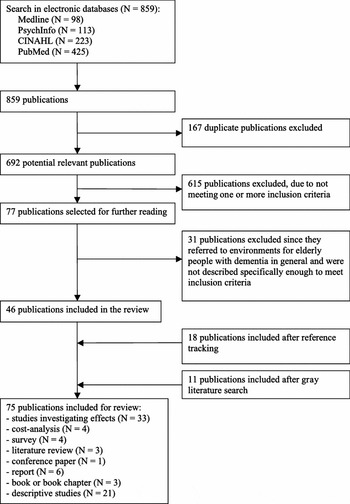
The search of the electronic databases yielded 859 publications. Based on title and abstract, 77 were selected for further reading, of which 46 were included in the final selection of publications (see Figure 1). Reference tracking yielded another 18 relevant publications. The gray literature search resulted in another 11 publications. Altogether, 75 publications were included in the review.
Flow chart of the publication search.

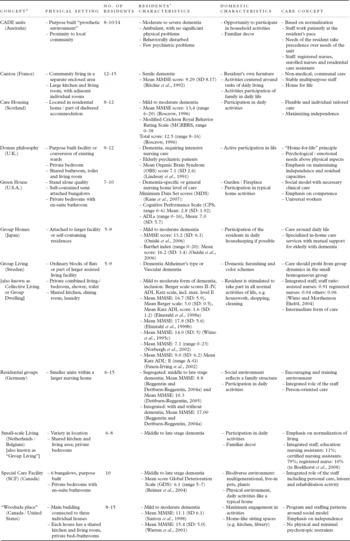
The 75 publications describe 11 types of concepts in 11 countries: “CADE units” (Australia), “Cantou” (France), “Care Housing” (Scotland), “Domuses” (U.K.), “Green Houses” (U.S.A.), “Group Home” (Japan), “Group Living” (Sweden), “Residential groups” (Germany), “Small-scale Living” (Netherlands/Belgium), “Special Care Facility” (Canada) and “Woodside place” (U.S.A./Canada). Concepts were identified based on name, country and characteristics as provided in the publications. Table 1 provides a short summary of the 11 concept types, based on the five main characteristics.
Concept characteristics (concepts are presented in alphabetical order)

a Publications:
CADE units: Carr and Marshall, Reference Carr and Marshall1993; Atkinson, Reference Atkinson1995; Fleming and Bowles, Reference Fleming and Bowles1994; Marshall, Reference Marshall1993; Marshall and Archibald, Reference Marshall and Archibald1998.
Cantou: Ritchie et al., Reference Ritchie, Colvez, Ankri, Ledésert, Gardent and Fontaine1992; Ritchie and Ledésert, Reference Ritchie and Ledésert1992; Marshall, Reference Marshall1993.
Care Housing: Roscrow, Reference Roscrow1996; Judd et al., Reference Judd, Marshall and Phippen1998; Marshall, Reference Marshall1993; Carr and Marshall, Reference Carr and Marshall1993.
Domus: Beecham et al., Reference Beecham, Cambridge, Hallam and Knapp1993; Dean et al., Reference Dean, Briggs and Lindesay1993a; Reference Dean, Proudfoot and Lindesay1993b; Macdonald et al., Reference Macdonald, Philpot and Briggs2004; Radzey et al., Reference Radzey, Kuhn, Rauh and Heeg2001; Skea and Lindesay, Reference Skea and Lindesay1996; Lindesay et al., Reference Lindesay, Briggs, Lawes, Macdonald and Herzberg1991; Marshall, Reference Marshall1993.
Green House: Rabig et al., Reference Rabig, Thomas, Kane, Cutler and Mcalilly2006; Angelelli, Reference Angelelli2006; Kane et al., Reference Kane, Lum, Cutler, Degenholtz and Yu2007.
Group Home: Funaki et al., Reference Funaki, Kaneko and Okamura2005; Hirakawa et al., Reference Hirakawa, Masuda, Uemura, Kuzuya, Kimata and Iguchi2006; Nakanishi and Honda, Reference Nakanishi and Honda2008; Yokota et al., Reference Yokota2006; Onishi et al., Reference Yokota2006.
Group Living: Annerstedt, Reference Annerstedt1993; Reference Annerstedt1994; Reference Annerstedt1997; Annerstedt et al., Reference Annerstedt1993a; Reference Annerstedt, Gustafson and Nilsson1993b; Reference Annerstedt, Sanada and Gustafson1996; Reference Annerstedt, Elmstahl, Ingvad and Samuelsson2000; Andren and Elmstahl, Reference Andren and Elmstahl2002; Reference Andren and Elmstahl2007; Ahlund, Reference Ahlund1999; Alfredson and Annerstedt, Reference Alfredson and Annerstedt1994; Elmstahl et al., Reference Elmstahl, Annerstedt and Ahlund1997; Reference Elmstahl, Ingvad and Annerstedt1998a; Reference Elmstahl, Stenberg, Annerstedt and Ingvad1998b; Faxen-Irving et al., Reference Faxen-Irving, Andren-Olsson, Af Geijerstam, Basun and Cederholm2002; Jensen et al., Reference Jensen, Olsson, Nyberg and Gustafson2002; Kihlgren et al., Reference Kihlgren, Brane, Karlsson, Kuremyr, Leissner and Norberg1992; Kuremyr et al., Reference Kuremyr, Kihlgren, Norberg, Astrom and Karlsson1994; Malmberg and Zarit, Reference Malmberg and Zarit1993; Marshall, Reference Marshall1993; Norbergh et al., Reference Norbergh, Nordahl, Sandman and Asplund2001; Reference Norbergh, Hellzen, Sandman and Asplun2002; Radzey et al., Reference Radzey, Kuhn, Rauh and Heeg2001; Sandman and Wallblom, Reference Sandman and Wallblom1996; Svensson et al., Reference Svensson, Edebalk and Persson1996; Wimo et al., Reference Wimo1991; Reference Wimo, Adolfsson and Sandman1995a; Reference Wimo, Asplund, Mattsson, Adolfsson and Lundgren1995b; Reference Wimo, Mattson, Krakau, Eriksson, Nelvig and Karlsson1995c; Wimo and Morthenson Ekelöf, Reference Wimo and Ekelöf2004.
Residential groups: Radzey et al., Reference Radzey, Kuhn, Rauh and Heeg2001; Reggentin and Dettbarn-Reggentin, Reference Reggentin and Dettbarn-Reggentin2004a; Reference Reggentin and Dettbarn-Reggentin2004b; Leichsenring et al., Reference Leichsenring, Strümpel and Group1998; Dettbarn-Reggentin, Reference Dettbarn-Reggentin2005.
Small-scale Living: Depla and te Boekhorst, Reference Depla and te Boekhorst2007; Leichsenring et al., Reference Leichsenring, Strümpel and Group1998; te Boekhorst, Reference te Boekhorst2007; te Boekhorst et al., Reference te Boekhorst, Depla, De Lange, Pot and Eefsting2007; Reference te Boekhorst, Willemse, Depla, Eefsting and Pot2008; Peters and Duine, Reference Peters and Duine1987; van Audenhove et al., Reference van Audenhove, Declercq, De Coster, Spruytte, Molenberghs and van den Heuvel2003; Fahrenfort, Reference Fahrenfort, Miesen and Jones1997; van Waarde and Wijnties, Reference van Waarde and Wijnties2007; Marshall, Reference Marshall1993.
Special Care Facility: Reimer et al., Reference Reimer, Slaughter, Donaldson, Currie and Eliasziw2004; Slaughter et al., Reference Slaughter, Calkins, Eliasziw and Reimer2006.
“Woodside”: Arehart-Treichel, Reference Arehart-Treichel2001; Danes, Reference Danes2002; Janzen, Reference Janzen2000; McAllister and Silverman, Reference McAllister and Silverman1999; Nagy, Reference Nagy2002; Saxton et al., Reference Saxton, Silverman, Ricci, Keane and Deeley1998; Warren et al., Reference Warren, Janzen, Andiel-Hett, Liu, Mckim and Schalm2001; Reference Warren, Janzen and McKim2002.
ADL = activities of daily living; CPS = Cognitive Performance Scales; GDS = Global Deterioration Scale; MDS = minimum data sets; MMSE = Mini-mental State Examination.
Physical setting
The concepts' location varies between units situated within a larger nursing home (e.g. “Residential groups” in Germany) to stand-alone facilities (e.g. “Green Houses” in the U.S.A. or “Special Care Facility” in Canada; Dettbarn-Reggentin, Reference Dettbarn-Reggentin2005; Rabig et al., Reference Rabig, Thomas, Kane, Cutler and Mcalilly2006; Reimer et al., Reference Reimer, Slaughter, Donaldson, Currie and Eliasziw2004). In addition, there are differences within projects. For instance, “Small-scale Living” in the Netherlands/Belgium and “Group Living” in Sweden can be located in ordinary houses in the community or may be part of a larger, assisted-living facility (te Boekhorst et al., Reference te Boekhorst, Depla, De Lange, Pot and Eefsting2007; Wimo and Morthenson Ekelöf, Reference Wimo and Ekelöf2004). Stand-alone facilities may prevent institutional characteristics from gaining hold in the project (Rabig et al., Reference Rabig, Thomas, Kane, Cutler and Mcalilly2006; Reimer et al., Reference Reimer, Slaughter, Donaldson, Currie and Eliasziw2004). However, such facilities are often not feasible owing to pressures of financing arrangements and the organization of health care. Some concepts, such as “CADE units” in Australia, are located in the local community because this increases residents' opportunity to maintain their social network (Atkinson, Reference Atkinson1995).
The buildings themselves are intended to offer a homelike environment with archetypical features such as a kitchen, dining room, living room and a laundry area (Rabig et al., Reference Rabig, Thomas, Kane, Cutler and Mcalilly2006; Annerstedt, Reference Annerstedt1994). The kitchen often has an important function as a meeting center (Leichsenring et al., Reference Leichsenring, Strümpel and Group1998). Almost all residents have private rooms and, in some cases, a private bathroom. In addition, some concepts use technology to support care in many different ways. For instance, “Green Houses” in the U.S.A. use “smart house” technology consisting of prosthetic, communication and educational devices (Rabig et al., Reference Rabig, Thomas, Kane, Cutler and Mcalilly2006). This includes an interactive television to keep distant family and residents in contact with each other.
Numbers of residents
The number of residents per house or unit varies from 5–9 (e.g. “Group Homes” in Japan, “Group living” in Sweden and “Small-scale Living” in the Netherlands/Belgium) to 13–15 residents (e.g. “CADE units” in Australia, “Cantou” in France) (Atkinson, Reference Atkinson1995; Onishi et al., Reference Onishi2006; te Boekhorst et al., Reference te Boekhorst, Depla, De Lange, Pot and Eefsting2007; Ritchie et al., Reference Ritchie, Colvez, Ankri, Ledésert, Gardent and Fontaine1992). The main purpose of a small group is to promote social activities and to create an environment resembling a family (Dettbarn-Reggentin, Reference Dettbarn-Reggentin2005). There is opportunity for staff, residents and family members to become familiar with each other and thereby allow close contact and communication (Leichsenring et al., Reference Leichsenring, Strümpel and Group1998). The group dynamics of a small group seem to be beneficial for the care of residents (Annerstedt, Reference Annerstedt1993). In practice, however, group size is often determined by practical considerations, such as budget, available space and staffing (Cohen and Weisman, Reference Cohen and Weisman1991).
Residents' characteristics
Residents' characteristics are very heterogeneous, both between and within projects (see Table 1). Mean MMSE scores range from 7.1 to 17.8, although many studies do not report such objective parameters. Some concepts are designed for residents in the early stages of their disease (e.g. “Woodside” in Canada/U.S.A. and “Group Living” in Sweden). Admission criteria may include a sufficient level of participation in activities, communication skills or being ambulatory (Annerstedt, Reference Annerstedt1993; Janzen, Reference Janzen2000). In these concepts, residents are usually transferred to another care setting when these criteria are no longer met. They manifest themselves as an intermediate form of care between the residents' own home and the nursing home. One concept (“CADE units” in Australia) is specifically aimed at residents with behavioral problems and no significant physical problems (Atkinson, Reference Atkinson1995). It is perceived as a complement to existing facilities and services. In contrast, concepts such as “Domuses” in the U.K. and “Cantou” in France have a “home-for-life” principle, with residents being able to stay there until they die (Lindesay et al., Reference Lindesay, Briggs, Lawes, Macdonald and Herzberg1991; Ritchie et al., Reference Ritchie, Colvez, Ankri, Ledésert, Gardent and Fontaine1992). “Care Housing” in Scotland is intended as a home for life, except for those residents who disturb the group living experience of other residents or those residents who do not benefit from the household approach (Carr and Marshall, Reference Carr and Marshall1993).
In practice, the principle of a home for life may vary within projects. In “Group Living” in Sweden, for example, residents have become more dependent over the years than initially was intended (Norbergh et al., Reference Norbergh, Nordahl, Sandman and Asplund2001; Wimo and Morthenson Ekelöf, Reference Wimo and Ekelöf2004). Nevertheless, in Sweden increased care needs and demanding behavior, such as aggression, are the most common reasons for relocations from non-specialized group-living into dementia care units (Horttana et al., Reference Horttana, Ahlstrom and Fahlstrom2007; Wimo et al., Reference Wimo, Asplund, Mattsson, Adolfsson and Lundgren1995b). In “Small-scale Living” in the Netherlands, a home for life is seen as a basic principle, but many projects nevertheless use inclusion and exclusion criteria for selection of their residents (te Boekhorst et al., Reference te Boekhorst, Depla, De Lange, Pot and Eefsting2007). Often, extreme behavioral problems are an exclusion criterion, since this is seen as especially problematic among a small group of residents (Verbeek et al., Reference Verbeek, van Rossum, Zwakhalen, Kempen and Hamers2008). In many parts of the Netherlands “Small-scale Living” is a relatively new concept and, due to inexperience, detailed information regarding everyday practice is often lacking. Some “Group Homes” in Japan provide end-of-life care, making them true “homes for life”, while others focus on providing accommodation for elderly people in the early stages of dementia (Hirakawa et al., Reference Hirakawa, Masuda, Uemura, Kuzuya, Kimata and Iguchi2006). Hirakawa et al. (Reference Hirakawa, Masuda, Uemura, Kuzuya, Kimata and Iguchi2006) found that 76% of “Group Home” facilities considered it possible to provide end-of-life care, if necessary. However, only 17% had actual experience in providing such services. Furthermore, a survey by the Institute for Health Economics and Policy reported that in practice only 5.4% of “Group Homes” in Japan provided end-of-life care to their residents (Nakanishi and Honda, Reference Nakanishi and Honda2008).
Domestic characteristics
To create a homelike environment, the care concepts incorporate physical as well as social and organizational domestic characteristics. Physical domestic characteristics include allowing residents' own furniture, as in the “Cantou” in France or “Small-scale Living” in the Netherlands/Belgium (Ritchie et al., Reference Ritchie, Colvez, Ankri, Ledésert, Gardent and Fontaine1992; te Boekhorst et al., Reference te Boekhorst, Depla, De Lange, Pot and Eefsting2007), pets, gardens and a fireplace. In addition, some concepts, such as the “Green House”, specifically exclude traditional institutional features such as long corridors, a nurses' station and medication carts (Rabig et al., Reference Rabig, Thomas, Kane, Cutler and Mcalilly2006). These are all attempts to make the physical environment familiar and appealing to the residents. However, the physical setting alone is not sufficient to create a homelike environment, it can only facilitate this (Cohen and Weisman, Reference Cohen and Weisman1991). Organizational and social aspects of the environment are necessary components in the development of a small, homelike therapeutic setting. In all concepts, residents are encouraged to participate in the household as far as possible (e.g. “Care Housing” in Scotland; Carr and Marshall, Reference Carr and Marshall1993), with activities of daily life being planned according to the residents' wishes. They have the opportunity to choose their meals, sleep, rest, personal care and activities whenever they want (Onishi et al., Reference Onishi2006; Rabig et al., Reference Rabig, Thomas, Kane, Cutler and Mcalilly2006), and are thereby able to maintain their own lifestyle to varying degrees (te Boekhorst et al., Reference te Boekhorst, Depla, De Lange, Pot and Eefsting2007).
Social care concept
In all concepts a social model of care is applied, focusing on residents' psychosocial wellbeing rather than their physical needs. To realize this, the physical and organizational environment has been fundamentally changed in comparison with the traditional setting in nursing homes (Kane et al., Reference Kane, Lum, Cutler, Degenholtz and Yu2007). Improvement of residents' quality of life is the main priority (Rabig et al., Reference Rabig, Thomas, Kane, Cutler and Mcalilly2006), with the family often being involved in the care program (e.g. the “Woodside”, “Cantou”, and “Small-scale Living” concepts; Janzen, Reference Janzen2000; Ritchie et al., Reference Ritchie, Colvez, Ankri, Ledésert, Gardent and Fontaine1992; te Boekhorst et al., Reference te Boekhorst, Depla, De Lange, Pot and Eefsting2007). Care staff have integrated tasks and are part of the household (e.g. “Residential Groups” in Germany; Dettbarn-Reggentin, Reference Dettbarn-Reggentin2005). They live together with the residents and provide individually tailored care. Residents are stimulated, encouraged and supported, emphasizing autonomy and choice. Daily life is organized around meaningful activities, such as cooking, with a lot of personal contact. This requires the care staff to have specific skills, such as high levels of social and communication skills (te Boekhorst et al., Reference te Boekhorst, Depla, De Lange, Pot and Eefsting2007). The care staff usually comprises nursing assistants and a limited number of nurses. Detailed information regarding education and staff ratio was only available from the Netherlands and Sweden (see Table 1). Involvement of other staff members varies among projects. Some concepts (e.g. the “Green House”) use a multidisciplinary team, including a medical doctor, social worker, dietician and activity workers, while other projects (e.g. the “Cantou”) are essentially non-medical, providing additional care only if necessary (Rabig et al., Reference Rabig, Thomas, Kane, Cutler and Mcalilly2006; Ritchie et al., Reference Ritchie, Colvez, Ankri, Ledésert, Gardent and Fontaine1992). In “Domuses”, special attention and training is given to anxieties and attitudes that staff may experience to improve quality of care (Lindesay et al., Reference Lindesay, Briggs, Lawes, Macdonald and Herzberg1991).
Concepts over time
The “Cantou”, developed in France in 1968, was identified in this study as the first small, homelike concept for older people with dementia (Ritchie et al., Reference Ritchie, Colvez, Ankri, Ledésert, Gardent and Fontaine1992). During the 1980s similar concepts appeared, such as “Group Living” in Sweden (Annerstedt, Reference Annerstedt1993), “Small- scale Living” in the Netherlands (Depla and te Boekhorst, Reference Depla and te Boekhorst2007) and “Domuses” in the U.K. (Lindesay et al., Reference Lindesay, Briggs, Lawes, Macdonald and Herzberg1991). Some of these have become regular dementia care settings, such as “Group Living” in Sweden and “Small-scale Living” in the Netherlands. In both countries, the government has stimulated the development of small, homelike facilities by adjusting their policy and financial support (Annerstedt et al., Reference Annerstedt, Sanada and Gustafson1996; Verbeek et al., Reference Verbeek, van Rossum, Zwakhalen, Kempen and Hamers2008). In contrast, other facilities, such as “Domuses” in the U.K., are smaller initiatives (Macdonald et al., Reference Macdonald, Philpot and Briggs2004). “Domuses” appear to be a more costly form of care (Beecham et al., Reference Beecham, Cambridge, Hallam and Knapp1993) and in the U.K. a more widespread model of care is the “multi-purpose nursing home”, in which long-term care as well as shorter stay, day and/or respite care are provided (Macdonald et al., Reference Macdonald, Philpot and Briggs2004). This suggests that government policies may have a large influence on dissemination of the concept.
Over time, there are some indications that the concept of “Group Living” in Sweden has changed with regard to the residents' characteristics and physical design. Originally, it was developed for residents with mild to moderate forms of dementia and sufficient ADL-capacities, situated in ordinary flats, as a form of intermediate care (Annerstedt, Reference Annerstedt1993; Reference Annerstedt1994). Nowadays, group living facilities tend to become part of larger assisted-living facilities and residents' functional dependence is increasing (Wimo and Morthenson Ekelöf, Reference Wimo and Ekelöf2004; Norbergh et al., Reference Norbergh, Nordahl, Sandman and Asplund2001), which implies that these are more likely to become “homes for life”. This shift is also seen within the concept of “Small-scale Living” in the Netherlands.
Costs
Concept costs were analyzed in only four studies. Costs of “Group Living” in Sweden were analyzed in three studies (Wimo et al., Reference Wimo1991; Reference Wimo, Mattson, Krakau, Eriksson, Nelvig and Karlsson1995c; Svensson et al., Reference Svensson, Edebalk and Persson1996), while another study investigated the costs of “Domuses” in the U.K. (Beecham et al., Reference Beecham, Cambridge, Hallam and Knapp1993). The latter concluded that Domus care is more costly than regular hospital care. However, a detailed evaluation was not possible due to a small sample size and lack of variation in individual costs.
The study by Wimo et al. (Reference Wimo1991) suggests that “Group Living” is cheaper compared to the costs of nursing home care. However, this study is based on a small population (two group living facilities housing 24 residents) and regards “Group Living” primarily as a non-institutional form of care. Costs such as hospital days and extra support from social services were not included. In addition, residents of both settings were not comparable in terms of care dependency. According to Wimo et al. (Reference Wimo, Mattson, Krakau, Eriksson, Nelvig and Karlsson1995c), “Group Living” seems a cost-effective form of dementia care, although the differences were small. If residents' care dependency levels increase, the costs of “Group Living” would increase as well since institutional care would be required. Svensson et al. (Reference Svensson, Edebalk and Persson1996) suggests that the average costs per patient might be higher in “Group Living” than in old people's homes, although the costs of care vary both with the physical design and functional ability of residents. Cost comparisons are therefore difficult to make. Svensson et al. (Reference Svensson, Edebalk and Persson1996) investigated 106 “Group Living” units, housing 765 residents. Here costs tend to be lower when the number of residents per unit increases and when units are attached to other institutional facilities. In addition, units housing residents with a higher level of functional disability have a higher staff ratio.
Discussion
This study is the first to present a comparative international overview of concepts that have implemented small-scale homelike facilities for older people with dementia. Based on our review of the literature, 11 concepts were identified in 11 different countries. Some concepts have become regular dementia care facilities, while others are smaller initiatives. Similarities among concepts reflect a common social care concept, with a focus on meaningful activities based around the daily household. The implementation among concepts, however, varies with differences in residents' characteristics, numbers of residents and physical settings and might be influenced by cultural and organizational differences among countries.
This review has some limitations. It is likely that not all initiatives will have been identified for different reasons. A standard definition of a small-scale, homelike concept of dementia care is lacking. We used many search terms that relate to the topic of small-scale, home like facilities, but this does not guarantee that all studies and projects were identified. In addition, the search was restricted to publications in German, Dutch or English only, and some initiatives, particularly smaller ones, may not have been reported at all and therefore not identified. However, where initiatives are widespread within a country, it is likely that they have been included in this review. Since this research is solely based on a literature search, it is difficult to assess to what extent a concept's philosophy is implemented in practice and therefore to what extent differences exist among concepts in daily practice. With regard to objective parameters, such as residents' characteristics (e.g. scores on cognition, ADL functioning, and behavior) very limited data were available.
Clinical implications
During the implementation process of a concept's core philosophy, it is very important to translate the care concept into every day practice clearly and unambiguously (Carr and Marshall, Reference Carr and Marshall1993; Marshall and Archibald, Reference Marshall and Archibald1998). Appropriate staff training and education is essential (Annerstedt, Reference Annerstedt1993). There is, however, a tension between the focus on everyday life and the medical needs of older people with dementia (Leichsenring et al., Reference Leichsenring, Strümpel and Group1998). When too much emphasis is given to normalization of living for older people with dementia, there is a risk that professionalism in dementia care may be lost (Annerstedt, Reference Annerstedt1993). This aspect of care should not be neglected when implementing small, homelike settings.
Furthermore, the role of care giving staff is changing. In small-scale projects care is person or resident oriented, with emphasis on individual well-being. This requires different capacities and skills, for example social and communication skills, compared with traditional task-oriented care (te Boekhorst et al., Reference te Boekhorst, Depla, De Lange, Pot and Eefsting2007). Moreover, the responsibility of care staff increases (Reggentin and Dettbarn-Reggentin, Reference Reggentin and Dettbarn-Reggentin2004b). Living together with older people with dementia and creating a household is a very intensive and complex process. The use of technology may support staff in this process and may increase job satisfaction (Engström et al., Reference Engström, Ljunggren, Lindqvist and Carlsson2005).
Research implications
Although the interest in small-scale, homelike facilities in dementia care has increased, many aspects regarding this development remain unclear. The characteristics of residents in these facilities are relatively unknown. We have tried to collect data based on the literature, but this was insufficient to gain a complete understanding of objective parameters concerning residents' characteristics such as cognition, ADL functioning, quality of life and behavioral patterns. Some studies report a few such measures, but they frequently suffer from methodological limitations, such as the inclusion of a limited number of residents. Moreover, outcomes are not comparable due to the use of different measurement scales. Future research should investigate characteristics of residents in small-scale and homelike facilities and regular large-scale nursing homes in a longitudinal context, focusing on outcome measures such as behavior, functional status, quality of life and medication use. A comparison of characteristics in both settings provides insight into suitable accommodation for older people with dementia, and how to meet the needs of possible subgroups. In addition, follow-up measurements allow comparison of the development and course of characteristics among residents. In this way, knowledge about effects of the concept will be obtained. Recent studies by Kane et al. (Reference Kane, Lum, Cutler, Degenholtz and Yu2007), Onishi et al. (Reference Onishi2006) and Depla and te Boekhorst (Reference Depla and te Boekhorst2007) are a first attempt to realize this. However, organizational structures of dementia care vary across countries and probably have an effect on these evaluations. Therefore, such comparisons are only valuable when they are placed in the context of the wider structures and organization of dementia care.
Besides residents' characteristics, attention should also be paid to the experiences of the family and care staff. Family members appear more satisfied with the provided care, although no differences in burden and health are reported (Depla and te Boekhorst, Reference Depla and te Boekhorst2007). Positive outcomes for staff have been suggested, such as increased job satisfaction, but negative results, for instance a higher workload, have also been reported (Reggentin and Dettbarn-Reggentin, Reference Reggentin and Dettbarn-Reggentin2004b). A recent study by te Boekhorst et al. (Reference te Boekhorst, Willemse, Depla, Eefsting and Pot2008) proposes that nursing staff in small-scale living are more satisfied with their jobs and report lower burnout symptoms than staff working in traditional nursing homes. However, the skills and competences of staff working in small-scale and homelike facilities have not yet been investigated. Since the role of care staff is changing in this concept, further research is needed.
A final important aspect that needs further investigation relates to the costs of small-scale, homelike facilities. In this overview, a few cost analyses have been reported showing contrasting results (Svensson et al., Reference Svensson, Edebalk and Persson1996; Wimo et al., Reference Wimo1991; Reference Wimo, Mattson, Krakau, Eriksson, Nelvig and Karlsson1995c; Beecham et al., Reference Beecham, Cambridge, Hallam and Knapp1993). However, there is little understanding as yet of the interplay of costs and financial structures on these concepts, particularly in terms of the services provided, staff education, residents' care dependency and the organization of care provision. The concepts identified in our overview lack a detailed description of these factors. A cost-based comparison would be valuable, though difficult, given the diverse financial structures of health care systems across countries, and particularly in dementia care. Comparisons should provide a detailed description of the organization of dementia care and residents' characteristics in relation to costs.
Conflict of interest
None.
Description of authors' roles
All authors critically reviewed the manuscript, read and approved the final manuscript.