Citizens’ willingness to fight for their country affects governments’ decisions to go to war and, once a conflict has started, a country’s performance on the battlefield.Footnote 1 What, then, explains citizens’ willingness to fight for their country in times of war? While high-profile traumatic events, such as the terrorist attacks in Paris in November 2015 or the 9/11 attacks on New York, can propel people to sign up and protect their country,Footnote 2 relatively little is known about people’s willingness to serve. Below, we explore some of the more enduring and material, rather than short-term or affective, determinants of individual willingness to fight for one’s country. Specifically, we focus on how individual income and country-level income inequality jointly relate to the willingness to fight.
Using data from six waves of the World Values Survey (WVS)Footnote 3 with over 100,000 respondents from more than ninety countries, we provide the most comprehensive analysis to date of the link between income, income inequality and people’s willingness to fight. We find that respondents from countries where income is more evenly distributed are more willing to fight for their country than those from high-inequality countries. Furthermore, there is no direct relationship between individual income and willingness to fight. Rather, the association between willingness to fight and respondents’ income depends on a country’s level of income inequality: when income inequality is high, higher-income individuals are less willing than their lower-income compatriots to fight for their country. When inequality is low, differences in the willingness to fight between better-off and less well-off citizens are modest and substantially smaller than the differences between rich and poor in high-inequality settings. Thus people at opposite ends of the income spectrum differ in their willingness to fight for their country only when income inequality is high. Finally, our analyses indicate that differences between the rich in high- versus low-inequality settings are more pronounced than differences between the poor in high- and low-inequality settings, suggesting that it is willingness to fight on the part of the rich rather than the poor that is chiefly affected by inequality.
We examine several potential explanations for these findings, including arguments based on mobilization costs, nationalism, redistribution concerns and capital intensity. Our results show the mobilization cost account to be most consistent with the data, especially with respect to the very rich in countries where inequality is most pronounced. More precisely, under such conditions better-off individuals can effectively ‘buy themselves out of service’ by paying their poorer compatriots to serve rather than doing so themselves. Meanwhile, as noted, the poor in high-inequality countries differ little from the poor in low-inequality settings in their willingness to fight, as would be expected if only opportunity costs are considered.
This article makes three main contributions. First, we provide insights into the country- and individual-level foundations of war-related attitudes that are central to states’ ability to mobilize their populations and to their performance on the battlefield. Secondly, our findings suggest that, in addition to factors such as feelings of patriotism, individuals’ backgrounds (for example, gender, age), the country’s history of military conflict and material considerations are important drivers of citizens’ willingness to fight, especially when it comes to wealthier individuals. Finally, we contribute to the growing literature on the link between income inequality and conflict by examining the role of economic factors in shaping attitudes about wartime behavior.
INCOME, INEQUALITY AND WILLINGNESS TO FIGHT
In recent years, social scientists have begun to explore why people are willing to fight for their country. For example, studies have shown that demographic and attitudinal factors matter – for instance, women, older people, divorced individuals and the unemployed have been found to be less willing to fight, and education does not appear to be a strong predictor of the inclination to serve.Footnote 4 Perhaps not surprisingly, attitudes such as national pride, confidence in the army and support for an authoritarian regime are positively correlated with the willingness to fight.Footnote 5 Country-level factors are also at work: willingness to fight is higher in the Nordic countries and lower in enduring democracies and countries that were on the losing side in World War II.Footnote 6 Current politics and policies matter too, as a country’s entanglement in ongoing conflictsFootnote 7 and having a conscription armyFootnote 8 have also been linked with individual motivation to fight for one’s country.
While undoubtedly important, one issue this previous research has yet to address is whether and how economic considerations and circumstances shape the willingness to fight. Our article tries to fill this gap by focusing on two prominent variables – individual income and country-level disparities in how income is distributed. We focus on inequality because the economic foundations of war have long been of interest to political scientists. The literature on war assumes that war is costly because it requires inputs of economic resources and labor.Footnote 9 A large strand in this literature suggests that these costs are not spread equally among individuals. Esteban and Ray show that in times of war, wealthier individuals choose to provide economic resources rather than labor because their market income exceeds what they can potentially earn through military service.Footnote 10 Poorer individuals, however, choose to contribute their labor because their market income is lower than their expected compensation for serving. There is plenty of anecdotal evidence to support this opportunity-cost-based logic. Military service often offers clear material advantages like a steady income, along with a means of acquiring human capital through education and technical training. The latter can lead to more satisfying and higher-paying careers after military service, particularly for minorities and marginalized groups.Footnote 11 In some cases, military service even provides a path to acquiring political and legal rights, citizenship and national integration for marginalized groups.Footnote 12
All told, the poor may feel that they have little to lose and much to gain from military service, and there is ample evidence that combatants are often recruited from the poorer segments of society.Footnote 13 Likewise, rich individuals often have legal means of buying themselves out of military service.Footnote 14 While some studies have questioned the empirical validity of the opportunity cost argument,Footnote 15 we would expect a negative relationship between individual income and willingness to fight for one’s country.
Other studies suggest that the distribution of income in society, measured at the country level, may affect citizens’ willingness to fight for their country. A large body of work suggests that income disparities beget intolerance, reduce civic participation, weaken interpersonal trust and satisfaction with the political system, and shape attitudes about gender equality.Footnote 16 Economic disparities have also been viewed as drivers of within-state instability.Footnote 17 Thus if inequality reduces within-state cohesion, it may be associated with a lower willingness of citizens to fight for their country. Inequality, however, may also have the opposite effect, at least among some. Solt, for example, provides evidence that income disparities are positively related to nationalistic sentiments.Footnote 18 Given that national pride is positively correlated with the willingness to fight in times of war,Footnote 19 inequality may increase willingness to fight for one’s country, to the extent that it increases nationalism. Whether income inequality enhances or diminishes people’s willingness to fight is currently an open empirical question.
There is some suggestive evidence that it does. Using the WVS data, Inglehart, Puranen and Welzel report that members of wealthier societies may be less willing to fight because they view their lives – and the value of their lives – in very different ways compared to members of poorer societies.Footnote 20 More specifically, improved living conditions bring fundamental shifts in people’s beliefs and values, most notably their readiness to sacrifice their lives. Building on this ‘opportunity–value link’ (whereby subjective human values are linked to objective life opportunities), they demonstrate that the publics of developed societies have become more supportive of ‘emancipative/post-materialist values’ while their willingness to fight in war has declined.
Our study extends Inglehart, Puranen and Welzel’s thesis in several ways. First, while they highlight the role of ‘life opportunities’ – a composite country-level measure that includes, among other things, the inverted Gini index – in explaining willingness to fight, our measures imply an important independent impact of income inequality. In fact, the economic explanation in their study receives relatively little empirical attention. Not only is the Gini index only one of six multi-component indicators of ‘life opportunities’, its low factor loading (0.56) (the lowest of the six items in the index) suggests that it captures a separate empirical and, we believe theoretical, dimension. Secondly, we examine how individual income and country-level income inequality jointly shape individual willingness to fight, whereas Inglehart, Puranen and Welzel do not examine individual income. In the present article, we explore the economic explanation more deeply, notably the interactive effect of individual income and country-level disparities on willingness to fight, thereby focusing on a different set of hypotheses than those tested by Inglehart, Puranen and Welzel.
Beyond the additive impact of individual and country-level economic drivers of willingness to fight, some research has sought to connect individual-level income and country-level inequality by suggesting that the two interact to affect willingness to fight for one’s country. This scholarship offers four main mechanisms for this interaction. First, according to Shayo,Footnote 21 inequality increases nationalism among the poor, for whom identification with the nation offers a higher status than their economic identity. To the extent that nationalism is correlated with willingness to fight, we may therefore expect that when inequality is high, the poor should be more willing to fight for their country than the rich. This logic implies that there may not be substantial differences between different economic strata when income inequality is low.
A second proposed mechanism for a conditional effect of income and inequality on willingness to fight focuses on mobilization costs. Esteban and Ray suggest that inequality lowers both the financial and human opportunity costs of conflict.Footnote 22 Thus when inequality is high it becomes cheaper for the rich to pay the poor to take on the burden of military service. High inequality also makes it more attractive for the poor to fight in exchange for benefits. Kuhn and Weidmann empirically show that greater income disparities within an ethnic group make ethnic conflict more likely because they make mobilizing the poor cheaper, and the rich have more resources to spare for mobilization.Footnote 23 Applying this logic to the country level suggests that greater inequality makes it cheaper for the rich to buy themselves out of service because poor individuals are willing to serve. This view also implies that we should not expect big differences between the poor and the rich when inequality is low.
A third proposed mechanism based on Scheve and Stasavage holds that wars that require full mobilization increase support for redistribution and progressive taxation.Footnote 24 This implies that when initial inequality is high, demands for redistribution are greater than when inequality is low. Thus, anticipating future demands for higher taxation, the rich in high-inequality countries may be less willing to serve than the poor (and less willing to support war altogether), since they know they will face higher taxation. In low-inequality countries, people at both ends of the spectrum should have relatively similar willingness to fight because low inequality means that taxation and redistribution are not expected to increase significantly in the event of a war.
Finally, focusing on democracies, Caverley suggests that poorer individuals in high-inequality contexts may be more willing to fight for their country because the capital intensity of their militaries reduces the likelihood that they will have to sacrifice their lives.Footnote 25 Meanwhile, the rich in democracies should be less willing to fight for their country if inequality is high because they will bear a disproportionate share of the economic costs of war. This explanation also implies that as inequality decreases, we should observe fewer differences between the rich and the poor in their willingness to fight.
To sum up, the literature implies that socio-economic position is likely to be a strong determinant of individual willingness to fight for one’s country in times of war. Individuals are more likely to express a willingness to join up if they expect to receive selective economic incentives that outweigh the benefits of not joining.Footnote 26 However, we should be cautious about the simplistic conclusion that low income alone is a sufficient trigger for military service during war. We propose that while low income is a motivating factor, its effect is conditional on the unequal distribution of income.
Taken together, the existing theorizing and evidence suggests four empirically testable hypotheses:
Hypothesis 1: Willingness to fight is lower in high-inequality countries.
Hypothesis 2: In general, willingness to fight is lower among the rich than among the poor.
Hypothesis 3: In high-inequality countries, willingness to fight is lower among the rich than among the poor.
Hypothesis 4: There are no major differences between the poor and the rich when inequality is low.
It should be noted that, for any given individual, willingness to fight may be moderated by the associated risk of actually having to do so. The most obvious variables that may affect these odds are gender and age, with young males aged 18–45 much more likely to experience conscription than women.
DATA AND EMPIRICAL METHOD
This section outlines the model and the data we use for the empirical analysis. Additional description of the data is in the Appendix. The unit of analysis is individual, based on responses to the WVS Waves 1–6 (the list of countries and years is in Appendix Table A.1) Anderson et al., (Reference Anderson, Getmansky and Hirsch-Hoefler2017).Footnote 27
Our basic specification is designed to estimate the effect of individual-level income and country-level inequality on the probability of an affirmative answer to the WVS willingness to fight for their country question, controlling for individual- and country-level variables that may affect this answer.Footnote 28 Formally, we estimate different versions of the following probit model:
 $$\eqalignno{ & \Pr \left( {Willingness\,to\,Fight_{{i,j,t}} {\equals}1\!\mid \! {\mib{QuintileZ}} _{i} ,\,Gini_{{j,t{\minus}1}} ,\,{\mib{X}} _{i} ,\, {\mib{X}} _{{j,t{\minus}1}} ,\,\lambda _{j} ,\,\gamma _{t} } \right) \cr & {\equals}\,G\left( {{\mib{QuintileZ}} _{i} {\plus}Gini_{{j,t{\minus}1}} {\plus}{\mib{QuintileZ}} _{i} {\times} Gini_{{j,t{\minus}1}} {\plus}{\mib{X}} _{{i,t}} {\plus}{\mib{X}} _{{j,t{\minus}1}} {\plus}\lambda _{j} {\plus}\gamma _{t} } \right) $$
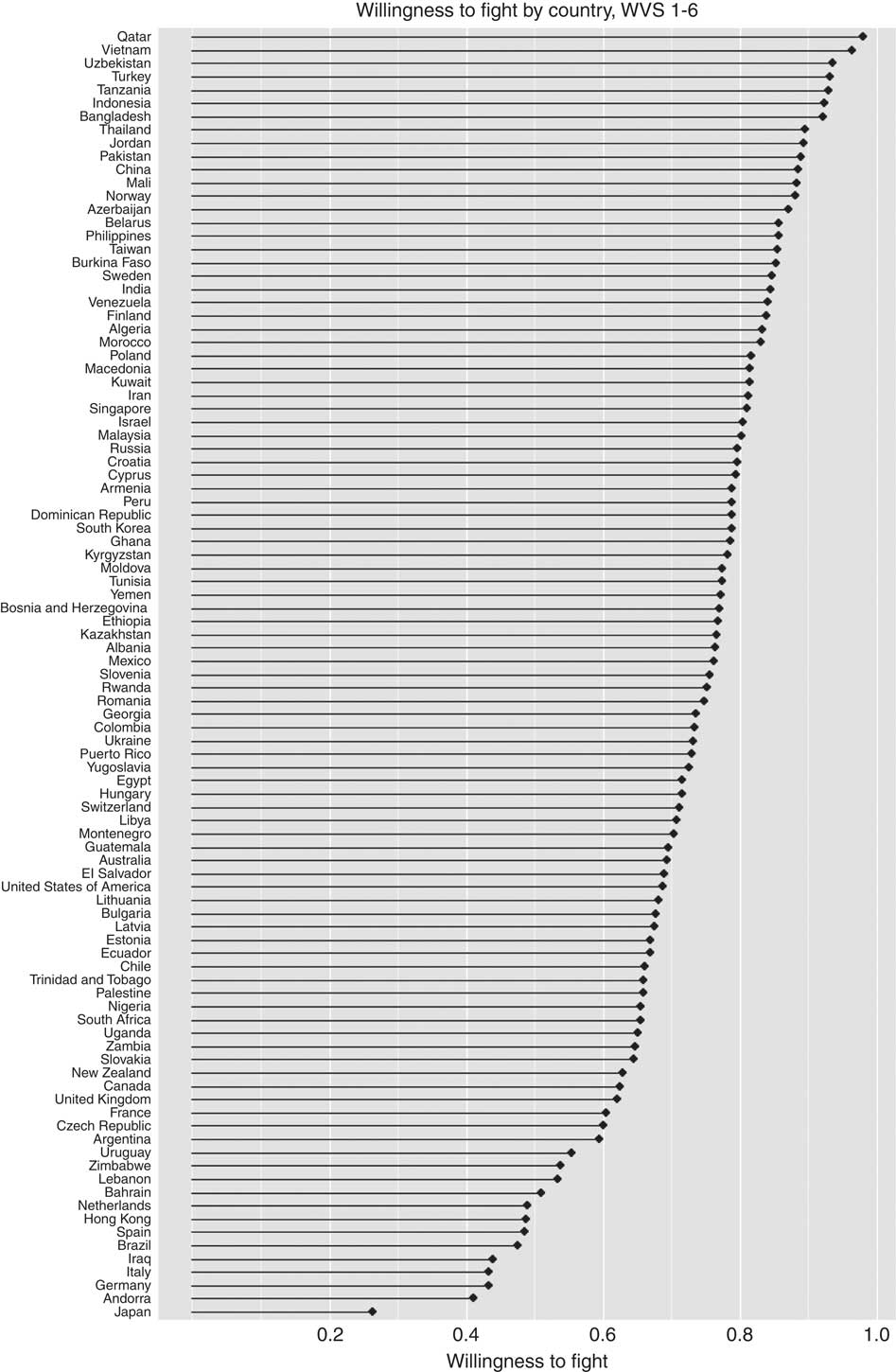
where Willingness to Fight i,j,t equals 1 if respondent i from country j in survey t replies ‘yes’ to the WVS question about willingness to fight, and 0 if the answer is ‘no’. The distribution of answers to this question is Figure 1. There is a high degree of heterogeneity among countries, with the percent of affirmative answers ranging from 26 per cent in Japan to 98 per cent in Vietnam. The median percent of missing values per country-year in the Willingness to Fight question is 12 per cent, and the mean is 20 per cent.Footnote 29
Willingness to fight

QuintileZ i is a vector of respondent i’s five income group fixed effects, with Z denoting income quintile.Footnote 30 These variables are based on the WVS question that asks respondents to indicate their income group on a scale from 1 (lowest income group) to 10 (highest income group). We convert these self-reported income deciles into five quintiles, and include five binary indicators of income quintiles. Gini j,t−1 is country-level income inequality measure based on the Net Gini variable from the Standardized World Income Inequality Dataset (SWIID).Footnote 31 We interact each indicator of QuintileZ i with Gini j,t−1 to examine whether country-level inequality affects the relationship between income quintile and willingness to fight.
X
i,t
is a vector of individual-level predictors taken from the WVS surveys. We include indicators for gender (Female
i
), age and age squared (Age
i
and
 $Age_{i}^{2} $
), three fixed effects for marital status (Single
i
, Married/Living together
i
, and Divorced/Separated
i
), and an indicator for whether the respondent listed a religious denomination. We use this variable to control for religiosity, although there may be secular individuals who nonetheless name a religious affiliation. In the Appendix, we also report the results of tests that include additional control variables such as education and being a member of a minority group, and attitudinal controls such as confidence in government and in the army, and feelings of national pride. Inclusion of these controls does not change our main results.
X i,t−1 is a vector of country-level time-varying characteristics. In this vector, we include GDP j,t−1(log) and Population j,t−1(log) using data from the Penn World Tables version 7.1.Footnote 32 We also control for the type of political regime. Figure 1 suggests that democratic countries tend to have lower levels of willingness to fight than less democratic countries (although there are outliers, such as Sweden and Norway, which rank high in willingness to fight). We control for regime type by including a variable Democracy j,t−1 that ranges from 0 (full autocracy) to 1 (full democracy), based on democracy and autocracy scores from Polity IV.Footnote 33 Additionally, we control for the country’s prior involvement in conflict in any of the five years that precede the survey (Conflict5 j,t−1). The data on conflict are from the Militarized Interstate Disputes 4.0 dataset and the Uppsala Conflict Data Program / Peace Research Institute Oslo Armed Conflict Dataset v.4-2014.Footnote 34 We also include an indicator Conscription j,t−1 that equals 1 if a respondent’s country has a conscription-based military.Footnote 35 Finally, in some specifications reported in the Appendix, we control for country-level ethnolinguistic fractionalization measured in 1961 (ELF61 j ).Footnote 36 Country-level controls are lagged. Summary statistics of individual- and country-level variables are in the online appendix.
λ j is a country fixed effect that controls for time-invariant country-level factors, and we include it to reduce the possibility of omitted variable bias.Footnote 37 γ t is a survey-wave fixed effect that absorbs time trends in responses to the willingness to fight question.Footnote 38 In some specifications, we cluster the standard errors at the subnational geographic area using information on the respondent’s subnational region of residence available for some surveys. Since in some cases responses from the same region may be correlated (for example, due to common ethnicity or past experience with conflict), we also report results adjusted for potential clustering within countries.
MAIN RESULTS
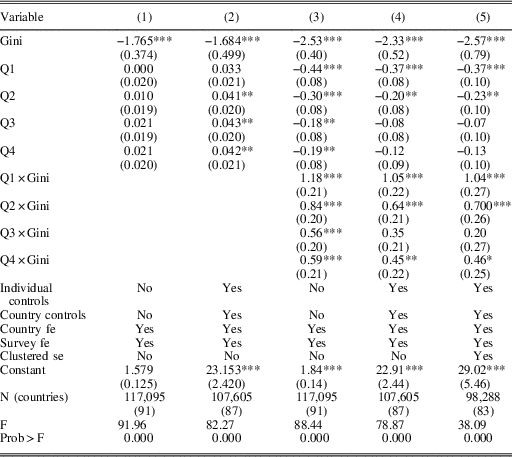
Table 1 presents the coefficients of various specifications of the model. Here we report the results for male respondents only because females are not required to serve in the military in all countries in our sample, with the exception of Israel. In the online appendix, we report the results for the entire sample, as well as the coefficients of our various control variables. By answering this question, male respondents are asked to consider a situation in which they might conceivably find themselves. In all models, our baseline is quintile five (the wealthiest respondents). We use all the 100 Gini j,t−1imputations.Footnote 39
Main Results

Note: the unit of observation is individual. Q5 is the baseline. Standard errors are in parentheses. These results are based on male respondents only (full sample results are in the Appendix). Column 5 reports robust standard errors adjusted for clustering within country. The individual controls include a gender indicator, age, age squared, three marital status fixed effects, and an indicator for whether the respondent is listed a religious denomination. The country controls include log of population, log of GDP, democracy score, an indicator for whether the respondent’s country was involved in a conflict at some point within the five years prior to the survey, and an indicator for whether the respondent’s country has a conscription-based military. All results include country and survey fixed effects. *p≤0.1, **p≤0.05, ***p≤0.01
We start with a simple model, controlling only for country and survey fixed effects, and without interacting individual income and country income inequality. Column 1 suggests that inequality is negatively related to willingness to fight (Hypothesis 1), but that individual income does not have a statistically significant relationship with willingness to fight (Hypothesis 2). When we add individual- and country-level time-varying controls in Column 2, inequality is still negatively associated with willingness to fight. The relationship between willingness to fight and income appears to be non-linear: it is higher in the middle of the income scale (Quintiles 2, 3, and 4), and lower among the poorest (Quintile 1) and wealthiest (Quintile 5) respondents. In summary, while willingness to fight for one’s country is negatively associated with country-level inequality (in support of Hypothesis 1), there is no strong direct association with individual income (contrary to Hypothesis 2).
Moving on with our tests, we interact income inequality with individual income to examine whether the effect of income on willingness to fight is conditional on income disparities. In Column 3, we test a simple model without controls (we include only country and survey fixed effects), and in Column 4 we add individual- and country-level time-varying controls. In Column 5, we adjust standard errors for within-country clustering. In the Appendix, we show that the results are also robust to clustering at the country level. The results suggest that the negative relationship between inequality and willingness to fight holds here as well. Moreover, the coefficients of some quintiles and the interaction terms are statistically significant.
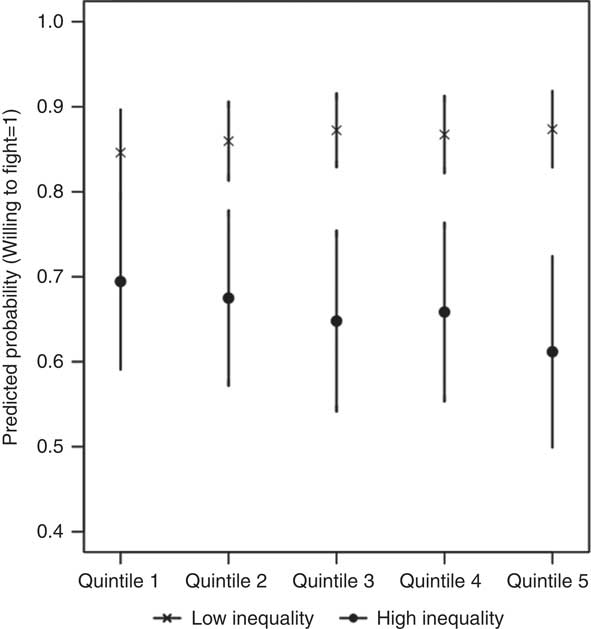
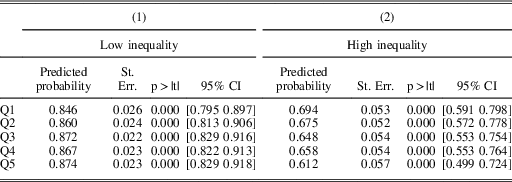
Since the coefficients cannot be directly interpreted, in Table 2 we present the predicted probabilities of ‘yes’ for each income quintile, holding net Gini at its minimum (low inequality) and then at its Footnote maximum (high inequality), and keeping the other variables at their real values.Footnote 41 These results are based on models with individual and country controls, as well as country and survey fixed effects, and clustered standard errors. They are the most conservative estimates: our findings are stronger for models with fewer controls. Figure 2 depicts the predicted probabilities for male respondents, by income and inequality level.
Predicted probabilities plot. Note: predicted probabilities based on estimates in Column 5 in Table 2 (male respondents only, controlling for individual- and time-varying country-level factors, survey wave and country fixed effects, and adjusting standard errors for clustering). For each income quintile, the plot presents predicted probabilities of ‘yes’, and their 95 per cent confidence interval, for low and high levels of inequality (net Gini set at minimum and at maximum, respectively). There is a statistically significant difference between low and high inequality. Even for quintile 1, where the confidence intervals overlap, the point estimate is statistically significant (p=0.51).

Predicted Probabilities of Willingness to Fight=‘yes’ based on Column 5 in Table 1

Note: this table reports estimates for male respondents (predicted probabilities for the full sample are reported in the Appendix). We calculate predicted probabilities using the –mimrgns- command in Stata,40 setting net Gini at its minimum (low inequality) and at its maximum (high inequality), keeping the other variables at their real values. There are statistically significant (95 per cent) differences between Quintile 1 and Quintile 5 in low inequality (0.846≠0.874, p=0.000) and in high inequality (0.694≠0.612, p=0.008).
In our interpretation of the predicted probabilities, we focus on comparing Quintiles 1 and 5 (the bottom and top 20 per cent, respectively). Four results emerge: (1) high inequality is associated with a lower probability of an affirmative answer in all income quintiles. (2) In low-inequality countries, the probability of ‘yes’ is increasing modestly in income, whereas in high-inequality countries it is decreasing in income. In countries where inequality is low, the predicted probability of ‘yes’ among poor male respondents is 0.846, and 0.873 among wealthy male respondents (p=0.000). Where inequality is high, the probability that a poor male respondent will reply affirmatively is 0.694, and 0.612 for a wealthy male respondent (p=0.008). (3) The substantive difference in the probability of an affirmative answer between Quintiles 1 and 5 is larger in countries where income inequality is high than where it is low (consistent with Hypotheses 3 and 4). In countries with low inequality, the poor are only 2.8 percentage points less likely to answer ‘yes’ than the wealthy, whereas they are 8.2 percentage points more likely to reply ‘yes’ than wealthy respondents in countries where inequality is high. Finally, (4) the differences among the rich are greater than the differences among the poor when we compare low and high inequality countries.Footnote 42
In sum, our findings suggest that willingness to fight is lower in countries with higher inequality; that it does not have a direct relationship with individual income; that the rich are less willing to fight for their country than the poor when income inequality is high, and the rich are slightly more willing to fight than the poor when inequality is low, though the differences are small; that the substantive differences between the willingness to fight of the poor and the rich are bigger when inequality is high; and that the differences between low and high inequality countries are more pronounced among the rich.
ROBUSTNESS CHECKS
We conduct several robustness checks to assess whether our main findings hold when we use alternative measurements of inequality, and restrict our sample. The regression tables and the predicted probabilities are in the Appendix. Overall, these checks show that our results are robust to using alternative measures of inequality (LIS Gini index and relative redistribution rather than Gini). We also show that outliers do not affect our findings: the results hold when we drop various outliers. Finally, our results become substantively stronger when we restrict our sample to young males aged 18–45 who reside in democratic countries.
EXPLAINING OUR FINDINGS
What accounts for our findings? In the discussion above, we outline four potential reasons for an interactive effect of income and inequality on willingness to fight. We now discuss which theory is more consistent with our data.
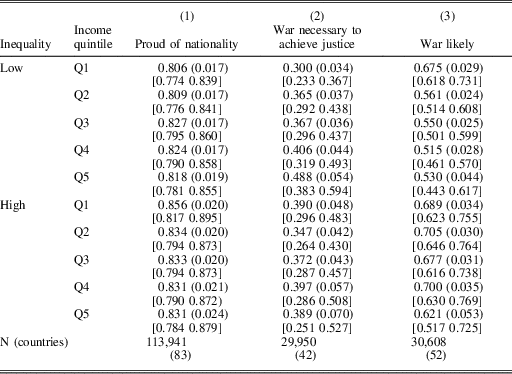
The first proposed explanation is that the poor become more nationalistic when inequality is high, making them more willing to fight than the rich.Footnote 43 We use the WVS question on how proud respondents are of their nationality to test this hypothesis.Footnote 44 Column 1 in Table 3 presents the linear predictions of nationalistic attitudes. The data suggest that there are no statistically significant differences between the poor and the rich, and that respondents from high-inequality countries express greater pride in their nationality than respondents from countries with low inequality. Thus nationalistic sentiments cannot account for the differences between the rich and the poor, or for the finding that respondents from high-inequality countries are less willing to fight.
Alternative Explanations for the Findings

Note: this table reports predictions based on OLS models (Columns 1, 3) and a probit model (Column 2), with standard errors adjusted for within country clustering in parentheses, and 95 per cent confidence intervals in square brackets. These results use male respondents only. All regressions include individual- and time-varying country-level factors. Column 1 includes country and survey fixed effects. Additional information about these tests and regression tables are in the Appendix.
According to the second proposed mechanism, high inequality makes it more attractive for the rich to buy themselves out of service, and thus reduces their willingness to fight. When income disparities are greater, the income of the poor falls even lower than the average income, thereby making it cheaper for the rich to mobilize the poor.Footnote 45 Since mobilization costs affect both the poor and the rich, this view implies that when inequality changes from low to high, the predicted probability of willingness to fight should rise among the poor by a similar order of magnitude as it falls among the rich. This is not precisely what we find. In the difference-in-difference calculation above (see footnote 41), we show that the gap in the predicted probability of willingness to fight among the rich is greater than its rise among the poor. However, the mobilization cost explanation still holds among the rich. At the same time, it remains to be examined why a drop in mobilization costs has a smaller effect on willingness to fight among the poor than among the rich.
According to the third explanation, the rich may be less willing to fight when inequality is high because they anticipate that progressive taxation will increase in the aftermath of a war.Footnote 46 This anticipated capital contribution makes them feel less obligated to contribute their labor. Based on the difference-in-difference calculations described above, this explanation is consistent with our data because it would explain why higher inequality has a stronger impact on the rich than on the poor. To further examine this explanation, we return to the WVS. One WVS question asks respondents whether, under some conditions, war is necessary to obtain justice. If the rich are less willing to fight for their country because of post-war redistribution concerns, then we expect the rich in countries with high inequality to be less likely to respond affirmatively to this question, compared to their poorer compatriots. This logic also implies that when inequality is low, there should not be a significant difference between people in different economic strata with respect to their views on the necessity of war. In fact, that is not the picture that emerges from Column 2 in Table 3. Rather, when inequality is high, there is no statistically significant difference between the rich and the poor with respect to their view on the necessity of war (the difference between 0.390 and 0.389 is not statistically significant, p>0.1). However, when inequality is low, better-off respondents are more likely to agree that war may be necessary (the difference between 0.300 and 0.488 is statistically significant, p<0.01). These findings cannot be explained by taxation concerns, but can be accounted for by the mobilization costs explanation.Footnote 47
Finally, Caverley’s theoryFootnote 48 implies that the poor in high-inequality democracies may be more willing to fight because capital-intensive militaries shield them from many risks of war, and the material costs of war are incurred by the rich. This view also implies that the poor in these countries should be more supportive of war in general. The results in Column 2 are not consistent with this view, and thus we conclude that it cannot account for our findings.Footnote 49
In sum, our analysis suggests that the patterns we identify with respect to willingness to fight are consistent with explanations that emphasize material considerations, especially for the rich in high-inequality countries. That said, mobilization costs do not make the poor in high-inequality countries more willing to fight than the poor in low-inequality countries. We also conclude that our data are not consistent with several other explanations that highlight the role of nationalism, redistribution concerns or greater willingness to support military policies on the part of the poor.
CONCLUSIONS
We examine the joint role played by individual income and country-level inequality in shaping people’s willingness to take up arms for their country using representative national surveys alongside country-level data for dozens of countries over more than three decades.
At the theoretical level, our work extends previous research on the determinants of individual willingness to fight for one’s country by connecting economic disparities with attitudes about wartime behavior. The first and perhaps most significant theoretical contribution of this research is the finding that the association between willingness to fight and respondents’ income depends on country-level income inequality. We find that people are less willing to fight for their country when income asymmetries are greater, while individual income does not have a robust relationship with willingness to fight. Additionally, we show that as the distribution of income becomes more unequal, the rich become less willing to fight. We also find that substantive differences in willingness to fight between people at opposite ends of the economic spectrum are greater when inequality is high. This pattern of findings extends Inglehart, Puranen and Welzel’s notion of life opportunities,Footnote 50 in that the better life opportunities that exist in low-inequality countries are consistent with our finding that there is no difference between the poor and the rich in their willingness to fight when inequality is low. This means that low inequality – which is part of the ‘life opportunities’ index in Inglehart, Puranen and Welzel – moderates the effect of individual income on the willingness to fight for one’s country – especially among young males in low-inequality democratic countries. Conversely, when inequality is high, individual income makes a difference, with poorer people more willing to fight.
Importantly, our analysis shows that the effect of inequality is stronger among the rich than among the poor (note the growing gap between low and high inequality in Figure 2 as income increases). Our explanation for this result is that inequality makes it cheaper to mobilize the poor, and thus reduces the willingness of the rich to fight. Poorer citizens, for their part, are insensitive to levels of income inequality. This may partially be explained by the fact that mobilization can be a route to relative upward mobility. In effect, by serving their country, low-income individuals gain status and recognition. Overall, our findings are consistent with explanations that stress material incentives and a cost–benefit approach, especially among wealthier citizens. We also present evidence that our results cannot be fully explained by several alternative approaches.
Consistent with previous research, age, gender and marital status have significant effects on willingness to fight, with a greater willingness to fight among younger citizens, men and married individuals. Religious affiliation also has a positive effect on willingness to fight in times of war. There is no correlation between education and willingness to fight (in fact, the relationship is not monotonic).Footnote 51 In line with other emerging work in the field of willingness to fight,Footnote 52 we find that attitudinal constructs, such as confidence in the government and armed forces and pride of nationality, significantly influence individuals’ willingness to go to war. Likewise, cross-national differences in countries’ histories of military conflict also exert significant effects on individuals’ willingness to fight,Footnote 53 such that the publics of Germany and Japan report low rates of willingness to fight.Footnote 54 There is also a slightly higher percentage of those willing to fight in countries with conscription.Footnote 55 Yet the substantive results of our analyses of six cumulative waves (1981–2013) of the WVS for more than ninety countries remained the same: the poor are slightly less likely to respond affirmatively than the rich when inequality is low, and they are more likely to respond affirmatively than the rich when inequality is high.
It should be noted that our main results hold when we restrict our sample to males in democracies. In non-democracies, there are no statistically significant differences between poorer and wealthier respondents. This makes sense if willingness to fight is driven by an expectation of future benefits, in that such benefits are less likely in non-democracies. This finding is consistent with Inglehart, Puranen and Welzel’s notion of life opportunities.
Our findings also have an important normative implication: greater income inequality may be associated with unequally shared burdens when it comes to the provision of labor for war efforts. If our findings are reflected in people’s actual behavior, the inescapable conclusion is that inequality begets less shared sacrifice.
These results speak to a variety of challenges that states must confront in defending themselves or their interests in the face of growing inequality, especially in an age when the military is increasingly high-tech, and therefore reliant on better-educated, highly skilled soldiers (who tend to come from better-off backgrounds). As those who are well-off become more apathetic, the ability of states to maintain a modern and well-prepared military may be undermined. Moreover, while wealthier citizens may be less likely to serve, they nonetheless make up the majority of those in positions of power – who ultimately make decisions on when and where to go to war.
All in all, while much attention has been paid to the need to address growing income inequality, the focus is often on the economic consequences of inequality for those who have less – and their implications for health care, education, and other aspects of public welfare and civil life. The results of this article suggest that states should be attuned to the possibility that greater income inequality also results in an increasingly asymmetric distribution of risk within society, by influencing decision making on the part of the rich when it comes to who goes to war.