Childhood obesity is an epidemic in the United States of America, affecting nearly one in four of the children. Reference Trasande, Liu, Fryer and Weitzman1 Children and young adults with CHD are similarly affected. Reference Pinto, Marino and Wernovsky2–Reference Shustak, McGuire, October, Phoon and Chun5 Moreover, some patients with CHD have impaired growth trajectories and are at risk of being underweight. Reference Daymont, Neal, Prosnitz and Cohen6,Reference Freud, Webster and Costello7 The effect of body mass index on paediatric CHD surgical outcomes has centred on short-term outcomes to date. Reference Garcia and Aggarwal8–Reference Zaidi, Bauer and Michalsky11 More recent data in CHD patients on both ends of the weight spectrum have found higher rates of major morbidity and longer lengths of stay in the immediate post-operative period. Reference Buelow, Earing and Hill10–Reference O’Byrne, Jacobs, Jacobs and Jonas14 Studies exploring adult cardiac surgical outcomes have reported that the impact of body mass index extends through the first post-operative year. Reference Johnson, Parlow, Whitehead, Xu, Rohland and Milne15,Reference Zittermann, Becker, Gummert and Börgermann16 However, the impact of body mass index on morbidity and mortality surgery beyond the initial post-operative period amongst paediatric and young adult patients undergoing elective CHD has not been explored.
The interplay amongst body mass index, race/ethnicity, and payer status are complex. Reference Trasande, Liu, Fryer and Weitzman1,Reference Freedman, Khan, Serdula, Ogden and Dietz17 Multiple studies have demonstrated associations amongst race/ethnicity, payer, and adverse short-term outcomes in CHD patients. Reference Anderson, Fieldston, Newburger, Bacha and Glied18,Reference Peterson, Chen, Nguyen and Setty19 However, the degree to which race/ethnicity and payer may explain the effect of body mass index – or body mass index may explain the effects of race/ethnicity and payer – has yet to be explored in the context of CHD post-operative outcomes.
We hypothesised that body mass index might be a potentially modifiable risk factor explaining some of the disparities in outcomes following CHD surgery. We aimed to assess associations between body mass index and 1-year unplanned re-admission and re-intervention rates and mortality in children and young adults following elective CHD surgery and to evaluate the impact of race/ethnicity and payer status on these associations.
Materials and methods
Study population
We performed a single-centre retrospective cohort study, including patients 2–25 years of age who underwent elective CHD surgery from 1 January, 2010 to 1 July, 2017 at the Columbia University Irving Medical Center. We excluded patients from 0 to 2 years of age because growth in this time period can be reflective of the intrauterine environment, and body mass index categories have not been recommended for clinical use in this age category. Reference Touwslager, Gielen and Derom20–23 We chose to focus on elective CHD surgical cases in which patients and providers have the potential to adjust pre-operative body mass index. To avoid potential confounding, patients with significant pre-operative risk factors defined in accordance with the Society of Thoracic Surgeons Congenital Heart Surgery Database (pre-operative mechanical circulatory support, shock, mechanical ventilation to treat cardiorespiratory failure, major neurological deficit, and renal dysfunction requiring dialysis); Reference Jacobs, O’Brien and Pasquali24 patients with pre-operative albumin <3 g/dL whose weight could be confounded with oedema; and patients with extra-cardiac anomalies and/or underlying genetic syndromes that impact growth trajectory and outcomes were excluded. Reference Cronk, Crocker and Pueschel25–Reference Alsoufi, Gillespie and Mahle28
If patients were expected to undergo multiple surgical procedures, we included the index case that met our age criterion. Mortality was all-cause. Morbidity included 1-year unplanned re-admissions and re-interventions.
Data sources
Patients were identified using our institutional clinical registry. Information regarding demographics, clinical characteristics, re-admission, re-intervention, and 1-year survival was obtained through administrative records and manual chart review. To ensure 100% data capture for mortality, survival status for patients lost to follow-up were obtained from the National Death Index and Centers for Disease Control and Prevention. 29
Data collection
Demographic data obtained from administrative records included age, sex, race/ethnicity, and payer status. Age was categorised to reflect developmental stages of pre-school, early school-age, middle-school, adolescent, and young adult as follows: 2–4 years, 5–8 years, 9–13 years, 14–18 years, and 19–25 years. Race/ethnicity was defined as non-Hispanic white, non-Hispanic black, Hispanic, Asian, or other. Individuals with unreported or missing race were categorised as other. Primary payer was recorded as public (Medicaid, Medicaid-managed care, Children’s Health Insurance Program, and Title V), private (commercial or employer-based), or self-pay.
Patient characteristics abstracted from the patient record included body mass index at index CHD surgery, pre-operative risk factors, type of operation, and surgeon. Standard body mass index definitions from the Centers for Disease Control and Prevention were applied. Reference Barlow21 For patients <18 years of age, obesity was defined by body mass index ≥95th percentile, overweight as 85th–95th percentile, normal as 5th–85th percentile, and underweight as ≤5th percentile. In those ≥ 18 years of age, obesity was defined as body mass index ≥30 kg/m2, overweight as 25–30 kg/m2, normal as 18.5–24.9 kg/m2, and underweight as <18.5 kg/m2. The type of operation was characterised into surgical risk categories as per the Society of Thoracic Surgeons–European Association for Cardio-Thoracic Surgery. Reference O’Brien, Clarke and Jacobs30
The primary outcomes of interest were unplanned re-admission and re-intervention within the first post-operative year. Unplanned re-admissions included treatment for post-operative infections, pleural or pericardial effusions, heart failure, arrhythmias, unplanned diagnostic cardiac catheterisations, or other cardiac symptoms (i.e., chest pain, desaturations, etc.). Re-interventions included unplanned interventional cardiac catheterisations or re-operations. If multiple unplanned re-admissions or re-interventions occurred within the first post-operative year, only the first was included for analysis.
All-cause in-hospital and 1-year mortality were obtained from the Clinical Registry and National Death Index.
Statistical analysis
Data were described using standard descriptive and univariable statistics. Variables with p-values <0.100 on univariable analyses were tested in multivariable models. Multilevel, logistic regression was performed to assess the effects of age, sex, Society of Thoracic Surgeons–European Association for Cardio-Thoracic Surgery category, body mass index, race/ethnicity, and payer on 1-year unplanned re-admission or re-intervention. Variables were entered in a forward, step-wise fashion, examining the effects of body mass index on outcomes first in unadjusted models and then adjusting for age, sex, Society of Thoracic Surgeons–European Association for Cardio-Thoracic Surgery category, race/ethnicity, payer, and race/ethnicity and payer. We calculated the percent attenuation of the magnitude of the effects of body mass index with model building and tested for interactions and effect modification. Standard errors were initially clustered by the surgeon. In sensitivity analyses, the surgeon was also tested as a fixed effect. Variables with p-values ≤0.050 were considered statistically significant.
Some patients who undergo surgery at our institution are referred by outside cardiologists and are not routinely followed at our centre. To test the possibility that our findings regarding re-admission and re-intervention were biased by patients lost to follow-up, we first compared baseline characteristics and re-admission and re-intervention between patients followed continuously at our institution and patients followed by outside cardiologists. We then re-tested our models, restricting the population to only those patients with continuous follow-up through the first post-operative year.
Statistical analyses were performed using STATA software, version 15 (Stata Corp., College Station, TX). This study was approved by the Columbia University Irving Medical Center Institutional Review Board and a waiver of informed consent was obtained.
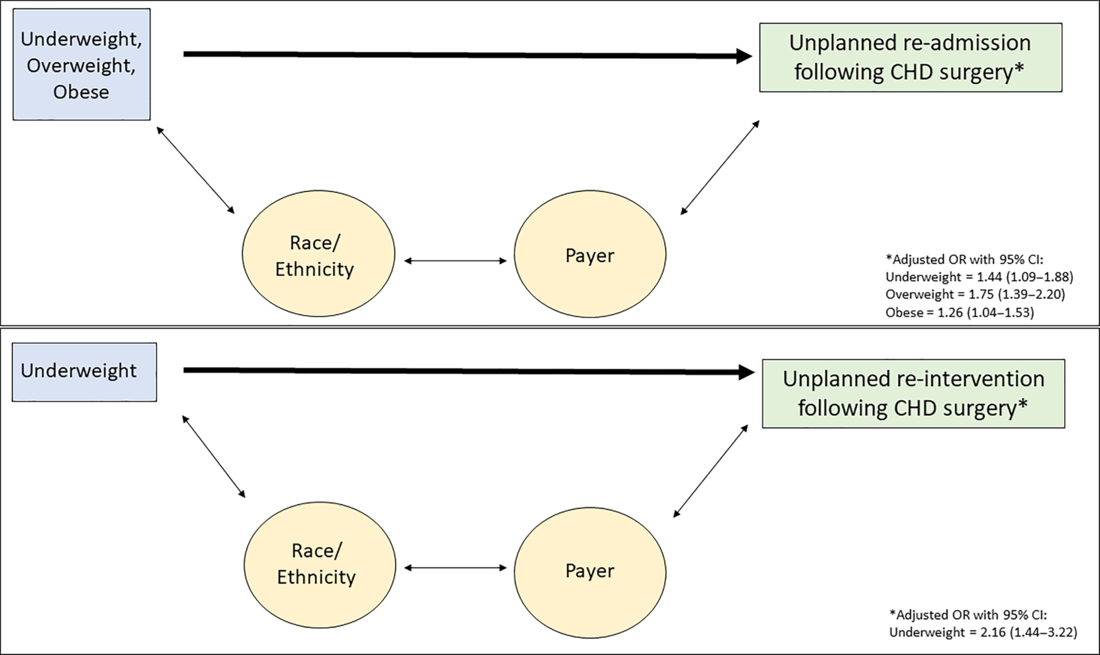
While race/ethnicity and payer status were associated with unplanned re-admissions and re-interventions, the association between body mass index and unplanned re-admissions and re-interventions persisted after adjusting for race/ethnicity and payer status.

Results
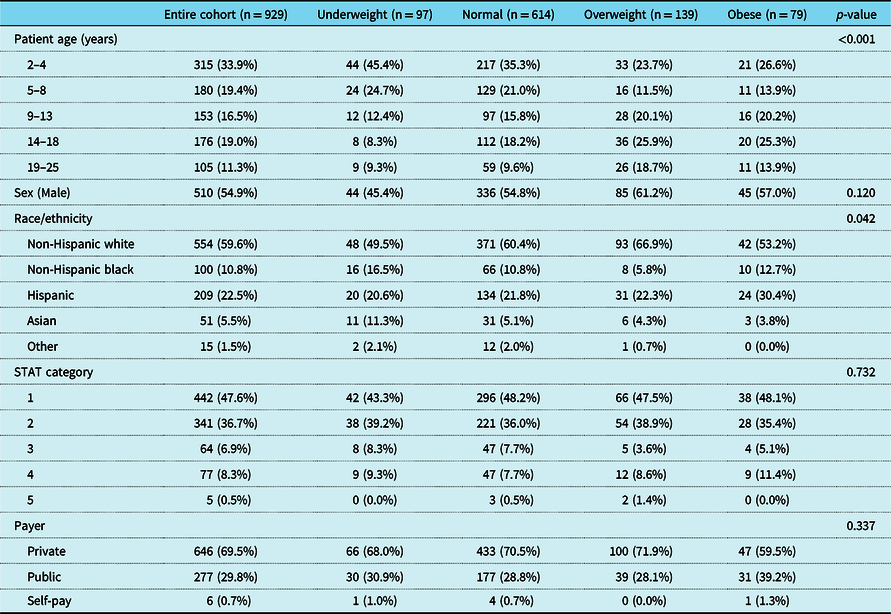
A total of 929 patients, aged 2–25 years, were admitted to our institution for elective CHD surgery during the study period. Table 1 describes the baseline and operative characteristics of the cohort. Our cohort included 10.4% (n = 97) underweight, 14.9% (n = 139) overweight, and 8.5% (n = 79) obese patients. By race/ethnicity, non-Hispanic white comprised 59.6% (n = 554) of the patients, non-Hispanic black 10.8% (n = 100), and Hispanic 22.5% (n = 209). The majority of patients were privately insured (69.5%, n = 646); 29.8% (n = 277) had public insurance; and <1.0% (n = 6) were self-pay.
Baseline patient and operative characteristics. STAT surgical risk category is defined as per the Society of Thoracic Surgeons–European Association for Cardio-Thoracic Surgery. The p-value indicates a comparison across the weight categories

Patients who were underweight were more likely to be non-Hispanic black (p = 0.031) and to have public insurance (p = 0.001). Patients who were overweight or obese did not significantly differ by race/ethnicity or payer type.
Mortality
One-year mortality data were available for 100% (n = 929) of patients. In-hospital mortality was low at 0.5% (n = 5), and all occurred in normal-weight patients. One additional patient experienced out-of-hospital death 2 months following truncal valve repair. There were no other deaths at 1-year amongst these elective cases.
Re-admission
One-year clinical data were available for 68.7% (n = 634) of patients surviving to hospital discharge. The availability of follow-up data did not differ by body mass index category, Society of Thoracic Surgeons–European Association for Cardio-Thoracic Surgery category, race/ethnicity, payer, or surgeon.
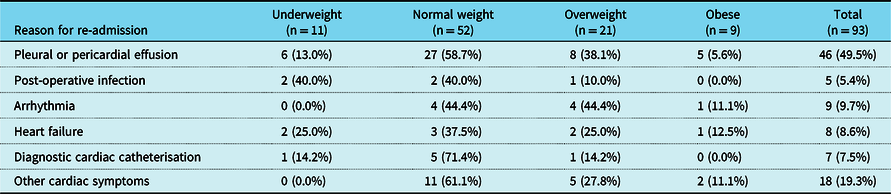
In the first post-operative year, 14.7% (n = 93) of patients with available follow-up data had an unplanned re-admission, representing 15.7% (n = 11) of underweight patients, 12.7% (n = 52) of normal weight, 22.8% (n = 21) of overweight, and 15.0% (n = 9) of obese patients. The most common reasons for re-admission were pleural or pericardial effusions, which comprised 49.5% of re-admissions (Table 2). Of the 93 re-admitted patients, 16.1% (n = 15) underwent multiple re-admissions in the first post-operative year.
Cardiac re-admission in the first post-operative year by weight category. Other cardiac symptoms included chest pain or desaturations managed medically

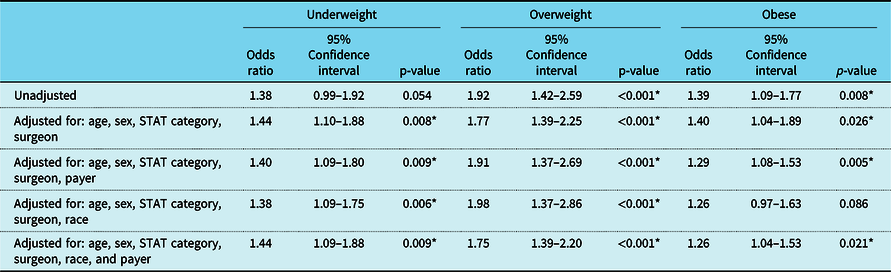
Table 3 demonstrates the multivariable models for re-admission by body mass index category. In unadjusted analyses, overweight and obese patients had significantly higher odds of re-admission (OR 1.92 [1.42–2.59], p < 0.001 and OR 1.39 [1.09–1.77], p = 0.008, respectively) compared with normal-weight patients. Adjusting for age, sex, Society of Thoracic Surgeons–European Association for Cardio-Thoracic Surgery category, and surgeon minimally impacted the magnitude of the effects of being overweight or obese. Importantly, the effect of being overweight or obese persisted after adjusting for race/ethnicity and payer status (OR 1.75 [1.39–2.20], p < 0.001 and OR 1.26 [1.04–1.53], p = 0.021, respectively).
Odds of unplanned re-admission by weight category. We adjusted for age at admission as a categorical variable, sex, and Society of Thoracic Surgeons–European Association for Cardio-Thoracic Surgery (STAT) surgical risk category. Results were clustered by the surgeon. All odds ratios are compared to normal weight. The reference group for age is 9–13 years, for sex is male, for race is non-Hispanic white, and for payer is private

*p-value < 0.050 was considered statistically significant.
Underweight patients did not have significantly higher odds of unplanned re-admission in unadjusted analyses (OR 1.38 [0.99–1.92], p = 0.054). However, they had significantly higher odds in adjusted analyses that also persisted with race/ethnicity and payer status in the model (OR 1.44 [1.09–1.88], p = 0.009) (Fig 1).
Non-Hispanic black and Hispanic patients had more than twice the odds of unplanned re-admission as non-Hispanic white patients (OR 2.04 [1.22–3.42], p = 0.007), after accounting for body mass index, age, sex, Society of Thoracic Surgeons–European Association for Cardio-Thoracic Surgery category, and surgeon. Payer was not significantly associated with re-admission in adjusted models. There were no significant interactions amongst body mass index, payer, and race/ethnicity. Our results did not differ meaningfully when restricting to only patients followed within our institution or when including surgeon as a fixed effect.
Re-intervention
The 1-year unplanned re-intervention rate amongst patients with follow-up data at our institution was 12.3% (n = 78), including 17.1% (n = 12) of underweight, 10.5% (n = 43) of normal weight, 16.3% (n = 15) of overweight, and 13.3% (n = 8) of obese patients. The unplanned re-interventions included 38 interventional cardiac catheterisations for stent placement, ballooning, coiling or device placement, and 40 re-operations, including 14 valve-related surgeries, 10 mediastinal explorations/sternal revisions, 6 pacemaker placements, 5 conduit or patch-related operations, and 5 vascular or lymphatic surgeries. Twenty of the re-interventions occurred during the index admission. Of the 78 patients, 16.7% (n = 13) underwent multiple re-interventions in the first post-operative year.
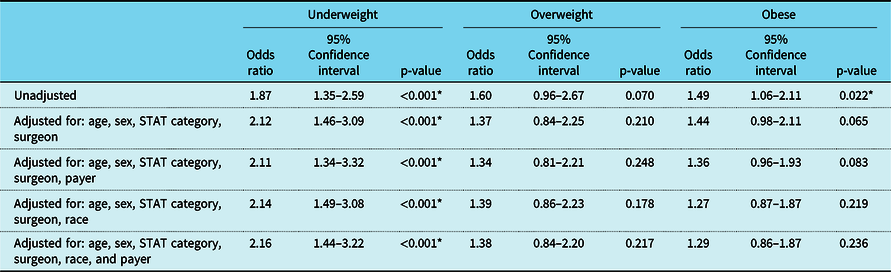
Table 4 demonstrates the multivariable models for re-intervention by body mass index category. In unadjusted analyses, underweight and obese patients had significantly higher odds of re-intervention within the first post-operative year compared with normal-weight patients (OR 1.87 [1.35–2.59], p < 0.001 and OR 1.49 [1.06–2.11], p = 0.022, respectively). Adjusting for age, sex, Society of Thoracic Surgeons–European Association for Cardio-Thoracic Surgery category, surgeon, payer, and race/ethnicity did not attenuate the effect of underweight on the odds of re-intervention (OR 2.16 [1.44–3.22], p < 0.001). The effect of obesity did not persist in the adjusted models.
Odds of unplanned re-intervention by weight category. We adjusted for age at admission as a categorical variable, sex, and Society of Thoracic Surgeons–European Association for Cardio-Thoracic Surgery (STAT) surgical risk category. Results were clustered by the surgeon. All odds ratios are compared to normal weight. The reference group for age is 9–13 years, for sex is male, for race is non-Hispanic white, and for payer is private

*p-value < 0.050 was considered statistically significant.
Non-Hispanic black and Hispanic patients had a significantly higher odds of re-intervention compared with non-Hispanic white patients (OR 1.74 [1.27–2.39], p = 0.001). Publicly insured patients also had a significantly higher odds of re-intervention as compared with privately insured (OR 1.69 [1.15–2.47], p = 0.007). Race/ethnicity and payer were highly associated, and significance could not be ascertained when entered into the model jointly. There were no significant interactions amongst body mass index, payer, and race/ethnicity. Our results did not differ meaningfully when restricting to only patients followed within our institution or when including surgeon as a fixed effect.
Discussion
In this study of nearly 1000 children and young adults undergoing elective CHD surgery, we found that overweight and obese patients were significantly more likely to be re-admitted within 1 year compared with normal-weight patients and that underweight patients were more likely to be both re-admitted and to undergo unplanned re-interventions. Further, we found that these effects were not sufficiently explained by differences in patient age or sex, Society of Thoracic Surgeons–European Association for Cardio-Thoracic Surgery category, surgeon, race/ethnicity, or payer status. Therefore, the data support our hypothesis that body mass index is a potentially modifiable risk factor.
To our knowledge, the higher risk of unplanned re-admission in overweight and obese children following elective CHD surgery has not been previously reported. This may be due to several factors. First, it is plausible that the impact of body mass index has become more apparent as the proportion of CHD patients who are overweight and obese has increased. Moreover, the selection of elective cases without genetic syndromes or extra-cardiac anomalies and the greater duration of follow-up through 1 year may have unmasked the higher risk of overweight and obesity as compared to prior literature. Reference O’Byrne, Kim and Hornik13,Reference Reeves, Ascione, Chamberlain and Angelini31 While the adult cardiac surgery literature suggests that an “obesity paradox” may exist, wherein obesity plays a protective role in post-operative outcomes, we did not uncover this phenomenon in the paediatric CHD population. Reference Johnson, Parlow, Whitehead, Xu, Rohland and Milne15,Reference Mariscalco, Wozniak and Dawson32–Reference Carnethon and Khan36 In contrast, our data suggest that counselling aimed at pre-operative weight optimisation, in conjunction with referral to nutrition specialists, may mitigate post-operative risk. Obesity is known to trigger inflammatory cascades, which may incite specific issues post-operatively, such as the development of fluid collections or infection and may, therefore, partly explain the unplanned re-admissions Reference Milner and Beck37,Reference Greenberg and Obin38 . As the survival of children with CHD continues to improve, lifestyle factors will become increasingly important not only for post-operative outcomes but also for long-term morbidity and mortality. Reference Ladouceur, Iserin, Cohen, Legendre, Boudjemline and Bonnet39,Reference Coats, Adamopoulos and Radaelli40
Our finding that underweight body mass index is also a pre-operative risk factor for unplanned re-admission and re-intervention following CHD surgery is supported by the existing literature, which demonstrates worse immediate post-operative adverse outcomes. Reference O’Byrne, Kim and Hornik13,Reference O’Byrne, Jacobs, Jacobs and Jonas14,Reference Sochet, Ayers and Quezada41,Reference Curzon, Milford-Beland and Li42 In children, it is known that pre-operative nutritional status impacts the recovery process. Reference Pollack, Ruttimann and Wiley43 Underweight is also associated with increased resource utilisation and poorer in-hospital survival in patients requiring intensive care admission, including for CHD. Reference Sharma, Raszynski and Totapally44–Reference Ross, Latham and Joffe48 The adult cardiac surgery literature suggests that the increased risk of underweight status persists through the first two post-operative years, and we similarly found increased risk up to 1 year following the surgery. Reference Zittermann, Becker, Gummert and Börgermann16,Reference Reeves, Ascione, Chamberlain and Angelini31,Reference Mariscalco, Wozniak and Dawson32 Adult guidelines recommend pre-operative nutritional screening and weight optimisation, and paediatric guidelines may also be warranted, which have already proven to be useful in the single ventricle population. Reference Hill, Nesterova and Lomivorotov49,Reference Stoppe, Goetzenich and Whitman50
As the direction of the relationship between body mass index and socio-economic factors was unknown, we studied whether race/ethnicity and payer status might be driving the observed effects of body mass index. Our data suggest that while black/Hispanic and publicly insured patients are more likely to be underweight, the negative effects of weight appear largely independent of race/ethnicity and payer.
The poorer outcomes amongst minority and economically disadvantaged populations with CHD have been well described, but the mechanism is not yet understood. Reference Anderson, Fieldston, Newburger, Bacha and Glied18,Reference Peterson, Chen, Nguyen and Setty19,Reference Nembhard, Salemi, Ethen, Fixler, DiMaggio and Canfield51–Reference Bucholz, Sleeper and Newburger54 Some studies have argued that discrepancies in outcomes in non-white patients following cardiac surgery are driven by hospital quality or regional differences. Reference Benavidez, Gauvreau and Jenkins55–Reference Rangrass, Ghaferi and Dimick57 Our study controlled for systems-level effects by including only patients operated on at a single centre and tested surgeon-level fixed effects. Nevertheless, we found an increased odd of re-admission and/or re-intervention amongst black/Hispanic and publicly insured patients compared with white, privately insured patients. Minority and publicly insured CHD populations may therefore be a potentially attractive target to pilot community health interventions to optimise weight status.
Our study had several limitations. First, our study was retrospective, which limits our ability to imply causality. Our study included patients from a single centre. While this had the advantage of reducing confounding from systems-level disparities and providers, it also reduced our statistical power and may limit our generalisability. In addition, only 69% of patients were followed longitudinally at our institution. The National Death Index was used to capture all death through the first post-operative year and to ensure that loss to follow-up was not secondary to mortality. As a regional quaternary care referral centre, most patients would be expected to have returned to our institution if re-admission or re-intervention were required. Moreover, follow-up at our institution did not significantly differ by body mass index category, race/ethnicity, payer, or surgeon, thereby minimising the likelihood that selection bias was significantly driving our results. However, it remains possible that our study may over-estimate re-admission and re-intervention rates as such episodes of care would be associated with increased follow-up. Finally, body mass index is an imperfect indicator of weight status. Differences in body mass index distribution by race/ethnicity and difficulty in predicting adiposity in young children have been well-described. Reference O’Byrne, Kim and Hornik13,Reference Nightingale, Rudnicka, Owen, Cook and Whincup58,Reference Vanderwall, Randall Clark, Eickhoff and Carrel59 Nevertheless, while it may mischaracterise a small subset of patients, body mass index is generally considered a reasonable proxy for weight status.
Conclusion
Pre-operative body mass index is associated with unplanned re-admission and re-intervention in children and young adults 1 year following elective CHD surgery. Specifically, overweight and obese patients had more re-admissions, and underweight patients had more re-admissions and re-interventions. The effects of body mass index were independent of race/ethnicity and payer status; suggesting that body mass index may be a modifiable pre-operative risk factor. Efforts to normalise pre-operative body mass index and the effect of these interventions on post-operative outcomes should be further explored.
Acknowledgements
We would like to acknowledge Lin Fang for her assistance with data retrieval.
Financial support
Dr Anderson receives salary support from the National Institutes of Health/National Heart Lung and Blood Institute (K23 HL133454).
Conflict of interest
None.
Ethical standards
This study was approved by the Institutional Review Board at the Columbia University Irving Medical Center.