I. INTRODUCTION
Manganese had been used as an alloying element added to Al–Mg based alloys to compensate for the negative effects of Fe. Reference Davis1,Reference Backerud, Krol and Tamminen2 It also contributes to the strength of the alloy through solid solution strengthening. Increasing the content of Mn in the alloy would increase its strength. For example, increasing the Mn concentration from 0.35 wt% in AA5182 alloy to 0.7 wt% in AA5083 alloy would increase the tensile strength by 15 MPa at O temper. Reference Bauccio3 However, Mn could also cause the formation of coarse intermetallic Al6(Fe,Mn). Reference Liu and Kang4 These constituents formed during solidification could not be dissolved during homogenization. During hot working, they would break, allowing for the formation of microcracks or voids, Reference Liu and Kang4 which could be the nucleation sites of cracks and lead to significant degradation of the alloy's mechanical properties. Reference Sakthivel, Palaninathan and Velmurugan5,Reference Liu, Cao and Chen6 Therefore, the concentration of Mn must be limited to a low level to avoid the formation of coarse Mn-rich constituents. If the coarse intermetallics could be inhibited during solidification, then more Mn could be added to the alloy and more Mn atoms could be solid solutioned in α-Al matrix, which would further improve the mechanical properties of the alloy. Finding a solution to achieve this goal had been a great challenge for the design and development of the Al–Mg based aluminum alloys.
Many research works had been conducted to improve the Al–Mg–Mn alloys, with emphasis focused on microstructures and properties, Reference Goswami, Spanos, Pao and Holtz7–Reference Lin, Liu, Wang and Lavernia10 superplasticity, Reference Verma and Kim11–Reference Hyuk Shin, Hwang, Oh and Park14 ultra-fine grain Reference Singh, Nageswara Rao and Jayaganthan15–Reference Witkin, Han and Lavernia19 and adding element, Reference Lin, Nie, Huang and Li20–Reference Meng, Zhang, Hua, Zhuang and Zhang23 etc. Little attempt had been made to investigate Al–Mg based alloy with high Mn content (>1.0 wt%).
Cooling rate had been an important factor affecting the formation of coarse intermetallics during solidification. Increasing cooling rate could change the morphologies or refine the size of the intermetallics. Under the condition of near-rapid cooling, the formation of some coarse intermetallics could even be inhibited. Reference Liu, Liu, Luo, Wang and Liu24 This led to a new method of developing materials with high concentration of alloying elements. By increasing the cooling rate to the level of near rapid, more alloying elements could be added without the formation of coarse intermetallics, which would improve the mechanical properties of the alloy.
The cooling in the continuous strip casting (CC) process of aluminum alloy is a near-rapid cooling with a cooling rate of 101 to 102 K/s. In the twin-belts CC process, the molten metal is continuously poured into a moving mold formed by two rolling steel belts to produce a cast slab, which is then immediately fed into hot rolling mills forming hot band products. The cast slab is about 20 mm thick. The two rolling steel belts which form the casting mold are continuously cooled by cold water. Therefore, the cooling rate of the molten aluminum is high enough to reach the near-rapid level.
This CC process could refine the coarse intermetallics to a great extent or even inhibit the formation of some intermetallics. A large amount of elements could retain solid solution in the cast slabs. It was assumed that new materials with high alloying element content could be developed and produced by using the CC process.
Al–Mg–Mn aluminum alloy sheet materials were often produced using CC process due to its advantage of high productivity and low cost. A lot of research had been carried out on the Al–Mg–Mn alloys produced by the CC process. Reference Xia, Ma, Zhang, Wang and Liu25–Reference Zhao and Morris29 The CC process had recently received more and more attention from manufacturers and end users. Reference Sanders30 It was assumed that the CC process was not just a production method with high productivity and low cost; it could also be a good process for producing high performance materials through its characteristic of near-rapid cooling.
To this end, this work investigated the microstructures and mechanical properties of Al–5Mg–Mn alloys with high Mn content which were cast under the condition of near-rapid cooling by using an apparatus simulating the CC process. The ultimate aim was to develop and produce high Mn concentration Al–Mg alloys with higher mechanical properties using the high productivity and low cost CC process.
II. EXPERIMENTAL PROCEDURES
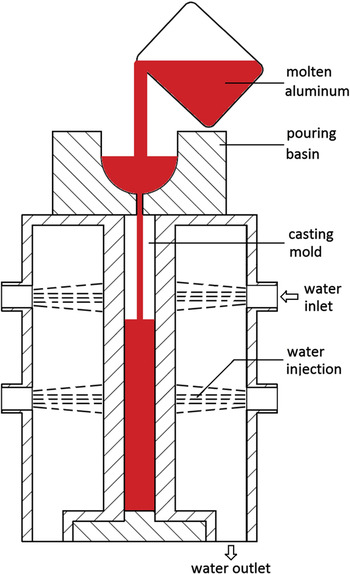
To simulate the cooling of CC, a double-side water cooled casting apparatus was designed, as shown in Fig. 1. The casting mold with a size of 150 × 150 × 15 mm was continuously cooled from two sides by cold water. The cooling rates during casting were measured by recording the temperature evolution with time.
Schematic sketch of the double-side water cold casting apparatus.

Two groups of Al–5Mg–Mn alloys were designed with different Fe contents. In the first group of alloys, the contents of Fe and Si were kept low, less than 0.1 wt% for Fe and less than 0.05 wt% for Si, which was slightly lower than common industrial practices. To investigate the combined effect of Mn, Fe, and Si, in the second group of alloys, higher contents of Fe and Si were used, 0.5 wt% for Fe and 0.25 wt% for Si, which were much higher than the common industrial practices. For each group, five samples were designed with Mn contents varying from 0.4 to 2.0 wt%.
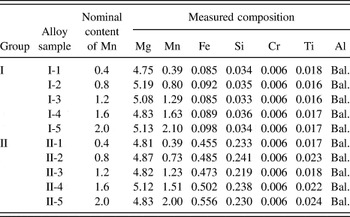
High grade commercial pure aluminum ingots (<0.10 wt% Fe and <0.04 wt% Si), magnesium ingot (99.9 wt%), Al–10Fe and Al–30Si mater alloys were used to prepare the studied samples. 2 kg of raw materials for each designed alloy were melted in a graphite-clay crucible in an electric resistance furnace. The molten aluminum was degassed by injecting Ar into the pool, refined by adding Al–5Ti–B grain refiner, then cast with the apparatus shown in Fig. 1 at around 725 °C. The chemical compositions of the cast slabs were analyzed by emission spectroscopy; the results are listed in Table I.
Chemical composition of alloys, wt%.

Bal. = Balance
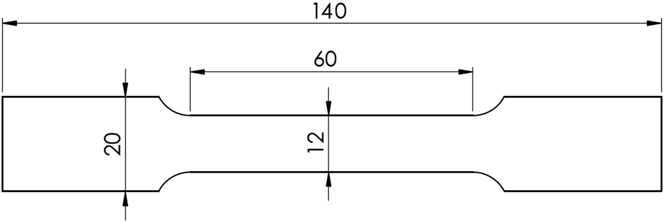
The cast slabs were heated and hot rolled at 420 °C to form 3.5 mm thick hot bands. The total reduction rate was about 75%. Then, the hot bands were annealed at 420 °C for 2 h and then followed by air cooling. All the annealed hot bands were subject to tensile tests with tensile specimens shown in Fig. 2. The tensile tests were performed at a tensile speed of 2 mm/min.
Dimensions of the tensile specimens (unit in millimeter).

The hot bands were metallographically examined. The metallographic samples (15 × 15 mm in size) were cut from the central areas of the hot bands. The examined surface was prepared using standard metallographic procedures. The samples were electropolished at a voltage of 27 V direct current (DC) for 15 s using 60 mL HClO4 + 140 mL H2O + 800 mL C2H5OH. The samples used for observing grain structures were anodized at a voltage of 18 V D.C. for 60 s using Barker's reagent (50 mL HBF4 + 950 mL H2O). The anodized samples were examined using an Olympus GX71 optical microscope (Olympus Corp., Shinjuku, Japan) with polarized light. A Zeiss scanning electron microscopy with energy dispersive x-ray (EDX; Carl Zeiss AG, Oberkochen, Germany) analyzer was used to identify intermetallic compounds and observe the fracture surface of the tensile specimens.
III. RESULTS
A. Microstructures
1. As-cast microstructures
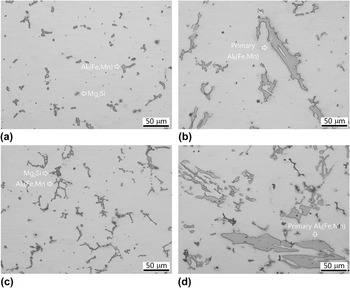
The as-cast microstructures of the Al–5Mg–Mn alloys were simple. They consisted of matrix α-Al and intermetallics Al6(Fe,Mn) and Mg2Si. The solidification process and as-cast microstructures of the alloys were greatly influenced by the contents of Mn, Fe, Si and cooling rate. Reference Liu, Luo, Han, Wang and Liu31,Reference Liu, Huang, Sun, Zhang, Huang, Wang and Liu32 Figure 3 shows the as-cast microstructures of some typical alloys solidified under near-rapid cooling. It was found that the near-rapid solidified intermetallics were very fine. Compared to the samples solidified under slow cooling, the intermetallics were significantly refined by the near-rapid cooling. Reference Liu, Luo, Han, Wang and Liu31,Reference Liu, Huang, Sun, Zhang, Huang, Wang and Liu32
The intermetallic structures in (a) Alloy I-4; (b) Alloy I-5; (c) Alloy II-1; (d) Alloy II-4.

In the first group of alloys with low contents of Fe and Si, the amount of intermetallic Al6(Fe,Mn) and Mg2Si formed during solidification were very small. In Alloy I-1 with low content of Mn, only a few small Al6(Fe,Mn) blocks were observed; the intermetallic Mg2Si was rare and small. With the increase of the content of Mn, the size and amount of Al6(Fe,Mn) increased. However, the increment was quite small. The intermetallic of Alloy I-4 with 1.6 wt% Mn was shown in Fig. 3(a). It can be seen that they were still small in size and amount. Most likely, only a portion of Mn atoms contributed to the formation of the Al6(Fe,Mn) phase. The rest were solid solutioned in the α-Al matrix. However, an essential change in the as-cast microstructures occurred in Alloy I-5 with 2.0 wt% Mn: some extremely coarse platelet-like Al6(Fe,Mn) appeared [Fig. 3(b)]. According to the previous research, Reference Liu, Huang, Sun, Zhang, Huang, Wang and Liu32 the composition of Alloy I-5 was hypereutectic; these platelet-like Al6(Fe,Mn) was primary phase.
In the second group of alloys with high Fe and medium Si, the amount of intermetallics Al6(Fe,Mn) and Mg2Si significantly increased. Figure 3(c) shows the intermetallics of Alloy II-1 with 0.4 wt% Mn. Al6(Fe,Mn) and Mg2Si were dense and complicated. Increasing the contents of Fe and Si resulted in the increase of Al6(Fe,Mn) and Mg2Si. However, the near-rapid cooling during casting gave rise to the refinement of the intermetallics. Therefore, the intermetallics were still relatively small in size. The coarse primary platelet-like Al6(Fe,Mn) appeared in Alloy II-4, suggesting that Alloy II-4 was a hypereutectic alloy. The content of Mn in Alloy II-4 was lower than that in Alloy I-5. In the alloys with high content of Fe, the chemical composition became hypereutectic at a lower content of Mn.
2. Particle structures in hot bands
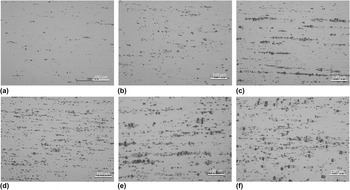
Figure 4 shows the particle microstructures of some typical samples. In Alloy I-1 hot band with low Mn content, the particles were rare and small. With the increase of Mn content in the alloys, the number of particles increased. As shown in Fig. 4(b), the number of particles in Alloy I-4 was much more than that in Alloy I-1, but still kept the scattered pattern. A sudden change in the number and size of the particles occurred in Alloy I-5 in which the number of particles was so large that the particles were lined up along the rolling direction [Fig. 4(c)]. In the second group of alloys, the high contents of Fe and Si caused the particles to significantly increase in both size and number. Comparing Alloy I-1 and Alloy II-1 which had the same content of Mn, the particles in Alloy II-1 increased significantly, see Figs. 4(a) and 4(d). With the increase of Mn, the particles increased, but the increment was not significant. A sudden increase in the number and size of the particles occurred in Sample II-4. In Sample II-5, the metallographic surface bestrewed the particles [Fig. 4(f)].
The particle structures of the hot bands (a) Alloy I-1; (b) Alloy I-4; (c) Alloy I-5; (d) Alloy II-1; (e) Alloy II-4; (f) Alloy II-5.

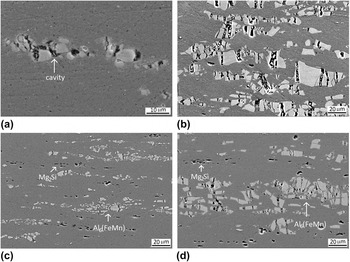
Figure 5 shows the typical morphologies of the particles at high magnification. It can be seen that in the first group of alloys, the particles mainly displayed a light gray color, it was difficult to find particles in other colors. In the second group of alloys, two particle structures were observed and distinguished by color: in light gray and dark gray. EDX analysis indicated that the light gray particles were Al–Fe–Mn particles with a formula close to Al6(Fe,Mn). The dark gray particles contained Mg and Si. These EDX results were comparable to the EDX analyses of the as-cast microstructure of those alloys. Reference Liu, Luo, Han, Wang and Liu31,Reference Liu, Huang, Sun, Zhang, Huang, Wang and Liu32 The light gray particles were the broken Al6(Fe,Mn) phase; the dark gray particles were the broken Mg2Si phase. In addition, some cavities between the broken particles were observed. The more and coarser the intermetallic Al6(Fe,Mn) formed during solidification, the more the cavities formed during hot rolling (Fig. 5).
The high magnification images of particles of the hot bands (a) Alloy I-1; (b) Alloy I-5; (c) Alloy II-1; (d) Alloy II-4.

3. Grain structures
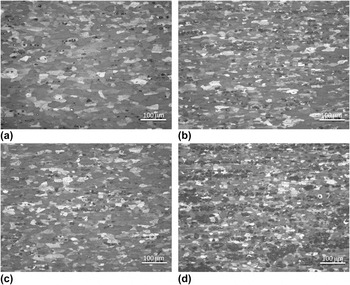
After being annealed at 420 °C for 2 h and followed by air cooling, all the hot bands were recrystallized. Figure 6 shows the grain structures on the longitude section of some typical samples. Observations of the three planes (rolling plane, longitude section, and transverse section) of all the hot bands indicated that all the samples had roughly equiaxed grain structures. With the increase of manganese content, the size of the recrystallized grains decreased.
The recrystallized grain structures (a) Alloy I-1; (b) Alloy I-5; (c) Alloy II-1; (d) Alloy II-5.

B. Mechanical properties
1. Tensile properties
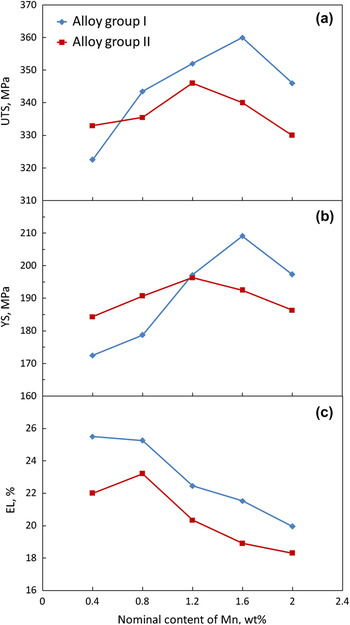
Figure 7 shows the tensile properties of the fully recrystallized hot bands at different Mn content. They were a function of the Mn concentration in the samples. With the increase of Mn concentration, both the ultimate tensile strength and yield strength increased. The tensile strength reached maximum when Mn was 1.6 wt% for the first group of alloys with low Fe content (Alloy I-4). Then the tensile strength decreased when the Mn content further increased. For the samples with higher Fe content (second group of alloys), the tensile strength reached maximum when Mn was 1.2 wt% (Alloy II-3). Then the tensile strength decreased when the Mn content further increased. These results were consistent with the particle structures in the hot bands. In Alloys I-5 and II-4, the intermetallic Al6(Fe,Mn) became the primary phase and the Al6(Fe,Mn) particles increased significantly, which deteriorated the mechanical properties. The elongation of the alloys was negatively correlated to the content of Mn. Increasing the Mn content in the alloys resulted in the decrease in ductility for both the low Fe content samples and high Fe content samples, see Fig. 7(c). But elongation still maintained a relatively high level (22%) when Mn was 1.6 wt% which was the sample with the maximum tensile strength.
The mechanical properties of the hot bands versus the content of Mn (a) ultimate tensile strength; (b) yield strength; (c) elongation.

The commercial AA5083 alloy was close to Alloy I-2 and Alloy II-2 in terms of composition. Compared to the typical tensile strength of AA5083 alloy at O temper (290 MPa), the tensile strengths of Alloy I-2 and Alloy II-2 were significantly improved due to the refinement of the as-cast microstructures by the near-rapid cooling. The mechanical properties of Alloy I-4 and Alloy II-3 were further improved due to higher contents of Mn. It was confirmed that, under the condition of near-rapid cooling during casting, the Al–5Mg–Mn alloy could be significantly improved by increasing the content of Mn to a higher level. However, the limit of Mn content was affected by the content of Fe. The higher the content of Fe in the alloy, the lower the Mn content could be allowed.
2. Fracture surface
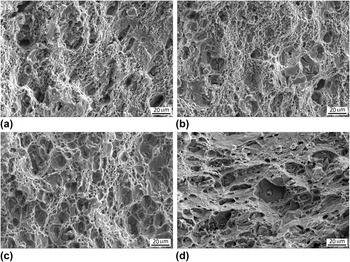
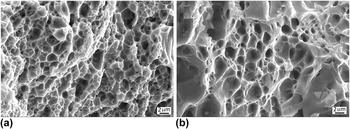
Figure 8 shows the fracture surface of some typical tensile samples. All the samples displayed ductile fracture mode. The fracture surface bestrewed fine dimples, see Fig. 9. Some holes were observed on the fracture surfaces which were created by the intermetallic particles fractured or left from the matrix. These intermetallic particles acted as the nucleation sites of cracks. These characteristics were consistent with the ductility of the materials.
The fracture surfaces of the hot bands (a) Alloy I-4; (b) Alloy I-5; (c) Alloy II-1; (d) Alloy II-4.

The fracture surfaces of the hot bands with dimples (a) Alloy I-4; (b) Alloy II-1.

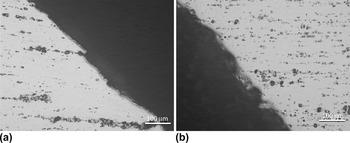
With the increase of Mn content in the samples, the size and number of holes on the fracture surface increased and the elongation of the materials decreased. In Samples I-1 to I-4 with Mn contents less than the eutectic composition, the remaining particles were rare and small, the number of holes left on the fracture surfaces were relatively less. In Sample I-5, a large number of coarse intermetallic particles were observed to have fractured or left from the matrix, initiating the micro voids. Secondary cracks were also observed on the intermetallic particles. But the secondary cracks did not extend into the matrix. Observations of the profiles of the fracture surfaces indicated that no secondary cracks extended into the matrix. Figure 10 shows the profiles of the fracture surfaces of some typical samples.
The profiles of the fracture surfaces of the hot bands (a) Alloy I-5; (b) Alloy II-4.

In the second group of alloys, more fractured particles or holes were observed on the fracture surface. This was consistent with the fact that there were more intermetallic particles in the second group of alloys than in the first group. Figure 8(c) shows the fracture surface of Sample II-1. In Sample II-4 [Fig. 8(d)] and Sample II-5, both with higher contents of Mn, Fe, and Si, the fraction of the surface with particles fractured or left from the matrix increased significantly.
IV. DISCUSSION
A. Effect of Mn on microstructures
The particle structures were determined by the solidification structures and rolling process. Since the Al6(Fe,Mn) phase was brittle, they were broken by the rolling process and became particles in the hot bands. The more intermetallic Al6(Fe,Mn) formed during solidification, the more particles remained in the hot bands. In Alloy I-1, the solidification structures of the alloys were very simple and the intermetallics formed were in a small amount. Therefore, the amount of particles in the hot bands was small. With the increase of the content of Mn, the amount of intermetallic Al6(Fe,Mn) formed during solidification increased. In return, the particles in the hot band increased. Since the intermetallic Al6(Fe,Mn) formed during solidification was significantly refined by the near-rapid cooling, the size of the particles created in the hot bands were small. In Alloy I-5, the intermetallic structure consisted of the Al6(Fe,Mn) phase formed from both the primary precipitation and the eutectic reaction. The amount of the intermetallic Al6(Fe,Mn) significantly increased. Therefore, there was a sudden increase in the number of particles. The primary intermetallic was very coarse and easily broken into particles with sharp edges and corners during hot rolling. These particles would have had difficulty in movement which caused the formation of cavities between the broken fragments. The coarse platelet-like primary Al6(Fe,Mn) formed during solidification created the coarse particles and cavities among the particles. The coarser the platelet or blocky intermetallics formed during solidification, the more and larger the cavities left between the broken fragments. Therefore, Sample I-5 displayed numerous cavities between the broken fragments.
In the second group of alloys, Fe and Si contributed to the formation of the complex microstructures from three aspects. First, the phase Mg2Si appeared which were hard to find in the first group of alloys; second, the amount of intermetallic Al6(Fe,Mn) significantly increased; and third, the Fe content in the phase Al6(Fe,Mn) greatly increased.
Si had a strong tendency of combining with magnesium to form intermetallic Mg2Si. In the first group of alloys with less than 0.04 wt% Si, only a very small amount of intermetallic Mg2Si formed in the solidification structures were within the triangle grain boundaries. Reference Liu, Luo, Han, Wang and Liu31 When Si content increased to 0.25 wt%, a large amount of Mg2Si was observed in the solidification structures. Reference Liu, Luo, Han, Wang and Liu31 The intermetallic Mg2Si was insoluble during heat treatment. Therefore, a large number of Mg2Si particles were observed in the hot bands in the second group of alloys.
The composition of Fe in the second group of alloys increased to 0.5 wt%. Since the solid solubility of Fe in aluminum was less than 0.05% at equilibrium, Fe had a very strong tendency of segregation Reference Liu, Zhang, Zhao, Wang, Liu and Grandfield33 and segregated to the interface front during solidification, which increased the local concentration of Fe in the interface front, and contributed to the formation of Al6(Mn,Fe). In the Al6(Fe,Mn) phase, the sum of Fe and Mn had to maintain roughly constant to meet the stoichiometric formula of the phase, but the individual compositions of Fe and Mn could vary. Therefore, the high concentration of Fe in the interface front resulted in the high concentration of Fe in the Al6(Fe,Mn) phase. The amount of intermetallic Al6(Fe,Mn) increased accordingly. Comparing Sample I-1 and Sample II-1, the concentration of Mn was the same, but Sample II-1, with higher Fe content, had a much higher quantity of Al6(Mn,Fe). In Sample II-4, the concentration of (Fe + Mn) was high enough to form primary intermetallic Al6(Fe,Mn) with coarse platelet-like morphology. Therefore, the size and density of Al6(Mn,Fe) in Sample II-4 was larger than that in Sample I-5. After hot rolling, Al6(Fe,Mn) line up along the rolling direction.
B. Effect of Mn on mechanical properties
The mechanical properties of the alloys were improved by increasing the content of Mn. The amount of Mn atoms solid solutioned in the matrix and the size, distribution and shape of the intermetallic particles remained in the hot bands played a critical role in the improvement. Huskins et al. Reference Huskins, Cao and Ramesh34 and Ryen et al. Reference Ryen, Nijs, Sjolander, Holmedal, Ekstrom and Nes35 studied the solute strengthening of Mn in aluminum alloys. Huskins et al. Reference Huskins, Cao and Ramesh34 calculated that the yield strength increment due to 1.0 wt% increase of Mn was 16.9 MPa. In this work, increasing the Mn content from 0.4 to 1.6 wt% resulted in the increase of the yield strength from 172 MPa to 209 MPa for the first group of the alloys. The yield strength increment was about 26.4 MPa per 1.0 wt% Mn, which was higher than the results of Huskins et al. Reference Ryen, Nijs, Sjolander, Holmedal, Ekstrom and Nes35 In this study, the materials were cast under near rapid cooling. The intermetallics were significantly refined; the deteriorating effect of the intermetallics was weakened. Therefore, the yield strength increment was much greater.
The remaining particles in the materials, especially the cavities between the fragments formed during deformation, acted as the nucleation sites of cracks and resulted in the premature failure of the materials. The more, coarser and sharper the particles remained in the material, the severer the deterioration of mechanical properties. This was confirmed by the fracture surface observation. Therefore, on one hand, increasing Mn resulted in the increase of Mn atoms solid solutioned in the matrix and improved the mechanical properties of the alloys through solid solution strengthening. On the other hand, increasing Mn gave rise to more intermetallic particles remaining in the materials which deteriorated the mechanical properties.
In the traditional production of Al–Mg–Mn alloys via direct chill casting process, higher content of Mn would result in the formation of coarse Mn-rich intermetallics which were usually massive and brittle. Therefore, the content of Mn had to be limited to a low level (<1.0 wt%) to avoid the formation of coarse Mn-rich intermetallic compounds. 36 Under the condition of near-rapid cooling, the Mn- and Fe-rich intermetallics were refined to a great extent or even inhibited, more Mn atoms were solid solutioned in the matrix. Increasing Mn content did not result in the formation of coarse intermetallics. The particles in the hot bands were small and rare. Therefore, with the increase of Mn content, the strengthening effect of the solid solutioning of the Mn atoms was higher than the deteriorating effect of the intermetallic compounds formed. The mechanical properties increased with the increase of Mn content. Once the composition of Mn increased beyond the eutectic point, intermetallic Al6(Fe,Mn) would became the primary phase and form coarse platelet-like morphology. Then, the remained particles and cavities in the hot band became larger in both size and amount. The deteriorating effect of the remained particles and cavities would exceed the strengthening effect. The mechanical properties would drop with the further increase of the content of Mn. This was demonstrated by Alloy I-5 and Alloy II-4. Therefore, the content of Mn should not be excess of eutectic composition to avoid the formation of coarse intermetallics.
Overall, the first group of alloys had higher mechanical properties than the second group. The degradation of the mechanical properties in the second group of alloys was attributed to the higher Fe and Si contents. Fe and Si promoted the formation of intermetallics Al6(Fe,Mn) and Mg2Si; the remained particles were much larger in number and size than those in the first group, as shown in Fig. 4. These particles were the potential nucleation sites of cracks and deteriorated the mechanical properties. Fe, combined with Mn, formed intermetallic compound Al6(Fe,Mn) and lowered the eutectic composition of Mn. The intermetallic Al6(Fe,Mn) become the primary phase at a lower composition of Mn. Thus, less amount of Mn was allowed to be added to the Al–5Mg alloy when the content of Fe was high without deteriorating mechanical properties.
V. CONCLUSIONS
-
(1) Mn combines with Fe to form intermetallic Al6(Fe,Mn) which is extremely refined by the near-rapid cooling during casting. With the increase of Mn content, the amount of Al6(Fe,Mn) phase does not increase significantly; a large amount of Mn atom maintains solid solution in α-Al matrix. Once the composition of Mn increases beyond the eutectic point, intermetallic Al6(Fe,Mn) become the primary phase with extremely coarse platelet-like morphology.
-
(2) Fe significantly promotes the formation and increases the amount of intermetallic Al6(Fe,Mn). Fe also reduces the eutectic composition of Mn. In the alloys with high Fe content, the chemical composition becomes hypereutectic at a lower content of Mn.
-
(3) The intermetallic Al6(Fe,Mn) particles in the hot bands with low Fe content are rare and small; but becomes dense and coarse with lots of cavities between the broken particles once Al6(Fe,Mn) becomes the primary phase. In the hot bands with high Fe content, Al6(Fe,Mn) increases in both size and amount.
-
(4) Increasing the content of Mn will increase the mechanical properties of the Al–5Mg–Mn alloys cast under near-rapid cooling. The content of Mn can be increased to a much higher level than the specification of AA5083 alloy and achieve significantly improved mechanical properties. But the mechanical properties will decrease once the intermetallic Al6(Fe,Mn) becomes the primary phase.
ACKNOWLEDGMENTS
The authors are grateful to the Research Foundation of Shenyang Aerospace University for its financial support.