Introduction
With declining health, older adults face many challenges that require increased adaptation to various changes in their lives (Fiksenbaum et al., Reference Fiksenbaum, Greenglass and Eaton2006). Those who cannot deal with these transformations and losses sometimes think that life is not worth living and wish for death. Hopelessness and death thoughts constitute the first steps into the suicidal process and can later lead to suicidal ideation or attempt (De Leo et al., Reference De Leo, Cerin, Spathonis and Burgis2005). However, this process fluctuates greatly over time and can be interrupted at any occasion by internal (e.g. hope) or external factors (e.g. social support). Moreover, its complexity makes it difficult for health professionals to identify suicidal individuals and to prevent suicidal behaviors (De Leo et al., Reference De Leo, Cerin, Spathonis and Burgis2005). Wishes to die are fairly common in old age, with a prevalence of 4% to 6% (Barnow and Linden, Reference Barnow and Linden1997; Scocco and De Leo, Reference Scocco and De Leo2002; Kim et al., Reference Kim, Bogner, Brown and Gallo2006). Their association with depression (Linden and Barnow, Reference Linden and Barnow1997), which is a major risk factor for suicide in old age (Préville et al., Reference Préville2008), suggests that they should be studied in order to provide more opportunities for preventive interventions for at-risk older adults (Heisel et al., Reference Heisel, Duberstein, Talbot, King and Tu2009). Little is known about other associated factors for the wish to die in old age. Results from two previous studies that have examined these characteristics showed that poor self-rated physical health, disability, pain, hearing and visual impairment as well as chronic medical conditions were associated with the wish to die (Jorm et al., Reference Jorm, Henderson, Scott, Korten, Christensen and Mackinnon1995; Kim et al., Reference Kim, Bogner, Brown and Gallo2006). These results are similar to those that found that serious physical illnesses, particularly those causing functional limitation and chronic pain, were reported as significant risk factors for depression, suicidal ideation, and suicide among older adults (Waern et al., Reference Waern, Rubenowitz and Wilhelmson2003; Juurlink et al., Reference Juurlink, Herrmann, Szalai, Kopp and Redelmeier2004; Meeks et al., Reference Meeks2008). Therefore it is expected that chronic illnesses will also be related to the wish to die.
Major depression is a well-known predictor of suicidality, but two symptoms seem to be more prevalent among depressed adults who die by suicide, compared to those who do not: death thoughts (OR = 12.58) and insomnia (OR = 2.37) (McGirr et al. Reference McGirr2007). Increasing evidence suggests that sleep disorders are associated with an elevated risk for suicidal behaviors, even when depression was controlled for (Meeks et al., Reference Meeks2008; Wojnar et al., Reference Wojnar, Ilgen, Wojnar, McCammon, Valenstein and Brower2009). Sleep deprivation might impair individuals' problem-solving abilities, judgment, and concentration, as well as their ability to regulate emotional states. Fatigue may also lead to hopelessness and decrease impulse control. Since sleep complaints are frequent in the older adult population (Ancoli-Israel and Cooke, Reference Ancoli-Israel and Cooke2005), we would expect an association with the wish to die.
Daily hassles – defined as “the irritating, frustrating, distressing demands that to some degree characterize everyday transactions with the environment” – have been considered a stronger predictor of subsequent physical and psychological symptoms than major life events (Kanner et al., Reference Kanner, Coyne, Schaefer and Lazarus1981; Landreville and Vézina, Reference Landreville and Vézina1992). It seems that the challenge of adaptation posed by a major life event may be found more in the changes in daily living that accompany this event (Pillow et al., Reference Pillow, Zautra and Sandler1996). The accumulation of daily hassles has also been associated with a greater risk for depression and suicidal ideations in old age (Kraaij et al., Reference Kraaij, Arensman and Spinhoven2002). For example, in a case-control psychological autopsy of suicide among older adults, researchers indicated that main events, like physical illness, interpersonal problems, and bereavement were problems perceived by the informants as contributory to suicide (Harwood et al., Reference Harwood, Hawton, Hope, Harriss and Jacoby2006). However, they also observed that daily hassles, such as worries about finances, problems with housing, difficulties adapting to retirement could differentiate older adults who died from suicide from those who died from natural causes. Based on these observations, it seems possible to hypothesize that daily hassles will also be associated with the wish to die.
The data presented here were taken from a large survey on the prevalence of mental disorders in the elderly population (Préville et al., Reference Préville2008) that also gathered information on many areas of individual functioning, such as quality of sleep, physical illnesses, and daily hassles. The goal of this research was to study the prevalence of wishes to die in older adults living in the community and to verify the hypothesis that daily hassles, physical illness, and sleep problems are important associated factors for the wish to die even when depression is controlled for.
Methods
Procedure and sample
Data used in this study came from a cross-sectional survey, the ESA study (Enquête sur la Santé des Aînés), conducted in 2005–2006 using a probabilistic sample of French-speaking community-dwelling older adults from each of the 16 administrative regions of the province of Quebec in Canada (in 2006, 80% of the population was francophone and the elderly population size was 1,065,081). A random digit dialing method was used to develop the sampling frame of the study which included stratification according to three geographical areas: (1) metropolitan, (2) urban, and (3) rural. Only one older adult (65 years and over) was selected from each household. The response rate for this study was 66.5%.
Data were collected by health professionals (N = 20), staff members of a national polling firm, who contacted the potential respondents and asked them to participate. Next, a letter describing the study was sent to them, and appointments were made with those who volunteered. The in-home interview took place within two weeks of initial contact. The Mini-Mental State Examination was completed at the beginning of the interview and people who scored below 22, indicating severe or moderate cognitive problems (Crum et al., Reference Crum, Anthony, Bassett and Folstein1993), were excluded from the sample because of their inability to answer questions accurately. All other participants responded to the additional questionnaires.
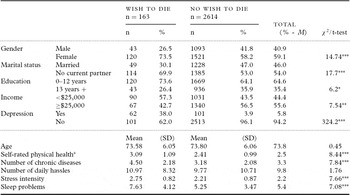
Data were weighted to ensure that a true proportion of older adults in each region and for each geographical area was reflected in the analyses (Préville et al., Reference Préville2008). The weighted sample (see Table 1) included 2777 older adults aged between 65 and 96 years (M = 73.8) who were living at home. Most of the participants (59.1%) were women. About half of the respondents had no current partner (54%), while 44.4% reported an annual income lower than $CDN 25,000. Many participants lived in a metropolitan area (44.6%), 38.7% in a rural region, and 16.8% in small urban communities. In terms of level of education, 23.4% had completed primary school only, 41.2% had attended or finished high school, and 35.4% had some years of college/university.
Differences between participants with and without wishes to die (N = 2777)

a 1 = Excellent, 5 = Bad.
*p < 0.05, **p < 0.01, ***p < 0.001.
Measures
Wishes to die were identified with the following question: “During the last 12 months, did you have a period of at least two weeks when you thought that you would be better dead?”
The respondent's mental health status was measured using a computer-assisted structured interview, the ESA Diagnostic Questionnaire (ESA-Q), which provided a 12-month period diagnosis according to DSM-IV criteria. The ESA-Q was developed in French. It includes specific questions that ascertain the presence or absence of each DSM-IV criterion item, and a computer algorithm that generates diagnoses of mental disorders (for prevalence of psychiatric disorders in the older adult population in Quebec using the ESA-Q, see Préville et al., Reference Préville2008). The structure of the ESA-Q interview is similar to the Diagnostic Interview Schedule (DIS), which was frequently used for assessment in epidemiologic studies and demonstrated satisfactory reliability and validity (Semler et al., Reference Semler, Wittchen, Joschke and Zaudig1987). For the purpose of the present study, only diagnoses of major or minor depression were considered. Participants who reported, in the ESA-Q interview, the essential features of depression (depressed mood or the loss of interest or pleasure) and at least five of the seven associated symptoms of depression were classified as having major depression; participants reporting the essential features of depression and between two and four of the seven associated symptoms were classified as minor depression. Since death thought is one of the symptoms of depression, all multivariate analyses were conducted with this particular symptom removed from the scoring of depression diagnosis in order to avoid a collinearity effect. Note that participants remained with the same depression diagnosis even when the “presence of death thoughts” was removed from the diagnostic criteria.
The presence of stressful and disruptive daily events was measured using a short version (30 items) of the French translation (64 items) adapted for the elderly (Vézina and Giroux, Reference Vézina and Giroux1988) of the Daily Hassles Scale (Kanner et al., Reference Kanner, Coyne, Schaefer and Lazarus1981). The French version was validated with 196 French-speaking seniors and had a Cronbach's α of 0.90. The test-retest reliability coefficients were 0.79 and 0.60 respectively for the frequency and intensity of hassles. The 30-items questionnaire (Cronbach α = 0.88) refers to hassles from different areas of life, such as family, health, money, security, transportation. Subjects were invited to score the severity of each hassle that had occurred in the last month on a 5-point scale ranging from 1 (not at all severe) to 5 (extremely severe). An index of stress intensity was calculated dividing the sum of the severity score of the 30 items by the total number of the items reported.
Sleep quality was assessed using the French adaptation (Blais et al., Reference Blais, Gendron, Mimeault and Morin1997) of the Pittsburgh Sleep Quality Index (PSQI) (Buysse et al., Reference Buysse, Reynolds, Monk, Berman and Kupfer1989). The PSQI evaluates the frequency and severity of various sleep problems which are grouped into seven components: (1) subjective sleep quality, (2) sleep latency (difficulty falling asleep), (3) sleep duration, (4) sleep efficiency (percentage of sleep while in bed), (5) sleep disturbances, (6) psychotropic drug use, and (7) daytime dysfunction. Global PSQI scores that are greater than 5 are indicative of poor sleep quality. Blais et al. (Reference Blais, Gendron, Mimeault and Morin1997) indicated that the index had an internal consistency of 0.88 and a satisfying temporal stability over 2 weeks (r = 0.62). The presence of various chronic health problems was documented using the list of the International Classification of Diseases. All participants were given information on mental health services in their region.
Results
Based on the weighted sample, results indicated that 163 respondents believed that they would be better dead. The prevalence is estimated at 5.9% (95% CI: 5.00–6.74). Table 1 shows that there was no difference in age between respondents with the wish to die and those without. However, there were significant differences between the two groups on gender, marital status, level of education and income. In the wish-to-die group, there was a significantly higher proportion of women (73.5% vs 58.2% for no wish to die), respondents with no current partner (69.9% vs 53%), persons with less than 12 years of education (73.6% vs 64.1%) or an income lower than $CDN 25,000 (57.3% vs 43.5%). When a multiple logistic regression analysis was conducted to study the associations between these five sociodemographic variables and the respondents' wish-to-die status (results not shown in the table), only gender (OR = 1.70, female, 95% CI: 1.17–2.49) and marital status (OR = 1.86, no current partner, 95% CI: 1.25–2.75) were associated with the presence of wishes to die. Therefore, for subsequent logistic regressions, we kept only those two sociodemographic variables.
Table 1 also indicates that, compared to those without the wish to die, persons with these thoughts reported significantly more often a negative perception of their physical health, a higher number of chronic illnesses, and a higher level of stress and sleep problems. Almost all daily hassles presented in the scale (25/30) were mentioned significantly more often (p < 0.001) by persons with a wish to die compared to those without. The proportion was exceptionally high for worries about decline in physical capacities (66.7%, wish to die vs. 35.8%, no wish to die), health of a family member (64.9% vs. 45.1%), a personal illness (60.8% vs. 30.6%), aging too rapidly (48.5% vs. 25.5%), becoming dependent on others (49.7% vs. 25.4%), making meals or house cleaning (34.1% vs. 16.5%), or having no one to help if the need arose (33.3% vs. 12%). Hassles related to health decline seemed to be foremost in the minds of these elderly people. Interpersonal conflicts came in second place: conflicts with family members (32.2% vs. 12.4%), isolation (30.4% vs. 8.4%), unsatisfactory marital relationship (24.5% vs. 7.7%), or fear of confrontation with someone (21.1% vs. 10.4%). Practical problems like transport (23.4% vs. 9.8%), shopping difficulties (27.5% vs. 8.9%) or lack of money for clothing (24.6% vs. 9.7%) were also frequently mentioned.
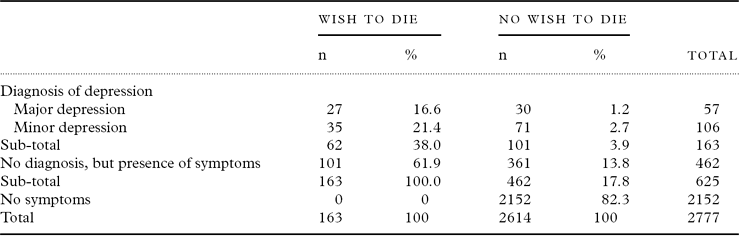
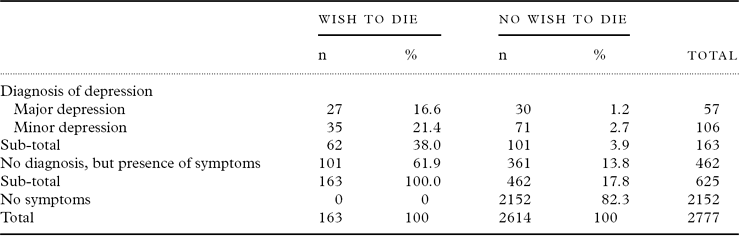
As shown in Table 2, all those with a wish to die presented some symptoms of depression for a period of at least two weeks during the previous 12 months. A diagnosis of major or minor depression, according to DSM-IV criteria, could be made for 62 persons (38%) in the wish-to-die group (n = 163), compared to 3.9% in the no-wish-to-die group (χ2 (1, n = 2777) = 324.2, p < 0.001). The 12-month prevalence rate for major depression in the group with wishes to die was 16.6% and 21.4% for minor depression, compared to 1.2% and 2.7% respectively for those with no wish to die. Among those with a diagnosis, 73.5% had experienced prior depressive episodes in their life; 50.5% were currently consulting a doctor and 34.4% were prescribed medications for their symptoms (results not shown in the table). It should be mentioned that among those with wishes to die, 61.9% presented a depressed mood accompanied by one to three depressive symptoms that fell short of DSM-IV threshold criteria, compared to 13.8% in the group with no wish to die.
Depression prevalence in elderly persons with and without wishes to die
Chronic illness
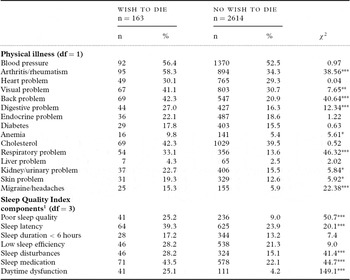
Table 3 shows that there were significant differences between the two groups in the frequency of certain types of chronic illnesses. Nine illnesses were found significantly more often in elderly persons with wishes to die. A logistic regression including the nine diseases that differentiated the groups revealed that when gender, marital status, and depression were controlled for, four types of chronic illnesses were significantly associated with increased odds of wishes to die: arthritis/rheumatism (OR = 1.76, 95% CI: 1.21–2.57), back problems (OR = 1.70, 95% CI: 1.15–2.51), respiratory disorders (OR = 2.50, 95% CI: 1.68–3.72), and headaches (OR = 1.79, 95% CI: 1.05–3.05). Elderly persons suffering from painful chronic diseases or illnesses that affect basic physiological needs (breathing) were more likely to have the wish to die. This model explains 25% of the variance in wish to die (R2 Nagelkerke).
Physical illnesses and sleep problems

*p < 0.05; **p < 0.01; ***p < 0.001.
1 Difficulty is present often or very often.
Quality of sleep
Table 3 shows that there were significant differences between the two groups on five components of the PSQI. A significantly higher number of people with wishes to die reported poor sleep quality, having difficulty falling asleep (sleep latency), more sleep disturbances (e.g. breathing difficulties, nightmares, pain), were taking a medication to sleep, and were experiencing daytime dysfunction due to their sleep problems (difficulty staying awake during daily activities).
A new logistic regression with all seven dimensions of the PSQI as independent variables indicated that when gender, marital status, and depression were controlled, two components were significantly associated with wish-to-die status: poor sleep quality (OR = 1.45, 95% CI: 1.04–2.02) and daytime dysfunction (OR = 2.01, 95% CI: 1.61–2.50). This model explains 26% of the variance in wish to die (R2 Nagelkerke).
Global model
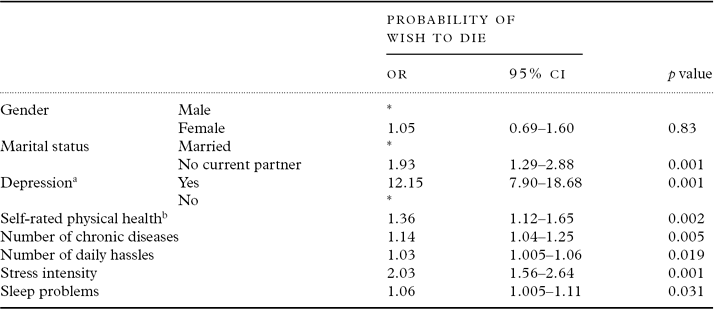
A final multiple logistic regression analysis (see Table 4) was conducted with eight independent variables: gender, marital status, depression, self-rated physical health, number of chronic diseases, number and intensity of daily hassles, and sleep problems. The results indicated that when the effects of gender, marital status, and depression were controlled for, self-rated physical health (OR = 1.36, 95% CI: 1.12–1.65), the number of chronic diseases (OR = 1.14, 95% CI: 1.04–1.25), the number of daily hassles (OR = 1.03, 95% CI: 1.005–1.06), their intensity (OR = 2.03, 95% CI: 1.56–2.64), as well as sleep problems (OR = 1.06, 95% CI: 1.005–1.11) appeared as significant associated factors with the wish to die in elderly adults. Persons experiencing stress related to daily hassles were almost twice as likely to have the wish to die. Gender was not associated with wishes to die, but having no current partner (OR = 1.93, 95% CI: 1.29–2.88) remained a significant risk factor. This model explains 29% of the variance in the wish to die (R2 Nagelkerke).
Risk to present wishes to die according to sociodemographic, health characteristics, daily hassles and sleep problems
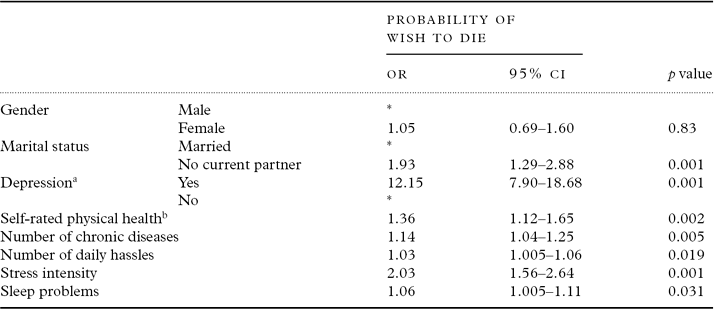
a Diagnosis of depression: major and minor.
b Excellent = 1, Bad = 5.
* These variables are not associated with wishes to die.
Discussion
The goal of the research was to study the prevalence of wishes to die in older adults living in the community. Results indicated a prevalence of 5.9% of death thoughts in our sample of 2777 older adults. These rates confirm data from previous studies that found a prevalence rate of 4% to 6% of wishes to die over various time frames: past week (Barnow and Linden, Reference Barnow and Linden1997), previous month (Scocco and De Leo, Reference Scocco and De Leo2002), and one year (Kim et al., Reference Kim, Bogner, Brown and Gallo2006). In our survey, women expressed wishes to die significantly more often than men, a result similar to that observed by Barnow and Linden (Reference Barnow and Linden1997) as well as Scocco and his team (Reference Scocco, Meneghel, Caon, Buono and De Leo2001). It is possible that women express more easily than men their wish to die as well as other forms of psychological pain (depression) as part of a help-seeking behavior (Scocco et al., Reference Scocco, Meneghel, Caon, Buono and De Leo2001). Further research is needed on wishes to die among men, who are particularly less inclined to seek help from mental health services (Drapeau et al., Reference Drapeau, Boyer and Lesage2009).
All three hypotheses were confirmed: the number of chronic diseases, stressful daily hassles, and sleep problems were associated factors for the wish to die even when depression, gender, and marital status were controlled for. Interestingly, results are similar to those that derive from case-control studies on risk factors for suicide. Diagnosed depression (38% of those with a wish to die) was also associated with significant increased odds of wishes to die (OR = 12.15, 95% CI: 7.90–18.68). However, a majority (61.9%) of our respondents with a wish to die (see Table 2) suffered from a depressed mood with a number of symptoms which fell short of DSM-IV threshold criteria. Jorm et al. (Reference Jorm, Henderson, Scott, Korten, Christensen and Mackinnon1995) also observed that only a minority of persons with the desire to die met sufficient diagnostic criteria to qualify for a depressive disorder (29%) even though most of them presented depressive symptoms. These data show that other variables, in addition to the detection of depression, should be included in the complex evaluation of psychological distress if we are to detect and help elderly people who wish to die.
Although many chronic illnesses were found significantly more often in persons with a wish to die, painful diseases (arthritis, back problems, headaches) were particularly important associated factors. This result is similar to those from studies that found that these chronic pain conditions significantly contributed to suicidal ideation (Juurlink et al., Reference Juurlink, Herrmann, Szalai, Kopp and Redelmeier2004; Ratcliffe et al., Reference Ratcliffe, Enns, Belik and Sareen2008). Helplessness and hopelessness might be important experiences that mediate the relation between physical pain and the wish to die, while insomnia caused by pain probably removes any possibility to escape from this unbearable situation. Moreover, breathing disorders were also a unique contributing factor to the wish to die, a factor also identified by Juurlink et al. (Reference Juurlink, Herrmann, Szalai, Kopp and Redelmeier2004). Kunik et al. (Reference Kunik2005) observed a high prevalence (65%) of depression and/or anxiety in patients with obstructive pulmonary disease, but noted that only a third of them were being treated for their mental disorders. Mental state assessment of older adults suffering from chronic pain or from diseases that significantly decrease their quality of life seems essential for preventive interventions.
Some studies have linked daily hassles with suicide (Kraaij et al. Reference Kraaij, Arensman and Spinhoven2002; Harwood et al., Reference Harwood, Hawton, Hope, Harriss and Jacoby2006), but, to our knowledge, none has shown the important and unique contribution of the stress produced by daily hassles to the wish to die of older adults. Referrals to social and community resources that can assist in improving life conditions, together with psychological help that can alleviate the stress and increase problem-solving abilities, might decrease the wish to die. Further research should look at the moderating effect of optimistic beliefs and meaning in life on the association between daily hassles and wishes to die, since recent findings have shown that positive attitudes toward the future moderates the effect of negative events on suicidal ideations (Lapierre et al., Reference Lapierre, Dubé, Bouffard and Alain2007; Hirsch et al., Reference Hirsch, Wolford, LaLonde, Brunk and Parker-Morris2009).
It would have been interesting to verify if there was an association between bereavement and wishes to die, since previous findings were contradictory (Waern et al., Reference Waern, Rubenowitz and Wilhelmson2003; Harwood et al., Reference Harwood, Hawton, Hope, Harriss and Jacoby2006). Our survey on the prevalence of mental disorders in old age was not structured to answer this question. However, a multivariate regression analysis indicated that death of the spouse in the previous two years was significantly associated with wishes to die (OR = 2.46, 95% CI: 1.39–4.36), even when depression and gender were controlled for. This result is limited to widowhood, although bereavement can be experienced following the loss of any significant relationship. There is a need for further investigation into the link between grieving difficulties and the wish for life to end.
Sleep problems were also independently associated with an increased risk of wish to die in older adults. Although respondents with the wish to die reported various sleep problems significantly more often than the comparison group, “poor sleep quality” and “daytime dysfunction because of a lack of sleep” were the two dimensions of the PSQI associated with the wish to die. This observation seems to indicate that older adults start to think that life is not worth living when sleep problems have an impact on daily activities. Future research and intervention should study the efficiency of sleep medication in people who express the wish to die, since our data indicated that 40% of those who take sleep medication still experience daytime dysfunction. They should also consider the possible interaction effect on insomnia of concomitant medications used to treat physical illnesses or depression (Ancoli-Israel and Cooke, Reference Ancoli-Israel and Cooke2005) and look at the possible effect of inappropriate long-term use of benzodiazepines that become ineffective as a result of physiological tolerance (Bain, Reference Bain2006). Furthermore, although previous research has indicated a distinct association between sleep disturbances, especially nightmares, and suicidality (Bernert and Joiner, Reference Bernert and Joiner2007), bad dreams (OR = 1.43, p = 1.07, 95% CI: 0.93–2.20) were not significantly associated with the wish to die when we did a logistic regression (controlling for gender, marital status, and depression) with three sleep disturbances (breathing difficulties, nightmares, and pain) as independent variables. However, pain (OR = 1.61, p = 0.01, 95% CI: 1.11–2.33) and breathing difficulties (OR = 2.34, p = 0.001, 95% CI: 1.41–3.87) increased the odds of wishes for death.
Since older adults might report more easily the presence of sleep disorders or physical pain than depression to health professionals, attention should be directed to those health-related factors that may be remediable. Pain evaluation as well as the assessment and management of sleep disorders (Bloom et al., Reference Bloom2009) should be more accessible to older adults and might be an essential part of the investigation of the suicide risk in elderly patients.
Since the expression of a wish to die could be the first step in the process toward suicidal behavior, the results from this study constitute an interesting contribution to the development of knowledge for preventive actions. The results do not suggest that wish for death or its correlates should be screened in all community-living older adults. However when health professionals encounter elderly persons suffering from painful physical diseases, significant sleep problems, or who are experiencing stressful daily hassles, they should ask the following questions which are widely used by suicide prevention hotlines to assess suicidal intent (Joiner et al., Reference Joiner2007): “With the difficulties you are experiencing currently, do you wish for death?” “Are you thinking about taking your own life?” “Have you made a plan to kill yourself?” (including a narrative on “how”, “when” and “where”). In situations where time is limited, these questions get at the most crucial information in order to determine if the professional should trigger a suicide prevention intervention. Nonetheless, knowledge of the factors associated with the wish to die can help design selective prevention programs which generally target those people who do not display signs of suicidal thoughts or behavior, but who are exposed to important losses and life transitions that make them vulnerable to depression and suicide (Erlangsen et al., Reference Erlangsen2011; Lapierre et al. Reference Lapierre2011). For example, an international panel of experts in the field of suicide prevention in older adults suggested that future selective prevention projects should include: systematic screening tools, outreach and support of isolated or stressed older adults, as well as training of professionals about losses that are significant to older people (retirement, loss of their driver's license, loss of mobility) in order to improve detection and risk assessment (Erlangsen et al., Reference Erlangsen2011). They also recommended optimizing treatment of sleep problems, pain, or other physical symptoms that decrease quality of life. Innovative strategies could also enhance positive aging and quality of life by increasing empowerment, coping and adaptive behavior, resilience, flexibility, social skills, self-esteem, sense of belonging, and hope, to help elderly persons face the challenges created by negative life events and daily hassles and improve protective factors against suicide (Lapierre et al., Reference Lapierre, Dubé, Bouffard and Alain2007; Reference Lapierre2011).
Current findings should be interpreted with the following limitations in mind. First, like other research in the field (Jorm et al., Reference Jorm, Henderson, Scott, Korten, Christensen and Mackinnon1995; Scocco et al. Reference Scocco, Meneghel, Caon, Buono and De Leo2001; Kim et al., Reference Kim, Bogner, Brown and Gallo2006), our study relied on a single self-report item that was simply answered by “yes” or “no” to determine the presence of the wish to die. Although, rigorous measures exist to assess suicidal ideations, there are no validated multi-item scales to explore the wish to die. Future research could develop new instruments that evaluate this concept. Second, there were not enough men (26.5%, n = 43) to study gender differences in the wish for death. Selection bias is a potential problem in this type of survey, even if the response rate is considered good (66%). Future research should see if the associated factors for the wish to die are different for men and women. The third limitation is related to the cross-sectional nature of the data which precludes determination of causality. However, it should be noted that this paper was limited to the presentation of the initial data (Time 1) from the ESA longitudinal survey on the prevalence of mental disorders in the elderly population. It will be interesting to see the changes in the participants' wishes to die at Time 2 (one year later) and to verify which variables still have an impact on the process involved in the desire for death. It should also be mentioned that the time frames of the four key variables differ. For example, wishes for death were examined for the last year, daily hassles and sleep problems were examined for the last month, while participants were currently suffering from their physical illness. Therefore, it is impossible to know if wishes to die occurred after or before the onset of the stressors. Finally, while our research studied the impact of various chronic conditions on wishes to die, our survey on mental disorders did not evaluate the presence of pain and common co-occurring disabilities which could also have a significant impact on the wish to die. In addition, our study was centered on the wish to die of older adults living in the community; new research should focus on institutionalized elderly persons, especially because their living conditions and health status could make them wish for death and at risk for suicidal thoughts.
More research investigating wishes to die is necessary since early detection is essential to prevent suicidal ideations and behaviors. Most preventive programs focus on the identification of depression as a mean to prevent suicide (Lapierre et al., Reference Lapierre2011), but this needs specialized clinical abilities. Our study showed that there are other related variables that could help in the early detection of psychological distress by those who are in contact with the aged population. By giving more rigorous attention to the stress produced by daily hassles, to pain, or to sleep problems, trained professionals would have a unique opportunity to detect at-risk individuals and refer them to resources that can help them improve their quality of life and well-being and incidentally restore their desire to live (Lapierre et al., Reference Lapierre2011).
Conflict of interest
None.
Description of authors' roles
Sylvie Lapierre was responsible for writing the paper and analyzing the data on daily hassles and physical illnesses. Richard Boyer was responsible for designing the study, carrying it out, and writing the section on suicide. Sophie Desjardins was responsible for analyzing the data and writing the section on sleep problems. Micheline Dubé was responsible for the clinical dimension of the paper and for writing the section on depression. Dominique Lorrain was responsible for designing the study, analyzing the data and writing the section on sleep problems. Michel Préville was responsible for designing the study, recruiting the participants, supervising the data entry and the statistical analyses. Joëlle Brassard was responsible for carrying out the statistical analyses.
Acknowledgments
This study was supported by the Canadian Institute of Health Research (200403MOP).