Summations
Schizophrenia patients showed higher monocyte count as compared with healthy controls.
Monocyte count should be a possible easy available peripheral marker of microgliaʼs activation in a real-world setting.
Considerations
The moderate to high statistical heterogeneity across studies that limits the generalisability of our conclusions.
Considering the limited number of included studies, it was impossible to quantitatively assess the significance of publication bias.
Introduction
Schizophrenia is a heterogeneous psychiatric disorder with a broad spectrum of clinical and biological manifestations; it is recognised as a major mental illness with a prevalence of approximately 1% in the global population (Kessler et al., Reference Kessler, Birnbaum, Demler, Falloon, Gagnon, Guyer, Howes, Kendler, Shi, Walters and Wu2005; Tomasik et al., Reference Tomasik, Rahmoune, Guest and Bahn2016). While its diagnostic and clinical features are well established, the pathogenesis remains elusive. Different theories have been investigated coming from biological, genetic, and psychosocial approaches (Haraldsson et al., Reference Haraldsson, Ettinger and Sigurdsson2011; Kahn and Sommer, Reference Kahn and Sommer2015).
Among the pathophysiological hypothesis, there is a growing interest in the association between psychosis and the activation of the inflammatory system (Khandaker and Dantzer, Reference Khandaker and Dantzer2016; Miller and Goldsmith, Reference Miller and Goldsmith2017).
Various studies suggested an increase of cytokines; some of them appeared to be a state marker as they were increased in acutely relapsed schizophrenia and in first episode psychosis (FEP) and normalised with antipsychotic treatment [interleukin (IL)-1β, IL-6, and transforming growth factor-β] and some other appeared to be a trait markers, as their levels remained elevated in acute exacerbations and following antipsychotic treatment [IL-12, interferon-γ, tumour necrosis factor-α (TNF-α), and soluble IL-2 receptor (Miller et al., Reference Miller, Buckley, Seabolt, Mellor and Kirkpatrick2011; Guo et al., Reference Guo, Liu, Wang, Feng and Zhang2015; Dasdemir et al., 2016; Turhan et al., Reference Dasdemir, Kucukali, Bireller, Tuzun and Cakmakoglu2016)]. Moreover, variants of cytokines receptor genes seem to be involved in the pathogenesis of more severe psychosis (Khandaker et al., Reference Khandaker, Zammit, Burgess, Lewis and Jones2018). Different studies also reported an increase in gene expression and serum levels of acute phase proteins, such as haptoglobin, serum resistin, and c-reactive protein, among patients with schizophrenia or at high risk to develop it later in life (Yang et al., Reference Yang, Wan, Li, Zhu, La, Xi, Chen, Jiang, Feng and He2006; Miller et al., Reference Miller, Culpepper and Rapaport2014; Klemettilä et al., Reference Klemettilä, Kampman, Seppälä, Viikki, Hämäläinen, Moilanen and Leinonen2017; Gurung et al., Reference Gurung, Chamlagai, Bera, Chaudhuri and Singh2018). Furthermore, abnormal expression of Toll-like receptors has been found in FEP and in the earliest stage of schizophrenia (Kéri et al., Reference Kéri, Szabó and Kelemen2017). An increased prevalence of autoimmune diseases has been observed in both patients with schizophrenia and their first-degree relatives, suggesting that autoimmune mechanisms may underlie these conditions (Eaton et al., Reference Eaton, Byrne, Ewald, Mors, Chen, Agerbo and Mortensen2006; Larsen et al., Reference Larsen, Iversen and Reitan2018).
Monocytes are a subset of leukocyte, derived from haematopoietic stem cells and formed in the bone marrow that can differentiate into macrophages and myeloid lineage dendritic cells. Monocytes are involved in the innate immune response and play a major role in defending the host from invading pathogens and influencing the process of adaptive immunity. The brain hosts several types of monocyte-derived cells, including perivascular cells, meningeal macrophages, choroid plexus macrophages, and microglia (Prinz and Priller, Reference Prinz and Priller2014). Peripheral monocyte count is part of the complete blood count, and it is widely used in the clinical setting as a marker of inflammation. There is replicated evidence for increased levels of circulating monocytes in schizophrenia, with monocytosis being especially prevalent in FEP (Drexhage et al., Reference Drexhage, Hoogenboezem, Cohen, Versnel, Nolen, van Beveren and Drexhage2011), due to enhanced expression of immune genes and overproduction of monocytes/macrophage-related cytokines (Beumer et al., Reference Beumer, Gibney, Drexhage, Pont-Lezica, Doorduin, Klein, Steiner, Connor, Harkin, Versnel and Drexhage2012). Moreover, circulating monocytes can be considered an indirect marker of microglia activation in the central nervous system, and monocytosis seems to be linked with high levels of activated brain microglia (Beumer et al., Reference Beumer, Gibney, Drexhage, Pont-Lezica, Doorduin, Klein, Steiner, Connor, Harkin, Versnel and Drexhage2012; Müller et al., Reference Müller, Wagner, Krause, Weidinger, Wildenauer, Obermeier, Dehning, Gruber and Schwarz2012). Indeed, under pathological condition, the activation of microglia may be part of systemic activation of the mononuclear phagocyte system that induces activation of circulating monocytes (Beumer et al., Reference Beumer, Gibney, Drexhage, Pont-Lezica, Doorduin, Klein, Steiner, Connor, Harkin, Versnel and Drexhage2012; Prinz and Priller, Reference Prinz and Priller2014). Post-mortem studies, positron emission tomography (PET) studies and magnetic resonance imaging (MRI) studies founded altered function, reduced density, and increased levels of microglial activation across several brain regions of schizophrenic patients (Radewicz et al., Reference Radewicz, Garey, Gentleman and Reynolds2000; Laskaris et al., Reference Laskaris, Di Biase, Everall, Chana, Christopoulos, Skafidas, Cropley and Pantelis2016; Trépanier et al., Reference Trépanier, Hopperton, Mizrahi, Mechawar and Bazinet2016; van Kesteren et al., Reference van Kesteren, Gremmels, de Witte, Hol, Van Gool, Falkai, Kahn and Sommer2017; Plavén-Sigray et al., Reference Plavén-Sigray, Matheson, Collste, Ashok, Coughlin, Howes, Mizrahi, Pomper, Rusjan, Veronese, Wang and Cervenka2018). Unfortunately, post-mortem, PET and MRI studies are expensive and hard to execute and they cannot be performed on large numbers of subjects. Thus, circulating monocyte count could represent an easy available indirect marker of the mononuclear phagocyte system activation.
While various meta-analyses and reviews about other inflammatory biomarkers in schizophrenia and related psychosis have already been published, there is a lack of systematic data analysing specifically the monocyte count. Considering that an adequate amount of evidence was collected, we carried out this systematic review and meta-analysis to investigate if there are significant differences in monocyte count in peripheral blood comparing healthy controls (HCs) with people suffering from schizophrenia and related disorders. We attempt to better understand the strengths and consistency of the relationship, taking into account the potential effect of relevant moderators and heterogeneity.
Materials and methods
We adhered to the Preferred Reporting Items for Systematic Reviews and Meta-Analyses (PRISMA) standard. The study protocol was registered in the International Prospective Register of Systematic Reviews (PROSPERO - registration number: CRD42019121566) (https://www.crd.york.ac.UK/prospero/).
Search strategy
We conducted a systematic search for all possible eligible peer-reviewed articles through PubMed, ScienceDirect, and Cochrane Library electronic databases. The search was extended until January 2019, including only abstracts in English. The publication date was not restricted in our search. According to different bibliographic rules, we combined the following keywords to identify specific and relevant studies: (psychosis OR psychotic OR schizophren* OR schizoaffective) AND (monocyt*). We also screened reference lists from selected articles to identify additional studies that may have been missed.
Eligibility criteria
Inclusion criteria were as follows: (1) adult subjects (≥18 years) diagnosed with schizophrenia and related disorder (schizophrenia, schizoaffective disorder, schizophreniform disorder, brief psychotic disorder, schizotypal personality disorder, delusional disorder) according to the American Psychiatric Associationʼs Diagnostic and Statistical Manual of Mental Disorders (DSM) criteria; (2) pairwise comparison with a control group of healthy volunteers; and (3) studies assessing monocyte count in peripheral blood in human blood samples in vivo. We considered FEP any first episode of psychosis (DSM diagnosis of schizophrenia and related disorders) occurring between 14 and 40 years in the absence of any substance use disorders. We excluded duplicate publication and overlapping samples to reduce the risk of an inappropriate weighting of study results. We decided to exclude studies with incomplete data, such as conference abstracts and dissertations, and grey literature of uncertain scientific quality or that did not undergo a rigorous peer-review process (Sacks et al., Reference Sacks, Reitman, Pagano and Kupelnick1996). The decision of whether to include studies in the meta-analyses was based on the above criteria, and a consensus was reached among the authors on those decisions.
Selection of studies and data extraction
After removal of duplicates, two authors (M.G.M. and S.L.) independently completed the preliminary screening based on titles and abstracts and, according to inclusion criteria, evaluated full text for the final decision. Two authors (S.L. and I.T.) independently extracted the following main information from all included studies: first author, year of publication, country, stage of disorder, setting, index, and control sample sizes, mean age, men and women ratio, psychopharmacology treatment and monocyte count for index and control groups. When the necessary data were not available from the published paper, we contacted the authors and requested the necessary information in order to reduce the risk of selective reporting bias and to include unpublished findings. Whenever multiple reports pertained to the same groups of patients, we retained only the most comprehensive report for the meta-analytic calculations to avoid duplication of information. Disagreements in suitability for inclusion were resolved by discussion and consensus, involving the mediation of all co-authors.
Quality assessment
Quality of eligible observational studies was assessed using the Newcastle Ottawa Scale (NOS) for case–control studies (Stang, Reference Stang2010). Each study was evaluated based on eight items, categorised into three groups: the selection of the study groups; the comparability of the groups; and the ascertainment of the outcome of interest for case–control studies. A higher score indicates higher methodological quality.
Data analysis
Meta-analyses of monocyte count were carried out generating pooled standardised mean differences (SMDs), with related 95% confidence intervals (CIs), between patients and HC. To address heterogeneity, meta-analyses were conducted according to the random effects model. Statistical significance was set at p < 0.05, and conventional forest plots were used to summarise results. Publication bias was explored using a visual examination of funnel plot. Besides, if at least 10 studies were included in the meta-analysis, Beggʼs test (Begg & Mazumdar, Reference Begg and Mazumdar1994) and Egger linear regression test were used to assess the symmetry of the effects and to statistically test for publication bias (Sterne et al., Reference Sterne, Egger and Smith2001). Consistency across studies was measured using the I 2 statistics test (Higgins et al., Reference Higgins, Thompson, Deeks and Altman2003), with values of 25%, 50%, and 75%, taken to indicate low, moderate, and high levels of heterogeneity, respectively.
We conducted sensitivity analyses removing studies with the strongest effect sizes and studies with the largest sample sizes as recommended by the Cochrane Handbook, section 9.7 (Higgins & Green, Reference Higgins and Green2008). Moreover, for analyses showing significant associations including at least four studies and showing an I 2 higher than 25%, we performed a sequential and combinatorial algorithms’ sensitivity analysis leaving out single studies up to a priori defined I 2 value of 25% (Patsopoulos et al., Reference Patsopoulos, Evangelou and Ioannidis2008). In this approach, for a meta-analysis of n studies, we perform n new meta-analyses, where one study is excluded from the calculations each time. The study that is responsible for the largest decrease in I 2 is dropped and a new set of n − 1 studies is created. We continue by successively re-analysing reduced sets of studies and applying the same rule one step before I 2 decreases below the requested I 2 (Patsopoulos et al., Reference Patsopoulos, Evangelou and Ioannidis2008). We also carried out subgroup analyses including analysis of statistical difference among subgroups in order to explore the heterogeneity of the effect according to a set of study characteristics such as stage of schizophrenia and related disorder (established disorder vs. FEP), setting (inpatients vs. outpatients), and country of origin (Europe vs. USA). Further, we performed meta-regression analyses (if the number of studies was at least 10) in order to investigate the possible effect of mean age and gender on monocyte count (Higgins & Green, Reference Higgins and Green2008).
Comprehensive Meta-analysis Software version 3.0 (Biostat, Englewood, NJ) was employed in all analyses.
Results
Studies selection and characteristics
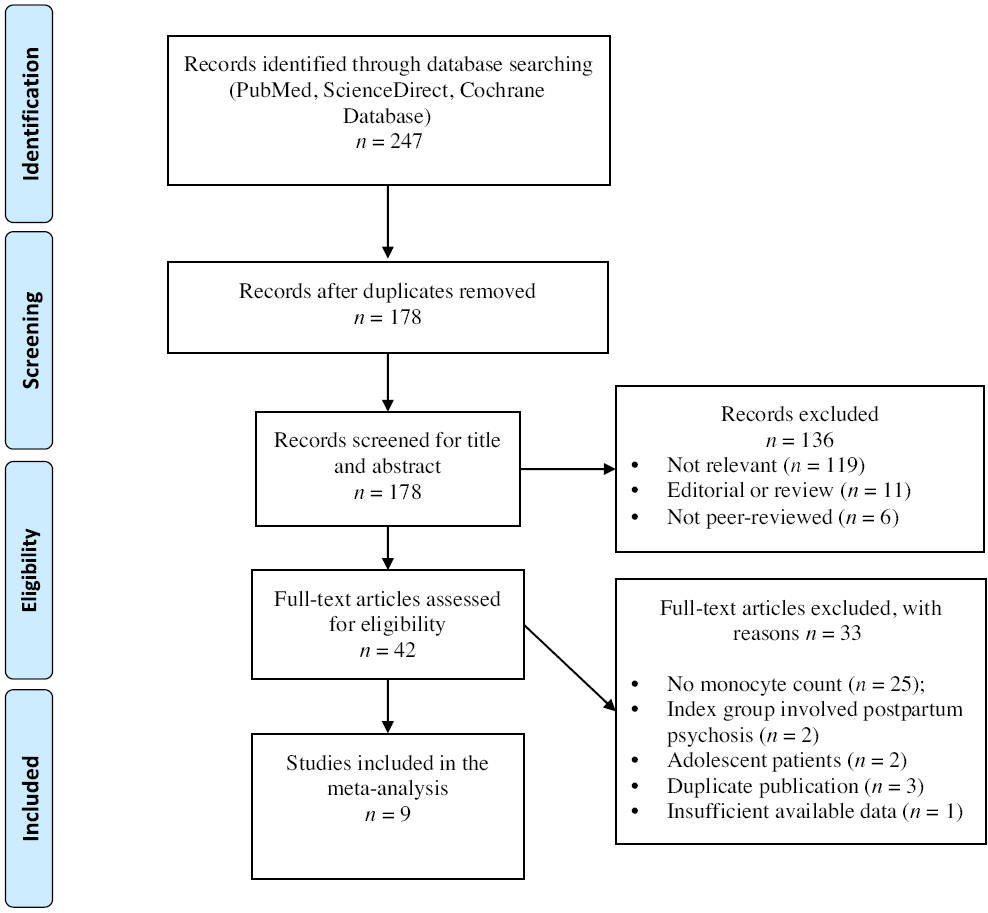
Our search generated 247 records. After removing duplicates, screening for title, abstract and full text, nine records met all our criteria and were included in our meta-analysis (Wilke et al., Reference Wilke, Arolt, Rothermundt, Weitzsch, Hornberg and Kirchner1996; Zorrilla et al., Reference Zorrilla, Cannon, Gur and Kessler1996; Miller et al., Reference Miller, Kandhal, Rapaport, Mellor and Buckley2015; Pavlović et al., Reference Pavlović, Babić, Rastović, Babić and Vasilj2016; Garcia-Rizo et al., Reference Garcia-Rizo, Casanovas, Fernandez-Egea, Oliveira, Meseguer, Cabrera, Mezquida, Bioque, Kirkpatrick and Bernardo2017; Özdin et al., Reference Özdin, Sarisoy and Böke2017; Moody and Miller, Reference Moody and Miller2018; Orhan et al., Reference Orhan, Schwieler, Fatouros-Bergman, Malmqvist, Cervenka, Collste, Flyckt, Farde, Sellgren, Piehl, Engberg and Erhardt2018; Yüksel et al., Reference Yüksel, Ertek, Dikmen and Göka2018) (Fig. 1).
Flow chart of studies selection process.

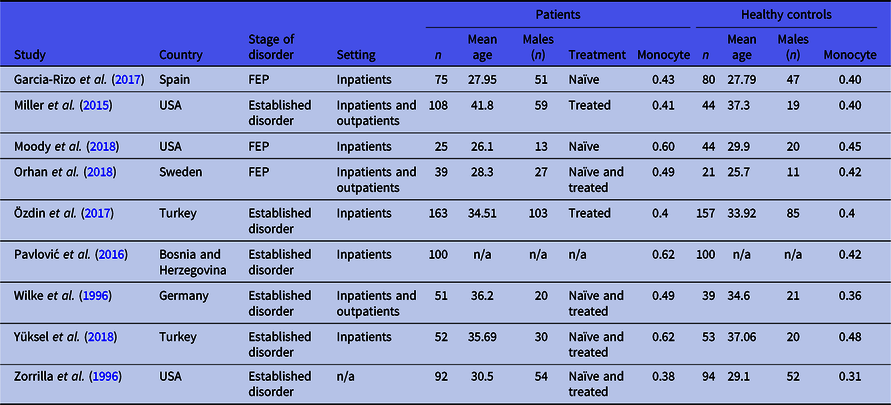
Included studies were published between May 1996 (Wilke et al., Reference Wilke, Arolt, Rothermundt, Weitzsch, Hornberg and Kirchner1996) and July 2018 (Orhan et al., Reference Orhan, Schwieler, Fatouros-Bergman, Malmqvist, Cervenka, Collste, Flyckt, Farde, Sellgren, Piehl, Engberg and Erhardt2018). Considering the stage of the disorder, three studies included FEP patients (Garcia-Rizo et al., Reference Garcia-Rizo, Casanovas, Fernandez-Egea, Oliveira, Meseguer, Cabrera, Mezquida, Bioque, Kirkpatrick and Bernardo2017; Moody and Miller, Reference Moody and Miller2018; Orhan et al., Reference Orhan, Schwieler, Fatouros-Bergman, Malmqvist, Cervenka, Collste, Flyckt, Farde, Sellgren, Piehl, Engberg and Erhardt2018), while the remaining six studies included subjects affected by established schizophrenia and related psychosis. Two studies included patients treated with psychotropic medications (Miller et al., Reference Miller, Kandhal, Rapaport, Mellor and Buckley2015; Özdin et al., Reference Özdin, Sarisoy and Böke2017), two included drug-naïve patients (Garcia-Rizo et al., Reference Garcia-Rizo, Casanovas, Fernandez-Egea, Oliveira, Meseguer, Cabrera, Mezquida, Bioque, Kirkpatrick and Bernardo2017; Moody and Miller, Reference Moody and Miller2018), four included mixed samples of drug-treated and drug-free patients (Wilke et al., Reference Wilke, Arolt, Rothermundt, Weitzsch, Hornberg and Kirchner1996; Zorrilla et al., Reference Zorrilla, Cannon, Gur and Kessler1996; Orhan et al., Reference Orhan, Schwieler, Fatouros-Bergman, Malmqvist, Cervenka, Collste, Flyckt, Farde, Sellgren, Piehl, Engberg and Erhardt2018; Yüksel et al., Reference Yüksel, Ertek, Dikmen and Göka2018), whereas for one study, this information was not available (Pavlović et al., Reference Pavlović, Babić, Rastović, Babić and Vasilj2016). All the included studies showed high methodological quality, one study obtained six stars at NOS (Pavlović et al., Reference Pavlović, Babić, Rastović, Babić and Vasilj2016), three studies obtained seven stars at NOS (Wilke et al., Reference Wilke, Arolt, Rothermundt, Weitzsch, Hornberg and Kirchner1996; Özdin et al., Reference Özdin, Sarisoy and Böke2017; Yüksel et al., Reference Yüksel, Ertek, Dikmen and Göka2018), while the remaining four studies obtained eight stars at NOS.
Since the included studies were less than 10, we could not assess the risk of publication bias. Full details of the included studies are summarised in Table 1.
Characteristics of studies included in the meta-analysis

FEP, first episode psychosis; n/a, not available.
Meta-Analysis
Nine studies (Wilke et al., Reference Wilke, Arolt, Rothermundt, Weitzsch, Hornberg and Kirchner1996; Zorrilla et al., Reference Zorrilla, Cannon, Gur and Kessler1996; Miller et al., Reference Miller, Kandhal, Rapaport, Mellor and Buckley2015; Pavlović et al., Reference Pavlović, Babić, Rastović, Babić and Vasilj2016; Garcia-Rizo et al., Reference Garcia-Rizo, Casanovas, Fernandez-Egea, Oliveira, Meseguer, Cabrera, Mezquida, Bioque, Kirkpatrick and Bernardo2017; Özdin et al., Reference Özdin, Sarisoy and Böke2017; Moody and Miller, Reference Moody and Miller2018; Orhan et al., Reference Orhan, Schwieler, Fatouros-Bergman, Malmqvist, Cervenka, Collste, Flyckt, Farde, Sellgren, Piehl, Engberg and Erhardt2018; Yüksel et al., Reference Yüksel, Ertek, Dikmen and Göka2018), based on nine different samples accounting for 1337 individuals, provided data suitable for monocyte count between patients (n = 705) and HC (n = 632).
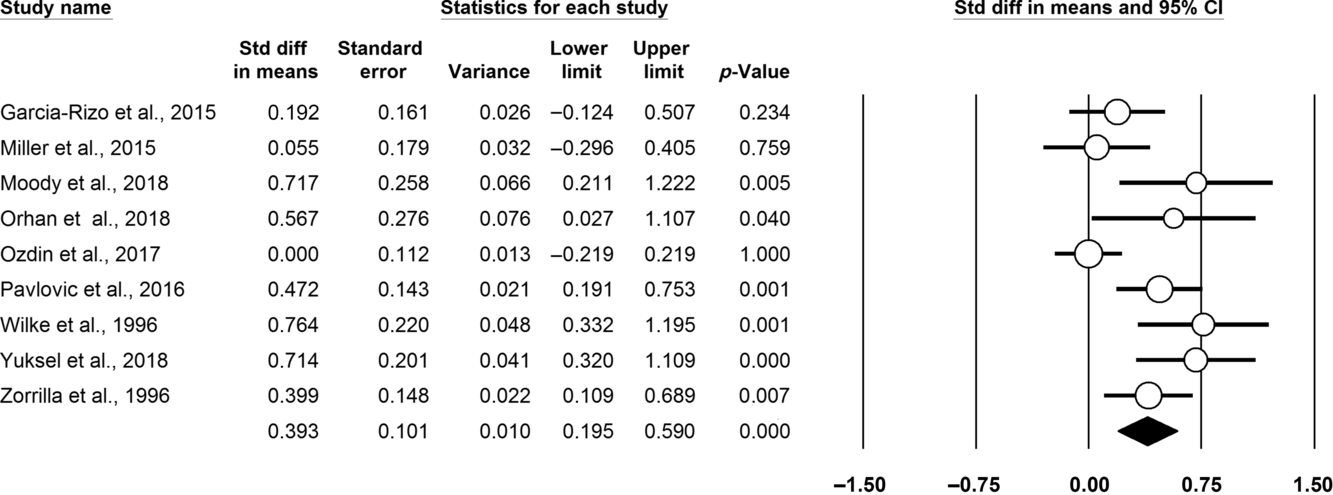
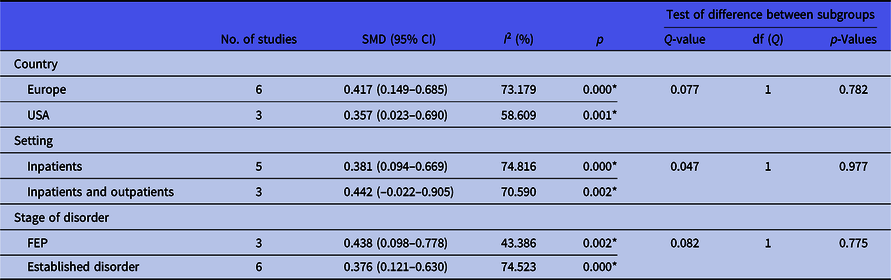
Psychotic patients had higher monocyte count as compared with HC (SMD = 0.393; 95% CI: 0.195 to 0.590; p = 0.001) (Fig. 2). Heterogeneity across studies was from moderate to high (I 2 = 65.952%). Sensitivity analyses removing the study with the strongest effect size (Wilke et al., Reference Wilke, Arolt, Rothermundt, Weitzsch, Hornberg and Kirchner1996) showed no difference in SMD and heterogeneity (SMD = 0.350; 95% CI: 0.152 to 0.547; p = 0.001; I 2 = 63.484%), while sensitive analysis removing the study with the largest sample size (Özdin et al., Reference Özdin, Sarisoy and Böke2017) showed slightly higher SMD and moderate heterogeneity (SMD = 0.449; 95% CI: 0.274 to 0.624; p = 0.000; I 2 = 43.697%). Sensitivity analysis, based on the sequential and combinatorial algorithms, leaving out two studies responsible for most of the heterogeneity (Miller et al., Reference Miller, Kandhal, Rapaport, Mellor and Buckley2015; Özdin et al., Reference Özdin, Sarisoy and Böke2017), showed a slightly higher SMD (SMD = 0.497; 95% CI: 0.341 to 0.652; p = 0.000; I 2 = 19.553%). Subgroup analyses showed no significant differences in the effect size across different study characteristics (stage of disorder, setting, and country of origin) (Table 2). Visual examination of the funnel plot showed a slight asymmetry (Supplementary Fig. 1), considering that the studies were fewer than 10, it was impossible to quantitatively assess the significance of publication bias.
Forest plot: differences in monocyte count between patients and healthy controls.

Monocytes count SMD by single study characteristics: subgroup analyses

SMD, standardised mean differences; FEP, first episode psychosis.
* Significantly different: p < 0.05; Statistical trend: 0.05 < p < 0.1.
Discussion
Main findings
The present meta-analysis is the first to explore the monocyte count in peripheral blood in schizophrenia and related psychosis compared to HC. We included nine studies, all of them showed high methodological quality according to the NOS for case–control studies, reinforcing our results. We observed that people suffering from schizophrenia and related psychosis showed statistically significant higher monocyte count than HC. According to conventional cut-offs, the effect was small to medium. Heterogeneity was from moderate to high. Relevant sensitivity analysis removing the study with the largest sample sizes (Özdin et al., Reference Özdin, Sarisoy and Böke2017) and sequential and combinatorial sensitivity analysis leaving-out Miller et al. (Reference Miller, Kandhal, Rapaport, Mellor and Buckley2015) and Özdin et al. (Reference Özdin, Sarisoy and Böke2017) studies showed an effect size slightly higher than the overall meta-analysis. Subgroup analysis revealed no influence of different study characteristics on the effect size excluding that the observed heterogeneity should be explained by the explored covariates. Meta-regression exploring the effect of mean age and gender was not conducted because the number of included studies was fewer than 10. Visual examination of the funnel plot showed a slight asymmetry suggesting a possible presence of publication bias, considering the small number of included studies, we cannot conduct Beggʼs and Egger test to quantify the significance of publication bias.
Interpretation of findings
This meta-analysis, showing higher levels of monocytes in schizophrenia and related psychosis compared to HC, should be read in the context of activation of cells of the mononuclear phagocyte system, with a particular focus on circulating monocytes and their possible cross-talk with the microglia.
Monocytosis has been observed in schizophrenia both in treated and drug-naïve subjects, in FEP, and in children with psychosis (Zorrilla et al., Reference Zorrilla, Cannon, Gur and Kessler1996; Drexhage et al., Reference Drexhage, Hoogenboezem, Cohen, Versnel, Nolen, van Beveren and Drexhage2011). Monocytosis is associated with worsening of psychotic symptoms, and it is modulated by antipsychotic treatment (Dimitrov, Reference Dimitrov2011; Miller & Goldsmith, Reference Miller and Goldsmith2017). Accumulation of monocytes and macrophages has also been found in the cerebrospinal fluid of patients with schizophrenia during acute psychotic episodes (Nikkilä et al., Reference Nikkilä, Müller, Ahokas, Miettinen, Rimón and Andersson1999). In addition to peripheral monocytosis, enhanced expression of inflammatory genes in circulating monocytes has been observed in non-affective psychosis. In particular, schizophrenia patients showed an activated monocyte gene cluster including IL-1β, IL-6, TNF, Prostaglandin-endoperoxide synthase 2, Pentraxin-3, and various proinflammatory chemokines. Interestingly, the overexpression of these genes was particularly evident in active psychosis (Drexhage et al., Reference Drexhage, van der Heul-Nieuwenhuijsen, Padmos, van Beveren, Cohen, Versnel, Nolen and Drexhage2010). Moreover, increased levels of cytokines mainly produced by monocytes (such as IL-1β, IL-6, IL-12, and TNF) or cytokines having a primary effect on mononuclear phagocyte system (such as granulocyte-macrophage colony-stimulating factor, monocyte chemoattractant protein-1, macrophage inflammatory protein-1α and 1β) have been found in schizophrenia (Miller et al., Reference Miller, Buckley, Seabolt, Mellor and Kirkpatrick2011; Frydecka et al., 2018; Gallego et al., Reference Frydecka, Krzystek-Korpacka, Lubeiro, Stramecki, Stańczykiewicz, Beszłej, Piotrowski, Kotowicz, Szewczuk-Bogusławska, Pawlak-Adamska and Misiak2018).
The mononuclear cells, in their brain (microglia), circulation (monocytes), and tissue (macrophages) components, have been considered as a key element in the two-hit pathogenesis model for psychosis (Bergink et al., Reference Bergink, Gibney and Drexhage2014). Gene–environment interactions (such as infection or stress) during foetal or early life in genetically susceptible individuals induce an aberrant pro-inflammatory differentiation of myeloid precursors to monocytes, macrophages, dendritic cells, and microglia. This inflammatory activation induces an abnormal growth, differentiation, and function of brain neuronal circuitry and leads to a “vulnerable brain” (first hit). The second hit takes place later, usually during adolescence, in the form of various exogenous or endogenous stimuli (microbes, stress, puberty, postpartum period), leading to a further and excessive microglia activation resulting in abnormalities of the neuronal circuitry in the brain and psychosis (Picker et al., Reference de Picker, Morrens, Chance and Boche2017). PET studies highlighted the microglial activation or dysfunction in schizophrenia patients, while neuroimaging investigation confirmed structural brain changes in both white and grey matter regions in patients with FEP and schizophrenia (Beumer et al., Reference Beumer, Gibney, Drexhage, Pont-Lezica, Doorduin, Klein, Steiner, Connor, Harkin, Versnel and Drexhage2012; Laskaris et al., Reference Laskaris, Di Biase, Everall, Chana, Christopoulos, Skafidas, Cropley and Pantelis2016; Plavén-Sigray et al., Reference Plavén-Sigray, Matheson, Collste, Ashok, Coughlin, Howes, Mizrahi, Pomper, Rusjan, Veronese, Wang and Cervenka2018). In this context, the microglia activation seems to be caused or accompanied by monocyte activation reflected by the above-mentioned blood monocytosis, enhanced inflammatory gene expression in monocytes, and high serum levels monocyte/macrophage-related cytokines (Beumer et al., Reference Beumer, Gibney, Drexhage, Pont-Lezica, Doorduin, Klein, Steiner, Connor, Harkin, Versnel and Drexhage2012). This cross-talk between monocytes and microglia is mainly mediated by cytokines found to be increased in schizophrenia such as IL-1β, IL-6, IL-8 or TNF-α (Beumer et al., Reference Beumer, Gibney, Drexhage, Pont-Lezica, Doorduin, Klein, Steiner, Connor, Harkin, Versnel and Drexhage2012), suggesting a role of monocytes and microgliaʼs interaction in the pathophysiology of psychosis (Miller et al., Reference Miller, Buckley, Seabolt, Mellor and Kirkpatrick2011; Notter and Meyer, Reference Notter and Meyer2017). Moreover, a recent study that identified brain tissue macrophages proximal to neurons in schizophrenic patients in high inflammatory state speculates on the monocytes capacity for infiltrating brain tissue when high inflammatory status drives the inflammatory cascade by signalling to microglia (Cai et al., Reference Cai, Catts, Webster, Galletly, Liu, O'Donnell, Weickert and Weickert2018).
All these evidence highlight a possible role of the mononuclear phagocyte system in the pathophysiology of psychotic disorders. Considering the activation of the microglia as part of a systemic activation of the mononuclear phagocyte system and the proofs of cross-talking between microglia and monocytes when an inflammation occurs, we can speculate that the observed higher monocyte count in psychotic patients is a reflex of the high levels of activated brain microglia (Beumer et al., Reference Beumer, Gibney, Drexhage, Pont-Lezica, Doorduin, Klein, Steiner, Connor, Harkin, Versnel and Drexhage2012; Garcia-Rizo et al., Reference Garcia-Rizo, Casanovas, Fernandez-Egea, Oliveira, Meseguer, Cabrera, Mezquida, Bioque, Kirkpatrick and Bernardo2017). We suggest, therefore, monocyte count as a possible easy available peripheral marker of microgliaʼs activation in a real-world setting. Monocyte count is inexpensive, often routinely available, and it can be calculated in large, already collected data sets. It is also characterised by minimal patient discomfort, making it easily replicable.
This result is consistent with the higher monocyte to lymphocyte ratio (MLR) observed in non-affective psychosis compared to HC found in our previous meta-analysis (Mazza et al., Reference Mazza, Lucchi, Rossetti and Clerici2019). Even if MLR, reflecting two immune pathways, is probably more predictive in evaluating inflammation than monocytes alone, we decided to deepen the investigation in the field with the present meta-analysis considering that by now there are only a few studies investigating MLR in psychosis.
Limitation
This meta-analysis should be considered in the context of the following limitations that may affect confidence on findings. First, although we tested effects of setting, stage of disorder, and country of origin, it should be considered that other covariates, such as lifestyle, smoking, BMI, and ethnicity, might influence this association. Moreover, the small number of studies including naïve (n = 2 studies) and treated (n = 2 studies) cohorts did not allow us to conduct a subgroup analysis investigating for the effect of the psychopharmacological treatment on the monocyte blood cell count. Second, we found a moderate to high statistical heterogeneity across studies that, even if explored using sensitivity and subgroups analysis, partially limits the generalisability of our conclusions. Third, considering the need for strict and rigorous diagnostic criteria according to American Psychiatric Association, we decided to exclude grey literature in order to reduce the risk of including low-quality studies not receiving peer-review process. However, the decision to exclude the grey literature should be considered as a possible limitation because it may provide data not found within published literature, providing an important forum for disseminating studies with null or negative results, thus excluding this source of literature could increase the publication bias (Paez, Reference Paez2017). Fourth, since several studies have been excluded due to our restrictive inclusion criteria, we included a limited number of studies and it was impossible to quantitatively assess the significance of publication bias. Moreover, we have to consider that cross-sectional studies are difficult to publish if the results are negative. Fifth, considering that the number of included studies was fewer than 10, we did not conduct meta-regression analysis exploring the effect of age and gender. Finally, all included studies had relatively moderate sample sizes and modest effect size limiting the strengths of the overall estimated effect size. In sum, judgement about evidence from this meta-analysis should be considered modest so far.
Supplementary material
To view supplementary material for this article, please visit https://doi.org/10.1017/neu.2020.12
Author contributions
MGM, AR and MC designed the study and wrote the protocol. IT and SL collected the data. MGM and AR conducted the analysis and interpretation of data. MGM, AR, MC, and MC wrote the first draft of the manuscript. IT and SL revised the manuscript. All authors contributed to and have approved the final manuscript.
Financial support
This research received no specific grant from any funding agency, commercial or not-for-profit sectors.
Conflict of interest
None.