Introduction
The Sakka Saṃyutta of the Pāli Saṃyutta-nikāya (abbreviated SN) is represented in Chinese by two versions, one in the Za Ahan Jing 雜 阿 含 經 (Saṃyuktāgama, abbreviated SA, Taishō vol. 2, no. 99), the other in the Bieyi Za Ahan Jing 別 譯 雜 阿 含 經 (Additional Translation of Saṃyuktāgama, abbreviated ASA, Taishō vol. 2, no. 100). This saṃyutta/xiangying 相 應 is a collection of various discourses on the subject of Śakra, ruler of the gods ‘devānaṃ indra’ in the heaven of Thirty-three gods (Skt. Trāyastriṃsā devāḥ; P. Tāvatiṃsa devā; Sanshisan Tian 三 十 三 天). This Śakra belongs to one of the particular classes of Indian divine beings (devas), but is also a devotee of the Buddha, as shown in the three versions. The discourses comprising the Pāli and Chinese versions of the Sakka Saṃyutta reflect the early Buddhist adaptation of general Indian religious beliefs about Śakra at the time of the Buddha.
In this paper I first briefly examine the textual structure of the three versions. Then I compare the main teachings contained in them, making use of new editions of SA: Yin Shun's Za Ahan Jing Lun Huibian 雜 阿 含 經 論 會 編 [Combined Edition of Sūtra and Śāstra of the Saṃyuktāgama] (abbreviated CSA) and the Foguang Tripiṭaka Za Ahan Jing (abbreviated FSA). This will reveal similarities and significant differences in structure and doctrinal content, thus advancing the study of early Buddhist teachings in this area.Footnote 1
1. Textual structure
The Pāli Sakka Saṃyutta is the final collection of the eleven saṃyuttas comprised in the Sagātha Vagga of SN. The two corresponding Chinese versions, contained in SA and ASA, were translated from now lost Indic-language originals. In the CSA edition the SA version bears the title Dishi Xiangying 帝 釋 相 應 (Śakra Saṃyukta, Connected with Śakra) supplied by the editor, Yin Shun. In earlier editions of SA and ASA, saṃyukta/xiangying titles are lacking and the beginning and end of each saṃyukta have to be inferred from the sūtra contents. Like the Sakka Saṃyutta, the SA counterpart, Dishi Xiangying, is located in the Sagātha Vagga, which is titled Bazhong Footnote 2 Song 八 眾 誦 (Eight Assemblies Section) in the SA tradition (Choong Reference Choong2006, p. 62, n. 5). It is the third of the eleven Xiangyings in this Vagga (Choong Reference Choong2000, pp. 20, 247). This Sagātha Vagga/Bazhong Song pertains to the Geya-aṅga (P. Geyya-aṅga) portion of SN/SA (Choong Reference Choong2009a, p. 372). The same location - the third of the eleven xiangyings - applies also to the reconstructed ASA version.Footnote 3
The Pāli Sakka Saṃyutta belongs to the Tāmraśāṭiya school (often called Theravāda), the SA version belongs to the Sarvāstivāda school, and the ASA version may belong to the Kā śyapīya school.Footnote 4 Thus, these three texts, the Pāli and its two Chinese versions, represent three different early Buddhist schools, three different versions of the same collection of discourses on Śakra, ruler of the gods.
The Pāli Sakka Saṃyutta comprises twenty-five discourses (SN 11.1–25). Of its Chinese counterparts, SA has twenty-one discourses (SA 1104–1120, 1222–1225) and ASA has twenty discourses (ASA 33–47, 50, 48–49, 51–52 in the reconstructed sequence).Footnote 5 The Pāli Sakka Saṃyutta therefore has more discourses than the two Chinese versions.
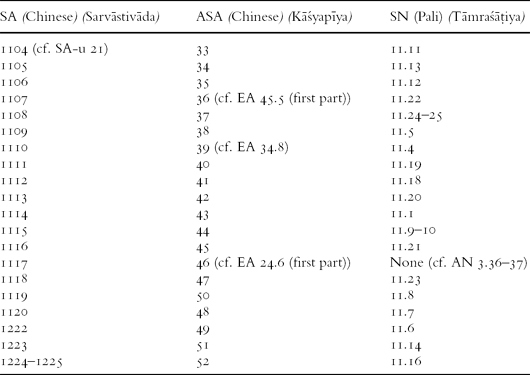
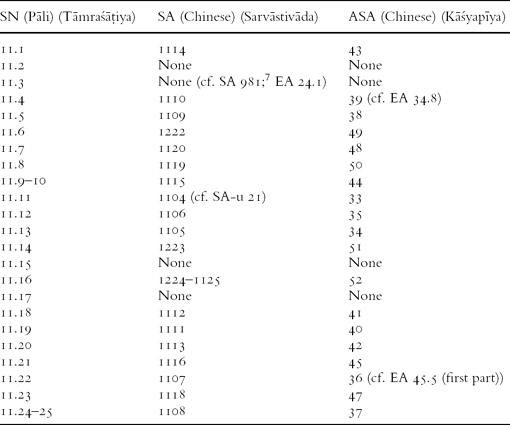
All discourses in the SA and ASA versions have Pāli counterparts. On the other hand, three discourses in the Pāli version (SN 11. 2, 15, 17) have no SA counterparts, while four discourses in the Pāli version (SN 11. 2–3, 15, 17) have no ASA counterparts. The full set of Chinese-Pāli and Pāli-Chinese counterparts is shown in Tables 1 and 2.
Chinese-Pāli correspondences of the Dishi Xiangying (Śakra Saṃyukta)

Pāli-Chinese correspondences of the Sakka Saṃyutta

7 This text belongs to Vyākaraṇa-aṅga (Tathāgata). Choong (Reference Choong2000), p. 248, n. 8.
The identification of the Chinese-Pāli and Pāli-Chinese counterparts shown in these tables is open to discussion. As is indicated in Table 1, the discourses of both the SA and ASA versions are out of order with regard to the structural arrangement. The rearrangement of the discourses indicated in Table 1 is according to the CSA version.Footnote 6 As is evident in the two tables, the discourses in the Pāli version match up very loosely with the discourses of the two Chinese versions as regards sequence, whereas the two Chinese versions match up with each other closely in the sequence of the discourses. The SA and ASA versions are therefore considered structurally much closer to each other than to the SN version.
Fragmentary Sanskrit counterparts of segments of the Chinese SA version (and the ASA version) were published by Fumio Enomoto (Reference Enomoto1994). The published Sanskrit counterparts of the discourses on the subject of Śakra comprise altogether nine fragments, corresponding to SA 1106, 1107, 1108, 1109, 1110, 1115, 1116, 1117, 1119 (= ASA 35, 36, 37, 38, 39, 44, 45, 46, 50). These fragmentary Sanskrit texts are useful for confirming certain Chinese technical terms.
2. The shared images of Śakra contained in the three versions of Śakra Saṃyukta
Before discussing disagreements on some teachings presented in the three versions of the Śakra Saṃyukta (P. Sakka Saṃyutta), some shared images of Śakra in the three versions will be discussed here.
(1) The term, Sakka devānaṃ inda, ‘Śakra, ruler of the gods’, in the Pāli Sakka Saṃyutta corresponds to Shi Tihuan Yin 釋 提 桓 因 and Di Shi 帝 釋 in the SA and ASA versions. These two Chinese terms are indiscriminately and frequently shown in both SA and ASA versions for the same Indic term, Śakra devānaṃ indra. Another Chinese term for the same Indic term is Tiandi Shi 天 帝 釋. This term is frequently used in the SA version, but is found in only one discourse in the ASA version (no. 52).
The term, Shi Tihuan Yin 釋 提 桓 因, is an entirely phonetic transcription of the Indic term in an abbreviated style. The full Chinese transcription of the Indic term is Shijia Tihuan Yintuoluo 釋 迦 提 桓 因 陀 羅. Shijia (= Shi) is Śakra, Tihuan is devānaṃ, and Yintuoluo (= Yin) represents indra. In other words, Shi 釋 is an abbreviation for Śakra and Shijia 釋 迦, and Yin 因 is an abbreviation for indra and Yintuoluo 因 陀 羅. Thus, this term, Shi Tihuan Yin, is entirely of the transcription type.Footnote 8
The other two Chinese terms, Di Shi 帝 釋 and Tiandi Shi 天 帝 釋, in contrast, are based on both the meaning and the sound of the Indic term. That is, the Chinese characters, Di/Tiandi, indicate in meaning a ruler of the gods (devānaṃ indra), whereas the character, Shi, is a phonetic transcription of the name Śakra. Thus, Di Shi and Tiandi Shi, both of which are a mixture of abbreviated phonetic transcription (Shi 釋) and translation of meaning (Di 帝, Tiandi 天 帝).
Di Shi and Tiandi Shi in their Chinese characters are easily identified as referring to the same Indic term, but this is not the case for Shi Tihuan Yin. The reason why the translators also used this Shi Tihuan Yin for the same Indic term within the same collection is unclear. It is likely that the translators actually intended to make up another Chinese name for Di Shi and Tiandi Shi.
Nevertheless, all three Chinese terms (Shi Tihuan Yin, Di Shi, and Tiandi Shi) in the SA and ASA versions are renderings of the same Indic term, Śakra devānaṃ indra.
(2) Śakra, meaning ‘mighty or powerful one’, is a name used as a description (an epithet) of a deity named Indra in the early Indian cosmological or mythical tradition. For example, the Ṛg Veda refers to Indra as Śakra ‘Mighty-one’ (Ṛg Veda Book 1, Hymn X. Indra). In the Vedic period, the number of gods (devāḥ) was generally reckoned as thirty–three, and Indra was their lord or ruler.
However, in the three versions of the Śakra Saṃyukta, Śakra is the usual individual name, not a description of Indra. For example, the title, Śakra devānaṃ indra ‘Śakra, ruler of the gods’, repeatedly used in the three versions indicates that Śakra is the usual individual name, and Indra, which is derived from the Brahmanic deity, is used as a descriptive name, meaning ‘ruler’ or ‘lord’ for Śakra. Thus, Śakra in the three versions has become the usual individual name for the Brahmanic idea of Indra.
(3) The numeral adjective term ‘Thirty-three’ (Skt. Trāyastriṃśā; P. Tāvatiṃsa; Sanshisan 三 十 三) used in the three versions of the Śakra Saṃyukta refers to a name of the heaven of the Thirty-three gods (Trāyastriṃśā devāḥ; Tāvatiṃsa devā; Sanshisan Tian 三 十 三 天), and Śakra was the ruler of the heaven. However, none of these three versions of the Śakra Saṃyukta clearly describe the heaven of the Thirty-three gods. They make no mention of Mount Sumeru (P. Sineru), though they do both mention the wars between Śakra/gods and asuras, and the heaven of the Four Great Kings.Footnote 9 Thus, the numeral term ‘Thirty-three’ presented in the three versions is still a general idea inherited from the Vedic mythology.
(4) Different names of Śakra are also indicated in SA 1106,Footnote 10 ASA 35Footnote 11 and their Pāli counterpart SN 11.12,Footnote 12 but only one name, Qiaoshijia 憍 尸 迦 (Skt. Kauśika, Kauśiya; P. Kosiya) in the SA and ASA version is not found in the corresponding Pāli version.Footnote 13
These discourses in the three versions also indicate how Śakra got his different names with Buddhist interpretations. Thus, the three versions are in agreement that Śakra has many names, though the individual name Śakra is the most usual in the three versions.
(5) Most of the discourses in the three versions report the Buddha telling stories of Śakra's deeds and conversations to monks. They do not report the Buddha's own encounters with Śakra. Only a few texts, such as, SA 1116 = ASA 45 = SN 11.21, and SA 1224 = ASA 52 = SN 11.16, present conversations between Śakra and the Buddha in verse, with Śakra coming to ask a question and the Buddha responding to it. Other texts the Buddha presents as a story teller, addressing monks about Śakra. Thus, the three versions share in common the notion that Śakra is presented as real in stories given by the Buddha.
(6) The three versions of the Śakra Saṃyukta repeatedly present stories about wars between Śakra/gods and asuras. Asuras shown in the three versions are clearly anti-Śakra/gods. Asuras are depicted as evil, whereas Śakra/gods as righteous. Three chiefs of asuras are found in the SN version, but only two are found in the SA and ASA versions. The chiefs of asuras in the SN version are Vepacitti (SN 11.4), Verocana (SN 11.8) and Sambara (SN 11.10). In the SA and ASA versions they are Pimozhiduoluo 毘 摩 質 多 羅 (SA 1110, 1115 = ASA 39, 44) and Biluzhenazipozhi 鞞 盧 闍 那 子 婆 稚 (SA 1119) = Balipolouzhi 拔 利 婆 婁 支 (ASA 50). Here the three versions agree that asuras have different groups.
Finally, (7) the stories of Śakra in the three versions are closely associated with Śakra as a great devotee of the Buddha. He respects the Buddha's dharma and his Saṅgha (SA 1111–1113, 1115 = ASA 40–42, 44 = SN 11.18–20, 9–10). The stories have connection to moral messages, such as Śakra as a model for lay devotees and monks (SA 1107–1108, 1118 = ASA 36–37, 47 = SN 11.22–25). The myth and characteristics of Śakra shared in the three versions are certainly not found in the Vedic Indra (the Ṛgveda).
To conclude, the shared images of Śakra in the three versions are threefold: (a) he belongs to a particular class of Indian deity (devas); (b) he is presented as a real deity in a unique story style; and (c) he is a supporter of the Buddha and of his dharma and Saṅgha. These reflect not only ethical messages of early Buddhism, but also early Buddhist adaptation of general Vedic religious beliefs about deities, and their application to one particular type of deities - Śakra.Footnote 14
3. Principal differences in teachings on Śakra
In the following I will discuss only the principal disagreements on some teachings presented in the three versions of Śakra Saṃyukta, under two topics: (1) the seven rules of conduct, and (2) the practice of faith, precepts, learning, charitable giving, and wisdom.
(1) The seven rules of conduct (SA 1104 = ASA 33 = SN 11.11; cf. SA-u 21)
The three versions record that Śakra in the past life when he was a human practiced ‘seven rules of conduct’ (SN: satta vatapadāni; SA: qizhongshou 七 種 受 /qifa 七 法; ASA: qixing 七 行). The contents of the seven in the three versions are not entirely the same. In the SA 1104 text, the seven are:
1. Supporting parents.
2. Respecting all the family elders.
3. Peaceful manner and gentle language.
4. Abstaining from abusive speech.
5. Abstaining from double-tongue/slander.
6. Always having true speech (= abstaining from false speech).
7. In the stingy world, [he] lives at home but abstaining from stinginess, practicing liberal donation, diligent in donation, delighting in charitable giving, providing donation-gathering, supportive to all.Footnote 15
The corresponding ASA 33 has:
1. Supporting parents.
2. Respecting the elders.
3. Using gentle language.
4. Abstention from double-tongue/slander.
5. Delighting in donation/charitable giving with no stinginess.
6. Always practising true speech, abstaining constantly from false speech
7. Abstention from anger. If hatred should arise, he seeks to dispel it.Footnote 16
The counterpart SN 11.11 reads:
1. As long as I live (yāva jīvaṃ), may I support my parents (mātapettibharo).
2. As long as I live, may I respect the family elders (kule jeṭṭhāpacāyī).
3. As long as I live, may I use gentle language (saṇhavāco).
4. As long as I live, may I speak no slander/double-tongue (apisuṇavāco).
5. As long as I live, may I live at home (agāraṃ ajjhāvaseyyaṃ) with a mind free from the taint of stinginess (vigatamalamaccherena cetasā), generous (muttacāgo), pure-handed (payatapāṇī), delighting in donation (vossaggarato), accessible to begging (yācayogo), delighting in sharing and charitable giving (dānasaṃvibhāgarato).
6. As long as I live, may I speak the truth (saccavādo).
7. As long as I live, may I be free from anger (akodhano). If anger should arise, may I quickly (khippam) dispel (paṭivineyyan) it.Footnote 17
Thus, their expression differs to some extent. Also, the SN and ASA versions are similar in both content and sequence, whereas the SA version lacks completely the item ‘abstention from anger’, which is found only in the SN and ASA versions.Footnote 18 Another difference between the three versions is that the SN and ASA versions specify that Śakra achieved the status of the so-called Śakra, ruler of the gods, because he in the past practised the seven conducts.Footnote 19 However, the SA version does not state so. The SA text records that if a person practises the seven rules of conduct, the person will be reborn into the heaven of Śakra, because Śakra himself also in the past practised such conduct.Footnote 20
Here, with regard to the teaching of the seven rules of conduct, the SN version is clearly closer to the ASA version.
(2) The practice of faith, precepts, learning, charitable giving, and wisdom (SA 1223 = ASA 51 = SN 11.14)
SA 1223Footnote 21 reports the Buddha as saying that once in the past there was a very poor man in Rājagṛha (P. Rājagaha). He had faith in the Buddha-Dharma-Saṅgha, undertook precepts/morality, attained wide learning, vigorously practised charitable giving, and established Right View.Footnote 22 After death and the breakup of the body, he was reborn in a heavenly world, the Trāyastriṃśā (P. Tāvatiṃsa) devas, where he surpassed the other devas in three things. The three things are: (1) heavenly lifespan, (2) heavenly beauty, and (3) heavenly fame/glory.Footnote 23 At that time, Śakra, ruler of the devas, recited verses, instructing the Trāyastriṃśā devas thus:
One has right faith in the Tathāgata, definitely unshakable, undertakes the true precepts, [and] does not turn away from the noble precepts.
One who has pure mind in the Buddha, establishes Right View, should be known as not poor, not living without meaning.
Thus, one should acquire pure faith in the Buddha-Dharma-Saṅgha, increase the light of the power of wisdom, reflect the right teachings of the Buddha.Footnote 24
The corresponding ASA 51Footnote 25 has some different presentation. It reports the Buddha as saying that in the past a very poor man in Rājagṛha had pure faith in the Three Jewels (Buddha-Dharma-Saṅgha), undertook precepts/morality, attained less learning, and practised little charitable giving.Footnote 26 After death and the breakup of the body, he was reborn in the heaven of Trāyastriṃśā devas,Footnote 27 where he surpassed the other devas in three things: (1) better beauty, (2) better fame, and (3) better lifespan.Footnote 28 At that time, Śakra instructed the Trāyastriṃśā devas in verses thus:
If one has pure faith in the Three Jewels, definitely unshakable mind, [and] does not violate precepts undertaken, this person should not be regarded as poor.
He is regarded as a wisdom-living person (智 慧 壽 命 人). This is because the one who respects the unsurpassed Three Jewels is able to reborn in the heaven to receive superior pleasure. Thus, one should learn such a practice.Footnote 29
The Pāli counterpart, SN 11.14, also does not have the same expression as the above-mentioned two Chinese versions. The Buddha in the Pāli text addresses the monks that long ago in Rājagṛha a certain man who was very poor embraced faith (saddhā), precepts/morality (sīla), learning (suta), charitable giving/generosity (cāga), and wisdom (paññā) in the Dharma and Discipline (dhammavinaya) proclaimed by the Tathāgata. Because he did so, after death, he was reborn in the heaven of Trāyastriṃśā devas, where he outshone the other devas in both beauty (vaṇ ṇa) and fame/glory (yasa). At that time, Śakra, ruler of the devas, recited verses, instructing the Trāyastriṃśā devas thus:Footnote 30
One who has trust (saddhā) in the Tathāgata,
Unshakable and well established,
And whose precepts/morality (sīla) is good and pure,
Is dear to and praised by the noble ones.
One who has faith (pasāda)Footnote 31 in the Saṅgha,
And whose vision is straight,
They say that one is not poor,
Nor life is lived in vain.
Therefore, faith and precepts,
Faith (pasāda) to the vision of the Dharma,
The wise should cultivate,
Remembering the Buddha's teaching.
Accordingly, the following tables show the similarities and differences between the three versions:

Thus, two issues need to be addressed. Only the ASA version under practice lists both less learning and little charitable giving. It emphasises only faith and precepts. The other major difference is that only the SN version does not mention heavenly greater lifespan among the results from the practice.
At the end, the three versions record that, as shown above, Śakra instructs other Trāyastriṃśā devas. The following table shows the comparison between the three versions:

Here, the expressions, ‘right view established’, ‘increasing the brightness of the power of wisdom’, ‘reflecting the right teachings of the Buddha’ in the SA version, and ‘straight vision’, ‘the vision of the Dharma’, and ‘remembering the Buddha's teaching’ in the SN version, are all not included in the ASA version. These expressions are all about learning for obtaining wisdom. Thus, only faith and precepts are shared in common by the three versions. This clearly suggests that the ASA version alone lays more emphasis on faith and precepts.
To conclude, all three versions teach the importance of faith in the Three Jewels and precepts. However, only the ASA version in the practices mentions less learning and little charitable giving, and emphasises faith and precepts more. By contrast, only the SA and SN versions mention the practice of learning, charitable giving, and wisdom. Nevertheless, all three versions agree that if one puts the teachings into practice (as taught by Śakra), life is not poor and is not lived in vain.
One small difference found between the three versions is that the SN version alone does not mention greater heavenly lifespan or surpassing other devas in the reborn heavenly world of Trāyastriṃśā devas.
Nevertheless, all three versions have failed to provide any clear reasons why they particularly mention that the person was reborn in, and surpassed the other devas in the heaven of Trāyastriṃśā devas, in some conditions as simply the results of their practices.
Conclusion
Structurally, regarding the Śakra Saṃyukta the SA and ASA versions are considered much closer to each other than to the SN version. This comparative study of these three different versions has focused on some shared images of Śakra and on disagreements of some teachings presented in the three versions.
Regarding the shared images of Śakra, it has revealed that Śakra is entirely presented as the personal and mythical aspect of deity in a unique story style for the supporter of the Buddha, of his dharma and Saṅgha. This style, in my view, reflects not only moral messages of early Buddhism, but also early Buddhist adaptation of general Brahmanic religious beliefs about divine beings (devas), and their application to one particular type of divine being – Śakra, ruler of the gods ‘devānaṃ indra’.
As for the disagreements on some teachings presented in the three versions of the Śakra Saṃyukta, they relate to two topics: the seven rules of conduct and the practice of faith, precepts, learning, charitable giving, and wisdom.
With regard to the seven rules of conduct, the contents and expression of them in the three versions are not entirely the same. But overall they are minor differences, although the SN version is a little closer to the ASA version.
With regard to the practice of faith, precepts, learning, charitable giving, and wisdom, this comparison has revealed the following:
-
1. Only faith and precepts are shared in common by the three versions. That is, all three versions teach the importance of faith in the Three Jewels and precepts.
-
2. Only the ASA version mentions ‘less learning’ and ‘little charitable giving’, and emphasises faith and precepts more.
-
3. Only the SA and SN versions mention the practice of learning (not ‘less learning’), charitable giving (not ‘less charitable giving’), and wisdom.
-
4. All three versions agree that if one practises the teachings, such as faith and precepts, as taught by Śakra, life is not poor, not lived in vain.
-
5. As for the results of the practice, the SN version alone does not mention greater heavenly lifespan which surpassed other devas in the heaven of Trāyastriṃśā devas. That is, in the SN version the person outshone the other devas in both beauty and fame, whereas in the SA and ASA versions he surpassed the other devas in beauty, fame, and lifespan.
-
6. All three versions have failed to provide any clear reasons why, as the results of their practices, the person was reborn in, and surpassed the other devas in the heaven of Trāyastriṃśā devas in some conditions.
Overall, this study has revealed some disagreements in the major teachings on Śakra between the three versions.
Abbreviations
-
AN Aṅguttara-nikāya
-
ASA Bieyi Za Ahan Jing [Additional Translation of Saṃyuktāgama] (T 2, no. 100)
-
CSA Yin Shun's Za Ahan Jing Lun Huibian [Combined Edition of Sūtra and Śāstra of the Saṃyuktāgama] (3 vols, 1983)
-
DA Dīrghāgama (T 1, no. 1)
-
EA Ekottarikāgama (T 2, no. 125)
-
FSA Foguang Tripiṭaka Za Ahan Jing (Saṃyuktāgama) (4 vols, 1983)
-
MA Madhyamāgama (T 1, no. 26)
-
PTS Pāli Text Society
-
SA Saṃyuktāgama (T 2, no. 99)
-
SA-u Unattributed SA (T 2, no. 101) (The author and school of this collection are unidentified. An Shigao (fl. 148–170) is considered the translator by some. Harrison Reference Harrison2002, p. 2).
-
SN Saṃyutta-nikāya
-
T Taishō Chinese Tripiṭaka (The standard edition for most scholarly purposes)
AN and SN references are to PTS editions.