








Introduction
The modal ontological argument (MOA) can be regimented as follows, where  $g$ abbreviates the proposition that God exists:
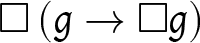
(P1)  $\square\left( g\rightarrow \square g \right)$
(P2)  $\unicode{x2B26} g$
(C)  $g$
The argument is valid in S5, but it faces a well-known symmetry problem. The conceivability and modal-intuition considerations that motivate (P2) appear equally to motivate the claim that God’s non-existence is possible:
(P2*)  $\unicode{x2B26}\neg g$
In S5, (P1) and (P2*) jointly entail  $\neg g$. So (P2) and (P2*) cannot both be true given (P1), and the considerations supporting one appear to support the other.
In a recent paper, Fritz et al. (Reference Fritz, Lo and Schmid2026) (henceforth FLS) propose a striking response. They observe that (P1), (P2), and (P2*) are jointly consistent in modal logics weaker than S5 – in particular, in S4. They argue that there are independent metaphysical reasons for adopting such a weaker logic.Footnote 1 The fact that S4 allows these three plausible modal claims all to be true together provides, they think, a further reason for preferring it over S5. Surprisingly, though, while the move to S4 invalidates the original MOA, the reverse modal ontological argument (RMOA) from (P1) and (P2*) to  $\neg g$ remains valid. The symmetry problem, they conclude, dissolves in favour of the atheist.
We assume for the sake of argument that the move to S4 is well-motivated, and we accept FLS’s formal results. But we argue that their proposal does not dissolve the symmetry problem – it merely relocates it. In S5, the problem was that the motivations for (P2) and (P2*) are symmetric and yet (P1) forces a choice between them. In S4, no such choice is forced: (P1), (P2), and (P2*) are jointly consistent, and the symmetry of motivations between (P2) and (P2*) ceases to generate a contradiction. But a new symmetry problem now arises at the level of necessity claims. FLS’s atheist conclusion in S4 depends on (P1) being well-motivated while its mirror,
(P1*)  $\square \left( \neg g\rightarrow \square \neg g \right)$,
is not. As FLS note (Fritz et al. Reference Fritz, Lo and Schmid2026, 323), the RMOA  $\left( \square\left( g\rightarrow \square g \right)\wedge \unicode{x2B26}\neg g \right)\rightarrow \neg g$ is truth-functionally equivalent to
 $\square\left( g\rightarrow \square g \right)\rightarrow \left( g\rightarrow \square g \right)$, which is a substitution instance of axiom T. However, (P1*) can be used to form a variant of the MOA which has exactly the same feature.
 $\left( \square \left( \neg g\rightarrow \square \neg g \right)\wedge \unicode{x2B26} g \right)\rightarrow g$ is truth-functionally equivalent to
 $\square \left( \neg g\rightarrow \square \neg g \right)\rightarrow \left( \neg g\rightarrow \square \neg g \right)$, an instance of T. Like the RMOA, this variant MOA is valid in S4 (and, indeed, in even weaker logics, all the way down to KT). Thus, FLS have resolved the symmetry problem only if (P1) is motivated in a way that (P1*) is not.
The crux of our disagreement with FLS, then, concerns the metaphysical status of (P1*). FLS grant that (P1*) would block their argument if true, but they hold that the standard motivations for (P1) do not transfer to it. We hold the opposite. Our central claim is a metaphysical symmetry thesis:
Symmetry Thesis. The principal metaphysical motivations for (P1) equally support (P1*).
The relevant notion of equal support should not be understood as requiring a premise-by-premise mirror image in every case. Our more precise claim is the following:
No-Advantage Thesis. The principal metaphysical frameworks relevant to FLS’s sub-S5 proposal do not provide a stable motivation for (P1) without providing at least comparable motivation for (P1*). Depending on the details, these frameworks support both principles, support neither, or generate an asymmetry that does not favour (P1).
The No-Advantage Thesis provides a more precise formulation of the dialectical symmetry we defend. The point is not that every argument for (P1) can be reproduced mechanically by substituting  $\neg g$ for
 $g$. It is that, once the relevant metaphysical commitments are made explicit, they do not yield the asymmetry FLS require: strong support for (P1) without a comparable level of support for (P1*).
We note in passing that (P1) and (P1*) are inter-derivable in any normal modal logic that includes axiom B together with S4 (Reference RubioRubio ms, Appendix A, theorem 1), since these together yield S5. But our argument does not rest on any such formal equivalence. Our claim concerns their comparative metaphysical support: once the commitments of the relevant metaphysical frameworks are made explicit, those frameworks do not provide a stable basis for accepting (P1) while rejecting, or assigning significantly less support to, (P1*). In some cases, the same framework supports both principles; in others it supports neither or generates an asymmetry that does not favour (P1). In what follows, we defend this claim with respect to four main lines of argument: dispositional theories of modality, actualist constraints on modality combined with divine simplicity, the inexplicability of God’s contingent existence, and theistic grounding. We close with brief remarks on perfection-based motivations.
Dispositional modality
Although FLS hold that (P1) is better motivated than (P1*), they admit in passing that there ‘might be other reasons for endorsing P1*’ and mention dispositional theories of modality as a possible reason (Fritz et al. Reference Fritz, Lo and Schmid2026, 323). FLS are correct that dispositional theories of modality support (P1*). They fail to note that the same general framework also provides significant support for (P1).
FLS cite Vetter (Reference Vetter2015) as the canonical version of the dispositional account of modality. Vetter defines possibility as follows:
POSSIBILITY. It is possible that  $p$
 ${ = _{df}}$ something has an iterated potentiality for it to be the case that
 $p$ (Vetter Reference Vetter2015, 198).
Necessity is defined as the impossibility of the negation. Vetter glosses the resulting principle informally: it is necessary that  $p$ just in case nothing has, had, or will have a potentiality to be such that not-
 $p$ (Vetter Reference Vetter2015, 203). Modal facts are, as she puts it, ‘hostage to the way things actually are’ (Vetter Reference Vetter2015, 202).
The argument for (P1*)
Vetter’s chapter 7 takes up exactly the cases that bear on our argument: possibilities of existence (§7.5) and possibilities of non-existence (§7.6). For possibilities of existence, Vetter is committed to a restrictive view. She defends a Principle of Potential Instantiation, on which a property of being  $F$ exists only if some particular thing is
 $F$, is potentially
 $F$, or is potentially such that something is
 $F$. She accepts the consequence that there is no possibility of ‘super-alien’ properties being instantiated – properties that no actual thing has any potentiality to instantiate, produce, or constitute (Vetter Reference Vetter2015, 269–273). Vetter calls this biting the bullet, and defends it as part of an attractive Aristotelian metaphysics of properties.
This is exactly the framework on which the (P1*) argument runs. Suppose  $\neg g$. By POSSIBILITY,
 $\unicode{x2B26}{g}$ requires some actual entity with an iterated potentiality to be, produce, or constitute God. By divine aseity, nothing distinct from God could have such a potentiality: God depends on nothing for hisFootnote 2 existence and is not the kind of thing that could be produced or constituted by anything else. And by hypothesis God does not actually exist, so he is not himself available as a witness. By Vetter’s own treatment of possibilities of existence,
 $\unicode{x2B26}{g}$ fails, and so
 $\square\neg g$. This yields (P1*).
The argument for (P1)
Vetter’s treatment of possibilities of non-existence in §7.6 is more subtle, and it gives us the resources for an argument running in the opposite direction. She draws a distinction we need to mark carefully. The possibility that an existing object should cease to exist, or should no longer exist, is one thing; the possibility that an existing object should never have existed at all, read timelessly, is another. Vetter argues that no object can itself bear the potentiality for its own timeless non-existence, since the object ‘can never be there to exercise such a potentiality’ (Vetter Reference Vetter2015, 274). So timeless non-existence possibilities must be grounded in the potentialities of an object’s producers or constituents, possessed at times prior to the object’s coming into being.
This argument relies on a further commitment of Vetter’s framework, which she calls the triviality thesis about past-concerning potentialities. Roughly, the thesis is that potentialities whose manifestation would consist in something having been the case at an earlier time have only trivial degrees: an object has such a potentiality to the maximal degree if its manifestation actually obtains, and to no degree otherwise (Vetter Reference Vetter2015, §5.8). The motivation is intuitive: potentialities are forward-looking, and there is no genuine backward-looking potentiality to alter what has already happened. The thesis implies that nothing has, or ever had, a non-trivial potentiality for the past to have been different.
Apply this to God. For  $\unicode{x2B26} \neg g$ to hold (read timelessly) on Vetter’s framework, some entity, at some time prior to God’s existence, would have to have had an iterated potentiality for God never to exist. But on the classical theistic conception, God is eternal and a se: he has no temporal origin and no producers or constituents. There is no ‘prior time’ at which any entity could have had a potentiality bearing on God’s existence. So no witness for
 $\unicode{x2B26} \neg g$ is available. By POSSIBILITY,
 $\neg\ \unicode{x2B26}\ \neg g$; and so
 $\square g$. This yields (P1).Footnote 3
Vetter’s necessary existents
There is a further dialectical point worth making. Vetter herself is forced, by her framework’s commitment to temporal asymmetry, to accept that some concrete entities exist necessarily on her view. Her reasoning: nothing has or ever had a potentiality for the beginning of time to be different than it was, since there was never a time at which such a potentiality could be possessed. So whatever entities existed at the beginning of the universe are necessary existents, on the potentiality account, in the sense that nothing has or ever had any iterated potentiality for them not to have existed (Vetter Reference Vetter2015, 276). Vetter accepts this consequence, noting that ‘the price has already been paid’ once the triviality thesis is granted.
Vetter assumes that there is a beginning of time. As an anonymous referee points out, the argument from the dispositional theory of modality for a necessary being requires this assumption. Strictly speaking, what the dispositional theory requires is that ‘possible worlds all “share” an initial history with the actual world and “branch” from the actual world’ when some potentiality is non-deterministically actualized (Oppy Reference Oppy and Goldschmidt2013, 47). If, for every moment of time, there is an earlier moment,Footnote 4 then perhaps for every merely possible world  ${w_1}$ there is another merely possible world
 ${w_2}$ such that
 ${w_2}$ diverges from the actual world earlier than
 ${w_1}$. Thus, what the dispositional theory really entails is that every possible world shares some initial segment (whether finite or infinite) with the actual world (again, see Oppy Reference Oppy and Goldschmidt2013, 47).
This requirement further clarifies why a dispositional theory of modality does not provide a stable basis for privileging (P1) over (P1*). The theist maintains that God, as the eternal, a se bearer of the iterated potentialities for all concrete reality, is a necessary being who stands at the root of the modal tree. The atheist denies this, maintaining either that the tree has a necessary non-divine root or else that necessarily the branching goes back to infinity. The framework does not adjudicate between these three answers; it merely tells us that some such answer is required.
This connection between dispositional theories of modality and the disagreement between theists and atheists has already been noted in the literature. For instance, Oppy (Reference Oppy and Goldschmidt2013) employs such a theory in an effort to defuse cosmological arguments for God’s existence. On the other side, Pruss (Reference Pruss2011) argues that proponents of dispositional theories of modality have good reason to be theists, since theism is required to reconcile their theory with our modal intuitions. Oppy and Pruss agree that whichever of their views is right is necessarily right. Their agreement on this point does not rest on S5, but rather on the observation that the dispositional theory of modality requires that every possible world share an initial segment with the actual world.
Taking stock
Two final observations. First, our reasoning parallels Vetter’s own treatment of the necessity of identity (Vetter Reference Vetter2015, 203–204). She argues that ‘Hesperus = Phosphorus’ is necessary because nothing has a potentiality to be such that Hesperus  $\neq$ Phosphorus. The argument moves from the absence of any actual witnessing potentiality to the necessity of the original claim. This is exactly the structure of our (P1) and (P1*) arguments. If the pattern is legitimate for identity, it is legitimate for theistic existence given the further premises about aseity, eternality, and omnipotence.
Second, a critic might object that Vetter’s framework is generous about witnesses, allowing extrinsic and joint potentialities to ground possibility claims. Could not some actual creature, then, have an extrinsic iterated potentiality for  $\neg g$? Vetter herself defuses this. She insists that the abundance of irrelevant witnesses is ‘no threat to the definition’, since metaphysical explanation requires relevant witnesses – objects whose potentialities do the real grounding work (Vetter Reference Vetter2015, 199). Aseity, eternality, and omnipotence jointly rule out any relevant witness for
 $\unicode{x2B26} \neg g$, regardless of how extrinsic potentialities are distributed.
The dispositional account thus provides support for both (P1) and (P1*), although the two arguments appeal to different features of Vetter’s theory. Once the relevant metaphysical premises about God are in place, the framework supplies no stable motivation for accepting (P1) while rejecting, or assigning substantially less support to, (P1*). The framework FLS invoke as atheist-friendly turns out, on closer inspection, to be neutral at best between theism and atheism.
Actualism, simplicity, and dependence
The dispositional argument of the previous section targets a specific family of views – those on which modality is grounded in the causal or productive potentialities of actual things. But a structurally similar argument is available on a broader class of views, including combinatorialist and other actualist accounts on which modality is not reduced to causal powers. The common feature of these views is what we will call an actualist constraint:
Actualist Constraint (AC). The space of metaphysical possibilities is fixed by what actually exists, together with what can be constructed, recombined, or derived from what actually exists.
(AC) is deliberately schematic. Different actualists will spell out ‘construction, recombination, or derivation’ differently – some in terms of causal production (Vetter), some in terms of mereological recombination (e.g., Armstrong Reference Armstrong1989), some in terms of qualitative variation over actual entities. What they share is the thought that what is possible cannot outrun what actuality provides the resources to ground. The arguments from (AC) are distinct from, but complementary to, the arguments from the dispositional account; they reach views on which modality is not reduced to potentiality but is nonetheless tied to the actual in the way (AC) specifies.
The aim of this section is to show that those who accept (AC) should accept both (P1*) and (P1). In addition to (AC), the arguments appeal to different elements of the classical conception of God: the argument for (P1*) appeals to divine simplicity and the argument for (P1) appeals to the dependence of all things on God. Insofar as these are equally central elements of classical theism, this shows that (AC) provides symmetric support for (P1*) and (P1).
The argument for (P1*)
The argument for (P1*) depends on a moderately strong version of the doctrine of divine simplicity. According to this doctrine, God’s existence could not depend on whether several independently existing objects are combined into a whole, nor could it depend on whether several metaphysically distinct attributes or properties are co-instantiated. That is, God is not ‘built out of’ parts or attributes.
Suppose  $\neg g$. Then no actually existing entity is God. Thus,
 $\unicode{x2B26} g$ can obtain only if either some actual entity is possibly God or some merely possible entity is possibly God. By simplicity, it cannot be the case that some actual entity would be God if it had different properties, since God cannot be constituted by the co-instantiation of the right properties. But simplicity and (AC) together also rule out the second route. On (AC), merely possible entities must be constructible, recombinable, or derivable from actual entities. But divine simplicity blocks any such construction: God has no parts that could be assembled from actual materials, and God could not be identical to any fusion or arrangement of actual non-God things. Hence if
 $\neg g$, then
 $\square \neg g$. This yields (P1*).
The argument has a Pegasus analogy that makes the structure vivid. Pegasus is often cited as a paradigm merely possible entity, and on recombinatorialist views Pegasus is possible because horse-stuff and wing-stuff actually exist and can in principle be recombined. Divine simplicity removes any analogous route for God. There is no divine stuff – no set of parts or attributes from which God could be assembled. So the recombinatorial route that makes Pegasus possible is not available for God.
A grounding-based argument closely related to our (P1*) direction has been developed by Kearns (Reference Kearns2022). Kearns argues that the possibility of a perfect being requires an actual perfect being as its ground, since possibilities of existence are grounded in actual things at least as fundamental as the possibilia they ground, and a perfect being is uniquely perfectly fundamental. His grounding principle, that if it is possible that there is an  $F$ then something actual grounds that possibility, is a version of our (AC), and like us he connects it to combinatorialism. Two points of contrast matter. First, Kearns argues that this apparatus gives the grounding theorist independent reason to depart from S5 (Kearns Reference Kearns2022, 810), which corroborates our working assumption that a sub-S5 setting need not be motivated on terms friendly to the atheist. Second, and more importantly, Kearns does not argue for (P1) and (P1*). He develops the apparatus in the opposite direction, treating the perfect being as a contingent ground of both its own possibility and the possibility of its non-existence, so that (P1) fails on his picture, and on his S5-preserving variant (P1*) fails as well (Kearns Reference Kearns2022, 810–811). This is instructive for our purposes. The actualist-grounding apparatus is by itself silent on the modal status of a perfect being: supplemented with Kearns’s assumptions it yields a contingent one, and supplemented with the classical attributes of aseity and simplicity it yields a necessary one. Nonetheless, on Kearns’s view, as on ours, (P1) and (P1*) stand or fall together.
The argument for (P1)
Suppose  $g$. For
 $\unicode{x2B26} \neg g$ to hold on an (AC)-constrained view, some God-less world would have to be constructible, recombinable, or derivable from the resources of the actual God-containing world. The natural route is subtraction: just as a recombinatorial framework lets us delete a simple electron from a world to obtain a world without it, it appears to let us delete a simple God. Simplicity does nothing to block this, since the worry is not that God must be assembled from parts but that God might be removed like any other simple. We grant that against a purely Humean recombination, on which there are no necessary connections between distinct existences, the subtraction route goes through and the (P1) direction fails.
Pure Humeanism is, however, inconsistent with the supposition that  $g$. On classical theism, all contingent concreta depend on God. One of the arguments discussed below expounds this dependence in terms of the notion of grounding. What matters for present purposes, however, is just that classical theism centrally involves a form of metaphysical dependence that violates pure Humeanism: God actively sustains all things so that you can’t subtract God without subtracting the whole created world. Since this is central to classical theism (and thus included in the proposition
 $g$), to suppose
 $g$ is to suppose that pure Humeanism is false.
It follows that, supposing  $g$ to be true, we cannot construct a possible world where
 $\neg g$ by subtracting God without also subtracting all contingent concreta. Thus, if possibly
 $\neg g$, then this possibility obtains only in the empty world. Whether the empty world is possible is controversial for reasons independent of theism (see, e.g., Lewis Reference Lewis1986, 73–74; Rundle Reference Rundle2004; Oppy Reference Oppy and Goldschmidt2013, 47). (AC), dependence, and the impossibility of the empty world together entail (P1).
But suppose the empty world is possible. Then (AC) breaks the symmetry in the opposite direction from FLS: it motivates (P1*) but not (P1). But this asymmetry won’t actually matter much to the dialectic around MOA and RMOA. This is because, even if the empty world is possible, the argument from (AC) still establishes the weaker principle,
(P1**)  $g\rightarrow \square \left( \exists xC\left( x \right)\rightarrow g \right)$
where  $C\left( x \right)$ means
 $x$ is concrete. The following revised RMOA is valid in S4 (and in weaker logics, down to KT)Footnote 5:
(P1**)  $g\rightarrow \square \left( \exists xC\left( x \right)\rightarrow g \right)$
(P2**)  $\unicode{x2B26} \left( \exists xC\left( x \right)\wedge \neg g \right)$
(C)  $\neg g$
Philosophers who find (P2*) (possibly, God does not exist) intuitive are likely also to find (P2**) intuitive. Additionally, by the reasoning about dependence above, (P2**) is implied by propositions such as possibly, there is an uncreated electron.
A second recombinatorial worry concerns duplication rather than subtraction: if God is a simple object, why can we not copy God, generating worlds with two or three perfect beings? Here we return to simplicity. On a familiar classical line, two numerically distinct things require some principle of differentiation, some respect in which they differ; but a perfect being, having no proper parts or internal complexity, offers no such respect, so there cannot be two. Uniqueness thus follows from God’s nature, and the putative duplication worlds are blocked by what God is, not by any restriction on recombination.
The upshot parallels our reasoning about dispositional theories of modality. When the proposition  $g$ is understood in a broadly classical way – understanding God as a simple being on whom all other concreta depend – (AC) provides good reason to accept both (P1) and (P1*): simplicity blocks the construction of God from a God-less world, and dependence blocks the subtraction of God from a God-containing one, unless we are willing to subtract all other concreta as well.
Dialectical upshot
The actualism-based arguments reinforce the point of our discussion of dispositional theories of modality by reaching a wider class of views. When  $g$ is understood in a broadly classical way, any metaphysician who accepts (AC) has reason to accept both necessity claims – and therefore reason to reject FLS’s asymmetric treatment of them. (AC) is accepted by dispositionalists, combinatorialists, and many other actualists. For those who accept such theories, (P1) and (P1*) stand together.
The argument from explanation
Ross (Reference Ross1969, 86–87, 173–175) presents an argument for (P1) based on the impossibility of explaining God’s contingent existence. The argument relies on the following principle:
(HE) Every contingent existence fact is hetero-explicable.
An existence fact is a fact about whether some individual object exists or whether some kind of objects is instantiated. A hetero-explanation of such a fact is an explanation that appeals to object(s) other than the one(s) whose existence is in question. A fact is hetero-explicable iff possibly it has a hetero-explanation.
Explanation is here understood as an objective, metaphysical relation among facts: the explanans makes the explanandum obtain, by grounding, causation, or something similar.
We first present a simplified version of Ross’s argument from this principle for (P1) then show that a parallel argument from (HE) also supports (P1*).
The argument for (P1)
Suppose God exists contingently. Then the fact that God exists is a contingent existence fact. By (HE), this fact is hetero-explicable. But this implies that God exists because of something other than God, which conflicts with divine aseity. Therefore, God’s existence cannot be contingent. This yields (P1).
The argument for (P1*)
Suppose it is contingently true that God does not exist. Then the fact that God does not exist is a contingent existence fact. By (HE), this fact is hetero-explicable. But hetero-explanations of non-existence facts come in only two varieties: they appeal either to the absence of a requisite for the entity’s existence or to the presence of a blocker that prevents it. Neither is available in God’s case.
By ‘a requisite’ we mean, following Leibniz (see Adams Reference Adams1994, 117–118), an entity (such as a constituent, ground, or cause) that is necessary for some other entity’s existence. Since God is a se, God has no requisites, and God’s non-existence could not, therefore, be explained by the absence of a requisite.
By ‘a blocker’ we mean an entity that somehow prevents another entity’s existence, despite the presence of its requisites (if any). There are no uncontroversial examples of blockers (and if there are no blockers then our argument succeeds). However, Paul and Hall (Reference Paul and Hall2013) discuss ‘inhibitory signals’ that block causes from having their usual effects, and Bader (Reference Bader2021) argues that instances of grounding may be blocked by the presence of another entity which grounds some incompatible fact. Since God has no causes or grounds, nothing could block God’s existence in this way.
Could there be other kinds of blockers for God’s existence – for instance, the mere obtaining of some contingent fact incompatible with God’s existence? We think not. The existence of (for instance) an uncreated concrete object would entail God’s non-existence, but would not explain it. It would not be the case that God does not exist because of that object.
God’s non-existence could not be explained by the absence of a requisite or the presence of a blocker. It therefore cannot be hetero-explained. By (HE), this implies that God’s non-existence could not be contingent. This yields (P1*).
Dialectical upshot
Divine aseity implies that neither God’s existence nor God’s non-existence could be hetero-explained. Given principle (HE), this yields both (P1) and (P1*).
The argument from theistic grounding
Another motivation for (P1) appeals to the doctrine that all finite concrete objects are grounded in God. This is one natural reading of the traditional claim that God both creates and sustains all concrete things.
The arguments of this section rely on two key claims:
1. Necessarily, if God exists, every finite concrete essence is creatable.
2. Necessarily, if an essence is creatable, it includes being-created-by-God as an essential property.
In saying that an essence is creatable, we mean that possibly God creates an object that instantiates it. (Whether the essences themselves are, or can be, created by God is a further, and more controversial, question.)
Assuming the general framework of essence and ground, claim (1) follows from divine omnipotence. The framework is also committed to claim (2). This can be shown by consideration of the notions of essence and ground.
Grounding is here understood as constitutive explanation. For instance, to say that a sandwich exists because a slice of ham is between two slices of bread (a standard example of a grounding explanation) is to explain the sandwich’s existence by an account of what it is to be a sandwich. An essence is (as Aristotle famously put it) the ‘what it is to be’ of some possible being or kind of beings. Thus, the sandwich explanation above appeals to the essence of sandwich. Because grounding explanations appeal to essences in this way, grounding relations track essential connections (Audi Reference Audi2012; Trogdon Reference Trogdon, Hoeltje, Schnieder and Steinberg2013; O’Conaill Reference O’Conaill2018). If all concrete things are grounded in God, then being-created-by-God will be part of what it is to be any finite thing or kind of finite thing (Pearce Reference Pearce2025, §1). This is what claim (2) says.
The arguments also make use of three further assumptions:
3. Necessarily, every concrete object instantiates an essence.
4. If it is possible that a certain essence exists, then necessarily that essence exists and encodes the properties it does.
5. Necessarily, at least one concrete object exists.
Claim (3) is widely accepted by friends of essence and ground.
Claim (4) is also endorsed by most defenders of essences and, indeed, is a widely held view about abstract objects in general. However, in the present context, it might be thought to come uncomfortably close to S5. This is because it is commonly held that all and only possible things have essences. This claim, together with (3) and (4), implies that if a concrete object possibly exists, then necessarily it possibly exists.Footnote 6 This is a restricted form of the S5 axiom,  $\unicode{x2B26} p\rightarrow \square\ \unicode{x2B26}\ p$.
In response, note first that this is a restricted form of the axiom. It applies only to propositions which state that a certain essence has a concrete instantiation. There may still be violations of the axiom for other types of propositions.
Second, note that the S4 axiom allows us to iterate the necessity operator in claim (4), with the implication (in model-theoretic terms) that there can be no variation in which essences exist from one world to another, anywhere in the model. However, this consequence does not follow in weaker logics such as B or KT. In those logics, it is consistent with our assumptions that some essences may be only contingently necessary. In other words, in B or KT, it is consistent with these assumptions that this restricted form of the S5 axiom may be only contingently true. That would still be a significant departure from S5. Our arguments below are both valid in KT, and so compatible with the view that it is possibly possible (though not actually possible) that there be variation in essences.
Finally, note that philosophers who endorse essences and S4 but accept that some concrete objects are only contingently possible have two options: they can either reject (4) or reject the essence-possibility link.
Claim (4) is thus not compatible with every possible way of rejecting S5, but it certainly does not entail that S5 is the correct logic for metaphysical modality. Philosophers who reject S5 may nonetheless have reason to accept (4). Such philosophers have at least three options: they can accept a restricted form of the S5 axiom, reject the S4 axiom, or reject the essence-possibility link.
As discussed in connection with the argument from (AC) for (P1) above, claim (5) (that there is no empty possible world) has been defended on grounds independent of theism but is, in any event, a harmless simplifying assumption. Without (5), the arguments would lead to more complex principles that would say, in effect, that God’s existence does not vary across non-empty worlds, which would still support versions of both MOA and RMOA.
The argument for (P1)
Suppose for reductio that God exists at the actual world  $w$ but not at some accessible world
 $v$. By (5), some concrete object exists at
 $v$. By (3), it instantiates some essence
 $E$. So
 $E$ possibly exists. By (4),
 $E$ exists necessarily, and therefore (by axiom T) exists. But since
 $E$ exists at
 $w$ (where God exists), (1) and (2) require that
 $E$ includes being-created-by-God.
The mere existence of  $E$ at
 $v$ is not problematic: an essence may exist at a world while remaining uninstantiated there, even if its essence involves an entity absent from that world. But if
 $E$ is instantiated at a world, its instance must exemplify the properties encoded in
 $E$. Since being-created-by-God entails depending on God for one’s existence,
 $E$ can be instantiated only at a world at which God exists. Thus
 $E$ cannot be instantiated at
 $v$, where God does not exist. Contradiction. So, if God exists, God exists necessarily. This yields (P1).
The argument for (P1*)
Now suppose God does not exist at the actual world  $w$. By (3) and (5), some essence
 $E$ is instantiated at
 $w$.
 $E$ does not include being-created-by-God essentially – if it did, it could not be instantiated at
 $w$. By (4),
 $E$ exists and encodes the same properties at every world accessible from
 $w$, including any world
 $v$ at which God exists. But by (1) and (2), every essence at any God-containing world includes being-created-by-God. Contradiction. So, if God does not exist, God necessarily does not exist. This yields (P1*).
Dialectical upshot
The grounding-based motivation, like the explanatory and dispositional motivations, supports (P1) and (P1*) symmetrically. The work is done by the essential connection between creatures and God; once that connection is in place, theistic and non-theistic worlds simply cannot share the same concrete essences, in either direction.
Perfection and conclusion
We have considered four metaphysical frameworks that fail to provide a stable advantage for (P1) over (P1*). FLS themselves identify a fifth motivation for (P1), which appeals directly to perfection: necessary existence is, or follows from, a perfection, so a perfect being exists necessarily if at all. They argue that this motivation does not transfer to (P1*), since the claim that God would be perfect if he existed says nothing about what would obtain were he not to exist.
Before turning to perfection, we emphasize that our four arguments do not all achieve equally clean symmetry. The argument from hetero-explicability comes closest to a direct parallel, although the argument for (P1*) also relies on an account of the possible explanations of non-existence. The argument from dispositional theories of modality invokes different features of Vetter’s theory in the two directions: her treatment of super-alien properties for (P1*) and the triviality thesis for (P1). The argument from the actualist constraint runs more naturally to (P1*) than to (P1), and the full argument for (P1) requires the further assumption that there is no empty possible world. Finally, both directions of the grounding argument rely on claim (4), which fixes the existence and essential content of an essence across the relevant worlds. What matters for our thesis is not that each framework yields a premise-by-premise mirror argument, but that none supplies the asymmetry FLS require: a stable motivation for (P1) without at least comparable motivation for (P1*).
We grant that the perfection-based motivation is the hardest case for our symmetry thesis. Necessary existence can be presented as a perfection of a being that exists, and there may be no equally direct perfection-based route to (P1*). This concession, however, does not establish the broader dialectical advantage FLS claim. The other principal metaphysical frameworks relevant to their proposal either support both necessity principles, support neither, or generate an asymmetry that does not favour (P1). At most, the perfection argument identifies one possible source of asymmetry; it does not show that the overall metaphysical case favours the RMOA.
The upshot is this. FLS argue that the move to S4 dissolves the symmetry problem because, while (P1), (P2), and (P2*) are jointly consistent in S4, the RMOA remains valid while the MOA does not. But, as FLS explicitly note (Fritz et al. Reference Fritz, Lo and Schmid2026, 322–323), this result yields an atheist advantage only if (P1) is better motivated than (P1*). The metaphysical frameworks we have examined provide no stable basis for that comparative judgment. Moreover, (P1*) together with (P2) yields  $g$ in S4 just as surely as (P1) together with (P2*) yields
 $\neg g$. The symmetry problem is therefore not dissolved but relocated. In S5, the symmetry concerns the possibility premises; in S4, it concerns the necessity premises. Either way, the considerations examined here do not adjudicate between theism and atheism.
We have not argued that the MOA succeeds or that the RMOA fails. Our claim is more modest: the dialectical advantage FLS claim for the RMOA over the MOA in S4 does not survive scrutiny. Anyone who accepts (P1) on the basis of the metaphysical frameworks considered here has not thereby acquired a stable reason to reject, or assign significantly less support to, (P1*). The symmetry FLS sought to break therefore re-emerges at the level of the necessity claims.
Acknowledgements
This paper originated in discussions following FLS’s presentation at the Society of Christian Philosophers Eastern Division Conference held at Princeton Theological Seminary (October 4, 2025). We thank FLS, the conference organizers, and the other discussants. We also thank FLS, Daniel Rubio, and two anonymous referees for comments on previous drafts.


 Open access

