The theory of deliberative democracy has come of age and established itself as the main reference of modern political theory. Deliberation has different types of merits: it has moral value when constraining authority by requiring that procedures be justified in terms of reasons acceptable to those burdened by authoritative decisions.Footnote 1 Deliberation has epistemic value when leading to improvements in information and judgment.Footnote 2 It is a justificatory as well as an error-detecting and a truth-finding device. Deliberation has transformative value when shaping beliefs and opinions conducive to agreement.Footnote 3 The democratic as well as the moral value of deliberation has been established, as has its epistemic value. This article deals with the transformative merit of deliberation, which hitherto has remained underdeveloped. The question is how to come to an agreement that terminates in a decision with the help of Deliberation.
It should be noted that the analytical and descriptive value of deliberation has been further specified by developing a systemic approach (Parkinson and Mansbridge Reference Parkinson and Mansbridge2012). This may be an answer to ‘the structural problem’ of deliberative theory identified by Dennis Thompson. However, he also identified an ‘analytical problem which requires distinguishing the elements of deliberation’ (Thompson Reference Thompson2008, 500). This art of distinguishing is needed for fleshing out the explanatory force of deliberation. According to Jürgen Habermas (Reference Habermas1984), it is the mechanism of reaching agreement that can explain how the actions of several actors are linked with one another. However, what is the causing effect of deliberation? Deliberation is reason-giving oriented towards decision-making, but how can reasons coordinate actions? Even under ideal conditions, deliberating actors may remain at odds with each other. Manipulation as well as framing effects are well known. The convincing force of reasons often depends on the context of the actors. What constitutes acceptable and compelling reasons and in what capacity, they do induce agreement are not clear.
The so-called constructivists have applied variants of this perspective to the study of international affairs.Footnote 4 While mechanisms like communicative action (Müller Reference Müller2004), arguing (Risse Reference Risse2004), socialization (Ikenberry and Kupchan Reference Ikenberry and Kupchan1990), norms, and rules (Kratochwil Reference Kratochwil1989) have been suggested, their ability to explain events remains unspecified. Norms may be open ended and contested, and socialization processes may fail. Not one but many rules may apply to a particular situation. Deliberation is also indeterminate as many outcomes are possible even when actors argue rationally.
In order to make a soft research program harder, this article establishes the explanatory force of deliberation. Three caveats apply: first, the concept of deliberation is specified with reference to decision-making; second, norms are conceived of as interpretative, viz., argumentative concepts; and third, the concept of explanatory force is released from its positivist connotations of prediction and is conceived of as the ability to account for the subject matter in the simplest and most likely way with the help of social mechanisms. We are dealing with mechanismic, post-factum explanations of social events.
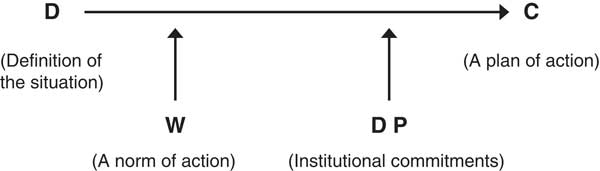
This article suggests a reason-based (RB) model of collective decision-making.Footnote 5 It does so first by conceiving collective decision-making as a process of practical reasoning, which when supported by specific institutional powers compels acceptance and compliance. Second, the article unpacks deliberation and connects it to explanatory mechanisms. The mechanisms – value consensus, mandatory norms, and evidence – transform initiatives into practical results. They ensure that justified reasons terminate in a binding agreement. The mechanisms are identified when collective decision-making is sequenced.Footnote 6 A conflictual decision-making process prototypically consists of three sequences commencing with a claim to something made by someone and addressed to somebody; a claim that is explained and justified in a public forum to third parties, and, if successful, leads to learning, viz., change of opinion (Figure 1).
The reason-based model of political decision-making.

I illustrate the explanatory potential of deliberation by analyzing the protracted process of getting to agreement on an empowered parliament – the European Parliament (EP) – in the European Union (EU). Short of a value consensus, which most often is the case in international affairs, mandatory norms, and evidence come about as mechanisms of deliberative decision-making. There are other pathways to deliberative agreements but in a political context, it is the procedure through which they come about that legitimizes them and transforms them into binding decisions.
I proceed by conceiving of deliberation as a form of practical reasoning about what to do, which, in a political context, is supported by institutional commitments. On this basis, I delineate the mechanisms of deliberative decision-making that constitute the RB model. Thereafter, I illustrate the relevance of this model in understanding the processes that established a ‘democratic deficit’ as the definition of the European political situation and led to claims for an empowered EP. Then, I discuss what type of learning the change of opinion with regard to the empowerment of the EP testifies to. Is it an instance of normative or of empirical learning? The last section, which holds the conclusion, reflects on the wider applicability of this approach. First of all, why the deliberative approach to international affairs?
Reason and sovereignty
It may appear counterintuitive to apply the deliberative approach to international affairs. Realists see the international order founded on the principles of co-existence and non-interference among sovereign states (Morgenthau Reference Morgenthau1993, 12). Here, the art of politics is conceived of as deeply contentious, as a strife and strategic game (Mearsheimer Reference Mearsheimer2011). In this tradition, deliberation is manipulation. According to Karl Marx (Marx and Engels Reference Marx1970), public deliberation is distorted by participants that mask their self-interests by appealing to altruistic reasons. In line with this, Jon Elster maintains that bargainers ‘gain a strategic advantage from framing their demands in terms of principle’ (Reference Elster2007, 423). Nevertheless, also realists, who hold the deliberative approach as overly naïve, recognize that actors wish to be seen as rational beings and hence justify their actions. The fact that we normally give reasons for what we are doing, which makes our actions appear as rational, may piggyback on the preferences themselves. Hypocrisy is the vice’s tribute to the virtue because mimicking altruism can lead to transmutation, to change in preferences, so that the actors come to understand that there is something to principles (Elster Reference Elster1998, 111f, 2007). Likewise, when actors are in a normative situation they do not control, they can become rhetorically entrapped (Schimmelfennig Reference Schimmelfennig2001).
Globalization, in general, testifies to complex interdependence and the prevalence of politicization and deliberation (Dryzek Reference Dryzek2006; Kuyper Reference Kuyper2014; Zürn Reference Zürn2018). Deliberation is required to handle contingencies and uncertainties. When the actors do not know what to do, they have to deliberate. Deliberation is required in order to establish the right thing to do, as conflicts from time to time have to be solved with a view to higher ranking law. There is a juridification of the international order in the wake of the United Nations (Koskenniemi Reference Koskenniemi[1989] 2005). Law no longer only come in ‘state-sized bites’ (Dworkin Reference Dworkin2013) as the elements of global constitutionalism attest to (see Peters Reference Peters2005; Dunoff and Trachtman Reference Dunoff and Trachtman2009).
The density and stickiness of norms beyond the nation state counter the Schmittian proviso of international politics as a state of affairs that is exempt from all justification – that it is justification by mere existence (Schmitt [Reference Schmitt1950] 2003). International law has grown: it regulates more and more fields and has curtailed states’ willpower. Sovereignty (or anarchy) may be what states make of it (Wendt Reference Wendt1992), organized hypocrisy (Krasner Reference Krasner1999), or merely nominal and useless (Jackson Reference Jackson1990; Kratochwil Reference Kratochwil2001). Still, sovereignty has normative relevance as it marks norms that should not be violated.Footnote 7
Today, sovereignty is disaggregated, divided and shared, and freed from the old straitjacket of external sovereignty (cp. Slaughter Reference Slaughter2004). It has become conditional on respect for human rights and democracy. In Europe, there is an abolishment of ‘unitary sovereignty’ (Keohane, Moravcsik and Slaugther Reference Keohane, Moravcsik and Slaugther2002, 745).Footnote 8 The EU is a case of the unbundling of state authority and, with this, a change in the constitutive principle of territorial sovereignty (Ruggie Reference Ruggie1993). The EU treaties constitute an overarching legal structure, which, in turn, serves to limit member states’ sovereignty. They function as a proxy for a constitution. There is thus a European rights-based order – a justificatory context, where, to talk with John Rawls, ‘the rights secured by justice are not subject to political bargaining or to the calculus of social interests’ (Reference Rawls1971, 4). The point of departure in this article is that a political context is always one of justification – the discipline of reason at the collective level. In normative orders, justification is forced upon the interlocutors as a condition sine qua non for agreement.
In order to illustrate the explanatory potential of the RB model, I draw on the puzzling European integration process. Here, democratic nation states have pooled sovereignty and overcome the collective action problem without being forced to do so. The states have ceded sovereignty to a supra-national entity with law-making procedures of its own – including a parliament, which makes the EU a competitor in terms of loyalty. How could this be possible when the ordinary resources of integration, such as a territorial control and a collective identity, are in short supply?
The integration process represents a puzzle for established theories of polity formation as states have voluntarily relinquished their sovereignty. Integration is commonly defined as a process where actors shift their loyalties and activities towards a new center with the authoritative right to rule in the name of all. In Europe, national sovereignty is ceded through qualified majority rule (QMV) in the European Council. Member states have ceded agenda-setting powers to the Commission; accept the rights of the EP to co-decide legislation, budgets, and even the political leadership of the Union, and accept the Court of Justice of the European Union (CJEU) interpretations of Union law as binding. In several policy areas, the veto option has been eliminated. The states have accepted to be outvoted.
The European integration process is a hard case because of the lingering sovereignty of the member states. It is the member states that keep the monopoly of violence in reserve, not the EU. At the European level, the manifest power threat is absent. Still, European states’ own exclusively national means of reciprocity and self-help measures have been removed. The states have voluntarily given up their foremost indicator of independence, viz., the right to take the law into their own hands. The integration process has thus taken place within a system bereft of the major physical means of coercion that we associate with a sovereign state and without a distinct identity to prompt trust and compliance. An explanation has been sought in the fact that interactions are more deliberative in a system largely unsettled and which lack the distinct power threat and the physical means of coercion.Footnote 9 It has been suggested that integration has taken place through deliberation (Eriksen and Fossum Reference Eriksen and Fossum2000).
Reason-based action coordination
Deliberation is minimally defined as the exchange of arguments. In collective decision-making deliberation entails reaching agreement on some joint course of action.
Proceeding deliberation
Deliberative theory posits the capacity of actors to engage reflexively in justificatory processes and harmonize their initiatives with argumentative means, viz., by raising knowledge claims, which can be accepted or rejected. A reason is not a reason unless it is related to conditions of truth and rightness. A reason for A to do X is a reason for B to agree to do X only when B sees that X makes sense, that it is true, that it is the right thing to do. Deliberation is a cognitive process for the assessment of reasons in a practical situation oriented towards reaching fair or good decisions.
Deliberation is thus more than discourse, discussion, or dialogue. It refers to the coordinative function of communicative interaction. Deliberation can be seen as a decision-making procedure like bargaining and voting. It is well established that actors are able to reach agreement on practical propositions through reason-giving, but how? Why is there deference in a practical situation where something is at stake? How can actors come to bow to the forceless force of the better argument Footnote 10 when doing so goes against their identity or self-interest? Collective decision-making requires ability to agree, and rational decision-making requires argumentative reasoning – to include and assess information and reasons.
Deliberation faces the problem of indeterminacy. It has no conditioning cause. There is free will as well as weakness of will – even when we know the actors’ preferences, we cannot be sure that they follow suit. Moreover, nobody is obliged to comply with cogent action norms unless all the others involved comply. In addition to the problems caused by weakness of will, the indeterminacy of norms, myopia, and bias, different rules of inference, and complex moral standards, there are inherent cognitive limits to rational consensus. Even under ideal conditions, a consensus may not occur.Footnote 11 However, as Mercier and Sperber note (Reference Mercier and Sperber2011, 57), when the context is specified, ‘people turn out to be skilled arguers’.Footnote 12 The typical framing effect is reduced by about 50% by 5-minute discussion (Drukman 2004, cited in Neblo Reference Neblo2015, 69). This is even more the case in legally organized processes, which limits premises and focuses the proceedings on reaching a decision within a time limit.
How to explain that rational actors who disagree on a policy (or polity) option can reach a collective decision despite lacking the instruments of power enforcing compliance? Interdependent actors who want to sort out common affairs and coordinate actions cooperatively face two kinds of tasks. First, they have to identify the issue at hand and agree upon the nature of the problem, viz., to establish a definition of the situation. It takes norms to identify the case in question as well as its proper form. Second, actors have to agree upon whether the problem should be solved, and if so, how and by which means.
The medium for action coordination is generally reason-giving and even more so in multicultural and multilateral contexts. There is no quick fix under conditions of pluralism – of persistent disagreement – and complexity stemming from increased specialization, but to establish a common and actionable understanding of the situation. Deliberation compels actors to verbalize and justify their plans of action when there are preferences over outcomes or conflicts of interests, when there is doubt, ambiguity, or uncertainty. Deliberative inquiry enlightens the actors and sheds new light on the issues at stake. Deliberation has many merits and may, if it is good, change actors’ attitudes or beliefs when it is proven that they are mistaken about the ‘fact’ of the case or the ‘principle’ in question.
Warranting agreement
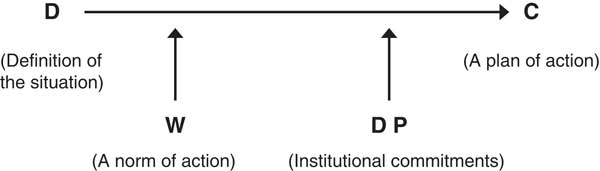
Deliberation can be conceived of as a form of practical reasoning in which actors identify what is the case in order to settle for what to do. Norms are important for solving problems – for answering what ‘ought’ to be done – but also for identifying what is the problem of the case at hand. According to Toulmin’s ([Reference Toulmin1958] 2003) theory of argumentation, practical reasoning involves three components: a description or definition of the situation (D), a warrant (W), and a conclusion (C) that refer to a course of action (or no action). W is an action norm that authorizes the step from the definition of the situation to a conclusion. That is, unless there is rebuttal, an argument which disqualifies the use of the warrant in the actual case. The qualifier on its part deals with the overall strength of the warrant. Norms are warrants, as far as they contain rules of inference, viz., rules for deriving at a conclusion of what ought to be done in a problematic situation.Footnote 13 They explain the conversion from premises to a conclusion of what to do in a situation of a particular kind.
To decide is to reach conclusion on a plan of action, but practical inferences are defeasible. Disagreement may be persistent and people may disagree on which inferences are correct. Rather than seeing action as a result of a series of inferences between propositions that happen to have action as its subject matter, I will understand it as a result of a practical syllogism, viz., ‘as the taking up of means with an action as it subject matter’ (Ripstein Reference Ripstein2009, 174). In a practical syllogism, reasons for action present themselves as premises of a conclusion and even if not as a universal quantified conditioner, then as a conditional conditioner. This is so because ‘non-compliance is a fault’ (Raz Reference Raz1975, 179).
A rational person is capable of recognizing and assessing as well as being moved by reasons (Scanlon Reference Scanlon1998, 23). The point is, however, not only that endorsing a reason gives it a grip on us (Brandom Reference Brandom1994, 52), but rather that when it becomes clear that non-compliance is a mistake: an actor is, under certain conditions, compelled to accept and comply. Acceptance means the approval of a claim or a decision on the basis of a fair judgment, whereas compliance refers to the observance of a binding decision. But what is actually the causing effect of deliberation? What exactly does the action coordinating property of deliberative decision-making consist in when there is free will as well as weakness of will? A ‘rational’ person may dispel good arguments when they go against his beliefs or wants (Pincione and Tesón Reference Pincione and Tesón2011). Even if actors know what the right thing to do is, they can defect.
Deontological powers (DPs) at work
Since actors may dispel good arguments as well as duties, deliberative theory faces the problem of indeterminacy, viz., ensuring a single correct course for action. We should, however, not treat this problem at the abstract level, as a philosophical question of freedom of will and as a question of consistency among rational actors performing institutionally unbound speech acts. Rather, we should locate the problem of indeterminacy at the institutional level where speech acts are bound. Reason and will are tempered by institutional commitments. In a political context, actors are not free to do what they want because action depends on collective decision (cp. McDowell Reference McDowell1998, 235). It is not up to actors to act as they wish. They are placed in a normative situation they do not control.
Institutional commitments are here seen to make up the backing that warrants require. Behind warrants ‘there will normally be other assurances, without which the warrants themselves would possess neither authority nor currency’ (Toulmin [Reference Toulmin1958] 2003, 96). Backing underpins and safeguards warrants. It justifies and helps realizing the warrant; hence, it reduces the indeterminacy of practical reason. Conclusions, agreements on what to do based on good reasons, need to be backed by the power of institutions. According to John Searle (Reference Searle2005), impartial arguments are strong enough to trump self-interests and stem not merely from our moral capacity to act disinterestedly, but from DPs afforded by institutional status functions.Footnote 14 They provide rights, obligations, and duties; they invoke demands, permissions, and authorizations, which give the actors reasons to act out of duty. Institutions sanction, socialize, and discipline actors: they establish standards for correct behavior, for distinguishing between social roles and their corresponding obligations. The question then is not whether the individual actor on its own is capable of acting out of duty, but what the members of an institution must do. It is not a question of what I want to do, but what we must do in order to reach an agreement that terminates in a decision. Acting is not an individual but a collective affair in an institutional setting.
Norms and institutional commitments give the actors reasons to act against their identity or self-interest. However, whereas moral norms refer to achievable ideals – what ought be done as a dictate of practical reason – institutions refer to a narrow social context of prohibitions and prescriptions connected to sanctions that apply here and now. While rules capture the past and norms the future, institutions capture the present. Institutions ensure the observance of justified norms. In the RB model, institutions solidify and realize norms in decision-making processes.
The legal structure of political decision-making, its democratic presuppositions in particular, makes it clear that there are normative commitments as to which norms apply and should be observed. Legal rules, like norms and institutions, are also reasons for action. Every system of law has at least one rule of recognition that requires officials to apply rules identified by criteria of validity included in it (Hart Reference Hart1961, 79ff, 266).Footnote 15 Collective decision-making that is legally structured involve a set of DPs depicting what is demanded by institutional actors, what their obligations are, and involve methods for converting agreements into binding decisions and for deterring non-compliance.Footnote 16 Institutional commitments are the net sum of DPs (Figure 2).
The components of practical reasoning.
Even though DPs of institutions reduce the indeterminacy of deliberation, a reason-based explanation does not contain a conditioning cause and does not generally enable predictions. The conditions for a covering law explanation do not generally apply in the social sciences.
Deliberative mechanisms
The RB model is premised on the conceptual resources of deliberative theory and offers mechanismic explanations of social events.
Mechanismic explanation
Deliberation does not contain a conditioning cause required by covering law explanations. Even moral norms – deontic norms that specify obligations – do not have the form of universalized conditionals. Law-like causality is generally problematic in the social sciences, as action may be motivated by norms as well as will, of ratio as well as voluntas, and usually in combination. However, we can explain action with reference to reasons without knowing the laws that link them (Davidson Reference Davidson1980, 37, 262). In most cases, the explanation takes the form of a more or less complicated set of causal statements.Footnote 17 The set is what we usually call a ‘social mechanism’ – a well-articulated set of causes responsible for a given social phenomenon (Bunge Reference Bunge2004; Hedström Reference Hedström2005). Mechanisms are hypothesizing devices that intermediate between an input and an output, a force that transforms initiatives into practical results. Mechanismic explanation represents an alternative to the covering law model of explanation, which entails subsuming an event or a phenomenon under a general law of human behavior and with reference to the conditions that make the law applicable in a specific case. That would entail a law-like conception of actors – as, for example, ‘norm-dopes’ or ‘utility maximizers’ – and an invariable opportunity situation. Such laws and conditions do not apply in ‘a free world’.
Mechanismic explanations are not deterministic, as more than one result may occur. They do not allow for predictions but explain why an event happened post-factum. Social mechanisms trigger actions under conditions of indeterminacy: they do not determine the outcomes (Elster Reference Elster2007, 36). That is, even though a mechanismic explanation follows the ‘if-then’ deductive logic, it does not require establishing the exact scope conditions for a norm – a warrant – to apply.
We have to do with a non-deterministic but not a mere probabilistic form of explanation. The RB model site agents’ reasons as explanation of actions but as far as we are dealing with collective decisions, the reasons must be of a certain quality to win through. Actors present their reasons as claims in first person singular (or in first person plural in case there are we-intentions); the claims’ success depends on their convincing force, which prototypically depends on the knowledge claims raised and which hence are intersubjectively appraisable.
The RB model combines an interpretative first-person perspective with a third-person objective perspective in explaining social behavior. Explaining why persons act for this or that reason requires knowledge as an enabling condition, including knowledge about normative facts such as moral or mandatory norms. Norms are ‘out there’ – they are not psychological, mental states of affairs – and they coordinate action in processes of reaching understanding and agreement when this involve figuring out the right thing to do. As mandatory norms provide an objective backstop, the form of explanation of RB model is not a probabilistic one that is open for interpretative regress.Footnote 18
The functions of claims-making
Under different circumstances, different knowledge constraints are operative and different argumentative logics apply. By specifying the argumentative theory to decision-making, one may distinguish between three sequences, each containing a set of explanatory mechanisms. Collective decision-making commences with a claim to something made by someone and addressed to somebody. A claim is a speech act that, at the same time, expresses the intention of the actor, represents a problem formulation, and is related to others. Claims have the cognitive function of representing a state of affairs, as well as the expressive function of making known experiences of the speaker, and the appellative function of directing requests to addressees.Footnote 19
A claim represents a need, a want, an interest or a belief that is generally unsatisfied and directed to others for recognition and justification. To be accepted, claim-makers must be able to present their request in such a way that others can understand and agree to it. A claim’s appeal depends on its value basis and its success depends on others’ acceptance. Justificatory force depends on the strengths of the norms involved. Public deliberation tests whether facts are correct and whether the right norm is appealed to in claims-making. It is assumed that an inconsistent argument never reaches the stage at which it can be presented as a claim responded to by others. As consistency and coherence are prerequisites for rational assessment, a proposition expressed in an unintelligible form will be dismissed. On the other hand, the RB model presumes that without substantial, common good, value-based arguments regarding what should or could be accomplished, no proposition will take the shape of a claim in the first place.
Claims-making without justification
Argumentative logic presumes that claims-making necessarily involves justification, but not all reasons for action require justification ‘all the way down’ in order to have empirical bite. Under certain circumstances, a claim would be able to prompt approval from affected parties just by being in correspondence with established values. One may, with Brandom (Reference Brandom1994, 221ff), maintain that claims in everyday life are accepted when defended by doxastic commitments or practical experience. Claims-making without justification suffices for decision-making when respondents, solely on the basis of the information entailed in the claim, become aware of a problem which, according to established standards and endorsed values, should be solved. People concur so to say just out of declaration or pedigree, out of a shared understanding of which regime of justice applies and of which values that are appealing: what is good for us in this specific situation (Boltanski and Thévenot Reference Boltanski and Thévenot1999, 362). They thus concur because of agreement on ethical norms, hence the proposition that claims are accepted when corresponding with established value based rules. An example of decision-making without normative justification is so-called ‘claro cultures’ (Gambetta Reference Gambetta1998). In these cultures actors can get away with assertions:
Many cultures – including Latin American ones I know – place considerable value on having strong opinions on virtually everything from the outset and on winning an argument rather than on listening and finding that something can occasionally be learnt from others (Hirschman Reference Hirschman1986, 42).
In claro cultures, no justification is needed for people to concur, and no learning based on changes in opinion is in sight. In such cultures, there is a value consensus premised on a conception of the common good that actors immediately understand, do not question, and are committed to, as it is what makes up their collective identity. Ethical norms are contextual and not objective – they are instituted by the normative attitudes of the participants. What happens when there is conflict stemming from irreconcilable values, different Gods, different conceptions of the good? The hard case for deliberative theory concerns cases that are resolved consensually despite ‘a sharp conflict of interests and/or opinion’ (Harré Reference Harré1999, 250). In reasonably open societies where the right to oppose exists, where value pluralism prevails – and dramatically more so at the international level – claims-making must transgress the valuations of a context bound regime. Claims-making takes a more principled form when the premises are challenged.
Arguing norms
Only justification can establish support when there is ambiguity or disagreement. People ask why the claim is presented and if it is due. For a claim to be agreed upon, it must generally be explained and justified to a wider audience (or audiences) with comprehensible reasons. Also, declarations of power or will have no effect unless they are verbalized and asserted publicly.Footnote 20 In contexts where the actors have rights and where opposition is institutionalized, political claims are usually questioned and contested. Equally valid norms may apply. Public justificatory discourses revolve on whether a claim is right or not.
Claims call for explanations and justification in a public forum to third parties with reference to what is the right thing to do. Here, the warrant (W) is agreement on which norm to apply in the specific situation. Mandatory norms are those that rule out competing norms and authorize the conversion from premises to conclusion, from a description of a situation to action or acceptance.Footnote 21 They rule out conflicting reasons and amount to explanatory mechanisms on par with a value consensus of claro cultures. Only agreement on a mandatory norm can ensure a well-grounded solution to practical problems. Mandatory norms purport to be valid and are not in need of further justification.
Norms are a particular type of concept. They are interpretative concepts whose correct use depends on their best justification (Dworkin Reference Dworkin2011, 158). Norms cannot be treated as physical objects raising truth claims – they have no objective world reference. Their very existence is a result of the meaning and importance actors attach to them. Especially in intercultural contexts, their veracity depends upon understanding-oriented communication. The meaning of norms is not fixed but subject to reason-giving and moral ‘know-how’. Interpretation is argumentation, and argumentation is the procedure for redeeming validity claims. Moral norms’ validity can, according to moral cognitivists, be settled rationally – through the give and take of reasons – because they have a cognitive core. The rightness of norms – are they just; are they equally good for all? – can be tested in a public deliberation and which hence narrows the variation in norms’ meaning and reduces their open-endedness.
Mandatory norms like democracy, human rights, justice, dignity and rule of law purport to have higher order deontic properties. These properties, which reflect the idea of inherent human worth, stem from a religious and mystic past as well as from modern human rights conventions and constitutions. We cannot but hold them self-evidently right or ‘true’. They are inalienable by morality as well as by our laws and by international covenants that we have sworn to uphold.
The conception of natural rights, sacred and inherent in man, was written into the constitutions of the eighteenth, nineteenth, and twentieth centuries, not because men had agreed on a philosophy, but because they had agreed, despite philosophic differences, on the formulation of a solution to a series of moral and political problems (McKeon Reference McKeon1948, 181).
Although human rights norms often are discarded by passion and interest and set aside by power holders, such norms have over time been reclaimed, reinterpreted, and extended to include new groups that struggle for recognition. Some of them have been specified as actionable basic rights. Norms like democracy, human rights, justice, dignity and rule of law, which are entrenched in EuropeanFootnote 22 and national law, are vital for identifying dominance, injustices, malpractice, corruption, power abuse, etc., as well as for suggesting rectifying measures. Thus, as mentioned, norms are problem identifiers as well as problem-solving devices. Norms are indispensable for reaching agreement and function as arbiters in collective decision-making. Without the mentioned norms, it would, for example, be difficult to account for the European integration process.
It is in the justificatory phase of the decision-making process that action plans can be tested in lieu of valid norms. Justification aims at settling conflicts impartially and bears the burden of legitimation in decision-making. It is also in this sequence of the process of getting to agreement that discarded or overlooked reasons can be identified. Justification has a critical and norm testing function: In the justificatory sequence of decision-making, counterfactuals and non-decisions can be recognized.Footnote 23 What would happen if the decision is not made?
The RB model is not deterministic as it explains what happens among deliberating actors who raise fallible knowledge claims. Mechanisms are operative as speech acts and more like traffic signs that coordinate behavior, than as universal conditioners. As deliberation in legal contexts is linked to decision-making, the arguing process is specialized and the speech acts are institutionally bound. To decide is to reach conclusion on a plan of action, not to find out what is ultimately valid, true or right. Here, there is no question of more or less, of degrees or relative weight of validity claims, but a binary requirement of yes or no: either you accept the information and reasons – relating to facts, values, and norms – presented as premises for agreement or you do not.
We cannot know whether a political decision is ultimately right unless all are heard. Thus, the criterion of deliberative agreement is not a single correct decision but a well-grounded one. Under conditions of pluralism and persistent disagreement, deliberative decision-making aims at reaching decisions that are generally worthy of recognition that could be observed out of insight. Consenting because one receives a benefit or because of ignorance does not count as qualified acceptance (Estlund Reference Estlund2008, 9).
In deliberative decision-making, there is thus the requirement of yes/no to proposed solutions: whether a claim should be accepted or not, whether one should go further, or whether the claims-making process should be stopped. If nobody is able to argue convincingly for the feasibility, rationality, and fairness of the claim – with publicly acceptable reasons – it will not engender support from disinterested parties, and contestants will take it down. Claims must pass the justificatory filter to be admitted for decision-making.
Learning compliance
Justification is a kind of differentiating property that provides causal reason for action, but justification is not explanation. The legitimating reasons may not be the motivating reason. A person can have a reason for acting, but this may not be the reason for why he did perform the action (Davidson Reference Davidson1980, 9). Even when a proposition is justified, it can be opposed. Actors may resist change without airing their reasons. There may be rebuttals, viz., exemptions to rules. Despite agreement on norms, disagreements on their application may prevail because of a different understanding of the situation as well as interest conflict, uncertainty, confusion, ambiguity, heuristic bias, etc.
Still, decisions have to be made. In case of disagreement, one or more of the dissenting actors must change their opinions concerning what to do, if a conclusion is to be reached; that is if agreement – a unanimous decision – is to be reached with argumentative means.Footnote 24 Some form of learning must take place. Exposure to counter arguments and the records of mistakes or falsely grounded beliefs need not suffice to bring about change. Even when faced with proof to the contrary, individuals may cling to their beliefs. Change can be painful and actors often resist change not perceived beneficial for own interests. However, since indecision, standstills and deadlocks prevail when there is disagreement, there is something at stake for the participants in collective decision-making. There are incentives for ending disagreement as well as institutional commitments, which subject actors to the reason-giving requirement. To oppose without good reason is risky. It can affect reputation and standing. Every organization has ways to abolish obstruction and pacify quarrellers, including through public naming, blaming, and shaming.
The mechanism of learning is evidence – evidence to the fact that noncompliance is a fault. This mechanism presents itself as something outside of our control: like internalized values and justified norms, evidence has an independent authoritative force. It can induce actors to change opinion on the case in question. Whether we like it or not, evidence causes us to change standpoint when proven wrong and even more so when it appears to be no alternative if cooperation is to carry on. When substantiated evidence shows that refusal is incorrect, evidence amounts to a trump.
Learning generally involves overcoming obstacles intelligently. It involves the recognition of mistakes and/or the discovery of new solutions on the basis of inferences made from outcomes. In deliberative decision-making, learning means that some actors’ opinions change when faced with new information – with better reasons. When actors agree out of insight of what norms or principles do apply in the specific case, there is normative learning. In that case, there is the employment of moral-practical knowledge, that is the recognition of the reason-giving force of moral considerations, to talk with Scanlon (Reference Scanlon1998, 149ff). Learning may mean a substantive solution to a distributive problem in collective decision-making. In case of continual conflict, it may mean agreement on how to proceed. In the latter case, learning means establishing procedural directives for ‘appropriate and justified conflict resolution in concrete situations’ (Günther Reference Günther1988, 148).
However, actors may also come to agree out of knowledge of (adverse) consequences of dissent. The latter may be termed empirical learning: beliefs or standpoints are changed on the basis of interferences made from real or expected outcomes. Empirical or experimental learning of different kinds is adaptive in the sense that rules are changed in order to establish a better fit with the environment on the basis of fact gathering (March Reference March1994, 80ff). Both for normative and empirical learning, the mechanism is evidence to the fact that non-compliance is wrong. Decision-makers cannot reject evidence without facing contradiction and/or consequences.
Deliberative decision-making
In practice, deliberative mechanisms of deliberative decision-making work in combination. Values and norms as well as evidence are used interchangeably in getting to agreement. What is more, claims-making, justification, and learning are involved in every step of the argumentative process. Defining the situation, establishing the warrant, activating DPs and reaching the conclusion are processes of reaching agreement. They are processes where claims are made and justified, where some learn and change opinion. Actors reach agreements when they define situations, when they establish warrants as well as when they activate institutional commitments and arrive at conclusions.
The mechanisms work together but can be separated analytically: they are logically different – values, norms, and evidence raise different knowledge and validity claims. Values relate to identity and conceptions of the common good; norms relate to justice and rightness; and evidence relate to normative and empirical facts – to truth. The value basis of claims-making explains why initiatives are taken and resources are mobilized to bring demands on the agenda; mandatory norms explain their putative public significance and the convincing force of claims in justification discourses; evidence explains why conflict is overcome so that justified claims terminate in binding decisions even when actors happen to disagree.
When a claim is recognized, it can be pursued; when it is justified, it can be adopted; and when there is learning, the justified claim leads to change and there can be a decision. Collective decision-making is not deliberative unless all sequences have been activated in getting to agreement. Decision-making without reflexive argumentation, without the give and take of arguments, of testing rebuttals and qualifiers, is not deliberative. Rules of thumb, standard operating procedures, customs, and conventions also result in voluntary agreement, but we cannot know whether they are justified. They can rest on non-public, private, or parochial reasons.
In a pluralistic world, and even more so in an international environment, a conventionalist basis for agreement-making is shrinking. Here, there are many contexts that must be neutralized and context bound arguments that must be reconciled or translated into general and crosscutting categories. It is not always clear what the force of the better argument consists in, hence the need for articulation, explanation and justification. Short of a value consensus in an international context, mandatory norms, and evidence are assumed to take the upper hand as mechanisms of deliberative decision-making. Some puzzling features about the European integration process illustrate the relevance of the RB model.
From disagreement to agreement
Empowering the EP attests, I submit, to learning as a result of protracted processes of claims-making and justification.
Claiming European democracy
Why has the European states voluntarily ceded sovereignty to a power wielding supra-national entity? Rational choice intergovernmentalism and constructivism represent two different approaches to this phenomena. Constructivists detect an anomaly in the former’s explanation. EP empowerment reduces governments’ power. Why would rational, self-interested actors reduce their sovereignty voluntarily? Rational actors would not voluntary weaken their own power without being payed off. Moreover, why would unequally situated governments, each focusing on their own interests, through a bargaining process arrive at some form of supra-national democratic system? (see Eriksen Reference Eriksen2014a, 26). However, also the constructivists’ explanation of the transfer of power poses questions. This explanation refers to nation national political élites and their legitimating beliefs (Rittberger and Schimmelfennig Reference Rittberger and Schimmelfennig2006).Why are governments willing to limit their own powers because of normative pressure and why is there normative pressure at all?
The RB model sheds light on these phenomena and, in particular, on the following question: Why has the parliamentary model ‘won’ as a justificatory template despite the fact that the preconditions for such are held to be lacking? Why has the democratization process taken the parliamentary institutional route when there is no European ‘demos’ and when many analysts and critics, as well as state representatives, have warned against parliamentarization at the European level?Footnote 25 At different points in time, empowering the EP was vetoed by the French Gaullists as well as by the British Thatcher government, because they saw it as detrimental to national sovereignty. Only when de Gaulle resigned, and Georges Pompidou took over as the president of the French Republic in 1969, the French government did change opinion and agree to what became the Luxembourg Treaty. Later, the UK position changed during the proceedings leading to the Maastricht Treaty. It changed when John Major succeeded Margaret Thatcher as the prime minister in November 1990.Footnote 26
This controversy revolves on the right level for the principle of democracy. Uploading democracy from the national level to the European level requires contestants in the Council to change opinion. For the EP to gain power, the treaties had to be changed. This has happened at regular intervals even though treaty changes require unanimity. The norm of European parliamentary democracy was proclaimed early on and helped to create an action-reinforcing process, which, over time, gave institutional shape to the supra-national democracy in a non-state supra-national setting. Since the 1960s, national parliaments (NPs) were active ‘in shaping European institutions. In particular, NPs were the key actors driving the empowerment of the EP’ (Haroche Reference Haroche2018, 1010). As NPs understood it as an compensation for own lost powers, they made their approval of any new transfer of powers to the European level conditional on EP empowerment (Eriksen and Fossum Reference Eriksen and Fossum2012, 334).
The EP developed from the body initially labeled the Common Assembly of the European Coal and Steel Community (1951). Over time, the institution, whose members have been directly elected since 1979, has undergone deep change: from an assembly with appointed members to an elected parliament with significant political clout. It was justified with reference to the Union’s dual legitimacy: a Union made up of citizens and of states. However, there were disagreements over whether direct European legitimation was needed or whether indirect legitimation through national democracy, through delegation, was enough. For the EP to be empowered, some actors had to change opinion. As mentioned, the treaties are agreements between states that can only be amended by unanimous decisions in the Council of the European Union.
Although central decision-makers had for a long time agreed that the system of own Community resources required a more prominent place for the EP in the budgetary process, there was little public discussion of the EU’s democratic credentials prior to the early 1990s. It should, however, be noted that a broad range of actors, including key personalities, in particular Altiero Spinelli but also to a varying degree, Jean Monnet, Robert Schuman, Konrad Adenauer, Alcide De Gasperi, Paul-Henri Spaak, Valéry Giscard d'Estaing, Helmut Kohl, François Mitterrand made claims for EU representative democracy from the Communities’ very inception. In the 1950s, democratic federalists were in the driving seat, and they sustained a close semantic link between democracy and the parliamentary principle. This link was corroborated by Joschka Fischer who, in 2000, launched the constitutional debate at Berlin’s Humboldt University and called for a transition from a Staatenverbund to a fully parliamentarized federation.
In addition to key personalities, most of the EU’s institutions have at various times acted as central agents for democratization. The CJEU in particular is portrayed as a ‘legal activist’. Member states have also been important claim-makers. At the time of the EU’s founding, the German delegation to the Schuman Plan (1952) negotiations propounded the federal democratic state as its normative template and has held on to it since then. In the 1960s, the Bundestag consistently called for ‘parliamentary democracy’ at the European level. The German political parties CDU/CSU, SPD and FDP agreed and have continued to agree on the template of a federal Europe as the ultimate goal of the integration process. The immediate background was the horrific World War II and the peace movement it spurred.
However, it is not the freestanding idea of a federal parliamentarized Europe that has justified the more recent claims for an upgrade of EP’s competence. Rather, it is the argument that as the integration process caught on, a system with own resources should be held to account by a popularly elected body. A legitimacy deficit was identified by some European leaders already in the 1960s, because power was wielded and resources allocated through non-elected bodies. The system in place was not considered justified. The Commission needed to be held to account. Thus, since the NPs have limited capacity to supervise and control their executives at the European level,
[a]n extension of the European Parliament’s powers appear indispensable to guarantee that, on the European level, parliamentary control can be exercised as concerns the Communities’ own resources whose deployment escapes the control of national parliaments. (EP 1970, cited in Rittberger Reference Rittberger2005, 121).Footnote 27
The extension of EP’s budgetary power could be seen as the logical consequence of the increase in the Communities’ own resources, but it was initially opposed by national delegations. The principle of national democracy was used as a rebuttal to a fully parliamentarized EU – it countered the claim of supra-national democracy. Over time, the mismatch between the depoliticized European bodies and the values and principles the EU subscribe to increasingly came to be recognized. It became common knowledge that the Commission had been an autonomous driver of European integration (Pollack Reference Pollack2003).
Compelling justification
The process of empowering the EP is a case for probing under what circumstances new evidence would transform beliefs – the elimination of inconsistencies and self-contradictions necessary to achieve agreement. There was (and is) a mismatch between the rhetoric on democracy and the actual European practice. To give away power and resources to a supra-national depoliticized body – the EU Commission – is not consistent with democratic principles. Democracy has become a mandatory norm: It has become the sole legitimation principle of power in modern societies.Footnote 28 Still, both proponents and opponents to EP empowerment may use this norm.
The ones objecting to empowering the EP would reserve the democratic principle for the national level. It can also be argued that European integration was initially not about European democracy but about making ‘member states safe for democracy’, to use Milward’s phrase (Reference Milward1984). Over time, it became, however, clear that integration was an elite-driven process that decisions affecting citizens’ daily lives and living conditions were made in closed-door settings by largely unaccountable bodies. The cry for more openness and democracy became ever-present as democracy struck back through negative referenda in the 1990s. Since the ratification of the Maastricht Treaty (1992), in particular, the corollaries of democracy, such as electoral control, separation of powers, and executive accountability, have become the common categories of comprehension and the joint evaluation standards that the actors use when dealing with the EU. Entrenching of European citizenship helped generate a framework wherein democracy has increasingly come to figure as the overarching norm that both proponents and opponents refer to. When claiming more power to the EP, one could appeal to an agreed-upon standard. Moreover, with a system of largely unaccountable powers in the possession of own resources in place, the ‘national’ position became untenable. It is hard to be a democrat and at the same time oppose uploading democracy to the European level when this is needed for establishing an accountable government.
The democratic deficit became the dominant definition of the situation, and this represented a legitimation problem for the decision-makers. Even though democracy at the national level was the norm, and supra-national democracy was contested, the democratic deficit, as the definition of the situation, amounted to a qualifier of the argument for supra-national democracy. In critical and justificatory discourses, the democratic deficit was used by the contestants. It became an argument for uploading the democratic norm to the EU level.
The ‘unmoved mover’
Explaining a social phenomenon means identifying its cause. In order to establish a systematic explanation we need to get at an ultimate cause. What could amount to such a cause in the present case if not the parliamentary principle, which has, as seen, figured centrally in the very inception of the integration process by establishing the European Assembly in 1951? Parliamentarian democracy is, however, not only widely cherished and has appeal as a common value and legitimation principle, it is also part of what it takes to get political results right. Parliamentary democracy should then not be conceived of as an alternative to deliberative democracy, but rather part of the system needed for realizing popular rule. The parliamentary complex constitutes the center (in contrast to the periphery revolving on the public sphere rooted in civil society) in the two-track theory of deliberative democracy (Habermas Reference Habermas1996: 329ff; cp. Eriksen and Weigård Reference Eriksen and Weigård2003, 184). In this perspective, the parliament is, to quote François Guizot, ‘the place in which particles of reason that are strewn unequally among human beings gather themselves and bring public power under their control’ (cited in Schmitt [Reference Schmitt1926] 1992, 45).
The parliament amounts to a
[…] congress of Opinions; an arena in which not only the general opinion of the nation, but that of every section of it, and as far as possible every eminent individual whom it contains, can produce itself in full light and challenge discussion […] where those whose opinion is overruled, feel satisfied that it is heard, as set aside not by a mere act of will, but for what are thought to be superior reasons. (Mill [Reference Mill1861] 1984, 258–59).
In parliamentary democracies, the process of deliberation is institutionalized and subjected to procedural constraints to such degree that the citizens do not govern themselves directly. Rather, laws and collective decisions made by a representative body are subjected to the test of public reason – public inquiry and scrutiny – to ‘the verdict of the people’ (Manin Reference Manin1997, 192).
The explanation of the persistent pressure for an empowered EP can thus be sought for in the normative force of parliamentary rule. When forms of representation are needed for democracy to prevail, it is hard to establish viable alternatives. Because of its moral qualities, the parliamentary principle amount to an exclusionary reason. Footnote 29 It is a mandatory norm for action, which rules out conflicting reasons. Only parliaments have achieved the competence to speak for ‘the people’. That only parliaments are the institutional manifestation of popular sovereignty, a supreme form of government, has taken the form of a stubborn fact in Europe. The parliamentary principle may thus be seen as the ‘unmoved mover’. But it is an interpretative concept that needs to be argued for.
Even though supra-national democracy is contested, the route of institutional reform of the EU has been that of representative, parliamentary democracy. Actors have been able to utilize the inherent legitimacy of the parliamentary principle to sway others to increase the EP’s role and status. In the European integration process, claims-making, contestation, and justification discourses testify to the prevalence of the standards and templates of the democratic constitutional state. Change has taken place as the EP over time has been granted more power. The Lisbon Treaty (2009) elevates the EP to a legislative entity on par with the Council. It instructs the governments to take into account the EP elections and states that the Commission President would be elected by the EP. Governments have consented to the empowerment of the EP. Still, many were (and are) opposed to the idea of supra-national parliamentary democracy.
Legal backing
Deliberative theory posits actors’ ability to comply with the force of the better argument through explication of the relevant rules of practical inference. Establishing that the appropriate description of the European political situation was one of a democratic deficit and that empowering the EP was the proper course of action, follows the structure of a practical syllogism where reasons for action present themselves as premises of a conclusion. In a decision-making context, the conclusion of what ought to be done can be seen as the outcome of claims-making subjected to explanatory and justificatory constraints. The warrant (W) – the action norm – that licensed the step from the description of the situation (D) to a conclusion (C) of what ought to be done, is, however, not merely democracy, it is parliamentary democracy. This form of democratic rule at the European level was and is opposed (not least by the states’ representatives who have the upper hand in European decision-making through the Council). Empowering the EP has been rebutted by the argument that it is a threat to national democracy. Even though there is a consensus on parliamentary democracy as the best form of government, there is no agreement that this is required at the European level. Quite the contrary – nation state democracy is the prevailing legitimation belief. The identification of a democratic deficit can be seen to have been the qualifier that made empowering the EP the proper course of action. But how could this insight be transformed into a practical result? Many factors, a complex set of motives, interests and norms have been at work. The RB model directs us to the institutional commitments in play.
If the conclusion of practical reasoning would be an empowered EP, and this also in fact was the result, even though some objected; how can it be explained? Actors do not always obey by the force of the better argument and in this case there was disagreement. The RB model suggests that collective decisions are supported by institutional commitments. By this is meant the DPs revolving on the moral and legal obligations of public officials.
The European integration process is to a large degree driven by law and its ways and means (Weiler Reference Weiler1994, 521; Alter Reference Alter2001). It is through constitutional and legal provisions that claims, via justification and learning, can be converted into practical political results (see Kratochwil Reference Kratochwil1989, 251). The EU’s legal system, like every system of law, has a rule of recognition that requires officials to apply norms identified by criteria of validity included in it. Even though the rules for recognition need not be held morally justified by those primary bodies that apply them, they are binding (Raz Reference Raz1975, 247).
Moreover, the CJEU has had a leading role in the democratization process of the EU. It embraced fundamental rights as a key principle of EU law and played a vital role in empowering the EP from early on. The CJEU spurred the EU’s constitutionalization dynamics: the more power that is granted to EU bodies and the more power that is exercised, the more constitutional guarantees and democratic parliamentary legitimation are required (Conway Reference Conway2012). In Europe, the very term constitutionalization has come to mean ‘the embedding of principles related to representative party-based democracy into the treaties’ (Day and Shaw Reference Day and Shaw2003, 150). Democratic presuppositions guide the struggle for reform also at the European level. Legal discourses aim at abolishing gaps and inconsistencies and have been vital in fostering agreement on democratic reforms of the EU. But is the final agreement on empowering the EP really based on learning, and in that case, what kind of learning are we witnessing?
Normative or empirical learning?
As mentioned, both Thatcher and de Gaulle, at different points in time, did not accept any change in the distribution of powers among Community institutions that was detrimental to national power. Other heads of governments did not share this view. Increasingly it became clear that an extension of QMV in the Council had to be complemented with an upgrade of the EP’s role in legislation in order for the citizens to be able to control the executive through their representatives (Rittberger Reference Rittberger2005, 182ff). This view is hard to counter. Still, the Thatcher government objected to conceding more power to the EP because it would mean loss of national sovereignty. Likewise, the French Gaullists objected to the Luxembourg Treaty on the basis of national independence.Footnote 30 Both the French and the British refutations could be seen as based on parochial rather than on general, public reasons and did not manage to drum up support from the other Council members. Over time, the resistance to an increase of EP’s power waned in France as well as in UK. John Mayor, who succeeded Thatcher in 1990, found the proposals for EP’s strengthened involvement rather uncontroversial and changed position.
Were actors who conceived of the EU as an international organization and resisted empowerment of the EP compelled to change opinion by being exposed to evidence, viz., that the member states no longer were the sole masters of integration due to the power of depoliticized bodies? This view sits with the deliberative approach. It sees rationality as a reflective stance through which responsibility for consequences is accepted and corrections take place. Novel action is undertaken on the basis of recognized mistakes, on the recognition of evil consequences, which hinges on the growth of democratic communication (Dewey Reference Dewey1927). Public deliberation is seen to be an inquiry about joint solutions to problematic issues that is backed by experience and the give and take of reasons. Learning takes place when one or more actors discover new solutions to a problem, when they realize errors or mistaken beliefs and change their opinions. Learning is of a normative kind, viz., when actors detect illicit orders or injustice and put their voice in and vote for reform on the basis of ethical and moral reasons.
If standpoints have been moved in a conflictual situation, if at least one of the participants have learned something and changed not only the original position but also changed opinion and that the parties thereby have reached an agreement with identical or mutually acceptable arguments, one may assume that this has been a process of normative learning.
Strategists equipped with instrumental rationality can also alter positions and change opinions, but only with regard to optimizing outcomes for themselves. Change may be due to new information about interdependence, the costs of being outliers, of benefits of second best solutions, etc. Strategists change action plans because of outlooks for success or to avoid failure. In that case, we have to do with empirical or experimental learning, as the actor has been informed about others’ preferences and resources and has thus changed position in order to at least achieve some of their goals. The actor has not really changed conviction – or wants, attitudes or beliefs – out of insight about what is the right thing to do, but has changed standpoint out of knowledge of the opportunity situation. This type of learning can be seen in the type of agreements they give rise to. Usually they take the form of compromises and can be identified in differences in the reasons actors list for agreeing (see Habermas Reference Habermas1996, 166; Eriksen Reference Eriksen2009, 50). In case of empirical learning, agreements would be compromises or modus vivendis; actors would agree for dissimilar reasons and would find the solution sub-optimal. Compromises are in standard cases agreements where actors make concessions with regard to their initial goals or principles. In case of normative learning, agreements would be deliberative and rational consensuses where actors agree with reference to an agreed upon norm, hence with identical reasons. Normative learning entails a qualitative change in one or more actors’ arguments.
In empirical as well as in normative learning, inferences from effects or outcomes are used to modify or change rules of action. In case of empirical learning actors comply because noncompliance is expensive and/or because continued opposition is futile. In case of normative learning, compliance is due the putative normative reasons that underpin the ensuing agreement or due to the recognition of the procedure that made it and the validity of the institutional powers involved.
Procrastination
Did the French and the UK leaders change opinion when they accepted the empowerment of the EP, or did they merely succumb to the majority? They could adapt to the majority view and see that as a better outcome than blocking Treaty changes because of the cost of non-agreement, of being an outlier. It may be hard to decide this matter, as we cannot know why actors changed opinion. We cannot know their real motives – and even if such motives exist, do they explain behavior? In order to have decision-making bite, motives have to be recognized, and they can only be accepted when they are portrayed as reasons for action also for others. In decision-making sites bereft of bargaining chips, legitimating reasons may turn out to be explanans even though actors do not believe in them. Motivations and interests, beliefs and wants are basically private reasons for action. They can explain why individual actors act as they do, but they cannot explain why a multitude of actors collectively act as they do. It is the process of reaching agreement with the help of public reasons that can explain how the actions of several actors are linked with one another.
In this case, there is probably a combination of empirical and normative learning. The mechanism can be that opinions changes through the slow learning that takes place with the passage of time where some reasons for positions have weakened while others have stood the test of time and of public scrutiny. What once were held to be strong, passionate norms about independence and national sovereignty waned over time and lost their grips on the actors’ mindsets. For example, the basis for a position held at a particular time may fade over time, in particular when it becomes clear that it does not hold up to closer scrutiny, when it turns out to be based more on emotions than on reasonable reasons. Related to this is the known propensity to procrastination, viz., putting off looming tasks to a later time. A rational actor may know that the sheer passing of time has eroded the basis for her position, but instead of changing opinion openly, she delays the actual change until she no longer is in position. Hence, others can make the formal change and she saves face and is relieved from the burdensome task of admitting mistake.Footnote 31
Conclusion
The requirement of justification of power explains why the empowerment of the EP became an issue that decision-makers attended to. The extension of EP’s budgetary power is the logical consequence of the increase in the Communities own resources. When scaling down of the Communities competences is not an option, mending the democratic deficit can only happen through empowering the EP. Still, this empowerment was opposed by national delegations. That the opposition eventually changed position can be explained by the force of the parliamentary principle, as a mandatory norm, which when supported by the DPs of EU’s legal system is made into a decision-making trump.
The RB model makes a case for principled reasons as part of the endeavor to come to an agreement. It reduces the indeterminacy of deliberation by relating it to the decision-making process where specific norms and powers are at work in different sequences of the process. Principled reasons are supported by institutional commitments that narrow down the number of alternatives, discipline the actors and focus decision-making on reaching a well-grounded solution. The RB model thus offers an alternative avenue for future research on European integration. It opens for a perspective that is not premised on power constellations and collective identity. The RB model does not see integration as merely functional or interest-driven, but as a result of anomalies identified by norms that cannot easily be discarded when activated in public processes of contestation and deliberation. Norms relating to human rights and democracy go to the core of the integration project and are so to say imperative. They have higher-order deontic powers.
EU interactions are often portrayed as deliberative. However, the deliberative quality has waned because of the crisis management regime of the Eurozone that was established in the wake of the international financial crunch (see Eriksen Reference Eriksen2018; Eriksen and Fossum Reference Eriksen and Fossumforthcoming). Because of disagreement, new treaties – including the Fiscal Compact (2012) – were established outside of EU law. The crisis-management regime is widely held to be in breach with democratic principles. However, with reference to the Fiscal Compact the EU has stated that the aim is to incorporate ‘the substance of the Treaty into the legal framework of the European Union’ (European Council 2012, Art. 16).
If this theory of deliberative decision-making applies to the EU case, it is applicable to a large set of unsettled orders, in which hierarchy is not in place but it is in everybody’s interest that solutions to problems are found and conflicts are resolved. It applies under circumstances where definitions of situations as well as technologies are unclear, where problems as well as solutions must be identified, where there is no correct answer without hearing the parties, and where conditions for bargaining and standard operative procedures do not apply.
The RB model applies to a whole range of fields where actors have to cope with contingencies and conflict resolution under conditions of interdependence; in all situations where decisions have to be made even when the formal instruments of power are lacking. The workings of many organizations, like NGOs and INGOs, research and knowledge organizations in general as well as public bodies – committees, councils, panels, conventions – are premised on the deliberative method. It is most urgently needed in international affairs where severe problems and conflicts prevail, where no one, in particular, is in charge, but something must be done. Deliberation helps sorting out who is responsible; what should be done, by whom, how, and when, by subjecting claims to justificatory constraints. The deliberative procedure justifies measures towards those burdened by them and hence increases the chances of learning – of acceptance and compliance.
The RB model of decision-making is, however, premised on institutionally bound speech acts. Many questions are predetermined and the rational assessments of reasons are constrained by the institutional binding and bonding of speech acts. Because deliberation is tailored to reaching a binding conclusion on a plan of action within a time limit, ‘the rule of reasons’ is constrained. Hence, we cannot know the precise normative quality of the results. But the impartial assessment and justification of claims, values, and interests, which the DB model requires, warrant the expectation of justified and well-grounded outcomes.
Acknowledgement
Revised version of paper read at The Epistemic Democracy Conference, Yale University, October 22–22, 2011 and at the conference on Die Idee deliberativer Demokratie in der Bewährungsprobe 20–22 March, 2013, Hannover. I am grateful for comments provided by the participants, in particular to André Bächtiger and Anders Molander. I am also indebted to the two referees of International Theory, and to Ragnhild Grønning for technical assistance.