With increasing availability of molecular genetic assessment several interactions between measured genes and measured environments have recently been found in studies on human development. The most famous example is the Dunedin study by Caspi and colleagues (Reference Caspi, McClay, Moffitt, Mill, Martin and Craig2002), documenting the moderating role of a specific genetic polymorphism in the association between rearing adversities (e.g., the experience of child maltreatment) and developmental outcome (e.g., antisocial behavior). Most studies have emphasized the cumulative negative effects of specific “risk genes” and an adverse rearing environment, whereas potentially cumulative positive effects of the same risk genes (better called “susceptibility” genes) interacting with positive rearing environments remained understudied (Bakermans-Kranenburg & van IJzendoorn, Reference Bakermans-Kranenburg and van IJzendoorn2007; Belsky, Bakermans-Kranenburg, & van IJzendoorn, Reference Bakermans-Kranenburg and van IJzendoorn2007). Here we present new empirical evidence for the importance of looking at the “bright side” of Gene × Environment (G × E) interactions, and we present the first meta-analysis of G × E studies on the bright side conducted thus far, in order to test whether positive effects of G × E interactions are as large as negative G × E interaction effects.
Most students of human development do not presume that every child is equally susceptible to the same environmental influences. Children with a reactive or fearful temperament or a reactive stress response system appear to suffer most from persistent family conflict or low quality of day care but also appear to benefit disproportionately from supportive rearing environments (Belsky, Reference Belsky1997; Belsky et al., Reference Belsky, Bakermans-Kranenbug and van IJzendoorn2007; Boyce & Ellis, Reference Boyce and Ellis2005; Boyce et al., Reference Boyce, Chesney, Alkon, Tschann, Adams and Chesterman1995). For example, in a study on children's skin conductance level in response to fear-inducing and neutral film clips, Gilissen, Bakermans-Kranenburg, van IJzendoorn, and Van der Veer (Reference Gilissen, Bakermans-Kranenburg, van IJzendoorn and Van der Veer2008) showed that more fearful children with a less secure attachment relationship showed the highest physiological reactivity to the frightening film clip, whereas comparable children with a more secure relationship showed the lowest reactivity. This is the essence of the novel hypothesis of “differential susceptibility.” The evolutionary-inspired proposition is advanced that some children are more susceptible to both the adverse effects of unsupportive environments and the beneficial effects of supportive rearing (Belsky, Reference Belsky1997; Boyce & Ellis, Reference Boyce and Ellis2005). Bakermans-Kranenburg and van IJzendoorn (2006, 2007) were the first to suggest that allelic variation in, for example, dopamine-related genes might act as a susceptibility factor.
Recent work indeed documented the potential role of dopamine-system genes, particularly dopamine receptor D4 (DRD4), for differential susceptibility. For example, children with the DRD4 7-repeat allele and unresponsive mothers displayed more externalizing behavior problems than children without the DRD4 7-repeat variant (irrespective of maternal responsiveness), but children with the DRD4 7-repeat allele and responsive mothers showed the lowest levels of externalizing problem behavior (Bakermans-Kranenburg & van IJzendoorn, Reference Bakermans-Kranenburg and van IJzendoorn2007). Are children with the DRD4 7-repeat allele also more susceptible to environmental pressures to act in a prosocial and altruistic way? The validity of the differential susceptibility hypothesis can only be determined when research not only examines risk environments and negative child outcomes but also includes effects of positive environments or assesses positive outcomes. Donating behavior is such a positive outcome.
Donating Behavior
The early roots of altruistic or prosocial behavior may be traced to genetic and environmental factors shaping the individual's inclination to spend resources without the expectation of personal gain. Here we focus on the early roots of donating behavior as an example of altruistic, prosocial behavior. Altruism has been speculated to be an evolutionary-based universal competence of human beings and of a large variety of avian and mammalian species (Bowles, Reference Bowles2008; Darwin, Reference Darwin1871). The actual altruistic performance might be built on this competence as well as its individual differences. Even if we assume an evolutionary basis for altruism and empathic concern (Hrdy, Reference Hrdy2009), we may still ask whether individual differences in actual prosocial performance are associated with situational determinants or with differences in genetic makeup, with specific rearing environments, or with the interaction between genes and the environment (van IJzendoorn, Bakermans-Kranenburg, Pannebakker, & Out, Reference Van IJzendoorn, Bakermans-Kranenburg, Pannebakker and Out2010).
Parenting, Attachment, and Prosocial Behavior
Twenty-seven years ago Hoffman (Reference Hoffman, Izard, Kagan and Zajone1984) suggested a potential role of parenting in promoting or hampering the development of prosocial behavior. He contended that if parents create a warm, sensitive atmosphere and consistently discipline child behavior that is damaging to others, they pave the way for feelings of empathy in their children. Nonempathic authoritarian control combined with frequent threats and love withdrawal may lead to compulsive compliance and a lack of moral internalization (Richters & Waters, Reference Richters, Waters, Lewis and Feinman1992; van IJzendoorn, Reference Van IJzendoorn1997).
Sensitive parents who respond promptly and adequately to the distress and anxiety of their children stimulate a secure bond and simultaneously model the use of empathy and altruism (De Waal, Reference De Waal2008; Hrdy, Reference Hrdy2009; Spiecker, Reference Spiecker1991; van IJzendoorn, Reference Van IJzendoorn1997). We hypothesize that children with an insecure attachment relationship with their primary caregiver may be less inclined to act prosocially than children with secure relationships. Mikulincer and Shaver (Reference Mikulincer and Shaver2008) presented experimental evidence for the role of attachment in adult helping behavior. They primed participants with security-enhancing figures who served as a potential secure base and observed more compassion with a woman in distress and more willingness to take over her aversive tasks as opposed to participants in control conditions.
G × E Interactions and Differential Susceptibility
Although several behavior genetic studies have been conducted on altruism in adult twins (e.g., Rushton, Lttlefield, & Lumsden, Reference Rushton, Littlefield and Lumsden1986), only two twin studies have been published on children's observed prosocial behavior, in particular, empathic helping behavior and concern for another person's pain and distress. Volbrecht, Lemery-Chalfant, Akzant, Zahn-Waxler, and Goldsmith (Reference Volbrecht, Lemery-Chalfant, Akzan, Zahn-Waxler and Goldsmith2007) did not find any genetic influence on empathic concern of children aged 19–25 months, and both shared and unique environmental factors explained the variation in prosocial behavior. In contrast, Knafo, Zahn-Waxler, Van Hulle, Robinson, and Rhee (Reference Knafo, Zahn-Waxler, Van Hulle, Robinson and Rhee2008) found a modest influence of genetic makeup increasing with age and decreasing effects of the shared environment in children aged 14–36 months. In the absence of strong main or additive genetic effects on prosocial behavior, genetics might still play an important role in the form of G × E interactions (Ebstein, Israel, Chew, Zhong, & Knafo, Reference Ebstein, Israel, Chew, Zhong and Knafo2010; Rutter, Reference Rutter2007). The same might be true in case of the absence of strong effects of the shared environment. Main effects within subgroups may be hidden in interactions (Bronfenbrenner, Reference Bronfenbrenner1979; Wachs, Reference Wachs, Wachs and Plomin1991), and children may be differentially susceptible to their environment depending on their genetic makeup (Belsky et al., Reference Belsky, Bakermans-Kranenbug and van IJzendoorn2007). In molecular genetic studies G × E interactions can be examined directly (Ebstein et al., Reference Ebstein, Israel, Chew, Zhong and Knafo2010; Rutter, Reference Rutter2007). In our empirical study on donating as well as in the subsequent meta-analysis we focus on dopamine-system related genetic polymorphisms that we suspect to index differential susceptibility (Bakermans-Kranenburg & van IJzendoorn, Reference Bakermans-Kranenburg and van IJzendoorn2007).
Dopamine-Related Genes as Susceptibility or Plasticity Factors
Although much of the processes underlying G × E interactions involving dopamine-related genes are still unknown, the suggestion that dopamine-related genetic polymorphisms play a role in differential susceptibility to the rearing environment is not far fetched. Low dopaminergic efficiency is associated with decreased attentional and reward mechanisms (Robbins, & Everitt, Reference Robbins, Everitt, Bloom, Landis, Robert, Squire and Zigmond1999), which may be advantageous or disadvantageous dependent on specific environmental characteristics (Suomi, Reference Suomi1997). The role of dopamine in feedback-based learning was also tested in a neuroimaging study (Klein et al., Reference Klein, Neumann, Reuter, Hennig, Von Cramon and Ullsperger2007). Subjects were grouped according to their dopamine receptor D2 (DRD2) genotype. Carriers of the A1 allele had significantly more difficulties learning from negative feedback. Moreover, their posterior medial frontal cortex, involved in feedback monitoring, responded less to negative feedback than their comparisons' did. However, they did not perform worse than comparisons when provided with positive feedback.
In a neurobiological model of altered reinforcement mechanisms in attention-deficit/hyperactivity disorder (ADHD), Tripp and Wickens (Reference Tripp and Wickens2008) hypothesize that children with ADHD show diminished anticipatory dopamine cell firing (called dopamine transfer deficit). Under conditions of delayed or partial reinforcement learning would be slower or even fail to occur: the weak anticipatory dopamine signal renders these children more sensitive to immediate positive feedback. That may explain why an intervention aimed at reducing toddler's externalizing behavior by enhancing parental positive discipline proved to be most effective for children with the DRD4 7-repeat allele. The intervention enhanced parents' use of positive discipline strategies such as support and complimenting, and children with the DRD4 7-repeat allele showed the steepest decrease of externalizing behaviors in reaction to their mothers' increased used of positive discipline strategies (Bakermans-Kranenburg, van IJzendoorn, Pijlman, Mesman, & Juffer, Reference Bakermans-Kranenburg, van IJzendoorn, Pijlman, Mesman and Juffer2008). The largest effects were actually found for children with the DRD4 7-repeat allele whose parents showed the largest increase in the use of positive discipline, underscoring their sensitivity to positive feedback, which was enhanced through the intervention.
The studies included in the meta-analysis examined the moderating role of three dopamine-related genes, DRD2, dopamine transporter (DAT), and DRD4, although most studies did not look explicitly for both the dark and the bright side of differential susceptibility. The meta-analysis aims at systematizing and testing the available G × E studies covering dopamine-related genes for differential susceptibility in children up to 10 years.
The DRD4 gene has a variable number of tandem repeats polymorphism in the 3′ exon that varies from 2 to 11 repeats across individuals. The D4 receptor participates in the mediation of dopaminergic transmission, and the 7-repeat allele shows lower dopamine reception efficiency. Carriers of the DRD4 7-repeat allele have been found to be at risk for ADHD, impulsivity, and sensation seeking (Congdon, Lesch, & Canli, Reference Congdon, Lesch and Canli2008; Faraone et al., Reference Faraone, Perlis, Doyle, Smoller, Goralnick and Holmgren2005; Li et al., Reference Li, Shao, Zhang, Zhao, Lin and Yan2006; Swanson et al., Reference Swanson, Flodman, Kennedy, Spence, Moyzis and Schuck2000).
The DAT gene has a variable number of tandem repeats polymorphism in the 5′ untranslated region. DAT is present in the perisynaptic area of dopaminergic neurons in areas of the brain where dopamine signaling is common. DAT provides the primary mechanism through which dopamine is cleared from synapses, transporting dopamine from the synapse into a neuron and terminating the dopamine signal. Having a DAT 10-repeat allele has been found to increase the risk to develop ADHD (for meta-analyses, see Faraone et al., Reference Faraone, Perlis, Doyle, Smoller, Goralnick and Holmgren2005; Maher, Marazita, Ferrell, & Vanyukov, Reference Maher, Marazita, Ferrell and Vanyukov2002).
DRD2 is primarily expressed in the striatum, nucleus accumbens, and midbrain. The DRD2 TaqI alleles are commonly referred to as A1 and A2. The A1 allele is less frequent in most populations, but its frequency varies considerably across ethnic groups (Barr & Kidd, Reference Barr and Kidd1993). Presence of the A1 allele is related to decreased DRD2 receptor expression and availability in the striatum. The DRD2 receptor is implicated in executive control; for example, carriers of the A1 allele are at higher risk for addiction (Noble, Reference Noble2003) and negative reinforcement seeking (Berman, Ozkaragoz, Young, & Noble, Reference Berman, Ozkaragoz, Young and Noble2002).
Hypotheses
In the current paper we present two studies. The first study on 7-year-old children examines their readiness to donate their money, earned by diligently participating in a series of experiments, to a charity (UNICEF) after watching a promotional video clip. We expect to find children with a secure attachment to be more willing to donate money to a charity, because they may have experienced more often examples of sensitive empathic concern from their parents. In line with the differential susceptibility model, however, the association between attachment and donating behavior is hypothesized to be moderated by the DRD4 genotype. A main effect of DRD4 on donating behavior is not expected, but the strongest association between attachment and donating behavior may be observed for those children who have the DRD4 7-repeat allele.
In the second study we present meta-analytic evidence for the role of dopamine-related genes (DRD2, DAT, DRD4) in making children more or less open to rearing influences, for better and for worse. As the number of measured G × E interaction studies has steeply increased recently, sufficient empirical studies are available to conduct a meta-analysis to explore the negative as well as positive effects of G × E interactions on development and to compare the combined effect sizes for both sides of the G × E equation. We expect the interactive effects of dopamine-related genes and positive environments on child development to be as large as the interaction effects of the same dopamine-related genes and risk environments.
Study 1
Method
Participants
Participants were 91 7-year-old twins (mean age = 7.4 years, SD = 0.3). The participants were the first-born children of each twin pair (43 boys, 48 girls). The first-born children were considered most representative, because they are known to have had fewer perinatal problems. The mean age of the mothers was 38.8 years (SD = 3.4), and they had completed 14.4 years of education on average (SD = 3.1). All participants were born in The Netherlands. None of the children had serious medical problems. For further details about recruitment, see Gilissen et al. (Reference Gilissen, Bakermans-Kranenburg, van IJzendoorn and Van der Veer2008). Permission for the study was obtained from the Committee for Medical Ethics of Leiden University Medical Centre and the Ethics Committee of the Faculty of Social and Behavioral Sciences of Leiden University.
Procedure
Mothers came to the laboratory with their children and they participated in a session consisting of two parts, in two separate rooms; the first one in which the children were shown some film clips (see Gilissen et al., Reference Gilissen, Bakermans-Kranenburg, van IJzendoorn and Van der Veer2008) and where the UNICEF donating task was administered, and the second one in which attachment representations were measured. All procedures were videotaped, and coding was done from videotape. Different coders coded the various variables to guarantee that they were unaware of other characteristics of the dyads.
Measures
Donating behavior
High-cost donating behavior was measured by the amount of money (the number of €0.20 coins) the child donated (Krevans & Gibbs, Reference Krevans and Gibbs1996) in response to a videotaped call for donation to UNICEF. Halfway through the lab visit, the children received 10 pieces of €0.20 for their cooperation in the absence of their mother. They were then shown a 2-min UNICEF promotional film of a child in a poor, developing country. At the end of this promo the voice-over asked the children to donate money in a money box that was clearly visible in the same room. The money box was filled with several euros in order to enhance the credibility. To see whether children would give money without extrinsic motivation, the experimenter left the room after starting the promotional film. The child had 60 s to make a donation. Then the experimenter came back into the room, and she asked in a standardized way if the child would want to donate any money. The mother returned after 5 min. Mothers were instructed to persuade their children to donate any money that they had kept for themselves to UNICEF. Maternal behavior was not standardized. The absolute numbers of coins donated to UNICEF after the standardized experimenter's request was the index for donating behavior. Donations before the experimenter probe were almost nonexistent and thus too skewed to be analyzed (van IJzendoorn et al., Reference Van IJzendoorn, Caspers, Bakermans-Kranenburg, Beach and Philibert2010). Donations at mothers' request were excluded from the donating index because mothers used divergent strategies to stimulate or even force their children to donate more money. The somewhat skewed distribution of coins donated after the experimenter probe was normalized through square root transformation (Tabachnik & Fidell, Reference Tabachnik and Fidell2006).
Attachment story completion task
The security of the children's attachment representations was measured with the attachment story completion task (Verschueren & Marcoen, Reference Verschueren and Marcoen1994; based on Bretherton, Prentiss, & Ridgeway, Reference Bretherton, Prentiss and Ridgeway1990; Cassidy, Reference Cassidy1988). Each attachment-related story was coded as secure, insecure–avoidant, insecure–bizarre/ambivalent, or, if the child did not tell a clearly secure or insecure story, secure/insecure. Stories classified as secure contained descriptions of positive feelings and harmonious interactions between the child and her/his mother without any negative, unclear, or bizarre subjects or issues. Stories that showed negative, hostile, or bizarre interactions with the mother figure were classified as insecure–bizarre/ambivalent. Stories with minimal interaction between mother and child, avoiding the topic, or reluctance to complete the story were classified as insecure–avoidant.
Five coders independently rated the verbal transcripts of the children's stories. Coders were trained and reliable on a set of 40 stories coded by Dr. Karine Verschueren (Leuven University). Intraclass correlations for the five coders on 40 stories ranged between .90 and .95. To reduce the possibility of an incorrect classification, all stories were coded twice by different coders. In cases of disagreement, a third coder decided. As prescribed by the coding system guidelines (Verschueren & Marcoen, Reference Verschueren and Marcoen1994), children received an overall classification of their attachment representation as secure or insecure on the basis of the classification of the five stories. The alpha reliability of the five stories was modest (α = 0.59; for comparable α values of the stories, see Verschueren & Marcoen, Reference Verschueren and Marcoen1999). To test if story fluency was associated with security, word count was done on the three control stories. Eighty percent of the control stories were transcribed. Security was not related to fluency, t (72) = −0.52, p = .60.
DRD4 genotyping
Cheek cells were collected at 50 months of age. The amplification primers 50-GCGACTACGTGGTCTACTCG-30 and 50-GGACCCTCATGGCCTTG-30 were used. The exon 3 fragments were amplified by an initial denaturation step of 5 min at 95°C, followed by 38 cycles of 45 s at 95°C, 30 s at 60°C, 1 min at 72°C, and a final extension step of 5 min at 72°C. The number of repeats for each sample was determined by size fractionating the exon 3 polymerase chain reaction products on a 2% agarose gel. The main DRD4 genotypes in the sample (2/4, 4/4, 4/7) were in Hardy–Weinberg equilibrium, χ2 (2, N = 75) = 1.25, p = .54. Children were grouped in subgroups with long DRD4 (at least one DRD4 7-repeat allele) versus short DRD4 (both alleles shorter than 7 repeats). Twenty-two children (24%) were carriers of at least one DRD4 7-repeat allele.
Results
Descriptives
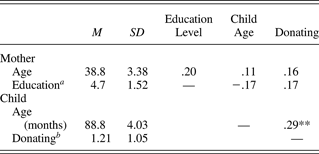
Table 1 presents means and standard deviations of the main variables, as well as the correlations between the variables. Older children donated more to UNICEF (r = .29, p < .01), although the age range was small. There were no other significant associations among background variables, child characteristics, and child donating behavior. DRD4 genotype was not related to children's donating behavior (p = .20).
Means, standard deviations, and correlations of maternal age and education and child age and donating behavior
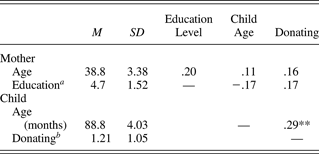
aRange = 1 (unfinished vocational training) to 7 (university degree).
bThe total number of coins donated after the experimenter's request (square root).
**p < .01.
Donating behavior, attachment, and DRD4
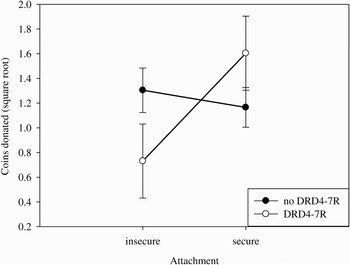
In order to explain the differences between children's donating behavior on the basis of specific genetic and child factors, we conducted a multivariate analysis with the total number of coins donated after the experimenter's probe as the dependent variable, with attachment and DRD4 as factors, and maternal educational level and child age as covariates. The model was significant, F (5, 85) = 3.82, p < .01, η2 = 0.18. Controlling for maternal educational level (p = .01) and child age (p < .01), we found a significant interaction effect of DRD4 and attachment security, F (1, 85) = 4.78, p = .03 (see Figure 1). Attachment security was related to donating more money to UNICEF, but only in the presence of the DRD4 7-repeat allele.
Donating of secure and insecure children with and without the dopamine receptor D4 7-repeat allele (DRD4-7R): the total number of coins donated after the experimenter's request, controlling for maternal education and child age.

To facilitate the interpretation of the interaction between attachment and DRD4, we created four groups based on DRD4 genotype (with or without the DRD4 7-repeat allele) and attachment quality, resulting in secure children without the DRD4 7-repeat allele (Group 1), insecure children without the DRD4 7-repeat allele (Group 2), secure children with the DRD4 7-repeat allele (Group 3), and insecure children with the DRD4 7-repeat allele (Group 4). We hypothesized that for children without the DRD4 7-repeat allele (Groups 1 and 2) the differences in attachment security would not be predictive of their donating behavior, whereas for children with the DRD4 7-repeat allele (Groups 3 and 4) we expected that secure children would donate more than insecure children. An analysis of variance on the number of coins donated after the experimenter's request, controlled for child age and maternal education, showed significant contrasts: secure and insecure children without the DRD4 7-repeat allele did not differ in the number of coins they donated, t (87) = −0.68, p = .50, but for children with the DRD4 7-repeat allele secure children donated significantly more than their insecure counterparts, t (87) = 2.12, p = .04. The contrast between insecure children with the DRD4 7-repeat allele and the three other groups was actually significant, t (87) = 2.01, p = .048, showing that insecure children with the DRD4 7-repeat allele donated less than all other groups together. Secure children with the DRD4 7-repeat allele tended to donate more than all other groups together, t (87) = −1.66, p = .10, pointing to a model of differential susceptibility to attachment quality for children with the DRD4 7-repeat allele rather than a double risk model with the DRD4 7-repeat allele and insecure attachment as risk factors.
Discussion
We found evidence for children with secure attachment representations to be more willing to donate if they had the 7-repeat variant of the DRD4 gene. The amount of money that children without the DRD4 7-repeat allele donated was independent of their attachment representation. We did not find main effects of attachment or genotype on donating behavior.
Differential susceptibility
Children's attachment representations can be considered mental crystallizations of their child-rearing experiences, in particular, the degree to which their parents interacted in a sensitive way. From ethological, developmental, and ethical perspectives parental sensitivity may be seen as one of the first and most salient models of altruistic behavior and empathic concern in the children's early lives (Spiecker, Reference Spiecker1991), and children's attachment representations mirror those experiences.
Although we failed to find a main effect for attachment security, we did find more donating behavior in secure children with a specific genetic makeup. For children with the short DRD4 variants attachment security did not make a difference for the amount of money donated to UNICEF. For the donating behavior of children with the DRD4 7-repeat allele, however, attachment security was important: secure children were inclined to donate more money when they had the DRD4 7-repeat allele, and insecure children with this polymorphism showed less donating. This two-sided effect of the DRD4 7-repeat allele, for better and for worse, suggests that the association between attachment security and donating behavior is another example of differential susceptibility (Belsky et al., Reference Belsky, Bakermans-Kranenbug and van IJzendoorn2007), similar to the association between parental sensitivity and children's externalizing behavior, dependent on children's DRD4 genotype (Bakermans-Kranenburg & van IJzendoorn, Reference Bakermans-Kranenburg and van IJzendoorn2006, 2007). Both genetic and environmental determinants of prosocial donating behavior appear important but only when they are considered in interaction.
Limitations
Our study included a relatively small sample of children. Because we built our study on earlier correlational and experimental investigations in various samples (Bakermans-Kranenburg & van IJzendoorn, Reference Bakermans-Kranenburg and van IJzendoorn2007; see also Sheese, Voelker, Rothbart, & Posner, Reference Sheese, Voelker, Rothbart and Posner2007), we only tested the DRD4 polymorphism as a potential moderator of the association between attachment and donating, thus preventing capitalization on chance. The use of attachment as a “proxy” for the children's environment is of course not ideal, and a more direct assessment of their experiences should be preferred.
Another limitation is the restriction to one laboratory measure of prosocial behavior, which is donating to a charity. Rushton and Wheelwright (Reference Rushton and Wheelwright1980) validated a similar assessment of donating behavior of 6- to 10-year-olds, who in a lab setting were asked to donate tokens to a charity. They found significant associations of donating to a charity with teacher-assessed altruism and with children's willingness to share scarce resources with their friends. Eisenberg and colleagues (Reference Eisenberg, Shell, Pasternack, Lennon, Beller and Mathy1987, Reference Eisenberg, Guthrie, Murphy, Shepard, Cumberland and Carlo1999) found that donating behavior was moderately stable across time and tended to be positively related to other-oriented moral reasoning as well as to spontaneous sharing of scarce resources with peers as observed in the preschool classroom. Bachner-Melman et al. (Reference Bachner-Melman, Gritsenko, Nemanov, Zohar, Dina and Ebstein2005) found a main effect of the dopamine receptor gene in that DRD4 was associated with self-reported human altruism, which may suggest that our G × E findings are restricted to observed altruism. Furthermore, the donating task was embedded within a lab session with some stressful components that might have interfered with donating behavior. Our study included only 7-year-old children, and we should be careful in making generalizations to other age cohorts. In their study on 3- to 16-year-old children, Grunberg, Maycock, and Anthony (Reference Grunberg, Maycock and Anthony1985) found that donating to a charity is not linearly related to age but reaches a dip around 7 years of age, as children have become more aware of the importance of individual ownership that might be overgeneralized, analogous to young children who overapply rules of grammar. Our study should therefore be repeated in other age cohorts.
Study 2
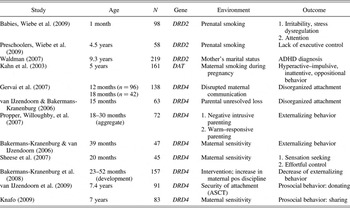
For our meta-analysis we systematically searched the databases Web of Science and MEDLINE with the key words dopamin*, interact*, environment*, genet*, and G × E in the title or abstract (the asterisk indicates that the search contained the word or word fragment). The search was restricted to studies with children under the age of 10 years, and we excluded medical treatment as the environmental variable. We finished the search in April 2009. The selected studies examined the moderating effect of DRD2, DAT, and DRD4 polymorphisms (see Table 2).
Studies included in the meta-analyses

Note: DRD2, DRD4, dopamine receptors D2 and D4; DAT, dopamine transporter; ADHD, attention-deficit/hyperactivity disorder; ASCT, attachment story completion task.
We identified 15 pertinent effect sizes on 1,232 subjects, providing data for two meta-analyses on the moderating role of dopamine-related genes for the impact of rearing environment on development. Nine effect sizes concerned vulnerability, that is, susceptibility to negative environmental factors. These studies examined moderation by dopamine-related “risk alleles” (DRD2-A1, DAT 10-repeat allele, DRD4 7-repeat allele) of the association between adverse rearing environment and behavioral disturbance such as externalizing behavior, sensation seeking, and ADHD. Six effect sizes, enabling a focus on the “bright side,” pertained to moderation of the relation between supportive contexts (e.g., warm–responsive parenting) and positive behavioral outcomes (such as effortful control or prosocial behavior) or the absence or reduction of negative behaviors (e.g., decrease in externalizing behavior after intervention). The Comprehensive Meta-Analysis (Borenstein, Hedges, & Higgins, Reference Borenstein, Hedges and Higgins2009) program was used to transform the results of the individual studies into the common metric of correlations. The correlations of interest were those between parenting and child behavior within each of the two genotype groups, one consisting of carriers of the supposed risk alleles and the other carrying their counterparts. Because genetic effects have been found to differ between subjects from varying racial backgrounds (e.g., Williams et al., Reference Williams, Marchuk, Gadde, Barefoot, Crichnik and Helms2003) and most studies involved (only) Caucasian children, we decided to exclude non-Caucasian subgroups (African American subgroup; Propper, Willoughby, Halpern, Cox, & Carbone, Reference Propper, Willoughby, Halpern, Cox and Carbone2007).
Vulnerability: Susceptibility to adverse rearing environments
Waldman (Reference Waldman2007) related mothers' marital status and history to their children's ADHD diagnosis, taking into account children's DRD2 genotype. For children without the DRD2-A1 allele an ADHD diagnosis was not more likely when there mothers had either never married or married more than once compared to children whose mothers married only once (effect size r = −.02), but for children carrying the A1 allele the likelihood of an ADHD diagnosis increased significantly when their mothers never married or married more than once (effect size r = .29). Note that the study included children with a clinical diagnosis and their (affected or unaffected) siblings and control families with one or two children, so that not all participants in the sample were independent.
Wiebe et al. (Reference Wiebe, Espy, Stopp, Respass, Stewart and Jameson2009) examined the combined effect of the DRD2 genotype and maternal prenatal smoking on self-regulation in a sample of neonates (4 weeks old) and in a sample of preschoolers (3 to 6 years old). Smoking during pregnancy is not only a direct risk for the developing baby, but it could also be considered an indicator of a less supportive caregiving environment (irresponsible or incompetent maternal behavior, which is likely to extend beyond pregnancy) as is apparent from low parental attentiveness to the child's well-being and neglect of child protection. In the infant sample, smoking women were oversampled to make up about half of the sample; maternal smoking was assessed via standardized interviews and maternal urine analyses. Neonatal temperament was observed in the infant's home at 4 weeks of age, and two factors were derived: attention and irritable reactivity. The irritability of infants carrying the A1 allele was somewhat higher when their mothers smoked during pregnancy than when their mothers did not smoke (r = .13); for infants without the A1 allele the effect size was r = −.08. The effects of prenatal maternal smoking on the positive child dimension of attention are presented in the next section.
The preschool study of Wiebe and colleagues (2009) relied on retrospective reporting of smoking during pregnancy. Children's executive control was assessed with the Preschool Trail Making Test (Espy & Cwik, Reference Espy and Cwik2004), which requests connecting stimuli on a page in sequence, with and without potential distractors. The number of errors was considered indicative of lack of executive control. Children carrying the A1 allele made more errors when their mothers smoked during pregnancy than when their mothers did not smoke (r = .09); for infants without the A1 allele the effect size was r = −.05.
Kahn, Khoury, Nichols, and Lanphear (Reference Kahn, Khoury, Nichols and Lanphear2003; see also Froehlich et al., Reference Froehlich, Lanphear, Dietrich, Cory-Slechta, Wang and Kahn2007) examined the joint effects of DAT polymorphisms and maternal prenatal smoking on childhood hyperactivity–impulsivity, inattentiveness, and oppositional behavior. Neither prenatal smoke exposure alone nor DAT 10-repeat/10-repeat genotype alone was associated with elevated scores on hyperactivity–impulsivity or inattentiveness, but children with both risk factors were significantly more hyperactive–impulsive and oppositional. No significant interaction effect was found for inattentiveness. We combined the findings for the three outcomes, resulting in effect sizes of r = .31 for maternal prenatal smoking in the group of children with the DAT 10-repeat/10-repeat genotype and r = .14 for children without this genotype. Children with the DAT 10-repeat/10-repeat genotype were more vulnerable to the negative effects of their mothers' smoking during pregnancy.
Sheese et al. (Reference Sheese, Voelker, Rothbart and Posner2007) examined the moderating effect of DRD4 on the association between quality of parenting as observed from a videotaped free-play procedure and two child outcomes: sensation seeking and effortful control. There were no main effects of DRD4 or parenting quality on sensation seeking, but the interaction between child DRD4 genotype and parenting quality was significant. For children without the DRD4 7-repeat allele there was no significant effect of parenting quality on sensation seeking (r = .22), but for children with the DRD4 7-repeat allele the effect of parenting was significant (r = .58). The effects of parenting on the positive child dimension of effortful control are presented in the next section.
Propper and colleagues (2007) tested G × E interaction effects for two overlapping but not identical (r = −.44) dimensions of parenting, negative–intrusive and warm–responsive maternal behavior. Focusing on externalizing behavior, the associations with negative–intrusive parenting were in the expected direction, and slightly larger for children with the DRD4 7-repeat allele: for children with the DRD4 7-repeat allele the effect size was r = .45; for children without the DRD4 7-repeat allele the effect size was r = .35. The results for warm–responsive parenting is reviewed in the next section.
In a longitudinal investigation of twins, maternal insensitivity observed when the children were 10 months was related to externalizing problems at 39 months of age (Bakermans-Kranenburg & van IJzendoorn, Reference Bakermans-Kranenburg and van IJzendoorn2006). For children carrying the DRD4 7-repeat allele the association amounted to r = .61, whereas for children without the risk allele the association was r = −.07. Maternal insensitivity was related to externalizing behavior, but only in the presence of the DRD4 7-repeat allele. It is important that DRD4 was not related to maternal sensitivity, excluding active gene–environment correlation as an alternative explanation for the findings.
A similar moderating effect of the DRD4 7-repeat allele was found for the association between maternal unresolved loss or trauma and infant attachment disorganization (van IJzendoorn & Bakermans-Kranenburg, 2006). Unresolved loss or trauma was measured with the Adult Attachment Interview (Hesse, Reference Hesse, Cassidy and Shaver2008). Infant attachment disorganization is an early predictor of externalizing behavior (for a meta-analysis, see Fearon, Bakermans-Kranenburg, van IJzendoorn, Lapsley, & Roisman, Reference Fearon, Bakermans-Kranenburg, van IJzendoorn, Lapsley and Roisman2010) and psychological disturbance later in life (Carlson, Reference Carlson1998). Maternal unresolved loss (which may be a proxy for maternal affective problems, preventing mothers from providing the best environment they could otherwise provide) predicted attachment disorganization with an effect size of r = .81 for children with the DRD4 7-repeat allele; for children without the risk allele the association was nonsignificant (r = −.16).
Gervai and colleagues (2007) found contrasting results in their combined sample of American high-risk and Hungarian low-risk families. Reporting on the same child outcome, attachment disorganization, they found a significant relation between maternal disruptive communication and infant disorganization among infants who did not carry the DRD4 7-repeat allele (r = .42), and no relation between maternal disruptive communication and infant disorganization among infants with the DRD4 7-repeat allele (r = .02).
Susceptibility to supportive rearing environments: The bright side
Six studies pertained to the relation between positive contexts and positive behavioral outcomes. Wiebe et al. (Reference Wiebe, Espy, Stopp, Respass, Stewart and Jameson2009) examined the combined effect of DRD2 genotype and the absence or presence of maternal prenatal smoking on attention and found that neonates with the “at-risk” A1 allele were more attentive when not exposed to maternal prenatal smoking than comparisons without the A1 allele whose mothers did not smoke. In smoking conditions, their attention scores were comparable. Thus, a stronger effect of the nonsmoking environment for the infants with the A1 allele emerged (r = .43) relative to comparisons without the A1 allele (r = −.14).
Sheese et al. (Reference Sheese, Voelker, Rothbart and Posner2007) found no moderating effect of DRD4 on the association between quality of parenting and child effortful control (effect sizes r = .00 for both genotypes).
The association between warm–responsive parenting and lower levels of externalizing toddler behavior was examined by Propper and colleagues (2007). For children with the DRD4 7-repeat allele the correlation was r = .07 (more warm–responsive parenting was associated with less externalizing behavior) and for children without the DRD4 7-repeat allele the correlation was r = −.08.
Strong evidence for (differential) susceptibility to the environment is provided by intervention studies, where the environment is experimentally manipulated. Children with the DRD4 7-repeat allele were found to be more susceptible to experimentally induced changes in maternal discipline with respect to externalizing behavior outcomes after an intervention aimed at enhancing maternal sensitivity and positive discipline strategies (Bakermans-Kranenburg et al., Reference Bakermans-Kranenburg, van IJzendoorn, Pijlman, Mesman and Juffer2008). Children with the DRD4 7-repeat allele showed the largest decrease of externalizing behaviors after the intervention (r = .29 vs. r = .05 for children without the DRD4 7-repeat allele), particularly when their parents showed the largest increase in the use of positive discipline.
Finally, two studies examined the effect of parenting on child prosocial behavior as moderated by the DRD4 genotype. In Knafo's (2009) Israeli study children were asked to share the stickers they had just received with a kid who had no stickers. For children without the DRD4 7-repeat allele observed supportive parenting was not related to the children's willingness to share their stickers (r = −.01), but for children with the DRD4 7-repeat allele more supportive and sensitive parenting and less intrusiveness and negative affect were related to giving away (r = .33). The outcome measure of giving away stickers is similar to the donating behavior as described in our Study 1, and so are the results: for children without the DRD4 7-repeat allele in our study attachment security did not make a difference for the amount of money they donated (r = −.07), but for children with the DRD4 7-repeat allele security predicted more money donated to UNICEF (r = .43).
Meta-analysis
The Comprehensive Meta-Analysis program was used to transform the results of the individual studies into the common metric of correlations and to combine effect sizes (Borenstein et al, Reference Borenstein, Hedges and Higgins2009). As is evident from the narrative review, studies could contribute to the meta-analysis of vulnerability studies and the meta-analysis of the bright side when they reported negative as well as positive environmental or outcome measures, but the same result was never used twice. The implication is, however, that some children were included in both meta-analyses; as a result, it was impossible to directly compare effect sizes across the two sets (i.e., to test whether children with the risk alleles were more susceptible to negative rearing effects compared to supportive rearing effects). Therefore, the 85% confidence intervals (CIs) for the point estimates of the combined effect sizes were computed: nonoverlapping 85% CIs suggest a significant difference between combined effect sizes that are not independent (Goldstein & Healy, Reference Goldstein and Healy1995; van IJzendoorn, Juffer, & Klein Poelhuis, Reference Van IJzendoorn, Juffer and Klein Poelhuis2005). Heterogeneity across studies was assessed using the Q-statistic. Significance tests were performed through random effects models (Borenstein et al., Reference Borenstein, Hedges and Higgins2009).
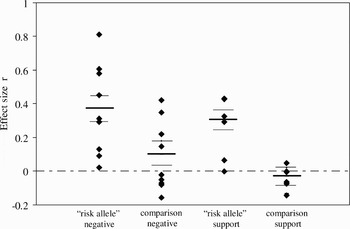
The combined effect size for behavioral disturbance in the presence of adverse rearing influences amounted to r = .37 (p < .001, 95% CI = 0.20, 0.51) for carriers of the risk alleles, in a heterogeneous set of studies, Q (df = 8) = 25.83, p = .001. The combined effect size for the comparisons without the risk alleles was r = .10 (p = .26, CI = −0.07, 0.26) in a heterogeneous set of studies, Q (df = 8) = 22.32, p = .004. Using a random effects test, the difference was significant (Q contrast = 5.24, p = .02), supporting the idea that carriers of the risk alleles were more vulnerable to environmental adversity (see Figure 2).
Single study effects and combined effect sizes (thick lines) with standard errors (thin lines) for the association between negative or positive parenting and child behavior for carriers of the supposed “risk alleles” (dopamine receptor D2 A1 alelle, dopamine receptor D4 7-repeat allele, dopamine transporter 10-repeat/10-repeat alelle) and their counterparts without the risk allele.

Turning to the bright side, that is, the association between parental support and better adaptation, we found a combined effect size of r = .31 (p < .001, CI = 0.16, 0.44) for carriers of the putatively risk alleles in a homogeneous set of studies, Q (df = 5) = 3.91, p = .56. The combined effect size for children without the risk alleles was r = −.03 (p = .53, CI = −0.14, 0.07) in a homogeneous set of studies, Q (df = 5) = 1.66, p = .89. The difference was again significant (Q contrast = 13.84, p < .01). Children with alleles that in adverse contexts put them at risk for behavioral disturbances benefited significantly more from parental support than their counterparts. Figure 2 illustrates the results.
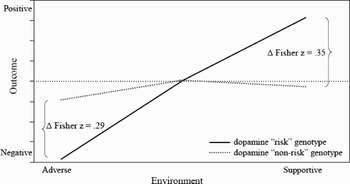
The 85% CIs for the point estimates of the combined effect size for children carrying the risk alleles were 0.25 to 0.48 for effect sizes pertaining to vulnerability and 0.20 to 0.40 for effect sizes on positive outcomes. The CIs were clearly overlapping, indicating no difference between the combined effect sizes. In other words, children with the putatively risk alleles were equally susceptible to negative and supportive influences. Moreover, the difference between the combined effect sizes of the genetically at risk children and their counterparts was 0.29 (Fisher Z) for the vulnerability studies and 0.35 (Fisher Z) for studies focusing on the bright side. The difference between the combined effect sizes in the second set of studies is thus comparable to and even somewhat larger than the difference in the first set of studies, suggesting that the susceptibility effect is certainly not weaker than the vulnerability effect (see Figure 3).
The differential susceptibility of dopamine-related genotypes for adverse and supportive environments in child development.

Discussion
Central to the diathesis–stress model is the postulate that some individuals are at heightened risk for psychiatric or behavioral disturbance when they encounter adversity, whereas others, lacking such (genetic) vulnerability, are not so affected when exposed to the same adversity. Our meta-analytic results provide support for the hypothesis that seemingly “vulnerable” individuals are actually more susceptible to the environment, “for better and for worse.” For the first time, G × E studies have been quantitatively meta-analyzed taking into account both sides of differential susceptibility. Dopamine-related genes that through their influence on attention and reward mechanisms make children more vulnerable to negative parenting may actually turn out to be susceptibility genes that in supportive family environments promote optimal development. The dopaminergic system is engaged in attentional, motivational, and reward mechanisms (Robbins & Everitt, Reference Robbins, Everitt, Bloom, Landis, Robert, Squire and Zigmond1999); lower dopaminergic signaling impedes negative feedback-based learning (Klein et al., Reference Klein, Neumann, Reuter, Hennig, Von Cramon and Ullsperger2007) and is related to stronger preference for immediate reinforcers (Tripp & Wickens, Reference Tripp and Wickens2008).
Limitations
The meta-analysis is limited because of the restricted number of pertinent studies, in particular on the bright side. We therefore included both studies with positive outcomes and studies with positive environments, thus combining outcomes from studies with observed positive environments and studies where positive environment meant that specific risk factors were absent. More studies on the association between environmental support and positive outcomes moderated by dopamine-related genes are clearly needed, and the next meta-analytic monitoring of progress in this area should be more balanced in numbers of studies shedding light on the risk versus the bright side of G × E interactions. Nevertheless, the number of studies is not different from that included in a recent ground-breaking meta-analysis on another series of G × E studies, which are those pertaining to monoamine oxidase A moderated associations between adverse environment and antisocial outcomes (Kim-Cohen et al., Reference Kim-Cohen, Caspi, Taylor, Williams, Newcombe and Craig2006). Note that our meta-analyses took both sides of the differential susceptibility hypothesis into account, but it does not directly examine whether children who do worse than comparisons in adverse environments also do better in supportive environments.
General Discussion
The associations between rearing environments and developmental outcomes as moderated by dopamine-related gene polymorphisms were examined in an empirical study and a meta-analytic study. In the empirical study we found that securely attached children showed more altruistic behavior than insecurely attached children but only when they had the DRD4 7-repeat allele. Children with this “susceptibility allele” and an insecure attachment representation mirroring their negative rearing experiences showed the lowest levels of donating behavior. Our meta-analysis confirmed the role of dopamine-related genes as moderators of the association between positive as well as negative environmental factors and developmental outcome. Differential susceptibility based on dopamine-related genotypes appears to be a replicable finding. Children with the less efficient dopamine-related genes did worse in negative environments than the comparisons without the “genetic risk,” but they also profited most from positive environments.
Experimental evidence needed
The susceptibility studies presented and discussed in the current paper are mostly correlational. Some (e.g., Bakermans-Kranenburg & van IJzendoorn, Reference Bakermans-Kranenburg and van IJzendoorn2006) but not all studies tested for gene–environment correlation that might be confounded with G × E effects. If the child evokes a specific type of parenting through its genetic layout, the parenting environment is dependent on the genetics of the child, hampering the test of varying susceptibility to the same environment (Belsky et al., Reference Belsky, Bakermans-Kranenbug and van IJzendoorn2007). More suggestive of differential susceptibility than such correlational evidence are (quasi)experimental studies, especially because they discount G × E correlation interpretations of G × E findings (see Ellis Boyce, Belsky, Bakermans-Kranenburg, & van IJzendoorn, 2011 [this issue]). Blair (Reference Blair2002) discovered that it was highly negative infants who benefited most from a multifaceted infant–toddler intervention program in terms of reduced levels of externalizing behavior problems and enhanced cognitive functioning. In a randomized intervention study Klein Velderman, Bakermans-Kranenburg, Juffer, and van IJzendoorn (Reference Klein Velderman, Bakermans-Kranenburg, Juffer and van IJzendoorn2006) found that experimentally induced changes in maternal responsiveness exerted greater impact on the attachment security of highly negatively reactive infants than other infants. In both experiments, environmental influences on “vulnerable” children were “for better” instead of “for worse.” Experimental designs, using manipulation of the environment through intervention in randomized control trials, take the edge off alternative interpretations such as gene–environment correlations and effectively tackle the issue of causation. It is important that the next generation of studies on differential susceptibility use designs including interventions or other “natural experiments” (Rutter, Reference Rutter2006) that allow for causal inferences.
Concerning susceptibility genotypes the question is whether children with the susceptible variants of dopamine-related genes would also be more susceptible to experimental manipulation of the (family) environment. The findings of the first experimental G × E tests in human development conducted by Bakermans-Kranenburg et al. (Reference Bakermans-Kranenburg, van IJzendoorn, Pijlman, Mesman and Juffer2008) indicate that children are differentially susceptible to family intervention effects depending on genetic differences. In this intervention experiment aimed at enhancing maternal responsiveness and positive discipline strategies, the participants were not randomly assigned to intervention and control groups according to their genetic makeup, so the DRD4 gene polymorphisms were unequally distributed across groups, which make the findings preliminary, yet promising. In order to be able to make causal claims, we need truly randomized trials in which treatment (“changes in the environment”) and genotypes are randomly distributed.
The studies conducted on the susceptibility role of the dopamine-related genes show associations between varied environments and developmental outcomes. This variety documents the robustness of the G × E interpretation of differential susceptibility for several domains of development and a rather large variety of environmental influences. Differential susceptibility therefore seems to be more a generic than a context-specific phenomenon, which may of course not be restricted to the dopamine-related genes. Belsky and Pluess (Reference Belsky and Pluess2009) reviewed some evidence for the potential moderating role of the serotonon transporter gene and monoamine oxidase A, but it is not clear whether studies on these genes have demonstrated a similar consistent and impressive moderating effect, for better and for worse, as in case of the dopamine-related genes. Comparative meta-analyses may address this question in the near future. When more G × E studies become available, it may also be possible to meta-analytically test what dopamine-related genes for what developmental outcomes are the most pertinent moderators of environmental influences. Moreover, we need to place differential susceptibility more firmly in a longitudinal perspective (Wachs, Reference Wachs1983). The expression of genes is not a constant that is independent of maturation or environment but is instead a dynamic system (Kaffman & Meaney, Reference Kaffman and Meaney2007; van IJzendoorn, Caspers, Bakermans-Kranenburg, Beach, & Philibert, Reference Van IJzendoorn, Caspers, Bakermans-Kranenburg, Beach and Philibert2010), and only longitudinal studies can trace the development of differential susceptibility as a dynamic interplay between genes and environment.
Evolutionary background of differential susceptibility
Belsky (Reference Belsky1997) emphasized the evolutionary rationale for varying susceptibility to environmental influences. In a continually changing and essentially unpredictable environment, the transmission of one's genes will be facilitated by a diversification of investments, that is, offspring with a differential susceptibility to various environments. Because the future is uncertain, parents in ancestral times could not know for certain (consciously or unconsciously) what rearing strategies would maximize reproductive fitness. To protect against all children being inadvertently steered in a direction that would prove disastrous at some later point in time, developmental processes were selected to vary children's susceptibility to rearing. In Belsky's evolutionary model it would be important to show that siblings within the same family are differentially susceptible to the rearing environment, a study that still has to be conducted.
Alternatively, Boyce and Ellis (Reference Boyce and Ellis2005; Ellis et al., Reference Ellis, Boyce, Belsky, Bakermans-Kranenburg and van IJzendoorn2011 [this issue]) posit an evolutionary–developmental theory of varying biological sensitivity to context, pointing to a crucial role of G × E interactions, and propose that susceptibility may reflect prenatally and postnatally programmed hyperreactivity to stress. From an evolutionary perspective, DRD4 appears to be a promising gene in the search for differential susceptibility (Levitan et al., 2006). Ding et al. (Reference Ding, Chi, Grady, Morishima, Kidd and Kidd2002) found that the 7-repeat allele originated as a rare mutational event that nevertheless increased to high frequency in human populations by positive selection, which has led to speculations about its meaning for the evolution and adaptability of human development (Ding et al., Reference Ding, Chi, Grady, Morishima, Kidd and Kidd2002; Wang et al., Reference Wang, Ding, Flodman, Kidd, Kidd and Grady2004), going beyond the common labeling of the DRD4 7-repeat allele as mere risk for the development of ADHD. From a statistical modeling perspective, Wolf, Van Doorn, and Weissing (Reference Wolf, Van Doorn and Weissing2008) make the evolutionary emergence of responsive and unresponsive individuals and their coexistence in the same species plausible, and they explicitly provide a theoretical foundation for differential susceptibility as an outcome of natural selection for humans and other species alike.
Susceptibility mechanisms
Several (nonmutually exclusive) explanations have been advanced for the heightened susceptibility of some children compared to others. Boyce and Ellis (Reference Boyce and Ellis2005) propose a role for heightened biological reactivity: psychobiological mechanisms that monitor specific features of childhood environments are used as a basis for calibrating the development of stress response systems to adaptively match those environments, resulting in high reactivity phenotypes emerging particularly in highly stressful and highly protected early social environments. Suomi (Reference Suomi1997) posits that the timidity of “up-tight” infants affords them extensive opportunity to learn by watching, a view that is perhaps consistent with the crucial moderating role of dopamine-related genes, given the link between the dopamine system and attention. Kochanska, Askan, and Joy (Reference Kochanska, Askan and Joy2007) contend that the ease with which anxiety is induced in fearful children makes them highly responsive to parental demands, with positive outcomes in cases of sensitive and warm parenting and negative outcomes in cases of harsh parenting. Fox, Hane, and Pine (Reference Fox, Hane and Pine2007) also point to fearfulness and argued that elevated levels of fearfulness in infants (associated with the short serotonin transporter linked polymorphic region [5-HTTLPR] allele) may interact with unresponsive parenting to increase inhibition in children. Alternatively, Belsky (Reference Belsky1997) speculated that negativity actually reflects a highly sensitive nervous system, with negative consequences when not regulated by the caregiver but with positive outcomes when adequate parental coregulation occurs. In our view, this points to a potentially central role for so-called sensory sensitivity, that is, openness to any environmental stimuli (Aron & Aron, Reference Aron and Aron1997; Evans & Rothbart, Reference Evans and Rothbart2007; Posner & Rothbart, Reference Posner and Rothbart2007), which has been associated with the dopamine system.
Ethnic differences in genetic susceptibility
Propper and colleagues (2007) tested G × E interaction effects in both African American and European American families. Relative to European American parents, African American mothers exhibited higher levels of negative–intrusive parenting and lower levels or warm–responsive parenting. Of more interest, in European American families the correlations between parenting and externalizing behavior were larger for children carrying the DRD4 7-repeat allele than for those without the 7-repeat allele, whereas the reverse was true for African American children. This three-way interaction of race, DRD4, and parenting underscores the caveat that the generalizability of genetic and G × E interaction effects to populations of a different race is not evident. The meaning and context of specific parental behaviors may vary between different cultural groups (Deater-Deckard, Dodge, Bates, & Pettit, Reference Deater-Deckard, Dodge, Bates and Pettit1996), but the effect of genes may also be dependent on race.
As an example, the short/short polymorphism of the serotonin gene 5-HTTLPR is associated with the production of higher levels of serotonergic function in the central nervous system of African American participants but lower levels of serotonergic function among European American participants (Williams et al., Reference Williams, Marchuk, Gadde, Barefoot, Crichnik and Helms2003). Propper et al.'s (2007) findings of stronger effects for African American children without the DRD4 7-repeat allele also seem to be reflected in a study on body mass index as an indicator of health in a study among chronically undernourished Ariaal pastoralists in Kenya (Eisenberg, Campbell, Gray, & Sorenson, Reference Eisenberg, Campbell, Gray and Sorenson2008). Depending on their way of living (settled or nomadic), males with different DRD4 genotypes were less or more underweight. Although the authors interpreted their data as indicative of the advantage of the DRD4 7-repeat allele for nomadic men and a disadvantage for settled men, the data are actually more supportive of the idea that the African males without the DRD4 7-repeat allele were more reactive to their subsistence environments.
Practical Implications and Conclusion
“What works for whom, and why” is still an unresolved issue in parent training literature and in intervention studies more generally. The average effects of parent training and other intervention studies appear to be modest at best, but average outcomes may hide the presence of large effects in susceptible participants and simultaneous small or absent effects in less susceptible subjects. The differential susceptibility hypothesis may contribute to insight into the differential effectiveness of preventive or therapeutic parent training programs for various groups of families at the levels of children as well as their parents (van IJzendoorn, Bakermans-Kranenburg, & Mesman, Reference Van IJzendoorn, Bakermans-Kranenburg and Mesman2008). These insights may have important implications for family (and broader, child care) policy and lead to pursuing optimal fit between intervention and target families. A better fit between intervention and target group will result in more cost-effective use of resources for (preventive) interventions. Of course, genotyping of potential intervention participants may not be practically possible or ethically desirable, but genotypes may be associated with specific endophenotypes that can serve more easily as a basis for screening to optimize the fit between individual and treatment. This is obviously not an argument for withholding intervention from less susceptible children (see Ellis et al., Reference Ellis, Boyce, Belsky, Bakermans-Kranenburg and van IJzendoorn2011 [this issue]). First, for reasons of equity there cannot be a difference in eligibility for intervention between children with the same needs; second, apparently less susceptible children may simply be less responsive to interventions that were tried or tested so far and need different types of intervention. Differential susceptibility may ideally lead to differential intervention and thus more effective treatment.